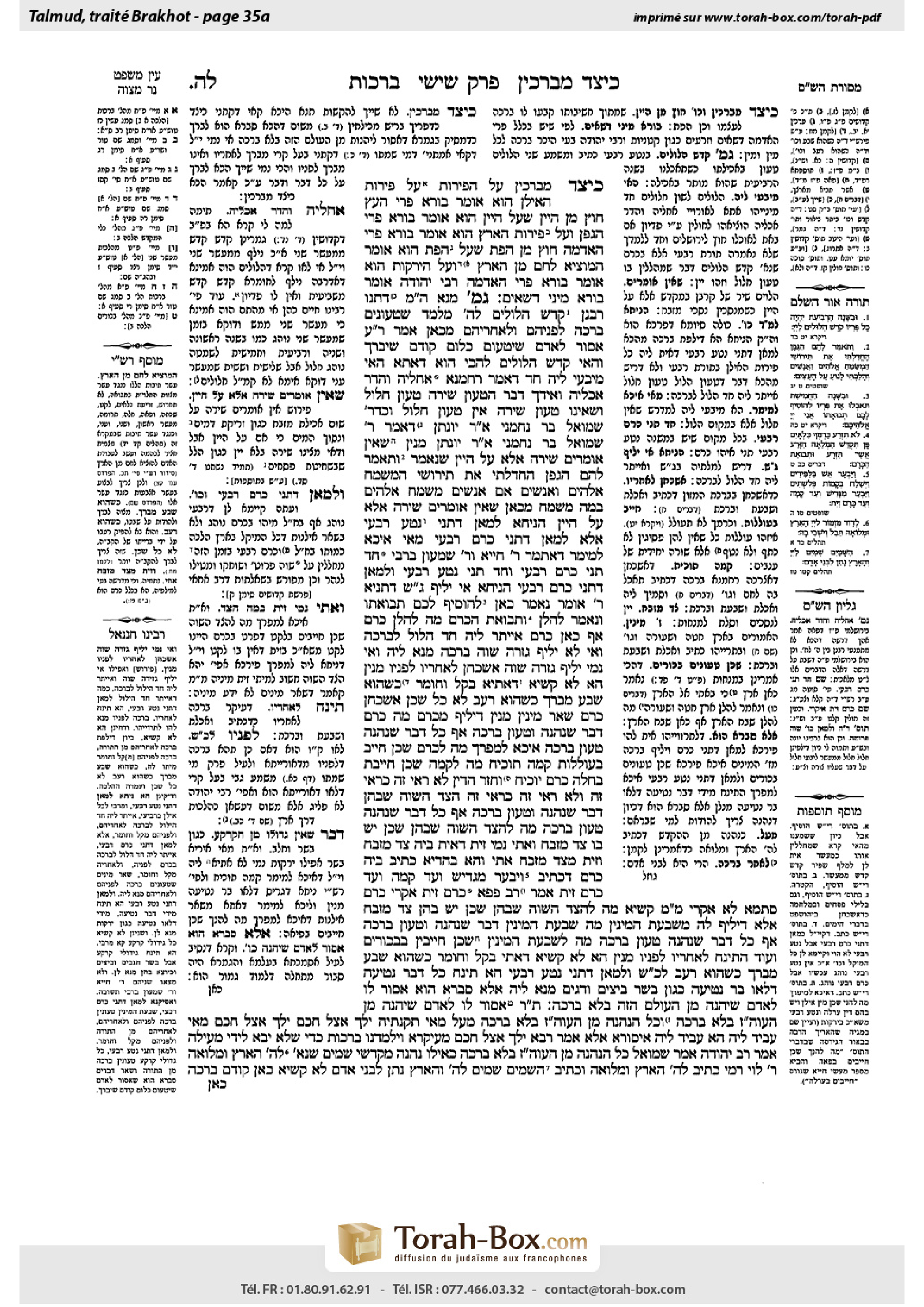
Berakhot 35a: Talmud study for Daf Yomi
Study the Talmud for Daf Yomi with scanned pages, Hebrew text, English translations from Sefaria and AI-generated French translations.
Passage selection and English or AI-generated French translation are available where the scan has annotations. Daf Study is independent of Torah-Box and Sefaria.
Browse Berakhot · ברכות · All tractatesBerakhot 35a text and translations
This page of Berakhot includes the Aramaic text, an English translation and an AI-generated French translation, alongside the scan above.
ברכות ל״ה א · Aramaic and Hebrew text
מַתְנִי׳ כֵּיצַד מְבָרְכִין עַל הַפֵּירוֹת? עַל פֵּירוֹת הָאִילָן הוּא אוֹמֵר: ״בּוֹרֵא פְּרִי הָעֵץ״, חוּץ מִן הַיַּיִן, שֶׁעַל הַיַּיִן הוּא אוֹמֵר: ״בּוֹרֵא פְּרִי הַגֶּפֶן״. וְעַל פֵּירוֹת הָאָרֶץ הוּא אוֹמֵר: ״בּוֹרֵא פְּרִי הָאֲדָמָה״, חוּץ מִן הַפַּת, שֶׁעַל הַפַּת הוּא אוֹמֵר: ״הַמּוֹצִיא לֶחֶם מִן הָאָרֶץ״. וְעַל הַיְּרָקוֹת הוּא אוֹמֵר: ״בּוֹרֵא פְּרִי הָאֲדָמָה״. רַבִּי יְהוּדָה אוֹמֵר: ״בּוֹרֵא מִינֵי דְשָׁאִים״.
גְּמָ׳ מְנָא הָנֵי מִילֵּי? דְּתָנוּ רַבָּנַן: ״קֹדֶשׁ הִלּוּלִים לַה׳״, מְלַמֵּד שֶׁטְּעוּנִים בְּרָכָה לִפְנֵיהֶם וּלְאַחֲרֵיהֶם. מִכָּאן אָמַר רַבִּי עֲקִיבָא: אָסוּר לְאָדָם שֶׁיִּטְעוֹם כְּלוּם קוֹדֶם שֶׁיְּבָרֵךְ.
וְהַאי ״קֹדֶשׁ הִלּוּלִים״ לְהָכִי הוּא דַּאֲתָא? הַאי מִיבְּעֵי לֵיהּ חַד דְּאָמַר רַחֲמָנָא אַחֲלֵיהּ וַהֲדַר אִכְלֵיהּ. וְאִידָךְ דָּבָר הַטָּעוּן שִׁירָה, טָעוּן חִלּוּל, וְשֶׁאֵינוֹ טָעוּן שִׁירָה, אֵין טָעוּן חִלּוּל. וְכִדְרַבִּי שְׁמוּאֵל בַּר נַחְמָנִי אָמַר רַבִּי יוֹנָתָן דְּאָמַר רַבִּי שְׁמוּאֵל בַּר נַחְמָנִי אָמַר רַבִּי יוֹנָתָן: מִנַּיִן שֶׁאֵין אוֹמְרִים שִׁירָה אֶלָּא עַל הַיַּיִן? — שֶׁנֶּאֱמַר: ״וַתֹּאמֶר לָהֶם הַגֶּפֶן הֶחֳדַלְתִּי אֶת תִּירוֹשִׁי הַמְשַׂמֵּחַ אֱלֹהִים וַאֲנָשִׁים״, אִם אֲנָשִׁים מְשַׂמֵּחַ, אֱלֹהִים בַּמֶּה מְשַׂמֵּחַ? מִכָּאן שֶׁאֵין אוֹמְרִים שִׁירָה אֶלָּא עַל הַיַּיִן!
הָנִיחָא לְמַאן דְּתָנֵי ״נֶטַע רְבָעִי״. אֶלָּא לְמַאן דְּתָנֵי ״כֶּרֶם רְבָעִי״ מַאי אִיכָּא לְמֵימַר? דְּאִתְּמַר רַבִּי חִיָּיא וְרַבִּי שִׁמְעוֹן בְּרַבִּי, חַד תָּנֵי ״כֶּרֶם רְבָעִי״, וְחַד תָּנֵי ״נֶטַע רְבָעִי״.
וּלְמַאן דְּתָנֵי ״כֶּרֶם רְבָעִי״ הָנִיחָא אִי יָלֵיף גְּזֵרָה שָׁוָה. דְּתַנְיָא, רַבִּי אוֹמֵר: נֶאֱמַר כָּאן ״לְהוֹסִיף לָכֶם תְּבוּאָתוֹ״, וְנֶאֱמַר לְהַלָּן ״וּתְבוּאַת הַכָּרֶם״. מָה לְהַלָּן כֶּרֶם, אַף כָּאן כֶּרֶם. אִייַּתַּר לֵיהּ חַד ״הִלּוּל״ לִבְרָכָה.
וְאִי לָא יָלֵיף גְּזֵרָה שָׁוָה, בְּרָכָה מְנָא לֵיהּ? וְאִי נָמֵי יָלֵיף גְּזֵרָה שָׁוָה, אַשְׁכְּחַן לְאַחֲרָיו, לְפָנָיו מִנַּיִן?
הָא לָא קַשְׁיָא, דְּאָתְיָא בְּקַל וָחוֹמֶר: כְּשֶׁהוּא שָׂבֵעַ מְבָרֵךְ, כְּשֶׁהוּא רָעֵב — לֹא כׇּל שֶׁכֵּן.
אַשְׁכְּחַן כֶּרֶם, שְׁאָר מִינִין מִנַּיִן?
דְּיָלֵיף מִכֶּרֶם: מָה כֶּרֶם דָּבָר שֶׁנֶּהֱנֶה וְטָעוּן בְּרָכָה, אַף כׇּל דָּבָר שֶׁנֶּהֱנֶה — טָעוּן בְּרָכָה.
אִיכָּא לְמִפְרַךְ: מָה לְכֶרֶם שֶׁכֵּן חַיָּיב בְּעוֹלֵלוֹת!
קָמָה תּוֹכִיחַ. מָה לְקָמָה שֶׁכֵּן חַיֶּיבֶת בְּחַלָּה!
כֶּרֶם יוֹכִיחַ. וְחָזַר הַדִּין: לֹא רְאִי זֶה כִּרְאִי זֶה וְלֹא רְאִי זֶה כִּרְאִי זֶה, הַצַּד הַשָּׁוֶה שֶׁבָּהֶן: דָּבָר שֶׁנֶּהֱנֶה וְטָעוּן בְּרָכָה, אַף כׇּל דָּבָר שֶׁנֶּהֱנֶה — טָעוּן בְּרָכָה.
מָה לְהַצַּד הַשָּׁוֶה שֶׁבָּהֶן שֶׁכֵּן יֵשׁ בּוֹ צַד מִזְבֵּחַ. וְאָתֵי נָמֵי זַיִת דְּאִית בֵּיהּ צַד מִזְבֵּחַ.
וְזַיִת מִצַּד מִזְבֵּחַ אָתֵי? וְהָא בְּהֶדְיָא כְּתִיב בֵּיהּ ״כֶּרֶם״, דִּכְתִיב ״וַיַּבְעֵר מִגָּדִישׁ וְעַד קָמָה וְעַד כֶּרֶם זָיִת״. אָמַר רַב פָּפָּא: ״כֶּרֶם זַיִת״ אִקְּרֵי, ״כֶּרֶם״ סְתָמָא לָא אִקְּרֵי.
מִכׇּל מָקוֹם קַשְׁיָא: מָה לְהַצַּד הַשָּׁוֶה שֶׁבָּהֶן שֶׁכֵּן יֵשׁ בָּהֶן צַד מִזְבֵּחַ! אֶלָּא, דְּיָלֵיף לַהּ מִשִּׁבְעַת הַמִּינִין: מָה שִׁבְעַת הַמִּינִין דָּבָר שֶׁנֶּהֱנֶה וְטָעוּן בְּרָכָה, אַף כׇּל דָּבָר שֶׁנֶּהֱנֶה טָעוּן בְּרָכָה.
מָה לְשִׁבְעַת הַמִּינִין שֶׁכֵּן חַיָּיבִין בְּבִכּוּרִים? וְעוֹד: הָתִינַח לְאַחֲרָיו, לְפָנָיו מִנַּיִן?
הָא לָא קַשְׁיָא דְּאָתֵי בְּקַל וָחוֹמֶר: כְּשֶׁהוּא שָׂבֵעַ מְבָרֵךְ, כְּשֶׁהוּא רָעֵב — לֹא כׇּל שֶׁכֵּן.
וּלְמַאן דְּתָנֵי ״נֶטַע רְבָעִי״, הָא תִּינַח כֹּל דְּבַר נְטִיעָה. דְּלָאו בַּר נְטִיעָה, כְּגוֹן בָּשָׂר בֵּיצִים וְדָגִים מְנָא לֵיהּ? אֶלָּא סְבָרָא הוּא: אָסוּר לוֹ לָאָדָם שֶׁיֵּהָנֶה מִן הָעוֹלָם הַזֶּה בְּלֹא בְּרָכָה.
תָּנוּ רַבָּנַן: אָסוּר לוֹ לָאָדָם שֶׁיֵּהָנֶה מִן הָעוֹלָם הַזֶּה בְּלֹא בְּרָכָה. וְכׇל הַנֶּהֱנֶה מִן הָעוֹלָם הַזֶּה בְּלֹא בְּרָכָה מָעַל. מַאי תַּקַּנְתֵּיהּ? — יֵלֵךְ אֵצֶל חָכָם.
יֵלֵךְ אֵצֶל חָכָם?! מַאי עָבֵיד לֵיהּ? הָא עֲבַד לֵיהּ אִיסּוּרָא! אֶלָּא אָמַר רָבָא: יֵלֵךְ אֵצֶל חָכָם מֵעִיקָּרָא וִילַמְּדֶנּוּ בְּרָכוֹת כְּדֵי שֶׁלֹּא יָבֹא לִידֵי מְעִילָה.
אָמַר רַב יְהוּדָה אָמַר שְׁמוּאֵל: כׇּל הַנֶּהֱנֶה מִן הָעוֹלָם הַזֶּה בְּלֹא בְּרָכָה כְּאִילּוּ נֶהֱנָה מִקׇּדְשֵׁי שָׁמַיִם, שֶׁנֶּאֱמַר: ״לַה׳ הָאָרֶץ וּמְלוֹאָהּ״. רַבִּי לֵוִי רָמֵי: כְּתִיב ״לַה׳ הָאָרֶץ וּמְלוֹאָהּ״, וּכְתִיב ״הַשָּׁמַיִם שָׁמַיִם לַה׳ וְהָאָרֶץ נָתַן לִבְנֵי אָדָם״! לָא קַשְׁיָא כָּאן קוֹדֶם בְּרָכָה,
Berakhot 35a · English translation
MISHNA: This mishna discusses the blessings recited over various foods. How does one recite a blessing over fruits? Over different fruits that grow on a tree one recites: Who creates fruit of the tree, with the exception of wine. Although wine is produced from fruit of the tree, due to its significance, its blessing differs from other fruits of the tree. Over wine one recites: Who creates fruit of the vine. Over fruits that grow from the earth, one recites: Who creates fruit of the ground, with the exception of bread. Bread, too, is significant and its blessing differs from other fruits of the ground, as over bread one recites: Who brings forth bread from the earth. Over herbs and leafy vegetables one recites: Who creates fruit of the ground. Rabbi Yehuda says that there is room to distinguish between fruits that grow from the earth, herbs, and leafy vegetables. Although they are all fruit of the ground, since they have different qualities, the blessing on the latter is: Who creates various kinds of herbs.
GEMARA: Concerning the fundamental basis for blessings, the Gemara asks: From where are these matters, the obligation to recite a blessing before eating, derived? The Gemara answers: As the Sages taught in the Sifra: With regard to saplings, it is stated that in their fourth year their fruit will be: “…sanctified for praises before the Lord” (Leviticus 19:24). This verse teaches that they require praise of God in the form of a blessing both beforehand and thereafter, as the verse says praises in the plural. From here, Rabbi Akiva said: A person is forbidden to taste anything before he recites a blessing, as without reciting praise over food, it has the status of a consecrated item, from which one is forbidden to derive pleasure.
The Gemara asks: And did this verse: “Sanctified for praises,” come for that purpose? This verse is necessary to derive other matters. One being that the Merciful One said: Redeem it and then eat it. This midrash interprets hillul, praise, as ḥillul, redemption. And the other matter derived from this verse is: An object which is offered upon the altar and requires a song of praise when it is offered, as is the case with the libation of wine, requires redemption. And that which does not require a song of praise, all other fruits, does not require redemption. And this is in accordance with the opinion that Rabbi Shmuel bar Naḥmani said that Rabbi Yonatan said, as Rabbi Shmuel bar Naḥmani said that Rabbi Yonatan said: From where is it derived that one only recites a song of praise in the Temple over the libation of wine on the altar? As it is stated: “And the vine replied: Should I leave my wine, which gladdens God and man, and go and wave above the trees?” (Judges 9:13). If wine gladdens people, in what way does it gladden God? Rather, derive from here that one only recites a song of praise over wine, as wine gladdens God when offered as part of the service in the Temple.In any case, other halakhot have been derived from this verse. From where, then, is the requirement to recite blessings derived?
Indeed, this works out well according to the one who taught, as a rule: A fourth-year sapling in the mishnayot dealing with the prohibition to eat fruits produced during the first three years of a tree’s existence and the sanctity of the fruit produced in its fourth year; as, in his opinion, fourth-year fruits that grow on all trees must be redeemed. However, according to the one who taught, as a rule: A fourth-year grapevine, what can be said? Indeed, he derives the halakha that only wine that is accompanied by a song of praise requires redemption, from the interpretation of hillul as ḥillul. As it was stated: Rabbi Ḥiyya and Rabbi Shimon, son of Rabbi Yehuda HaNasi, one taught these mishnayot using the term: A fourth-year grapevine, and one taught using the term: A fourth-year sapling.
And according to the one who taught: A fourth year grapevine, this works out well if he derives this matter from a verbal analogy [gezera shava], and therefore need not derive this halakha from the term hillulim. As it was taught in a baraita that Rabbi Yehuda HaNasi said: It is stated here with regard to the laws of the prohibition of fruit for the tree’s first three years: “But in the fifth year you may eat its fruit, so that it may increase your produce [tevuato]; I am the Lord your God” (Leviticus 19:25). And it is stated below, with regard to the laws of diverse kinds: “You shall not sow your vineyard with two kinds of seed, lest the growth of the seed that you have sown be forfeited with the produce [utevuat] of the vineyard” (Deuteronomy 22:9). Based on a verbal analogy, it can be derived: Just as below, with regard to the laws of diverse kinds, the produce is that which grows in vineyards; so too, here, with regard to the halakhot of the fruits of a sapling, the produce is that which grows in vineyards. Consequently, according to the one who holds this verbal analogy, one extra hillul remains from which to derive the blessing. Since he derives that the laws of fourth-year saplings apply only to grapes from the verbal analogy, he can derive the requirement to recite blessings before partaking of food from the word hillulim.
And if he does not derive this halakha by means of a verbal analogy, he must derive this halakha from the term hillulim, in which case, from where does he derive the mitzva to recite a blessing before partaking of food? And even if he derives this halakha by means of a verbal analogy, we found a source for the obligation to recite a blessing after eating, similar to the obligation stated in the verse: “And you will eat and be satisfied and then you shall bless.” However, from where is it derived that there is an obligation to recite a blessing beforehand? From one hillul, the fundamental halakha of redemption of fourth-year saplings is derived.
The Gemara answers this: This is not difficult, as it may be derived by means of an a fortiori inference: If when he is satiated, after eating, he is obligated to recite a blessing over food, when he is hungry, before eating, all the more so that he is obligated to recite a blessing over food.
The Gemara comments: In that way, we found a source for the obligation to recite a blessing over the produce of vineyards, but from where is it derived with regard to other types of produce?
The Gemara responds: It is derived by means of the hermeneutic principle: What do we find, from the produce of a vineyard: Just as the fruit of the vineyard is an item from which one derives benefit and it requires a blessing, so too, any item from which one derives benefit, requires a blessing.
The Gemara rejects this proof: This derivation can be refuted, as a vineyard is unique: What is unique about a vineyard, that it is obligated in the mitzva requiring to give small, incomplete clusters of grapes [olelot] to the poor? That is a stringency that does not apply to other fruits. Perhaps the blessing is also a stringency that applies only to grapes.
The Gemara answers: In that case, standing grain can prove that the halakha of olelot is not a factor in the obligation to recite a blessing. One is obligated by Torah law to recite a blessing after eating bread, even though the halakha of olelot does not apply to grain. The Gemara rejects this proof: What is unique about ripe grain, that it is obligated in the mitzva of separating ḥalla from the dough? That is a stringency that does not apply to other foods. Perhaps the blessing is also a stringency that applies only to grain.
The Gemara responds: In that regard, vineyards can prove that the halakha of ḥalla is not a factor in the obligation to recite a blessing. In summary: And the derivation has reverted to its starting point. However, at this point the halakha is derived from a combination of the two sources: The aspect of this is not like the aspect of that, and the aspect of that is not like the aspect of this; the common denominator is: Both are items from which one derives benefit and each requires a blessing. A general principle may be derived: So too, any item from which one derives benefit, requires a blessing.
Again, the Gemara objects: What is unique about the common denominator between grapes and grain that prevents utilizing it as a paradigm for other food items? Grapes and grain have an aspect of being offered upon the altar, and perhaps that is the reason that they require blessings. Based on that reasoning, although all other food items cannot be derived from the common denominator, an olive may also be derived as it too has an aspect of being offered upon the altar, as olive oil is one of the components of a meal offering.
The Gemara questions this point: Is an olive derived from the fact that it has an aspect of being offered upon the altar? Isn’t it written explicitly with regard to the olive listed that the orchard in which it grows is called kerem; as it is written: “And burnt up from the shocks and the standing grain and the olive yards [kerem zayit]” (Judges 15:5)? Just as the orchard in which grapes grow is called kerem, and grapes require a blessing, the olive also grows in a kerem and should require a blessing. Rav Pappa said: Nevertheless, an analogy may not be drawn between the two; where the olive grows is called kerem zayit, it is not called kerem unmodified, which is a term reserved for grapevines.
The Gemara returns to the issue at hand, noting that in any case, it is difficult: What is unique about the common denominator between grapes and grain? That they possess an aspect of being offered upon the altar. Rather, it is derived from the obligation to recite a blessing upon the seven species. After the verse speaks of the seven species, it states: “And you will eat and be satisfied and then you shall bless.” This is a paradigm for all other foods, that they too require a blessing: Just as the seven species are items from which one derives benefit and require a blessing, any item from which one derives benefit, requires a blessing.
Again, the Gemara rejects this: What is unique about the seven species? That one is obligated in the mitzva of first fruits. However, other produce with regard to which one is not obligated in the mitzva of first fruits, from where is it derived that they require a blessing? Furthermore, even if the seven species can serve as a paradigm, this works out well with regard to the blessing thereafter; but from where is the obligation to recite a blessing beforehand derived?
The Gemara responds to the question: This is not difficult, as it may be derived by means of an a fortiori inference: If when he is satiated, after eating, he is obligated to recite a blessing over food, when he is hungry, before eating, all the more so he is obligated to recite a blessing over food.
In any case, this is not an absolute proof. Furthermore, even according to the one who taught: A fourth-year sapling in all the relevant mishnayot, it works out well with regard to everything that can be planted, that one is obligated to recite a blessing. However, with regard to items that cannot be planted, such as meat, eggs, and fish, from where does he derive the halakha that one is obligated to recite a blessing? Rather, all previous attempts at deriving this halakha are rejected. The fundamental obligation to recite a blessing over food is founded on reason: One is forbidden to derive benefit from this world without a blessing.
The Sages taught in a Tosefta: One is forbidden to derive benefit from this world, which is the property of God, without reciting a blessing beforehand. And anyone who derives benefit from this world without a blessing, it is as if he is guilty of misuse of a consecrated object. The Gemara adds: What is his remedy? He should go to a Sage.
The Gemara is puzzled: He should go to a Sage; what will he do to him? How can the Sage help after he has already violated a prohibition? Rather, Rava said, this is how it should be understood: He should go to a Sage initially, in his youth, and the Sage will teach him blessings, so that he will not come to be guilty of this type of misuse of a consecrated object in the future.
Similarly, Rav Yehuda said that Shmuel said: One who derives benefit from this world without a blessing, it is as if he enjoyed objects consecrated to the heavens, as it is stated: “The earth and all it contains is the Lord’s, the world and all those who live in it” (Psalms 24:1). Rabbi Levi expressed this concept differently. Rabbi Levi raised a contradiction: It is written: “The earth and all it contains is the Lord’s,” and it is written elsewhere: “The heavens are the Lord’s and the earth He has given over to mankind” (Psalms 115:16). There is clearly a contradiction with regard to whom the earth belongs. He himself resolves the contradiction: This is not difficult. Here, the verse that says that the earth is the Lord’s refers to the situation before a blessing is recited,
Berakhot 35a · Traduction française (IA)
MICHNA: Cette mésorah discute des bénédictions prononcées sur divers aliments. Comment prie-t-on une bénédiction sur les fruits ? Sur les fruits différents qui poussent sur un arbre, on prie : Celui qui crée les fruits des arbres, à l'exception du vin. Bien que le vin soit produit à partir de fruits des arbres, en raison de son importance, sa bénédiction diffère des autres fruits des arbres. Sur le vin, on prie : Celui qui crée les fruits de la vigne. Sur les fruits qui poussent sur la terre, on prie : Celui qui crée les fruits de la terre, à l'exception du pain. Le pain est également important et sa bénédiction diffère des autres fruits de la terre, car sur le pain, on prie : Celui qui fait sortir le pain de la terre. Sur les herbes et les légumes feuillus, on prie : Celui qui crée les fruits de la terre. Rabbi Yéhuda dit qu'il y a place pour distinguer entre les fruits qui poussent sur la terre, les herbes et les légumes feuillus. Bien qu'ils soient tous des fruits de la terre, en raison de leurs qualités différentes, la bénédiction sur les derniers est : Celui qui crée diverses sortes d'herbes.
GUEMARA : En ce qui concerne la base fondamentale des bénédictions, la Guemara pose la question : D'où proviennent ces choses, l'obligation de prier une bénédiction avant de manger ? La Guemara répond : Comme les Sages ont enseigné dans la Sifra : En ce qui concerne les jeunes arbres, il est dit que dans leur quatrième année, leurs fruits seront : « Sanctifiés pour des louanges devant l'Éternel » (Lévitique 19:24). Cette versette enseigne que l'on doit rendre grâce à Dieu sous forme de bénédiction à la fois avant et après, car la versette dit « louanges » au pluriel. D'où Rabbi Akiva a dit : Une personne est interdite de goûter quelque chose avant d'avoir prononcé une bénédiction, car sans prier une louange sur les aliments, il a le statut d'un objet consacré, d'où l'on est interdit de tirer un plaisir.
La Guemara pose la question : Et cette versette : « Sanctifiés pour des louanges », vient-elle à ce sujet ? Cette versette est nécessaire pour déduire d'autres choses. Une chose étant que le Très Miséricordieux a dit : Rédemptez-le et ensuite mangez-le. Ce baraïta interprète hillul, louange, comme ḥillul, rédemption. Et l'autre chose déduite de cette versette est : Un objet offert sur l'autel et nécessitant une chanson de louange lorsqu'il est offert, comme c'est le cas avec la libation de vin, nécessite la rédemption. Et celui qui ne nécessite pas une chanson de louange, tous les autres fruits, ne nécessite pas la rédemption. Et cela est selon l'opinion de Rabbi Shmuel bar Naḥmani, qui a dit que Rabbi Yonatan a dit, comme Rabbi Shmuel bar Naḥmani a dit que Rabbi Yonatan a dit : D'où est-il déduit que l'on ne prie qu'une chanson de louange dans le Temple sur la libation de vin sur l'autel ? Comme il est dit : « Et la vigne répondit : Dois-je laisser mon vin, qui réjouit Dieu et l'homme, et aller et agiter au-dessus des arbres ? » (Juges 9:13). Si le vin réjouit les gens, en quoi le réjouit-il Dieu ? Plutôt, déduisez-en ici que l'on ne prie qu'une chanson de louange sur le vin, car le vin réjouit Dieu lorsqu'il est offert comme partie du service dans le Temple. En tout cas, d'autres halakhot ont été déduites de cette versette. D'où, alors, provient l'obligation de prier des bénédictions ?
En effet, cela s'aligne bien selon celui qui enseignait, comme une règle : un jeune arbre de la quatrième année dans les mitsvot concernant l'interdiction de manger les fruits produits pendant les trois premières années de l'existence d'un arbre et la sanctité des fruits produits en sa quatrième année ; car, selon son avis, les fruits de la quatrième année poussant sur tous les arbres doivent être rachetés. Cependant, selon celui qui enseignait, comme une règle : une vigne de la quatrième année, que peut-on dire ? En effet, il déduit la halakha que seul le vin accompagné d'une chanson de louange nécessite la rédemption, à partir de l'interprétation de hillul comme ḥillul. Comme il a été dit : Rabbi Ḥiyya et Rabbi Shim'on, fils de Rabbi Yéhuda HaNasi, l'un a enseigné ces mitsvot en utilisant le terme : Une vigne de la quatrième année, et l'autre a enseigné en utilisant le terme : Un jeune arbre de la quatrième année.
Et selon celui qui enseignait : Une vigne de la quatrième année, cela s'aligne bien si l'on déduit cette matière à partir d'une analogie verbale [gezera shava], et donc n'a pas besoin de déduire cette halakha à partir du terme hillulim. Comme il a été enseigné dans une baraïta que Rabbi Yéhuda HaNasi a dit : Il est dit ici concernant les lois de l'interdiction des fruits pour l'arbre pendant les trois premières années : « Mais en cinquième année, vous pouvez manger ses fruits, afin qu'il augmente votre récolte [tevuato] ; je suis l'Éternel votre Dieu » (Lévitique 19:25). Et il est dit plus bas, concernant les lois des diverses sortes : « Vous ne semerez pas votre vigne avec deux sortes de grain, afin que la croissance du grain que vous avez semé ne soit pas perdue avec la récolte [utevuat] de la vigne » (Dn 22:9). Par analogie verbale, on peut déduire : Comme ci-dessous, concernant les lois des diverses sortes, la récolte est celle qui pousse dans les vignobles ; ainsi, ici, concernant les halakhot des fruits d'un jeune arbre, la récolte est celle qui pousse dans les vignobles. Ainsi, selon celui qui tient cette analogie verbale, un seul hillul reste pour déduire la bénédiction. Puisqu'il déduit que les lois des jeunes arbres de la quatrième année s'appliquent uniquement aux raisins à partir de l'analogie verbale, il peut déduire l'obligation de reciter une bénédiction avant de manger à partir du mot hillulim.
Et s'il ne déduit pas cette halakha par une analogie verbale, il doit la déduire à partir du terme hillulim, dans ce cas, d'où déduit-il l'obligation de réciter une bénédiction avant de manger ? Et même s'il déduit cette halakha par une analogie verbale, nous avons trouvé une source pour l'obligation de réciter une bénédiction après avoir mangé, similaire à l'obligation mentionnée dans la versette : « Et vous mangerez et serez rassasié, et alors vous bénirez. » Cependant, d'où est-il déduit que l'obligation de réciter une bénédiction avant de manger existe ? D'un seul hillul, la halakha fondamentale de la rédemption des jeunes arbres de la quatrième année est déduite.
La Guemara répond à cela : Ce n'est pas difficile, car cela peut être déduit par une inférence a fortiori : Si, lorsqu'il est rassasié, après avoir mangé, il est obligé de réciter une bénédiction sur les aliments, lorsqu'il est affamé, avant de manger, il est encore plus obligé de réciter une bénédiction sur les aliments.
La Guemara commente : Ainsi, nous avons trouvé une source pour l'obligation de réciter une bénédiction sur les produits des vignobles, mais d'où provient-elle concernant d'autres types de produits ?
La Guemara répond : Cela est déduit par le principe herméneutique : Qu'observons-nous dans le produit d'un domaine viticole ? Comme le fruit du domaine est une chose à partir de laquelle on tire un bénéfice et qu'il exige une bénédiction, de même toute chose à partir de laquelle on tire un bénéfice exige une bénédiction.
La Guemara rejette cette déduction : Cette déduction peut être réfutée, car un domaine viticole est unique : Qu'est-ce qui rend unique un domaine viticole, qu'il est tenu de donner des grappes incomplètes [olelot] aux pauvres ? C'est une stricte exigence qui ne s'applique pas aux autres fruits. Peut-être la bénédiction est-elle aussi une stricte exigence qui s'applique uniquement aux raisins.
La Guemara répond : Dans ce cas, le blé en épi peut démontrer que la halakha des olelot n'est pas un facteur dans l'obligation de réciter une bénédiction. On est tenu par la loi de réciter une bénédiction après avoir mangé du pain, même si la halakha des olelot ne s'applique pas au blé. La Guemara rejette cette déduction : Qu'est-ce qui rend unique le blé mûr, qu'il est tenu de séparer la challa du pain ? C'est une stricte exigence qui ne s'applique pas aux autres aliments. Peut-être la bénédiction est-elle aussi une stricte exigence qui s'applique uniquement au blé.
La Guemara répond : En ce sens, les vignobles peuvent démontrer que la halakha de la challa n'est pas un facteur dans l'obligation de réciter une bénédiction. En résumé : Et la déduction est retournée à son point de départ. Cependant, à ce stade, la halakha est déduite d'une combinaison des deux sources : L'aspect de cela n'est pas comme l'aspect de cela, et l'aspect de cela n'est pas comme l'aspect de cela ; le point commun est : Toutes sont des choses à partir desquelles on tire un bénéfice et chacune exige une bénédiction. On peut déduire un principe général : De même, toute chose à partir de laquelle on tire un bénéfice exige une bénédiction.
Encore, la Guemara s'oppose à cela : Qu'est-ce qui rend unique le point commun entre les raisins et le blé qui empêche d'utiliser ce point comme modèle pour d'autres aliments ? Les raisins et le blé ont un aspect d'offrande sur l'autel, et peut-être c'est pour cette raison qu'ils exigent des bénédictions. Selon cette raisonnement, bien que tous les autres aliments ne puissent pas être déduits du point commun, une olive peut aussi être déduite, car elle a aussi un aspect d'offrande sur l'autel, car l'huile d'olive est l'un des composants d'une offrande de table.
La Guemara questionne ce point : L'olive est-elle déduite du fait qu'elle a un aspect d'offrande sur l'autel ? N'est-il pas écrit explicitement concernant l'olive que l'oranger dans lequel elle pousse est appelé kerem ; comme il est écrit : « Et il brûla les épis et le blé en épi et les vergers d'olivier [kerem zayit] » (Juges 15:5) ? Comme l'oranger dans lequel les raisins pousse est appelé kerem, et les raisins exigent une bénédiction, l'olive aussi pousse dans un kerem et devrait exiger une bénédiction. Rav Pappa dit : Cependant, on ne peut pas établir une analogie entre les deux ; où l'olive pousse est appelé kerem zayit, il n'est pas appelé kerem sans qualification, qui est un terme réservé aux vigne.
La Guemara reprend l'objet principal, notant que, dans tous les cas, c'est difficile : Qu'est-ce qui rend unique le point commun entre les raisins et le blé ? Que ce soit un aspect d'offrande sur l'autel. Plutôt, cela est déduit de l'obligation de réciter une bénédiction sur les sept espèces. Après que le verset parle des sept espèces, il dit : « Et vous mangerez et vous serez rassasié, et alors vous bénirez. » C'est un modèle pour tous les autres aliments, qu'ils exigent aussi une bénédiction : Comme les sept espèces sont des choses à partir desquelles on tire un bénéfice et exigent une bénédiction, toute chose à partir de laquelle on tire un bénéfice exige une bénédiction.
Encore, la Guemara rejette cela : Qu'est-ce qui rend unique les sept espèces ? Que l'un est tenu de la mitsva des premiers fruits. Cependant, d'autres produits concernant lesquels l'on n'est pas tenu de la mitsva des premiers fruits, d'où est-il déduit qu'ils exigent une bénédiction ? De plus, même si les sept espèces peuvent servir de modèle, cela s'applique bien aux bénédictions après le repas ; mais d'où est-il déduit l'obligation de réciter une bénédiction avant le repas ?
La Guemara répond à la question : Ce n'est pas difficile, car cela peut être déduit par une inférence a fortiori : Si, lorsqu'il est rassasié, après avoir mangé, il est tenu de réciter une bénédiction sur les aliments, lorsqu'il est affamé, avant de manger, il est encore plus tenu de réciter une bénédiction sur les aliments.
Dans tous les cas, cela n'est pas une preuve absolue. De plus, même selon celui qui enseignait : Un jeune arbre de quatre ans dans toutes les mishnayot pertinentes, cela s'applique bien à tout ce qui peut être planté, que l'on est tenu de réciter une bénédiction. Cependant, concernant les choses qui ne peuvent pas être plantées, comme la viande, les œufs et les poissons, d'où vient-il la halakha qu'on est tenu de réciter une bénédiction ? Plutôt, toutes les tentatives précédentes de déduire cette halakha sont rejetées. L'obligation fondamentale de réciter une bénédiction sur les aliments est fondée sur la raison : On est interdit de tirer un bénéfice de ce monde sans bénédiction.
Les Sages enseignèrent dans une Tosefta : On est interdit de tirer un bénéfice de ce monde, qui est la propriété de Dieu, sans réciter une bénédiction auparavant. Et celui qui tire un bénéfice de ce monde sans bénédiction, c'est comme s'il commet une faute de détournement d'un objet consacré. La Guemara ajoute : Quel est son remède ? Il devrait aller à un Sage.
La Guemara est perplexe : Il devrait aller à un Sage ; que fera-t-il ? Comment le Sage peut-il aider après qu'il ait déjà violé une interdiction ? Plutôt, Rava dit, c'est ainsi qu'il faut le comprendre : Il devrait aller à un Sage dès son jeune âge, et le Sage lui enseignera les bénédictions, afin qu'il ne vienne pas à commettre ce type de détournement d'un objet consacré à l'avenir.
De même, Rav Yehuda a dit que Shmuel a dit : Celui qui tire un bénéfice de ce monde sans bénir, c'est comme s'il se réjouissait d'objets consacrés au ciel, comme il est dit : « La terre et tout ce qu'elle contient appartient au Seigneur, le monde et tous ceux qui y habitent » (Psaumes 24:1). Rabbi Levi a exprimé cette idée différemment. Rabbi Levi a soulevé une contradiction : Il est écrit : « La terre et tout ce qu'elle contient appartient au Seigneur », et il est écrit ailleurs : « Les cieux appartiennent au Seigneur et la terre qu'Il a donnée à l'humanité » (Psaumes 115:16). Il y a clairement une contradiction concernant à qui appartient la terre. Il lui-même résout la contradiction : Ce n'est pas difficile. Ici, la versette qui dit que la terre appartient au Seigneur fait référence à la situation avant que la bénédiction ne soit prononcée,
Traduction française générée par IA à partir de l’édition anglaise de Sefaria. Vérifie toujours un passage avec le texte source.
Text from Sefaria: William Davidson Edition - Vocalized Aramaic (CC BY NC); William Davidson Edition - English (CC BY NC).