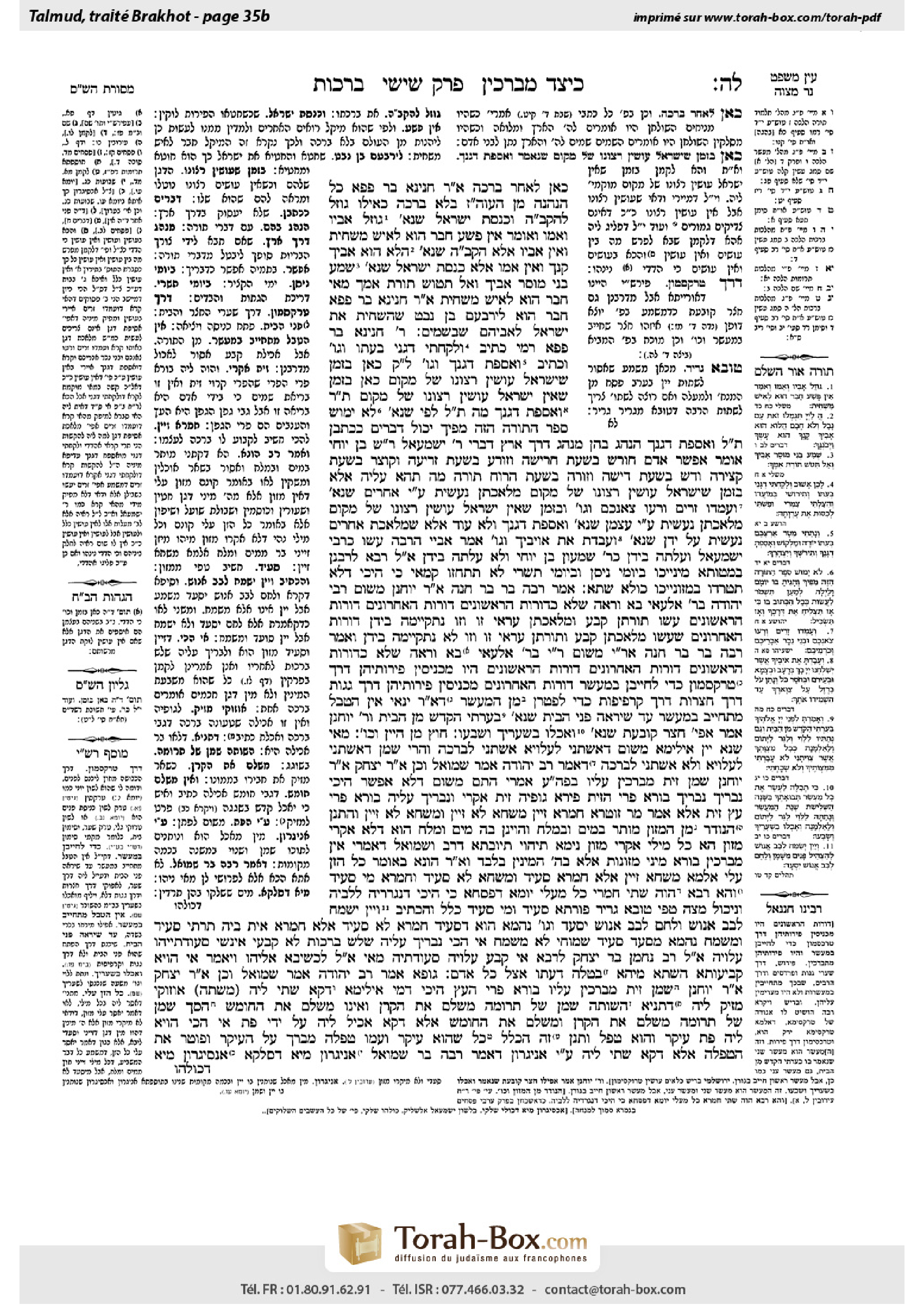
Berakhot 35b: Talmud study for Daf Yomi
Study the Talmud for Daf Yomi with scanned pages, Hebrew text, English translations from Sefaria and AI-generated French translations.
Passage selection and English or AI-generated French translation are available where the scan has annotations. Daf Study is independent of Torah-Box and Sefaria.
Browse Berakhot · ברכות · All tractatesBerakhot 35b text and translations
This page of Berakhot includes the Aramaic text, an English translation and an AI-generated French translation, alongside the scan above.
ברכות ל״ה ב · Aramaic and Hebrew text
כָּאן לְאַחַר בְּרָכָה.
אָמַר רַבִּי חֲנִינָא בַּר פָּפָּא: כׇּל הַנֶּהֱנֶה מִן הָעוֹלָם הַזֶּה בְּלֹא בְּרָכָה כְּאִילּוּ גּוֹזֵל לְהַקָּדוֹשׁ בָּרוּךְ הוּא וּכְנֶסֶת יִשְׂרָאֵל, שֶׁנֶּאֱמַר: ״גּוֹזֵל אָבִיו וְאִמּוֹ וְאוֹמֵר אֵין פָּשַׁע חָבֵר הוּא לְאִישׁ מַשְׁחִית״. וְאֵין ״אָבִיו״ אֶלָּא הַקָּדוֹשׁ בָּרוּךְ הוּא, שֶׁנֶּאֱמַר: ״הֲלֹא הוּא אָבִיךְ קָּנֶךָ״, וְאֵין ״אִמּוֹ״ אֶלָּא כְּנֶסֶת יִשְׂרָאֵל, שֶׁנֶּאֱמַר: ״שְׁמַע בְּנִי מוּסַר אָבִיךָ וְאַל תִּטּוֹשׁ תּוֹרַת אִמֶּךָ״.
מַאי ״חָבֵר הוּא לְאִישׁ מַשְׁחִית״? אָמַר רַבִּי חֲנִינָא בַּר פָּפָּא: חָבֵר הוּא לְיָרׇבְעָם בֶּן נְבָט שֶׁהִשְׁחִית אֶת יִשְׂרָאֵל לַאֲבִיהֶם שֶׁבַּשָּׁמַיִם.
רַבִּי חֲנִינָא בַּר פָּפָּא רָמֵי: כְּתִיב ״וְלָקַחְתִּי דְגָנִי בְּעִתּוֹ וְגוֹ׳״, וּכְתִיב ״וְאָסַפְתָּ דְגָנֶךָ וְגוֹ׳״.
לָא קַשְׁיָא: כָּאן בִּזְמַן שֶׁיִּשְׂרָאֵל עוֹשִׂין רְצוֹנוֹ שֶׁל מָקוֹם, כָּאן בִּזְמַן שֶׁאֵין יִשְׂרָאֵל עוֹשִׂין רְצוֹנוֹ שֶׁל מָקוֹם.
תָּנוּ רַבָּנַן: ״וְאָסַפְתָּ דְגָנֶךָ״ מָה תַּלְמוּד לוֹמַר? — לְפִי שֶׁנֶּאֱמַר: ״לֹא יָמוּשׁ סֵפֶר הַתּוֹרָה הַזֶּה מִפִּיךָ״ — יָכוֹל דְּבָרִים כִּכְתָבָן, תַּלְמוּד לוֹמַר: ״וְאָסַפְתָּ דְגָנֶךָ״ — הַנְהֵג בָּהֶן מִנְהַג דֶּרֶךְ אֶרֶץ, דִּבְרֵי רַבִּי יִשְׁמָעֵאל.
רַבִּי שִׁמְעוֹן בֶּן יוֹחַאי אוֹמֵר: אֶפְשָׁר אָדָם חוֹרֵשׁ בִּשְׁעַת חֲרִישָׁה, וְזוֹרֵעַ בִּשְׁעַת זְרִיעָה, וְקוֹצֵר בִּשְׁעַת קְצִירָה, וְדָשׁ בִּשְׁעַת דִּישָׁה, וְזוֹרֶה בִּשְׁעַת הָרוּחַ, תּוֹרָה מַה תְּהֵא עָלֶיהָ? אֶלָּא בִּזְמַן שֶׁיִּשְׂרָאֵל עוֹשִׂין רְצוֹנוֹ שֶׁל מָקוֹם — מְלַאכְתָּן נַעֲשֵׂית עַל יְדֵי אֲחֵרִים, שֶׁנֶּאֱמַר: ״וְעָמְדוּ זָרִים וְרָעוּ צֹאנְכֶם וְגוֹ׳״, וּבִזְמַן שֶׁאֵין יִשְׂרָאֵל עוֹשִׂין רְצוֹנוֹ שֶׁל מָקוֹם — מְלַאכְתָּן נַעֲשֵׂית עַל יְדֵי עַצְמָן, שֶׁנֶּאֱמַר: ״וְאָסַפְתָּ דְגָנֶךָ״. וְלֹא עוֹד אֶלָּא שֶׁמְּלֶאכֶת אֲחֵרִים נַעֲשֵׂית עַל יָדָן, שֶׁנֶּאֱמַר: ״וְעָבַדְתָּ אֶת אוֹיְבֶךָ וְגוֹ׳״.
אָמַר אַבָּיֵי: הַרְבֵּה עָשׂוּ כְּרַבִּי יִשְׁמָעֵאל, וְעָלְתָה בְּיָדָן. כְּרַבִּי שִׁמְעוֹן בֶּן יוֹחַי, וְלֹא עָלְתָה בְּיָדָן.
אֲמַר לְהוּ רָבָא לְרַבָּנַן: בְּמָטוּתָא מִינַּיְיכוּ, בְּיוֹמֵי נִיסָן וּבְיוֹמֵי תִּשְׁרֵי לָא תִּתְחֲזוֹ קַמַּאי, כִּי הֵיכִי דְּלָא תִּטַּרְדוּ בִּמְזוֹנַיְיכוּ כּוּלָּא שַׁתָּא.
אָמַר רַבָּה בַּר בַּר חָנָה אָמַר רַבִּי יוֹחָנָן מִשּׁוּם רַבִּי יְהוּדָה בְּרַבִּי אִלְעַאי: בֹּא וּרְאֵה שֶׁלֹּא כְּדוֹרוֹת הָרִאשׁוֹנִים דּוֹרוֹת הָאַחֲרוֹנִים. דּוֹרוֹת הָרִאשׁוֹנִים עָשׂוּ תּוֹרָתָן קֶבַע וּמְלַאכְתָּן עֲרַאי, זוֹ וָזוֹ נִתְקַיְּימָה בְּיָדָן. דּוֹרוֹת הָאַחֲרוֹנִים שֶׁעָשׂוּ מְלַאכְתָּן קֶבַע וְתוֹרָתָן עֲרַאי, זוֹ וָזוֹ לֹא נִתְקַיְּימָה בְּיָדָן.
וְאָמַר רַבָּה בַּר בַּר חָנָה אָמַר רַבִּי יוֹחָנָן מִשּׁוּם רַבִּי יְהוּדָה בְּרַבִּי אִלְעַאי: בֹּא וּרְאֵה שֶׁלֹּא כְּדוֹרוֹת הָרִאשׁוֹנִים דּוֹרוֹת הָאַחֲרוֹנִים. דּוֹרוֹת הָרִאשׁוֹנִים הָיוּ מַכְנִיסִין פֵּירוֹתֵיהֶן דֶּרֶךְ טְרַקְסְמוֹן כְּדֵי לְחַיְּיבָן בְּמַעֲשֵׂר, דּוֹרוֹת הָאַחֲרוֹנִים מַכְנִיסִין פֵּירוֹתֵיהֶן דֶּרֶךְ גַּגּוֹת, דֶּרֶךְ חֲצֵרוֹת, דֶּרֶךְ קַרְפֵּיפוֹת, כְּדֵי לְפׇטְרָן מִן הַמַּעֲשֵׂר. דְּאָמַר רַבִּי יַנַּאי: אֵין הַטֶּבֶל מִתְחַיֵּיב בְּמַעֲשֵׂר עַד שֶׁיִּרְאֶה פְּנֵי הַבַּיִת, שֶׁנֶּאֱמַר: ״בִּעַרְתִּי הַקֹּדֶשׁ מִן הַבַּיִת״.
וְרַבִּי יוֹחָנָן אָמַר: אֲפִילּוּ חָצֵר קוֹבַעַת, שֶׁנֶּאֱמַר: ״וְאָכְלוּ בִשְׁעָרֶיךָ וְשָׂבֵעוּ״.
חוּץ מִן הַיַּיִן וְכוּ׳: מַאי שְׁנָא יַיִן? אִילֵּימָא מִשּׁוּם דְּאִשְׁתַּנִּי לְעִלּוּיָא אִשְׁתַּנִּי לִבְרָכָה, וַהֲרֵי שֶׁמֶן, דְּאִשְׁתַּנִּי לְעִלּוּיָא וְלָא אִשְׁתַּנִּי לִבְרָכָה, דְּאָמַר רַב יְהוּדָה אָמַר שְׁמוּאֵל, וְכֵן אָמַר רַבִּי יִצְחָק אָמַר רַבִּי יוֹחָנָן: שֶׁמֶן זַיִת מְבָרְכִין עָלָיו ״בּוֹרֵא פְּרִי הָעֵץ״.
אָמְרִי: הָתָם מִשּׁוּם דְּלָא אֶפְשָׁר. הֵיכִי נְבָרֵיךְ? נְבָרֵיךְ ״בּוֹרֵא פְּרִי הַזַּיִת״ — פֵּירָא גּוּפֵיהּ ״זַיִת״ אִקְּרִי.
וּנְבָרֵיךְ עֲלֵיהּ ״בּוֹרֵא פְּרִי עֵץ זַיִת״? אֶלָּא אָמַר מָר זוּטְרָא: חַמְרָא — זָיֵין, מִשְׁחָא — לָא זָיֵין.
וּמִשְׁחָא לָא זָיֵין? וְהָתְנַן הַנּוֹדֵר מִן הַמָּזוֹן — מוּתָּר בַּמַּיִם וּבַמֶּלַח. וְהָוֵינַן בַּהּ: מַיִם וּמֶלַח הוּא דְּלָא אִקְּרִי ״מָזוֹן״, הָא כׇּל מִילֵּי אִקְּרִי ״מָזוֹן״.
נֵימָא תֶּיהְוֵי תְּיוּבְתָּא דְּרַב וּשְׁמוּאֵל, דְּאָמְרִי אֵין מְבָרְכִין ״בּוֹרֵא מִינֵי מְזוֹנוֹת״ אֶלָּא בַּחֲמֵשֶׁת הַמִּינִין בִּלְבַד. וְאָמַר רַב הוּנָא: בְּאוֹמֵר ״כׇּל הַזָּן עָלַי״.
אַלְמָא מִשְׁחָא זָיֵין! אֶלָּא, חַמְרָא סָעֵיד, וּמִשְׁחָא לָא סָעֵיד. וְחַמְרָא מִי סָעֵיד? וְהָא רָבָא הֲוָה שָׁתֵי חַמְרָא כׇּל מַעֲלֵי יוֹמָא דְפִסְחָא כִּי הֵיכִי דְּנִגְרְרֵיהּ לְלִבֵּיהּ וְנֵיכוֹל מַצָּה טְפֵי? טוּבָא — גָּרֵיר, פּוּרְתָּא — סָעֵיד.
וּמִי סָעֵיד כְּלָל?! וְהָכְתִיב: ״וְיַיִן יְשַׂמַּח לְבַב אֱנוֹשׁ וְלֶחֶם לְבַב אֱנוֹשׁ יִסְעָד וְגוֹ׳״ — נַהֲמָא הוּא דְּסָעֵיד חַמְרָא לָא סָעֵיד! אֶלָּא, חַמְרָא אִית בֵּיהּ תַּרְתֵּי: סָעֵיד וּמְשַׂמַּח. נַהֲמָא מִסְעָד סָעֵיד, שַׂמּוֹחֵי לָא מְשַׂמַּח.
אִי הָכִי נְבָרֵיךְ עֲלֵיהּ שָׁלֹשׁ בְּרָכוֹת! לָא קָבְעִי אִינָשֵׁי סְעוֹדְתַּיְיהוּ עִלָּוֵיהּ.
אֲמַר לֵיהּ רַב נַחְמָן בַּר יִצְחָק לְרָבָא: אִי קָבַע עִלָּוֵיהּ סְעוֹדְתֵּיהּ מַאי? אָמַר לֵיהּ: לִכְשֶׁיָּבֹא אֵלִיָּהוּ וְיֹאמַר אִי הָוֵי קְבִיעוּתָא. הַשְׁתָּא מִיהָא בָּטְלָה דַּעְתּוֹ אֵצֶל כׇּל אָדָם.
גּוּפָא. אָמַר רַב יְהוּדָה אָמַר שְׁמוּאֵל, וְכֵן אָמַר רַבִּי יִצְחָק אָמַר רַבִּי יוֹחָנָן: שֶׁמֶן זַיִת מְבָרְכִין עָלָיו ״בּוֹרֵא פְּרִי הָעֵץ״. הֵיכִי דָּמֵי? אִילֵּימָא דְּקָא שָׁתֵי לֵיהּ מִשְׁתָּא — אוֹזוֹקֵי מַזִּיק לֵיהּ. דְּתַנְיָא: הַשּׁוֹתֶה שֶׁמֶן שֶׁל תְּרוּמָה — מְשַׁלֵּם אֶת הַקֶּרֶן, וְאֵינוֹ מְשַׁלֵּם אֶת הַחוֹמֶשׁ. הַסָּךְ שֶׁמֶן שֶׁל תְּרוּמָה — מְשַׁלֵּם אֶת הַקֶּרֶן וּמְשַׁלֵּם אֶת הַחוֹמֶשׁ.
אֶלָּא דְּקָא אָכֵיל לֵיהּ עַל יְדֵי פַּת. אִי הָכִי, הָוְיָא לֵיהּ פַּת עִיקָּר וְהוּא טָפֵל. וּתְנַן, זֶה הַכְּלָל: כׇּל שֶׁהוּא עִיקָּר וְעִמּוֹ טְפֵלָה — מְבָרֵךְ עַל הָעִיקָּר וּפוֹטֵר אֶת הַטְּפֵלָה! אֶלָּא דְּקָא שָׁתֵי לֵיהּ עַל יְדֵי ״אֲנִיגְרוֹן״, דְּאָמַר רַבָּה בַּר שְׁמוּאֵל: ״אֲנִיגְרוֹן״ — מַיָּא דְסִלְקָא, ״אַנְסִיגְרוֹן״ — מַיָּא
Berakhot 35b · English translation
and here, where it says that He gave the earth to mankind refers to after a blessing is recited.
Rabbi Ḥanina bar Pappa said: Anyone who derives benefit from this world without a blessing, it is as if he stole from God and the community of Israel, as it is stated: “Whoever robs his father and his mother and says: It is no transgression, he is the companion of a destroyer” (Proverbs 28:24). The phrase, his father, refers to none other than God, as it is stated: “Is He not your Father Who created you, Who made you and established you” (Deuteronomy 32:6). The phrase his mother refers to none other than the community of Israel, as it is stated: “Hear, my son, the discipline of your father, and do not forsake the Torah of your mother” (Proverbs 1:8). The mention of the Torah as emanating from the mouth of the mother, apparently means that your mother is the community of Israel.
What is the meaning of the continuation of the verse: He is the companion of a destroyer? Rabbi Ḥanina bar Pappa said: He is a companion of Jeroboam ben Nevat, who corrupted Israel before their Father in heaven by sinning and causing others to sin.
On a similar note, the Gemara cites that Rabbi Ḥanina bar Pappa raised a contradiction: It is written, “I will take back My grain at its time and wine in its season” (Hosea 2:11), and it is written: “And you shall gather your grain, your wine and your oil” (Deuteronomy 11:14). To whom does the grain belong: To God, or to the people?
The Gemara responds: This is not difficult. Here, where God promises Israel that they will gather their grain, the verse refers to a time when they perform God’s will. Here, where the verse indicates that the grain belongs to God, it refers to a time when they do not perform God’s will, as then He will take back the grain, demonstrating that it belongs to Him.
The Sages taught: What is the meaning of that which the verse states: “And you shall gather your grain”? Because it is stated: “This Torah shall not depart from your mouths, and you shall contemplate in it day and night” (Joshua 1:8), I might have thought that these matters are to be understood as they are written; one is to literally spend his days immersed exclusively in Torah study. Therefore, the verse states: “And you shall gather your grain, your wine and your oil,” assume in their regard, the way of the world; set aside time not only for Torah, but also for work. This is the statement of Rabbi Yishmael.
Rabbi Shimon ben Yoḥai says: Is it possible that a person plows in the plowing season and sows in the sowing season and harvests in the harvest season and threshes in the threshing season and winnows in the windy season, as grain is separated from the chaff by means of the wind, and is constantly busy; what will become of Torah? Rather, one must dedicate himself exclusively to Torah at the expense of other endeavors; as when Israel performs God’s will, their work is performed by others, as it is stated: “And strangers will stand and feed your flocks, and foreigners will be your plowmen and your vinedressers” (Isaiah 61:5). When Israel does not perform God’s will, their work is performed by them themselves, as it is stated: “And you shall gather your grain.” Moreover, if Israel fails to perform God’s will, others’ work will be performed by them, as it is stated: “You shall serve your enemy whom God shall send against you, in hunger, in thirst, in nakedness and in want of all things” (Deuteronomy 28:48).
Summing up this dispute, Abaye said: Although there is room for both opinions, many have acted in accordance with the opinion of Rabbi Yishmael, and combined working for a living and learning Torah, and although they engaged in activities other than the study of Torah, were successful in their Torah study. Many have acted in accordance with the opinion of Rabbi Shimon ben Yoḥai and were not successful in their Torah study. They were ultimately forced to abandon their Torah study altogether.
Similarly, Rava said to the Sages who would attend his study hall: I implore you; during the months of Nisan and Tishrei, the crucial agricultural periods, do not appear before me. Engage in your agricultural work then so that you will not be preoccupied with your sustenance all year.
Summarizing these statements, Rabba bar bar Ḥana said that Rabbi Yoḥanan said in the name of the tanna Rabbi Yehuda, son of Rabbi El’ai: Come and see that the latter generations are not like the earlier generations; rather they are their inferiors. The earlier generations made their Torah permanent and their work occasional, and this, Torah study, and that, their work, were successful for them. However, the latter generations who made their work permanent and their Torah occasional, neither this nor that was successful for them.
Along these lines, Rabba bar bar Ḥana said that Rabbi Yoḥanan said in the name of Rabbi Yehuda, son of Rabbi El’ai: Come and see that the latter generations are not like the earlier generations. In the earlier generations, people would bring their fruits into their courtyards through the main gate in order to obligate them in tithes. However, the latter generations bring their fruits through roofs, through courtyards and through enclosed courtyards, avoiding the main gate in order to exempt them from the mitzva of tithing. As Rabbi Yannai said: Untithed produce is not obligated in the mitzva of tithing until it sees the front of the house through which people enter and exit, and it is brought into the house that way as it is stated in the formula of the confession of the tithes: “I have removed the consecrated from the house” (Deuteronomy 26:13), as the obligation to tithe produce whose purpose has not yet been designated takes effect only when it is brought into the house.
And Rabbi Yoḥanan said: Even bringing it into the courtyard determines its status as having completed the production process and obligates the produce to be tithed, as it is written in the confession of the tithes: “And I have given to the Levite, the stranger, the orphan and the widow, and they shall eat in your gates and be satisfied” (Deuteronomy 26:12).
We learned in our mishna: Over fruits that grow on a tree one recites: Who creates fruit of the tree, with the exception of wine that even though it originates from fruit of the tree, a separate blessing was established for it: Who creates the fruit of the vine. The Gemara asks: What is different about wine, that a separate blessing was established for it? If you say that because the fruit changed for the better into wine, therefore, the blessing changed. Olive oil changed for the better and nevertheless, its blessing did not change. As Rabbi Yehuda said that Shmuel said, and so too Rabbi Yitzḥak said that Rabbi Yoḥanan said: Over olive oil, one recites: Who creates fruit of the tree, just as he does over the fruit itself.
The Sages said: There, in the case of oil, it is because it is impossible to find an appropriate blessing, as how shall we recite the blessing? If we recite the blessing: Who creates fruit of the olive, the fruit itself is called olive and that is what was created. The oil is a man-made product of that fruit, rendering that formula inappropriate. Similarly, reciting a formula parallel to the blessing on wine: Who creates the fruit of the vine, is inappropriate as the grapes themselves are the fruit that was created, as opposed to oil which was not.
The Gemara challenges: Nevertheless, it is still possible to formulate a blessing, as we may recite the blessing: Who creates fruit of the olive tree, which would be parallel to the blessing recited over wine. Rather, Mar Zutra offered a different rationale: The reason that no separate blessing was established over oil is because, as opposed to wine that nourishes, oil does not nourish.
The Gemara asks: And oil does not nourish? Didn’t we learn in a mishna: One who vows that nourishment is forbidden to him is permitted to eat water and salt, as they are not considered nourishment. And we discussed this halakha: By inference, water and salt are not considered nourishment, but all other edible items are considered nourishment.
Let us say that this is a conclusive refutation of Rav and Shmuel, who said: One only recites: Who creates various kinds of nourishment, over the five species of grain alone, as they alone are considered nourishing. And Rav Huna said as a solution that this mishna referred to a case where he vows and says: Anything that nourishes is prohibited to me. That formula includes anything that is at all nourishing and therefore only water and salt are excluded. Olive oil is not excluded.
Apparently, oil nourishes. Rather, there is another distinction between wine and oil: Wine satisfies, oil does not satisfy. Wine not only nourishes, but it is also filling. The Gemara asks: And does wine satisfy? Wouldn’t Rava drink wine all day on the eve of Passover in order to stimulate his heart, i.e., whet his appetite so that he might eat more matza at the seder? Wine does not satisfy, it whets the appetite. The Gemara answers: A lot of wine stimulates, a little satisfies.
Again, the Gemara asks: Does wine satisfy at all? Isn’t it written: “Wine gladdens the heart of man, making the face brighter than oil, and bread fills man’s heart” (Psalms 104:15); bread is that which satisfies, wine does not satisfy. Rather, this verse is not a proof; wine has two advantages, it satisfies and gladdens. Bread, however, satisfies but does not gladden.
Since wine possesses all of these virtues, the Gemara asks: If so, let us recite the three blessings of Grace after Meals over it after drinking, just as we do after eating bread. The Gemara answers: People do not base their meals on wine.
Rav Naḥman bar Yitzḥak said to Rava: If one based his meal on it, what is the ruling? Must he recite the Grace after Meals as he does after bread? He replied: When Elijah comes and says whether or not it can serve as the basis for a meal, this will be resolved. Nevertheless, now, until then, his intention is rendered irrelevant by the opinions of all other men and he is not required to recite the complete Grace after Meals.
Previously, the Gemara cited the halakha that one recites the blessing: Who creates fruit of the tree, over olive oil. The Gemara discusses the matter itself. Rav Yehuda said that Shmuel said, and so too Rabbi Yitzḥak said that Rabbi Yoḥanan said: One recites the blessing: Who creates fruit of the tree, over olive oil just as he does over the fruit itself. What are the circumstances? If you say that he drank it plain, it causes damage to the drinker. As it was taught in a baraita: One who drinks oil of teruma, while unaware that it was teruma, pays the principal and does not pay the additional fifth which is the typical penalty for unintentional misuse of consecrated property, as in that case the individual is considered to have only damaged consecrated property without deriving benefit from it. One who anoints his body with the oil of teruma pays the principal and pays the fifth, as he derived benefit from it. Apparently, one who drinks oil derives no benefit and it even causes him damage.
Rather, it is referring to a case where he eats the oil by dipping bread into it. If so, the bread is primary and the oil secondary, and we learned in a mishna: This is the principle: Any food that is primary, and is eaten with food that is secondary, one recites a blessing over the primary food, and that blessing exempts the secondary from the requirement to recite a blessing before eating it. A blessing need only be recited over the bread, not over the oil. Rather, it is referring to a case where he is drinking it by means of an anigeron, as Rabba bar Shmuel said: Anigeron is water in which a beet was boiled, ansigeron is the water
Berakhot 35b · Traduction française (IA)
et ici, où il est dit qu'Il a donné la terre aux hommes, cela se réfère après que la prière ait été récitée.
Rabbi Ḥanina bar Pappa a dit : Celui qui tire un bénéfice de ce monde sans avoir récité une bénédiction, c'est comme s'il volait à Dieu et à la communauté d'Israël, comme il est dit : « Celui qui vole à son père et à sa mère et dit : Ce n'est pas une transgression, il est compagnon d'un destructeur » (Proverbes 28:24). La mention de « son père » ne désigne personne d'autre que Dieu, comme il est dit : « N'est-ce pas ton Père, celui qui t'a créé, qui t'a fait et qui t'a établi » (Deutéronome 32:6). La mention de « sa mère » ne désigne personne d'autre que la communauté d'Israël, comme il est dit : « Écoute, mon fils, la discipline de ton père, et ne délaisse pas la Torah de ta mère » (Proverbes 1:8). La mention de la Torah comme provenant de la bouche de la mère semble signifier que ta mère est la communauté d'Israël.
Quelle est la signification de la continuation de la parole : « Il est le compagnon d'un destructeur » ? Rabbi Ḥanina bar Pappa a dit : Il est un compagnon de Jéroboam ben Nevat, qui a corrompu Israël devant leur Père céleste en péchant et en faisant pécher les autres.
Sur un plan similaire, la Guemara cite que Rabbi Ḥanina bar Pappa a soulevé une contradiction : Il est écrit, « Je prendrai mon blé à son temps et mon vin à sa saison » (Osée 2:11), et il est écrit : « Et tu réuniras ton blé, ton vin et ton huile » (Deutéronome 11:14). À qui appartient le blé : à Dieu, ou au peuple ?
La Guemara répond : Ce n'est pas difficile. Ici, où Dieu promet à Israël qu'ils réuniront leur blé, la parole se réfère à un temps où ils accomplissent la volonté de Dieu. Ici, où la parole indique que le blé appartient à Dieu, cela se réfère à un temps où ils ne accomplissent pas la volonté de Dieu, car alors Il le reprendra, démontrant qu'il lui appartient.
Les Sages ont enseigné : Quelle est la signification de ce que la parole dit : « Et tu réuniras ton blé » ? Parce qu'il est dit : « Cette Torah ne doit pas sortir de tes lèvres, et tu dois la méditer jour et nuit » (Josué 1:8), je pourrais penser que ces choses doivent être comprises telles quelles sont écrites ; on doit passer ses jours uniquement immergé dans l'étude de la Torah. Par conséquent, la parole dit : « Et tu réuniras ton blé, ton vin et ton huile », assume en ce qui concerne cela, la manière du monde ; réserve un temps non seulement pour la Torah, mais aussi pour le travail. C'est la déclaration de Rabbi Yishmael.
Rabbi Shimon ben Yoḥai dit : Est-ce possible qu'un homme plante en saison de ploughing et sème en saison de semaille et récolte en saison de récolte et épile en saison d'épilation et trie en saison de vent, comme le blé est séparé de la paille par le vent, et qu'il est constamment occupé ; que deviendra la Torah ? Plutôt, on doit se consacrer exclusivement à la Torah au détriment d'autres activités ; car lorsque Israël accomplit la volonté de Dieu, leur travail est accompli par d'autres, comme il est dit : « Et des étrangers se dresseront et nourriront vos troupeaux, et des étrangers seront vos laboureurs et vos vignerons » (Isaïe 61:5). Lorsque Israël ne accomplit pas la volonté de Dieu, leur travail est accompli par eux-mêmes, comme il est dit : « Et tu réuniras ton blé. » De plus, si Israël échoue à accomplir la volonté de Dieu, le travail des autres sera accompli par eux, comme il est dit : « Tu serviras ton ennemi que Dieu enverra contre toi, en faim, en soif, en nudité et en manque de tout » (Deutéronome 28:48).
En résumant ce débat, Abaye a dit : Bien que place soit laissée aux deux opinions, beaucoup ont agi selon l'opinion de Rabbi Yishmael, et ont combiné le travail pour vivre et l'étude de la Torah, et bien qu'ils aient engagé dans des activités autres que l'étude de la Torah, ils ont réussi dans leur étude de la Torah. Beaucoup ont agi selon l'opinion de Rabbi Shimon ben Yoḥai et n'ont pas réussi dans leur étude de la Torah. Ils ont fini par être contraints de tout abandonner.
De même, Rava a dit aux Sages qui assistaient à ses séminaires : Je vous implore ; pendant les mois de Nisan et de Tishrei, les périodes agricoles importantes, ne vous présentez pas devant moi. Engagez-vous dans votre travail agricole alors afin de ne pas être occupé par votre subsistance toute l'année.
En résumant ces déclarations, Rabba bar bar Ḥana a dit que Rabbi Yoḥanan a dit au nom du tanna Rabbi Yehuda, fils de Rabbi El’ai : Approchez-vous et voyez que les générations ultérieures ne sont pas comme les générations précédentes ; elles sont leurs inférieurs. Les générations précédentes ont rendu leur Torah permanente et leur travail occasionnel, et cela, l'étude de la Torah, et cela, leur travail, a été réussi pour eux. Cependant, les générations ultérieures qui ont rendu leur travail permanent et leur Torah occasionnel, ni cela ni cela n'a été réussi pour eux.
Dans ce sens, Rabba bar bar Ḥana a dit que Rabbi Yoḥanan a dit au nom de Rabbi Yehuda, fils de Rabbi El’ai : Approchez-vous et voyez que les générations ultérieures ne sont pas comme les générations précédentes. Dans les générations précédentes, les gens apportaient leurs fruits dans leurs courtyards par la porte principale afin d'obliger à la mitsva des offrandes. Cependant, les générations ultérieures apportent leurs fruits par les toits, par les courtyards et par les courtyards clos, évitant la porte principale afin d'exempter de la mitsva des offrandes. Comme Rabbi Yannai a dit : Les fruits non offerts ne sont pas obligés à la mitsva des offrandes jusqu'à ce qu'ils voient la façade de la maison par laquelle les gens entrent et sortent, et qu'ils soient apportés dans la maison ainsi, comme il est dit dans la formule de la confession des offrandes : « J'ai ôté les consacrés de la maison » (Deutéronome 26:13), car l'obligation d'offrir des fruits dont la destination n'a pas encore été désignée prend effet seulement lorsqu'ils sont apportés dans la maison.
Et le maître Rabbi Yoḥanan a dit : Même l'entrée dans le cour de l'enclos détermine le statut de l'objet comme ayant achevé le processus de production et impose l'obligation de dîme sur les produits, car il est écrit dans la déclaration des dîmes : « Et j'ai donné au lévite, à l'étranger, à l'orphelin et à la veuve, et ils mangeront à vos portes et seront rassasiés » (Deutéronome 26:12).
Nous avons appris dans notre mitsna : Sur les fruits qui croissent sur un arbre, on récite : Qui crée les fruits de l'arbre, à l'exception du vin, qui bien qu'il provienne des fruits de l'arbre, a une bénédiction particulière : Qui crée les fruits de la vigne. La Guemara pose la question : Qu'est-ce qui diffère dans le vin, qui ait une bénédiction particulière ? Si vous dites que c'est parce que le fruit s'est amélioré en vin, donc la bénédiction s'est modifiée. L'huile d'olive s'est améliorée et pourtant, sa bénédiction n'a pas changé. Comme Rabbi Yehuda a dit que Shmuel a dit, et de même Rabbi Yitzḥak a dit que Rabbi Yoḥanan a dit : Sur l'huile d'olive, on récite : Qui crée les fruits de l'arbre, tout comme on le fait sur le fruit lui-même.
Les Sages ont dit : Là, dans le cas de l'huile, c'est parce qu'il est impossible de trouver une bénédiction appropriée, car comment allons-nous réciter la bénédiction ? Si nous récitons la bénédiction : Qui crée les fruits de l'olive, le fruit lui-même est appelé olive et c'est ce qui a été créé. L'huile est un produit fait par l'homme de ce fruit, rendant cette formule inadaptée. De même, réciter une formule parallèle à la bénédiction sur le vin : Qui crée les fruits de la vigne, est inadapté, car les raisins eux-mêmes sont les fruits qui ont été créés, contrairement à l'huile qui n'a pas été créée.
La Guemara conteste : Toutefois, il est toujours possible de formuler une bénédiction, car nous pouvons réciter la bénédiction : Qui crée les fruits de l'arbre d'olive, qui serait parallèle à la bénédiction récitée sur le vin. En revanche, Mar Zutra a offert une autre raison : La raison pour laquelle aucune bénédiction particulière n'a été établie sur l'huile est parce que, contrairement au vin qui nourrit, l'huile ne nourrit pas.
La Guemara pose la question : Et l'huile ne nourrit pas ? N'avons-nous pas appris dans une mitsna : Celui qui fait un vœu disant que la nourriture est interdite à lui est autorisé à manger de l'eau et du sel, car ils ne sont pas considérés comme de la nourriture. Et nous avons discuté de cette halakha : Par déduction, l'eau et le sel ne sont pas considérés comme de la nourriture, mais tous les autres aliments comestibles sont considérés comme de la nourriture.
Disons que cela est une réfutation concluante de Rav et de Shmuel, qui ont dit : On récite seulement : Qui crée diverses sortes de nourriture, sur les cinq espèces de céréales seulement, car elles seules sont considérées comme nourrissantes. Et Rav Huna a dit comme solution que cette mitsna faisait référence à un cas où il fait un vœu et dit : Tout ce qui nourrit est interdit à moi. Cette formule inclut tout ce qui est du moins nourrissant, et par conséquent seulement l'eau et le sel sont exclus. L'huile d'olive n'est pas exclue.
Apparemment, l'huile nourrit. Cependant, il existe une autre distinction entre le vin et l'huile : le vin rassasie, l'huile ne rassasie pas. Le vin nourrit non seulement, mais il est également rassasiant. La Guemara pose la question : Et le vin rassasie-t-il ? Ne serait-ce pas le cas que Rava boive du vin toute la journée la veille de Pâque afin d'exciter son cœur, c'est-à-dire d'attiser son appétit afin qu'il mange davantage de matza lors de la cérémonie ? Le vin ne rassasie pas, il attise l'appétit. La Guemara répond : Une grande quantité de vin excite, une petite quantité rassasie.
Encore, la Guemara pose la question : Le vin rassasie-t-il du tout ? N'est-il pas écrit : « Le vin réjouit le cœur de l'homme, le rendant plus brillant que l'huile, et le pain rassasie le cœur de l'homme » (Psaumes 104:15) ; le pain est celui qui rassasie, le vin ne rassasie pas. Cependant, cette verset n'est pas une preuve ; le vin a deux avantages, il rassasie et réjouit. Le pain, en revanche, rassasie mais ne réjouit pas.
Puisque le vin possède toutes ces vertus, la Guemara pose la question : Si c'est ainsi, que l'on récite les trois bénédictions de Grace après les repas sur lui après avoir bu, tout comme on le fait après avoir mangé du pain. La Guemara répond : Les gens ne fondent pas leurs repas sur le vin.
Rav Naḥman bar Yitzḥak dit à Rava : Si l'on fondait son repas sur cela, quelle serait la décision ? Faut-il réciter la Grace après les repas comme on le fait après le pain ? Il répondit : Quand Elie viendra et dira s'il peut servir de base à un repas, cela sera résolu. Cependant, maintenant, jusqu'à ce que cela arrive, son intention est rendue inutile par les opinions de tous les autres hommes et il n'est pas tenu de réciter la Grace complète après les repas.
Précédemment, la Guemara a cité la halakha selon laquelle on récite la bénédiction : Qui a créé les fruits des arbres, sur l'huile d'olive. La Guemara discute de cette question. Rav Yehuda dit que Shmuel a dit, et ainsi aussi Rabbi Yitzḥak dit que Rabbi Yoḥanan a dit : On récite la bénédiction : Qui a créé les fruits des arbres, sur l'huile d'olive, tout comme on le fait sur le fruit lui-même. Quelles sont les circonstances ? Si l'on dit qu'il l'a bu pur, cela cause un préjudice à celui qui boit. Comme il a été enseigné dans une baraïta : Celui qui boit l'huile de terouma, sans savoir qu'il s'agissait de terouma, paie le principal et ne paie pas le cinquième supplémentaire, qui est la sanction typique pour l'usage involontaire de propriété consacrée, car dans ce cas l'individu est considéré comme ayant seulement endommagé la propriété consacrée sans en tirer un bénéfice. Celui qui anime son corps avec l'huile de terouma paie le principal et paie le cinquième, car il a tiré un bénéfice de cela. Apparemment, celui qui boit l'huile ne tire aucun bénéfice et cela lui cause même un préjudice.
Cependant, il s'agit d'un cas où il mange l'huile en trempant du pain dedans. Si c'est ainsi, le pain est principal et l'huile secondaire, et nous avons appris dans une michna : C'est le principe : Tout aliment principal, mangé avec un aliment secondaire, on récite une bénédiction sur l'aliment principal, et cette bénédiction exempt l'aliment secondaire de la nécessité de réciter une bénédiction avant de le manger. Une bénédiction doit être récitée uniquement sur le pain, pas sur l'huile. Cependant, il s'agit d'un cas où il boit en utilisant un anigeron, comme Rabba bar Shmuel a dit : L'anigeron est de l'eau dans laquelle un navet a été bouilli, et l'anigeron est l'eau
Traduction française générée par IA à partir de l’édition anglaise de Sefaria. Vérifie toujours un passage avec le texte source.
Text from Sefaria: William Davidson Edition - Vocalized Aramaic (CC BY NC); William Davidson Edition - English (CC BY NC).