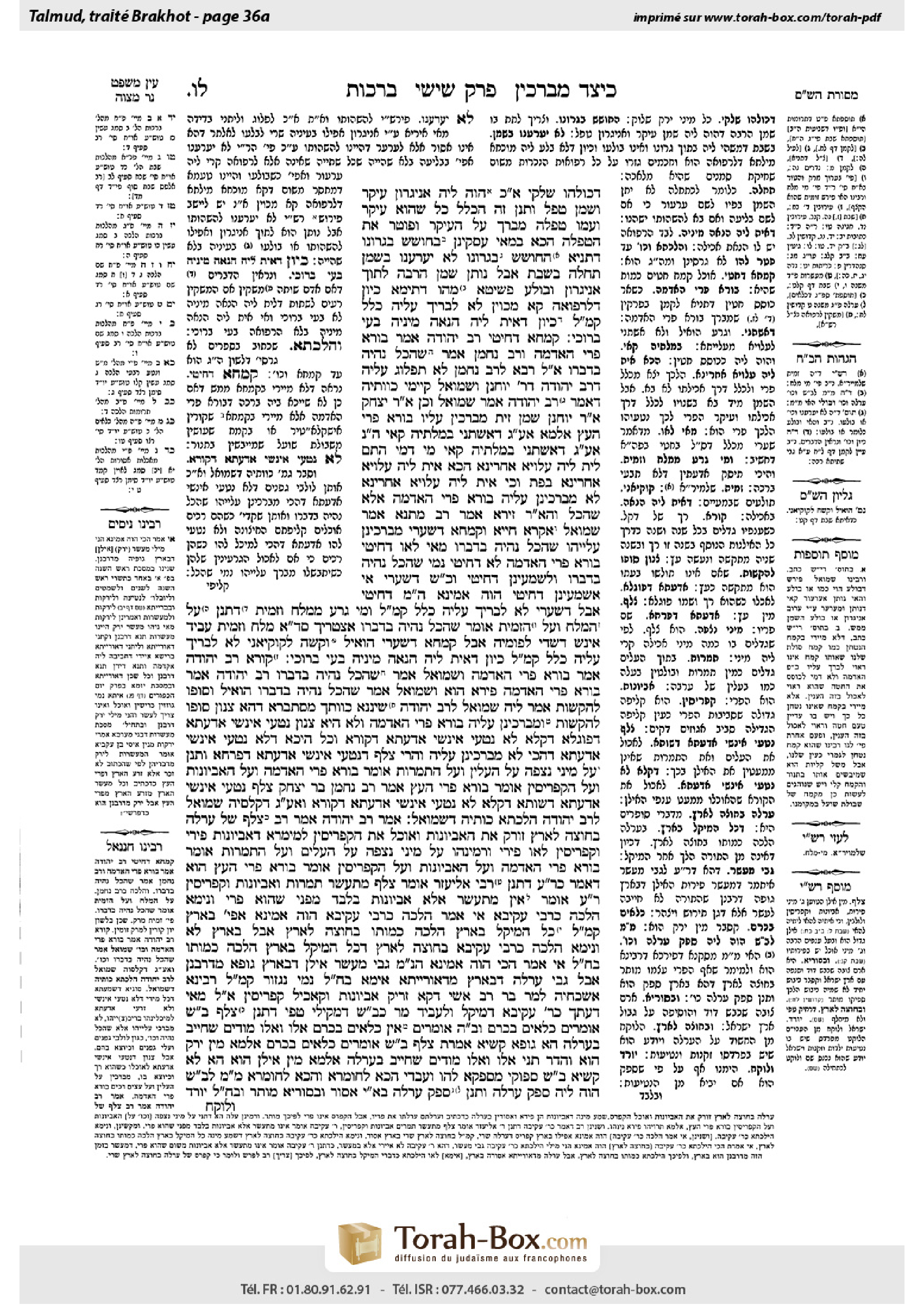
Berakhot 36a: Talmud study for Daf Yomi
Study the Talmud for Daf Yomi with scanned pages, Hebrew text, English translations from Sefaria and AI-generated French translations.
Passage selection and English or AI-generated French translation are available where the scan has annotations. Daf Study is independent of Torah-Box and Sefaria.
Browse Berakhot · ברכות · All tractatesBerakhot 36a text and translations
This page of Berakhot includes the Aramaic text, an English translation and an AI-generated French translation, alongside the scan above.
ברכות ל״ו א · Aramaic and Hebrew text
דְּכוּלְּהוּ שִׁלְקֵי.
אִם כֵּן, הָוֵה לֵיהּ אֲנִיגְרוֹן עִיקָּר וְשֶׁמֶן טָפֵל, וּתְנַן, זֶה הַכְּלָל: כֹּל שֶׁהוּא עִיקָּר וְעִמּוֹ טְפֵלָה, מְבָרֵךְ עַל הָעִיקָּר וּפוֹטֵר אֶת הַטְּפֵלָה!
הָכָא בְּמַאי עָסְקִינַן — בְּחוֹשֵׁשׁ בִּגְרוֹנוֹ. דְּתַנְיָא: הַחוֹשֵׁשׁ בִּגְרוֹנוֹ לֹא יְעָרְעֶנּוּ בְּשֶׁמֶן תְּחִלָּה בְּשַׁבָּת, אֲבָל נוֹתֵן שֶׁמֶן הַרְבֵּה לְתוֹךְ אֲנִיגְרוֹן וּבוֹלֵעַ.
פְּשִׁיטָא! מַהוּ דְתֵימָא: כֵּיוָן דְּלִרְפוּאָה קָא מְכַוֵּין לָא לְבָרֵיךְ עֲלֵיהּ כְּלָל, קָא מַשְׁמַע לַן כֵּיוָן דְּאִית לֵיהּ הֲנָאָה מִינֵּיהּ, בָּעֵי בָּרוֹכֵי.
קִמְחָא דְחִיטֵּי, רַב יְהוּדָה אָמַר: ״בּוֹרֵא פְּרִי הָאֲדָמָה״, וְרַב נַחְמָן אָמַר: ״שֶׁהַכֹּל נִהְיֶה בִּדְבָרוֹ״.
אֲמַר לֵיהּ רָבָא לְרַב נַחְמָן: לָא תִּפְלוֹג עֲלֵיהּ דְּרַב יְהוּדָה, דְּרַבִּי יוֹחָנָן וּשְׁמוּאֵל קָיְימִי כְּווֹתֵיהּ. דְּאָמַר רַב יְהוּדָה אָמַר שְׁמוּאֵל, וְכֵן אָמַר רַבִּי יִצְחָק אָמַר רַבִּי יוֹחָנָן: שֶׁמֶן זַיִת מְבָרְכִין עָלָיו ״בּוֹרֵא פְּרִי הָעֵץ״. אַלְמָא: אַף עַל גַּב דְּאִשְׁתַּנִּי — בְּמִלְּתֵיהּ קָאֵי. הָא נָמֵי, אַף עַל גַּב דְּאִשְׁתַּנִּי — בְּמִלְּתֵיהּ קָאֵי.
מִי דָּמֵי? הָתָם — לֵית לֵיהּ עִלּוּיָא אַחֲרִינָא, הָכָא — אִית לֵיהּ עִלּוּיָא אַחֲרִינָא בְּפַת.
וְכִי אִית לֵיהּ עִלּוּיָא אַחֲרִינָא לָא מְבָרְכִינַן עֲלֵיהּ ״בּוֹרֵא פְּרִי הָאֲדָמָה״ אֶלָּא ״שֶׁהַכֹּל״? וְהָא אָמַר רַבִּי זֵירָא אָמַר רַב מַתְנָא אָמַר שְׁמוּאֵל: אַקָּרָא חַיָּיא וְקִמְחָא דִשְׂעָרֵי מְבָרְכִינַן עֲלַיְיהוּ ״שֶׁהַכֹּל נִהְיָה בִּדְבָרוֹ״. מַאי לָאו דְּחִיטֵּי בּוֹרֵא פְּרִי הָאֲדָמָה!
לָא, דְּחִיטֵּי נָמֵי ״שֶׁהַכֹּל נִהְיָה בִּדְבָרוֹ״.
וְלַשְׁמְעִינַן דְּחִיטֵּי וְכׇל שֶׁכֵּן דִּשְׂעָרֵי!
אִי אַשְׁמְעִינַן דְּחִיטֵּי הֲוָה אָמֵינָא הָנֵי מִילֵּי דְּחִיטֵּי, אֲבָל דִּשְׂעָרֵי לָא לְבָרֵיךְ עֲלֵיהּ כְּלָל, קָא מַשְׁמַע לַן.
וּמִי גָּרַע מִמֶּלַח וְזָמִית, דִּתְנַן עַל הַמֶּלַח וְעַל הַזָּמִית אוֹמֵר ״שֶׁהַכֹּל נִהְיֶה בִּדְבָרוֹ״. אִצְטְרִיךְ, סָלְקָא דַעְתָּךְ אָמֵינָא מֶלַח וְזָמִית עָבֵיד אִינָשׁ דְּשָׁדֵי לְפוּמֵּיהּ, אֲבָל קִמְחָא דִשְׂעָרֵי הוֹאִיל וְקָשֶׁה לְקוּקְיָאנֵי, לָא לְבָרֵיךְ עֲלֵיהּ כְּלָל, קָא מַשְׁמַע לַן כֵּיוָן דְּאִית לֵיהּ הֲנָאָה מִינֵּיהּ בָּעֵי בָּרוֹכֵי.
קוֹרָא, רַב יְהוּדָה אָמַר: ״בּוֹרֵא פְּרִי הָאֲדָמָה״, וּשְׁמוּאֵל אָמַר: ״שֶׁהַכֹּל נִהְיֶה בִּדְבָרוֹ״.
רַב יְהוּדָה אָמַר ״בּוֹרֵא פְּרִי הָאֲדָמָה״, פֵּירָא הוּא. וּשְׁמוּאֵל אָמַר ״שֶׁהַכֹּל נִהְיָה בִּדְבָרוֹ״, הוֹאִיל וְסוֹפוֹ לְהַקְשׁוֹת.
אֲמַר לֵיהּ שְׁמוּאֵל לְרַב יְהוּדָה: שִׁינָּנָא, כְּווֹתָךְ מִסְתַּבְּרָא, דְּהָא צְנוֹן סוֹפוֹ לְהַקְשׁוֹת וּמְבָרְכִינַן עֲלֵיהּ ״בּוֹרֵא פְּרִי הָאֲדָמָה״. וְלָא הִיא: צְנוֹן נָטְעִי אִינָשֵׁי אַדַּעְתָּא דְפוּגְלָא, דִּקְלָא לָא נָטְעִי אִינָשֵׁי אַדַּעְתָּא דְקוֹרָא.
וְכׇל הֵיכָא דְּלָא נָטְעִי אִינָשֵׁי אַדַּעְתָּא דְּהָכִי לָא מְבָרְכִינַן עֲלֵיהּ? וַהֲרֵי צָלָף, דְּנָטְעִי אִינָשֵׁי אַדַּעְתָּא דְפִרְחָא, וּתְנַן: עַל מִינֵי נִצְפָּה, עַל הֶעָלִין וְעַל הַתְּמָרוֹת אוֹמֵר ״בּוֹרֵא פְּרִי הָאֲדָמָה״, וְעַל הָאֲבִיּוֹנוֹת וְעַל הַקַּפְרֵיסִין אוֹמֵר ״בּוֹרֵא פְּרִי הָעֵץ״.
אָמַר רַב נַחְמָן בַּר יִצְחָק: צָלָף נָטְעִי אִינָשֵׁי אַדַּעְתָּא דְשׁוּתָא, דִּקְלָא לָא נָטְעִי אִינָשֵׁי אַדַּעְתָּא דְקוֹרָא. וְאַף עַל גַּב דְּקַלְּסֵיהּ שְׁמוּאֵל לְרַב יְהוּדָה, הִלְכְתָא כְּווֹתֵיהּ דִּשְׁמוּאֵל.
אָמַר רַב יְהוּדָה אָמַר רַב: צָלָף שֶׁל עׇרְלָה בְּחוּצָה לָאָרֶץ זוֹרֵק אֶת הָאֲבִיּוֹנוֹת וְאוֹכֵל אֶת הַקַּפְרֵיסִין. לְמֵימְרָא דַּאֲבִיּוֹנוֹת פֵּירֵי וְקַפְרֵיסִין לָאו פֵּירֵי? וּרְמִינְהוּ: עַל מִינֵי נִצְפָּה, עַל הֶעָלִים וְעַל הַתְּמָרוֹת אוֹמֵר ״בּוֹרֵא פְּרִי הָאֲדָמָה״, וְעַל הָאֲבִיּוֹנוֹת וְעַל הַקַּפְרֵיסִין אוֹמֵר ״בּוֹרֵא פְּרִי הָעֵץ״!
הוּא דְּאָמַר כְּרַבִּי עֲקִיבָא. דִּתְנַן, רַבִּי אֱלִיעֶזֶר אוֹמֵר: צָלָף מִתְעַשֵּׂר תְּמָרוֹת וַאֲבִיּוֹנוֹת וְקַפְרֵיסִין. רַבִּי עֲקִיבָא אוֹמֵר: אֵין מִתְעַשֵּׂר אֶלָּא אֲבִיּוֹנוֹת בִּלְבַד, מִפְּנֵי שֶׁהוּא פֶּרִי.
וְנֵימָא: ״הֲלָכָה כְּרַבִּי עֲקִיבָא״! אִי אָמַר הֲלָכָה כְּרַבִּי עֲקִיבָא, הֲוָה אָמֵינָא אֲפִילּוּ בָּאָרֶץ, קָא מַשְׁמַע לַן: כׇּל הַמֵּיקֵל בָּאָרֶץ — הֲלָכָה כְּמוֹתוֹ בְּחוּצָה לָאָרֶץ, אֲבָל בָּאָרֶץ — לָא.
וְנֵימָא: ״הֲלָכָה כְּרַבִּי עֲקִיבָא בְּחוּצָה לָאָרֶץ״, דְּכׇל הַמֵּיקֵל בָּאָרֶץ — הֲלָכָה כְּמוֹתוֹ בְּחוּצָה לָאָרֶץ. אִי אָמַר הָכִי, הֲוָה אָמֵינָא הָנֵי מִילֵּי גַּבֵּי מַעְשַׂר אִילָן, דְּבָאָרֶץ גּוּפָא מִדְּרַבָּנַן, אֲבָל גַּבֵּי עׇרְלָה, דְּבָאָרֶץ מִדְּאוֹרָיְיתָא, אֵימָא בְּחוּצָה לָאָרֶץ נָמֵי נִגְזוֹר, קָא מַשְׁמַע לַן.
רָבִינָא אַשְׁכְּחֵיהּ לְמָר בַּר רַב אָשֵׁי דְּקָא זָרֵיק אֲבִיּוֹנוֹת וְקָאָכֵיל קַפְרֵיסִין. אֲמַר לֵיהּ: מַאי דַעְתָּךְ, כְּרַבִּי עֲקִיבָא דְּמֵיקֵל? וְלֶעֱבֵיד מָר כְּבֵית שַׁמַּאי דִּמְקִילִּי טְפֵי! דִּתְנַן: צָלָף, בֵּית שַׁמַּאי אוֹמְרִים: כִּלְאַיִם בַּכֶּרֶם. וּבֵית הַלֵּל אוֹמְרִים: אֵין כִּלְאַיִם בַּכֶּרֶם. אֵלּוּ וְאֵלּוּ מוֹדִים שֶׁחַיָּיב בְּעׇרְלָה.
הָא גוּפָא קַשְׁיָא: אָמְרַתְּ צָלָף בֵּית שַׁמַּאי אוֹמְרִים כִּלְאַיִם בַּכֶּרֶם, אַלְמָא מִין יָרָק הוּא, וַהֲדַר תָּנֵי: אֵלּוּ וְאֵלּוּ מוֹדִים שֶׁחַיָּיב בְּעׇרְלָה, אַלְמָא מִין אִילָן הוּא!
הָא לָא קַשְׁיָא: בֵּית שַׁמַּאי סַפּוֹקֵי מְסַפְּקָא לְהוּ, וְעָבְדִי הָכָא לְחוּמְרָא וְהָכָא לְחוּמְרָא. מִכׇּל מָקוֹם, לְבֵית שַׁמַּאי הָוֵה לֵיהּ סָפֵק עׇרְלָה, וּתְנַן: סָפֵק עׇרְלָה — בְּאֶרֶץ יִשְׂרָאֵל אָסוּר, וּבְסוּרְיָא מוּתָּר. וּבְחוּצָה לָאָרֶץ יוֹרֵד
Berakhot 36a · English translation
in which all boiled vegetables were boiled. A certain amount of oil is added to anigeron.
However, if so, here too, anigeron is primary and oil is secondary, and we learned in a mishna: This is the principle: Any food that is primary, and it is eaten with food that is secondary, one recites a blessing over the primary food, and that blessing exempts the secondary from the requirement to recite a blessing before eating it. One need recite a blessing only over the anigeron.
The Gemara reconciles: With what are we dealing here? With one who has a sore throat, which he is treating with oil. As it was taught in a baraita: One who has a sore throat should not, ab initio, gargle oil on Shabbat for medicinal purposes, as doing so would violate the decree prohibiting the use of medicine on Shabbat. However, he may, even ab initio, add a large amount of oil to the anigeron and swallow it. Since it is common practice to swallow oil either alone or with a secondary ingredient like anigeron for medicinal purposes, in this case one recites: Who creates fruit of the tree.
The Gemara challenges: This is obvious that one must recite a blessing. The Gemara responds: Lest you say: Since he intends to use it for medicinal purposes, let him not recite a blessing over it at all, as one does not recite a blessing before taking medicine. Therefore, it teaches us that, since he derived pleasure from it, he must recite a blessing over it.
The Gemara clarifies: If one was eating plain wheat flour, what blessing would he recite? Rav Yehuda said that one recites: Who creates fruit of the ground, and Rav Naḥman said that one recites: By Whose word all things came to be.
Rava said to Rav Naḥman: Do not disagree with Rav Yehuda, as Rabbi Yoḥanan and Shmuel hold in accordance with his opinion, even though they addressed another topic. As Rav Yehuda said that Shmuel said, and so too Rabbi Yitzḥak said that Rabbi Yoḥanan said: One recites the blessing: Who creates fruit of the tree, over olive oil. Consequently, even though the olive has changed into olive oil, the formula of the blessing remains as it was. This too, even though the wheat has changed into flour, its blessing remains as it was: Who creates fruit of the ground.
The Gemara responds: Is it comparable? There, the olive oil has no potential for additional enhancement, while here, the flour has the potential for additional enhancement as bread. Since oil is the olive’s finished product, one should recite the same blessing over it as over the tree itself. Wheat flour, on the other hand, is used to bake bread, so the flour is a raw material for which neither the blessing over wheat nor the blessing over bread is appropriate. Only the blessing: By Whose word all things came to be is appropriate.
The Gemara asks: When it has a potential for additional enhancement, one does not recite: Who creates fruit of the ground; rather one recites: By Whose word all things came to be? Didn’t Rabbi Zeira say that Rav Mattana said that Shmuel said: Over a raw gourd and over barley flour, one recites the blessing: By Whose word all things came to be. What, is that not to say that over wheat flour one recites: Who creates fruit of the ground? Over barley flour, which people do not typically eat, it is appropriate to recite: By Whose word all things came to be. Over wheat flour, it is appropriate to recite: Who creates fruit of the ground.
This argument is rejected: No, one also recites: By Whose word all things came to be, over wheat flour.
The Gemara asks: Then let the Sages teach us that this halakha applies with regard to wheat flour, and all the more so regarding barley flour as well.
The Gemara responds: It was necessary to teach us that one must recite a blessing even before eating barley flour. Had the Sages taught us this halakha with regard to wheat, I would have said: This applies only with regard to wheat flour, but over barley flour, let one not recite a blessing at all. Therefore, it teaches us that one recites a blessing over barley flour.
The Gemara challenges this explanation. How could one have considered that possibility? Is it inferior to salt and salt water [zamit]? As we learned in a mishna that over salt and salt water one recites: By Whose word all things came to be, and all the more so it should be recited over barley flour. This question is rejected: Nevertheless, it was necessary to teach the halakha regarding barley flour, as it might enter your mind to say: Although one occasionally places salt or salt water into his mouth, barley flour, which is damaging to one who eats it and causes intestinal worms, let one recite no blessing over it at all. Therefore, it teaches us, since one derives pleasure from it, he must recite a blessing.
Another dispute over the appropriate blessing is with regard to the heart of palm [kura], which is a thin membrane covering young palm branches that was often eaten. Rav Yehuda said that one should recite: Who creates fruit of the ground. And Shmuel, Rav Yehuda’s teacher, said that one should recite: By Whose word all things came to be.
Rav Yehuda said: Who creates fruit of the ground; it is a fruit. And Shmuel said: By Whose word all things came to be, since it will ultimately harden and it is considered part of the tree, not a fruit.
Shmuel said to Rav Yehuda: Shinnana. It is reasonable to rule in accordance with your opinion, as a radish ultimately hardens if left in the ground; nevertheless, one who eats it while it is soft recites over it: Who creates fruit of the ground. In any case, despite this praise, the Gemara states: That is not so; people plant a radish with the soft radish in mind. However, people do not plant palm trees with the heart of palm in mind and therefore it cannot be considered a fruit.
In response to this, the Gemara asks: And whenever people do not plant with that result in mind, one does not recite a blessing over it? What of the caper-bush that people plant with their fruit in mind, and we learned in a mishna that with regard to the parts of the caper-bush [nitzpa], over the leaves and young fronds, one recites: Who creates fruit of the ground, and over the berries and buds he recites: Who creates fruit of the tree. This indicates that even over leaves and various other parts of the tree that are secondary to the fruit, the blessing is: Who creates fruit of the ground, and not: By Whose word all things came to be.
Rav Naḥman bar Yitzḥak said that there is still a difference: Caper-bushes, people plant them with their leaves in mind; palm trees, people do not plant them with the heart of palm in mind. Therefore, no proof may be brought from the halakha in the case of the caper-bush to the halakha in the case of the of the palm. The Gemara concludes: Although Shmuel praised Rav Yehuda, the halakha is in accordance with the opinion of Shmuel.
Incidental to this discussion, the Gemara cites an additional halakha concerning the caper-bush. Rav Yehuda said that Rav said: A caper-bush during the first three years of its growth [orla] outside of Eretz Yisrael, when its fruits are prohibited by rabbinic and not Torah law, one throws out the berries, the primary fruit, but eats the buds. The Gemara raises the question: Is that to say that the berries are fruit of the caper, and the bud is not fruit? The Gemara raises a contradiction from what we learned in the mishna cited above: With regard to the parts of the caper-bush [nitzpa], over the leaves and young fronds, one recites: Who creates fruit of the ground, and over the berries, and buds he recites: Who creates fruit of the tree. Obviously, the buds are also considered the fruit of the caper-bush.
The Gemara responds: Rav’s statement is in accordance with the opinion of Rabbi Akiva, as we learned in a mishna that Rabbi Eliezer says: A caper-bush is tithed from its component parts, its young fronds, berries and buds, as all these are considered its fruit. And Rabbi Akiva says: Only the berries alone are tithed, because it alone is considered fruit. It was in accordance with this opinion, that Rav prohibited only the eating of the berries during the caper-bush’s years of orla.
The Gemara asks: If this is the case, why did Rav issue what seemed to be an independent ruling regarding orla? He should have simply said: The halakha is in accordance with the opinion of Rabbi Akiva, from which we could have drawn a practical halakhic conclusion regarding orla as well. The Gemara responds: Had Rav said: The halakha is in accordance with the opinion of Rabbi Akiva, I would have said that the halakha is in accordance with his opinion even in Eretz Yisrael. Therefore, he teaches us by stating the entire halakha, that there is a principle: Anyone who is lenient in a dispute with regard to the halakhot of orla in Eretz Yisrael, the halakha is in accordance with his opinion outside of Eretz Yisrael, but not in Eretz Yisrael.
The Gemara questions this: If so, then let Rav say: The halakha is in accordance with the opinion of Rabbi Akiva outside of Eretz Yisrael as anyone who is lenient in a dispute with regard to the halakhot of orla in Eretz Yisrael, the halakha is in accordance with his opinion outside of Eretz Yisrael. The Gemara answers: Had he said that, I would have said: That only applies with regard to the tithing of trees, which even in Eretz Yisrael itself is an obligation by rabbinic law; but with regard to orla, which is prohibited in Eretz Yisrael by Torah law, say that we should issue a decree prohibiting orla even outside of Eretz Yisrael. Therefore, he teaches us that even with regard to orla, the halakha is in accordance with the opinion of Rabbi Akiva.
On this topic, the Gemara relates: Ravina found Mar bar Rav Ashi throwing away the berries and eating the buds of an orla caper-bush. Ravina said to Mar bar Rav Ashi: What is your opinion, that you are eating the buds? If it is in accordance with the opinion of Rabbi Akiva, who is lenient, then you should act in accordance with the opinion of Beit Shammai, who are even more lenient. As we learned in a mishna with regard to the laws of forbidden mixtures of diverse kinds that Beit Shammai say: A caper-bush is considered a diverse kind in the vineyard, as it is included in the prohibition against planting vegetables in a vineyard. Beit Hillel say: A caper-bush is not considered a diverse kind in a vineyard. Nevertheless, these and those, Beit Shammai and Beit Hillel, agree that the caper-bush is obligated in the prohibition of orla.
Before dealing with the problem posed by Ravina to Mar bar Rav Ashi, the Gemara notes an internal contradiction in this mishna. This mishna itself is problematic: You said that Beit Shammai say: A caper-bush is considered a diverse kind in a vineyard; apparently, they hold that it is a type of vegetable bush, and then you taught: These and those, Beit Shammai and Beit Hillel, agree that the caper-bush is obligated in the prohibition of orla; apparently, it is a type of tree.
The Gemara responds: This is not difficult; Beit Shammai are uncertain whether the caper-bush is a vegetable bush or a tree, and here, regarding diverse kinds, they act stringently and here, regarding orla, they act stringently. In any case, according to Beit Shammai the caper-bush has the status of uncertain orla, and we learned the consensus halakha in a mishna: Uncertain orla in Eretz Yisrael is forbidden to eat, and in Syria it is permitted, and we are not concerned about its uncertain status. Outside of Eretz Yisrael, the gentile owner of a field may go down into his field
Berakhot 36a · Traduction française (IA)
dans lequel tous les légumes bouillis étaient bouillis. Une quantité d'huile est ajoutée à l'anigeron.
Cependant, si c'est ainsi, ici aussi, l'anigeron est principal et l'huile est secondaire, et nous avons appris dans une mitsna : Ce principe est le suivant : Tout aliment qui est principal, et qui est mangé avec un aliment secondaire, on bénit sur l'aliment principal, et cette bénédiction exempt l'aliment secondaire de la nécessité de bénir avant de le manger. On doit bénir uniquement sur l'anigeron.
La Guemara résout : De quoi sommes-nous en train de parler ? De celui qui a une angine, qu'il traite avec de l'huile. Comme cela a été enseigné dans une baraïta : Celui qui a une angine ne doit pas, dès le début, gargouiller de l'huile le sabbat à des fins médicales, car cela violerait la déclaration interdisant l'utilisation de médicaments le sabbat. Cependant, il peut, même dès le début, ajouter une grande quantité d'huile à l'anigeron et la avaler. Puisque c'est une pratique courante d'avaler de l'huile seul ou avec un ingrédient secondaire comme l'anigeron à des fins médicales, dans ce cas-là, on bénit : Qui crée les fruits des arbres.
La Guemara conteste : Cela est évident que l'on doit bénir. La Guemara répond : De peur que vous disiez : Puisqu'il l'utilise à des fins médicales, qu'il ne bénisse pas du tout, comme on ne bénit pas avant de prendre un médicament. Ainsi, elle nous apprend que, puisqu'il a trouvé du plaisir dans cela, il doit bénir.
La Guemara clarifie : Si l'on mange du farine de blé brute, quelle bénédiction doit-on bénir ? Rav Yehuda a dit que l'on bénit : Qui crée les fruits des arbres, et Rav Naḥman a dit que l'on bénit : Par la parole dont toutes choses sont venues à l'être.
Rava a dit à Rav Naḥman : Ne discutez pas avec Rav Yehuda, car Rabbi Yoḥanan et Shmuel adoptent son opinion, même s'ils abordaient un autre sujet. Comme Rav Yehuda a dit que Shmuel a dit, et de même Rabbi Yitzḥak a dit que Rabbi Yoḥanan a dit : On bénit la bénédiction : Qui crée les fruits des arbres, sur l'huile d'olive. Ainsi, même si l'olive est devenue de l'huile d'olive, la formule de la bénédiction reste telle qu'elle était. De même, même si le blé est devenu de la farine, sa bénédiction reste telle qu'elle était : Qui crée les fruits des terres.
La Guemara répond : Est-ce comparable ? Là, l'huile d'olive n'a pas de potentiel d'amélioration supplémentaire, tandis que ici, la farine a le potentiel d'amélioration supplémentaire en pain. Puisque l'huile d'olive est le produit fini de l'olive, on doit bénir la même bénédiction sur elle que sur l'arbre lui-même. La farine de blé, en revanche, est utilisée pour faire du pain, donc la farine est un matériau brut pour lequel ni la bénédiction sur le blé ni celle sur le pain ne sont appropriées. Seule la bénédiction : Par la parole dont toutes choses sont venues à l'être est appropriée.
La Guemara pose la question : Lorsqu'il a un potentiel d'amélioration supplémentaire, on ne bénit pas : Qui crée les fruits des terres ; plutôt on bénit : Par la parole dont toutes choses sont venues à l'être ? N'a-t-il pas dit Rabbi Zeira que Rav Mattana a dit que Shmuel a dit : Sur un melon cru et sur la farine de blé, on bénit la bénédiction : Par la parole dont toutes choses sont venues à l'être. Qu'est-ce que cela signifie, autre chose que sur la farine de blé, on bénit : Qui crée les fruits des terres ? Sur la farine de blé, qui n'est pas habituellement mangée, il est approprié de bénir : Par la parole dont toutes choses sont venues à l'être. Sur la farine de blé, il est approprié de bénir : Qui crée les fruits des terres.
Cette argumentation est rejetée : Non, on bénit aussi : Par la parole dont toutes choses sont venues à l'être, sur la farine de blé.
La Guemara pose la question : Alors, les Sages doivent nous enseigner que cette halakha s'applique à la farine de blé, et encore plus à la farine de seigle.
La Guemara répond : Il était nécessaire d'enseigner que l'on doit bénir même avant de manger la farine de seigle. Si les Sages nous avaient enseigné cette halakha concernant le blé, j'aurais dit : Cela s'applique uniquement à la farine de blé, mais sur la farine de seigle, on ne doit pas bénir du tout. Ainsi, elle nous apprend que l'on bénit sur la farine de seigle.
La Guemara conteste cette explication. Comment pouvait-on envisager cette possibilité ? Est-ce inférieur au sel et à l'eau salée [zamit] ? Comme nous avons appris dans une mitsva que sur le sel et l'eau salée, on bénit : Par la parole dont toutes choses sont venues à l'être, et encore plus encore, cela devrait être bénit sur la farine de seigle. Cette question est rejetée : Néanmoins, il était nécessaire d'enseigner la halakha concernant la farine de seigle, car cela pourrait entrer dans votre esprit de dire : Bien que l'on mette parfois du sel ou de l'eau salée dans sa bouche, la farine de seigle, qui est nuisible pour celui qui la mange et qui cause des vers intestinaux, ne mérite pas de bénédiction. Ainsi, elle nous apprend que, puisqu'on y trouve du plaisir, il faut bénir.
Un autre débat concernant la bénédiction appropriée est celui du cœur de palmier [kura], qui est une membrane fine couvrant les jeunes branches de palmier qui était souvent mangé. Rav Yehuda a dit que l'on devrait bénir : Qui crée les fruits de la terre. Et Shmuel, le maître de Rav Yehuda, a dit que l'on devrait bénir : Par la parole dont toutes choses sont venues à l'être.
Rav Yehuda a dit : Qui crée les fruits de la terre ; c'est un fruit. Et Shmuel a dit : Par la parole dont toutes choses sont venues à l'être, car il durcit finalement et est considéré comme faisant partie de l'arbre, pas un fruit.
Shmuel a dit à Rav Yehuda : Shinnana. Il est raisonnable de décider selon votre opinion, car un radis durcit finalement s'il reste dans le sol ; néanmoins, celui qui le mange mou récite : Qui crée les fruits de la terre. En tout cas, malgré ce compliment, la Guemara dit : Ce n'est pas ainsi ; les gens plantent un radis avec l'idée du radis mou. Cependant, les gens ne plantent pas les palmiers avec l'idée du cœur de palmier, donc il ne peut pas être considéré comme un fruit.
En réponse à cela, le Guemara pose la question : Et lorsqu'on ne plante pas avec l'intention de produire un fruit, on ne récite pas la bénédiction sur cela ? Et que dire du buis, que l'on plante avec l'intention de récolter ses fruits, et nous avons appris dans une mitsna que concernant les parties du buis [nitzpa], sur les feuilles et les jeunes feuillages, on récite : Qui crée les fruits de la terre, et sur les baies et les bourgeons, on récite : Qui crée les fruits de l'arbre. Cela montre que même sur les feuilles et diverses autres parties de l'arbre qui sont secondaires par rapport au fruit, la bénédiction est : Qui crée les fruits de la terre, et non : Par la Parole duquel toutes choses sont venues à l'être.
Rav Naḥman bar Yitzḥak a dit que la distinction persiste : Les buis, on les plante avec l'intention de leurs feuilles ; les palmiers, on ne les plante pas avec l'intention du cœur de palmier. Par conséquent, on ne peut pas établir de preuve à partir de la halakha concernant le buis pour la halakha concernant le palmier. Le Guemara conclut : Bien que Shmuel ait loué Rav Yehuda, la halakha suit l'opinion de Shmuel.
En dehors de cette discussion, le Guemara cite une autre halakha concernant le buis. Rav Yehuda a dit que Rav a dit : Un buis pendant les trois premières années de sa croissance [orla] en dehors d'Eretz Yisrael, lorsque ses fruits sont interdits par la loi rabbinique et non par la loi de la Torah, on jette les baies, le fruit principal, mais on mange les bourgeons. Le Guemara soulève la question : Est-ce que cela signifie que les baies sont les fruits du buis, et que le bourgeon n'est pas un fruit ? Le Guemara soulève une contradiction à partir de ce que nous avons appris dans la Michna citée ci-dessus : Concernant les parties du buis [nitzpa], sur les feuilles et les jeunes feuillages, on récite : Qui crée les fruits de la terre, et sur les baies et les bourgeons, on récite : Qui crée les fruits de l'arbre. Évidemment, les bourgeons sont également considérés comme les fruits du buis.
Le Guemara répond : L'affirmation de Rav est en conformité avec l'opinion de Rabbi Akiva, comme nous avons appris dans une mitsna que Rabbi Eliezer dit : Le buis est tenu à la tithe à partir de ses parties composantes, ses jeunes feuillages, ses baies et ses bourgeons, car toutes ces parties sont considérées comme ses fruits. Et Rabbi Akiva dit : Seules les baies sont tenu à la tithe, car c'est seul le fruit qui est considéré comme tel. C'est en conformité avec cette opinion que Rav a interdit de manger les baies pendant les années de orla du buis.
Le Guemara pose la question : Si c'est ainsi, pourquoi Rav a-t-il émis ce qui semblait être une décision indépendante concernant orla ? Il aurait simplement dit : La halakha suit l'opinion de Rabbi Akiva, à partir de laquelle nous aurions pu tirer une conclusion halakhique pratique concernant orla également. Le Guemara répond : Si Rav avait dit : La halakha suit l'opinion de Rabbi Akiva, j'aurais dit que la halakha suit son opinion même en Eretz Yisrael. Par conséquent, il nous enseigne en disant l'ensemble de la halakha, qu'il y a un principe : Quiconque est plus accommodant dans un débat concernant les halakhot d'orla en Eretz Yisrael, la halakha suit son opinion en dehors d'Eretz Yisrael, mais pas en Eretz Yisrael.
Le Guemara questionne cela : Si c'est ainsi, alors que Rav dise : La halakha suit l'opinion de Rabbi Akiva en dehors d'Eretz Yisrael, car celui qui est plus accommodant dans un débat concernant les halakhot d'orla en Eretz Yisrael, la halakha suit son opinion en dehors d'Eretz Yisrael. Le Guemara répond : S'il avait dit cela, j'aurais dit : Cela ne s'applique qu'en ce qui concerne la titrification des arbres, qui même en Eretz Yisrael est une obligation par la loi rabbinique ; mais en ce qui concerne orla, qui est interdit en Eretz Yisrael par la loi de la Torah, disons que nous devons émettre un décret interdisant orla même en dehors d'Eretz Yisrael. Par conséquent, il nous enseigne que même en ce qui concerne orla, la halakha suit l'opinion de Rabbi Akiva.
Sur ce sujet, le Guemara rapporte : Ravina a trouvé Mar bar Rav Ashi jeter les baies et manger les bourgeons d'un buis orla. Ravina a dit à Mar bar Rav Ashi : Quelle est ton opinion, que tu manges les bourgeons ? Si c'est en conformité avec l'opinion de Rabbi Akiva, qui est accommodant, alors tu devrais agir selon l'opinion de Beit Shammai, qui sont encore plus accommodants. Comme nous avons appris dans une mitsva concernant les lois des mélanges interdits de diverses espèces, Beit Shammai dit : Le buis est considéré comme une espèce diverse dans un vignoble, car il est inclus dans l'interdiction de planter des légumes dans un vignoble. Beit Hillel dit : Le buis n'est pas considéré comme une espèce diverse dans un vignoble. Cependant, ces deux opinions, Beit Shammai et Beit Hillel, s'accordent sur le fait que le buis est tenu à l'interdiction d'orla.
Avant d'aborder le problème posé par Ravina à Mar bar Rav Ashi, le Guemara note une contradiction interne dans cette mitsna. Cette mitsna elle-même est problématique : Tu as dit que Beit Shammai disent : Le buis est considéré comme une espèce diverse dans un vignoble ; apparemment, ils pensent qu'il s'agit d'un buis de légumes, et puis tu as appris : Ces et ceux, Beit Shammai et Beit Hillel, s'accordent sur le fait que le buis est tenu à l'interdiction d'orla ; apparemment, il s'agit d'un arbre.
Le Guemara répond : Ce n'est pas difficile ; Beit Shammai sont incertains si le buis est un buis de légumes ou un arbre, et ici, concernant les espèces diverses, ils agissent avec rigueur, et ici, concernant orla, ils agissent avec rigueur. En tout cas, selon Beit Shammai, le buis a le statut d'orla incertain, et nous avons appris la halakha consensus dans une mitsna : L'orla incertain en Eretz Yisrael est interdit de manger, et en Syrie il est permis, et nous ne nous soucions pas de son statut incertain. En dehors d'Eretz Yisrael, le propriétaire gentil d'un champ peut descendre dans son champ
Traduction française générée par IA à partir de l’édition anglaise de Sefaria. Vérifie toujours un passage avec le texte source.
Text from Sefaria: William Davidson Edition - Vocalized Aramaic (CC BY NC); William Davidson Edition - English (CC BY NC).