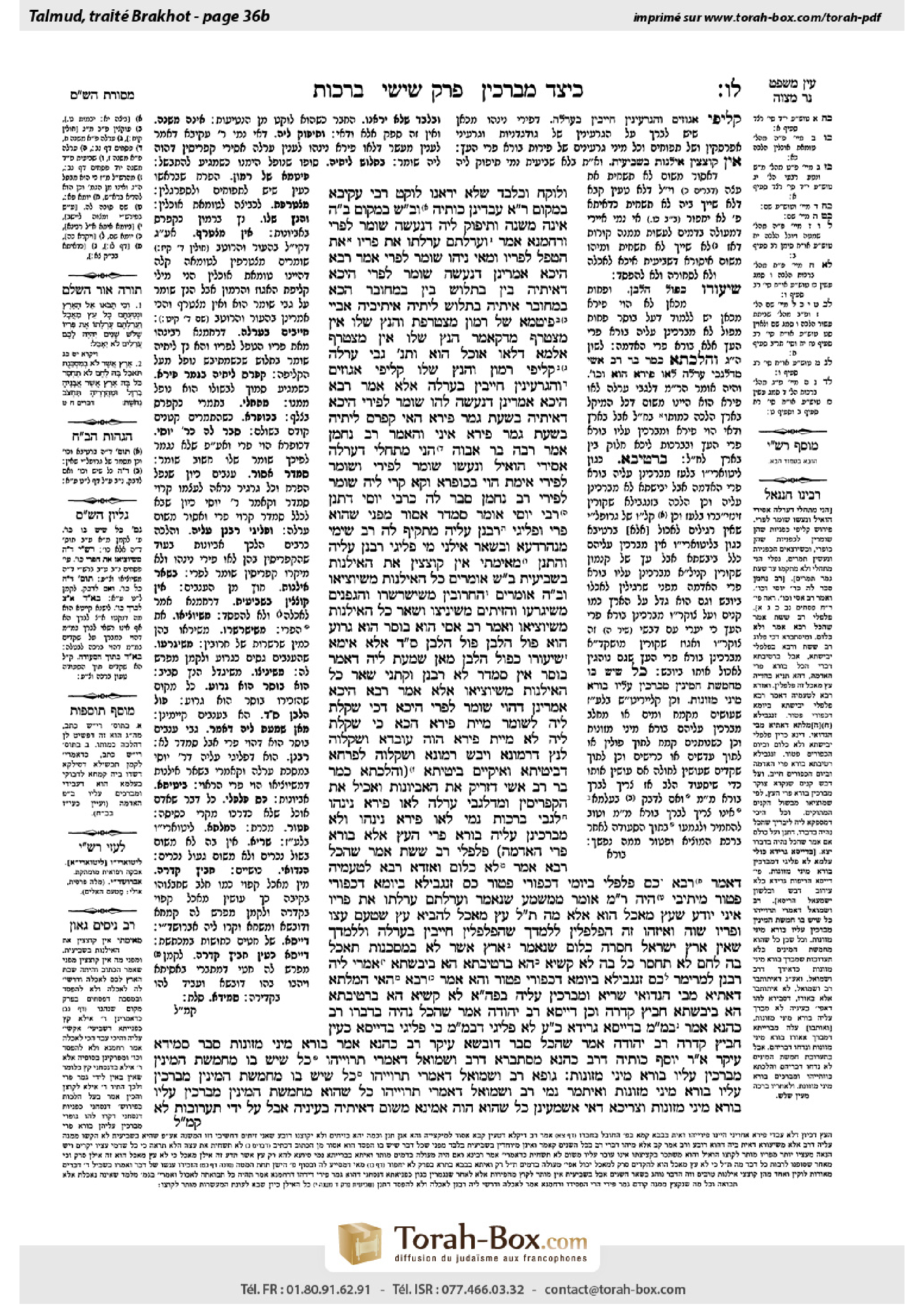
Berakhot 36b: Talmud study for Daf Yomi
Study the Talmud for Daf Yomi with scanned pages, Hebrew text, English translations from Sefaria and AI-generated French translations.
Passage selection and English or AI-generated French translation are available where the scan has annotations. Daf Study is independent of Torah-Box and Sefaria.
Browse Berakhot · ברכות · All tractatesBerakhot 36b text and translations
This page of Berakhot includes the Aramaic text, an English translation and an AI-generated French translation, alongside the scan above.
ברכות ל״ו ב · Aramaic and Hebrew text
וְלוֹקֵחַ — וּבִלְבַד שֶׁלֹּא יִרְאֶנּוּ לוֹקֵט.
רַבִּי עֲקִיבָא בִּמְקוֹם רַבִּי אֱלִיעֶזֶר עָבְדִינַן כְּוָתֵיהּ, וּבֵית שַׁמַּאי בִּמְקוֹם בֵּית הִלֵּל — אֵינָהּ מִשְׁנָה.
וְתִיפּוֹק לֵיהּ דְּנַעֲשָׂה שׁוֹמֵר לַפְּרִי, וְרַחֲמָנָא אָמַר: ״וַעֲרַלְתֶּם עׇרְלָתוֹ אֶת פִּרְיוֹ״, אֶת הַטָּפֵל לְפִרְיוֹ, וּמַאי נִיהוּ — שׁוֹמֵר לַפְּרִי.
אָמַר רָבָא: הֵיכָא אָמְרִינַן דְּנַעֲשָׂה שׁוֹמֵר לַפְּרִי — הֵיכָא דְּאִיתֵיהּ בֵּין בְּתָלוּשׁ בֵּין בִּמְחוּבָּר, הָכָא בִּמְחוּבָּר — אִיתֵיהּ, בְּתָלוּשׁ — לֵיתֵיהּ.
אֵיתִיבֵיהּ אַבָּיֵי: פִּיטְמָא שֶׁל רִמּוֹן מִצְטָרֶפֶת, וְהַנֵּץ שֶׁלּוֹ אֵין מִצְטָרֵף. מִדְּקָאָמַר הַנֵּץ שֶׁלּוֹ אֵין מִצְטָרֵף, אַלְמָא דְּלָאו אוֹכֶל הוּא. וּתְנַן גַּבֵּי עׇרְלָה: קְלִיפֵּי רִמּוֹן וְהַנֵּץ שֶׁלּוֹ, קְלִיפֵּי אֱגוֹזִים וְהַגַּרְעִינִין חַיָּיבִין בְּעׇרְלָה.
אֶלָּא אָמַר רָבָא: הֵיכָא אָמְרִינַן דְּנַעֲשָׂה לְהוּ שׁוֹמֵר לְפֵירֵי — הֵיכָא דְּאִיתֵיהּ בִּשְׁעַת גְּמַר פֵּירָא, הַאי קַפְרֵס לֵיתֵיהּ בִּשְׁעַת גְּמַר פֵּירָא.
אִינִי?! וְהָאָמַר רַב נַחְמָן אָמַר רַבָּה בַּר אֲבוּהּ: הָנֵי מְתַחֲלֵי דְעׇרְלָה אֲסִירִי, הוֹאִיל וְנַעֲשׂוּ שׁוֹמֵר לְפֵירֵי. וְשׁוֹמֵר לְפֵירֵי אִימַּת הָוֵי — בְּכוּפְרָא, וְקָא קָרֵי לֵיהּ ״שׁוֹמֵר לְפֵירֵי״.
רַב נַחְמָן סָבַר לַהּ כְּרַבִּי יוֹסֵי, דִּתְנַן רַבִּי יוֹסֵי אוֹמֵר: סְמָדַר אָסוּר מִפְּנֵי שֶׁהוּא פֶּרִי. וּפְלִיגִי רַבָּנַן עֲלֵיהּ.
מַתְקִיף לַהּ רַב שִׁימִי מִנְּהַרְדְּעָא: וּבִשְׁאָר אִילָנֵי מִי פְּלִיגִי רַבָּנַן עֲלֵיהּ? וְהָתְנַן: מֵאֵימָתַי אֵין קוֹצְצִין אֶת הָאִילָנוֹת בַּשְּׁבִיעִית — בֵּית שַׁמַּאי אוֹמְרִים: כׇּל הָאִילָנוֹת מִשֶּׁיּוֹצִיאוּ, וּבֵית הִלֵּל אוֹמְרִים: הֶחָרוּבִין מִשֶּׁיְּשַׁרְשְׁרוּ, וְהַגְּפָנִים מִשֶּׁיְּגָרְעוּ, וְהַזֵּיתִים מִשֶּׁיָּנֵיצוּ, וּשְׁאָר כׇּל הָאִילָנוֹת מִשֶּׁיּוֹצִיאוּ.
וְאָמַר רַב אַסִּי: הוּא בּוֹסֶר, הוּא גֵּרוּעַ, הוּא פּוֹל הַלָּבָן. פּוֹל הַלָּבָן סָלְקָא דַעְתָּךְ?! אֶלָּא אֵימָא: שִׁיעוּרוֹ כְּפוֹל הַלָּבָן. מַאן שָׁמְעַתְּ לֵיהּ דְּאָמַר בּוֹסֶר אִין, סְמָדַר לָא — רַבָּנַן, וְקָתָנֵי שְׁאָר כׇּל הָאִילָנוֹת — מִשֶּׁיּוֹצִיאוּ?
אֶלָּא אָמַר רָבָא: הֵיכָא אָמְרִינַן דְּהָוֵי שׁוֹמֵר לְפֵרֵי — הֵיכָא דְּכִי שָׁקְלַתְּ לֵיהּ לְשׁוֹמֵר מָיֵית פֵּירָא. הָכָא כִּי שָׁקְלַתְּ לֵיהּ — לָא מָיֵית פֵּירָא.
הֲוָה עוֹבָדָא וְשַׁקְלוּהּ לְנֵץ דְּרִמּוֹנָא, וִיבַשׁ רִמּוֹנָא, וְשַׁקְלוּהּ לְפִרְחָא דְבִיטִיתָא — וְאִיקַּיַּים בִּיטִיתָא.
(וְהִלְכְתָא כְּמָר בַּר רַב אָשֵׁי דְּזָרֵיק אֶת הָאֲבִיּוֹנוֹת וְאָכֵיל אֶת הַקַּפְרֵיסִין. וּמִדִּלְגַבֵּי עׇרְלָה לָאו פֵּירָא נִינְהוּ, לְגַבֵּי בְּרָכוֹת נָמֵי לָאו פֵּירָא נִינְהוּ, וְלָא מְבָרְכִינַן עֲלֵיהּ ״בּוֹרֵא פְּרִי הָעֵץ״, אֶלָּא ״בּוֹרֵא פְּרִי הָאֲדָמָה״.)
פִּלְפְּלֵי, רַב שֵׁשֶׁת אָמַר: ״שֶׁהַכֹּל״, רָבָא אָמַר: לָא כְלוּם. וְאָזְדָא רָבָא לְטַעְמֵיהּ, דְּאָמַר רָבָא: כַּס פִּלְפְּלֵי בְּיוֹמָא דְכִפּוּרֵי — פָּטוּר, כַּס זַנְגְּבִילָא בְּיוֹמָא דְכִפּוּרֵי — פָּטוּר.
מֵיתִיבִי, הָיָה רַבִּי מֵאִיר אוֹמֵר: מִמַּשְׁמַע שֶׁנֶּאֱמַר ״וַעֲרַלְתֶּם עׇרְלָתוֹ אֶת פִּרְיוֹ״ אֵינִי יוֹדֵעַ שֶׁעֵץ מַאֲכָל הוּא? אֶלָּא מָה תַּלְמוּד לוֹמַר ״עֵץ מַאֲכָל״ — לְהָבִיא עֵץ שֶׁטַּעַם עֵצוֹ וּפִרְיוֹ שָׁוֶה, וְאֵיזֶהוּ? — זֶה הַפִּלְפְּלִין. לְלַמֶּדְךָ שֶׁהַפִּלְפְּלִין חַיָּיבִין בְּעׇרְלָה, וּלְלַמֶּדְךָ שֶׁאֵין אֶרֶץ יִשְׂרָאֵל חֲסֵרָה כְּלוּם, שֶׁנֶּאֱמַר: ״אֶרֶץ אֲשֶׁר לֹא בְמִסְכֵּנֻת תֹּאכַל בָּהּ לֶחֶם לֹא תֶחְסַר כֹּל בָּהּ״.
לָא קַשְׁיָא: הָא בְּרַטִּיבְתָּא, הָא בְּיַבִּשְׁתָּא.
אָמְרִי לֵיהּ רַבָּנַן לְמָרִימָר: כַּס זַנְגְּבִילָא בְּיוֹמָא דְכִפּוּרֵי פָּטוּר? וְהָא אָמַר רָבָא: הַאי הִמְלְתָא דְּאָתְיָא מִבֵּי הִנְדּוּאֵי — שַׁרְיָא, וּמְבָרְכִינַן עֲלַהּ ״בּוֹרֵא פְּרִי הָאֲדָמָה״. לָא קַשְׁיָא: הָא בְּרַטִּיבְתָּא, הָא בְּיַבִּשְׁתָּא.
חֲבִיץ קְדֵרָה וְכֵן דַּיְיסָא, רַב יְהוּדָה אָמַר: ״שֶׁהַכֹּל נִהְיֶה בִּדְבָרוֹ״. רַב כָּהֲנָא אָמַר: ״בּוֹרֵא מִינֵי מְזוֹנוֹת״. בְּדַיְיסָא גְּרֵידָא כּוּלֵּי עָלְמָא לָא פְּלִיגִי דְּ״בוֹרֵא מִינֵי מְזוֹנוֹת״. כִּי פְּלִיגִי בְּדַיְיסָא כְּעֵין חֲבִיץ קְדֵרָה, רַב יְהוּדָה אָמַר ״שֶׁהַכֹּל״, סָבַר דּוּבְשָׁא עִיקָּר. רַב כָּהֲנָא אָמַר ״בּוֹרֵא מִינֵי מְזוֹנוֹת״, סָבַר סְמִידָא עִיקָּר. אָמַר רַב יוֹסֵף: כְּוָתֵיהּ דְּרַב כָּהֲנָא מִסְתַּבְּרָא, דְּרַב וּשְׁמוּאֵל דְּאָמְרִי תַּרְוַיְיהוּ: כֹּל שֶׁיֵּשׁ בּוֹ מֵחֲמֵשֶׁת הַמִּינִין מְבָרְכִין עָלָיו ״בּוֹרֵא מִינֵי מְזוֹנוֹת״.
גּוּפָא: רַב וּשְׁמוּאֵל דְּאָמְרִי תַּרְוַיְיהוּ כֹּל שֶׁיֵּשׁ בּוֹ מֵחֲמֵשֶׁת הַמִּינִין מְבָרְכִין עָלָיו ״בּוֹרֵא מִינֵי מְזוֹנוֹת״. וְאִיתְּמַר נָמֵי, רַב וּשְׁמוּאֵל דְּאָמְרִי תַּרְוַיְיהוּ: כֹּל שֶׁהוּא מֵחֲמֵשֶׁת הַמִּינִין מְבָרְכִין עָלָיו בּוֹרֵא מִינֵי מְזוֹנוֹת.
וּצְרִיכָא, דְּאִי אַשְׁמְעִינַן ״כֹּל שֶׁהוּא״ הֲוָה אָמֵינָא מִשּׁוּם דְּאִיתֵיהּ בְּעֵינֵיהּ, אֲבָל עַל יְדֵי תַּעֲרוֹבוֹת — לָא.
Berakhot 36b · English translation
and take from the orla fruit, and as long as the Jew does not see him gather it, he may purchase the fruit from the gentile. If so, then outside of Eretz Yisrael, one may act in accordance with the opinion of Beit Shammai who hold that the caper-bush has the status of uncertain orla, and eat even the berries without apprehension.
The Gemara answers: The general rule that outside of Eretz Yisrael one acts in accordance with the lenient opinion in a dispute within Eretz Yisrael applies when Rabbi Akiva expresses a more lenient opinion in place of Rabbi Eliezer, and we act in accordance with his opinion. And however, when Beit Shammai express an opinion where Beit Hillel disagree, their opinion is considered as if it were not in the mishna, and is completely disregarded.
The Gemara approaches this matter from a different perspective: Let us derive the halakha that buds are included in the prohibition of orla from the fact that the bud serves as protection for the fruit, and the Torah says: “When you enter the land and plant any tree for food you shall regard its fruit [et piryo] as orla” (Leviticus 19:23), and et piryo is interpreted to mean that which is secondary to the fruit. What is that? That section of the plant which is protection for the fruit. The buds should be prohibited as orla, since they protect the fruit.
Rava said: Where do we say that a section of the plant becomes protection for the fruit? That is specifically when it exists both when the fruit is detached from the tree and when it is still connected to the tree. However, here, it exists when the fruit is connected to the tree, but when it is detached it does not, and since the protection falls off of the fruit when it is picked, it is no longer considered protection.
Abaye raised a challenge based on what we learned with regard to the halakhot of ritual impurity: The crown of a pomegranate joins together with the pomegranate as a unified entity with regard to calculating the requisite size in order to become ritually impure. And its flower, however, does not join together with the pomegranate in that calculation. From the fact that it says that the pomegranate’s flower does not join, consequently the flower is secondary to the fruit and is not considered food. And we learned in a mishna regarding the laws of orla: The rinds of a pomegranate and its flower, nutshells, and pits of all kinds, are all obligated in the prohibition of orla. This indicates that the criteria dictating what is considered protection of a fruit and what is considered the fruit itself with regard to ritual impurity, are not the same criteria used with regard to orla, as is illustrated by the case of the pomegranate flower. Therefore, even if the buds are not regarded as protecting the fruit with regard to ritual impurity, they may still be considered fruit with regard to orla.
Rather, Rava said another explanation: Where do we say that a section of the plant becomes protection for the fruit? Where it exists when the fruit is ripe. This bud does not exist when the fruit is ripe, because it falls off beforehand.
The Gemara challenges this explanation as well: Is that so? Didn’t Rav Naḥman say that Rabba bar Avuh said: Those orla date coverings are prohibited, because they became protection for the fruit. And when do these coverings serve as protection for the fruit? When the fruit is still young; and he, nevertheless, calls them protection for the fruit. This indicates that in order to be considered protection for the fruit it need not remain until the fruit is fully ripened. The question remains: Why are the buds not accorded the same status as the berries of the caper-bush?
The Gemara explains that Rav Naḥman held in accordance with the opinion of Rabbi Yosei, as we learned in a mishna that Rabbi Yosei says: The grape-bud, i.e., a cluster of grapes in its earliest stage, immediately after the flowers dropped from the vine, is prohibited due to orla, because it is already considered a fruit. According to this opinion, even the date coverings that exist in the earliest stage of the ripening process are nevertheless considered protection for the fruit and prohibited due to orla. The Rabbis disagree with him, explaining that fruit at that stage is not considered fruit; and, therefore, the date coverings and caper-bush buds are not considered protection for the fruit and are not prohibited due to orla.
Rav Shimi of Neharde’a strongly objects to this halakha: Do the Rabbis disagree with the opinion of Rabbi Yosei with regard to the fruits of all other trees besides grapes, that even in the very first stage of ripening, they are considered fruit? Didn’t we learn in a mishna: With regard to fruit, which grows during the Sabbatical year, the Torah says: “And the Shabbat of the land shall be to you for eating” (Leviticus 25:6). The Sages inferred, for eating, and not for loss. Because one is prohibited from discarding fruit grown during the Sabbatical year, the question is raised: From when may one no longer cut trees during the Sabbatical year as he thereby damages the fruit? Beit Shammai say: All trees, from when the blossoms fall off and fruit begins to emerge in its earliest stage. And Beit Hillel say: There is a distinction between different types of trees. Carob trees may not be cut from when they form chains of carobs, vines may not be cut misheyegaru, explained below, olives from when they blossom, and all other trees from when fruit emerges.
And Rav Asi said: Sheyegaru in our mishna is to be understood: It is an unripe grape, it is a grape kernel, it is a white bean. Before this is even explained, the Gemara expresses its astonishment: Does it enter your mind that the grape is, at any stage, a white bean? Rather, say: Its size, that of an unripe grape, is equivalent to the size of a white bean. In any case, whom did you hear that said: An unripe grape, yes, is considered fruit, while a grape-bud, no, is not considered fruit? Wasn’t it the Rabbis who disagree with Rabbi Yosei, and it is taught that, according to these Sages, one is forbidden to cut all other trees from when fruit emerges. This indicates that even they agree that from the very beginning of the ripening process, the fruit is forbidden due to orla. The question remains: Why are the buds permitted?
Rather, Rava said a different explanation: Where do we say that a section of the plant becomes protection for the fruit? Where if you remove the protection, the fruit dies. Here, in the case of the caper-bush, when you remove the bud, the fruit does not die.
In fact, there was an incident and they removed the flower of a pomegranate, and the pomegranate withered. And they removed the flower of the fruit of a caper-bush and the fruit of the caper-bush survived. Therefore, buds are not considered protection for the fruit.
The Gemara concludes: The halakha is in accordance with the opinion of Mar bar Rav Ashi, who discarded the berries and ate the buds. And since they are not considered fruit with regard to orla, they are also not considered fruit with regard to blessings, and one does not recite over them: Who creates fruit of the tree, but rather: Who creates fruit of the ground.
The question arose with regard to the blessing over peppers. Rav Sheshet said: One who eats peppers must recite: By Whose word all things came to be. Rava said: One need not recite a blessing at all. This is consistent with Rava’s opinion that eating peppers is not considered eating, as Rava said: One who chews on peppers on Yom Kippur is exempt, one who chews on ginger on Yom Kippur is exempt. Eating sharp spices is an uncommon practice, and is therefore not considered to be eating, which is prohibited by Torah law on Yom Kippur.
The Gemara raised an objection to this based on what was taught in a baraita, that regarding the verse: “When you enter the land and plant any tree for food you shall regard its fruit as orla” (Leviticus 19:23), Rabbi Meir would say: By inference from that which is stated: “You shall regard its fruit as orla,” don’t I know that it is referring to a tree that produces food? Rather, for what purpose does the verse state: “Any tree for food”? To include a tree whose wood and fruit have the same taste. And which tree is this? This is the pepper tree. And this comes to teach you that the peppers, and even the wood portions, are edible and are therefore obligated in the prohibition of orla, and to teach that Eretz Yisrael lacks nothing, as it is stated: “A land where you shall eat bread without scarceness, you shall lack nothing” (Deuteronomy 8:9). Obviously, peppers are fit for consumption.
The Gemara responds: This is not difficult, as there is a distinction between two different cases. This, where Rabbi Meir spoke of peppers fit for consumption, is referring to a case when it is damp and fresh; and this, where chewing on pepper is not considered eating on Yom Kippur and does not require a blessing, is referring to a case when it is dry.
With regard to this discussion of chewing pepper on Yom Kippur, the Gemara cites what the Sages said to Mareimar: Why is one who chews ginger on Yom Kippur exempt? Didn’t Rava say: One is permitted to eat the ginger that comes from India, and over it, one recites: Who creates fruit of the ground. With regard to blessing, it is considered edible; therefore, with regard to chewing on Yom Kippur, it should be considered edible as well. The Gemara responds: This is not difficult. This, where a blessing is recited, is referring to a case when it is damp and fresh; this, where no blessing is recited, is referring to a case when it is dry.
The Gemara cites a similar dispute with regard to the blessing be recited over ḥavitz, a dish consisting of flour, oil, and honey cooked in a pot as well as pounded grain. Rav Yehuda said that one recites: By Whose word all things came to be. Rav Kahana said that one recites: Who creates the various kinds of nourishment. The Gemara explains: With regard to pounded grain alone, everyone agrees that one recites: Who creates the various kinds of nourishment. When they argue, it is with regard to pounded grain mixed with honey, in the manner of a ḥavitz cooked in a pot. Rav Yehuda said that one recites: By Whose word all things came to be, as he held that the honey is primary, and on honey one recites: By Whose word all things came to be. Rav Kahana said that one recites: Who creates the various kinds of nourishment, as he held that the flour, as is the case with all products produced from grain, is primary, and therefore one recites: Who creates the various kinds of nourishment. Rav Yosef said: It is reasonable to say in accordance with the opinion of Rav Kahana, as Rav and Shmuel both said: Anything that has of the five species of grain in it, one recites over it: Who creates the various kinds of nourishment, even if it is mixed with other ingredients.
With regard to the halakha of the blessing recited over the five species of grain, the Gemara clarifies the matter itself. Rav and Shmuel both said: Anything that has of the five species of grain in it, one recites over it: Who creates the various kinds of nourishment. Elsewhere, it was stated that Rav and Shmuel both said: Anything that is from the five species of grain, one recites over it: Who creates the various kinds of nourishment. This is problematic, as these statements appear redundant.
The Gemara explains: Both statements are necessary, as had he taught us only: Anything that is from the five species of grain, one recites over it: Who creates the various kinds of nourishment, I would have said that is because the grain is in its pure, unadulterated form, but if one eats it in the context of a mixture, no, one does not recite: Who creates the various kinds of nourishment.
Berakhot 36b · Traduction française (IA)
et prendre les fruits de la vigne, et tant que le Juif ne voit pas l'homme les récolter, il peut acheter les fruits auprès du non-Juif. Si c'est ainsi, alors en dehors de la Terre d'Israël, on peut agir selon l'opinion de Beit Shammai, qui considère la plante de la corneille comme étant de statut incertain en matière d'orla, et manger même les baies sans crainte.
La Guemara répond : La règle générale selon laquelle en dehors de la Terre d'Israël on agit selon l'opinion la plus clémente dans un désaccord entre les sages d'Israël s'applique lorsque Rabbi Akiva exprime une opinion plus clémente à la place de Rabbi Eliezer, et on agit selon son opinion. Cependant, lorsque Beit Shammai exprime une opinion où Beit Hillel s'oppose, leur opinion est considérée comme si elle n'était pas dans la mitsna, et est entièrement ignorée.
La Guemara aborde cette question sous un autre angle : Examinons la halakha selon laquelle les bourgeons sont inclus dans l'interdiction d'orla à partir du fait que le bourgeon sert de protection au fruit, et la Torah dit : « Quand vous entrerez dans la terre et planterez toute espèce d'arbre pour la nourriture, vous regarderez son fruit [et piryo] comme orla » (Lévitique 19:23), et « et piryo » est interprété pour signifier ce qui est secondaire par rapport au fruit. Qu'est-ce que cela ? Celle partie de la plante qui sert de protection au fruit. Les bourgeons devraient être interdits comme orla, car ils protègent le fruit.
Rava dit : Où trouvons-nous que une partie de la plante devient protection pour le fruit ? C'est spécifiquement lorsque cette partie existe à la fois lorsque le fruit est détaché de l'arbre et lorsque l'arbre est encore connecté. Cependant, ici, cette partie existe lorsque le fruit est connecté à l'arbre, mais lorsque le fruit est détaché, elle n'existe pas, et puisque la protection tombe lorsque le fruit est récolté, elle n'est plus considérée comme protection.
Abaye a soulevé un défi basé sur ce que nous avons appris concernant les lois de l'impureté rituelle : La couronne d'une pomele est unifiée avec la pomele en tant qu'entité unique pour calculer la taille nécessaire afin d'être impur. Cependant, sa fleur ne s'unifie pas avec la pomele dans ce calcul. Du fait qu'il est dit que la fleur de la pomele ne s'unifie pas, cela signifie que la fleur est secondaire par rapport au fruit et n'est pas considérée comme nourriture. Et nous avons appris dans une mitsva concernant les lois d'orla : Les peaux de pomele, sa fleur, les coques de noix, et les noyaux de toutes sortes sont tous soumis à l'interdiction d'orla. Cela indique que les critères déterminant ce qui est considéré comme protection d'un fruit et ce qui est considéré comme le fruit lui-même en matière d'impureté rituelle ne sont pas les mêmes que ceux utilisés en matière d'orla, comme le montre le cas de la fleur de pomele. Ainsi, même si les bourgeons ne sont pas considérés comme protégeant le fruit en matière d'impureté rituelle, ils peuvent être considérés comme des fruits en matière d'orla.
Plutôt, Rava a dit une autre explication : Où trouvons-nous que une partie de la plante devient protection pour le fruit ? Lorsqu'elle existe lorsque le fruit est mûr. Ce bourgeon n'existe pas lorsque le fruit est mûr, car il tombe avant.
La Guemara conteste cette explication également : Est-ce ainsi ? N’a-t-il pas dit Rav Naḥman que Rabba bar Avuh a dit : Les enveloppes des figues d’orla sont interdites, car elles deviennent protection pour le fruit. Et lorsqu’elles servent de protection pour le fruit ? Lorsque le fruit est encore jeune ; et pourtant, il les appelle protection pour le fruit. Cela montre que pour être considérées comme protection pour le fruit, elles n’ont pas besoin de rester jusqu’au moment où le fruit est pleinement mûr. La question reste : pourquoi les bourgeons ne sont-ils pas accordés le même statut que les baies de la corneille ?
La Guemara explique que Rav Naḥman tenait compte de l’opinion de Rabbi Yosei, comme nous l’avons appris dans une mitsna que Rabbi Yosei dit : Le bourgeon de raisin, c’est-à-dire un amas de raisins à leur plus jeune stade, immédiatement après que les fleurs aient tombé de la vigne, est interdit en raison d’orla, car il est déjà considéré comme un fruit. Selon cette opinion, même les enveloppes des figues existant à l’étape la plus tôt du processus de maturité sont néanmoins considérées comme protection pour le fruit et interdites en raison d’orla. Les Sages s’opposent à lui, expliquant que les fruits à cette étape ne sont pas considérés comme des fruits ; et par conséquent, les enveloppes des figues et les bourgeons de corneille ne sont pas considérés comme protection pour le fruit et ne sont pas interdits en raison d’orla.
Rav Shimi de Neharde’a s'oppose fermement à cette halakha : Les Rabbins s'opposent-ils à l'opinion de Rabbi Yosei concernant les fruits de tous les arbres autres que le raisin, que même à la première étape de maturité, ils sont considérés comme des fruits ? N'avons-nous pas appris dans une Michna : Concernant les fruits qui croissent pendant l'année sabbatique, la Torah dit : « Et le sabbat de la terre sera pour vous pour manger » (Lévitique 25:6). Les Sages ont inféré, pour manger, et non pour la perte. Parce qu'on est interdit de jeter les fruits qui croissent pendant l'année sabbatique, la question se pose : À partir de quand peut-on plus couper les arbres pendant l'année sabbatique, car cela endommage les fruits ? Beit Shammai disent : Tous les arbres, à partir du moment où les fleurs tombent et les fruits commencent à apparaître à leur plus jeune stade. Et Beit Hillel disent : Il y a une distinction entre les différents types d'arbres. Les caroubes ne peuvent pas être coupés à partir du moment où ils forment des chaînes de caroubes, les vignes ne peuvent pas être coupés misheyegaru, expliqué ci-dessous, les oliviers à partir du moment où ils fleurissent, et tous les autres arbres à partir du moment où les fruits apparaissent.
Et Rav Asi a dit : « Sheyegaru » dans notre mitsna est à comprendre ainsi : c'est un raisin vert, c'est un noyau de raisin, c'est un haricot blanc. Avant même que cela ne soit expliqué, la Guemara exprime son étonnement : Est-ce que cela entre dans votre esprit que le raisin, à tout moment, soit un haricot blanc ? Plutôt, disons : sa taille, celle d'un raisin vert, est équivalente à la taille d'un haricot blanc. En tout cas, à qui as-tu entendu dire que le raisin vert, oui, est considéré comme fruit, tandis que la bourgeon de raisin, non, n'est pas considéré comme fruit ? N'était-ce pas les Sages qui s'opposaient à Rabbi Yosei, et il est enseigné que, selon ces Sages, on est interdit de couper tous les autres arbres à partir de l'émergence des fruits. Cela indique qu'ils s'accordent même sur le fait que dès le début du processus de maturité, le fruit est interdit en raison d'orla. La question reste : pourquoi les bourgeons sont-ils permis ?
Plutôt, Rava a dit une autre explication : Où disons-nous qu'une partie de la plante devient une protection pour le fruit ? Où si vous enlevez la protection, le fruit meurt. Ici, dans le cas du buis, quand vous enlevez le bourgeon, le fruit ne meurt pas.
En effet, il y avait un incident où ils ont enlevé la fleur d'un pamplemousse, et le pamplemousse a dépéri. Et ils ont enlevé la fleur du fruit du buis, et le fruit du buis a survécu. Ainsi, les bourgeons ne sont pas considérés comme une protection pour le fruit.
La Guemara conclut : la halakha suit l'opinion de Mar bar Rav Ashi, qui a rejeté les baies et a mangé les bourgeons. Et puisque ce n'est pas considéré comme un fruit en ce qui concerne l'orla, ils ne sont pas non plus considérés comme des fruits en ce qui concerne les bénédictions, et on ne récite pas sur eux : Celui qui crée les fruits des arbres, mais plutôt : Celui qui crée les fruits du sol.
Une question s'est levée concernant la bénédiction sur les piments. Rav Sheshet a dit : celui qui mange des piments doit réciter : Par la Parole dont toutes choses sont venues à l'être. Rava a dit : on n'a pas besoin de réciter une bénédiction du tout. Cela est cohérent avec l'opinion de Rava selon laquelle manger des piments n'est pas considéré comme manger, car Rava a dit : celui qui mâche des piments le jour de la Journee de l'Expiation est exempt, celui qui mâche du gingembre le jour de la Journee de l'Expiation est exempt. Manger des épices piquantes est une pratique inhabituelle, et est donc considérée comme ne pas être manger, ce qui est interdit par la Loi divine le jour de la Journee de l'Expiation.
La Guemara a soulevé un objet à cela en se basant sur ce qui a été enseigné dans une baraïta, à savoir concernant la versette : « Quand vous entrerez dans la terre et planterez tout arbre pour nourriture, vous regarderez ses fruits comme orla » (Lévitique 19:23), Rabbi Meir disait : par déduction de ce qui est dit : « Vous regarderez ses fruits comme orla », ne sais-je pas que cela fait référence à un arbre qui produit de la nourriture ? Plutôt, à quel but le verset dit : « Tout arbre pour nourriture » ? Pour inclure un arbre dont le bois et le fruit ont le même goût. Et quel arbre est-ce ? C'est l'arbre des piments. Et cela vient enseigner que les piments, et même les parties de bois, sont comestibles et sont donc soumis à l'interdiction d'orla, et enseigner que la Terre d'Israël n'a rien manqué, comme il est dit : « Une terre où vous mangerez du pain sans rareté, vous manquerez de rien » (Deutéronome 8:9). Évidemment, les piments sont adaptés à la consommation.
La Guemara répond : cela n'est pas difficile, car il y a une distinction entre deux cas différents. Celui-ci, où Rabbi Meir parlait de piments comestibles, fait référence à un cas où il est humide et frais ; et celui-ci, où mâcher des piments n'est pas considéré comme manger le jour de l'Expiation et ne nécessite pas une bénédiction, fait référence à un cas où il est sec.
Concernant cette discussion sur la mâchon de piments le jour de l'Expiation, la Guemara cite ce que les Sages dirent à Mareimar : pourquoi celui qui mâche du gingembre le jour de l'Expiation est exempt ? N'avait pas Rava dit : on est autorisé à manger le gingembre qui vient d'Inde, et sur lui, on récite : Celui qui crée les fruits du sol. Concernant la bénédiction, il est considéré comme comestible ; donc, concernant la mâchon le jour de l'Expiation, il devrait être considéré comme comestible également. La Guemara répond : cela n'est pas difficile. Celui-ci, où une bénédiction est récitée, fait référence à un cas où il est humide et frais ; celui-ci, où aucune bénédiction n'est récitée, fait référence à un cas où il est sec.
La Guemara cite un débat similaire concernant la bénédiction à réciter sur le ḥavitz, un plat composé de farine, d'huile et de miel cuits dans une marmite ainsi que de grains broyés. Rav Yehuda disait que l'on récite : Par la Parole dont toutes choses sont venues à l'être. Rav Kahana disait que l'on récite : Celui qui crée les diverses sortes de nourriture. La Guemara explique : concernant le grain broyé seul, tout le monde s'accorde à dire que l'on récite : Celui qui crée les diverses sortes de nourriture. Lorsqu'ils débattent, c'est concernant le grain broyé mélangé au miel, dans la manière d'un ḥavitz cuit dans une marmite. Rav Yehuda disait que l'on récite : Par la Parole dont toutes choses sont venues à l'être, car il considérait que le miel est principal, et sur le miel, l'on récite : Par la Parole dont toutes choses sont venues à l'être. Rav Kahana disait que l'on récite : Celui qui crée les diverses sortes de nourriture, car il considérait que la farine, comme c'est le cas pour tous les produits issus du grain, est principale, et donc l'on récite : Celui qui crée les diverses sortes de nourriture. Rav Yosef a dit : il est raisonnable de suivre l'opinion de Rav Kahana, car Rav et Shmuel ont tous deux dit : tout ce qui contient l'une des cinq espèces de grain, l'on récite sur lui : Celui qui crée les diverses sortes de nourriture, même s'il est mélangé avec d'autres ingrédients.
Concernant la halakha de la bénédiction récitée sur les cinq espèces de grain, la Guemara clarifie la question elle-même. Rav et Shmuel ont tous deux dit : tout ce qui contient l'une des cinq espèces de grain, l'on récite sur lui : Celui qui crée les diverses sortes de nourriture. Ailleurs, il a été dit que Rav et Shmuel ont tous deux dit : tout ce qui provient des cinq espèces de grain, l'on récite sur lui : Celui qui crée les diverses sortes de nourriture. Cela est problématique, car ces déclarations semblent redondantes.
La Guemara explique que les deux déclarations sont nécessaires, car s'il nous avait enseigné seulement : Tout ce qui provient des cinq espèces de céréales, on récite sur cela : Qui crée les diverses sortes de nourriture, j'aurais dit que c'est parce que la céréale est dans sa forme pure et non altérée, mais si l'on mange cela dans le contexte d'un mélange, non, on ne récite pas : Qui crée les diverses sortes de nourriture.
Traduction française générée par IA à partir de l’édition anglaise de Sefaria. Vérifie toujours un passage avec le texte source.
Text from Sefaria: William Davidson Edition - Vocalized Aramaic (CC BY NC); William Davidson Edition - English (CC BY NC).