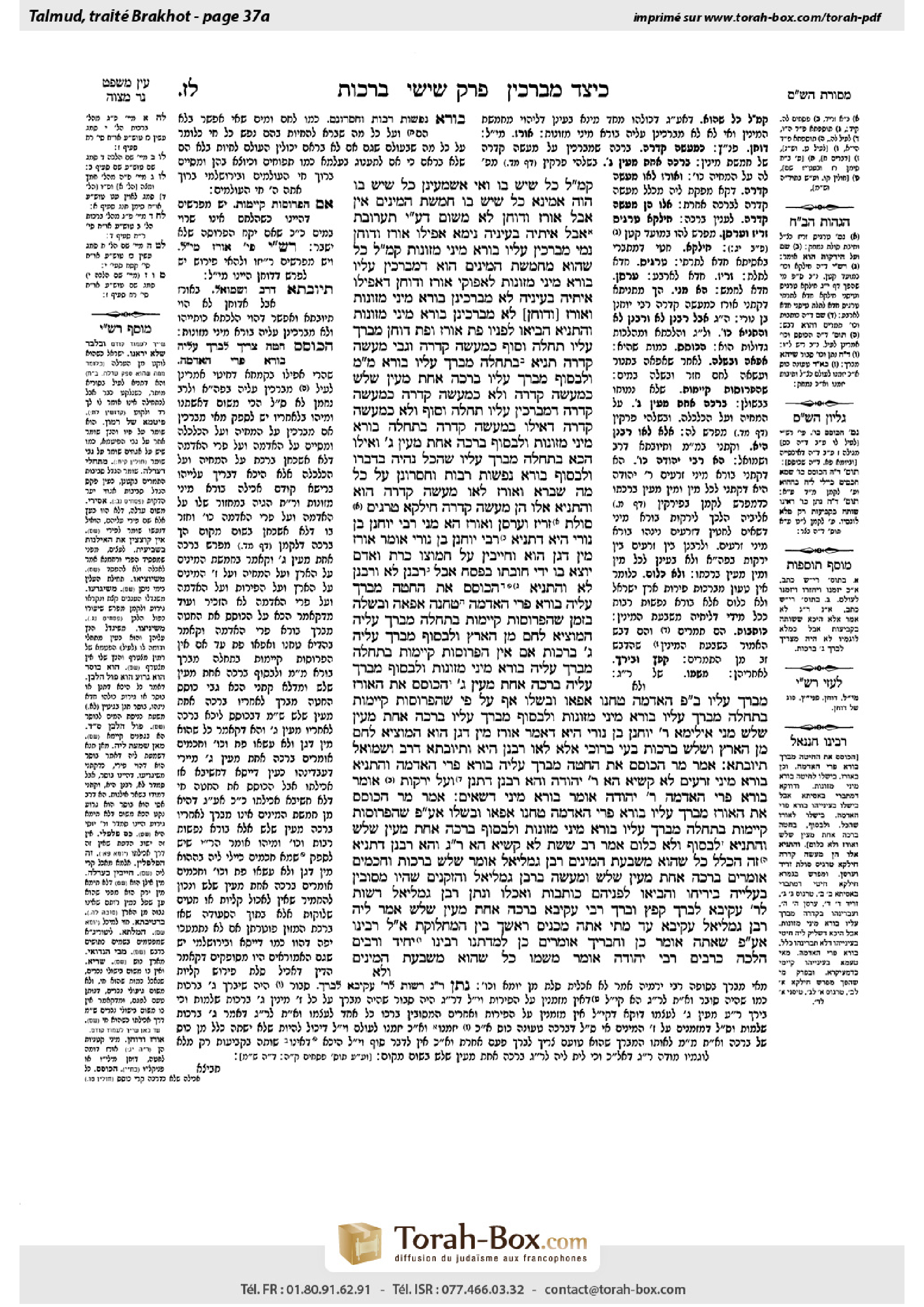
Berakhot 37a: Talmud study for Daf Yomi
Study the Talmud for Daf Yomi with scanned pages, Hebrew text, English translations from Sefaria and AI-generated French translations.
Passage selection and English or AI-generated French translation are available where the scan has annotations. Daf Study is independent of Torah-Box and Sefaria.
Browse Berakhot · ברכות · All tractatesBerakhot 37a text and translations
This page of Berakhot includes the Aramaic text, an English translation and an AI-generated French translation, alongside the scan above.
ברכות ל״ז א · Aramaic and Hebrew text
קָא מַשְׁמַע לַן — ״כֹּל שֶׁיֵּשׁ בּוֹ״. וְאִי אַשְׁמְעִינַן ״כֹּל שֶׁיֵּשׁ בּוֹ״ הָוֵה אָמֵינָא כֹּל שֶׁיֵּשׁ בּוֹ חֲמֵשֶׁת הַמִּינִים — אִין, אֲבָל אוֹרֶז וְדוֹחַן — לָא, מִשּׁוּם דְּעַל יְדֵי תַּעֲרוֹבֶת. אֲבָל אִיתֵיהּ בְּעֵינֵיהּ — נֵימָא אֲפִילּוּ אוֹרֶז וְדוֹחַן נָמֵי מְבָרְכִין עָלָיו ״בּוֹרֵא מִינֵי מְזוֹנוֹת״. קָא מַשְׁמַע לַן — כֹּל שֶׁהוּא מֵחֲמֵשֶׁת הַמִּינִים הוּא דִּמְבָרְכִין עָלָיו בּוֹרֵא מִינֵי מְזוֹנוֹת, לְאַפּוֹקֵי אוֹרֶז וְדוֹחַן, דַּאֲפִילּוּ אִיתֵיהּ בְּעֵינֵיהּ לָא מְבָרְכִינַן ״בּוֹרֵא מִינֵי מְזוֹנוֹת״.
וְאוֹרֶז וְדוֹחַן לָא מְבָרְכִינַן ״בּוֹרֵא מִינֵי מְזוֹנוֹת״? וְהָתַנְיָא: הֵבִיאוּ לְפָנָיו פַּת אוֹרֶז וּפַת דּוֹחַן — מְבָרֵךְ עָלָיו תְּחִלָּה וָסוֹף כְּמַעֲשֵׂה קְדֵרָה. וְגַבֵּי מַעֲשֵׂה קְדֵרָה תַּנְיָא: בַּתְּחִלָּה מְבָרֵךְ עָלָיו ״בּוֹרֵא מִינֵי מְזוֹנוֹת״, וּלְבַסּוֹף מְבָרֵךְ עָלָיו בְּרָכָה אַחַת מֵעֵין שָׁלֹשׁ.
כְּמַעֲשֵׂה קְדֵרָה וְלָא כְּמַעֲשֵׂה קְדֵרָה: כְּמַעֲשֵׂה קְדֵרָה דִּמְבָרְכִין עָלָיו תְּחִלָּה וָסוֹף, וְלָא כְּמַעֲשֵׂה קְדֵרָה דְּאִילּוּ בְּמַעֲשֵׂה קְדֵרָה — בַּתְּחִלָּה ״בּוֹרֵא מִינֵי מְזוֹנוֹת״ וּלְבַסּוֹף בְּרָכָה מֵעֵין שָׁלֹשׁ, וְאִילּוּ הָכָא — בַּתְּחִלָּה מְבָרֵךְ עָלָיו ״שֶׁהַכֹּל נִהְיֶה בִּדְבָרוֹ״, וּלְבַסּוֹף ״בּוֹרֵא נְפָשׁוֹת רַבּוֹת וְחֶסְרוֹנָן עַל כָּל מַה שֶּׁבָּרָאתָ״.
וְאוֹרֶז לָאו מַעֲשֵׂה קְדֵרָה הוּא? וְהָתַנְיָא, אֵלּוּ הֵן מַעֲשֵׂה קְדֵרָה: חִילְקָא, טַרְגִּיס, סוֹלֶת, זָרִיז, וְעַרְסָן, וְאוֹרֶז.
הָא מַנִּי — רַבִּי יוֹחָנָן בֶּן נוּרִי הִיא. דְּתַנְיָא: רַבִּי יוֹחָנָן בֶּן נוּרִי אוֹמֵר: אוֹרֶז מִין דָּגָן הוּא, וְחַיָּיבִין עַל חִמּוּצוֹ כָּרֵת, וְאָדָם יוֹצֵא בּוֹ יְדֵי חוֹבָתוֹ בַּפֶּסַח. אֲבָל רַבָּנַן לָא.
וְרַבָּנַן לָא?! וְהָתַנְיָא: הַכּוֹסֵס אֶת הַחִטָּה מְבָרֵךְ עָלֶיהָ ״בּוֹרֵא פְּרִי הָאֲדָמָה״. טְחָנָהּ אֲפָאָהּ וּבִשְּׁלָהּ, בִּזְמַן שֶׁהַפְּרוּסוֹת קַיָּימוֹת — בַּתְּחִלָּה מְבָרֵךְ עָלֶיהָ ״הַמּוֹצִיא לֶחֶם מִן הָאָרֶץ״, וּלְבַסּוֹף מְבָרֵךְ עָלֶיהָ שָׁלֹשׁ בְּרָכוֹת. אִם אֵין הַפְּרוּסוֹת קַיָּימוֹת — בַּתְּחִלָּה מְבָרֵךְ עָלֶיהָ ״בּוֹרֵא מִינֵי מְזוֹנוֹת״, וּלְבַסּוֹף מְבָרֵךְ עָלֶיהָ בְּרָכָה אַחַת מֵעֵין שָׁלֹשׁ.
הַכּוֹסֵס אֶת הָאוֹרֶז מְבָרֵךְ עָלָיו ״בּוֹרֵא פְּרִי הָאֲדָמָה״. טְחָנוֹ אֲפָאוֹ וּבִשְּׁלוֹ, אַף עַל פִּי שֶׁהַפְּרוּסוֹת קַיָּימוֹת, בַּתְּחִלָּה מְבָרֵךְ עָלָיו ״בּוֹרֵא מִינֵי מְזוֹנוֹת״, וּלְבַסּוֹף מְבָרֵךְ עָלָיו בְּרָכָה אַחַת מֵעֵין שָׁלֹשׁ.
מַנִּי, אִילֵּימָא רַבִּי יוֹחָנָן בֶּן נוּרִי הִיא דְּאָמַר אוֹרֶז מִין דָּגָן הוּא, ״הַמּוֹצִיא לֶחֶם מִן הָאָרֶץ״ וְשָׁלֹשׁ בְּרָכוֹת בָּעֵי בָּרוֹכֵי!
אֶלָּא לָאו, רַבָּנַן הִיא, וּתְיוּבְתָּא דְּרַב וּשְׁמוּאֵל!
תְּיוּבְתָּא.
אָמַר מָר: הַכּוֹסֵס אֶת הַחִטָּה מְבָרֵךְ עָלֶיהָ ״בּוֹרֵא פְּרִי הָאֲדָמָה״. וְהָתַנְיָא ״בּוֹרֵא מִינֵי זְרָעִים״! לָא קַשְׁיָא: הָא רַבִּי יְהוּדָה, וְהָא רַבָּנַן. דִּתְנַן: וְעַל יְרָקוֹת אוֹמֵר ״בּוֹרֵא פְּרִי הָאֲדָמָה״, רַבִּי יְהוּדָה אוֹמֵר: ״בּוֹרֵא מִינֵי דְשָׁאִים״.
אָמַר מָר, הַכּוֹסֵס אֶת הָאוֹרֶז מְבָרֵךְ עָלָיו ״בּוֹרֵא פְּרִי הָאֲדָמָה״. טְחָנוֹ אֲפָאוֹ וּבִשְּׁלוֹ, אַף עַל פִּי שֶׁהַפְּרוּסוֹת קַיָּימוֹת, בַּתְּחִלָּה מְבָרֵךְ עָלָיו ״בּוֹרֵא מִינֵי מְזוֹנוֹת״, וּלְבַסּוֹף בְּרָכָה אַחַת מֵעֵין שָׁלֹשׁ.
וְהָתַנְיָא לְבַסּוֹף וְלָא כְלוּם! אָמַר רַב שֵׁשֶׁת: לָא קַשְׁיָא: הָא רַבָּן גַּמְלִיאֵל, וְהָא רַבָּנַן. דְּתַנְיָא, זֶה הַכְּלָל: כֹּל שֶׁהוּא מִשִּׁבְעַת הַמִּינִים, רַבָּן גַּמְלִיאֵל אוֹמֵר שָׁלֹשׁ בְּרָכוֹת, וַחֲכָמִים אוֹמְרִים בְּרָכָה אַחַת מֵעֵין שָׁלֹשׁ.
וּמַעֲשֶׂה בְּרַבָּן גַּמְלִיאֵל וְהַזְּקֵנִים שֶׁהָיוּ מְסוּבִּין בַּעֲלִיָּיה בִּירִיחוֹ, וְהֵבִיאוּ לִפְנֵיהֶם כּוֹתָבוֹת וְאָכְלוּ, וְנָתַן רַבָּן גַּמְלִיאֵל רְשׁוּת לְרַבִּי עֲקִיבָא לְבָרֵךְ. קָפַץ וּבֵרַךְ רַבִּי עֲקִיבָא בְּרָכָה אַחַת מֵעֵין שָׁלֹשׁ. אֲמַר לֵיהּ רַבָּן גַּמְלִיאֵל: עֲקִיבָא, עַד מָתַי אַתָּה מַכְנִיס רֹאשְׁךָ בֵּין הַמַּחֲלוֹקֶת! אָמַר לוֹ: רַבֵּינוּ, אַף עַל פִּי שֶׁאַתָּה אוֹמֵר כֵּן וַחֲבֵרֶיךָ אוֹמְרִים כֵּן, לִמַּדְתָּנוּ רַבֵּינוּ יָחִיד וְרַבִּים הֲלָכָה כָּרַבִּים.
רַבִּי יְהוּדָה אוֹמֵר מִשְּׁמוֹ: כֹּל שֶׁהוּא מִשִּׁבְעַת הַמִּינִים
Berakhot 37a · English translation
Therefore, he teaches us: Anything that has of the five species of grain in it, even if it is in the context of a mixture with other ingredients. And had he taught us only: Anything that has of the five species of grain in it, I would have said that specifically over anything that has of the five species of grain in it, yes, one recites: Who creates the various kinds of nourishment, even if it is in the context of a mixture with other ingredients. However, over anything that has rice and millet in it, no, one does not recite: Who creates the various kinds of nourishment, because one is eating it in the context of a mixture. However, if the rice or millet is in its pure, unadulterated form, say that even over rice and millet one recites: Who creates the various kinds of nourishment, because they, too, are types of grain. Therefore, he teaches us specifically: Anything that is from the five species of grain, one recites over it: Who creates the various kinds of nourishment, to the exclusion of rice and millet, over which, even in its pure, unadulterated form, one does not recite: Who creates the various kinds of nourishment.
With regard to the previous conclusion, the Gemara asks: And over rice and millet we do not recite: Who creates the various kinds of nourishment? But wasn’t it taught in a baraita: If they brought before him rice bread or millet bread, he recites the blessing over it both before and after, as he would recite the blessing over a cooked dish containing dough from the five species of the grain. And with regard to a cooked dish, it was taught in a baraita: At the start, one recites: Who creates the various kinds of nourishment, and at the end, one recites one blessing abridged from the three blessings of Grace after Meals [al hamiḥya]. Apparently, one recites: Who creates the various kinds of nourishment, over rice and millet.
The Gemara rejects this proof: Indeed, rice or millet is like a cooked dish, and is not like a cooked dish in every sense. The Gemara elaborates: It is considered like a cooked dish in that one recites a blessing over it both at the beginning and the end. And it is unlike a cooked dish in that over a cooked dish, at the start, one recites: Who creates the various kinds of nourishment, and at the end, one recites one blessing abridged from the three blessings of Grace after Meals; whereas here, over rice, at the start, one recites: By Whose word all things came to be, and at the end, one recites: Who creates the many forms of life and their needs for all that You have created.
The Gemara challenges: And rice is not a cooked dish? Wasn’t it taught in a baraita that these are cooked dishes: Wheat kernels split into two parts, wheat kernels crushed into three parts [teraggis], flour, wheat kernels crushed into four parts [zariz], wheat kernels crushed into five parts [arsan] and rice? Apparently, rice is considered a cooked dish like crushed wheat.
The Gemara responds: Whose opinion is reflected in this baraita? It is Rabbi Yoḥanan ben Nuri’s opinion, as it was taught in a baraita: Rabbi Yoḥanan ben Nuri says: Rice is a type of grain in every respect and, therefore, one is liable to death by karet if it leavens on Passover and he eats it intentionally. And a person who ate matza baked from rice flour fulfills his obligation on Passover; however, according to the Rabbis, no, rice is not in the category of a cooked dish.
The Gemara challenges this: And the Rabbis hold that rice is not considered a cooked dish? Wasn’t it taught in a Tosefta: One who chews wheat recites: Who creates fruit of the ground. However, if he ground the wheat, baked it, and cooked the bread, there is a distinction between two situations: When the slices are intact and did not dissolve in the boiling process, at the start one recites: Who brings forth bread from the earth, and at the end one recites the three blessings of Grace after Meals, as he does after eating bread. When the slices dissolved in the course of the boiling process and are not intact, then at the start one recites: Who creates the various kinds of nourishment, and at the end one recites one blessing abridged from the three blessings of Grace after Meals.
One who chews rice recites: Who creates fruit of the ground. If one ground it, baked it, and then cooked it, even though the pieces are intact, at the start one recites: Who creates the various kinds of nourishment, and at the end one recites one blessing abridged from the three blessings of Grace after Meals.
The Gemara discusses this Tosefta: Whose opinion is reflected in this Tosefta? If you say that it is the opinion of Rabbi Yoḥanan ben Nuri who said that rice is a type of grain, it should have said that one must recite: Who brings forth bread from the earth, beforehand and the three blessings of Grace after Meals thereafter, as he does after eating bread.
Rather, isn’t it the opinion of the Rabbis, who hold that rice is not a type of grain, but nevertheless hold that over rice one recites: Who creates the various kinds of nourishment? If so, this is a conclusive refutation of the opinion of Rav and Shmuel.
The Gemara comments: Indeed, this is a conclusive refutation of their opinion.
Above, it was taught in the Tosefta that the Master said: One who chews wheat recites: Who creates fruit of the ground. The Gemara challenges: Wasn’t it taught in a baraita that one who chews wheat recites: Who creates various kinds of seeds? The Gemara resolves the problem: This is not difficult, as it is the subject of a tannaitic dispute. This opinion, that one must recite: Who creates various kinds of seeds, is the opinion of Rabbi Yehuda, and this opinion, that one must recite: Who creates fruit of the ground, is the opinion of the Rabbis. As we learned in our mishna: Over herbs and leafy vegetables one recites: Who creates fruit of the ground. Rabbi Yehuda says: Who creates various kinds of herbs. Rabbi Yehuda designates specific blessings for every type of plant, and he certainly distinguishes between vegetables in general and seeds.
It was taught in the same Tosefta that the Master said: One who chews rice recites: Who creates fruit of the ground. If one ground it, baked it and then cooked it, even though the pieces are intact, at the start one recites: Who creates the various kinds of nourishment, and at the end one recites one blessing abridged from the three blessings of Grace after Meals.
The Gemara raises the challenge: Wasn’t it taught in a baraita that in that case, at the end one need not recite any of the blessings recited over the fruits of Eretz Yisrael, but rather: Who creates the many forms of life. Rav Sheshet said: This is not difficult, as this is the subject of a tannaitic dispute. This, that one recites one blessing abridged from the three blessings of Grace after Meals, is the opinion of Rabban Gamliel. This, that one need only recite: Who creates the many forms of life, is the opinion of the Rabbis. As it was taught in a Tosefta that this is the principle: Anything that is from the seven species of grain and fruits for which Eretz Yisrael is praised, Rabban Gamliel says: Afterwards, one recites the three blessings of the Grace after Meals. And the Rabbis say: One blessing abridged from the three blessings of Grace after Meals is sufficient.
The Gemara relates: And there was an incident involving Rabban Gamliel and the Sages who were sitting in an upper floor in Jericho and they brought dates before them and they ate. And afterwards, Rabban Gamliel gave Rabbi Akiva permission to recite the blessing. Rabbi Akiva hurried and recited one blessing abridged from the three blessings of Grace after Meals. Rabban Gamliel said: Akiva, until when will you continue to stick your head into the dispute among the Sages with regard to what you did? Rabbi Akiva said to him: Our teacher, even though you say this while your colleagues disagree and say that, you taught us, our teacher, the general principle that guides resolution of halakhic disputes: In a dispute between an individual and the many, the halakha is in accordance with the opinion of the many. Although you are the Nasi, it is appropriate to act in accordance with the opinion of the many.
The Gemara records a variation on the dispute between Rabban Gamliel and the Rabbis: Rabbi Yehuda says in his name, the name of Rabbi Akiva. With regard to anything that is from the seven species
Berakhot 37a · Traduction française (IA)
Par conséquent, il nous enseigne : Tout ce qui contient l'un des cinq genres de céréales, même s'il est dans le contexte d'un mélange avec d'autres ingrédients. Et s'il nous avait enseigné seulement : Tout ce qui contient l'un des cinq genres de céréales, j'aurais dit que spécifiquement sur tout ce qui contient l'un des cinq genres de céréales, oui, on récite : Celui qui crée les diverses sortes de nourriture, même s'il est dans le contexte d'un mélange avec d'autres ingrédients. Cependant, sur tout ce qui contient du riz et du millet, non, on ne récite pas : Celui qui crée les diverses sortes de nourriture, car on le mange dans le contexte d'un mélange. Cependant, si le riz ou le millet est dans sa forme pure et non altérée, disons que même sur le riz et le millet, on récite : Celui qui crée les diverses sortes de nourriture, car ils sont également des genres de céréales. Par conséquent, il nous enseigne spécifiquement : Tout ce qui provient des cinq genres de céréales, on récite sur cela : Celui qui crée les diverses sortes de nourriture, à l'exclusion du riz et du millet, sur lesquels, même dans leur forme pure et non altérée, on ne récite pas : Celui qui crée les diverses sortes de nourriture.
En ce qui concerne la conclusion précédente, le Guemara pose la question : Et sur le riz et le millet, on ne récite pas : Celui qui crée les diverses sortes de nourriture ? Mais n'avait-il pas été enseigné dans une baraïta : Si on apporte devant lui du pain de riz ou de millet, il récite la bénédiction sur cela à la fois avant et après, comme s'il récitait la bénédiction sur un plat cuisiné contenant de la pâte des cinq genres de céréales. Et en ce qui concerne un plat cuisiné, il a été enseigné dans une baraïta : Au début, on récite : Celui qui crée les diverses sortes de nourriture, et à la fin, on récite une bénédiction abrégée des trois bénédictions de la prière de remerciement après le repas [al hamichya]. Apparemment, on récite : Celui qui crée les diverses sortes de nourriture, sur le riz et le millet.
Le Guemara rejette cette preuve : En effet, le riz ou le millet est comme un plat cuisiné, et n'est pas comme un plat cuisiné en tous sens. Le Guemara développe : Il est considéré comme un plat cuisiné dans la mesure où on récite une bénédiction sur lui à la fois au début et à la fin. Et il n'est pas comme un plat cuisiné dans la mesure où, sur un plat cuisiné, au début, on récite : Celui qui crée les diverses sortes de nourriture, et à la fin, on récite une bénédiction abrégée des trois bénédictions de la prière de remerciement après le repas ; tandis que ici, sur le riz, au début, on récite : Par la Parole dont toutes choses sont venues à l'être, et à la fin, on récite : Celui qui crée les diverses formes de vie et leurs besoins pour tout ce que Tu as créé.
Le Guemara conteste : Et le riz n'est pas un plat cuisiné ? N'avait-il pas été enseigné dans une baraïta que ces-ci sont des plats cuisinés : Les grains de blé divisés en deux parties, les grains de blé broyés en trois parties [teraggis], la farine, les grains de blé broyés en quatre parties [zariz], les grains de blé broyés en cinq parties [arsan] et le riz ? Apparemment, le riz est considéré comme un plat cuisiné comme les grains de blé broyés.
Le Guemara répond : Quel est l'opinion reflétée dans cette baraïta ? C'est l'opinion de Rabbi Yoḥanan ben Nuri, comme il a été enseigné dans une baraïta : Rabbi Yoḥanan ben Nuri dit : Le riz est une céréale en tous points, et par conséquent, on est puni par la mort par karet si on le fait lever pendant la Pâque et qu'on le mange intentionnellement. Et une personne qui mange du matza fait de farine de riz remplit son obligation pendant la Pâque ; cependant, selon les Rabbins, non, le riz n'appartient pas à la catégorie des plats cuisinés.
Le Guemara conteste cela : Et les Rabbins considèrent que le riz n'appartient pas à la catégorie des plats cuisinés ? N'avait-il pas été enseigné dans une Tosefta : Celui qui mâche du blé récite : Celui qui crée les fruits de la terre. Cependant, si on broie le blé, on le fait cuire et on fait du pain, il y a une distinction entre deux situations : Lorsque les morceaux sont intacts et n'ont pas fondus dans le processus de cuisson, au début on récite : Celui qui fait sortir le pain de la terre, et à la fin on récite les trois bénédictions de la prière de remerciement après le repas, comme après avoir mangé du pain. Lorsque les morceaux ont fondus pendant le processus de cuisson et ne sont pas intacts, alors au début on récite : Celui qui crée les diverses sortes de nourriture, et à la fin on récite une bénédiction abrégée des trois bénédictions de la prière de remerciement après le repas.
Celui qui mâche du riz récite : Celui qui crée les fruits de la terre. Si on le broie, on le fait cuire et on le fait cuire, même si les morceaux sont intacts, au début on récite : Celui qui crée les diverses sortes de nourriture, et à la fin on récite une bénédiction abrégée des trois bénédictions de la prière de remerciement après le repas.
Le Guemara discute de cette Tosefta : Quelle est l'opinion reflétée dans cette Tosefta ? Si vous dites que c'est l'opinion de Rabbi Yoḥanan ben Nuri qui a dit que le riz est un genre de céréale, il aurait dû dire que l'on doit réciter : Celui qui fait sortir le pain de la terre, avant et les trois bénédictions de la prière de remerciement après le repas, après, comme après avoir mangé du pain.
Plutôt, n'est-ce pas l'opinion des Rabbins, qui considèrent que le riz n'est pas un genre de céréale, mais qui considèrent tout de même que sur le riz on récite : Celui qui crée les diverses sortes de nourriture ? Si c'est le cas, c'est une réfutation définitive de l'opinion de Rav et de Shmuel.
Le Guemara commente : En effet, c'est une réfutation définitive de leur opinion.
Au-dessus, il a été enseigné dans la Tosefta que le Maître a dit : Celui qui mâche du blé récite : Celui qui crée les fruits de la terre. La Guemara conteste : N'avait-il pas été enseigné dans une baraïta que celui qui mâche du blé récite : Celui qui crée diverses sortes de graines ? La Guemara résout le problème : Ce n'est pas difficile, car il s'agit d'un débat tannaitique. Cette opinion, que l'on doit réciter : Celui qui crée diverses sortes de graines, est l'opinion de Rabbi Yehuda, et cette opinion, que l'on doit réciter : Celui qui crée les fruits de la terre, est l'opinion des Rabbins. Comme nous avons appris dans notre mitsva : Sur les herbes et les légumes feuillus, on récite : Celui qui crée les fruits de la terre. Rabbi Yehuda dit : Celui qui crée diverses sortes d'herbes. Rabbi Yehuda désigne des bénédictions spécifiques pour chaque type de plante, et il distingue clairement entre les légumes généralement et les graines.
Il fut enseigné dans la même Tosefta que le Maître a dit : Celui qui mâche du riz récite : Qui crée les fruits de la terre. Si l'on le mélange, le fait cuire et ensuite le prépare, même si les morceaux sont intacts, au début on récite : Qui crée les diverses sortes de nourriture, et à la fin on récite une bénédiction abrégée parmi les trois bénédictions de la Bénédiction après le repas.
La Guemara soulève un défi : N'était-ce pas enseigné dans une baraïta que dans ce cas, à la fin on n'a pas besoin de réciter aucune des bénédictions récitées sur les fruits de la Terre d'Israël, mais plutôt : Qui crée les diverses formes de vie. Rav Sheshet a dit : Ce n'est pas difficile, car cela relève d'un débat tannaitique. Celle-ci, qui consiste à réciter une bénédiction abrégée parmi les trois bénédictions de la Bénédiction après le repas, est l'opinion de Rabban Gamliel. Celle-ci, qui consiste à réciter seulement : Qui crée les diverses formes de vie, est l'opinion des Sages. Comme il fut enseigné dans une Tosefta que cela est le principe : Tout ce qui provient des sept espèces de céréales et de fruits pour lesquels la Terre d'Israël est louée, Rabban Gamliel dit : Après cela, on récite les trois bénédictions de la Bénédiction après le repas. Et les Sages disent : Une bénédiction abrégée parmi les trois bénédictions de la Bénédiction après le repas suffit.
La Guemara rapporte : Il y avait un incident impliquant Rabban Gamliel et les Sages qui étaient assis au premier étage à Jéricho et ils apportèrent des dattes devant eux et ils mangèrent. Et après cela, Rabban Gamliel donna à Rabbi Akiva la permission de réciter la bénédiction. Rabbi Akiva s'empressa et récita une bénédiction abrégée parmi les trois bénédictions de la Bénédiction après le repas. Rabban Gamliel dit : Akiva, jusqu'à quand vas-tu continuer à te mettre la tête dans le débat des Sages concernant ce que tu as fait ? Rabbi Akiva répondit à lui : Notre maître, même si tu dis cela alors que tes collègues divergent et disent cela, tu nous as appris, notre maître, le principe général qui guide la résolution des débats halakhiques : Dans un débat entre un individu et la majorité, la halakha suit l'opinion de la majorité. Bien que tu sois le Nasi, il est approprié d'agir selon l'opinion de la majorité.
La Guemara enregistre une variation sur le débat entre Rabban Gamliel et les Sages : Rabbi Yéhuda dit en son nom, le nom de Rabbi Akiva. Concernant toute chose provenant des sept espèces, la Torah l'a mentionné.
Traduction française générée par IA à partir de l’édition anglaise de Sefaria. Vérifie toujours un passage avec le texte source.
Text from Sefaria: William Davidson Edition - Vocalized Aramaic (CC BY NC); William Davidson Edition - English (CC BY NC).