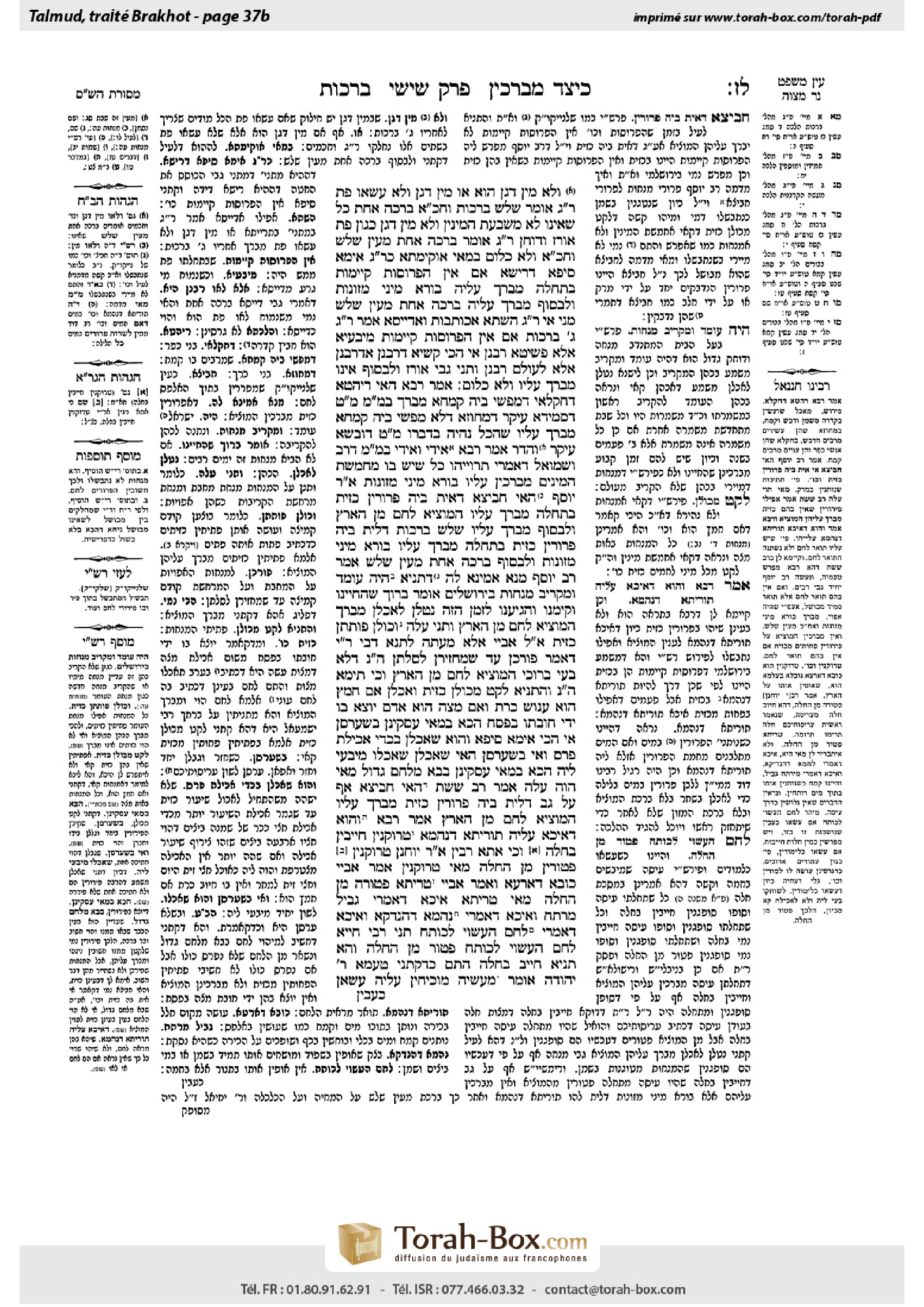
Berakhot 37b: Talmud study for Daf Yomi
Study the Talmud for Daf Yomi with scanned pages, Hebrew text, English translations from Sefaria and AI-generated French translations.
Passage selection and English or AI-generated French translation are available where the scan has annotations. Daf Study is independent of Torah-Box and Sefaria.
Browse Berakhot · ברכות · All tractatesBerakhot 37b text and translations
This page of Berakhot includes the Aramaic text, an English translation and an AI-generated French translation, alongside the scan above.
ברכות ל״ז ב · Aramaic and Hebrew text
וְלֹא מִין דָּגָן הוּא, אוֹ מִין דָּגָן וְלֹא עֲשָׂאוֹ פַּת — רַבָּן גַּמְלִיאֵל אוֹמֵר שָׁלֹשׁ בְּרָכוֹת, וַחֲכָמִים אוֹמְרִים בְּרָכָה אַחַת. כֹּל שֶׁאֵינוֹ לֹא מִשִּׁבְעַת הַמִּינִין וְלֹא מִין דָּגָן, כְּגוֹן פַּת אוֹרֶז וְדוֹחַן — רַבָּן גַּמְלִיאֵל אוֹמֵר בְּרָכָה אַחַת מֵעֵין שָׁלֹשׁ, וַחֲכָמִים אוֹמְרִים וְלֹא כְלוּם.
בְּמַאי אוֹקִימְתָּא — כְּרַבָּן גַּמְלִיאֵל? אֵימָא סֵיפָא דְּרֵישָׁא, אִם אֵין הַפְּרוּסוֹת קַיָּימוֹת — בַּתְּחִלָּה מְבָרֵךְ עָלֶיהָ ״בּוֹרֵא מִינֵי מְזוֹנוֹת״, וּלְבַסּוֹף מְבָרֵךְ עָלֶיהָ בְּרָכָה אַחַת מֵעֵין שָׁלֹשׁ. מַנִּי: אִי רַבָּן גַּמְלִיאֵל, הַשְׁתָּא אַכּוֹתָבוֹת וְאַדַּיְיסָא אָמַר רַבָּן גַּמְלִיאֵל שָׁלֹשׁ בְּרָכוֹת, אִם אֵין הַפְּרוּסוֹת קַיָּימוֹת מִיבַּעְיָא?!
אֶלָּא פְּשִׁיטָא רַבָּנַן. אִי הָכִי קַשְׁיָא דְּרַבָּנַן אַדְּרַבָּנַן! אֶלָּא לְעוֹלָם רַבָּנַן, וּתְנִי גַּבֵּי אוֹרֶז: ״וּלְבַסּוֹף אֵינוֹ מְבָרֵךְ עָלָיו וְלֹא כְּלוּם״.
אָמַר רָבָא: הַאי רִיהֲטָא דְּחַקְלָאֵי דְּמַפְּשִׁי בֵּיהּ קִמְחָא, מְבָרֵךְ ״בּוֹרֵא מִינֵי מְזוֹנוֹת״. מַאי טַעְמָא? — דִּסְמִידָא עִיקָּר. דְּמָחוֹזָא, דְּלָא מַפְּשִׁי בֵּיהּ קִמְחָא, מְבָרֵךְ עָלָיו ״שֶׁהַכֹּל נִהְיָה בִּדְבָרוֹ״. מַאי טַעְמָא? — דּוּבְשָׁא עִיקָּר. וַהֲדַר אָמַר רָבָא: אִידֵּי וְאִידֵּי, ״בּוֹרֵא מִינֵי מְזוֹנוֹת״. דְּרַב וּשְׁמוּאֵל דְּאָמְרִי תַּרְוַיְיהוּ: כֹּל שֶׁיֵּשׁ בּוֹ מֵחֲמֵשֶׁת הַמִּינִים מְבָרְכִין עָלָיו ״בּוֹרֵא מִינֵי מְזוֹנוֹת״.
אָמַר רַב יוֹסֵף: הַאי חֲבִיצָא דְּאִית בֵּיהּ פֵּרוּרִין כְּזַיִת — בַּתְּחִלָּה מְבָרֵךְ עָלָיו ״הַמּוֹצִיא לֶחֶם מִן הָאָרֶץ״, וּלְבַסּוֹף מְבָרֵךְ עָלָיו שָׁלֹשׁ בְּרָכוֹת. דְּלֵית בֵּיהּ פֵּרוּרִין כְּזַיִת — בַּתְּחִלָּה מְבָרֵךְ עָלָיו ״בּוֹרֵא מִינֵי מְזוֹנוֹת״, וּלְבַסּוֹף בְּרָכָה אַחַת מֵעֵין שָׁלֹשׁ.
אָמַר רַב יוֹסֵף: מְנָא אָמֵינָא לַהּ — דְּתַנְיָא: הָיָה עוֹמֵד וּמַקְרִיב מְנָחוֹת בִּירוּשָׁלַיִם — אוֹמֵר: ״בָּרוּךְ שֶׁהֶחֱיָינוּ וְקִיַּמְנוּ וְהִגִּיעָנוּ לַזְּמַן הַזֶּה״. נְטָלָן לְאׇכְלָן — מְבָרֵךְ ״הַמּוֹצִיא לֶחֶם מִן הָאָרֶץ״. וְתָנֵי עֲלַהּ: וְכוּלָּן, פּוֹתְתָן כְּזַיִת.
אָמַר לֵיהּ אַבָּיֵי: אֶלָּא מֵעַתָּה, לְתַנָּא דְּבֵי רַבִּי יִשְׁמָעֵאל דְּאָמַר פּוֹרְכָן עַד שֶׁמַּחְזִירָן לְסׇלְתָּן, הָכִי נָמֵי דְּלָא בָּעֵי בָּרוֹכֵי ״הַמּוֹצִיא לֶחֶם מִן הָאָרֶץ״?! וְכִי תֵּימָא הָכִי נָמֵי, וְהָתַנְיָא: לָקַט מִכּוּלָּן כְּזַיִת וַאֲכָלָן, אִם חָמֵץ הוּא — עָנוּשׁ כָּרֵת, וְאִם מַצָּה הוּא — אָדָם יוֹצֵא בּוֹ יְדֵי חוֹבָתוֹ בַּפֶּסַח.
הָכָא בְּמַאי עָסְקִינַן — בְּשֶׁעֵרְסָן. אִי הָכִי אֵימָא סֵיפָא, וְהוּא שֶׁאֲכָלָן בִּכְדֵי אֲכִילַת פְּרָס — וְאִי בְּשֶׁעֵרְסָן, הַאי ״שֶׁאֲכָלָן״, ״שֶׁאֲכָלוֹ״ מִיבְּעֵי לֵיהּ?
אֶלָּא הָכָא בְּמַאי עָסְקִינַן — בְּבָא מִלֶּחֶם גָּדוֹל.
מַאי הָוֵה עֲלַהּ? אָמַר רַב שֵׁשֶׁת: הַאי חֲבִיצָא, אַף עַל גַּב דְּלֵית בֵּיהּ פֵּרוּרִין כְּזַיִת — מְבָרֵךְ עָלָיו ״הַמּוֹצִיא לֶחֶם מִן הָאָרֶץ״. אָמַר רָבָא: וְהוּא דְּאִיכָּא עֲלֵיהּ תּוֹרִיתָא דְנַהְמָא.
טְרוֹקְנִין, חַיָּיבִין בַּחַלָּה. וְכִי אֲתָא רָבִין אָמַר רַבִּי יוֹחָנָן: טְרוֹקְנִין פְּטוּרִין מִן הַחַלָּה. מַאי טְרוֹקְנִין? אָמַר אַבָּיֵי: כּוּבָּא דְאַרְעָא.
וְאָמַר אַבָּיֵי: טְרִיתָא פְּטוּרָה מִן הַחַלָּה. מַאי טְרִיתָא? אִיכָּא דְּאָמְרִי גְּבִיל מְרַתַּח, וְאִיכָּא דְּאָמְרִי נַהֲמָא דְהִנְדְּקָא, וְאִיכָּא דְּאָמְרִי לֶחֶם הֶעָשׂוּי לְכוּתָּח.
תָּנֵי רַבִּי חִיָּיא: לֶחֶם הֶעָשׂוּי לְכוּתָּח פָּטוּר מִן הַחַלָּה. וְהָא תַּנְיָא חַיָּיב בַּחַלָּה! הָתָם כִּדְקָתָנֵי טַעְמָא — רַבִּי יְהוּדָה אוֹמֵר: מַעֲשֶׂיהָ מוֹכִיחִין עָלֶיהָ. עֲשָׂאָן
Berakhot 37b · English translation
and is not a species of grain, but one of the fruits, or which is a species of grain and has not been made into bread, there is a dispute. Rabban Gamliel says that one recites the three blessings of the Grace after Meals and the Rabbis say that one recites a single blessing. And over anything that is neither one of the seven species nor a species of grain, such as rice bread or millet bread, Rabban Gamliel says that after eating, one recites one blessing abridged from the three blessings of Grace after Meals, and the Rabbis say that one need not recite any blessing, i.e., Grace after Meals or one blessing abridged from three, but instead he recites: Who creates the many forms of life. If so, the Tosefta, which says that after rice one recites one blessing abridged from three, is in accordance with Rabbi Yehuda’s version of Rabban Gamliel’s opinion.
The Gemara challenges: How did you establish the Tosefta? In accordance with the opinion of Rabban Gamliel. Say the latter clause of the first section of this Tosefta, which states that even over wheat bread, when the slices are not intact, then at the start one recites: Who creates the various kinds of nourishment, and at the end one recites one blessing abridged from the three blessings of Grace after Meals. Whose opinion is reflected in that section of the Tosefta? If it is the opinion of Rabban Gamliel, now if over dates and pounded wheat, Rabban Gamliel said that one recites the three blessings of Grace after Meals, in a case where the slices of bread are not intact, is it necessary to say that one recites Grace after Meals?
Rather, it is clear that the Tosefta is in accordance with the opinion of the Rabbis. If so, there is a contradiction between one opinion of the Rabbis and a second opinion of the Rabbis. The Gemara resolves the contradiction: Rather, actually, the Tosefta is in accordance with the opinion of the Rabbis and emend the text and teach with regard to rice: At the end, one does not recite any blessing, consistent with their opinion in the baraita.
With regard to the blessings recited over various types of porridge, Rava said: Over the farmer’s mixture of flour and honey to which they add extra flour, one recites: Who creates the various kinds of nourishment. What is the reason? Because the flour is the primary ingredient in the mixture. Over this same dish, however, when it is prepared in the manner that it is prepared in Meḥoza where they do not add extra flour, one recites: By Whose word all things came to be. What is the reason? Because in that dish, the honey is the primary ingredient. And Rava reconsidered and said: Over both this, the mixture of the farmers, and that, the mixture of Meḥoza, one recites: Who creates the various kinds of nourishment. As Rav and Shmuel both said: Anything that is from the five species of grain, one recites over it: Who creates the various kinds of nourishment.
Rav Yosef said: Over this cooked dish, which contains pieces of bread that are the size of an olive-bulk, at the start one recites: Who brings forth bread from the earth, and afterward one recites the three blessings of Grace after Meals as he would over bread. Over that same cooked dish, which does not contain pieces of bread that are the size of an olive-bulk, at the start one recites: Who creates the various kinds of nourishment, and at the end one recites one blessing abridged from the three blessings of Grace after Meals, as he would over a cooked dish.
And Rav Yosef said: From where do I say this halakha? As it was taught in a baraita: The first time the priest would stand and offer meal-offerings in Jerusalem, he would recite: Who has given us life, sustained us, and brought us to this time, as it is the first time that he fulfilled the mitzva of offering that sacrifice (Rashi). When he would take the meal-offerings in order to eat them, he would recite: Who brings forth bread from the earth. And it was taught on the topic of meal-offerings: And all of the meal-offerings, he crumbles them into pieces, approximately the size of an olive-bulk. This proves that over bread crumbs the size of an olive-bulk, one recites: Who brings forth bread from the earth.
Abaye said to Rav Yosef: But if what you say is so, then now, according to the tanna of the school of Rabbi Yishmael who said with regard to meal-offerings: He crushes them until he restores them to the form that they were when they were flour, would you say that so too, in that case, he need not recite: Who brings forth bread from the earth? And if you say that that is so, that one does not recite: Who brings forth bread from the earth, over these meal-offerings, wasn’t it taught in a baraita: One who gathered an olive-bulk sized portion from all of the crumbs of the meal-offerings and ate them, if it was an offering of leavened bread like that of a thanks-offering, if he ate them on Passover he is punishable by karet. If it was an offering of unleavened bread, one fulfills his obligation to eat matza on Passover. This illustrates that bread crumbs, regardless of their size, are always considered bread.
Rav Yosef answered that this is not the case, and one does not recite a blessing over bread crumbs as he would over actual bread. Rather, with what are we dealing here? With a case where one mixed the bread crumbs with water and compacted them into a single mass. The Gemara challenges this: If so, say the latter clause, in which we learn that this case of one who eats the crumbs speaks specifically about when he ate them, all of the crumbs that constitute the size of an olive-bulk in the time it takes to eat a half-loaf of bread. And if it is referring to a case where one compacted them into a single mass, that expression: When he ate them, is inappropriate. When he ate it, is what it needed to say, as it is a single loaf.
Rather, it can be explained in another way: With what are we dealing here? With a case where each of the crumbs came from a large loaf of bread over which one is obligated to recite: Who brings forth bread from the earth. Over crumbs that were never part of a loaf of bread large enough to require this blessing, however, one need only recite: Who brings forth bread from the earth, if they are at least the size of an olive-bulk.
Since all of the proofs for and against this opinion were rejected, the Gemara asks: What conclusion was reached about this halakha? Rav Sheshet said: Over this cooked dish, which contains bread crumbs, even though it does not contain crumbs the size of an olive-bulk, one recites: Who brings forth bread from the earth. Rava said: This is specifically in a case where the crumbs still have the appearance of bread and did not dissolve completely.
Another issue concerned terokanin, with regard to which it was said that they are obligated in the mitzva to separate ḥalla, meaning that terokanin have the halakhic status of bread. And, when Ravin came from Eretz Yisrael to Babylonia, he said that Rabbi Yoḥanan said: Terokanin are exempt from the mitzva to separate ḥalla. The Gemara asks: What are terokanin? Abaye said: Terokanin are made of a watery mixture of flour and water roasted in a cavity in a stove in the ground and is not actually bread.
And Abaye said: Terita is exempt from the mitzva to separate ḥalla. The Gemara asks: What is terita? There are several opinions: Some say, it is flour and water kneaded that is poured onto a boiling hot stove. And some say, it is bread from India, made from dough wrapped around a skewer and covered with oil or eggs before baking. And some say, it is bread made for kutaḥ, bread baked in an unusual manner so that it would become extremely leavened and could be used as an ingredient in the Babylonian spice, kutaḥ.
And similarly, Rabbi Ḥiyya taught: Bread made for kutaḥ; one is exempt from the mitzva to separate ḥalla. The Gemara asks: Wasn’t it taught in a baraita that one is obligated in the mitzva to separate ḥalla from bread made for kutaḥ? The Gemara answers: There, as the reason was taught that Rabbi Yehuda says: There is a distinction between different types of bread made for kutaḥ, as the actions taken in its preparation prove the purpose for which it was made. If he made them
Berakhot 37b · Traduction française (IA)
et ce n'est pas une espèce de céréale, mais un fruit, ou bien c'est une espèce de céréale et n'a pas été transformé en pain, il y a un débat. Rabban Gamliel dit qu'on récite les trois bénédictions de la Bénédiction de la Grâce après le repas, et les Sages disent qu'on récite une seule bénédiction. Et concernant toute chose qui n'est ni l'une des sept espèces ni une espèce de céréale, comme le pain de riz ou le pain de millet, Rabban Gamliel dit qu'après avoir mangé, on récite une bénédiction abrégée tirée des trois bénédictions de la Grâce après le repas, et les Sages disent qu'on n'a pas besoin de réciter aucune bénédiction, c'est-à-dire la Grâce après le repas ou une bénédiction abrégée des trois, mais plutôt on récite : Celui qui crée les diverses formes de vie. Si c'est ainsi, la Tosefta, qui dit qu'après le riz on récite une bénédiction abrégée des trois, est en conformité avec la version de Rabbi Yehuda de l'opinion de Rabban Gamliel.
Le Guemara conteste : Comment avez-vous établi la Tosefta ? Selon l'opinion de Rabban Gamliel. Dites la dernière partie de la première section de cette Tosefta, qui stipule que même sur le pain de blé, lorsque les tranches ne sont pas intactes, alors au début on récite : Celui qui crée les diverses sortes de nourriture, et à la fin on récite une bénédiction abrégée des trois bénédictions de la Grâce après le repas. Quelle opinion est reflétée dans cette section de la Tosefta ? Si c'est l'opinion de Rabban Gamliel, maintenant, concernant les dattes et le blé broyé, Rabban Gamliel a dit qu'on récite les trois bénédictions de la Grâce après le repas, dans un cas où les tranches de pain ne sont pas intactes, est-il nécessaire de dire qu'on récite la Grâce après le repas ?
Plutôt, il est clair que la Tosefta est conforme à l'opinion des Sages. Si c'est ainsi, il y a une contradiction entre une opinion des Sages et une autre opinion des Sages. La Guemara résout cette contradiction : Plutôt, en réalité, la Tosefta est conforme à l'opinion des Sages et corrige le texte et enseigne concernant le riz : À la fin, on ne récite aucune bénédiction, conformément à leur opinion dans la baraïta.
Concernant les bénédictions récitées sur divers types de porridge, Rava a dit : Sur le mélange du fermier de farine et de miel auquel on ajoute de la farine supplémentaire, on récite : Celui qui crée les diverses sortes de nourriture. Quelle est la raison ? Parce que la farine est l'ingrédient principal du mélange. Sur ce même plat, cependant, lorsque préparé de la manière dont il est préparé à Méchoza où on n'ajoute pas de farine supplémentaire, on récite : Par la Parole dont toutes choses sont venues à l'être. Quelle est la raison ? Parce que dans ce plat, le miel est l'ingrédient principal. Et Rava a réexaminé et a dit : Sur les deux, ce mélange du fermier et celui de Méchoza, on récite : Celui qui crée les diverses sortes de nourriture. Comme Rav et Shmuel ont tous deux dit : Tout ce qui provient des cinq espèces de céréales, on récite sur cela : Celui qui crée les diverses sortes de nourriture.
Rav Yosef a dit : Sur ce plat cuit, qui contient des morceaux de pain de la taille d'une olive, au début on récite : Celui qui fait sortir le pain de la terre, et ensuite on récite les trois bénédictions de la Grâce après le repas comme on le ferait sur le pain. Sur le même plat cuit, qui ne contient pas de morceaux de pain de la taille d'une olive, au début on récite : Celui qui crée les diverses sortes de nourriture, et à la fin on récite une bénédiction abrégée des trois bénédictions de la Grâce après le repas, comme on le ferait sur un plat cuit.
Et Rav Yosef a dit : D'où dis-je cette halakha ? Comme il a été enseigné dans une baraïta : La première fois que le prêtre se levait et offrait des offrandes de table à Jérusalem, il récitait : Celui qui nous a donné la vie, nous a nourri, et nous a conduit à ce moment, car c'est la première fois qu'il accomplissait la mitsva d'offrir cette offrande (Rashi). Lorsqu'il prenait les offrandes de table pour les manger, il récitait : Celui qui fait sortir le pain de la terre. Et il a été enseigné sur le sujet des offrandes de table : Et toutes les offrandes de table, il les réduisait en morceaux, approximativement de la taille d'une olive-boule. Cela prouve qu'on récite : Celui qui fait sortir le pain de la terre sur les morceaux de pain de la taille d'une olive-boule.
Abaye a dit à Rav Yosef : Mais si ce que vous dites est ainsi, alors maintenant, selon le tanna de l'école de Rabbi Yishmael qui a dit concernant les offrandes de table : Il les broie jusqu'à ce qu'il les ramène à la forme qu'ils avaient lorsqu'ils étaient farine, diriez-vous aussi, dans ce cas, qu'il n'est pas nécessaire de réciter : Celui qui fait sortir le pain de la terre ? Et si vous dites que c'est ainsi, qu'on n'récite pas : Celui qui fait sortir le pain de la terre, sur ces offrandes de table, n'était-il pas enseigné dans une baraïta : Celui qui a ramassé une portion de la taille d'une olive-boule de toutes les particules des offrandes de table et les a mangées, si c'était une offrande de pain levé comme celle d'une offrande de remerciement, s'il les a mangées pendant la Pâque, il est puni par karet. Si c'était une offrande de pain sans levain, il accomplissait son obligation de manger le matza pendant la Pâque. Cela illustre que les morceaux de pain, qu'ils soient grands ou petits, sont toujours considérés comme du pain.
Rav Yosef a répondu que cela n'est pas le cas, et qu'on ne récite pas une bénédiction sur les morceaux de pain comme on le ferait sur le pain réel. Plutôt, avec quoi sommes-nous en train de nous occuper ? Avec un cas où l'on a mélangé les morceaux de pain avec de l'eau et les a compactés en une seule masse. Le Guemara conteste cela : Si c'est ainsi, dit la dernière partie, dans laquelle nous apprenons que ce cas de celui qui mange les morceaux parle spécifiquement du cas où il les a mangés, tous les morceaux qui constituent la taille d'une olive dans le temps qu'il faut pour manger une demi-boule de pain. Et si c'est un cas où l'on les a compactés en une seule masse, cette expression : Lorsqu'il les a mangés, est inadaptée. Lorsqu'il les a mangés, c'est ce qu'il fallait dire, car c'est une seule boule.
Plutôt, cela peut être expliqué d'une autre manière : Avec quoi sommes-nous en train de nous occuper ? Avec un cas où chaque morceau provenait d'une grande boule de pain sur laquelle on est tenu de réciter : Celui qui fait sortir le pain de la terre. Sur les morceaux qui n'ont jamais été partie d'une boule de pain suffisamment grande pour exiger cette bénédiction, cependant, on n'a besoin que de réciter : Celui qui fait sortir le pain de la terre, à condition qu'ils soient au moins de la taille d'une olive.
Puisque toutes les preuves en faveur et contre cette opinion avaient été rejetées, la Guemara demande : quelle conclusion a été tirée concernant cette halakha ? Rav Sheshet dit : concernant ce plat cuit qui contient des miettes de pain, même s'il ne contient pas des miettes de la taille d'une olive, on récite : Celui qui fait sortir le pain de la terre. Rava dit : cela concerne spécifiquement le cas où les miettes conservent encore l'apparence du pain et n'ont pas complètement disparu.
Une autre question concernait les terokanin, à propos desquels on disait qu'ils étaient obligés de séparer la challa, ce qui signifie que les terokanin avaient le statut halakhique de pain. Et lorsque Ravin est venu de la Terre d'Israël en Babylone, il a dit que Rabbi Yoḥanan a dit : les terokanin sont dispensés de la mitsva de séparer la challa. La Guemara demande : quels sont les terokanin ? Abaye a dit : les terokanin sont faits d'un mélange liquide de farine et d'eau cuit dans une cavité d'une cuisinière souterraine et ne sont pas réellement du pain.
Et Abaye a dit : le terita est dispensé de la mitsva de séparer la challa. La Guemara demande : qu'est-ce que le terita ? Il y a plusieurs opinions : certains disent qu'il s'agit d'un mélange de farine et d'eau pétri qui est versé sur une cuisinière brûlante. D'autres disent qu'il s'agit de pain indien, fait à partir de pâte enroulée autour d'une brochette et recouverte d'huile ou d'œufs avant cuisson. D'autres disent qu'il s'agit de pain fait pour le kutaḥ, du pain cuit de manière inhabituelle pour devenir extrêmement levé et être utilisé comme ingrédient dans la poudre babylonienne, le kutaḥ.
De même, Rabbi Ḥiyya a enseigné : le pain fait pour le kutaḥ ; on est dispensé de la mitsva de séparer la challa. La Guemara demande : n'a-t-il pas été enseigné dans une baraïta que l'on est obligé de séparer la challa du pain fait pour le kutaḥ ? La Guemara répond : là, comme la raison a été enseignée que Rabbi Yehuda dit : il y a une distinction entre les différents types de pain fait pour le kutaḥ, car les actions accomplies dans sa préparation prouvent le but pour lequel il a été fait. Si l'on a fait cela
Traduction française générée par IA à partir de l’édition anglaise de Sefaria. Vérifie toujours un passage avec le texte source.
Text from Sefaria: William Davidson Edition - Vocalized Aramaic (CC BY NC); William Davidson Edition - English (CC BY NC).