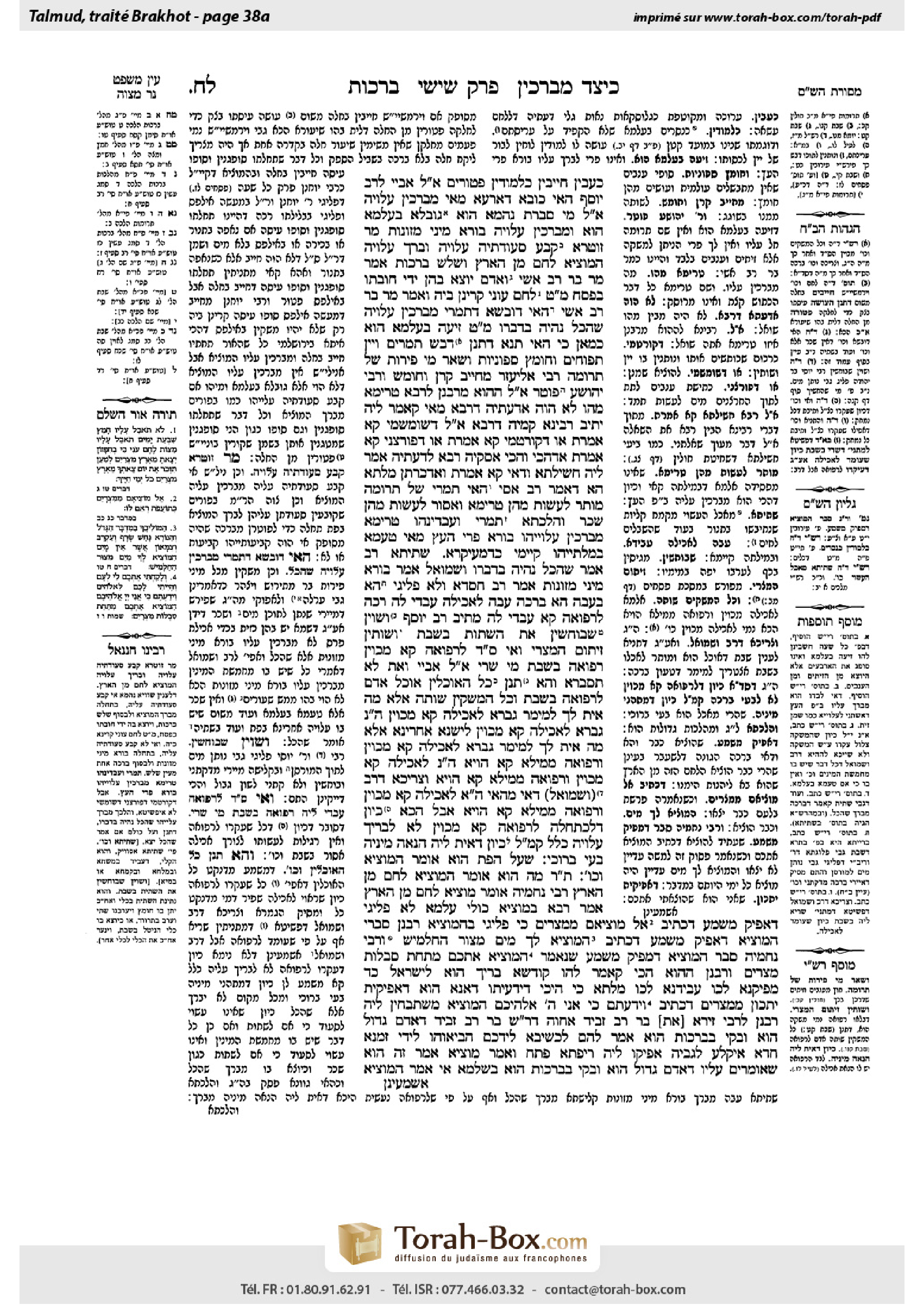
Berakhot 38a: Talmud study for Daf Yomi
Study the Talmud for Daf Yomi with scanned pages, Hebrew text, English translations from Sefaria and AI-generated French translations.
Passage selection and English or AI-generated French translation are available where the scan has annotations. Daf Study is independent of Torah-Box and Sefaria.
Browse Berakhot · ברכות · All tractatesBerakhot 38a text and translations
This page of Berakhot includes the Aramaic text, an English translation and an AI-generated French translation, alongside the scan above.
ברכות ל״ח א · Aramaic and Hebrew text
כְּעָבִין — חַיָּיבִין, כְּלִמּוּדִין — פְּטוּרִים. אֲמַר לֵיהּ אַבָּיֵי לְרַב יוֹסֵף: הַאי כּוּבָּא דְאַרְעָא מַאי מְבָרְכִין עִלָּוֵיהּ? אֲמַר לֵיהּ: מִי סָבְרַתְּ נַהֲמָא הוּא?! גּוּבְלָא בְּעָלְמָא הוּא וּמְבָרְכִין עִלָּוֵיהּ ״בּוֹרֵא מִינֵי מְזוֹנוֹת״.
מָר זוּטְרָא קְבַע סְעוֹדְתֵּיהּ עִלָּוֵיהּ, וּבָרֵךְ עִלָּוֵיהּ ״הַמּוֹצִיא לֶחֶם מִן הָאָרֶץ״, וְשָׁלֹשׁ בְּרָכוֹת.
אָמַר מָר בַּר רַב אָשֵׁי: וְאָדָם יוֹצֵא בָּהֶן יְדֵי חוֹבָתוֹ בַּפֶּסַח, מַאי טַעְמָא — ״לֶחֶם עוֹנִי״ קָרֵינַן בֵּיהּ.
וְאָמַר מָר בַּר רַב אָשֵׁי: הַאי דּוּבְשָׁא דְתַמְרֵי מְבָרְכִין עִלָּוֵיהּ ״שֶׁהַכֹּל נִהְיֶה בִּדְבָרוֹ״. מַאי טַעְמָא? — זֵיעָה בְּעָלְמָא הוּא.
כְּמַאן? — כִּי הַאי תַּנָּא דִּתְנַן דְּבַשׁ תְּמָרִים, וְיֵין תַּפּוּחִים, וְחוֹמֶץ סִפְוָנִיּוֹת, וּשְׁאָר מֵי פֵירוֹת שֶׁל תְּרוּמָה — רַבִּי אֱלִיעֶזֶר מְחַיֵּיב קֶרֶן וָחוֹמֶשׁ, וְרַבִּי יְהוֹשֻׁעַ פּוֹטֵר.
אֲמַר לֵיהּ הָהוּא מֵרַבָּנַן לְרָבָא: טְרִימָא מַהוּ? לָא הֲוָה אַדַּעְתֵּיהּ דְּרָבָא מַאי קָאָמַר לֵיהּ. יְתֵיב רָבִינָא קַמֵּיהּ דְּרָבָא, אֲמַר לֵיהּ: דְּשׁוּמְשְׁמֵי קָא אָמְרַתְּ, אוֹ דְּקוּרְטְמֵי קָא אָמְרַתְּ, אוֹ דְּפוּרְצָנֵי קָא אָמְרַתְּ?
אַדְּהָכִי וְהָכִי אַסְּקֵיהּ רָבָא לְדַעְתֵּיהּ, אֲמַר לֵיהּ: חֲשִׁילְתָּא וַדַּאי קָא אָמְרַתְּ, וְאַדְכַּרְתַּן מִלְּתָא הָא דְּאָמַר רַב אַסִּי: הַאי תַּמְרֵי שֶׁל תְּרוּמָה מוּתָּר לַעֲשׂוֹת מֵהֶן טְרִימָא, וְאָסוּר לַעֲשׂוֹת מֵהֶן שֵׁכָר. וְהִלְכְתָא תַּמְרֵי וְעַבְדִינְהוּ טְרִימָא — מְבָרְכִין עִלָּוַיְיהוּ ״בּוֹרֵא פְּרִי הָעֵץ״. מַאי טַעְמָא? — בְּמִלְּתַיְיהוּ קָיְימִי כִּדְמֵעִיקָּרָא.
שְׁתִיתָא, רַב אָמַר ״שֶׁהַכֹּל נִהְיֶה בִּדְבָרוֹ״, וּשְׁמוּאֵל אָמַר ״בּוֹרֵא מִינֵי מְזוֹנוֹת״.
אָמַר רַב חִסְדָּא, וְלָא פְּלִיגִי: הָא בְּעָבָה, הָא בְּרַכָּה. עָבָה לַאֲכִילָה עָבְדִי לַהּ, רַכָּה לִרְפוּאָה קָא עָבְדִי לַהּ.
מֵתִיב רַב יוֹסֵף: וְשָׁוִין שֶׁבּוֹחֲשִׁין אֶת הַשַּׁתּוּת בְּשַׁבָּת וְשׁוֹתִין זֵיתוֹם הַמִּצְרִי. וְאִי סָלְקָא דַעְתָּךְ לִרְפוּאָה קָא מְכַוֵּין, רְפוּאָה בְּשַׁבָּת מִי שְׁרֵי?!
אֲמַר לֵיהּ אַבָּיֵי: וְאַתְּ לָא תִּסְבְּרָא? וְהָא תְּנַן: כׇּל הָאוֹכָלִין אוֹכֵל אָדָם לִרְפוּאָה בְּשַׁבָּת, וְכׇל הַמַּשְׁקִין שׁוֹתֶה. אֶלָּא מָה אִית לָךְ לְמֵימַר — גַּבְרָא לַאֲכִילָה קָא מְכַוֵּין, הָכִי נָמֵי גַּבְרָא לַאֲכִילָה קָא מְכַוֵּין.
לִישָּׁנָא אַחֲרִינָא: אֶלָּא מָה אִית לָךְ לְמֵימַר — גַּבְרָא לַאֲכִילָה קָא מְכַוֵּין, וּרְפוּאָה מִמֵּילָא קָא הָוְיָא? הָכִי נָמֵי לַאֲכִילָה קָא מְכַוֵּין, וּרְפוּאָה מִמֵּילָא קָא הָוְיָא.
וּצְרִיכָא דְּרַב וּשְׁמוּאֵל. דְּאִי מֵהַאי, הֲוָה אָמֵינָא לַאֲכִילָה קָא מְכַוֵּין וּרְפוּאָה מִמֵּילָא קָא הָוְיָא, אֲבָל הָכָא, כֵּיוָן דִּלְכַתְּחִילָּה לִרְפוּאָה קָא מְכַוֵּין — לָא לְבָרֵיךְ עִלָּוֵיהּ כְּלָל. קָא מַשְׁמַע לַן כֵּיוָן דְּאִית לֵיהּ הֲנָאָה מִינֵּיהּ בָּעֵי בָּרוֹכֵי.
שֶׁעַל הַפַּת הוּא אוֹמֵר ״הַמּוֹצִיא״ וְכוּ׳. תָּנוּ רַבָּנַן: מָה הוּא אוֹמֵר? — ״הַמּוֹצִיא לֶחֶם מִן הָאָרֶץ״. רַבִּי נְחֶמְיָה אוֹמֵר: ״מוֹצִיא לֶחֶם מִן הָאָרֶץ״. אָמַר רָבָא: בְּ״מוֹצִיא״ כּוּלֵּי עָלְמָא לָא פְּלִיגִי דְּאַפֵּיק מַשְׁמַע, דִּכְתִיב: ״אֵל מוֹצִיאָם מִמִּצְרָיִם״. כִּי פְּלִיגִי בְּ״הַמּוֹצִיא״, רַבָּנַן סָבְרִי הַמּוֹצִיא דְּאַפֵּיק מַשְׁמַע, דִּכְתִיב: ״הַמּוֹצִיא לְךָ מַיִם מִצּוּר הַחַלָּמִישׁ״. וְרַבִּי נְחֶמְיָה סָבַר הַמּוֹצִיא דְּמַפֵּיק מַשְׁמַע, שֶׁנֶּאֱמַר: ״הַמּוֹצִיא אֶתְכֶם מִתַּחַת סִבְלוֹת מִצְרָיִם״.
וְרַבָּנַן? — הָהוּא הָכִי קָאָמַר לְהוּ קוּדְשָׁא בְּרִיךְ הוּא לְיִשְׂרָאֵל: כַּד מַפֵּיקְנָא לְכוּ, עָבֵידְנָא לְכוּ מִלְּתָא כִּי הֵיכִי דְּיָדְעִיתוּ דַּאֲנָא הוּא דְּאַפֵּיקִית יָתְכוֹן מִמִּצְרַיִם, דִּכְתִיב: ״וִידַעְתֶּם כִּי אֲנִי ה׳ אֱלֹהֵיכֶם הַמּוֹצִיא״.
מִשְׁתַּבְּחִין לֵיהּ רַבָּנַן לְרַבִּי זֵירָא [אֶת] בַּר רַב זְבִיד אֲחוּהּ דְּרַבִּי שְׁמוּאֵל בַּר רַב זְבִיד דְּאָדָם גָּדוֹל הוּא וּבָקִי בִּבְרָכוֹת הוּא. אָמַר לָהֶם: לִכְשֶׁיָּבֹא לְיֶדְכֶם הֲבִיאוּהוּ לְיָדִי. זִמְנָא חֲדָא אִיקְּלַע לְגַבֵּיהּ אַפִּיקוּ לֵיהּ רִיפְתָּא, פָּתַח וְאָמַר ״מוֹצִיא״. אָמַר: זֶה הוּא שֶׁאוֹמְרִים עָלָיו דְּאָדָם גָּדוֹל הוּא וּבָקִי בִּבְרָכוֹת הוּא?! בִּשְׁלָמָא אִי אֲמַר ״הַמּוֹצִיא״
Berakhot 38a · English translation
thick [ke’avin], so that they appear like loaves of bread, they are obligated in ḥalla, and if he shaped them like boards [kelimmudin], they are exempt, since they will certainly only be used for kutaḥ. Abaye said to Rav Yosef: What blessing is recited over the dough of the ground? Rav Yosef said to him: Do you think that it is bread? It is merely kneaded dough, and just like over all other cooked grains, one recites over it the blessing: Who creates the various kinds of nourishment.
Mar Zutra based his meal on this dough, and he recited: Who brings forth bread from the earth, beforehand and the three blessings of Grace after Meals thereafter. Since he based his meal on it, he considered it to be bread.
Mar bar Rav Ashi said: With these types of bread, a person fulfills his obligation to eat matza on Passover. What is the reason? Because we call it bread of affliction, and in that sense, it is in the category of matza.
And with regard to blessings, Mar bar Rav Ashi said: Over this date honey one recites: By Whose word all things came to be. What is the reason that one does not recite: Who creates fruit of the tree, as he does over the date itself? Because date honey is not the essence of the fruit, but merely moisture that drips from the ripe fruit.
In accordance with whose opinion does he recite that blessing? In accordance with the opinion of this tanna, as we learned in a mishna: If a non-priest ate date honey, apple wine or vinegar made from grapes of autumn that grow stunted at the end of the season and are unfit for wine production, or any other type of juice made from fruits of teruma, Rabbi Eliezer obligates him to repay the principal and an additional fifth as a penalty for misuse of consecrated items. And Rabbi Yehoshua exempts him from payment, because he holds that these are byproducts of the fruit and do not have the status of the fruit itself. Mar bar Rav Ashi’s ruling with regard to blessings was based on Rabbi Yehoshua’s ruling with regard to teruma.
One of the Sages said to Rava: What is the halakha with regard to terima? Rava was unfamiliar with the term terima and did not understand what he was saying to him. Ravina sat before Rava and said to the student who had posed the question to Rava: In posing the question, are you speaking of sesame terima or are you speaking of safflower terima or are you speaking of grape-pits terima?
Meanwhile, Rava comprehended the meaning of the term and said to the Sage: Certainly, you are speaking of pressed items, and you reminded me of a matter that Rav Asi said: Those dates of teruma; one is permitted to press them in order to make terima, because the dates maintain their form, and one is forbidden to make date beer from them, as in so doing the dates are damaged and it is forbidden to damage teruma. The Gemara concludes: The halakha is that over dates that were made into terima, one recites: Who creates fruit of the tree. What is the reason? Because they remain in their original state.
The Gemara raises another question with regard to the blessing recited on roasted barley to which honey or vinegar was added [shetita]. Rav said that one recites: By Whose word all things came to be; and Shmuel said that one recites: Who creates the various kinds of nourishment.
Rav Ḥisda said: And they do not disagree, as each is referring to a different case. This, where Shmuel said that one recites: Who creates the various kinds of nourishment, is in a case where the mixture is thick, while this, where Rav said that one recites: By Whose word all things came to be, is in a case where the mixture is thin. When it is thick, he made it as food; therefore one recites a blessing just as he would over any food made from the five species of grain. When it is thin, he made it as medicine, therefore one only recites: By Whose word all things came to be.
With regard to the assumption that this mixture is essentially medicinal, Rav Yosef raised a challenge from the laws of Shabbat: And they agree that one may mix shetita on Shabbat and drink Egyptian beer [zitom haMitzri], which contains a mixture of a pungent spice in flour. And if it enters your mind to say that when one prepares shetita, his intention is for medicinal purposes, is medicine permitted on Shabbat?
Abaye said to Rav Yosef: Do you not hold that to be true? Didn’t we learn in a mishna: All foods that are commonly eaten; a person may eat them for medicinal purposes on Shabbat, and all drinks that are not designated for medicinal purposes, a person may drink them for medicinal purposes on Shabbat. But what can you say in explaining that ruling? The man’s intention is for the purpose of eating; here too, when he mixes the shetita, the man’s intention is for the purpose of eating.
The Gemara cites another version of what was taught above: But what can you say in explaining that ruling? The man’s intention is for the purpose of eating and the cure comes about on its own; here too, the man’s intention is for the purpose of eating and the cure comes about on its own. Ostensibly, after proving that it is permissible to drink the shetita on Shabbat, it is clearly a type of food over which one is required to recite a blessing. If so, it is difficult to understand the need for Rav and Shmuel to point out that one is required to recite a blessing over it.
Therefore the Gemara says: And the statement of Rav and Shmuel is necessary, as if the halakha had been derived solely from this mishna that permits drinking shetita on Shabbat, I would have said: This applies specifically when one’s intention is for the purpose of eating and the cure comes about on its own. Here, however, since from the outset, his intention in eating the shetita is for the purpose of medicine; just as one recites no blessing when he ingests medicine, let him recite no blessing over the shetita at all. Therefore, Rav and Shmuel taught us that here, since he derives pleasure from eating it, he is required to recite a blessing.
We learned in the mishna that over bread one recites: Who brings forth bread from the earth. The Sages taught in a baraita: What does one who eats bread recite before eating? Who brings forth [hamotzi] bread from the earth. Rabbi Neḥemya says that the blessing is phrased: Who brought forth [motzi] bread from the earth. Rava said: Everyone agrees that the term motzi means brought, in the past tense, as it is written: “God who brought them forth [motziam] from Egypt is for them like the horns of the wild ox” (Numbers 23:22). When do they disagree? With regard to the term hamotzi, as the Rabbis hold that hamotzi means that God brought forth, in the past tense, as it is written: “Who brought forth [hamotzi] for you water from a rock of flint” (Deuteronomy 8:15), which depicts a past event. Rabbi Neḥemya holds that the term hamotzi means that God brings forth in the present tense, as it is stated in Moses’ prophecy to the Jewish people in Egypt: “And you will know that I am the Lord your God who is bringing you forth [hamotzi] from under the burdens of Egypt” (Exodus 6:7). Since, in that context, hamotzi is used with regard to an event transpiring in the present or possibly even one that will transpire in the future, it is inappropriate to include this term in a blessing referencing the past.
And the Rabbis, how do they respond to that proof? The Sages interpret that verse to mean that the Holy one, Blessed be He, said to Israel as follows: When I bring you forth, I will perform something for you that you will know that I am the one who brought you forth from Egypt, as it is written: “And you will know that I am the Lord your God who brought you forth [hamotzi]”; in this verse, too, hamotzi refers to the past.
On that note, the Gemara relates: The Sages would praise son of Rav Zevid, brother of Rabbi Shmuel bar Rav Zevid to Rabbi Zeira, that he is a great man and he is expert in blessings. Rabbi Zeira said to the Sages: When he comes to you, bring him to me so that I can meet him. One day he happened to come before him. They brought out bread to the guest, he began and recited: Who brought forth [motzi] bread from the earth. Rabbi Zeira grew annoyed and said: This is he of whom they say that he is a great man and expert in blessings? Granted, had he recited: Hamotzi,
Berakhot 38a · Traduction française (IA)
Épais [ke’avin], de sorte qu'ils ressemblent à des pains, ils sont obligatoires en ḥalla, et si l'on les façonne comme des planches [kelimmudin], ils sont exemptés, car ils seront certainement uniquement utilisés pour kutaḥ. Abaye a dit à Rav Yosef : Quel bénédiction est récitée sur la pâte du sol ? Rav Yosef a répondu à lui : Penses-tu qu'il s'agit de pain ? C'est simplement de la pâte pétrie, et tout comme pour toutes les autres céréales cuites, on récite sur elle la bénédiction : Celui qui crée les diverses sortes de nourriture.
Mar Zutra a fondé son repas sur cette pâte, et il a récité : Celui qui fait sortir le pain de la terre, avant et les trois bénédictions de gratitude après le repas ensuite. Puisqu'il avait fondé son repas sur cela, il considérait cela comme du pain.
Mar bar Rav Ashi a dit : Avec ces types de pains, une personne remplit son obligation de manger le matza pendant la Pâque. Quelle est la raison ? Parce que nous appelons cela pain d'affliction, et dans ce sens, il appartient à la catégorie du matza.
Et concernant les bénédictions, Mar bar Rav Ashi a dit : Sur ce miel de dattes, on récite : Par la Parole dont toutes choses sont venues à l'être. Quelle est la raison pour laquelle on ne récite pas : Celui qui crée les fruits des arbres, comme on le fait sur la date elle-même ? Parce que le miel de dattes n'est pas l'essence du fruit, mais simplement la moiteur qui coule du fruit mûr.
Selon l'opinion de qui récite-t-on cette bénédiction ? Selon l'opinion de ce tanna, comme nous avons appris dans une mitsna : Si un non-prêtre a mangé du miel de dattes, du vin de pomme ou du vinaigre fait à partir de raisins d'automne qui sont rachitiques à la fin de la saison et ne sont pas adaptés à la production de vin, ou n'importe quel autre type de jus fait à partir de fruits de terouma, Rabbi Eliezer oblige à rembourser le principal et un cinquième supplémentaire comme pénalité pour l'usage incorrect des objets consacrés. Et Rabbi Yehoshua exempt de paiement, car il considère que ces sont des sous-produits des fruits et n'ont pas le statut du fruit lui-même. La décision de Mar bar Rav Ashi concernant les bénédictions était basée sur la décision de Rabbi Yehoshua concernant la terouma.
Un des Sages a dit à Rava : Quelle est la halakha concernant la terouma ? Rava ne connaissait pas le terme terouma et ne comprenait pas ce que l'autre disait. Ravina s'est assis devant Rava et a dit au disciple qui avait posé la question à Rava : En posant la question, parles-tu de terouma de sésame ou de safran ou de terouma de pépins de raisin ?
En même temps, Rava comprit le sens du terme et dit au Sage : Certainement, tu parles des produits pressés, et tu m'as rappelé une affaire que Rav Asi avait dit : Ces dattes de terouma ; on est autorisé à les presser afin de faire de la terouma, car les dattes conservent leur forme, et on est interdit de faire du vin de dattes à partir d'elles, car en le faisant, les dattes sont endommagées et il est interdit d'endommager la terouma. La Guemara conclut : La halakha est que sur les dattes qui ont été transformées en terouma, on récite : Celui qui crée les fruits des arbres. Quelle est la raison ? Parce qu'elles restent dans leur état originel.
La Guemara soulève une autre question concernant la bénédiction récitée sur le grain rôti auquel du miel ou du vinaigre a été ajouté [shetita]. Rav dit que l'on récite : Par la Parole dont toutes choses sont venues à l'être ; et Shmuel dit que l'on récite : Celui qui crée les diverses sortes de nourriture.
Rav Ḥisda dit : Et ils ne s'opposent pas, car chacun parle d'un cas différent. Celui-ci, où Shmuel dit que l'on récite : Celui qui crée les diverses sortes de nourriture, est dans un cas où le mélange est épais, tandis que celui-ci, où Rav dit que l'on récite : Par la Parole dont toutes choses sont venues à l'être, est dans un cas où le mélange est fin. Lorsqu'il est épais, il l'a fait comme nourriture ; donc l'on récite une bénédiction comme on le ferait sur toute nourriture faite à partir des cinq espèces de céréales. Lorsqu'il est fin, il l'a fait comme médicament, donc l'on récite seulement : Par la Parole dont toutes choses sont venues à l'être.
Concernant l'hypothèse que ce mélange est essentiellement médical, Rav Yosef a soulevé un défi en matière de Shabbat : Et ils s'accordent sur le fait qu'on peut mélanger shetita le sabbat et boire le vin égyptien [zitom haMitzri], qui contient un mélange d'une épice piquante dans la farine. Et si cela entre dans votre tête de dire que lorsqu'on prépare shetita, son intention est pour des usages médicaux, est-ce que le médicament est permis le sabbat ?
Abaye a dit à Rav Yosef : Ne tiens-tu pas cela pour vrai ? N'avons-nous pas appris dans une mitsva : Tous les aliments qui sont couramment mangés ; une personne peut les manger à des fins médicales le sabbat, et toutes les boissons qui ne sont pas destinées à des usages médicaux, une personne peut les boire à des fins médicales le sabbat. Mais que peux-tu dire pour expliquer cette décision ? L'intention de la personne est pour l'acte de manger ; ici aussi, lorsqu'il mélange le shetita, l'intention de la personne est pour l'acte de manger.
La Guemara cite une autre version de ce qui a été enseigné ci-dessus : Mais que peux-tu dire pour expliquer cette décision ? L'intention de la personne est pour l'acte de manger et la guérison s'opère d'elle-même ; ici aussi, l'intention de la personne est pour l'acte de manger et la guérison s'opère d'elle-même. Apparemment, après avoir prouvé que boire le shetita le sabbat est permis, il est clair qu'il s'agit d'un type d'aliment sur lequel on doit réciter une bénédiction. Si tel est le cas, il est difficile de comprendre la nécessité de Rav et Shmuel de préciser que l'on doit réciter une bénédiction sur cela.
Par conséquent, la Guemara dit : Et la déclaration de Rav et Shmuel est nécessaire, car si la halakha avait été dérivée uniquement de cette mitsva qui permet de boire le shetita le sabbat, j'aurais dit : Cela s'applique spécifiquement lorsque l'intention est pour l'acte de manger et la guérison s'opère d'elle-même. Ici cependant, puisque dès le départ, l'intention de manger le shetita est pour la médecine ; tout comme on ne récite pas de bénédiction lorsqu'on ingère un médicament, on ne doit pas réciter de bénédiction sur le shetita du tout. Par conséquent, Rav et Shmuel nous ont appris que ici, puisque l'on y trouve du plaisir à le manger, il est nécessaire de réciter une bénédiction.
Nous avons appris dans la Michna que l'on récite sur le pain : Celui qui fait sortir le pain de la terre. Les Sages ont enseigné dans une baraïta : Qu'exprime-t-on avant de manger du pain ? Celui qui fait sortir [hamotzi] le pain de la terre. Rabbi Néhémia dit que la bénédiction est formulée : Celui qui a fait sortir [motzi] le pain de la terre. Rava a dit : Tout le monde convient que le terme motzi signifie faire sortir, au passé, comme il est écrit : « L'Éternel qui a fait sortir [motziam] Israël d'Égypte est pour eux comme les cornes de l'antilope sauvage » (Nombres 23:22). À quel moment divergent-on ? En ce qui concerne le terme hamotzi, car les Sages pensent que hamotzi signifie que Dieu a fait sortir, au passé, comme il est écrit : « Celui qui a fait sortir [hamotzi] pour vous de la pierre de flint de l'eau » (Deutéronome 8:15), ce qui décrit un événement passé. Rabbi Néhémia pense que le terme hamotzi signifie que Dieu fait sortir au présent, comme il est dit dans la prophétie de Moïse au peuple d'Israël en Égypte : « Et vous connaîtrez que je suis l'Éternel votre Dieu qui fait sortir [hamotzi] de sous les charges d'Égypte » (Exode 6:7). Puisque, dans ce contexte, hamotzi est utilisé en référence à un événement présent ou même futur, il est inapproprié d'inclure ce terme dans une bénédiction faisant référence au passé.
Et les Sages, comment répondent-ils à cette preuve ? Les Sages interprètent cette versette pour signifier que le Saint, béni soit-Il, a dit à Israël ainsi : Lorsque je vous ferai sortir [hamotzi], je ferai quelque chose pour vous que vous connaîtrez que c'est moi qui vous ai fait sortir d'Égypte, comme il est écrit : « Et vous connaîtrez que je suis l'Éternel votre Dieu qui vous a fait sortir [hamotzi] » ; dans cette versette aussi, hamotzi fait référence au passé.
À ce propos, le Guemara rapporte : Les Sages louaient le fils de Rav Zévid, frère de Rabbi Shmuel bar Rav Zévid, devant Rabbi Zéira, en disant qu'il est un grand homme et qu'il est expert en bénédiction. Rabbi Zéira dit aux Sages : Lorsqu'il viendra chez vous, amenez-le-moi afin que je le rencontre. Un jour, il arriva devant lui. On apporta du pain au convive, il commença et récita : Celui qui a fait sortir [motzi] le pain de la terre. Rabbi Zéira s'énerva et dit : C'est celui dont on dit qu'il est un grand homme et expert en bénédiction ? Puisque, s'il avait récité : Hamotzi,
Traduction française générée par IA à partir de l’édition anglaise de Sefaria. Vérifie toujours un passage avec le texte source.
Text from Sefaria: William Davidson Edition - Vocalized Aramaic (CC BY NC); William Davidson Edition - English (CC BY NC).