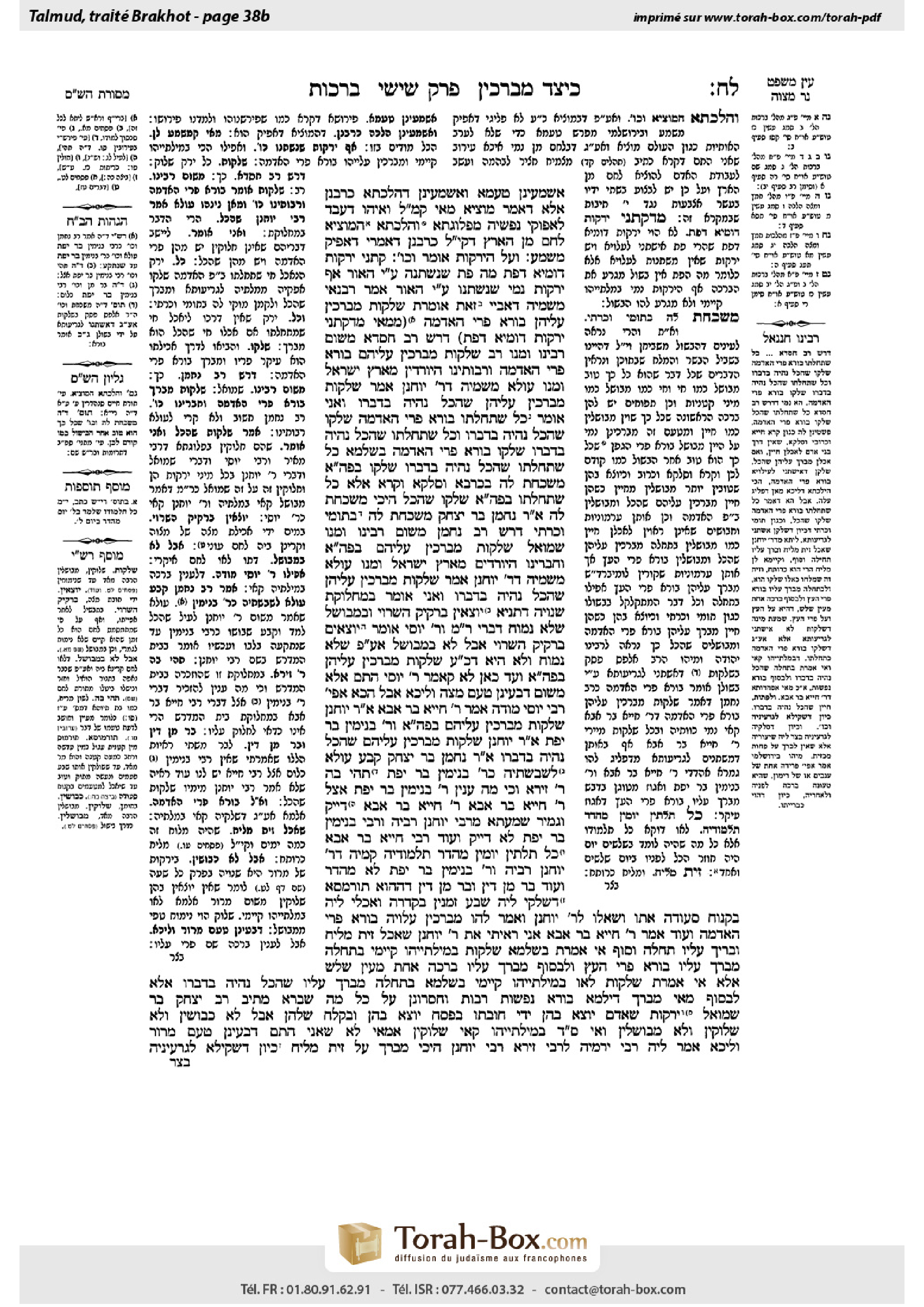
Berakhot 38b: Talmud study for Daf Yomi
Study the Talmud for Daf Yomi with scanned pages, Hebrew text, English translations from Sefaria and AI-generated French translations.
Passage selection and English or AI-generated French translation are available where the scan has annotations. Daf Study is independent of Torah-Box and Sefaria.
Browse Berakhot · ברכות · All tractatesBerakhot 38b text and translations
This page of Berakhot includes the Aramaic text, an English translation and an AI-generated French translation, alongside the scan above.
ברכות ל״ח ב · Aramaic and Hebrew text
אַשְׁמְעִינַן טַעְמָא, וְאַשְׁמְעִינַן דְּהִלְכְתָא כְּרַבָּנַן. אֶלָּא דַּאֲמַר ״מוֹצִיא״ מַאי קָא מַשְׁמַע לַן? וְאִיהוּ דַּעֲבַד לְאַפּוֹקֵי נַפְשֵׁיהּ מִפְּלוּגְתָּא.
וְהִלְכְתָא ״הַמּוֹצִיא לֶחֶם מִן הָאָרֶץ״, דְּקַיְימָא לַן כְּרַבָּנַן, דְּאָמְרִי דְּאַפֵּיק מַשְׁמַע.
וְעַל הַיְּרָקוֹת אוֹמֵר וְכוּ׳. קָתָנֵי יְרָקוֹת דּוּמְיָא דְפַת — מָה פַּת שֶׁנִּשְׁתַּנָּה עַל יְדֵי הָאוּר, אַף יְרָקוֹת נָמֵי שֶׁנִּשְׁתַּנּוּ עַל יְדֵי הָאוּר. אָמַר רַבְנַאי מִשְּׁמֵיהּ דְּאַבָּיֵי: זֹאת אוֹמֶרֶת שְׁלָקוֹת מְבָרְכִין עֲלֵיהֶן ״בּוֹרֵא פְּרִי הָאֲדָמָה״. מִמַּאי? — מִדְּקָתָנֵי יְרָקוֹת דּוּמְיָא דְפַת.
דָּרַשׁ רַב חִסְדָּא מִשּׁוּם רַבֵּינוּ, וּמַנּוּ — רַב: שְׁלָקוֹת מְבָרְכִין עֲלֵיהֶם ״בּוֹרֵא פְּרִי הָאֲדָמָה״. וְרַבּוֹתֵינוּ הַיּוֹרְדִין מֵאֶרֶץ יִשְׂרָאֵל, וּמַנּוּ — עוּלָּא מִשְּׁמֵיהּ דְּרַבִּי יוֹחָנָן אָמַר: שְׁלָקוֹת מְבָרְכִין עֲלֵיהֶן ״שֶׁהַכֹּל נִהְיֶה בִּדְבָרוֹ״. וַאֲנִי אוֹמֵר: כֹּל שֶׁתְּחִלָּתוֹ ״בּוֹרֵא פְּרִי הָאֲדָמָה״, שְׁלָקוֹ — ״שֶׁהַכֹּל נִהְיֶה בִּדְבָרוֹ״. וְכֹל שֶׁתְּחִלָּתוֹ ״שֶׁהַכֹּל נִהְיֶה בִּדְבָרוֹ״, שְׁלָקוֹ — ״בּוֹרֵא פְּרִי הָאֲדָמָה״.
בִּשְׁלָמָא כֹּל שֶׁתְּחִלָּתוֹ ״שֶׁהַכֹּל נִהְיֶה בִּדְבָרוֹ״ שְׁלָקוֹ ״בּוֹרֵא פְּרִי הָאֲדָמָה״ — מַשְׁכַּחַתְּ לַהּ בִּכְרָבָא וְסִלְקָא וְקָרָא, אֶלָּא כֹּל שֶׁתְּחִלָּתוֹ ״בּוֹרֵא פְּרִי הָאֲדָמָה״ שְׁלָקוֹ ״שֶׁהַכֹּל״, הֵיכִי מַשְׁכַּחַתְּ לַהּ? אָמַר רַב נַחְמָן בַּר יִצְחָק: מַשְׁכַּחַתְּ לַהּ בְּתוּמֵי וְכַרָּתֵי.
דָּרַשׁ רַב נַחְמָן מִשּׁוּם רַבֵּינוּ, וּמַנּוּ — שְׁמוּאֵל: שְׁלָקוֹת מְבָרְכִין עֲלֵיהֶם ״בּוֹרֵא פְּרִי הָאֲדָמָה״. וַחֲבֵרֵינוּ הַיּוֹרְדִים מֵאֶרֶץ יִשְׂרָאֵל, וּמַנּוּ — עוּלָּא מִשְּׁמֵיהּ דְּרַבִּי יוֹחָנָן אָמַר: שְׁלָקוֹת מְבָרְכִין עֲלֵיהֶן ״שֶׁהַכֹּל נִהְיֶה בִּדְבָרוֹ״.
וַאֲנִי אוֹמֵר בְּמַחֲלוֹקֶת שְׁנוּיָה. דְּתַנְיָא: יוֹצְאִין בְּרָקִיק הַשָּׁרוּי וּבִמְבוּשָּׁל שֶׁלֹּא נִמּוֹחַ דִּבְרֵי רַבִּי מֵאִיר, וְרַבִּי יוֹסֵי אוֹמֵר: יוֹצְאִים בְּרָקִיק הַשָּׁרוּי, אֲבָל לֹא בַּמְבוּשָּׁל, אַף עַל פִּי שֶׁלֹּא נִמּוֹחַ.
וְלָא הִיא, דְּכוּלֵּי עָלְמָא שְׁלָקוֹת מְבָרְכִין עֲלֵיהֶן ״בּוֹרֵא פְּרִי הָאֲדָמָה״, וְעַד כָּאן לָא קָאָמַר רַבִּי יוֹסֵי הָתָם, אֶלָּא מִשּׁוּם דְּבָעֵינַן טַעַם מַצָּה, וְלֵיכָּא, אֲבָל הָכָא אֲפִילּוּ רַבִּי יוֹסֵי מוֹדֶה.
אָמַר רַבִּי חִיָּיא בַּר אַבָּא אָמַר רַבִּי יוֹחָנָן: שְׁלָקוֹת מְבָרְכִין עֲלֵיהֶם ״בּוֹרֵא פְּרִי הָאֲדָמָה״, וְרַבִּי בִּנְיָמִין בַּר יֶפֶת אָמַר רַבִּי יוֹחָנָן: שְׁלָקוֹת מְבָרְכִין עֲלֵיהֶם ״שֶׁהַכֹּל נִהְיֶה בִּדְבָרוֹ״. אָמַר רַב נַחְמָן בַּר יִצְחָק: קְבַע עוּלָּא לְשַׁבֶּשְׁתֵּיהּ כְּרַבִּי בִּנְיָמִין בַּר יֶפֶת.
תָּהֵי בַּהּ רַבִּי זֵירָא: וְכִי מָה עִנְיָן רַבִּי בִּנְיָמִין בַּר יֶפֶת אֵצֶל רַבִּי חִיָּיא בַּר אַבָּא? רַבִּי חִיָּיא בַּר אַבָּא דָּיֵיק וְגָמַר שְׁמַעְתָּא מֵרַבִּי יוֹחָנָן רַבֵּיהּ, וְרַבִּי בִּנְיָמִין בַּר יֶפֶת לָא דָּיֵיק. וְעוֹד, רַבִּי חִיָּיא בַּר אַבָּא כֹּל תְּלָתִין יוֹמִין מַהְדַּר תַּלְמוּדֵיהּ קַמֵּיהּ דְּרַבִּי יוֹחָנָן רַבֵּיהּ, וְרַבִּי בִּנְיָמִין בַּר יֶפֶת לָא מַהְדַּר. וְעוֹד, בַּר מִן דֵּין וּבַר מִן דֵּין, דְּהָהוּא תּוּרְמְסָא דְּשָׁלְקִי לֵיהּ שְׁבַע זִמְנִין בִּקְדֵרָה וְאָכְלִי לֵיהּ בְּקִנּוּחַ סְעוּדָה, אֲתוֹ וּשְׁאִלוּ לְרַבִּי יוֹחָנָן, וְאָמַר לְהוּ: מְבָרְכִין עִלָּוֵיהּ ״בּוֹרֵא פְּרִי הָאֲדָמָה״.
וְעוֹד, אָמַר רַבִּי חִיָּיא בַּר אַבָּא: אֲנִי רָאִיתִי אֶת רַבִּי יוֹחָנָן שֶׁאָכַל זַיִת מָלִיחַ, וּבֵרַךְ עָלָיו תְּחִלָּה וָסוֹף. אִי אָמְרַתְּ בִּשְׁלָמָא שְׁלָקוֹת בְּמִילְּתַיְיהוּ קָיְימִי — בַּתְּחִלָּה מְבָרֵךְ עָלָיו ״בּוֹרֵא פְּרִי הָעֵץ״, וּלְבַסּוֹף מְבָרֵךְ עָלָיו בְּרָכָה אַחַת מֵעֵין שָׁלֹשׁ. אֶלָּא אִי אָמְרַתְּ שְׁלָקוֹת לָאו בְּמִילְּתַיְיהוּ קָיְימִי, בִּשְׁלָמָא בַּתְּחִלָּה מְבָרֵךְ עָלָיו ״שֶׁהַכֹּל נִהְיֶה בִּדְבָרוֹ״ — אֶלָּא לְבַסּוֹף מַאי מְבָרֵךְ?
דִּילְמָא ״בּוֹרֵא נְפָשׁוֹת רַבּוֹת וְחֶסְרוֹנָן עַל כׇּל מַה שֶּׁבָּרָא״.
מֵתִיב רַב יִצְחָק בַּר שְׁמוּאֵל: יְרָקוֹת שֶׁאָדָם יוֹצֵא בָּהֶן יְדֵי חוֹבָתוֹ בַּפֶּסַח — יוֹצֵא בָּהֶן וּבַקֶּלַח שֶׁלָּהֶן, אֲבָל לֹא כְּבוּשִׁין, וְלֹא שְׁלוּקִין, וְלֹא מְבוּשָּׁלִין. וְאִי סָלְקָא דַעְתָּךְ בְּמִילְּתַיְיהוּ קָאֵי — שְׁלוּקִין אַמַּאי לָא?
שָׁאנֵי הָתָם, דְּבָעֵינַן טַעַם מָרוֹר, וְלֵיכָּא.
אֲמַר לֵיהּ רַבִּי יִרְמְיָה לְרַבִּי זֵירָא: רַבִּי יוֹחָנָן הֵיכִי מְבָרֵךְ עַל זַיִת מָלִיחַ? כֵּיוָן דִּשְׁקִילָא לְגַרְעִינֵיהּ
Berakhot 38b · English translation
I would have understood that he thereby taught us the meaning of the verse: “Who brought you forth from Egypt,” and he thereby taught us that the halakha is in accordance with the opinion of the Rabbis. However, what did he teach us by reciting motzi? Everyone agrees that one fulfills his obligation when reciting motzi. The Gemara explains: The son of Rav Zevid did this in order to preclude himself from taking sides in the dispute. He preferred to phrase his blessing in a manner appropriate according to all opinions, rather than teach a novel concept, which is not universally accepted.
The Gemara concludes: And the halakha is that one recites: Who brings forth [hamotzi] bread from the earth, as we hold in accordance with the opinion of the Rabbis who say that it also means: Who brought forth.
We learned in the mishna that over vegetables one recites: Who creates fruits of the ground. The Gemara comments: The mishna taught vegetables together with, and therefore similar to, bread, and from this analogy one may infer: Just as bread is food that was transformed by fire, so too vegetables retain the blessing: Who creates fruits of the ground, after they have been transformed by fire. Rabbenai said in the name of Abaye: This means that over boiled vegetables one recites: Who creates fruits of the ground. From where is this matter inferred? From the fact that the mishna taught vegetables similar to bread.
Rav Ḥisda taught in the name of Rabbeinu; and the Gemara remarks incidentally: Who is Rabbeinu? Rav. Over boiled vegetables one recites: Who creates fruit of the ground. And our Rabbis who descended from Eretz Yisrael, and again the Gemara explains: And who is the Sage with this title? Ulla said in the name of Rabbi Yoḥanan: Over boiled vegetables one recites: By whose word all things came to be, since after they are boiled, they are no longer the same as they were before. Expressing his own opinion, Rav Ḥisda said: And I say that there is an intermediate opinion: Any vegetable that, when eaten in its original uncooked state, one recites: Who creates fruit of the ground, when he boiled it, he recites: By whose word all things came to be, as boiling damages it qualitatively. And any vegetable that when eaten in its original uncooked state, one recites: By whose word all things came to be, because it is not typically eaten raw, when he boiled it, he recites: Who creates fruit of the ground.
The Gemara asks: Granted, any vegetable that, when eaten in its original uncooked state, one recites: By whose word all things came to be, when he boiled it, he recites: Who creates fruit of the ground, as you can find several vegetables, e.g., cabbage, chard, and pumpkin which are virtually inedible raw, and boiling renders it edible. However, under what circumstances can you find a case where any vegetable that when eaten in its original uncooked state, one recites: Who creates fruit of the ground, when he boiled it, he recites: By whose word all things came to be, as boiling damages the vegetable qualitatively? Rav Naḥman bar Yitzḥak said: You can find it in the case of garlic and leeks.
Rav Naḥman taught in the name of Rabbeinu; and who is Rabbeinu? Shmuel: Over boiled vegetables one recites: Who creates fruit of the ground. And our colleagues who descended from Eretz Yisrael; and who is the Sage with this title? Ulla said in the name of Rabbi Yoḥanan: Over boiled vegetables, one recites: By whose word all things came to be.
Rav Naḥman remarked: I say this is dependent upon and taught as a tannaitic dispute, as it was taught in a baraita with regard to the halakhot of matza on Passover: One fulfills the mitzva of matza with a wafer soaked in water or with one that is boiled as long that it did not dissolve; this is the statement of Rabbi Meir. And Rabbi Yosei says: One fulfills the mitzva of matza with a soaked wafer but not with one that is boiled even if it did not dissolve. Rav Naḥman concludes that this dispute with regard to boiled matza reflects a larger dispute with regard to boiling in general, whether or not it diminishes the flavor of that which is boiled.
This approach is rejected by the Gemara: That is not so; as everyone agrees that over boiled vegetables one recites: Who creates fruit of the ground. Rabbi Yosei only said the halakha, that one fulfills his obligation of matza if it is soaked but not if it is boiled, there, because in order to fulfill the mitzva, we require the taste of matza, and it is lacking. However, here, even Rabbi Yosei agrees that boiling vegetables does not damage it qualitatively.
Ulla’s statement in the name of Rabbi Yoḥanan with regard to boiled vegetables was cited above. The Gemara cites two conflicting traditions with regard to Rabbi Yoḥanan’s statement. Rabbi Ḥiyya bar Abba said that Rabbi Yoḥanan said: Over boiled vegetables, one recites: Who creates fruit of the ground, and Rabbi Binyamin bar Yefet said that Rabbi Yoḥanan said: Over boiled vegetables, one recites: By whose word all things came to be. Commenting on this, Rav Naḥman bar Yitzḥak said: Ulla established his error in accordance with the opinion of Rabbi Binyamin bar Yefet, which conflicted with the prevailing opinion among the Sages in Babylonia.
Rabbi Zeira wondered with regard to Ulla’s approach: What is the matter of Rabbi Binyamin bar Yefet doing in the same discussion with Rabbi Ḥiyya bar Abba? Rabbi Ḥiyya bar Abba was meticulous and learned the halakha from Rabbi Yoḥanan, his teacher; and Rabbi Binyamin bar Yefet was not meticulous. Furthermore, every thirty days, Rabbi Ḥiyya bar Abba reviews his studies before Rabbi Yoḥanan, his teacher, while Rabbi Binyamin bar Yefet does not review his studies. Furthermore, aside from these reasons concerning the difference between a wise and meticulous student like Rabbi Ḥiyya bar Abba and a student like Rabbi Binyamin bar Yefet, one can also bring proof from the custom of Rabbi Yoḥanan, as the lupin is boiled seven times in a pot and eaten as dessert at the end of a meal. They came and asked Rabbi Yoḥanan with regard to the blessing to be recited over this lupin, and he said to them: One recites over it: Who creates fruit of the ground, indicating that one recites that blessing over boiled vegetables.
Furthermore, Rabbi Ḥiyya bar Abba said: I saw Rabbi Yoḥanan eat a salted olive, which, halakhically, is considered cooked, and he recited a blessing over it both before and after. Granted, if you say that boiled vegetables remain in their original state and that cooking does not qualitatively damage them, then certainly at the start one recites over it: Who creates fruit of the tree, and at the end one recites over it one blessing abridged from the three blessings of Grace after Meals, just as he would over any of the seven species for which Eretz Yisrael was praised. However, if you say that boiled vegetables do not remain in their original state, granted, at the start, one recites: By whose word all things came to be. However, at the end, what blessing does he recite? There are several opinions that hold that no blessing is recited after eating something whose initial blessing was: By whose word all things came to be.
The Gemara rejects this: That is no proof, as perhaps Rabbi Yoḥanan held that on items over which at the start one recites: By whose word all things came to be, at the end he recites: Who creates the many forms of life and their needs, for all that You have created.
Rabbi Yitzḥak bar Shmuel raised an objection to the ruling that over both boiled vegetables and raw vegetables one recites the same blessing, from a baraita concerning the halakhot of eating bitter herbs on Passover: Vegetables with which one may fulfill his obligation in the mitzva of bitter herbs on Passover, one fulfills his obligation with both the vegetables themselves as well as with their stalks. However, one may neither fulfill his obligation with pickled vegetables, nor with boiled vegetables nor with cooked vegetables. And if it would enter your mind that they remain in their original state, why are boiled vegetables not fit for use in fulfilling the mitzva of bitter herbs?
The Gemara answers: It is different there, as even if we assert that boiled vegetables remain in their original state, we require the taste of bitter herbs, and it is lacking. There is no proof that boiling damages the vegetable qualitatively.
The Gemara related above that Rabbi Yoḥanan recited a blessing over a salted olive. With regard to this story, Rabbi Yirmeya said to Rabbi Zeira: How did Rabbi Yoḥanan recite a blessing over a salted olive after he ate it? Since the pit was removed, i.e., he did not eat it,
Berakhot 38b · Traduction française (IA)
Je pensais avoir compris qu'il nous enseignait ainsi la signification de la parole : « Qui t'a fait sortir d'Égypte », et qu'il nous apprenait que la halakha suit l'opinion des Rabbins. Cependant, qu'enseignait-il ainsi en disant « motzi » ? Tout le monde convient qu'on rempli son obligation en disant « motzi ». La Guemara explique : Le fils de Rav Zevid a fait cela afin d'exclure toute prise de position dans le débat. Il préférait formuler sa bénédiction d'une manière appropriée selon toutes les opinions, plutôt que d'enseigner une idée nouvelle, qui n'est pas universellement acceptée.
La Guemara conclut : Et la halakha est que l'on dit : « Qui fait sortir [hamotzi] le pain de la terre », comme nous suivons l'opinion des Rabbins qui disent qu'il signifie aussi : « Qui a fait sortir. »
Nous avons appris dans la michna que sur les légumes l'on dit : « Qui crée les fruits de la terre ». La Guemara commente : La michna a enseigné les légumes ensemble avec, et donc semblables à, le pain, et à partir de cette analogie on peut déduire : Comme le pain est un aliment transformé par le feu, ainsi les légumes conservent la bénédiction : « Qui crée les fruits de la terre », après avoir été transformés par le feu. Les Rabbanim ont dit en nom d'Abaye : Cela signifie que sur les légumes bouillis l'on dit : « Qui crée les fruits de la terre ». D'où cette déduction ? De ce fait que la michna a enseigné les légumes semblables au pain.
Rav Ḥisda a enseigné en nom de Rabbeinu ; et la Guemara fait une remarque incidentelle : Qui est Rabbeinu ? Rav. Sur les légumes bouillis, l'on dit : « Qui crée les fruits de la terre ». Et nos Sages qui sont descendus d'Éretz Yisrael, et à nouveau la Guemara explique : Et qui est le Sage avec ce titre ? Ulla a dit en nom de Rabbi Yoḥanan : Sur les légumes bouillis, l'on dit : « Par la parole dont toutes choses sont venues à l'être », car après avoir été bouillis, ils ne sont plus les mêmes qu'avant. Exprimant son propre avis, Rav Ḥisda a dit : Et je dis qu'il existe une opinion intermédiaire : Tout légume que l'on mange dans son état original cru, l'on dit : « Qui crée les fruits de la terre », et quand on le bouille, l'on dit : « Par la parole dont toutes choses sont venues à l'être », car bouillir le dégrade qualitativement. Et tout légume que l'on mange dans son état original cru, l'on dit : « Par la parole dont toutes choses sont venues à l'être », car il n'est pas typiquement mangé cru, et quand on le bouille, l'on dit : « Qui crée les fruits de la terre. »
La Guemara pose une question : Cela est admis, tout légume que l'on mange dans son état original cru, l'on dit : « Par la parole dont toutes choses sont venues à l'être », et quand on le bouille, l'on dit : « Qui crée les fruits de la terre », comme vous pouvez trouver plusieurs légumes, par exemple le chou, le chard et le potiron, qui sont presque inedibles crus, et bouillir les rend comestibles. Cependant, dans quel cas pouvez-vous trouver un cas où tout légume que l'on mange dans son état original cru, l'on dit : « Qui crée les fruits de la terre », et quand on le bouille, l'on dit : « Par la parole dont toutes choses sont venues à l'être », car bouillir dégrade le légume qualitativement ? Rav Naḥman bar Yitzḥak a dit : Vous pouvez le trouver dans le cas des oignons et des échalotes.
Rav Naḥman a enseigné en nom de Rabbeinu ; et qui est Rabbeinu ? Shmuel : Sur les légumes bouillis, l'on dit : « Qui crée les fruits de la terre ». Et nos collègues qui sont descendus d'Éretz Yisrael ; et qui est le Sage avec ce titre ? Ulla a dit en nom de Rabbi Yoḥanan : Sur les légumes bouillis, l'on dit : « Par la parole dont toutes choses sont venues à l'être. »
Rav Naḥman a dit : Je dis que cela dépend et a été enseigné comme un débat tannaitique, car il a été enseigné dans une baraïta concernant les halakhot du matza pendant la Pessah : On rempli la mitsva du matza avec un pain trempé dans l'eau ou avec un qui est bouilli tant qu'il n'a pas dissous ; c'est l'opinion de Rabbi Meir. Et Rabbi Yosei dit : On rempli la mitsva du matza avec un pain trempé mais pas avec un qui est bouilli même s'il n'a pas dissous. Rav Naḥman conclut que ce débat concernant le matza bouilli reflète un débat plus vaste concernant la cuisson en général, savoir si la cuisson diminue le goût de ce qui est cuit.
Cette approche est rejetée par la Guemara : Ce n'est pas ainsi ; car tout le monde convient que sur les légumes bouillis, l'on dit : « Qui crée les fruits de la terre ». Rabbi Yosei a seulement dit la halakha, que l'on rempli son obligation de matza si c'est trempé mais pas si c'est bouilli, là, car pour remplir la mitsva, nous exigeons le goût du matza, et il manque. Cependant, ici, même Rabbi Yosei convient que bouillir les légumes ne dégrade pas qualitativement.
L'énoncé d'Ulla en nom de Rabbi Yoḥanan concernant les légumes bouillis a été cité ci-dessus. La Guemara cite deux traditions contradictoires concernant l'énoncé de Rabbi Yoḥanan. Rabbi Ḥiyya bar Abba a dit que Rabbi Yoḥanan a dit : Sur les légumes bouillis, l'on récite : « Qui crée les fruits de la terre », et Rabbi Binyamin bar Yefet a dit que Rabbi Yoḥanan a dit : Sur les légumes bouillis, l'on récite : « Par la parole dont toutes choses sont venues à l'être ». Commentant cela, Rav Naḥman bar Yitzḥak a dit : Ulla a établi son erreur selon l'opinion de Rabbi Binyamin bar Yefet, qui s'est heurtée à l'opinion dominante parmi les Sages en Babylonie.
Rabbi Zeira s'interrogeait sur l'approche d'Ulla : Quel est le rôle de Rabbi Binyamin bar Yefet dans la même discussion avec Rabbi Ḥiyya bar Abba ? Rabbi Ḥiyya bar Abba était minutieux et avait appris la halakha de Rabbi Yoḥanan, son maître ; et Rabbi Binyamin bar Yefet n'était pas minutieux. De plus, tous les trente jours, Rabbi Ḥiyya bar Abba révise ses études devant Rabbi Yoḥanan, son maître, tandis que Rabbi Binyamin bar Yefet n'en fait pas de même. De plus, outre ces raisons concernant la différence entre un étudiant sage et minutieux comme Rabbi Ḥiyya bar Abba et un étudiant comme Rabbi Binyamin bar Yefet, on peut aussi apporter une preuve à partir de la coutume de Rabbi Yoḥanan, à savoir que le lupin est bouilli sept fois dans une marmite et mangé comme dessert à la fin d'un repas. Ils sont venus demander à Rabbi Yoḥanan quelle berakha il convient de réciter sur ce lupin, et il a dit : On récite : Celui qui crée les fruits de la terre, indiquant qu'on récite cette berakha sur les légumes bouillis.
De plus, Rabbi Ḥiyya bar Abba a dit : J'ai vu Rabbi Yoḥanan manger un olivier salé, qui, halakhiquement, est considéré comme cuit, et il a récité une berakha avant et après. Admettons que vous disiez que les légumes bouillis restent dans leur état originel et que la cuisson ne les détériore pas qualitativement, alors certainement au début on récite : Celui qui crée les fruits de l'arbre, et à la fin on récite une berakha abrégée des trois berakhot de grâce après le repas, tout comme on le ferait sur l'un des sept espèces pour lesquelles Eretz Yisrael a été bénie. Cependant, si vous disiez que les légumes bouillis ne restent pas dans leur état originel, admettons que, au début, on récite : Par la parole dont toutes choses sont venues à l'être. Cependant, à la fin, quelle berakha récite-t-on ? Il existe plusieurs opinions selon lesquelles aucune berakha n'est récitée après avoir mangé quelque chose dont la berakha initiale était : Par la parole dont toutes choses sont venues à l'être.
La Guemara rejette cela : Cela n'est pas une preuve, car peut-être Rabbi Yoḥanan pensait que sur les choses sur lesquelles on récite au début : Par la parole dont toutes choses sont venues à l'être, on récite à la fin : Celui qui crée les multiples formes de vie et leurs besoins, pour toutes choses que Tu as créées.
Rabbi Yitzḥak bar Shmuel a soulevé un objet contre la décision selon laquelle on récite la même berakha sur les légumes bouillis et les légumes crus, à partir d'une baraïta concernant les halakhot de la consommation de herbes amères pendant la Pessah : Les légumes avec lesquels on peut remplir son obligation dans la mitsva des herbes amères pendant la Pessah, on rempli son obligation avec les légumes eux-mêmes ainsi que leurs tiges. Cependant, on ne peut pas remplir son obligation avec des légumes marinés, ni avec des légumes bouillis, ni avec des légumes cuits. Et si cela vous venait à l'esprit qu'ils restent dans leur état originel, pourquoi les légumes bouillis ne sont-ils pas adaptés à remplir la mitsva des herbes amères ?
La Guemara répond : C'est différent là, car même si nous affirmions que les légumes bouillis restent dans leur état originel, nous exigeons le goût des herbes amères, et il est absent. Il n'y a pas de preuve que la cuisson détériore qualitativement le légume.
La Guemara a rapporté ci-dessus que Rabbi Yoḥanan a récité une berakha sur un olivier salé. En ce qui concerne cette histoire, Rabbi Yirmeya a dit à Rabbi Zeira : Comment Rabbi Yoḥanan a-t-il pu réciter une berakha sur un olivier salé après l'avoir mangé ? Puisque la pulpe avait été retirée, c'est-à-dire qu'il n'avait pas mangé la pulpe,
Traduction française générée par IA à partir de l’édition anglaise de Sefaria. Vérifie toujours un passage avec le texte source.
Text from Sefaria: William Davidson Edition - Vocalized Aramaic (CC BY NC); William Davidson Edition - English (CC BY NC).