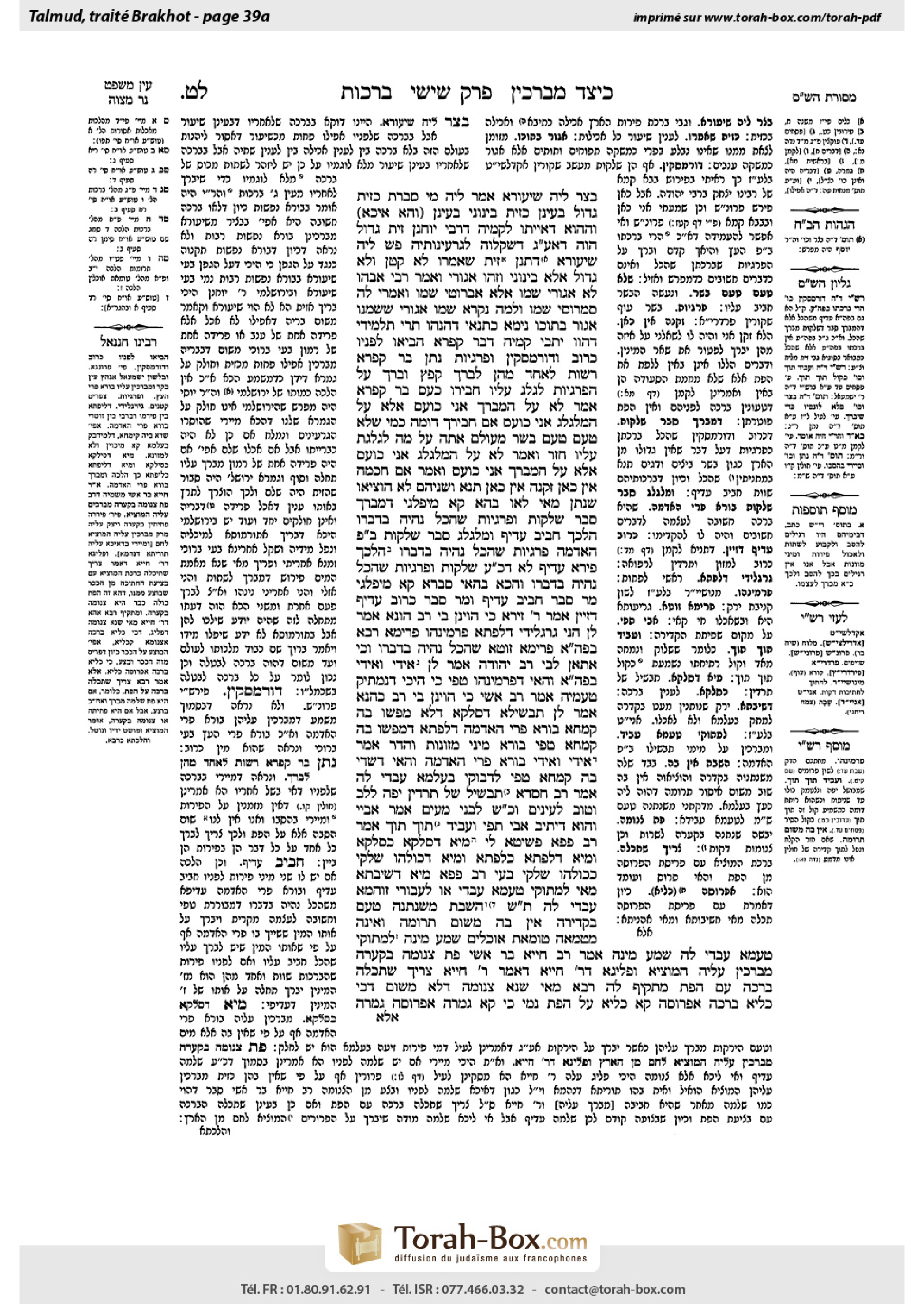
Berakhot 39a: Talmud study for Daf Yomi
Study the Talmud for Daf Yomi with scanned pages, Hebrew text, English translations from Sefaria and AI-generated French translations.
Passage selection and English or AI-generated French translation are available where the scan has annotations. Daf Study is independent of Torah-Box and Sefaria.
Browse Berakhot · ברכות · All tractatesBerakhot 39a text and translations
This page of Berakhot includes the Aramaic text, an English translation and an AI-generated French translation, alongside the scan above.
ברכות ל״ט א · Aramaic and Hebrew text
בָּצַר לֵיהּ שִׁיעוּרָא.
אָמַר לֵיהּ: מִי סָבְרַתְּ כְּזַיִת גָּדוֹל בָּעֵינַן? כְּזַיִת בֵּינוֹנִי בָּעֵינַן (וְהָא אִיכָּא), וְהַהוּא דְּאַיְיתוֹ לְקַמֵּיהּ דְּרַבִּי יוֹחָנָן זַיִת גָּדוֹל הֲוָה, דְּאַף עַל גַּב דְּשַׁקְלוּהָ לְגַרְעִינוּתֵיהּ פָּשׁ לֵיהּ שִׁיעוּרָא.
דִּתְנַן: זַיִת שֶׁאָמְרוּ לֹא קָטָן וְלֹא גָּדוֹל, אֶלָּא בֵּינוֹנִי — וְזֶהוּ ״אֵגוֹרִי״. וְאָמַר רַבִּי אֲבָהוּ: לֹא ״אֵגוֹרִי״ שְׁמוֹ אֶלָּא ״אִבְרוֹטִי״ שְׁמוֹ, וְאָמְרִי לַהּ ״סִמְרוֹסִי״ שְׁמוֹ. וְלָמָּה נִקְרָא שְׁמוֹ ״אֵגוֹרִי״ — שֶׁשַּׁמְנוֹ אָגוּר בְּתוֹכוֹ.
נֵימָא כְּתַנָּאֵי: דְּהָנְהוּ תְּרֵי תַּלְמִידֵי דַּהֲווֹ יָתְבִי קַמֵּיהּ דְּבַר קַפָּרָא. הֵבִיאוּ לְפָנָיו כְּרוּב וְדוֹרְמַסְקִין וּפַרְגִּיּוֹת. נָתַן בַּר קַפָּרָא רְשׁוּת לְאֶחָד מֵהֶן לְבָרֵךְ, קָפַץ וּבֵרַךְ עַל הַפַּרְגִּיּוֹת. לִגְלֵג עָלָיו חֲבֵירוֹ. כָּעַס בַּר קַפָּרָא אָמַר: לֹא עַל הַמְבָרֵךְ אֲנִי כּוֹעֵס, אֶלָּא עַל הַמְלַגְלֵג אֲנִי כּוֹעֵס. אִם חֲבֵירְךָ דּוֹמֶה כְּמִי שֶׁלֹּא טָעַם טַעַם בָּשָׂר מֵעוֹלָם, אַתָּה עַל מָה לִגְלַגְתָּ עָלָיו? חָזַר וְאָמַר: לֹא עַל הַמְלַגְלֵג אֲנִי כּוֹעֵס, אֶלָּא עַל הַמְבָרֵךְ אֲנִי כּוֹעֵס. וְאָמַר: אִם חָכְמָה אֵין כָּאן, זִקְנָה אֵין כָּאן?!
תָּנָא: וּשְׁנֵיהֶם לֹא הוֹצִיאוּ שְׁנָתָן.
מַאי לָאו בְּהָא קָא מִיפַּלְגִי, דִּמְבָרֵךְ סָבַר שְׁלָקוֹת וּפַרְגִּיּוֹת ״שֶׁהַכֹּל נִהְיֶה בִּדְבָרוֹ״, הִלְכָּךְ חַבִּיב עֲדִיף, וּמְלַגְלֵג סָבַר שְׁלָקוֹת ״בּוֹרֵא פְּרִי הָאֲדָמָה״, פַּרְגִּיּוֹת ״שֶׁהַכֹּל נִהְיֶה בִּדְבָרוֹ״, הִלְכָּךְ פֵּירָא עֲדִיף.
לָא, דְּכוּלֵּי עָלְמָא שְׁלָקוֹת וּפַרְגִּיּוֹת ״שֶׁהַכֹּל נִהְיָה בִּדְבָרוֹ״, וְהָכָא בְּהַאי סְבָרָא קָא מִיפַּלְגִי: מָר סָבַר חַבִּיב עֲדִיף, וּמָר סָבַר כְּרוּב עֲדִיף, דְּזָיֵין.
אָמַר רַבִּי זֵירָא, כִּי הֲוֵינַן בֵּי רַב הוּנָא אֲמַר לַן: הָנֵי גַּרְגְּלִידֵי דְלִפְתָּא, פַּרְמִינְהוּ פְּרִימָא רַבָּא — ״בּוֹרֵא פְּרִי הָאֲדָמָה״, פְּרִימָא זוּטָא — ״שֶׁהַכֹּל נִהְיֶה בִּדְבָרוֹ״. וְכִי אֲתָאן לְבֵי רַב יְהוּדָה אֲמַר לַן: אִידֵּי וְאִידֵּי ״בּוֹרֵא פְּרִי הָאֲדָמָה״, וְהָא דְּפַרְמִינְהוּ טְפֵי, כִּי הֵיכִי דְּנִמְתִּיק טַעְמֵיהּ.
אָמַר רַב אָשֵׁי, כִּי הֲוֵינַן בֵּי רַב כָּהֲנָא אֲמַר לַן: תַּבְשִׁילָא דְסִלְקָא, דְּלָא מַפְּשׁוּ בַּהּ קִמְחָא — ״בּוֹרֵא פְּרִי הָאֲדָמָה״. דְּלִפְתָּא, דְּמַפְּשׁוּ בַּהּ קִמְחָא טְפֵי — ״בּוֹרֵא מִינֵי מְזוֹנוֹת״. וַהֲדַר אָמַר: אִידֵּי וְאִידֵּי ״בּוֹרֵא פְּרִי הָאֲדָמָה״, וְהַאי דְּשָׁדֵי בַּהּ קִמְחָא טְפֵי — לְדַבּוֹקֵי בְּעָלְמָא עָבְדִי לַהּ.
אָמַר רַב חִסְדָּא: תַּבְשִׁיל שֶׁל תְּרָדִין יָפֶה לַלֵּב, וְטוֹב לָעֵינַיִם, וְכׇל שֶׁכֵּן לִבְנֵי מֵעַיִם. אָמַר אַבָּיֵי: וְהוּא דְּיָתֵיב אַבֵּי תָפֵי וְעָבֵיד ״תּוֹךְ תּוֹךְ״.
אָמַר רַב פָּפָּא: פְּשִׁיטָא לִי מַיָּא דְסִלְקָא — כְּסִלְקָא, וּמַיָּא דְלִפְתָּא — כְּלִפְתָּא, וּמַיָּא דְּכוּלְּהוּ שִׁלְקֵי — כְּכוּלְּהוּ שִׁלְקֵי. בָּעֵי רַב פָּפָּא: מַיָּא דְשִׁיבְתָּא מַאי? לְמַתּוֹקֵי טַעְמָא עָבְדִי, אוֹ לְעַבּוֹרֵי זוּהֲמָא עָבְדִי לַהּ?
תָּא שְׁמַע: הַשֶּׁבֶת מִשֶּׁנָּתְנָה טַעַם בַּקְּדֵירָה אֵין בָּהּ מִשּׁוּם תְּרוּמָה, וְאֵינָהּ מְטַמְּאָה טוּמְאַת אוֹכָלִים. שְׁמַע מִינַּהּ לְמַתּוֹקֵי טַעְמָא עָבְדִי לַהּ. שְׁמַע מִינַּהּ.
אָמַר רַב חִיָּיא בַּר אָשֵׁי: פַּת צְנוּמָה בִּקְעָרָה מְבָרְכִין עָלֶיהָ ״הַמּוֹצִיא״. וּפְלִיגָא דְּרַבִּי חִיָּיא, דְּאָמַר רַבִּי חִיָּיא: צָרִיךְ שֶׁתִּכְלֶה בְּרָכָה עִם הַפַּת.
מַתְקִיף לַהּ רָבָא: מַאי שְׁנָא צְנוּמָה דְּלָא, מִשּׁוּם דְּכִי כָּלְיָא בְּרָכָה — אַפְּרוּסָה קָא כָּלְיָא? עַל הַפַּת נָמֵי, כִּי קָא גָמְרָה — אַפְּרוּסָה גָּמְרָה!
Berakhot 39a · English translation
it lacks the requisite measure? The smallest quantity of food that is considered eating is the size of an olive-bulk, and an olive with its pit removed is smaller than that.
He said to him: Do you hold that we require a large olive as the measure of food necessary in order to recite a blessing after eating? We require a medium-sized olive and that olive was that size, as the olive that they brought before Rabbi Yoḥanan was a large olive. Even though they removed its pit, the requisite measure remained.
The Gemara cites a proof that the halakhic measure of an olive is not based on a large olive as we learned in a mishna: The olive of which the Sages spoke with regard to the halakhic measures is neither small nor large, but medium, and that olive is called aguri. And Rabbi Abbahu said: The name of that genus of olives is not aguri, but its name is avruti, and some say that its name is samrusi. And why, then, is it called aguri? Because its oil is accumulated [agur] inside it.
With regard to the appropriate blessing over boiled vegetables: Let us say that this dispute is parallel to a dispute between the tanna’im, as the Gemara relates: Two students were sitting before bar Kappara when cooked cabbage, cooked Damascene plums and pullets were set before him. Bar Kappara gave one of the students permission to recite a blessing. He hurried and recited a blessing over the pullets and his counterpart ridiculed him for gluttonously reciting the blessing that should have been recited later, first. Bar Kappara became angry with both of them, he said: I am not angry with the one who recited the blessing, but at the one who ridiculed him. If your counterpart is like one who never tasted the flavor of meat and was therefore partial to the pullet, and hurriedly ate it, why did you ridicule him? Bar Kappara continued and said to the second student: I am not upset at the one who ridiculed him, rather it is with the one who recited the blessing that I am angry. And he said: If there is no wisdom here, is there no elder here? If you are uncertain which blessing to recite first, couldn’t you have asked me, as I am an elder?
The Gemara concludes that it was taught: And both of them did not live out his year. Due to bar Kappara’s anger they were punished, and both died within the year.
The Gemara attempts to infer from this story to the topic at hand: What? Is it not that they disagreed with regard to the following? The one who recited the blessing over the pullet first held that the blessing to be recited over both boiled vegetables and pullet is: By whose word all things came to be, and, therefore, that which he prefers takes precedence and is eaten first. The one who ridiculed him held that over boiled vegetables one recites: Who creates fruit of the ground, and over pullet one recites: By whose word all things came to be, and, therefore, the fruit takes precedence, as its blessing is more specific and therefore more significant.
The Gemara rejects this explanation: No, everyone agrees that over boiled vegetables and pullet one recites: By whose word all things came to be, and here they argue over this: This Sage, who recited the blessing, held that the food which is preferred takes precedence and one recites a blessing over it first, and the Sage who ridiculed him held: Cabbage takes precedence, as it nourishes.
Rabbi Zeira said: When we were in the study hall of Rav Huna he said to us: These turnip heads, if one cut them into large slices, he recites over them: Who creates fruit of the ground, because in doing so he has not significantly changed them. If he cut them into small pieces, he recites over them: By whose word all things came to be. And when we came to the study hall of Rav Yehuda he said to us: Over both these, large slices, and those, small pieces, one recites: Who creates fruit of the ground, and the fact that he cut them extensively was in order to sweeten its flavor.
On a similar note, Rav Ashi said: When we were in the study hall of Rav Kahana, he said to us: Over a cooked dish of beets to which they, typically, do not add a significant amount of flour, one recites: Who creates fruit of the ground. Over a cooked dish of turnips to which they, typically, add a more significant amount of flour, one recites: Who creates the various types of nourishment. And Rav Kahana reconsidered his previous statement and said: Over both these, beets, and those, turnips, one recites: Who creates fruit of the ground, and the fact that they threw extra flour in with the turnips, they did so merely so the components of the cooked dish would stick together. The primary ingredient in the dish remains the turnips, not the flour.
Tangential to this mention of a turnip dish, Rav Ḥisda added, and said: A cooked dish of beets is beneficial for the heart, good for the eyes and all the more so, for the intestines. Abaye said: That is specifically when the dish sits on the stove and makes a tukh tukh sound, i.e., it boils.
Rav Pappa said: It is clear to me that beet water, water in which beets were boiled, has the same status as beets, and turnip water has the same status turnips, and the water in which all boiled vegetables were boiled has the same status as all boiled vegetables. However, Rav Pappa raised a dilemma: What is the status of water in which dill was boiled? Do they use dill to sweeten the taste, or do they use it to remove residual filth? If the dill was added to flavor the food then the water in which it was boiled should be treated like water in which any other vegetable was boiled. However, if the dill was added merely to absorb the residue of the soup, then there was never any intention to flavor the dish and one should not recite a blessing over it.
Come and hear a resolution to this dilemma from what we learned in a mishna in the tractate Okatzin: Dill, once it has already given its flavor in the pot, no longer has any value and is no longer subject to the halakhot of teruma and since it is no longer considered food, it can no longer become impure with the ritual impurity of food. Learn from this that they used dill to sweeten the taste. The Gemara concludes: Indeed, learn from this.
Rav Ḥiyya bar Ashi said: Over dry bread that was placed in a bowl to soak, one recites: Who brings forth bread from the earth, even if there is another loaf of bread before him, as it is considered bread in every respect. This halakha disagrees with the opinion of Rabbi Ḥiyya, as Rabbi Ḥiyya said: The blessing must conclude with the beginning of the breaking of the loaf of bread. The dried bread had already been sliced and separated from the loaf.
Rava strongly objects to this assumption: What is different about dried bread, that one does not recite: Who brings forth bread from the earth, over it, because when the blessing concludes, it concludes on a slice? In a case where he recites a blessing on a loaf of bread as well, when he completes the blessing, he completes it on a slice, as one cuts the bread before the blessing.
Berakhot 39a · Traduction française (IA)
Il manque la mesure requise ? La plus petite quantité de nourriture considérée comme un repas est la taille d'une olive, et une olive avec son noyau retiré est plus petite que cela.
Il lui dit : Tu penses que nous exigeons une olive grande comme mesure de nourriture nécessaire pour réciter une bénédiction après avoir mangé ? Nous exigeons une olive moyenne et cette olive était de cette taille, car l'olive que l'on apporta devant Rabbi Yoḥanan était une olive grande. Même s'ils enlevèrent son noyau, la mesure requise resta.
Le Guemara cite une preuve que la mesure halakhique d'une olive ne s'appuie pas sur une olive grande comme nous l'avons appris dans une mitsva : L'olive dont les Sages parlèrent en ce qui concerne les mesures halakhiques n'est ni petite ni grande, mais moyenne, et cette olive s'appelle aguri. Et Rabbi Abbahu dit : Le nom de cette espèce d'olives n'est pas aguri, mais son nom est avruti, et certains disent que son nom est samrusi. Et pourquoi alors s'appelle-t-elle aguri ? Parce que son huile est accumulée [agur] à l'intérieur.
En ce qui concerne la bénédiction appropriée sur les légumes bouillis : Disons que ce débat est parallèle à un débat entre les tannaïm, comme le Guemara le rapporte : Deux étudiants étaient assis devant bar Kappara lorsqu'on lui présenta des chou-fleur bouillis, des pruniers de Damas bouillis et des poulets. Bar Kappara permit à l'un des étudiants de réciter une bénédiction. Il s'empressa de réciter une bénédiction sur les poulets et son collègue le moqua pour avoir récité la bénédiction de manière gloutonne, celle qui aurait dû être récitée plus tard, d'abord. Bar Kappara s'indigna contre les deux, il dit : Je ne suis pas en colère contre celui qui a récité la bénédiction, mais contre celui qui l'a moqué. Si ton collègue est comme celui qui n'a jamais goûté le goût de la viande et était donc partial pour le poulet, et s'est empressé de le manger, pourquoi as-tu moqué ? Bar Kappara continua et dit au second étudiant : Je ne suis pas en colère contre celui qui l'a moqué, plutôt c'est avec celui qui a récité la bénédiction que je suis en colère. Et il dit : S'il n'y a pas de sagesse ici, n'y a-t-il pas d'ancien ici ? Si tu es incertain de quelle bénédiction réciter en premier, ne pouvais-tu pas me demander, car je suis un ancien ?
Le Guemara conclut que cela fut enseigné : Et les deux ne vécurent pas la durée de l'année. À cause de la colère de bar Kappara, ils furent punis et les deux moururent dans l'année.
Le Guemara tente d'inférer de cette histoire à propos du sujet en question : Quoi ? N'est-ce pas que l'opposition était sur la suivante ? Celui qui a récité la bénédiction sur le poulet d'abord pensait que la bénédiction à réciter sur les légumes bouillis et le poulet est : Par la parole dont toutes choses sont venues à l'être, et, donc, ce que l'on préfère est mangé d'abord. Celui qui a moqué dit qu'il faut réciter : Qui crée les fruits de la terre sur les légumes bouillis, et sur le poulet : Par la parole dont toutes choses sont venues à l'être, et, donc, le fruit prend la priorité, car sa bénédiction est plus spécifique et donc plus importante.
Le Guemara rejette cette explication : Non, tout le monde est d'accord que sur les légumes bouillis et le poulet on récite : Par la parole dont toutes choses sont venues à l'être, et ici ils débattent de cela : Ce sage, qui a récité la bénédiction, pensait que la nourriture préférée est prioritaire et qu'on récite une bénédiction sur elle d'abord, et le sage qui a moqué dit : Le chou prend la priorité, car il nourrit.
Rabbi Zeira dit : Quand nous étions dans la salle de study de Rav Huna, il nous dit : Ces têtes de navets, si l'on les coupe en grandes tranches, on récite sur elles : Qui crée les fruits de la terre, car en le faisant on n'a pas significativement changé leur forme. Si l'on les coupe en petites tranches, on récite sur elles : Par la parole dont toutes choses sont venues à l'être. Et quand nous sommes arrivés dans la salle de study de Rav Yehuda, il nous dit : Sur ces deux, les grandes tranches et celles, les petites, on récite : Qui crée les fruits de la terre, et le fait qu'on les ait coupés en profondeur était pour rendre leur goût plus doux.
Sur un point similaire, Rav Ashi dit : Quand nous étions dans la salle de study de Rav Kahana, il nous dit : Sur un plat de betteraves à laquelle on n'ajoute généralement pas une quantité significative de farine, on récite : Qui crée les fruits de la terre. Sur un plat de navets à laquelle on ajoute généralement une quantité plus importante de farine, on récite : Qui crée les divers types de nourriture. Et Rav Kahana réexamina sa déclaration précédente et dit : Sur ces deux, les betteraves et les navets, on récite : Qui crée les fruits de la terre, et le fait qu'ils aient ajouté de la farine supplémentaire aux navets était uniquement pour que les composants du plat restent ensemble. L'ingrédient principal du plat reste les navets, pas la farine.
En lien avec cette mention d'un plat de navets, Rav Ḥisda ajouta et dit : Un plat de betteraves est bénéfique pour le cœur, bon pour les yeux et encore plus, pour les intestins. Abaye dit : C'est spécifiquement quand le plat est sur le feu et fait un bruit tukh tukh, c'est-à-dire qu'il bouillonne.
Rav Pappa dit : Il est clair pour moi que l'eau de betteraves, l'eau dans laquelle les betteraves ont été bouillies, a le même statut que les betteraves, et l'eau de navets a le même statut que les navets, et l'eau dans laquelle tous les légumes bouillis ont été bouillis a le même statut que tous les légumes bouillis. Cependant, Rav Pappa souleva un dilemme : Quel est le statut de l'eau dans laquelle on a bouilli du persil ? Utilisent-ils le persil pour assaisonner le goût, ou l'utilisent-ils pour éliminer les résidus de soupe ? Si le persil a été ajouté pour assaisonner la nourriture, alors l'eau dans laquelle il a été bouilli devrait être traitée comme l'eau dans laquelle tout autre légume a été bouilli. Cependant, si le persil a été ajouté uniquement pour absorber les résidus de la soupe, alors il n'y avait pas l'intention d'assaisonner le plat et on ne devrait pas réciter une bénédiction sur elle.
Venez écouter une solution à ce dilemme tirée de ce que nous avons appris dans une mitsna du traité Okatzin : Le ciboule, une fois qu'elle a déjà donné son goût dans la casserole, n'a plus de valeur et n'est plus soumise aux halakhot de terouma, et puisqu'elle n'est plus considérée comme de la nourriture, elle ne peut plus devenir impure par l'impureté rituelle de la nourriture. Apprenez-en cela que l'on utilisait le ciboule pour assaisonner. La Guemara conclut : En effet, apprenez-en cela.
Rav Ḥiyya bar Ashi a dit : Sur du pain sec placé dans un bol pour s'imprégner, on récite : Celui qui fait sortir le pain de la terre, même s'il y a une autre tranche de pain devant lui, car il est considéré comme du pain en tout point. Cette halakha est en désaccord avec l'opinion de Rabbi Ḥiyya, car Rabbi Ḥiyya a dit : La bénédiction doit se terminer par le début de la décomposition de la baguette de pain. Le pain sec avait déjà été tranché et séparé de la baguette.
Rava s'oppose fermement à cette hypothèse : Qu'est-ce qui diffère dans le pain sec, que l'on ne récite pas : Celui qui fait sortir le pain de la terre sur lui, car lorsque la bénédiction se termine, elle se termine sur une tranche ? Dans un cas où l'on récite une bénédiction sur une baguette de pain également, lorsque l'on termine la bénédiction, l'on termine sur une tranche, car l'on coupe le pain avant la bénédiction.
Traduction française générée par IA à partir de l’édition anglaise de Sefaria. Vérifie toujours un passage avec le texte source.
Text from Sefaria: William Davidson Edition - Vocalized Aramaic (CC BY NC); William Davidson Edition - English (CC BY NC).