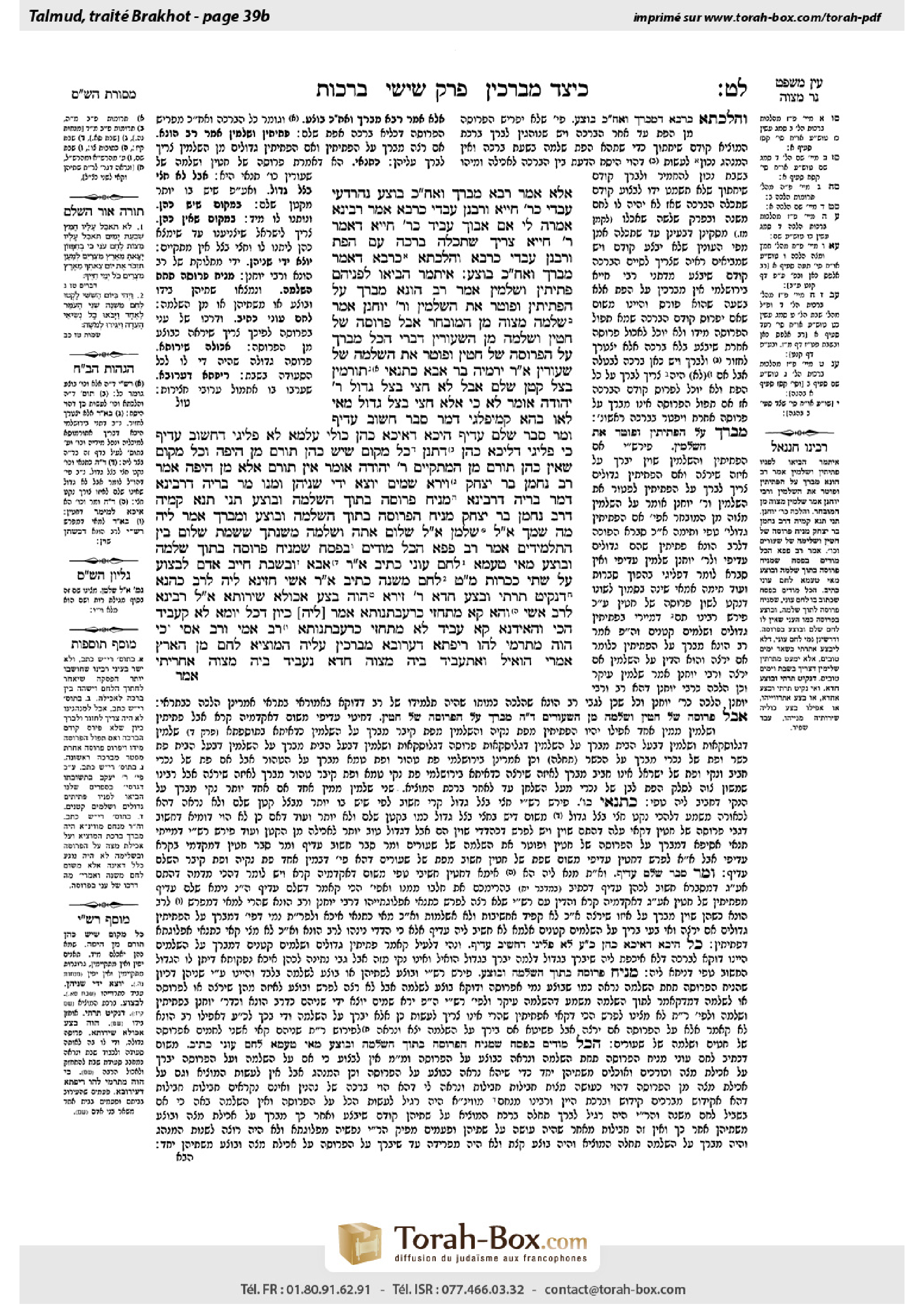
Berakhot 39b: Talmud study for Daf Yomi
Study the Talmud for Daf Yomi with scanned pages, Hebrew text, English translations from Sefaria and AI-generated French translations.
Passage selection and English or AI-generated French translation are available where the scan has annotations. Daf Study is independent of Torah-Box and Sefaria.
Browse Berakhot · ברכות · All tractatesBerakhot 39b text and translations
This page of Berakhot includes the Aramaic text, an English translation and an AI-generated French translation, alongside the scan above.
ברכות ל״ט ב · Aramaic and Hebrew text
אֶלָּא אָמַר רָבָא: מְבָרֵךְ וְאַחַר כָּךְ בּוֹצֵעַ.
נְהַרְדָּעֵי עָבְדִי כְּרַבִּי חִיָּיא וְרַבָּנַן עָבְדִי כְּרָבָא. אָמַר רָבִינָא: אָמְרָה לִי אֵם, אֲבוּךְ עָבֵיד כְּרַבִּי חִיָּיא, דְּאָמַר רַבִּי חִיָּיא: צָרִיךְ שֶׁתִּכְלֶה בְּרָכָה עִם הַפַּת. וְרַבָּנַן עָבְדִי כְּרָבָא. וְהִלְכְתָא כְּרָבָא, דְּאָמַר מְבָרֵךְ וְאַחַר כָּךְ בּוֹצֵעַ.
אִיתְּמַר: הֵבִיאוּ לִפְנֵיהֶם פְּתִיתִין וּשְׁלֵמִין, אָמַר רַב הוּנָא: מְבָרֵךְ עַל הַפְּתִיתִין וּפוֹטֵר אֶת הַשְּׁלֵמִין. וְרַבִּי יוֹחָנָן אָמַר: שְׁלֵמָה מִצְוָה מִן הַמּוּבְחָר. אֲבָל פְּרוּסָה שֶׁל חִטִּין וּשְׁלֵמָה מִן הַשְּׂעוֹרִין, דִּבְרֵי הַכֹּל מְבָרֵךְ עַל הַפְּרוּסָה שֶׁל חִטִּין, וּפוֹטֵר אֶת הַשְּׁלֵמָה שֶׁל שְׂעוֹרִין.
אָמַר רַבִּי יִרְמְיָה בַּר אַבָּא כְּתַנָּאֵי: תּוֹרְמִין בָּצָל קָטָן שָׁלֵם, אֲבָל לֹא חֲצִי בָּצָל גָּדוֹל. רַבִּי יְהוּדָה אוֹמֵר: לֹא כִי, אֶלָּא חֲצִי בָּצָל גָּדוֹל. מַאי לָאו בְּהָא קָמִיפַּלְגִי, דְּמָר סָבַר חָשׁוּב עָדִיף, וּמָר סָבַר שָׁלֵם עָדִיף.
הֵיכָא דְּאִיכָּא כֹּהֵן, כּוּלֵּי עָלְמָא לָא פְּלִיגִי דְּחָשׁוּב עָדִיף. כִּי פְּלִיגִי דְּלֵיכָּא כֹּהֵן. דִּתְנַן: כׇּל מָקוֹם שֶׁיֵּשׁ כֹּהֵן — תּוֹרֵם מִן הַיָּפֶה, וְכׇל מָקוֹם שֶׁאֵין כֹּהֵן — תּוֹרֵם מִן הַמִּתְקַיֵּים. רַבִּי יְהוּדָה אוֹמֵר: אֵין תּוֹרֵם אֶלָּא מִן הַיָּפֶה.
אָמַר רַב נַחְמָן בַּר יִצְחָק: וִירֵא שָׁמַיִם יוֹצֵא יְדֵי שְׁנֵיהֶן, וּמַנּוּ? — מָר בְּרֵיהּ דְּרָבִינָא, דְּמָר בְּרֵיהּ דְּרָבִינָא מַנִּיחַ פְּרוּסָה בְּתוֹךְ הַשְּׁלֵמָה וּבוֹצֵעַ.
תָּנֵי תַּנָּא קַמֵּיהּ דְּרַב נַחְמָן בַּר יִצְחָק: מַנִּיחַ הַפְּרוּסָה בְּתוֹךְ הַשְּׁלֵמָה וּבוֹצֵעַ וּמְבָרֵךְ. אֲמַר לֵיהּ: מַה שִּׁמְךָ? אֲמַר לֵיהּ: שַׁלְמָן. אֲמַר לֵיהּ: שָׁלוֹם אַתָּה וּשְׁלֵמָה מִשְׁנָתְךָ, שֶׁשַּׂמְתָּ שָׁלוֹם בֵּין הַתַּלְמִידִים.
אָמַר רַב פָּפָּא: הַכֹּל מוֹדִים בְּפֶסַח, שֶׁמַּנִּיחַ פְּרוּסָה בְּתוֹךְ שְׁלֵמָה וּבוֹצֵעַ. מַאי טַעְמָא? — ״לֶחֶם עֹנִי״ כְּתִיב.
אָמַר רַבִּי אַבָּא וּבְשַׁבָּת חַיָּיב אָדָם לִבְצוֹעַ עַל שְׁתֵּי כִכָּרוֹת. מַאי טַעְמָא? — ״לֶחֶם מִשְׁנֶה״ כְּתִיב.
אָמַר רַב אָשֵׁי: חֲזֵינָא לֵיהּ לְרַב כָּהֲנָא דְּנָקֵיט תַּרְתֵּי וּבָצַע חֲדָא. רַבִּי זֵירָא הֲוָה בָּצַע אַכּוֹלָּא שֵׁירוּתָא. אֲמַר לֵיהּ רָבִינָא לְרַב אָשֵׁי: וְהָא קָא מִתְחֲזֵי כְּרַעַבְתָנוּתָא. אֲמַר [לֵיהּ]: כֵּיוָן דְּכָל יוֹמָא לָא קָעָבֵיד הָכִי, וְהָאִידָּנָא קָא עָבֵיד — לָא מִתְחֲזֵי כְּרַעַבְתָנוּתָא.
רַב אַמֵּי וְרַב אַסִּי כִּי הֲוָה מִתְרְמֵי לְהוּ רִיפְתָּא דְעֵרוּבָא מְבָרְכִין עֲלֵיהּ ״הַמּוֹצִיא לֶחֶם מִן הָאָרֶץ״. אָמְרִי: הוֹאִיל וְאִתְעֲבִיד בֵּיהּ מִצְוָה חֲדָא, נַעֲבֵיד בֵּיהּ מִצְוָה אַחֲרִיתִי.
Berakhot 39b · English translation
Rather, Rava said: When breaking bread, one recites the blessing over the complete loaf and only afterwards, he breaks it.
The Gemara relates: The Sages of Neharde’a acted in accordance with the opinion of Rabbi Ḥiyya and would recite the blessing as they were breaking the bread and conclude the blessing as he finished breaking off the piece of bread. And the Rabbis acted in accordance with the opinion of Rava and would recite the blessing before breaking the bread. Ravina said: My mother told me: Your father acted in accordance with the opinion of Rabbi Ḥiyya, as Rabbi Ḥiyya said: The blessing must conclude with the beginning of the breaking of the loaf of bread. And the Rabbis acted in accordance with the opinion of Rava. The Gemara concludes: The halakha is in accordance with the opinion of Rava, who said one recites the blessing over the complete loaf and only afterwards he breaks it.
It was stated that there was an amoraic dispute with regard to whether to recite the blessing over a whole loaf of bread or to recite it over a piece of bread: If they brought pieces and whole loaves of bread before those partaking of a meal, Rav Huna said: One may recite the blessing over the pieces and with that blessing exempts the whole loaves as well. Rabbi Yoḥanan said: The optimal manner in which to fulfill the mitzva is to recite the blessing over the whole loaf. However, if the piece was of wheat bread and the whole loaf was of barley bread, everyone agrees that one recites a blessing over the piece of wheat bread. Although it is a piece of bread, it is nevertheless of superior quality, and in so doing one exempts the whole loaf of barley bread.
Rabbi Yirmeya bar Abba said that the dispute between Rav Huna and Rabbi Yoḥanan is parallel to a tannaitic dispute with regard to the halakhot of teruma. We learned: Even though the onions from which the teruma must be separated are divided equally between the two, one separates teruma from a whole small onion but not from half of a large onion. Rabbi Yehuda says: No, rather, he separates teruma from half of a large onion. What, is it not that they disagree over this point, that one Sage, Rabbi Yehuda, held that the more significant takes precedence; therefore half of a large onion which is of superior quality is preferable, and the first tanna held that the whole item takes precedence?
The Gemara rejects this comparison: Where there is a priest who can immediately take the teruma from him, everyone agrees that more significant takes precedence. When they disagree is in a case where there is no priest there, as we learned in a mishna: Everywhere that there is a priest, one separates teruma from the best, and whenever there is no priest, one separates teruma from that which will endure, so that when a priest ultimately receives it, he will be able to derive benefit from it. Rabbi Yehuda says: One always separates teruma only from the best, even though it is not the longest-lasting.
With regard to the dispute between Rabbi Yoḥanan and Rav Huna, Rav Naḥman bar Yitzḥak said: A God-fearing individual fulfills both. And who is this God-fearing person? Mar, son of Ravina, as the Gemara relates that Mar, son of Ravina, would place the piece inside the whole loaf and break them together.
Similarly, the Gemara relates that the tanna recited a baraita before Rav Naḥman bar Yitzḥak: One places the piece inside the whole loaf, then breaks the bread and recites a blessing. Rav Naḥman said to him: What is your name? He answered: Shalman. Rav Naḥman replied with a pun: You are peace [shalom] and the teaching that you recited is complete [shelema] as by means of this baraita the disputing opinions are reconciled and you established peace among students.
This resolution is reinforced in a unique case, as Rav Pappa said: Everyone agrees that while fulfilling the mitzva of eating matza on Passover, one places the piece inside the whole and breaks. What is the reason? With regard to matza the phrase “Bread of affliction” (Deuteronomy 16:3) is written, and the poor typically eat their bread in pieces. Therefore, eating matza on Passover evening, the broken matza is also significant.
In connection to the various halakhot with regard to breaking bread, especially on Festivals, the Gemara cites another halakha. Rabbi Abba said: And on Shabbat one is obligated to break bread for the meal over two loaves. What is the reason? Because in the Torah portion that discusses gathering manna on Friday for Shabbat, the phrase: “Twice as much bread” (Exodus 16:22) is written. To commemorate this, Shabbat meals are based on two loaves of bread.
With regard to the manner in which these two loaves are to be broken, Rav Ashi said: I saw Rav Kahana who would take two loaves and break one. Rabbi Zeira would break off one large piece from the loaf, and eat from it for the entire Shabbat meal. Ravina said to Rav Ashi about this: Doesn’t it appear gluttonous for one to break off so large a piece? Rav Ashi said to him: Since every other day he does not do so, and today he does, it does not appear gluttonous, but rather in deference to the mitzva of the Shabbat meals.
With regard to eating on Shabbat, the Gemara relates: Rav Ami and Rav Asi, when the opportunity to use the bread of the eiruv in the Shabbat meal would present itself, they would recite: Who brings forth bread from the earth over it. They said in explanation: Since one mitzva was performed with it, we will perform another mitzva with it.
Berakhot 39b · Traduction française (IA)
En effet, Rava a dit : Lorsqu'on brise du pain, on récite la bénédiction sur le pain entier et ensuite seulement on le brise.
Le Guemara rapporte : Les Sages de Neharde’a agissaient selon l’opinion de Rabbi Ḥiyya et récitaient la bénédiction pendant qu’ils brisaient le pain et concluaient la bénédiction à la fin de la brisure. Les Rabbins agissaient selon l’opinion de Rava et récitaient la bénédiction avant de briser le pain. Ravina a dit : Ma mère m’a dit : Votre père agissait selon l’opinion de Rabbi Ḥiyya, car Rabbi Ḥiyya a dit : La bénédiction doit conclure au début de la brisure du pain entier. Et les Rabbins agissaient selon l’opinion de Rava. Le Guemara conclut : La halakha suit l’opinion de Rava, qui a dit qu’on récite la bénédiction sur le pain entier et ensuite seulement on le brise.
Il a été dit qu’il y avait un débat entre les amoraim concernant la question de savoir si on doit réciter la bénédiction sur un pain entier ou sur une part de pain : Si on apporte des parts et des pains entiers devant ceux qui prennent un repas, Rav Huna a dit : On peut réciter la bénédiction sur les parts et cette bénédiction exemptera aussi les pains entiers. Rabbi Yoḥanan a dit : La manière optimale de remplir la mitsva est de réciter la bénédiction sur le pain entier. Cependant, si la part était de pain de blé et le pain entier de pain de seigle, tout le monde convient qu’on récite la bénédiction sur la part de pain de blé. Bien qu’il s’agisse d’une part de pain, il s’agit d’une qualité supérieure, et en récitant la bénédiction sur cette part, on exemptera le pain entier de seigle.
Rabbi Yirmeya bar Abba a dit que le débat entre Rav Huna et Rabbi Yoḥanan est parallèle à un débat tannaitique concernant les halakhot de terouma. Nous avons appris : Même si les oignons d’où la terouma doit être séparée sont divisés équitablement entre les deux, on sépare la terouma d’un petit oignon entier mais pas d’une moitié d’un grand oignon. Rabbi Yehuda dit : Non, plutôt, on sépare la terouma d’une moitié d’un grand oignon. Qu’est-ce que cela signifie ? N’est-ce pas que les Sages s’opposent sur ce point, que l’un d’entre eux, Rabbi Yehuda, considère que l’élément plus important a la priorité ; donc la moitié d’un grand oignon, qui est de meilleure qualité, est préférable, et le premier tanna considère que l’objet entier a la priorité ?
Le Guemara rejette cette comparaison : Lorsqu’il y a un prêtre qui peut immédiatement prendre la terouma, tout le monde convient que l’élément plus important a la priorité. Le débat survient dans un cas où il n’y a pas de prêtre, comme nous l’avons appris dans une mishna : Partout où il y a un prêtre, on sépare la terouma du meilleur, et chaque fois qu’il n’y a pas de prêtre, on sépare la terouma de ce qui endure le plus longtemps, afin que lorsqu’un prêtre recevra finalement cela, il pourra en tirer un bénéfice. Rabbi Yehuda dit : On sépare toujours la terouma uniquement du meilleur, même s’il n’est pas le plus durable.
Concernant le débat entre Rabbi Yoḥanan et Rav Huna, Rav Naḥman bar Yitzḥak a dit : Un homme craignant Dieu rempli les deux. Et qui est ce homme craignant Dieu ? Mar, fils de Ravina, comme le Guemara rapporte que Mar, fils de Ravina, plaçait la part à l’intérieur du pain entier et brisait les deux ensemble.
De même, le Guemara rapporte que le tanna a récité un baraïta devant Rav Naḥman bar Yitzḥak : On place la part à l’intérieur du pain entier, puis on brise le pain et on récite la bénédiction. Rav Naḥman lui a demandé : Quel est ton nom ? Il a répondu : Shalman. Rav Naḥman a répondu avec une double entente : Tu es la paix [shalom] et la doctrine que tu as récitée est complète [shelema], car grâce à ce baraïta, les opinions divergentes sont réconciliées et tu as établi la paix entre les élèves.
Cette résolution est renforcée dans un cas unique, comme Rav Pappa a dit : Tout le monde convient que lors de l’accomplissement de la mitsva de manger du matza pendant la Pessah, on place la part à l’intérieur du pain entier et on le brise. Quelle est la raison ? Concernant le matza, la phrase « Pain d’affliction » (Deutéronome 16:3) est écrite, et les pauvres mangent généralement leur pain en parts. Ainsi, manger du matza pendant la nuit de Pessah, la matza brisée est également significative.
En lien avec les divers halakhot concernant la brisure du pain, notamment pendant les fêtes, le Guemara cite une autre halakha. Rabbi Abba a dit : Et le sabbat, on est tenu de briser du pain pour le repas avec deux pains. Quelle est la raison ? Parce que dans la portion de la Torah qui parle de la collecte de manna le vendredi pour le sabbat, la phrase : « Deux fois plus de pain » (Exode 16:22) est écrite. Pour commémorer cela, les repas du sabbat sont basés sur deux pains.
Concernant la manière dont ces deux pains doivent être brisés, Rav Ashi a dit : J’ai vu Rav Kahana qui prenait deux pains et brisait l’un d’eux. Rabbi Zeira brisait une grande part du pain et mangeait avec elle tout le repas du sabbat. Ravina a dit à Rav Ashi à ce sujet : N’est-ce pas apparemment glouton de briser une telle grande part ? Rav Ashi a répondu à lui : Puisque chaque autre jour il ne fait pas cela, et aujourd’hui il le fait, cela ne semble pas glouton, mais plutôt un dévouement à la mitsva des repas du sabbat.
Concernant la consommation le sabbat, le Guemara rapporte : Rav Ami et Rav Asi, lorsqu’une opportunité de utiliser le pain de l’eiruv dans le repas du sabbat se présentait, récitaient : Celui qui fait sortir du pain de la terre sur lui. Ils ont expliqué : Puisque une mitsva a été accomplie avec cela, nous accomplirons une autre mitsva avec cela.
Traduction française générée par IA à partir de l’édition anglaise de Sefaria. Vérifie toujours un passage avec le texte source.
Text from Sefaria: William Davidson Edition - Vocalized Aramaic (CC BY NC); William Davidson Edition - English (CC BY NC).