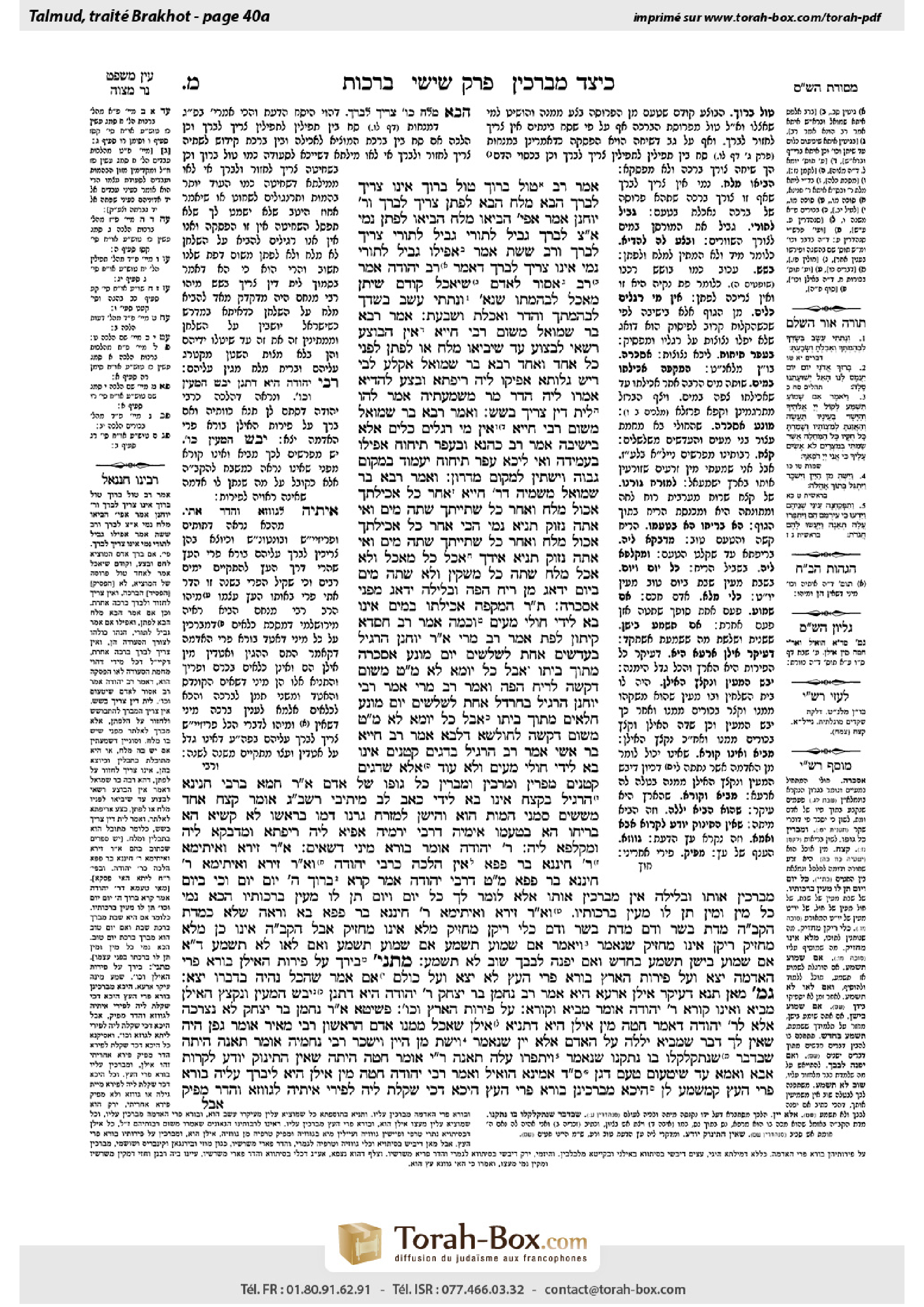
Berakhot 40a: Talmud study for Daf Yomi
Study the Talmud for Daf Yomi with scanned pages, Hebrew text, English translations from Sefaria and AI-generated French translations.
Passage selection and English or AI-generated French translation are available where the scan has annotations. Daf Study is independent of Torah-Box and Sefaria.
Browse Berakhot · ברכות · All tractatesBerakhot 40a text and translations
This page of Berakhot includes the Aramaic text, an English translation and an AI-generated French translation, alongside the scan above.
ברכות מ׳ א · Aramaic and Hebrew text
אָמַר רַב: ״טוֹל בָּרוּךְ, טוֹל בָּרוּךְ״ — אֵינוֹ צָרִיךְ לְבָרֵךְ. ״הָבֵא מֶלַח״ ״הָבֵא לִפְתָּן״ — צָרִיךְ לְבָרֵךְ. וְרַבִּי יוֹחָנָן אָמַר: אֲפִילּוּ ״הָבִיאוּ מֶלַח״ ״הָבִיאוּ לִפְתָּן״ נָמֵי אֵינוֹ צָרִיךְ לְבָרֵךְ, ״גַּבֵּיל לְתוֹרֵי, גַּבֵּיל לְתוֹרֵי״ צָרִיךְ לְבָרֵךְ. וְרַב שֵׁשֶׁת אָמַר: אֲפִילּוּ ״גַּבֵּיל לְתוֹרֵי״ נָמֵי אֵינוֹ צָרִיךְ לְבָרֵךְ, דְּאָמַר רַב יְהוּדָה אָמַר רַב: אָסוּר לָאָדָם שֶׁיֹּאכַל קוֹדֶם שֶׁיִּתֵּן מַאֲכָל לִבְהֶמְתּוֹ, שֶׁנֶּאֱמַר: ״וְנָתַתִּי עֵשֶׂב בְּשָׂדְךָ לִבְהֶמְתֶּךָ״ וַהֲדַר ״וְאָכַלְתָּ וְשָׂבָעְתָּ״.
אָמַר רָבָא בַּר שְׁמוּאֵל מִשּׁוּם רַבִּי חִיָּיא: אֵין הַבּוֹצֵעַ רַשַּׁאי לִבְצוֹעַ עַד שֶׁיָּבִיאוּ מֶלַח אוֹ לִפְתָּן לִפְנֵי כׇּל אֶחָד וְאֶחָד. רָבָא בַּר שְׁמוּאֵל אִקְּלַע לְבֵי רֵישׁ גָּלוּתָא, אַפִּיקוּ לֵיהּ רִיפְתָּא, וּבְצַע לְהֶדְיָא. אֲמַרוּ לֵיהּ: הֲדַר מָר מִשְּׁמַעְתֵּיהּ? אֲמַר לְהוּ: לֵית דֵּין צְרִיךְ בְּשַׁשׁ.
וְאָמַר רָבָא בַּר שְׁמוּאֵל מִשּׁוּם רַבִּי חִיָּיא: אֵין מֵי רַגְלַיִם כָּלִים אֶלָּא בִּישִׁיבָה. אָמַר רַב כָּהֲנָא: וּבְעָפָר תִּיחוּחַ, אֲפִילּוּ בַּעֲמִידָה. וְאִי לֵיכָּא עָפָר תִּיחוּחַ, יַעֲמוֹד בְּמָקוֹם גָּבוֹהַּ וְיַשְׁתִּין לִמְקוֹם מִדְרוֹן.
וְאָמַר רָבָא בַּר שְׁמוּאֵל מִשְּׁמֵיהּ דְּרַבִּי חִיָּיא אַחַר כׇּל אֲכִילָתְךָ אֱכוֹל מֶלַח, וְאַחַר כׇּל שְׁתִיָּיתְךָ שְׁתֵה מַיִם, וְאִי אַתָּה נִזּוֹק. תַּנְיָא נָמֵי הָכִי: אַחַר כׇּל אֲכִילָתְךָ אֱכוֹל מֶלַח, וְאַחַר כׇּל שְׁתִיָּיתְךָ שְׁתֵה מַיִם, וְאִי אַתָּה נִזּוֹק. תַּנְיָא אִידַּךְ: אָכַל כׇּל מַאֲכָל וְלֹא אָכַל מֶלַח, שָׁתָה כׇּל מַשְׁקִין וְלֹא שָׁתָה מַיִם, בַּיּוֹם — יִדְאַג מִן רֵיחַ הַפֶּה, וּבַלַּיְלָה — יִדְאַג מִפְּנֵי אַסְכָּרָה.
תָּנוּ רַבָּנַן: הַמַּקְפֶּה אֲכִילָתוֹ בְּמַיִם, אֵינוֹ בָּא לִידֵי חוֹלִי מֵעַיִם. וְכַמָּה? אָמַר רַב חִסְדָּא: קִיתוֹן לְפַת.
אָמַר רַב מָרִי אָמַר רַבִּי יוֹחָנָן: הָרָגִיל בַּעֲדָשִׁים אַחַת לִשְׁלשִׁים יוֹם מוֹנֵעַ אַסְכָּרָה מִתּוֹךְ בֵּיתוֹ. אֲבָל כׇּל יוֹמָא — לָא. מַאי טַעְמָא? — מִשּׁוּם דְּקָשֶׁה לְרֵיחַ הַפֶּה.
וְאָמַר רַב מָרִי אָמַר רַבִּי יוֹחָנָן: הָרָגִיל בְּחַרְדָּל אַחַת לִשְׁלשִׁים יוֹם — מוֹנֵעַ חֳלָאִים מִתּוֹךְ בֵּיתוֹ. אֲבָל כׇּל יוֹמָא — לָא, מַאי טַעְמָא? — מִשּׁוּם דְּקָשֵׁה לְחוּלְשָׁא דְלִבָּא.
אָמַר רַב חִיָּיא בַּר אָשֵׁי אָמַר רַב: הָרָגִיל בְּדָגִים קְטַנִּים — אֵינוֹ בָּא לִידֵי חוֹלִי מֵעַיִם. וְלֹא עוֹד, אֶלָּא שֶׁדָּגִים קְטַנִּים מַפְרִין וּמַרְבִּין וּמַבְרִין כׇּל גּוּפוֹ שֶׁל אָדָם.
אָמַר רַבִּי חָמָא בְּרַבִּי חֲנִינָא: הָרָגִיל בְּקֶצַח אֵינוֹ בָּא לִידֵי כְּאֵב לֵב. מֵיתִיבִי: רַבָּן שִׁמְעוֹן בֶּן גַּמְלִיאֵל אוֹמֵר: קֶצַח — אֶחָד מִשִּׁשִּׁים סַמָּנֵי הַמָּוֶת הוּא, וְהַיָּשֵׁן לְמִזְרַח גׇּרְנוֹ — דָּמוֹ בְּרֹאשׁוֹ. לָא קַשְׁיָא: הָא בְּרֵיחוֹ, הָא בְּטַעְמוֹ. אִימֵּיהּ דְּרַבִּי יִרְמְיָה אָפְיָא לֵיהּ רִיפְתָּא, וּמְדַבְּקָא לֵיהּ וּמְקַלְּפָא לֵיהּ.
רַבִּי יְהוּדָה אוֹמֵר ״בּוֹרֵא מִינֵי דְשָׁאִים״. אָמַר רַבִּי זֵירָא, וְאִיתֵּימָא רַבִּי חִינָּנָא בַּר פָּפָּא: אֵין הֲלָכָה כְּרַבִּי יְהוּדָה. וְאָמַר רַבִּי זֵירָא וְאִיתֵּימָא רַבִּי חִינָּנָא בַּר פָּפָּא: מַאי טַעְמָא דְּרַבִּי יְהוּדָה — אָמַר קְרָא ״בָּרוּךְ ה׳ יוֹם יוֹם״. וְכִי בַּיּוֹם מְבָרְכִין אוֹתוֹ, וּבַלַּיְלָה אֵין מְבָרְכִין אוֹתוֹ? אֶלָּא לוֹמַר לָךְ: כׇּל יוֹם וָיוֹם תֵּן לוֹ מֵעֵין בִּרְכוֹתָיו, הָכָא נָמֵי כׇּל מִין וּמִין תֵּן לוֹ מֵעֵין בִּרְכוֹתָיו.
וְאָמַר רַבִּי זֵירָא וְאִיתֵּימָא רַבִּי חִינָּנָא בַּר פָּפָּא: בּוֹא וּרְאֵה שֶׁלֹּא כְּמִדַּת הַקָּדוֹשׁ בָּרוּךְ הוּא מִדַּת בָּשָׂר וָדָם. מִדַּת בָּשָׂר וָדָם — כְּלִי רֵיקָן מַחֲזִיק, מָלֵא אֵינוֹ מַחֲזִיק. אֲבָל הַקָּדוֹשׁ בָּרוּךְ הוּא אֵינוֹ כֵן, מָלֵא מַחֲזִיק, רֵיקָן אֵינוֹ מַחֲזִיק. שֶׁנֶּאֱמַר: ״וַיֹּאמֶר אִם שָׁמוֹעַ תִּשְׁמַע״, אִם שָׁמוֹעַ — תִּשְׁמַע, וְאִם לָאו — לֹא תִשְׁמָע. דָּבָר אַחֵר: אִם שָׁמוֹעַ — בַּיָּשָׁן, תִּשְׁמַע — בֶּחָדָשׁ. וְאִם יִפְנֶה לְבָבְךָ — שׁוּב לֹא תִשְׁמָע.
מַתְנִי׳ בֵּירַךְ עַל פֵּירוֹת הָאִילָן ״בּוֹרֵא פְּרִי הָאֲדָמָה״ — יָצָא. וְעַל פֵּירוֹת הָאָרֶץ ״בּוֹרֵא פְּרִי הָעֵץ״ — לֹא יָצָא. וְעַל כּוּלָּם, אִם אָמַר ״שֶׁהַכֹּל נִהְיֶה בִּדְבָרוֹ״ — יָצָא.
גְּמָ׳ מַאן תַּנָּא דְּעִיקַּר אִילָן אַרְעָא הִיא?! אָמַר רַב נַחְמָן בַּר יִצְחָק: רַבִּי יְהוּדָה הִיא, דִּתְנַן: יָבֵשׁ הַמַּעְיָן וְנִקְצַץ הָאִילָן — מֵבִיא וְאֵינוֹ קוֹרֵא. רַבִּי יְהוּדָה אוֹמֵר: מֵבִיא וְקוֹרֵא.
עַל פֵּירוֹת הָאָרֶץ וְכוּ׳. פְּשִׁיטָא! אָמַר רַב נַחְמָן בַּר יִצְחָק: לֹא נִצְרְכָה אֶלָּא לְרַבִּי יְהוּדָה, דְּאָמַר חִטָּה מִין אִילָן הִיא. דְּתַנְיָא: אִילָן שֶׁאָכַל מִמֶּנּוּ אָדָם הָרִאשׁוֹן, רַבִּי מֵאִיר אוֹמֵר: גֶּפֶן הָיָה, שֶׁאֵין לְךָ דָּבָר שֶׁמֵּבִיא יְלָלָה עַל הָאָדָם אֶלָּא יַיִן, שֶׁנֶּאֱמַר: ״וַיֵּשְׁתְּ מִן הַיַּיִן וַיִּשְׁכָּר״. רַבִּי נְחֶמְיָה אוֹמֵר: תְּאֵנָה הָיְתָה, שֶׁבַּדָּבָר שֶׁנִּתְקַלְקְלוּ בּוֹ נִתַּקְּנוּ, שֶׁנֶּאֱמַר: ״וַיִּתְפְּרוּ עֲלֵה תְאֵנָה״. רַבִּי יְהוּדָה אוֹמֵר: חִטָּה הָיְתָה, שֶׁאֵין הַתִּינוֹק יוֹדֵעַ לִקְרוֹת ״אַבָּא״ וְ״אִמָּא״ עַד שֶׁיִּטְעוֹם טַעַם דָּגָן.
סָלְקָא דַּעְתָּךְ אָמֵינָא, הוֹאִיל וְאָמַר רַבִּי יְהוּדָה חִטָּה מִין אִילָן הִיא, לִיבָרֵךְ עֲלֵיהּ ״בּוֹרֵא פְּרִי הָעֵץ״. קָא מַשְׁמַע לַן, הֵיכָא מְבָרְכִינַן בּוֹרֵא פְּרִי הָעֵץ — הֵיכָא דְּכִי שָׁקְלַתְּ לֵיהּ לְפֵירֵי אִיתֵיהּ לִגְווֹזָא, וַהֲדַר מַפֵּיק,
Berakhot 40a · English translation
Continuing to discuss the halakhot of breaking bread, Rav said: One who broke bread, and before eating it, offered a piece to another, and said: Take it and recite a blessing, take it and recite a blessing, need not recite the blessing a second time, because that is considered to have been for the purpose of the blessing. If, however, he said: Bring salt or bring relish, he must recite the blessing a second time, as that is considered an interruption between the blessing and eating the bread. And Rabbi Yoḥanan said: Even if he said: Bring salt or bring relish, it is not considered an interruption and he need not recite the blessing a second time. Only if he said: Mix the food for the oxen, mix the food for the oxen, it is considered an interruption and he is required to recite the blessing a second time. And Rav Sheshet said: Even if he said: Mix for the oxen, he need not recite a blessing a second time, as that is also considered to be for the purpose of the blessing, as Rav Yehuda said that Rav said: One is prohibited from eating before feeding his animals, as it is stated: “And I will give grass in your fields for your animals” first and only then: “And you shall eat and be satisfied” (Deuteronomy 11:15). In the verse, preparation of food for one’s cattle precedes preparation of his own food. Consequently, it is considered part of the preparation for one’s own meal.
Rava bar Shmuel said in the name of Rabbi Ḥiyya: One who breaks bread is not permitted to break it until they bring salt or relish before each and every one seated at the table. However, the Gemara relates that Rava bar Shmuel himself happened to come to the House of the Exilarch. They brought him bread, which he immediately broke, without waiting for them to bring salt or relish. They said to him: Did the Master reconsider his halakhic ruling? He said to them: Although poor quality bread requires salt in order to give the bread flavor, and therefore one must wait before breaking bread, this refined bread served in the House of the Exilarch needs no salt, and does not require waiting.
And Rava bar Shmuel said in the name of Rabbi Ḥiyya: Urine only completely leaves the body if one urinates seated, as, otherwise, due to concern that drops of urine will drip onto his clothes, he attempts to conclude prematurely. Rav Kahana said: Over loose soil which absorbs the urine, one is not concerned that it will splash on him; therefore, even when standing the urine leaves his body. And if there is no loose soil there is another way to prevent the urine from splashing on his clothes while standing. Stand on an elevated place and urinate down an inclined plane.
And Rava bar Shmuel said the following advice in the name of Rabbi Ḥiyya: After all eating, eat salt and after all drinking, drink water and you will not be harmed. That was also taught in a baraita: After all eating, eat salt and after all drinking, drink water and you will not be harmed. It was taught in another baraita: If one ate any food and did not eat salt afterward, or if he drank any liquid and did not drink water afterward, during the day, he should be concerned about bad breath, and at night he should be concerned about diphtheria.
On the topic of health, the Gemara cites that the Sages taught in a baraita: One who inundates his food with water, i.e., one who drinks a great deal of water, will not come to suffer from intestinal illness. The Gemara asks: And how much water? Rav Ḥisda said: One jug [kiton] per loaf.
Rav Mari said that Rabbi Yoḥanan said: One who is accustomed to eat lentils once in thirty days prevents diphtheria from afflicting his house. The Gemara comments: However, one should not eat lentils every day. What is the reason? Because it is deleterious in that it causes bad breath.
And Rav Mari said that Rabbi Yoḥanan said: One who is accustomed to eat mustard once in thirty days prevents illnesses from afflicting his house. The Gemara comments: However, one should not eat mustard every day. What is the reason? Because it is deleterious in that it causes weakness of the heart.
Another health recommendation: Rabbi Ḥiyya bar Ashi said that Rav said: One who is accustomed to eat small fish will not come to suffer from intestinal illness. Moreover, eating small fish causes one’s entire body to flourish, to grow, and to be healthy.
Rabbi Ḥama, son of Rabbi Ḥanina, said: One who is accustomed to eat black cumin, a medicine for the heart, will not come to suffer from heart pain. The Gemara raises an objection: Rabban Shimon ben Gamliel says: Black cumin is one of sixty deadly drugs, and therefore one who sleeps to the east of its storage area, where its odor wafts with the westerly wind, responsibility for his blood is on his own head. The Gemara responds: This is not difficult, as this, where Rabban Shimon ben Gamliel said that black cumin is harmful, refers to its odor, whereas this, where Rabbi Ḥama, son of Rabbi Ḥanina, said that it is beneficial for the heart, refers only to its taste. And the Gemara relates: The mother of Rabbi Yirmeya would bake him bread and would stick black cumin to it so its taste would be absorbed, and she would peel it off, so that its odor would not harm him.
We learned in the mishna that Rabbi Yehuda says that one recites over herbs and leafy greens: Who creates various kinds of herbs. Rabbi Zeira, and some say Rabbi Ḥinnana bar Pappa, said: The halakha is not in accordance with the opinion of Rabbi Yehuda. And Rabbi Zeira, and some say Rabbi Ḥinnana bar Pappa, said: What is the reason for Rabbi Yehuda’s opinion? The verse says: “Blessed is the Lord, day by day” (Psalms 68:20). The question arises: Is it so that one blesses Him by day and does not bless Him at night? Rather, the verse comes to tell you: Each and every day, give the Lord the appropriate blessings for that day. Here too, with regard to the blessings recited over food, for each and every type of food, give the Lord the appropriate blessings for that food.
And Rabbi Zeira, and some say Rabbi Ḥinnana bar Pappa, said: Come and see that the attribute of flesh and blood is unlike the attribute of the Holy One, Blessed be He. The attribute of flesh and blood is that an empty vessel holds that which is placed within it, while a full vessel does not hold it. The attribute of the Holy One, Blessed be He, however, is not so, as if God adds to a person who is a full vessel in terms of knowledge or good attributes, he will hold it; a person who is an empty vessel will not hold it. This is alluded to by the verse where it is said: “And He said, if you will surely listen [shamo’a tishma] to the voice of the Lord your God and do what is right in His eyes” (Exodus 15:26). This verse is interpreted homiletically: If you listen [shamo’a] in the present, you will listen [tishma] in the future as well; and if not, you will not listen. Alternatively: If you listened [shamo’a] to the old, you review what you already learned, then you will listen [tishma] to the new as well. But if you turn your heart away, you will no longer be able to hear.
MISHNA: This mishna discusses how, after the fact, a more general blessing exempts one from the obligation to recite a more specific one. One who recited: Who creates fruit of the ground, over fruit of the tree, fulfilled his obligation. One who recited: Who creates fruit of the tree, over fruits of the earth, did not fulfill his obligation. And over all food items, one who recited: By whose word all things came to be, fulfilled his obligation.
GEMARA: The Gemara begins by ascertaining: Who is the tanna that holds that the primary factor in the growth of a tree is the earth, and therefore one may recite: Who creates fruit of the ground, over fruits of the tree fulfills his obligation? Rav Naḥman bar Yitzḥak said: That is the opinion of Rabbi Yehuda, as we learned in a mishna dealing with the halakhot of first fruits: If, after one picked the first fruits from his field, the spring dried up and the tree upon which the fruit grew was chopped down, he brings the first fruits to the Temple but does not read the accompanying praise. The tree or spring, which were the primary components of the growth of the fruit, no longer exist and he cannot recite the passage thanking God for “the good land.” Rabbi Yehuda says: He brings the first fruits and reads the accompanying praise, as the land is the primary factor in the growth of the tree, and the tree itself is merely an extension of the land. Even after the tree is felled, the land remains intact. Similarly, with regard to blessings, the halakha maintains that fruit of the tree is considered to be fruit of the ground, as well.
We learned in the mishna: One who recited: Who creates fruit of the tree, over fruits of the earth, did not fulfill his obligation. The Gemara asks: That is obvious, as fruits of the earth do not fall under the rubric of trees. Rav Naḥman bar Yitzḥak said: This ruling in the mishna is only necessary according to the opinion of Rabbi Yehuda, who said in another context that wheat is a type of tree, as we learned in a baraita: The tree from which Adam, the first man, ate, Rabbi Meir says: It was a vine, as nothing brings wailing and trouble upon man even today other than wine, as it is stated with regard to Noah: “And he drank from the wine and became drunk” (Genesis 9:21). Rabbi Neḥemya says: It was a fig tree, as with the object with which they were corrupted and sinned they were rehabilitated, as it is stated: “And they sewed together fig leaves and made for themselves loincloths” (Genesis 3:7). They must have taken the leaves from the tree closest at hand, the Tree of Knowledge. Rabbi Yehuda says: It was wheat, as, even today, the child does not know how to call his father and mother until he tastes the taste of grain.
Based on this, it might have entered your mind to say, since Rabbi Yehuda said that wheat is a type of tree, one should recite over it: Who creates fruit of the tree. Therefore, the mishna taught us that with regard to blessings, the principle is different. Where does one recite: Who creates fruit of the tree? Only in a case where, when you take the fruit, the branch remains and again produces fruit.
Berakhot 40a · Traduction française (IA)
En poursuivant la discussion sur les halakhot de la rupture du pain, Rav dit : Celui qui brise le pain, et avant de le manger, offre un morceau à un autre et dit : Prends-le et bénis, prends-le et bénis, n'a pas besoin de répéter la bénédiction, car cela est considéré comme étant fait à l'intention de la bénédiction. Cependant, si l'on dit : Apporte du sel ou apporte de la sauce, il doit répéter la bénédiction, car cela est considéré comme une interruption entre la bénédiction et la consommation du pain. Rabbi Yoḥanan a dit : Même si l'on dit : Apporte du sel ou apporte de la sauce, cela n'est pas considéré comme une interruption et il n'a pas besoin de répéter la bénédiction. Seul si l'on dit : Mélange la nourriture pour les bœufs, mélange la nourriture pour les bœufs, cela est considéré comme une interruption et il est tenu de répéter la bénédiction. Et Rav Sheshet a dit : Même si l'on dit : Mélange pour les bœufs, il n'a pas besoin de répéter la bénédiction, car cela est également considéré comme étant fait à l'intention de la bénédiction, comme Rav Yehuda a dit que Rav a dit : On est interdit de manger avant d'avoir nourri ses bêtes, car il est dit : « Et je donnerai de l'herbe dans tes champs pour tes bêtes » d'abord et seulement ensuite : « Et tu mangeras et tu seras rassasié » (Deutéronome 11:15). Dans la parole, la préparation de nourriture pour ses bêtes précède la préparation de sa propre nourriture. Par conséquent, cela est considéré comme faisant partie de la préparation de son propre repas.
Rava bar Shmuel a dit en nom de Rabbi Ḥiyya : Celui qui brise le pain n'est pas autorisé à le briser avant qu'on n'apporte du sel ou de la sauce à chacun des convives assis à la table. Cependant, la Guemara rapporte que Rava bar Shmuel lui-même est venu à la Maison de l'Exilarch. Ils lui ont apporté du pain, qu'il a immédiatement brisé sans attendre qu'on apporte du sel ou de la sauce. Ils lui ont dit : Le Maître a-t-il révisé sa décision halakhique ? Il a répondu à ceux-ci : Bien que le pain de mauvaise qualité nécessite du sel pour lui donner du goût, et donc qu'on doive attendre avant de briser le pain, ce pain raffiné servi dans la Maison de l'Exilarch n'a besoin de sel et ne nécessite pas d'attendre.
Et Rava bar Shmuel a dit en nom de Rabbi Ḥiyya : L'urine ne quitte entièrement le corps que si l'on urine assis, car, autrement, en raison de la crainte que des gouttes d'urine tombent sur ses vêtements, il tente de terminer prématurément. Rav Kahana a dit : Sur un sol lâche qui absorbe l'urine, on n'a pas à craindre qu'elle ne goutte sur lui ; par conséquent, même en se tenant debout, l'urine quitte son corps. Et si il n'y a pas de sol lâche, il y a une autre manière de prévenir que l'urine ne goutte pas sur ses vêtements en se tenant debout. Tenez-vous sur un endroit élevé et urinez sur une pente inclinée.
Et Rava bar Shmuel a dit l'avis suivant en nom de Rabbi Ḥiyya : Après avoir mangé tout, mangez du sel, et après avoir bu tout, buvez de l'eau, et vous ne serez pas atteint. Cela a également été enseigné dans une baraïta : Après avoir mangé tout, mangez du sel, et après avoir bu tout, buvez de l'eau, et vous ne serez pas atteint. Il a été enseigné dans une autre baraïta : Si l'on a mangé quelque nourriture sans avoir mangé de sel après, ou si l'on a bu quelque liquide sans avoir bu de l'eau après, pendant la journée, il faut craindre la mauvaise haleine, et la nuit, craindre la diphtérie.
Sur le sujet de la santé, la Guemara cite que les Sages ont enseigné dans une baraïta : Celui qui inonde sa nourriture d'eau, c'est-à-dire celui qui boit beaucoup d'eau, ne viendra pas à souffrir d'une maladie intestinale. La Guemara pose la question : Et combien d'eau ? Rav Ḥisda a dit : Un jug [kiton] par pain.
Rav Mari a dit que Rabbi Yoḥanan a dit : Celui qui est habitué à manger des lentilles une fois par mois empêche la diphtérie de frapper sa maison. La Guemara commente : Cependant, on ne doit pas manger des lentilles tous les jours. Pourquoi ? Parce qu'elles sont nuisibles, car elles causent une mauvaise haleine.
Et Rav Mari a dit que Rabbi Yoḥanan a dit : Celui qui est habitué à manger de la moutarde une fois par mois empêche les maladies de frapper sa maison. La Guemara commente : Cependant, on ne doit pas manger de la moutarde tous les jours. Pourquoi ? Parce qu'elles sont nuisibles, car elles causent une faiblesse du cœur.
Une autre recommandation de santé : Rabbi Ḥiyya bar Ashi a dit que Rav a dit : Celui qui est habitué à manger des petits pois ne souffrira pas d'infirmités intestinales. De plus, manger des petits pois cause que tout le corps s'épanouisse, s'élargisse et soit en bonne santé.
Rabbi Ḥama, fils de Rabbi Ḥanina, a dit : Celui qui est habitué à manger du cumin noir, un remède pour le cœur, ne souffrira pas de douleur cardiaque. La Guemara soulève une objection : Rabban Shimon ben Gamliel dit : Le cumin noir est l'un des soixante médicaments mortels, et donc celui qui dort à l'est du lieu de stockage du cumin noir, où son odeur monte avec le vent d'ouest, la responsabilité de son sang est sur sa tête. La Guemara répond : Ce n'est pas difficile, car cela, où Rabban Shimon ben Gamliel a dit que le cumin noir est nuisible, fait référence à son odeur, tandis que cela, où Rabbi Ḥama, fils de Rabbi Ḥanina, a dit qu'il est bénéfique pour le cœur, fait référence uniquement à son goût. Et la Guemara rapporte : La mère de Rabbi Yirmeya faisait cuire du pain pour lui et collait du cumin noir dessus afin que son goût soit absorbé, et elle le retirait, afin que son odeur ne le nuise pas.
Nous avons appris dans la michna que Rabbi Yehuda dit que l'on bénit sur les herbes et les feuillages : Celui qui crée diverses sortes d'herbes. Rabbi Zeira, et certains disent Rabbi Ḥinnana bar Pappa, a dit : La halakha n'est pas selon l'opinion de Rabbi Yehuda. Et Rabbi Zeira, et certains disent Rabbi Ḥinnana bar Pappa, a dit : Quelle est la raison de l'opinion de Rabbi Yehuda ? La versette dit : « Béni soit l'Éternel, jour par jour » (Psaumes 68:20). La question se pose : Est-ce que cela signifie que l'on bénit l'Éternel le jour et qu'on ne le bénit pas la nuit ? Plutôt, la versette vient vous dire : Chaque jour, donnez à l'Éternel les bénédictions appropriées pour ce jour. Ici aussi, concernant les bénédictions récitées sur les aliments, pour chaque type d'aliment, donnez à l'Éternel les bénédictions appropriées pour cet aliment.
Et Rabbi Zéira, et certains disent Rabbi Hinnana bar Pappa, a dit : Approchez-vous et voyez que l'attribut de la chair et du sang est différent de l'attribut du Saint des Saints. L'attribut de la chair et du sang est que le récipient vide contient ce qui est mis dedans, tandis que le récipient plein ne le contient pas. L'attribut du Saint des Saints, en revanche, n'est pas ainsi, car si Dieu ajoute à une personne qui est un récipient plein en termes de connaissance ou de bonnes qualités, il le contient ; une personne qui est un récipient vide ne le contient pas. Cela est allégué par la parole : « Et il dit : Si tu écoutes [shamo’a tishma] la voix du Seigneur ton Dieu et que tu fais ce qui est droit à Ses yeux » (Exode 15:26). Cette parole est interprétée de manière allégorique : Si tu écoutes [shamo’a] maintenant, tu écouteras [tishma] aussi à l'avenir ; et si non, tu ne pourras pas écouter. Alternativement : Si tu as écouté [shamo’a] l'ancien, tu revois ce que tu as déjà appris, alors tu écouteras [tishma] le nouveau aussi. Mais si tu tournes ton cœur, tu ne pourras plus entendre.
MICHNA : Cette mishna discute de la manière dont, après coup, une bénédiction générale exempt de l'obligation de réciter une bénédiction plus spécifique. Celui qui a récité : « Qui crée les fruits de la terre », sur les fruits des arbres, a rempli son obligation. Celui qui a récité : « Qui crée les fruits des arbres », sur les fruits de la terre, n'a pas rempli son obligation. Et sur tous les aliments, celui qui a récité : « Par Sa parole toutes choses sont venues à l'être », a rempli son obligation.
GUEMARA : La Guemara commence par établir : Qui est le tanna qui affirme que le facteur principal dans la croissance d'un arbre est la terre, et donc on peut réciter : « Qui crée les fruits de la terre », sur les fruits des arbres, remplir son obligation ? Rav Naḥman bar Yitzḥak a dit : C'est l'opinion de Rabbi Yéhuda, comme nous avons appris dans une mishna concernant les halakhot des premiers fruits : Si, après avoir récolté les premiers fruits de son champ, la fonte s'est tarie et l'arbre sur lequel les fruits ont grandi a été coupé, il apporte les premiers fruits au Temple mais ne lit pas la prière accompagnante. L'arbre ou la fonte, qui étaient les composants principaux de la croissance des fruits, n'existant plus, il ne peut pas réciter la prière de gratitude pour « la bonne terre ». Rabbi Yéhuda dit : Il apporte les premiers fruits et lit la prière accompagnante, car la terre est le facteur principal dans la croissance de l'arbre, et l'arbre lui-même n'est qu'une extension de la terre. Même après que l'arbre ait été abattu, la terre reste intacte. De même, concernant les bénédictions, la halakha maintient que les fruits des arbres sont considérés comme des fruits de la terre, car ainsi.
Nous avons appris dans la mishna : Celui qui a récité : « Qui crée les fruits des arbres », sur les fruits de la terre, n'a pas rempli son obligation. La Guemara demande : Cela est évident, car les fruits de la terre ne tombent pas sous la rubrique des arbres. Rav Naḥman bar Yitzḥak a dit : Cette décision de la mishna est nécessaire uniquement selon l'opinion de Rabbi Yéhuda, qui a dit dans un autre contexte que le blé est un type d'arbre, comme nous avons appris dans une baraïta : L'arbre d'où Adam, le premier homme, a mangé, Rabbi Méir dit : C'était une vigne, car rien ne provoque le chagrin et les ennuis chez l'homme aujourd'hui autre que le vin, comme il est dit concernant Noé : « Et il but du vin et devint ivre » (Genèse 9:21). Rabbi Néchemyah dit : C'était un arbre à figues, car avec l'objet avec lequel ils ont été corrompus et ont péché, ils ont été réparés, comme il est dit : « Et ils cousirent des feuilles de figue et firent pour eux des culottes » (Genèse 3:7). Ils doivent avoir pris les feuilles de l'arbre le plus proche, l'Arbre de la Connaissance. Rabbi Yéhuda dit : C'était du blé, car même aujourd'hui, l'enfant ne sait pas appeler son père et sa mère jusqu'à ce qu'il goûte le goût du grain.
En se basant sur cela, il pourrait avoir traversé votre esprit de dire, puisque Rabbi Yéhuda a dit que le blé est un type d'arbre, on devrait réciter sur lui : « Qui crée les fruits des arbres ». Par conséquent, la mishna nous a appris que concernant les bénédictions, le principe est différent. Où réciter : « Qui crée les fruits des arbres » ? Seulement dans le cas où, lorsqu'on prend le fruit, la branche reste et produit à nouveau des fruits.
Traduction française générée par IA à partir de l’édition anglaise de Sefaria. Vérifie toujours un passage avec le texte source.
Text from Sefaria: William Davidson Edition - Vocalized Aramaic (CC BY NC); William Davidson Edition - English (CC BY NC).