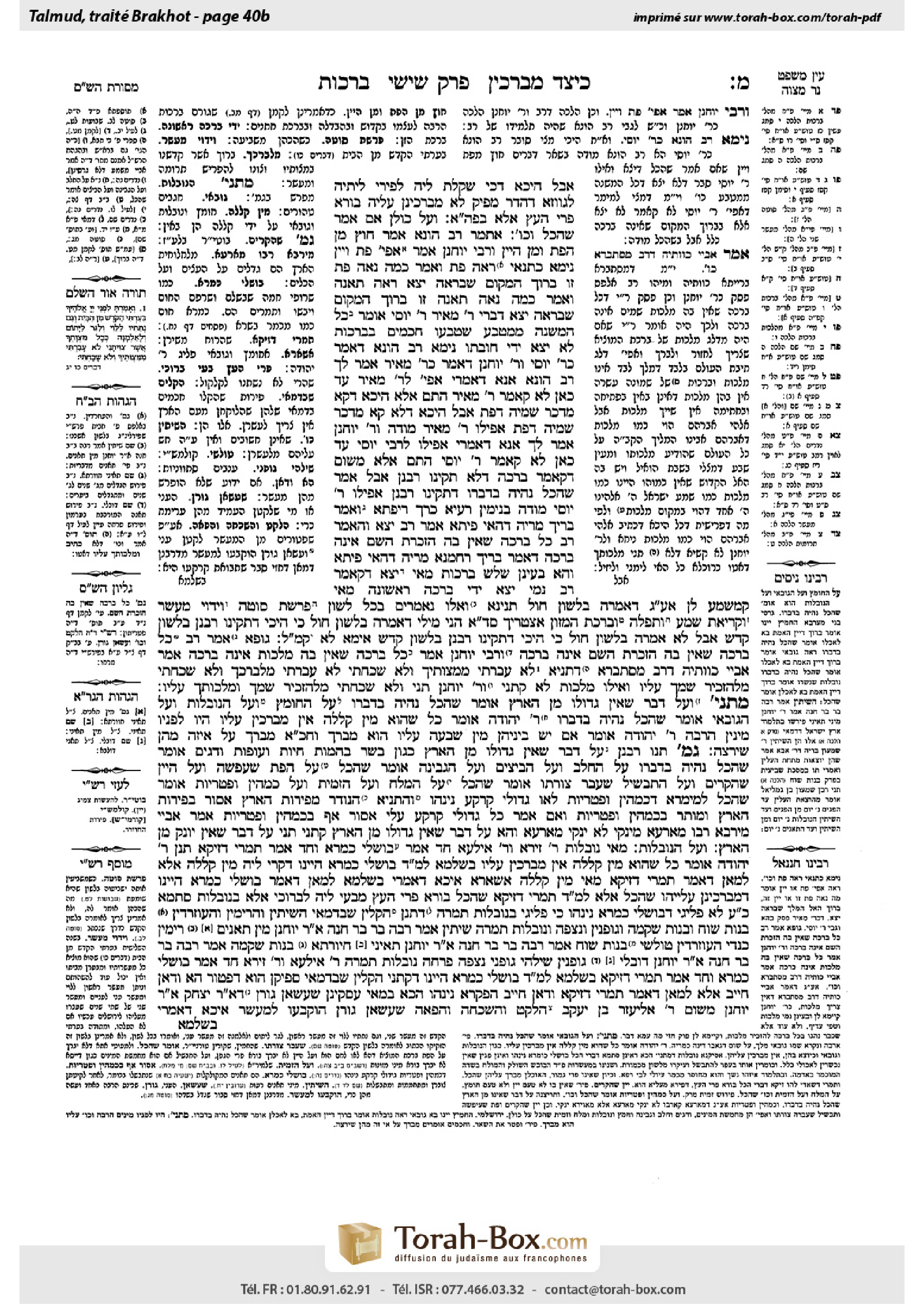
Berakhot 40b: Talmud study for Daf Yomi
Study the Talmud for Daf Yomi with scanned pages, Hebrew text, English translations from Sefaria and AI-generated French translations.
Passage selection and English or AI-generated French translation are available where the scan has annotations. Daf Study is independent of Torah-Box and Sefaria.
Browse Berakhot · ברכות · All tractatesBerakhot 40b text and translations
This page of Berakhot includes the Aramaic text, an English translation and an AI-generated French translation, alongside the scan above.
ברכות מ׳ ב · Aramaic and Hebrew text
אֲבָל הֵיכָא דְּכִי שָׁקְלַתְּ לֵיהּ לְפֵירֵי לֵיתֵיהּ לִגְווֹזָא דַּהֲדַר מַפֵּיק, לָא מְבָרְכִינַן עֲלֵיהּ ״בּוֹרֵא פְּרִי הָעֵץ״ אֶלָּא ״בּוֹרֵא פְּרִי הָאֲדָמָה״.
וְעַל כּוּלָּן אִם אָמַר ״שֶׁהַכֹּל״ וְכוּ׳. אִתְּמַר. רַב הוּנָא אָמַר: חוּץ מִן הַפַּת וּמִן הַיַּיִן. וְרַבִּי יוֹחָנָן אָמַר: אֲפִילּוּ פַּת וְיַיִן.
נֵימָא כְּתַנָּאֵי: רָאָה פַּת וְאָמַר: ״כַּמָּה נָאָה פַּת זוֹ, בָּרוּךְ הַמָּקוֹם שֶׁבְּרָאָהּ״ — יָצָא. רָאָה תְּאֵנָה וְאָמַר ״כַּמָּה נָאָה תְּאֵנָה זוֹ, בָּרוּךְ הַמָּקוֹם שֶׁבְּרָאָהּ״ — יָצָא, דִּבְרֵי רַבִּי מֵאִיר. רַבִּי יוֹסֵי אוֹמֵר: כׇּל הַמְשַׁנֶּה מִמַּטְבֵּעַ שֶׁטָּבְעוּ חֲכָמִים בִּבְרָכוֹת — לֹא יָצָא יְדֵי חוֹבָתוֹ. נֵימָא רַב הוּנָא דְּאָמַר כְּרַבִּי יוֹסֵי, וְרַבִּי יוֹחָנָן דְּאָמַר כְּרַבִּי מֵאִיר?!
אָמַר לָךְ רַב הוּנָא: אֲנָא דַּאֲמַרִי אֲפִילּוּ לְרַבִּי מֵאִיר, עַד כָּאן לָא קָאָמַר רַבִּי מֵאִיר הָתָם, אֶלָּא הֵיכָא דְּקָא מַדְכַּר שְׁמֵיהּ דְּפַת, אֲבָל הֵיכָא דְּלָא קָא מַדְכַּר שְׁמֵיהּ דְּפַת אֲפִילּוּ רַבִּי מֵאִיר מוֹדֶה.
וְרַבִּי יוֹחָנָן אָמַר לָךְ: אֲנָא דַּאֲמַרִי אֲפִילּוּ לְרַבִּי יוֹסֵי, עַד כָּאן לָא קָאָמַר רַבִּי יוֹסֵי הָתָם אֶלָּא מִשּׁוּם דְּקָאָמַר בְּרָכָה דְּלָא תַּקִּינוּ רַבָּנַן, אֲבָל אָמַר ״שֶׁהַכֹּל נִהְיֶה בִּדְבָרוֹ״ דְּתַקִּינוּ רַבָּנַן, אֲפִילּוּ רַבִּי יוֹסֵי מוֹדֶה.
בִּנְיָמִין רָעֲיָא כְּרַךְ רִיפְתָּא, וַאֲמַר: ״בְּרִיךְ מָרֵיהּ דְּהַאי פִּיתָּא״. אָמַר רַב: יָצָא. וְהָאָמַר רַב: כׇּל בְּרָכָה שֶׁאֵין בָּהּ הַזְכָּרַת הַשֵּׁם אֵינָהּ בְּרָכָה! דְּאָמַר: ״בְּרִיךְ רַחֲמָנָא מָרֵיהּ דְּהַאי פִּיתָּא״.
וְהָא בָּעֵינַן שָׁלֹשׁ בְּרָכוֹת? מַאי ״יָצָא״ דְּקָאָמַר רַב — נָמֵי יָצָא יְדֵי בְּרָכָה רִאשׁוֹנָה.
מַאי קָמַשְׁמַע לַן? אַף עַל גַּב דַּאֲמָרָהּ בִּלְשׁוֹן חוֹל.
תְּנֵינָא: וְאֵלּוּ נֶאֱמָרִים בְּכָל לְשׁוֹן: פָּרָשַׁת סוֹטָה, וִידּוּי מַעֲשֵׂר, קְרִיאַת שְׁמַע, וּתְפִלָּה, וּבִרְכַּת הַמָּזוֹן. אִצְטְרִיךְ: סָלְקָא דַעְתָּךְ אָמֵינָא, הָנֵי מִילֵּי דַּאֲמָרָהּ בִּלְשׁוֹן חוֹל כִּי הֵיכִי דְּתַקִּינוּ רַבָּנַן בִּלְשׁוֹן קֹדֶשׁ, אֲבָל לֹא אֲמָרָהּ בִּלְשׁוֹן חוֹל כִּי הֵיכִי דְּתַקִּינוּ רַבָּנַן בִּלְשׁוֹן קֹדֶשׁ, אֵימָא לָא. קָא מַשְׁמַע לַן.
גּוּפָא. אָמַר רַב: כׇּל בְּרָכָה שֶׁאֵין בָּהּ הַזְכָּרַת הַשֵּׁם — אֵינָהּ בְּרָכָה. וְרַבִּי יוֹחָנָן אָמַר: כׇּל בְּרָכָה שֶׁאֵין בָּהּ מַלְכוּת אֵינָהּ בְּרָכָה. אָמַר אַבָּיֵי: כְּווֹתֵיהּ דְּרַב מִסְתַּבְּרָא, דְּתַנְיָא: ״לֹא עָבַרְתִּי מִמִּצְוֹתֶיךָ וְלֹא שָׁכָחְתִּי״: לֹא עָבַרְתִּי — מִלְּבָרֶכְךָ, וְלֹא שָׁכָחְתִּי — מִלְּהַזְכִּיר שִׁמְךָ עָלָיו. וְאִילּוּ מַלְכוּת לָא קָתָנֵי.
וְרַבִּי יוֹחָנָן תָּנֵי: ״וְלֹא שָׁכָחְתִּי״ — מִלְּהַזְכִּיר שִׁמְךָ וּמַלְכוּתְךָ עָלָיו.
מַתְנִי׳ וְעַל דָּבָר שֶׁאֵין גִּדּוּלוֹ מִן הָאָרֶץ אוֹמֵר ״שֶׁהַכֹּל נִהְיֶה בִּדְבָרוֹ״. עַל הַחוֹמֶץ וְעַל הַנּוֹבְלוֹת וְעַל הַגּוֹבַאי, אוֹמֵר ״שֶׁהַכֹּל נִהְיֶה בִּדְבָרוֹ״. רַבִּי יְהוּדָה אוֹמֵר: כֹּל שֶׁהוּא מִין קְלָלָה אֵין מְבָרְכִין עָלָיו.
הָיוּ לְפָנָיו מִינִין הַרְבֵּה, רַבִּי יְהוּדָה אוֹמֵר: אִם יֵשׁ בֵּינֵיהֶן מִין שִׁבְעָה — עָלָיו הוּא מְבָרֵךְ. וַחֲכָמִים אוֹמְרִים: מְבָרֵךְ עַל אֵיזֶה מֵהֶן שֶׁיִּרְצֶה.
גְּמָ׳ תָּנוּ רַבָּנַן: עַל דָּבָר שֶׁאֵין גִּדּוּלוֹ מִן הָאָרֶץ, כְּגוֹן בְּשַׂר בְּהֵמוֹת חַיּוֹת וְעוֹפוֹת וְדָגִים אוֹמֵר ״שֶׁהַכֹּל נִהְיֶה בִּדְבָרוֹ״. עַל הֶחָלָב וְעַל הַבֵּיצִים וְעַל הַגְּבִינָה אוֹמֵר ״שֶׁהַכֹּל״. עַל הַפַּת שֶׁעִפְּשָׁה, וְעַל הַיַּיִן שֶׁהִקְרִים, וְעַל הַתַּבְשִׁיל שֶׁעִבֵּר צוּרָתוֹ אוֹמֵר ״שֶׁהַכֹּל״. עַל הַמֶּלַח וְעַל הַזָּמִית וְעַל כְּמֵהִין וּפִטְרִיּוֹת אוֹמֵר ״שֶׁהַכֹּל״. לְמֵימְרָא דִּכְמֵהִין וּפִטְרִיּוֹת לָאו גִּדּוּלֵי קַרְקַע נִינְהוּ? וְהָתַנְיָא הַנּוֹדֵר מִפֵּירוֹת הָאָרֶץ — אָסוּר בְּפֵירוֹת הָאָרֶץ, וּמוּתָּר בִּכְמֵהִין וּפִטְרִיּוֹת, וְאִם אָמַר ״כׇּל גִּדּוּלֵי קַרְקַע עָלַי״ — אָסוּר אַף בִּכְמֵהִין וּפִטְרִיּוֹת.
אָמַר אַבָּיֵי: מִירְבָּא רָבוּ מֵאַרְעָא, מֵינָק לָא יָנְקִי מֵאַרְעָא.
וְהָא ״עַל דָּבָר שֶׁאֵין גִּדּוּלוֹ מִן הָאָרֶץ״ קָתָנֵי! תְּנִי: עַל דָּבָר שֶׁאֵין יוֹנֵק מִן הָאָרֶץ.
וְעַל הַנּוֹבְלוֹת: מַאי נוֹבְלוֹת? רַבִּי זֵירָא וְרַבִּי אִילְעָא. חַד אָמַר: בּוּשְׁלֵי כַמְרָא. וְחַד אָמַר: תַּמְרֵי דְזִיקָא.
תְּנַן, רַבִּי יְהוּדָה אוֹמֵר: כֹּל שֶׁהוּא מִין קְלָלָה אֵין מְבָרְכִין עָלָיו. בִּשְׁלָמָא לְמַאן דְּאָמַר בּוּשְׁלֵי כַמְרָא, הַיְינוּ דְּקָרֵי לֵיהּ ״מִין קְלָלָה״, אֶלָּא לְמַאן דְּאָמַר תַּמְרֵי דְזִיקָא — מַאי מִין קְלָלָה?
אַשְּׁאָרָא.
אִיכָּא דְּאָמְרִי: בִּשְׁלָמָא לְמַאן דְּאָמַר בּוּשְׁלֵי כַמְרָא, הַיְינוּ דִּמְבָרְכִינַן עֲלַיְיהוּ ״שֶׁהַכֹּל״. אֶלָּא לְמַאן דְּאָמַר תַּמְרֵי דְזִיקָא, ״שֶׁהַכֹּל״?! ״בּוֹרֵא פְּרִי הָעֵץ״ מִבְּעֵי לֵיהּ לְבָרוֹכֵי!
אֶלָּא, בְּנוֹבְלוֹת סְתָמָא כּוּלֵּי עָלְמָא לָא פְּלִיגִי דְּבוּשְׁלֵי כַמְרָא נִינְהוּ. כִּי פְּלִיגִי בְּנוֹבְלוֹת תְּמָרָה. דִּתְנַן: הַקַּלִּין שֶׁבַּדְּמַאי: הַשִּׁיתִין, וְהָרִימִּין, וְהָעוּזְרָדִין, בְּנוֹת שׁוּחַ, וּבְנוֹת שִׁקְמָה, וְגוּפְנִין, וְנִצְפָּה, וְנוֹבְלוֹת תְּמָרָה.
שִׁיתִין, אָמַר רַבָּה בַּר בַּר חָנָה אָמַר רַבִּי יוֹחָנָן: מִין תְּאֵנִים. רִימִּין — כַּנְדֵי. הָעוּזְרָדִין — טוּלְשֵׁי. בְּנוֹת שׁוּחַ, אָמַר רַבָּה בַּר בַּר חָנָה אָמַר רַבִּי יוֹחָנָן: תְּאֵינֵי חִיוָּרָתָא. בְּנוֹת שִׁקְמָה, אָמַר רַבָּה בַּר בַּר חָנָה אָמַר רַבִּי יוֹחָנָן: דּוּבְלֵי. גּוּפְנִין — שִׁילְהֵי גּוּפְנֵי. נִצְפָּה — פִּרְחָה. נוֹבְלוֹת תְּמָרָה — רַבִּי אִילְעָא וְרַבִּי זֵירָא, חַד אָמַר: בּוּשְׁלֵי כַמְרָא, וְחַד אָמַר: תַּמְרֵי דְזִיקָא.
בִּשְׁלָמָא לְמַאן דְּאָמַר בּוּשְׁלֵי כַמְרָא — הַיְינוּ דְּקָתָנֵי הַקַּלִּין שֶׁבַּדְּמַאי סְפֵיקָן הוּא דְּפָטוּר, הָא וַדָּאָן — חַיָּיב. אֶלָּא לְמַאן דְּאָמַר תַּמְרֵי דְזִיקָא — וַדָּאָן חַיָּיב?! הֶפְקֵרָא נִינְהוּ!
הָכָא בְּמַאי עָסְקִינַן — שֶׁעֲשָׂאָן גּוֹרֶן. דְּאָמַר רַבִּי יִצְחָק אָמַר רַבִּי יוֹחָנָן מִשּׁוּם רַבִּי אֱלִיעֶזֶר בֶּן יַעֲקֹב: הַלֶּקֶט וְהַשִּׁכְחָה וְהַפֵּאָה שֶׁעֲשָׂאָן גּוֹרֶן — הוּקְבְּעוּ לְמַעֲשֵׂר.
אִיכָּא דְּאָמְרִי:
Berakhot 40b · English translation
However, in a situation where, when you take the fruit, the branch does not remain and again produce fruit, we do not recite the blessing: Who creates fruit of the tree, but rather: Who creates fruit of the ground.
We learned in the mishna: And on all food items, if he recited: By whose word all things came to be, he fulfilled his obligation. It was stated that the amora’im disputed the precise explanation of the mishna. Rav Huna said: This halakha applies to all foods except for bread and wine. Since they have special blessings, one does not fulfill his obligation by reciting the general blessing: By whose word all things came to be. And Rabbi Yoḥanan said: One fulfills his obligation with the blessing: By whose word all things came to be, even over bread and wine.
The Gemara remarks: Let us say that this dispute is parallel to a tannaitic dispute found elsewhere, as it was taught in a Tosefta: One who saw bread and said: How pleasant is this bread, blessed is the Omnipresent Who created it, fulfilled his obligation to recite a blessing. One who saw a fig and said: How pleasant is this fig, blessed is the Omnipresent Who created it, fulfilled his obligation. This is the statement of Rabbi Meir. Rabbi Yosei says: One who deviates from the formula coined by the Sages in blessings, did not fulfill his obligation. If so, let us say that Rav Huna, who said that one who recites: By whose word all things came to be, over bread or wine, did not fulfill his obligation, holds in accordance with the opinion of Rabbi Yosei; and Rabbi Yoḥanan, who said that one who recites: By whose word all things came to be, over bread or wine fulfills his obligation, holds in accordance with the opinion of Rabbi Meir.
The Gemara rejects this: Rav Huna could have said to you: I said my statement, even in accordance with the opinion of Rabbi Meir, as Rabbi Meir only stated his opinion, that one who alters the formula of the blessing fulfills his obligation, there, where the individual explicitly mentions the term bread in his blessing, but where he does not mention the term bread, even Rabbi Meir agrees that he did not fulfill his obligation.
And Rabbi Yoḥanan could have said to you: I said my statement, even in accordance with the opinion of Rabbi Yosei, as Rabbi Yosei only stated his opinion, that one who alters the formula of the blessing does not fulfill his obligation, there, because he recited a blessing that was not instituted by the Sages; however, if he recited: By whose word all things came to be, which was instituted by the Sages, even Rabbi Yosei agrees that, after the fact, he fulfilled his obligation to recite a blessing.
Regarding blessings that do not conform to the formula instituted by the Sages, the Gemara relates that Binyamin the shepherd ate bread and afterward recited in Aramaic: Blessed is the Master of this bread. Rav said, he thereby fulfilled his obligation to recite a blessing. The Gemara objects: But didn’t Rav himself say: Any blessing that does not contain mention of God’s name is not considered a blessing? The Gemara emends the formula of his blessing. He said: Blessed is the All-Merciful, Master of this bread.
The Gemara asks: But don’t we require three blessings in Grace after Meals? How did he fulfill his obligation with one sentence? The Gemara explains: What is: Fulfills his obligation, that Rav also said? He fulfills the obligation of the first of the three blessings, and must recite two more to fulfill his obligation completely.
The Gemara asks: What is he teaching us? The Gemara answers: Although he recited the blessing in a secular language, other than Hebrew, he fulfilled his obligation.
This remains difficult, as we already learned this in a mishna in Sota: And these are recited in any language that one understands: The portion of the swearing of the sota, the confession of the tithes when a homeowner declares that he has given all teruma and tithes appropriately, the recitation of Shema, and the Amida prayer and Grace after Meals. If Grace after Meals is clearly on the list of matters that may be recited in any language, what did Rav teach us? The Gemara answers: Rav’s ruling with regard to Binyamin the Shepherd is necessary, as it might have entered your mind to say: This, the permission to recite Grace after Meals in any language, applies only to a case where one recited it in a secular language, just as it was instituted by the Sages in the holy tongue. However, in a case where one did not recite the blessing in a secular language, just as it was instituted by the Sages in the holy tongue, say that no, he did not fulfill his obligation. Therefore, Rav teaches us that, after the fact, not only is the language not an impediment to fulfillment of his obligation to recite a blessing, the formula is not an impediment either.
The Gemara considers the matter of Rav’s opinion itself and cites the fundamental dispute in that regard. Rav said: Any blessing that does not contain mention of God’s name is not considered a blessing. And Rabbi Yoḥanan said: Any blessing that does not contain mention of God’s sovereignty is not considered a blessing. Abaye said: It stands to reason in accordance with the opinion of Rav, as it was taught in a Tosefta: In the confession of the tithes, one recites, “I did not transgress your mitzvot and I did not forget” (Deuteronomy 26:13). The meaning of phrase, I did not transgress, is that I did not refrain from blessing You when separating tithes; and the meaning of the phrase, and I did not forget, is that I did not forget to mention Your name in the blessing recited over it. However, this baraita did not teach that one must mention God’s sovereignty in the blessing.
And Rabbi Yoḥanan would say: Emend the baraita: And I did not forget to mention Your name and Your sovereignty in the blessing recited over it; indicating that one must mention both God’s name and God’s sovereignty.
MISHNA: And over a food item whose growth is not from the ground, one recites: By whose word all things came to be. And over vinegar, wine that fermented and spoiled, and over novelot, dates that spoiled, and over locusts, one recites: By whose word all things came to be. Rabbi Yehuda says: Over any food item that is a type resulting from a curse, one does not recite a blessing over it at all. None of the items listed exist under normal conditions, and they come about as the result of a curse.
On a different note: If there were many types of food before him, over which food should he recite a blessing first? Rabbi Yehuda says: If there is one of the seven species for which Eretz Yisrael was praised among them, he recites the first blessing over it. And the Rabbis say: He recites a blessing over whichever of them he wants.
GEMARA: The Sages taught: Over a food item whose growth is not from the earth, for example, meat from domesticated animals, non-domesticated animals, and fowl and fish, one recites: By whose word all things came to be. So too, over milk, and over eggs, and over cheese, one recites: By whose word all things came to be. This is not only true with regard to items that come from animals, but over moldy bread, and over wine that fermented slightly, and over a cooked dish that spoiled, one recites: By whose word all things came to be, because the designated blessing is inappropriate for food that is partially spoiled. Similarly, over salt and over brine, and over truffles and mushrooms, one recites: By whose word all things came to be. The Gemara asks: Is this to say that truffles and mushrooms are not items that grow from the ground? Wasn’t it taught in a baraita: One who vows not to eat from the fruit of the earth is forbidden to eat all fruit of the earth; however, he is permitted to eat truffles and mushrooms. And if he said: All items that grow from the ground are forbidden to me, he is forbidden to eat even truffles and mushrooms. Apparently, truffles and mushrooms are items that grow from the ground.
Abaye said: With regard to growth, they grow from the earth, but with regard to sustenance, they do not draw sustenance from the earth.
The Gemara asks: Why is that distinction significant? Wasn’t it taught: Over a food item whose growth is not from the ground one recites the blessing: By whose word all things came to be? Even according to Abaye, mushrooms grow from the ground. The Gemara answers: Emend the baraita to read: Over a food item that does not draw sustenance from the ground, one recites: By whose word all things came to be. Consequently, even over mushrooms one recites: By whose word all things came to be.
We learned in the mishna that over novelot one recites: By whose word all things came to be. The Gemara asks: What are novelot? The Gemara responds that the amora’im Rabbi Zeira and Rabbi Il’a disputed this. One said that the term refers to dates that, due to extreme conditions, were burned by the heat of the sun and ripened prematurely. And one said that they are dates that fell from the tree because of the wind.
We learned later in the mishna that Rabbi Yehuda says: Over any food item that is a type resulting from a curse, one does not recite a blessing over it at all. Granted, according to the one who said that novelot are dates burned by the heat of the sun, that is the reason that he considers them a type of curse; however, according to the one who said that novelot are dates that fell because of the wind, what is the reason that it is considered a type of curse? Dates that fell from the tree are no worse than other dates.
The Gemara reconciles: Rabbi Yehuda’s statement was about the rest, the vinegar and locusts, not about the novelot.
Some say that the Gemara raised the question differently: Granted, according to the one who said that novelot are dates burned by the heat of the sun, that is the reason that we recite over them: By whose word all things came to be, as they are of inferior quality. However, to the one who said that novelot are dates that fell because of the wind, should we recite over them: By whose word all things came to be? We should recite: Who creates fruit of the tree.
Rather, the conclusion is, with regard to novelot unmodified, everyone agrees that they are dates that were burned by the heat of the sun. When they argue, it is with regard to those dates known as novelot temara, as we learned in a mishna concerning the laws of doubtfully tithed produce [demai]: Although, under normal circumstances, fruits that come into one’s possession by means of an am ha’aretz must be tithed due to concern lest the am ha’aretz failed to do so, the following fruits of inferior quality are lenient with regard to demai and one need not tithe them: Shittin, rimin, uzradin, benot shuaḥ, benot shikma, gufnin, nitzpa, and novelot temara.
The Gemara identifies these plants. Shittin, Rabba bar bar Ḥana said that Rabbi Yoḥanan said: They are a type of figs. Rimin are lote. Uzradin are crabapples. Benot shuaḥ, Rabba bar bar Ḥana said that Rabbi Yoḥanan said: They are white figs. Benot shikma, Rabba bar bar Ḥana said that Rabbi Yoḥanan said: They are the fruit of the sycamore tree. Gufnin are the last grapes which remain on the tree at the end of the season. Nitzpa are the fruit of the caper-bush. Novelot temara, Rabbi Il’a and Rabbi Zeira disagreed. One said that they are dates burned by the heat of the sun, and one said that they are dates that fell because of the wind.
Here too, the Gemara asks: Granted, according to the one who said that novelot temara are dates burned by the heat of the sun, that is the reason that it was taught concerning them: Their halakhot are lenient with regard to demai, meaning that it is those with regard to which there is uncertainty whether or not they were tithed that are exempt from being tithed. Those with regard to which there is certainty that they were not tithed, one is obligated to tithe those dates. However, according to the one who said that novelot temara are dates felled because of the wind, this is difficult: Those regarding which there is certainty that they were not tithed, one is obligated? They are ownerless, and ownerless produce is exempt from the requirement to tithe.
The Gemara responds: With what are we dealing here? With a case where he gathered the dates that fell because of the wind and made them into a pile, like a pile of threshed grain, signifying that the produce is a finished product. As Rabbi Yitzḥak said that Rabbi Yoḥanan said in the name of Rabbi Eliezer ben Ya’akov: Even gifts to the poor such as gleanings, forgotten sheaves, and produce of the corners, which are normally exempt from tithes, if a poor person gathered them and made them into a pile of threshed grain, by rabbinic law they were rendered obligated in tithes. In that case, only demai would be exempt from tithes.
Some say that the discussion was as follows:
Berakhot 40b · Traduction française (IA)
Cependant, dans un cas où, en prenant les fruits, la branche ne reste pas et ne produit plus de fruits, nous ne récitons pas la bénédiction : Celui qui crée les fruits des arbres, mais plutôt : Celui qui crée les fruits du sol.
Nous avons appris dans la mitsna : Et sur tous les aliments, si l'on récite : Par la parole dont toutes choses sont venues à l'être, il rempli son obligation. Il a été dit que les amoraïm disputaient l'explication précise de la mitsna. Rav Huna disait : Cette halakha s'applique à tous les aliments sauf le pain et le vin. Puisqu'ils ont des bénédictions spéciales, on ne rempli pas son obligation en récitant la bénédiction générale : Par la parole dont toutes choses sont venues à l'être. Et Rabbi Yoḥanan disait : On rempli son obligation en récitant la bénédiction : Par la parole dont toutes choses sont venues à l'être, même sur le pain et le vin.
Le Guemara remarque : Disons que cette dispute est parallèle à une dispute tannaitique trouvée ailleurs, comme il a été enseigné dans une Tosefta : Celui qui a vu du pain et a dit : Quel délicieux est ce pain, béni soit l'Éternel qui l'a créé, rempli son obligation de réciter une bénédiction. Celui qui a vu un figue et a dit : Quel délicieux est ce figue, béni soit l'Éternel qui l'a créé, rempli son obligation. C'est l'opinion de Rabbi Meir. Rabbi Yosei dit : Celui qui s'écarte de la formule établie par les Sages dans les bénédictions, n'a pas rempli son obligation. Si tel est le cas, disons que Rav Huna, qui disait que celui qui récite : Par la parole dont toutes choses sont venues à l'être, sur du pain ou du vin, n'a pas rempli son obligation, suit l'opinion de Rabbi Yosei ; et Rabbi Yoḥanan, qui disait que celui qui récite : Par la parole dont toutes choses sont venues à l'être, sur du pain ou du vin rempli son obligation, suit l'opinion de Rabbi Meir.
Le Guemara refuse cela : Rav Huna aurait pu dire à toi : J'ai énoncé mon opinion, même selon l'opinion de Rabbi Meir, car Rabbi Meir n'a que déclaré son opinion, que celui qui modifie la formule de la bénédiction accompli son obligation, là où l'individu mentionne explicitement le terme pain dans sa bénédiction, mais là où il ne mentionne pas le terme pain, même Rabbi Meir est d'accord pour dire qu'il n'a pas accompli son obligation.
Et Rabbi Yoḥanan aurait pu dire à toi : J'ai énoncé mon opinion, même selon l'opinion de Rabbi Yosei, car Rabbi Yosei n'a que déclaré son opinion, que celui qui modifie la formule de la bénédiction n'accompli son obligation, là où il récite une bénédiction qui n'a pas été instituée par les Sages ; cependant, si il récite : Par la parole dont toutes choses sont venues à l'être, qui a été instituée par les Sages, même Rabbi Yosei est d'accord pour dire qu'après coup, il a accompli son obligation de réciter une bénédiction.
Concernant les bénédictions qui ne correspondent pas à la formule instituée par les Sages, le Guemara rapporte que Binyamin le berger mangea du pain et ensuite récita en araméen : Béni soit le Maître de ce pain. Rav dit, il a ainsi accompli son obligation de réciter une bénédiction. Le Guemara s'oppose : Mais n'a-t-il pas dit lui-même : Toute bénédiction qui ne contient pas la mention du nom d'Éternel n'est pas considérée comme une bénédiction ? Le Guemara modifie la formule de sa bénédiction. Il dit : Béni soit le Tout-Puissant, Maître de ce pain.
Le Guemara pose la question : Mais ne requiert-on pas trois bénédictions dans la prière de grâce après le repas ? Comment a-t-il rempli son obligation avec une seule phrase ? Le Guemara explique : Qu'est-ce que : Rempli son obligation, que Rav a aussi dit ? Il remplit l'obligation de la première des trois bénédictions, et doit réciter deux autres pour remplir son obligation complètement.
Le Guemara pose la question : Qu'enseigne-t-il ? Le Guemara répond : Bien qu'il ait récité la bénédiction dans une langue laïque, autre que l'hébreu, il a rempli son obligation.
Cela reste difficile, car nous avons déjà appris cela dans une mitsna de Sota : Et ces prières sont récitées dans toute langue que l'on comprend : La partie du serment de la sota, la confession des dîmes lorsque le propriétaire déclare qu'il a donné toutes les terouma et les dîmes de manière appropriée, la récitation du Chéma, et la prière Amida et la prière de grâce après le repas. Si la prière de grâce après le repas est clairement sur la liste des choses qui peuvent être récitées dans toute langue, que nous enseigne Rav ? Le Guemara répond : Le jugement de Rav concernant Binyamin le berger est nécessaire, car il pourrait entrer en vous l'idée que cette permission de réciter la prière de grâce après le repas dans toute langue s'applique uniquement à un cas où l'on a récité cela dans une langue laïque, tout comme il a été institué par les Sages dans la langue sainte. Cependant, dans un cas où l'on n'a pas récité la bénédiction dans une langue laïque, tout comme il a été institué par les Sages dans la langue sainte, disons que non, il n'a pas rempli son obligation. Ainsi, Rav nous enseigne que, même après coup, non seulement la langue n'est pas un obstacle à remplir son obligation de réciter une bénédiction, la formule ne l'est pas non plus.
Le Guemara examine la question de l'opinion de Rav elle-même et cite le débat fondamental à cet égard. Rav disait : Toute bénédiction qui ne contient pas la mention du nom d'Éternel n'est pas considérée comme une bénédiction. Et Rabbi Yoḥanan disait : Toute bénédiction qui ne contient pas la mention de la souveraineté d'Éternel n'est pas considérée comme une bénédiction. Abaye disait : Il est logique selon l'opinion de Rav, car il a été enseigné dans une Tosefta : Dans la confession des dîmes, on récite : « J'ai ne pas transgressé tes mitsvot et j'ai ne pas oublié » (Deutéronome 26:13). Le sens de la phrase « J'ai ne pas transgressé » est que j'ai ne pas évité de bénir Toi lors de la séparation des dîmes ; et le sens de la phrase « et j'ai ne pas oublié » est que j'ai ne pas oublié de mentionner ton nom dans la bénédiction récitée sur cela. Cependant, cette baraïta n'a pas enseigné que l'on doit mentionner la souveraineté d'Éternel dans la bénédiction.
Et Rabbi Yoḥanan disait : Modifie la baraïta : Et je n'ai pas oublié de mentionner ton nom et ta souveraineté dans la bénédiction récitée sur cela ; indiquant que l'on doit mentionner à la fois le nom d'Éternel et sa souveraineté.
MICHNA : Et sur un aliment dont la croissance ne vient pas du sol, on récite : Par la parole dont toutes choses sont venues à l'être. Et sur le vinaigre, sur le vin qui a fermenté et pourri, et sur les novelot, sur les dattes pourries, et sur les sauterelles, on récite : Par la parole dont toutes choses sont venues à l'être. Rabbi Yehuda dit : Sur tout aliment qui est un type issu d'une malédiction, on ne récite aucune berakha sur lui. Aucun de ces aliments ne se trouve sous des conditions normales, et ils sont le résultat d'une malédiction.
Sur un autre sujet : Si plusieurs types d'aliments étaient présents devant lui, sur quel aliment devrait-il réciter une berakha en premier ? Rabbi Yehuda dit : Si l'un des sept espèces pour lesquelles l'Éretz Yisrael a été louée est parmi eux, il récite la première berakha sur lui. Et les Sages disent : Il récite une berakha sur celui qu'il veut.
GUEMARA : Les Sages enseignent : Sur un aliment dont la croissance ne vient pas du sol, par exemple, la viande des animaux domestiques, des animaux sauvages, des oiseaux et des poissons, on récite : Par la parole dont toutes choses sont venues à l'être. De même, sur le lait, sur les œufs, et sur le fromage, on récite : Par la parole dont toutes choses sont venues à l'être. Cela n'est pas seulement vrai concernant les aliments issus d'animaux, mais aussi sur le pain moisissu, sur le vin qui a fermenté légèrement, et sur un plat cuit qui a pourri, on récite : Par la parole dont toutes choses sont venues à l'être, car la berakha appropriée n'est pas adaptée aux aliments partiellement pourris. De même, sur le sel et sur la saumure, et sur les truffes et les champignons, on récite : Par la parole dont toutes choses sont venues à l'être. La Guemara pose la question : Est-ce que cela signifie que les truffes et les champignons ne sont pas des aliments qui croissent du sol ? N'avait-on pas appris dans une baraïta : Celui qui jure de ne pas manger des fruits de la terre est interdit de manger tous les fruits de la terre ; cependant, il est autorisé à manger les truffes et les champignons. Et si il dit : Tous les aliments qui croissent du sol sont interdits à moi, il est interdit de manger même les truffes et les champignons. Apparemment, les truffes et les champignons sont des aliments qui croissent du sol.
Abaye dit : En ce qui concerne la croissance, ils croissent du sol, mais en ce qui concerne la subsistance, ils n'ont pas leur subsistance du sol.
La Guemara pose la question : Pourquoi cette distinction est-elle importante ? N'avait-on pas appris : Sur un aliment dont la croissance ne vient pas du sol, on récite la berakha : Par la parole dont toutes choses sont venues à l'être ? Même selon Abaye, les champignons croissent du sol. La Guemara répond : Corrige la baraïta pour dire : Sur un aliment qui ne tire pas sa subsistance du sol, on récite : Par la parole dont toutes choses sont venues à l'être. Ainsi, même sur les champignons, on récite : Par la parole dont toutes choses sont venues à l'être.
Nous avons appris dans la mishna que sur les novelot, on récite : Par la parole dont toutes choses sont venues à l'être. La Guemara pose la question : Quels sont les novelot ? La Guemara répond que les amoraïm Rabbi Zeira et Rabbi Il’a ont disputé sur ce point. L'un disait que le terme désigne des dattes qui, en raison des conditions extrêmes, ont été brûlées par la chaleur du soleil et sont mûries prématurément. L'autre disait qu'il s'agit de dattes tombées de l'arbre en raison du vent.
Nous avons appris plus tard dans la mishna que Rabbi Yehuda dit : Sur tout aliment qui est un type issu d'une malédiction, on ne récite aucune berakha sur lui. Bien sûr, selon celui qui disait que les novelot sont des dattes brûlées par la chaleur du soleil, c'est la raison pour laquelle il les considère comme un type de malédiction ; cependant, selon celui qui disait que les novelot sont des dattes tombées en raison du vent, quelle est la raison pour laquelle il les considère comme un type de malédiction ? Les dattes tombées de l'arbre ne sont pas plus mauvaises que d'autres dattes.
La Guemara réconcilie : La déclaration de Rabbi Yehuda concernait les autres aliments, à savoir le vinaigre et les sauterelles, pas les novelot.
Certains disent que la Guemara a posé la question différemment : Bien sûr, selon celui qui disait que les novelot sont des dattes brûlées par la chaleur du soleil, c'est la raison pour laquelle on récite sur elles : Par la parole dont toutes choses sont venues à l'être, car elles sont de qualité inférieure. Cependant, pour celui qui disait que les novelot sont des dattes tombées en raison du vent, devrait-on réciter sur elles : Par la parole dont toutes choses sont venues à l'être ? On devrait réciter : Celui qui crée les fruits des arbres.
En réalité, la conclusion est que, concernant les novelot non modifiés, tout le monde convient qu'ils sont des dattes brûlées par la chaleur du soleil. Lorsqu'ils débattent, c'est concernant les dattes connues sous le nom de novelot temara, comme nous l'avons appris dans une mishna concernant les lois des produits douteusement titrés [demai] : Bien que, sous des conditions normales, les fruits qui entrent en possession d'une personne par le biais d'un am ha'aretz doivent être tithés en raison de la crainte que l'am ha'aretz n'ait pas fait cela, les fruits de qualité inférieure suivants sont plus favorables en ce qui concerne le demai et on n'a pas besoin de les tithés : Shittin, rimin, uzradin, benot shuaḥ, benot shikma, gufnin, nitzpa, et novelot temara.
La Guemara identifie ces plantes. Shittin, Rabba bar bar Ḥana dit que Rabbi Yoḥanan dit : Ce sont un type de figues. Rimin sont des lotus. Uzradin sont des pommes de reinette. Benot shuaḥ, Rabba bar bar Ḥana dit que Rabbi Yoḥanan dit : Ce sont des figues blanches. Benot shikma, Rabba bar bar Ḥana dit que Rabbi Yoḥanan dit : Ce sont les fruits de l'arbre de l'orme. Gufnin sont les dernières raisins restant sur l'arbre à la fin de la saison. Nitzpa sont les fruits de la plante de caper. Novelot temara, Rabbi Il’a et Rabbi Zeira ont disputé. L'un disait qu'ils sont des dattes brûlées par la chaleur du soleil, et l'autre disait qu'ils sont des dattes tombées en raison du vent.
Ici aussi, la Guemara pose la question : Admettons que celui qui a dit que les novelot temara sont des dattes brûlées par la chaleur du soleil, c’est pour cela qu’il a été enseigné à leur sujet : leurs halakhot sont favorables en ce qui concerne le demai, c’est-à-dire que ce sont celles dont on est incertain quant à leur titres ou non qui sont exemptes de titres. Ce sont celles dont on est certain qu’elles n’ont pas été titrées, que l’on est tenu de titrer ces dattes. Cependant, selon celui qui a dit que les novelot temara sont des dattes tombées à cause du vent, cela pose un problème : celles dont on est certain qu’elles n’ont pas été titrées, l’on est tenu ? Elles sont sans propriétaire, et les produits sans propriétaire sont exemptés de l’obligation de titres.
La Guemara répond : Avec quoi sommes-nous en train de nous occuper ici ? Avec un cas où l’on a rassemblé les dattes tombées à cause du vent et les a faites en tas, comme un tas de céréales épiées, signifiant que le produit est un produit fini. Comme Rabbi Yitzhak a dit que Rabbi Yochanan a dit en nom de Rabbi Eliezer ben Ya’akov : Même des dons aux pauvres tels que les restes de moisson, les épis oubliés et les produits des coins, qui sont normalement exemptés des titres, si un pauvre les a rassemblés et les a fait en tas de céréales épiées, selon la loi rabbinique, ils sont devenus obligatoires en matière de titres. Dans ce cas, seulement le demai est exempt de titres.
Certains disent que la discussion était comme suit :
Traduction française générée par IA à partir de l’édition anglaise de Sefaria. Vérifie toujours un passage avec le texte source.
Text from Sefaria: William Davidson Edition - Vocalized Aramaic (CC BY NC); William Davidson Edition - English (CC BY NC).