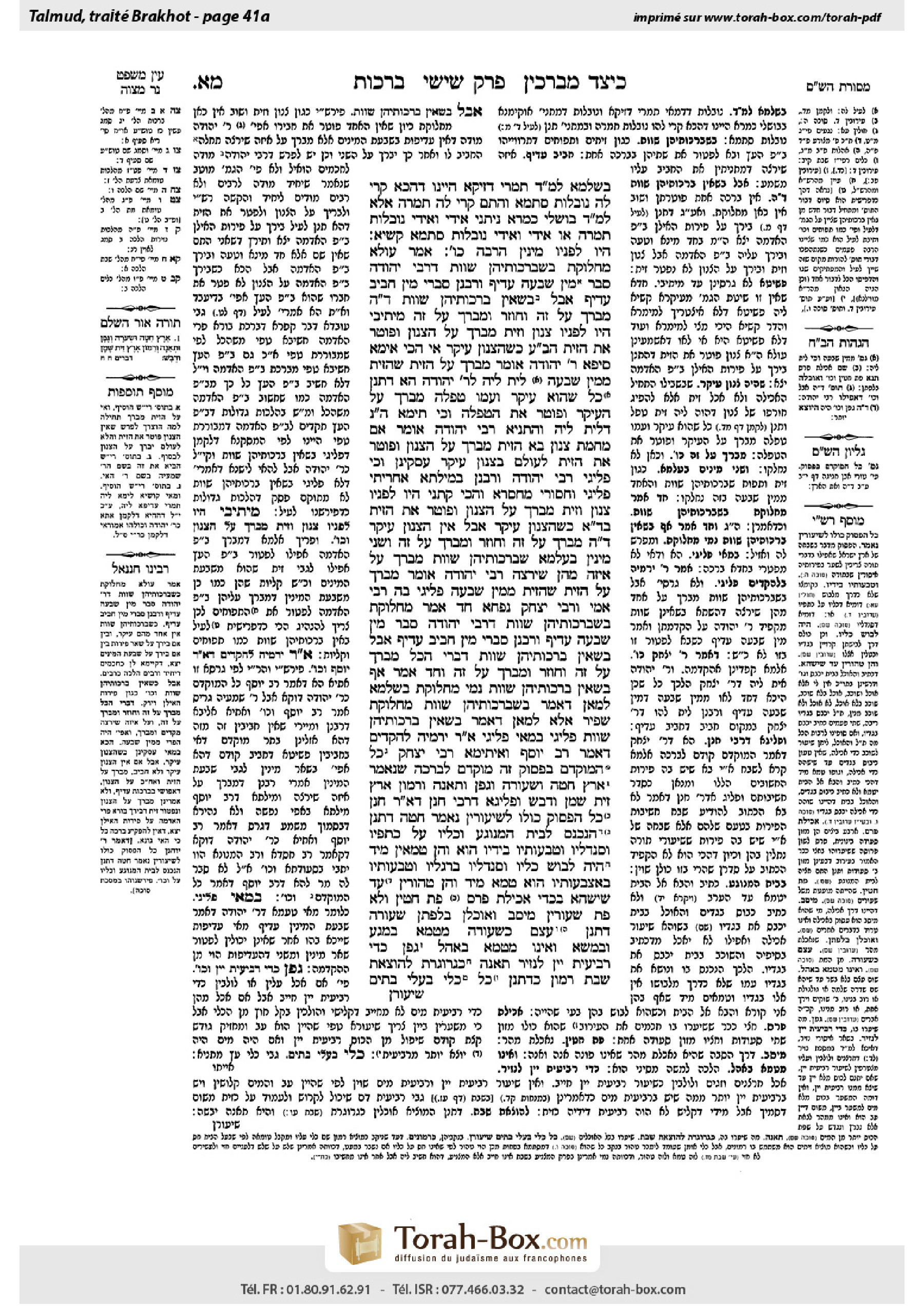
Berakhot 41a: Talmud study for Daf Yomi
Study the Talmud for Daf Yomi with scanned pages, Hebrew text, English translations from Sefaria and AI-generated French translations.
Passage selection and English or AI-generated French translation are available where the scan has annotations. Daf Study is independent of Torah-Box and Sefaria.
Browse Berakhot · ברכות · All tractatesBerakhot 41a text and translations
This page of Berakhot includes the Aramaic text, an English translation and an AI-generated French translation, alongside the scan above.
ברכות מ״א א · Aramaic and Hebrew text
בִּשְׁלָמָא לְמַאן דְּאָמַר תַּמְרֵי דְזִיקָא, הַיְינוּ דְּהָכָא קָרֵי לַהּ ״נוֹבְלוֹת״ סְתָמָא, וְהָתָם קָרֵי לַהּ ״תְּמָרָה״, אֶלָּא לְמַאן דְּאָמַר בּוּשְׁלֵי כַמְרָא, נִיתְנֵי אִידֵּי וְאִידֵּי ״נוֹבְלוֹת תְּמָרָה״, אוֹ אִידֵּי וְאִידֵּי ״נוֹבְלוֹת״ סְתָמָא. קַשְׁיָא.
הָיוּ לְפָנָיו מִינִין הַרְבֵּה וְכוּ׳. אָמַר עוּלָּא: מַחֲלוֹקֶת בְּשֶׁבִּרְכוֹתֵיהֶן שָׁווֹת, דְּרַבִּי יְהוּדָה סָבַר מִין שִׁבְעָה עָדִיף, וְרַבָּנַן סָבְרִי מִין חָבִיב עָדִיף. אֲבָל בְּשֶׁאֵין בִּרְכוֹתֵיהֶן שָׁווֹת — דִּבְרֵי הַכֹּל מְבָרֵךְ עַל זֶה, וְחוֹזֵר וּמְבָרֵךְ עַל זֶה.
מֵיתִיבִי: הָיוּ לְפָנָיו צְנוֹן וְזַיִת — מְבָרֵךְ עַל הַצְּנוֹן וּפוֹטֵר אֶת הַזַּיִת! הָכָא בְּמַאי עָסְקִינַן — כְּשֶׁהַצְּנוֹן עִקָּר.
אִי הָכִי, אֵימָא סֵיפָא: רַבִּי יְהוּדָה אוֹמֵר מְבָרֵךְ עַל הַזַּיִת, שֶׁהַזַּיִת מִמִּין שִׁבְעָה. לֵית לֵיהּ לְרַבִּי יְהוּדָה, הָא דִּתְנַן: כׇּל שֶׁהוּא עִיקָּר וְעִמּוֹ טְפֵלָה — מְבָרֵךְ עַל הָעִיקָּר וּפוֹטֵר אֶת הַטְּפֵלָה? וְכִי תֵּימָא: הָכִי נָמֵי דְּלֵית לֵיהּ, וְהָתַנְיָא: רַבִּי יְהוּדָה אוֹמֵר: אִם מֵחֲמַת צְנוֹן בָּא הַזַּיִת — מְבָרֵךְ עַל הַצְּנוֹן וּפוֹטֵר אֶת הַזַּיִת.
לְעוֹלָם בִּצְנוֹן עִיקָּר עָסְקִינַן, וְכִי פְּלִיגִי רַבִּי יְהוּדָה וְרַבָּנַן — בְּמִילְּתָא אַחֲרִיתִי פְּלִיגִי, וְחַסּוֹרֵי מְחַסְּרָא, וְהָכִי קָתָנֵי: הָיוּ לְפָנָיו צְנוֹן וְזַיִת — מְבָרֵךְ עַל הַצְּנוֹן וּפוֹטֵר אֶת הַזַּיִת. בַּמֶּה דְּבָרִים אֲמוּרִים — כְּשֶׁהַצְּנוֹן עִיקָּר, אֲבָל אֵין הַצְּנוֹן עִיקָּר — דִּבְרֵי הַכֹּל מְבָרֵךְ עַל זֶה וְחוֹזֵר וּמְבָרֵךְ עַל זֶה. וּשְׁנֵי מִינִין בְּעָלְמָא שֶׁבִּרְכוֹתֵיהֶן שָׁווֹת — מְבָרֵךְ עַל אֵיזֶה מֵהֶן שֶׁיִּרְצֶה. רַבִּי יְהוּדָה אוֹמֵר: מְבָרֵךְ עַל הַזַּיִת, שֶׁהַזַּיִת מִמִּין שִׁבְעָה.
פְּלִיגִי בַּהּ רַבִּי אַמֵּי וְרַבִּי יִצְחָק נַפָּחָא. חַד אָמַר: מַחֲלוֹקֶת בְּשֶׁבִּרְכוֹתֵיהֶן שָׁווֹת, דְּרַבִּי יְהוּדָה סָבַר מִין שִׁבְעָה עָדִיף, וְרַבָּנַן סָבְרִי מִין חָבִיב עָדִיף. אֲבָל בְּשֶׁאֵין בִּרְכוֹתֵיהֶן שָׁווֹת — דִּבְרֵי הַכֹּל מְבָרֵךְ עַל זֶה וְחוֹזֵר וּמְבָרֵךְ עַל זֶה. וְחַד אָמַר: אַף בְּשֶׁאֵין בִּרְכוֹתֵיהֶן שָׁווֹת נָמֵי מַחֲלוֹקֶת.
בִּשְׁלָמָא לְמַאן דְּאָמַר בְּשֶׁבִּרְכוֹתֵיהֶן שָׁווֹת מַחֲלוֹקֶת — שַׁפִּיר, אֶלָּא לְמַאן דְּאָמַר בְּשֶׁאֵין בִּרְכוֹתֵיהֶן שָׁווֹת פְּלִיגִי, בְּמַאי פְּלִיגִי! אָמַר רַבִּי יִרְמְיָה: לְהַקְדִּים.
דְּאָמַר רַב יוֹסֵף וְאִיתֵּימָא רַבִּי יִצְחָק: כׇּל הַמּוּקְדָּם בְּפָסוּק זֶה, מוּקְדָּם לִבְרָכָה, שֶׁנֶּאֱמַר: ״אֶרֶץ חִטָּה וּשְׂעֹרָה וְגֶפֶן וּתְאֵנָה וְרִמּוֹן אֶרֶץ זֵית שֶׁמֶן וּדְבָשׁ״.
וּפְלִיגָא דְּרַבִּי חָנָן. דְּאָמַר רַבִּי חָנָן: כׇּל הַפָּסוּק כּוּלּוֹ לְשִׁיעוּרִין נֶאֱמַר.
״חִטָּה״, דִּתְנַן: הַנִּכְנָס לַבַּיִת הַמְנוּגָּע, וְכֵלָיו עַל כְּתֵפָיו, וְסַנְדָּלָיו וְטַבְּעוֹתָיו בְּיָדָיו — הוּא וָהֵן טְמֵאִין מִיָּד. הָיָה לָבוּשׁ כֵּלָיו, וְסַנְדָּלָיו בְּרַגְלָיו, וְטַבְּעוֹתָיו בְּאֶצְבְּעוֹתָיו — הוּא טָמֵא מִיָּד, וְהֵן טְהוֹרִין עַד שֶׁיִּשְׁהֶא בִּכְדֵי אֲכִילַת פְּרָס. פַּת חִטִּין וְלֹא פַּת שְׂעוֹרִין, מֵיסֵב וְאוֹכְלָן בְּלִפְתָּן.
״שְׂעֹרָה״, דִּתְנַן: עֶצֶם כִּשְׂעוֹרָה מְטַמֵּא בְּמַגָּע וּבְמַשָּׂא, וְאֵינוֹ מְטַמֵּא בְּאֹהֶל.
״גֶּפֶן״, כְּדֵי רְבִיעִית יַיִן לְנָזִיר. ״תְּאֵנָה״, כִּגְרוֹגֶרֶת לְהוֹצָאַת שַׁבָּת. ״רִמּוֹן״, כְּדִתְנַן: כׇּל כְּלֵי בַּעֲלֵי בָתִּים
Berakhot 41a · English translation
Granted, according to the one who said that novelot temara are dates felled by the wind, that is why here, when our mishna speaks of ruined dates, it calls them novelot, unmodified and there, when it speaks of those that fell because of the wind, it calls them novelot temara. However, according to the one who said that novelot temara are dates burned by the heat of the sun, it should have taught in this mishna here and that, the mishna in tractate Demai, novelot temara; or taught in this and that novelot, unmodified. The use of different terms indicates that the mishnayot are discussing different items. No answer was found to this question, and the Gemara notes that indeed, according to the one who said that novelot temara are dates burned by the heat of the sun, it is difficult.
The mishna cited a dispute with regard to the order in which one is supposed to recite the blessings when there were many types of food before him. Rabbi Yehuda says: If there is one of the seven species for which Eretz Yisrael was praised among them, he recites the first blessing over it. And the Rabbis say: He recites a blessing over whichever of them he wants. Ulla said: This dispute is specifically in a case where the blessings to be recited over each type of food are the same, as in that case Rabbi Yehuda holds: The type of the seven species takes precedence, and the Rabbis hold: The preferred type takes precedence, and a blessing is recited over it first. However, when their blessings are not the same, everyone agrees that one must recite a blessing over this type of food and then recite another blessing over that, ensuring that the appropriate blessing is recited over each type of food.
The Gemara raises an objection to this based on what was taught in a baraita: If a radish and an olive were before him, he recites a blessing over the radish and exempts the olive from the requirement of a blessing, although their blessings are different. The Gemara answers: With what are we dealing here? With a case where the radish is the primary component for the one partaking of them, and the olive serves only to temper the taste of the radish. Therefore, he need recite a blessing only over the radish.
The Gemara continues and asks: If so, say the latter clause of the baraita where Rabbi Yehuda says: One recites a blessing over the olive, as the olive is a type of the seven species. Does Rabbi Yehuda not accept that principle which we learned in a mishna: Any food that is primary, and is eaten with food that is secondary, one recites a blessing over the primary food, and that blessing exempts the secondary from the requirement to recite a blessing before eating it? And if you say: Indeed, he does not hold that the primary food exempts the secondary, wasn’t it taught in a baraita: Rabbi Yehuda says: If it is due to the radish that the olive comes, one recites a blessing over the radish and exempts the olive. If so, the dispute whether to recite a blessing over the radish or the olive must be in a case where the radish is not primary. This is an apparent contradiction of Ulla’s statement.
The Gemara responds: Actually, we are dealing with a case where the radish is the primary component of the meal, and when Rabbi Yehuda and the Rabbis disagree, it is with regard to a different case that they disagree, and this baraita is incomplete and it teaches the following: If a radish and an olive were before him, he recites a blessing over the radish and exempts the olive. In what circumstances does this apply? Specifically when the radish is primary, but when the radish is not primary, everyone agrees that one recites the appropriate blessing over this one and then he again recites the appropriate blessing over that one. However, in general, if two types of food whose blessings are identical were before him, he recites a blessing over whichever of them that he wants. Rabbi Yehuda says: He recites a blessing over the olive, as the olive is a type of the seven species.
Rabbi Ami and Rabbi Yitzḥak Nappaḥa disagreed with regard to this subject. One said: The dispute is in a case where their blessings are identical, as Rabbi Yehuda held: A type of the seven species takes precedence and the blessing is recited over it first. And the Rabbis held: The preferred type takes precedence, and a blessing is recited over it first; however, when their blessings are not identical, everyone agrees that one recites the appropriate blessing over this one and then he again recites the appropriate blessing over that one. And one said: Even when their blessings are not identical, there is also a dispute.
The Gemara discusses this: Granted, according to the one who said that the dispute is in a case where their blessings are identical, it works out well. However, according to the one who says that they disagree in a case where their blessings are not identical, then about what do they disagree? One must recite two blessings in any case. Rabbi Yirmeya said: They disagree with regard to which blessing precedes the other.
As Rav Yosef, and some say Rabbi Yitzḥak, said: Each food whose significance is manifest in that it precedes the others in this verse, which sings the praises of Eretz Yisrael, takes precedence over the others in terms of blessing as well, as it is stated: “A land of wheat and barley, vines, figs and pomegranates, a land of olive oil and honey” (Deuteronomy 8:8).
The Gemara notes: And this opinion disagrees with the opinion of Rabbi Ḥanan. As Rabbi Ḥanan said: The entire verse was stated for the purpose of teaching measures with regard to different halakhot in the Torah.
Wheat was mentioned as the basis for calculating the time required for one to become ritually impure by entering a house afflicted with leprosy, as we learned in a mishna: One who enters a house afflicted with leprosy of the house (see Leviticus 14:33–53) with his clothes resting on his shoulders, and his sandals and his rings are in his hands, both he and they, the clothes, sandals, and rings, immediately become ritually impure. However, if he was dressed in his clothes, and his sandals were on his feet and his rings on his fingers, he immediately becomes ritually impure upon entering the house, but they, the clothes, sandals, and rings, remain pure until he stays in the house long enough to eat half a loaf of bread. This calculation is made with wheat bread, which takes less time to eat, and not with barley bread, and with one who is reclining and eating the bread with a relish, which hastens the eating. There is, then, a Torah measurement that is connected specifically to wheat.
Barley is also used as the basis for a measure, as we learned in a mishna: A bone from a corpse that is the size of a grain of barley imparts ritual impurity through contact and by being carried, but it does not impart impurity by means of a tent, i.e., if the bone was inside a house, it does not defile all of the articles in the house.
The halakhic measure determined by vines is the quantity of a quarter log of wine for a Nazirite and not the wine equivalent of a quarter log of water, which is a slightly different measure. Figs serve as the basis for the measure of a dried fig-bulk, typically the smallest unit of food for which someone will be held liable for carrying out on Shabbat from one domain to another. Pomegranates teach us a particular measurement as well, as we learned in a mishna: All ritually impure wooden utensils belonging to ordinary homeowners become pure through breaking the utensil,
Berakhot 41a · Traduction française (IA)
Il est vrai, selon celui qui dit que les novelot temara sont des dattes brûlées par la chaleur du soleil, c'est pourquoi ici, lorsque notre mitsna parle de dattes abîmées, elle les appelle novelot, sans modification, et là, lorsque elle parle de celles qui sont tombées par le vent, elle les appelle novelot temara. Cependant, selon celui qui dit que les novelot temara sont des dattes tombées par le vent, il aurait dû enseigner ici et là, dans la mitsna de la tractate Demai, novelot temara ; ou enseigner ici et là novelot, sans modification. L'usage de termes différents indique que les mitsnayot discutent d'objets différents. Aucune réponse n'a été trouvée à cette question, et la Guemara note que, selon celui qui dit que les novelot temara sont des dattes brûlées par la chaleur du soleil, cela est difficile.
La mitsna cite un débat concernant l'ordre dans lequel on doit réciter les bénédictions lorsqu'il y a plusieurs types de nourriture devant soi. Rabbi Yehuda dit : Si l'un des sept espèces pour lesquelles Eretz Yisrael a été loué est parmi eux, il récite la première bénédictions sur celui-ci. Et les Sages disent : Il récite une bénédictions sur celui qu'il veut. Ulla dit : Ce débat est spécifiquement dans un cas où les bénédictions à réciter sur chaque type de nourriture sont les mêmes, comme dans ce cas Rabbi Yehuda maintient : Le type des sept espèces a la priorité, et les Sages maintiennent : Le type préféré a la priorité, et une bénédictions est récitée sur celui-ci en premier. Cependant, lorsque leurs bénédictions ne sont pas les mêmes, tout le monde convient qu'il faut réciter une bénédictions sur ce type de nourriture et ensuite réciter une autre bénédictions sur celui-ci, en veillant à ce que la bénédictions appropriée soit récitée sur chaque type de nourriture.
La Guemara soulève une objection à cela, basée sur ce qui a été enseigné dans une baraïta : Si un radis et une olive étaient devant lui, il récite une bénédiction sur le radis et exempt l'olive de la nécessité de bénédiction, bien que leurs bénédictions soient différentes. La Guemara répond : Avec quels cas sommes-nous en train de parler ? Avec un cas où le radis est le composant principal pour celui qui les consomme, et l'olive sert seulement à tempérer le goût du radis. Par conséquent, il ne faut réciter qu'une bénédiction sur le radis.
La Guemara continue et pose la question : Si c'est le cas, disent les derniers mots de la baraïta où Rabbi Yehuda dit : On récite une bénédiction sur l'olive, car l'olive est un type des sept espèces. Rabbi Yehuda ne accepte-t-il pas ce principe que nous avons appris dans une mitsva : Tout aliment qui est principal et est mangé avec un aliment secondaire, on récite une bénédiction sur l'aliment principal, et cette bénédiction exempt l'aliment secondaire de la nécessité de réciter une bénédiction avant de le manger ? Et si vous dites : En effet, il ne tient pas que l'aliment principal exempt l'aliment secondaire, n'était-il pas enseigné dans une baraïta : Rabbi Yehuda dit : Si c'est à cause du radis que l'olive vient, on récite une bénédiction sur le radis et exempt l'olive. Si c'est le cas, le débat sur la question de réciter une bénédiction sur le radis ou l'olive doit être dans un cas où le radis n'est pas principal. C'est une contradiction apparente de l'affirmation d'Ulla.
La Guemara répond : En réalité, nous traitons d’un cas où le radis est le composant principal du repas, et lorsque Rabbi Yehuda et les Sages s’opposent, c’est concernant un cas différent qu’ils s’opposent, et cette baraïta est incomplète et elle enseigne ce qui suit : Si un radis et une olive étaient devant lui, il récite une bénédiction sur le radis et exempt l’olive. Dans quelles circonstances cela s’applique ? Spécifiquement lorsque le radis est principal, mais lorsque le radis n’est pas principal, tout le monde convient qu’on récite la bénédiction appropriée sur celui-ci et ensuite on récite à nouveau la bénédiction appropriée sur celui-là. Cependant, en général, si deux types de nourriture dont les bénédictions sont identiques étaient devant lui, il récite une bénédiction sur celui qu’il veut. Rabbi Yehuda dit : Il récite une bénédiction sur l’olive, car l’olive est un type des sept espèces.
Rabbi Ami et Rabbi Yitzḥak Nappaḥa ont eu un désaccord concernant cette question. L’un dit : Le débat est dans un cas où leurs bénédictions sont identiques, car Rabbi Yehuda maintenait : Un type des sept espèces a la priorité et la bénédiction est récitée sur celui-ci en premier. Et les Sages maintenaient : Le type préféré a la priorité, et une bénédiction est récitée sur celui-ci en premier ; cependant, lorsque leurs bénédictions ne sont pas identiques, tout le monde convient qu’on récite la bénédiction appropriée sur celui-ci et ensuite on récite à nouveau la bénédiction appropriée sur celui-là. Et l’autre dit : Même lorsque leurs bénédictions ne sont pas identiques, il y a aussi un débat.
La Guemara discute cela : Il est vrai, selon celui qui dit que le débat est dans un cas où leurs bénédictions sont identiques, cela s’arrange bien. Cependant, selon celui qui dit qu’ils s’opposent dans un cas où leurs bénédictions ne sont pas identiques, alors sur quel point s’opposent-ils ? On doit réciter deux bénédictions dans tous les cas. Rabbi Yirmeya dit : Ils s’opposent concernant laquelle des bénédictions précède l’autre.
Comme Rav Yosef, et certains disent Rabbi Yitzḥak, a dit : Chaque aliment dont la signification est manifeste dans le fait qu'il précède les autres dans cette verset qui loue Eretz Yisrael, a la priorité sur les autres en termes de bénédictions, car il est dit : « Une terre de blé et de seigle, de vigne, de figues et de grenades, une terre d'huile d'olive et de miel » (Deutéronome 8:8).
La Guemara note : Et cet avis s'oppose à l'avis de Rabbi Ḥanan. Car Rabbi Ḥanan a dit : L'ensemble du verset a été dit à l'effet d'enseigner des mesures concernant différentes halakhot dans la Torah.
Le blé a été mentionné comme la base pour calculer le temps requis pour que l'on devienne impur rituellement en entrant dans une maison atteinte de la maladie de la peau, comme nous l'avons appris dans une mitsna : Celui qui entre dans une maison atteinte de la maladie de la peau (voir Lévitique 14:33–53) avec ses vêtements sur ses épaules, et ses sandales et ses bagues à la main, lui et ses vêtements, sandales et bagues deviennent immédiatement impurs rituellement. Cependant, si l'on était vêtu de ses vêtements, et ses sandales étaient sur ses pieds et ses bagues sur ses doigts, il devient immédiatement impur rituellement en entrant dans la maison, mais les vêtements, sandales et bagues restent purs jusqu'à ce qu'il reste dans la maison assez longtemps pour manger une moitié de pain. Ce calcul est fait avec du pain de blé, qui prend moins de temps à manger, et non avec du pain de seigle, et avec celui qui s'allonge et mange le pain avec un condiment, ce qui accélère la consommation. Il y a donc une mesure de la Torah liée spécifiquement au blé.
Le seigle est également utilisé comme base pour une mesure, comme nous l'avons appris dans une mitsna : Une osselette provenant d'un cadavre, de la taille d'une graine de seigle, transmet l'impureté rituelle par contact et par portage, mais ne transmet pas l'impureté par le biais d'un abri, c'est-à-dire si l'osselette était à l'intérieur d'une maison, elle ne rend pas impurs tous les objets de la maison.
La mesure halakhique déterminée par les vignes est la quantité d'un quart de log de vin pour un Nazir, et non le vin équivalent à un quart de log d'eau, qui est une mesure légèrement différente. Les figues servent de base pour la mesure d'une figue sèche, généralement la plus petite unité de nourriture pour laquelle on tient responsable de porter de l'un à l'autre le sabbat. Les grenades nous apprennent également une mesure particulière, comme nous l'avons appris dans une mitsna : Tous les ustensiles en bois impurs rituellement appartenant aux propriétaires ordinaires deviennent purs en brisant l'ustensile,
Traduction française générée par IA à partir de l’édition anglaise de Sefaria. Vérifie toujours un passage avec le texte source.
Text from Sefaria: William Davidson Edition - Vocalized Aramaic (CC BY NC); William Davidson Edition - English (CC BY NC).