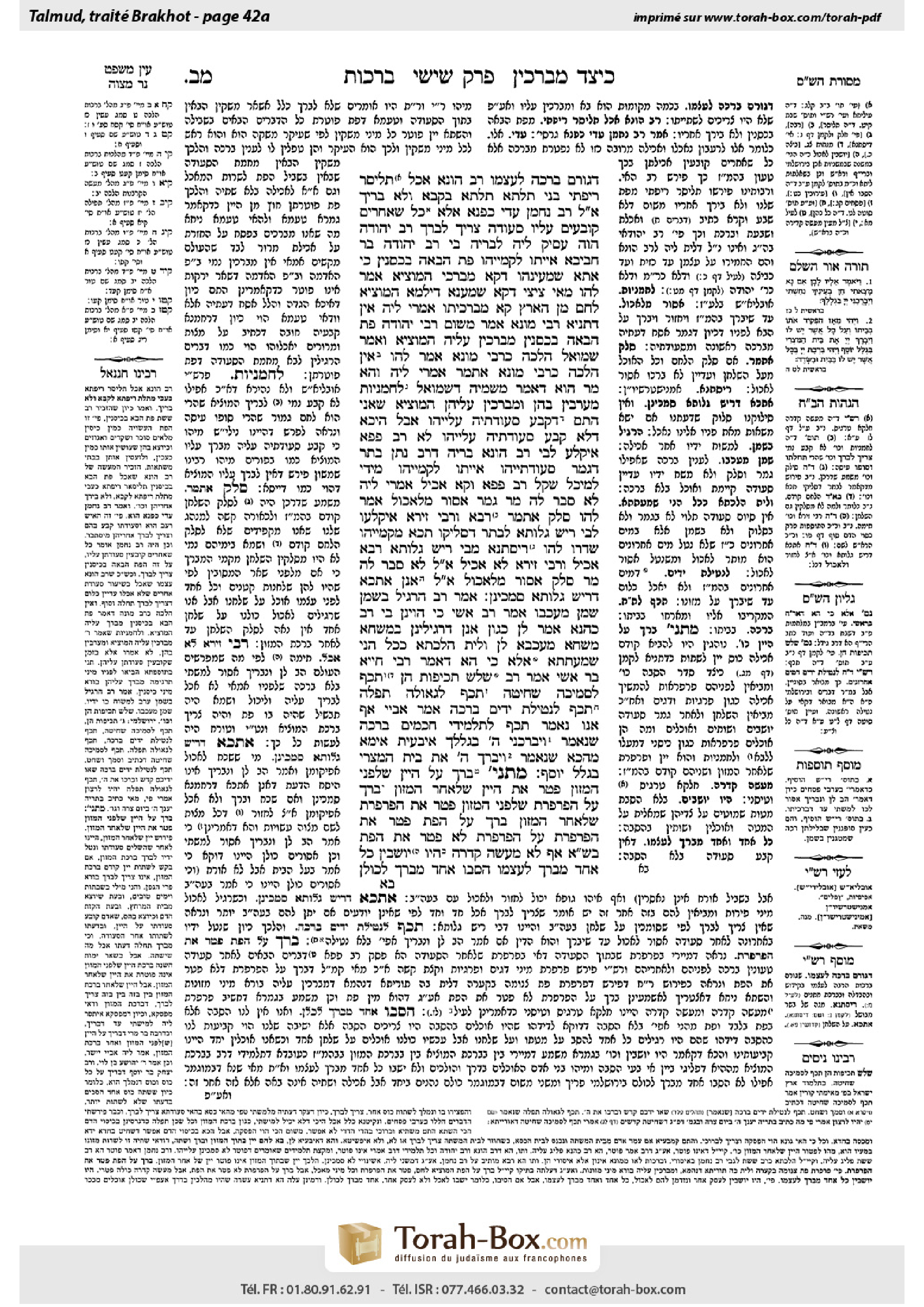
Berakhot 42a: Talmud study for Daf Yomi
Study the Talmud for Daf Yomi with scanned pages, Hebrew text, English translations from Sefaria and AI-generated French translations.
Passage selection and English or AI-generated French translation are available where the scan has annotations. Daf Study is independent of Torah-Box and Sefaria.
Browse Berakhot · ברכות · All tractatesBerakhot 42a text and translations
This page of Berakhot includes the Aramaic text, an English translation and an AI-generated French translation, alongside the scan above.
ברכות מ״ב א · Aramaic and Hebrew text
דְּגוֹרֵם בְּרָכָה לְעַצְמוֹ.
רַב הוּנָא אֲכַל תְּלֵיסַר רִיפְתֵי בְּנֵי תְּלָתָא תְּלָתָא בְּקַבָּא וְלָא בָּרֵיךְ. אֲמַר לֵיהּ רַב נַחְמָן: עָדֵי כַּפְנָא! אֶלָּא כֹּל שֶׁאֲחֵרִים קוֹבְעִים עָלָיו סְעוּדָה, צָרִיךְ לְבָרֵךְ.
רַב יְהוּדָה הֲוָה עָסֵיק לֵיהּ לִבְרֵיהּ בֵּי רַב יְהוּדָה בַּר חֲבִיבָא. אַיְיתוֹ לְקַמַּיְיהוּ פַּת הַבָּאָה בְּכִסָנִין. כִּי אֲתָא, שַׁמְעִינְהוּ דְּקָא מְבָרְכִי ״הַמּוֹצִיא״. אָמַר לְהוּ: מַאי ״צִיצִי״ דְּקָא שָׁמַעְנָא? דִּילְמָא ״הַמּוֹצִיא לֶחֶם מִן הָאָרֶץ״ קָא מְבָרְכִיתוּ? אָמְרִי לֵיהּ: אִין. דְּתַנְיָא, רַבִּי מוּנָא אָמַר מִשּׁוּם רַבִּי יְהוּדָה: פַּת הַבָּאָה בְּכִסָנִין מְבָרְכִין עָלֶיהָ ״הַמּוֹצִיא״, וְאָמַר שְׁמוּאֵל: הֲלָכָה כְּרַבִּי מוּנָא.
אָמַר לְהוּ: אֵין הֲלָכָה כְּרַבִּי מוּנָא אִתְּמַר. אָמְרִי לֵיהּ: וְהָא מָר הוּא דְּאָמַר מִשְּׁמֵיהּ דִּשְׁמוּאֵל לַחְמָנִיּוֹת מְעָרְבִין בָּהֶן, וּמְבָרְכִין עֲלֵיהֶן ״הַמּוֹצִיא״? שָׁאנֵי הָתָם דְּקָבַע סְעוֹדְתֵּיהּ עֲלַיְיהוּ, אֲבָל הֵיכָא דְּלָא קָבַע סְעוֹדְתֵּיהּ עֲלַיְיהוּ — לָא.
רַב פָּפָּא אִיקְּלַע לְבֵי רַב הוּנָא בְּרֵיהּ דְּרַב נָתָן. בָּתַר דְּגָמְרִי סְעוֹדְתַּיְיהוּ אַיְיתוֹ לְקַמַּיְיהוּ מִידֵּי לְמֵיכַל שָׁקֵל רַב פָּפָּא וְקָא אָכֵיל. אָמְרִי לֵיהּ: לָא סָבַר לַהּ מָר גָּמַר אָסוּר מִלֶּאֱכוֹל? אָמַר לְהוּ: ״סִלֵּק״ אִתְּמַר.
רָבָא וְרַבִּי זֵירָא אִיקְּלַעוּ לְבֵי רֵישׁ גָּלוּתָא. לְבָתַר דְּסַלִּיקוּ תַּכָּא מִקַּמַּיְיהוּ שַׁדַּרוּ לְהוּ רִיסְתָּנָא מִבֵּי רֵישׁ גָּלוּתָא. רָבָא אָכֵיל וְרַבִּי זֵירָא לָא אָכֵיל. אֲמַר לֵיהּ: לָא סָבַר לַהּ מָר סִלֵּק אָסוּר מִלֶּאֱכוֹל? אֲמַר לֵיהּ: אֲנַן אַתַּכָּא דְּרֵישׁ גָּלוּתָא סָמְכִינַן.
אָמַר רַב: הָרָגִיל בְּשֶׁמֶן — שֶׁמֶן מְעַכְּבוֹ. אָמַר רַב אָשֵׁי: כִּי הָוֵינַן בֵּי רַב כָּהֲנָא, אָמַר לַן: כְּגוֹן אֲנַן דִּרְגִילִינַן בְּמִשְׁחָא — מִשְׁחָא מְעַכְּבָא לַן. וְלֵית הִלְכְתָא כְּכׇל הָנֵי שְׁמַעְתָּתָא, אֶלָּא כִּי הָא דְּאָמַר רַבִּי חִיָּיא בַּר אָשֵׁי אָמַר רַב: שָׁלֹשׁ תְּכִיפוֹת הֵן: תֵּכֶף לִסְמִיכָה שְׁחִיטָה, תֵּכֶף לִגְאוּלָּה תְּפִלָּה, תֵּכֶף לִנְטִילַת יָדַיִם בְּרָכָה.
אָמַר אַבָּיֵי, אַף אָנוּ נֹאמַר: תֵּכֶף לְתַלְמִידֵי חֲכָמִים בְּרָכָה. שֶׁנֶּאֱמַר: ״וַיְבָרְכֵנִי ה׳ בִּגְלָלֶךָ״. אִיבָּעֵית אֵימָא מֵהָכָא, שֶׁנֶּאֱמַר: ״וַיְבָרֶךְ ה׳ אֶת בֵּית הַמִּצְרִי בִּגְלַל יוֹסֵף״.
מַתְנִי׳ בֵּרַךְ עַל הַיַּיִן שֶׁלִּפְנֵי הַמָּזוֹן — פָּטַר אֶת הַיַּיִן שֶׁלְּאַחַר הַמָּזוֹן. בֵּרַךְ עַל הַפַּרְפֶּרֶת שֶׁלִּפְנֵי הַמָּזוֹן — פָּטַר אֶת הַפַּרְפֶּרֶת שֶׁלְּאַחַר הַמָּזוֹן. בֵּרַךְ עַל הַפַּת — פָּטַר אֶת הַפַּרְפֶּרֶת. עַל הַפַּרְפֶּרֶת — לֹא פָּטַר אֶת הַפַּת. בֵּית שַׁמַּאי אוֹמְרִים: אַף לֹא מַעֲשֵׂה קְדֵרָה.
הָיוּ יוֹשְׁבִין — כׇּל אֶחָד מְבָרֵךְ לְעַצְמוֹ. הֵסַבּוּ — אֶחָד מְבָרֵךְ לְכוּלָּן.
Berakhot 42a · English translation
as it causes a blessing itself. It is so significant, that one recites a blessing over it together with other blessings like kiddush and havdala, even though he does not particularly want to drink it. During a meal too, a blessing is recited over the wine and it is not exempted by the blessing over the bread.
As the Gemara mentioned bread that comes as dessert, it now relates that Rav Huna ate thirteen substantially sized, sweetened loaves, three loaves per kav of flour, and he did not recite Grace after Meals because they were not genuine bread. Rav Naḥman said to him: That is hunger. One does not typically eat that much merely as dessert. Rather, over anything which is substantial enough to satiate and others base a meal upon it, one must recite Grace after Meals.
The Gemara also relates: Rav Yehuda was engaged in preparations for his son’s wedding at the house of Rav Yehuda bar Ḥaviva when they brought bread that comes as dessert before them. When it arrived, he heard them reciting: Who brings forth bread from the earth. He said to them: What is this tzitzi sound that I hear? Perhaps you are reciting: Who brings forth bread from the earth? They said to him: Yes, indeed, as it was taught in a baraita: Rabbi Mona said in the name of Rabbi Yehuda: Over bread that comes as dessert, one recites: Who brings forth bread from the earth. And Shmuel said: The halakha is in accordance with the opinion of Rabbi Mona.
Rav Yehuda said to them: You are mistaken. Actually, it was stated that Shmuel said: The halakha is not in accordance with the opinion of Rabbi Mona. They said to him: But aren’t you, Master, the one who said in the name of Shmuel with regard to wafers: One may establish an eiruv, the joining of courtyards, to permit carrying in a shared courtyard and the joining of cooked foods, to permit cooking on a festival for Shabbat, with them and recite over them: Who brings forth bread from the earth. Why is that the blessing over those wafers? They too are sweetened bread that comes as dessert. He answered them: It is different there as he based his meal upon them, but here, where one did not base his meal upon them, no, he does not recite: Who brings forth bread from the earth.
The Gemara relates: Rav Pappa happened to come to the house of Rav Huna, son of Rav Natan. After they finished their meal, they brought before them something to eat. Rav Pappa took this food item and ate it without reciting a blessing. They said to him: Do you, Master, not hold that once one finished his meal he is forbidden to eat again without reciting a blessing? He said to them that in the correct version of that halakha, it is stated: Removed. One need recite a second blessing only when eating after the table was removed from before him.
Similarly, the Gemara relates: Rava and Rabbi Zeira happened to come to the house of the Exilarch. After the meal, when they removed the table from before them, a portion [ristena] of food was sent to them from the house of the Exilarch. Rava ate it and Rabbi Zeira did not eat it. Rabbi Zeira said to Rava: Do you, Master, not hold that once the table was removed, he is forbidden to eat? Rava said to him: We are dependent upon the table of the Exilarch, and so long as he has not completed his meal, his guests have not completed their meals either.
Rav said: One who is accustomed to applying fragrant oil to his hands after meals, failure to apply that oil delays the end of his meal and he is not considered to have finished his meal and is not required to recite a blessing before continuing to eat. Similarly, Rav Ashi said: When we were in the house of Rav Kahana, he said to us: We, for example, who are accustomed to oil, failure to apply that oil delays the end of the meal for us. Nevertheless, the Gemara concludes: And the halakha is not in accordance with all of these statements and the end of the meal is not determined by those factors. Rather, it is determined by that which Rabbi Ḥiyya bar Ashi said that Rav said: There are three pairs that immediately follow each other: Immediately following placing hands on the head of a sacrifice, is its slaughter; immediately following the blessing of redemption recited after Shema, is the Amida prayer; and immediately following the ritual washing of the hands after a meal, is the blessing of Grace after Meals.
Abaye said that on a similar note, we too will say: Immediately following the entrance of Torah scholars into a house, a blessing rests upon that house, as it is stated with regard to Laban and Jacob: “The Lord has blessed me because of you” (Genesis 30:27). If you wish, say instead, that the proof is from here, as it is stated: “And it was from when he placed him in charge of his house and over all that he owned, the Lord blessed the house of the Egyptian on account of Joseph” (Genesis 39:5).
MISHNA: This mishna explains those cases and those circumstances in which blessings recited over particular foods exempt other foods at the meal from the requirement to recite a blessing over them. One who recited a blessing over the wine that one drank before the meal, with that blessing he exempted the wine that he drinks after the meal. Similarly, one who recited a blessing over the appetizers that one ate before the meal, with that blessing he exempted the appetizers that he eats after the meal. One who recited a blessing over the bread exempted the appetizers, as they are considered secondary to the bread. However, one who recited a blessing over the appetizers did not exempt the bread. Beit Shammai say: The blessing recited over the appetizers did not exempt even a cooked dish that he eats during the meal.
An additional halakha is cited: If several people were sitting to eat not in the framework of a joint meal, each recites a blessing for himself. If they were reclined on divans to eat, which renders it a joint meal, one recites a blessing on behalf of them all.
Berakhot 42a · Traduction française (IA)
car il provoque lui-même une béatitude. Il est si important que l'on récite une béatitude sur lui avec d'autres béatitudes comme le Chéma et la Havdala, même s'il ne désire pas particulièrement boire. Pendant un repas également, une béatitude est récitée sur le vin et il n'est pas dispensé par la béatitude sur le pain.
Comme la Guemara mentionnait le pain qui vient en dessert, elle relate maintenant que Rav Huna a mangé treize pains considérables, sucrés, trois pains par kav de farine, et il n'a pas récité la béatitude après le repas car ils n'étaient pas du vrai pain. Rav Naḥman lui a dit : C'est la faim. On ne mange généralement pas autant simplement en dessert. En revanche, sur toute chose suffisante pour rassasier et sur laquelle d'autres fondent leur repas, il faut réciter la béatitude après le repas.
La Guemara relate également : Rav Yehuda était en train de préparer son fils pour son mariage à la maison de Rav Yehuda bar Ḥaviva lorsqu'ils apportèrent du pain qui venait en dessert devant eux. Lorsqu'il arriva, il entendit qu'ils récitaient : Qui fait sortir le pain de la terre. Il leur dit : Quel son de tzitzi entends-je ? Peut-être récitez-vous : Qui fait sortir le pain de la terre ? Ils lui dirent : Oui, en effet, comme cela a été enseigné dans une baraïta : Rabbi Mona a dit en nom de Rabbi Yehuda : Sur le pain qui vient en dessert, on récite : Qui fait sortir le pain de la terre. Et Shmuel a dit : La halakha suit l'opinion de Rabbi Mona.
Rav Yehuda leur dit : Vous êtes en erreur. En réalité, il a été dit que Shmuel a dit : La halakha ne suit pas l'opinion de Rabbi Mona. Ils lui dirent : Mais ne vous, Maître, n'avez-vous pas dit en nom de Shmuel concernant les galettes : On peut établir un eiruv, la jonction des courtyards, pour permettre le transport dans un courtil partagé et la jonction des aliments cuits, pour permettre la cuisson de fête pour le sabbat, avec eux et réciter sur eux : Qui fait sortir le pain de la terre. Pourquoi cette béatitude sur ces galettes ? Elles sont aussi du pain sucré qui vient en dessert. Il répondit : C'est différent là, car il fondait son repas sur elles, mais ici, où l'on n'a pas fondé son repas sur elles, non, on ne récite pas : Qui fait sortir le pain de la terre.
La Guemara relate : Rav Pappa arriva par hasard à la maison de Rav Huna, fils de Rav Natan. Après qu'ils eurent fini leur repas, ils apportèrent devant eux quelque chose à manger. Rav Pappa prit cet aliment et le mangea sans réciter une béatitude. Ils lui dirent : Maître, ne tenez-vous pas que lorsqu'on a fini son repas, on est interdit de manger à nouveau sans réciter une béatitude ? Il leur dit que dans la version correcte de cette halakha, il est dit : Retiré. On doit réciter une deuxième béatitude uniquement lorsqu'on mange après que la table a été retirée devant soi.
De même, la Guemara relate : Rava et Rabbi Zeira arrivèrent à la maison de l'Exilarch. Après le repas, lorsqu'ils retirèrent la table devant eux, une portion [ristena] d'aliment fut envoyée à eux par la maison de l'Exilarch. Rava la mangea et Rabbi Zeira ne la mangea pas. Rabbi Zeira dit à Rava : Maître, ne tenez-vous pas que lorsqu'on a retiré la table, on est interdit de manger ? Rava lui dit : Nous dépendons de la table de l'Exilarch, et tant qu'il n'a pas terminé son repas, ses invités n'ont pas non plus terminé leur repas.
Rav dit : Celui qui est habitué à appliquer de l'huile parfumée sur ses mains après le repas, l'omission de cette huile retarde la fin de son repas et il n'est pas considéré comme ayant terminé son repas et n'est pas tenu de réciter une béatitude avant de continuer à manger. De même, Rav Ashi dit : Quand nous étions chez Rav Kahana, il nous a dit : Nous, par exemple, qui sommes habitués à l'huile, l'omission de cette huile retarde la fin du repas pour nous. Cependant, la Guemara conclut : Et la halakha ne suit pas toutes ces déclarations et la fin du repas n'est pas déterminée par ces facteurs. En revanche, elle est déterminée par ce que Rabbi Ḥiyya bar Ashi a dit que Rav a dit : Il y a trois paires qui suivent immédiatement l'une l'autre : Immédiatement après avoir posé les mains sur la tête d'un sacrifice, vient sa mise à mort ; immédiatement après la béatitude de la délivrance récitée après le Chéma, vient la prière de l'Amida ; et immédiatement après le lavage rituel des mains après un repas, vient la béatitude de la Grâce après le repas.
Abaye dit que sur un point similaire, nous disons aussi : Immédiatement après l'entrée des savants dans une maison, une béatitude repose sur cette maison, comme il est dit concernant Laban et Jacob : « L'Éternel a béni moi à cause de vous » (Genèse 30:27). Si vous le souhaitez, dites plutôt que la preuve vient d'ici, comme il est dit : « Et c'était à partir du moment où il le mit à la tête de sa maison et sur tout ce qu'il possédait, l'Éternel béni la maison de l'Égyptien à cause de Joseph » (Genèse 39:5).
MICHNA : Cette mitsva explique ces cas et ces circonstances dans lesquels les bénédictions récitées sur certains aliments dispensent d'autres aliments du repas de la nécessité de réciter une bénédictions sur eux. Celui qui a récité une bénédictions sur le vin qu'il a bu avant le repas, avec cette bénédictions il a dispensé le vin qu'il boit après le repas. De même, celui qui a récité une bénédictions sur les amuse-gueules qu'il a mangés avant le repas, avec cette bénédictions il a dispensé les amuse-gueules qu'il mange après le repas. Celui qui a récité une bénédictions sur le pain a dispensé les amuse-gueules, car ils sont considérés comme secondaires par rapport au pain. Cependant, celui qui a récité une bénédictions sur les amuse-gueules n'a pas dispensé le pain. Beit Shammai disent : La bénédictions récitée sur les amuse-gueules n'a pas dispensé même un plat cuisiné qu'il mange pendant le repas.
Une autre halakha est citée : Si plusieurs personnes étaient assises à manger sans être dans le cadre d'un repas partagé, chacun récite une bénédictions pour lui-même. Si ils étaient allongés sur des divans pour manger, ce qui rend cela un repas partagé, l'un récite une bénédictions pour eux tous.
Traduction française générée par IA à partir de l’édition anglaise de Sefaria. Vérifie toujours un passage avec le texte source.
Text from Sefaria: William Davidson Edition - Vocalized Aramaic (CC BY NC); William Davidson Edition - English (CC BY NC).