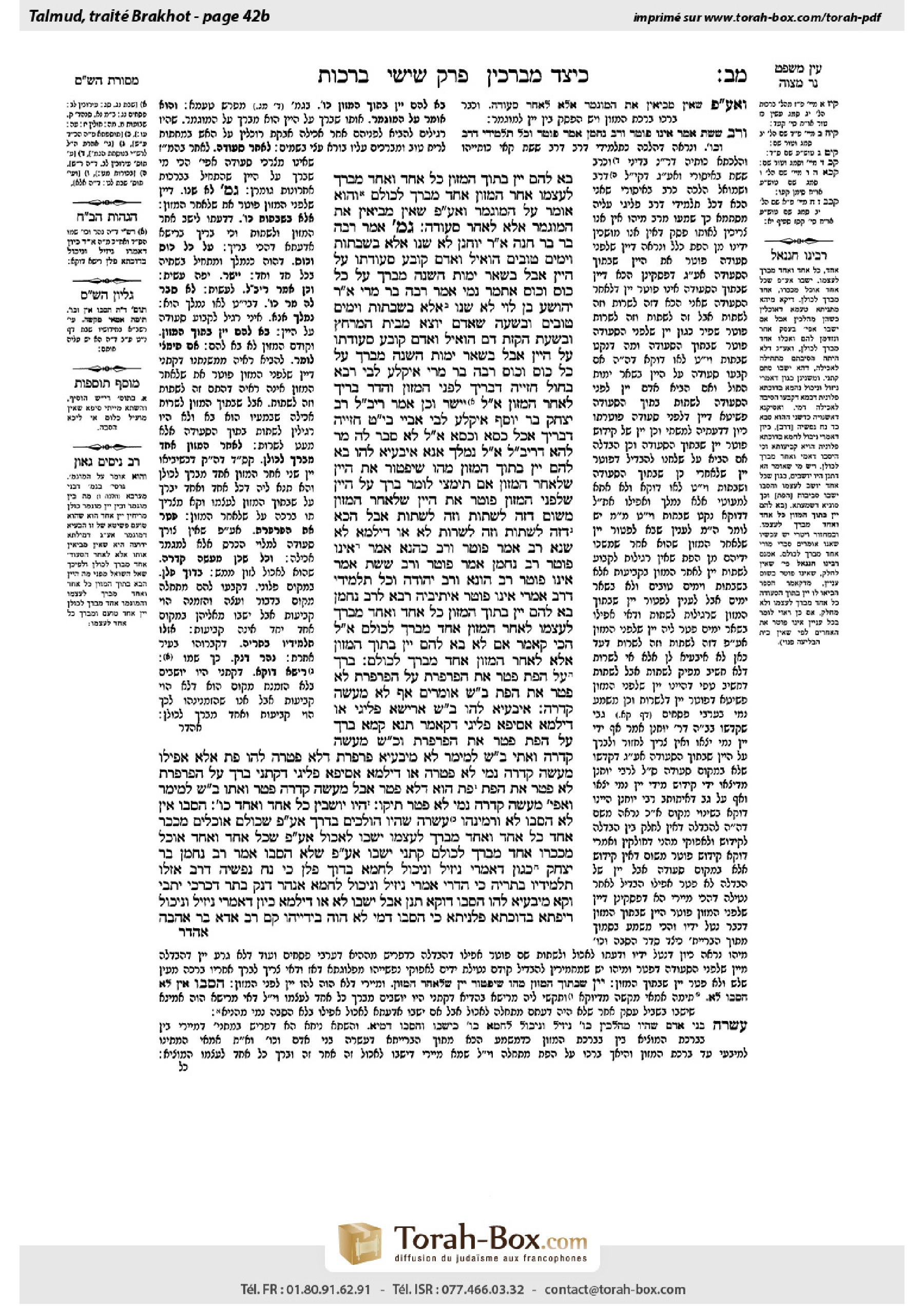
Berakhot 42b: Talmud study for Daf Yomi
Study the Talmud for Daf Yomi with scanned pages, Hebrew text, English translations from Sefaria and AI-generated French translations.
Passage selection and English or AI-generated French translation are available where the scan has annotations. Daf Study is independent of Torah-Box and Sefaria.
Browse Berakhot · ברכות · All tractatesBerakhot 42b text and translations
This page of Berakhot includes the Aramaic text, an English translation and an AI-generated French translation, alongside the scan above.
ברכות מ״ב ב · Aramaic and Hebrew text
בָּא לָהֶם יַיִן בְּתוֹךְ הַמָּזוֹן — כׇּל אֶחָד וְאֶחָד מְבָרֵךְ לְעַצְמוֹ. אַחַר הַמָּזוֹן — אֶחָד מְבָרֵךְ לְכוּלָּם. וְהוּא אוֹמֵר עַל הַמּוּגְמָר, וְאַף עַל פִּי שֶׁאֵין מְבִיאִין אֶת הַמּוּגְמָר אֶלָּא לְאַחַר סְעוּדָה.
גְּמָ׳ אָמַר רַבָּה בַּר בַּר חָנָה אָמַר רַבִּי יוֹחָנָן: לֹא שָׁנוּ אֶלָּא בְּשַׁבָּתוֹת וְיָמִים טוֹבִים, הוֹאִיל וְאָדָם קוֹבֵעַ סְעוּדָּתוֹ עַל הַיַּיִן. אֲבָל בִּשְׁאָר יְמוֹת הַשָּׁנָה, מְבָרֵךְ עַל כׇּל כּוֹס וָכוֹס.
אִתְּמַר נָמֵי: אָמַר רַבָּה בַּר מָרִי אָמַר רַבִּי יְהוֹשֻׁעַ בֶּן לֵוִי: לֹא שָׁנוּ אֶלָּא בְּשַׁבָּתוֹת וְיָמִים טוֹבִים, וּבְשָׁעָה שֶׁאָדָם יוֹצֵא מִבֵּית הַמֶּרְחָץ, וּבִשְׁעַת הַקָּזַת דָּם, הוֹאִיל וְאָדָם קוֹבֵעַ סְעוּדָּתוֹ עַל הַיַּיִן. אֲבָל בִּשְׁאָר יְמוֹת הַשָּׁנָה — מְבָרֵךְ עַל כׇּל כּוֹס וָכוֹס.
רַבָּה בַּר מָרִי אִיקְּלַע לְבֵי רָבָא בְּחוֹל. חַזְיֵיהּ דְּבָרֵיךְ לִפְנֵי הַמָּזוֹן, וַהֲדַר בָּרֵיךְ לְאַחַר הַמָּזוֹן. אֲמַר לֵיהּ: יִישַׁר. וְכֵן אָמַר רַבִּי יְהוֹשֻׁעַ בֶּן לֵוִי.
רַב יִצְחָק בַּר יוֹסֵף אִיקְּלַע לְבֵי אַבָּיֵי בְּיוֹם טוֹב. חַזְיֵיהּ דְּבָרֵיךְ אַכֹּל כָּסָא וְכָסָא. אֲמַר לֵיהּ: לָא סָבַר לַהּ מָר לְהָא דְּרַבִּי יְהוֹשֻׁעַ בֶּן לֵוִי?! אֲמַר לֵיהּ: נִמְלָךְ אֲנָא.
אִיבַּעְיָא לְהוּ: בָּא לָהֶם יַיִן בְּתוֹךְ הַמָּזוֹן מַהוּ שֶׁיִּפְטוֹר אֶת הַיַּיִן שֶׁלְּאַחַר הַמָּזוֹן? אִם תִּימְצֵי לוֹמַר בֵּרַךְ עַל הַיַּיִן שֶׁלִּפְנֵי הַמָּזוֹן פּוֹטֵר אֶת הַיַּיִן שֶׁלְּאַחַר הַמָּזוֹן — מִשּׁוּם דְּזֶה לִשְׁתּוֹת וְזֶה לִשְׁתּוֹת. אֲבָל הָכָא — דְּזֶה לִשְׁתּוֹת, וְזֶה לִשְׁרוֹת — לָא. אוֹ דִילְמָא לָא שְׁנָא.
רַב אָמַר: פּוֹטֵר, וְרַב כָּהֲנָא אָמַר: אֵינוֹ פּוֹטֵר. רַב נַחְמָן אָמַר: פּוֹטֵר, וְרַב שֵׁשֶׁת אָמַר: אֵינוֹ פּוֹטֵר. רַב הוּנָא וְרַב יְהוּדָה וְכׇל תַּלְמִידֵי דְּרַב אָמְרִי: אֵינוֹ פּוֹטֵר. אֵיתִיבֵיהּ רָבָא לְרַב נַחְמָן: בָּא לָהֶם יַיִן בְּתוֹךְ הַמָּזוֹן — כׇּל אֶחָד וְאֶחָד מְבָרֵךְ לְעַצְמוֹ. לְאַחַר הַמָּזוֹן — אֶחָד מְבָרֵךְ לְכוּלָּם. אֲמַר לֵיהּ, הָכִי קָאָמַר: אִם לֹא בָּא לָהֶם יַיִן בְּתוֹךְ הַמָּזוֹן אֶלָּא לְאַחַר הַמָּזוֹן, אֶחָד מְבָרֵךְ לְכוּלָּם.
בֵּרַךְ עַל הַפַּת, פָּטַר אֶת הַפַּרְפֶּרֶת. עַל הַפַּרְפֶּרֶת, לֹא פָּטַר אֶת הַפַּת. בֵּית שַׁמַּאי אוֹמְרִים: אַף לֹא מַעֲשֵׂה קְדֵרָה.
אִיבַּעְיָא לְהוּ: בֵּית שַׁמַּאי אַרֵישָׁא פְּלִיגִי, אוֹ דִילְמָא אַסֵּיפָא פְּלִיגִי? דְּקָאָמַר תַּנָּא קַמָּא בֵּרַךְ עַל הַפַּת — פָּטַר אֶת הַפַּרְפֶּרֶת, וְכׇל שֶׁכֵּן מַעֲשֵׂה קְדֵרָה. וְאָתֵי בֵּית שַׁמַּאי לְמֵימַר לָא מִיבַּעְיָא פַּרְפֶּרֶת דְּלָא פָּטְרָה לְהוּ פַּת, אֶלָּא אֲפִילּוּ מַעֲשֵׂה קְדֵרָה נָמֵי לָא פָּטְרָה. אוֹ דִילְמָא אַסֵּיפָא פְּלִיגִי, דְּקָתָנֵי: בֵּרַךְ עַל הַפַּרְפֶּרֶת — לֹא פָּטַר אֶת הַפַּת. פַּת הוּא דְּלָא פָּטַר אֲבָל מַעֲשֵׂה קְדֵרָה — פָּטַר. וְאָתוּ בֵּית שַׁמַּאי לְמֵימַר וַאֲפִילּוּ מַעֲשֵׂה קְדֵרָה נָמֵי לָא פָּטַר.
תֵּיקוּ.
הָיוּ יוֹשְׁבִין כׇּל אֶחָד וְאֶחָד כּוּ׳. הֵסַבּוּ — אִין, לֹא הֵסַבּוּ — לָא. וּרְמִינְהוּ: עֲשָׂרָה שֶׁהָיוּ הוֹלְכִים בַּדֶּרֶךְ, אַף עַל פִּי שֶׁכּוּלָּם אוֹכְלִים מִכִּכָּר אֶחָד — כׇּל אֶחָד וְאֶחָד מְבָרֵךְ לְעַצְמוֹ. יָשְׁבוּ לֶאֱכוֹל, אַף עַל פִּי שֶׁכָּל אֶחָד וְאֶחָד אוֹכֵל מִכִּכָּרוֹ — אֶחָד מְבָרֵךְ לְכוּלָּם. קָתָנֵי ״יָשְׁבוּ״ אַף עַל פִּי שֶׁלֹּא הֵסַבּוּ!
אָמַר רַב נַחְמָן בַּר יִצְחָק: כְּגוֹן דְּאָמְרִי ״נֵיזִיל וְנֵיכוֹל לַחְמָא בְּדוּךְ פְּלָן״.
כִּי נָח נַפְשֵׁיהּ דְּרַב, אֲזוּל תַּלְמִידֵיהּ בָּתְרֵיהּ. כִּי הָדְרִי, אָמְרִי: נֵיזִיל וְנֵיכוּל לַחְמָא אַנְּהַר דָּנָק. בָּתַר דְּכָרְכִי, יָתְבִי וְקָא מִיבַּעְיָא לְהוּ: ״הֵסַבּוּ״ דַּוְקָא תְּנַן, אֲבָל יָשְׁבוּ לָא, אוֹ דִילְמָא כֵּיוָן דְּאָמְרִי ״נֵיזִיל וְנֵיכוֹל רִיפְתָּא בְּדוּכְתָּא פְּלָנִיתָא״ — כִּי הֵסַבּוּ דָּמֵי? לָא הֲוָה בִּידַיְיהוּ.
קָם רַב אַדָּא בַּר אַהֲבָה
Berakhot 42b · English translation
Additionally: If wine came before them during the meal, each and every diner recites a blessing over the wine for himself. If the wine came after the meal, one recites a blessing on behalf of them all. And he, who recited the blessing over the wine, also says the blessing over the incense [mugmar], although they only bring the incense to the diners after the meal.
GEMARA: With regard to the mishna’s statement that wine that precedes a meal exempts wine that follows a meal, Rabba bar bar Ḥana said that Rabbi Yoḥanan said: This halakha was only taught with regard to Shabbat and Festivals, since, because one can continue drinking at his leisure, one bases his meal on the wine. However, during the rest of the days of the year, one who drinks wine at a meal recites a blessing over each and every cup, as his original intention was not to drink a lot.
It was also stated: Rabba bar Mari said that Rabbi Yehoshua ben Levi said: This was only taught in the mishna with regard to Shabbat and Festivals, and when a person emerges tired from the bathhouse, and wishes to eat and rest, and during bloodletting, after which one tends to drink a lot, since on these occasions one typically bases his meal on wine. However, during the rest of the days of the year, one who drinks wine at a meal recites a blessing over each and every cup.
The Gemara relates that Rabba bar Mari happened to come to the house of Rava during the week. He saw him recite a blessing over wine before the meal, and again recite a blessing on the wine after the meal. He said to him: Well done. And so too, Rabbi Yehoshua ben Levi said that this was proper conduct.
The Gemara also relates: Rabbi Yitzḥak bar Yosef happened to come to the house of Abaye on a Festival. He saw that he recited a blessing over each and every cup of wine. Rabbi Yitzḥak said to him: Does the Master not hold in accordance with that halakha of Rabbi Yehoshua ben Levi, who said that one blessing is sufficient? Abaye said to him: My original intention was not to base my meal upon wine and with each cup I change my mind and decide to drink it. Even Rabbi Yehoshua ben Levi would agree that under those circumstances, one must recite a blessing over each and every cup.
A dilemma was raised before the Sages: If wine came out to them during the meal, what is the halakha with regard to exempting the wine after the meal from a blessing? The dilemma is as follows: If you say: One who recited a blessing over the wine that one drank before the meal, with that blessing he exempted the wine that he drinks after the meal, perhaps that is because the purpose of drinking this, wine before the meal, is to drink, and that, wine after the meal, is to drink for its own sake. However, here, where the purpose of drinking this, the wine after the meal, is to drink and that, the wine during the meal, is to moisten the food and to facilitate its consumption, no. The blessing on one cannot exempt the other. Or perhaps there is no difference, and all drinking is considered the same.
Opinions differed: Rav said: It exempts, and Rav Kahana said: It does not exempt. Rav Naḥman said: It exempts, and Rav Sheshet said: It does not exempt. Rav Huna and Rav Yehuda and all the students of Rav said: It does not exempt. Rava raised an objection to Rav Naḥman from our mishna: If wine came before them during the meal, each and every diner recites a blessing over the wine for himself. If the wine came after the meal, one recites a blessing on behalf of them all. Apparently, even though they recited a blessing over wine during the course of the meal, they must recite a blessing over the wine after the meal as well. Rav Naḥman said to him: The mishna says as follows: There are two independent cases. The second case is: If wine did not come before them during the meal, but only after the meal, one recites a blessing on behalf of them all.
We learned in the mishna: One who recited a blessing over the bread exempted the appetizers, as they are considered secondary to the bread. However, one who recited a blessing over the appetizers did not exempt the bread. Beit Shammai say: The blessing recited over the appetizers did not exempt even a cooked dish that he eats during the meal.
With regard to this case, a dilemma was raised before the Sages: Do Beit Shammai disagree with the first clause in the mishna or with the latter clause, as it may be explained in both ways? It can be understood that the first tanna says: One who recited a blessing over the bread exempted the appetizers and all the more so it exempted a cooked dish. And Beit Shammai come to say: It goes without saying that the blessing over bread does not exempt appetizers; as the blessing over bread does not even exempt a cooked dish. Or perhaps they disagree with the latter clause, as it was taught: One who recited a blessing over the appetizers did not exempt the bread. By inference, the blessing did not exempt bread, but it did exempt a cooked dish. And Beit Shammai come to say that the blessing over the appetizers did not exempt even a cooked dish.
The Gemara concludes: Let it stand, as this dilemma remains unresolved.
The mishna distinguished between a case where several people were sitting to eat, which is not a joint meal, and each and every diner recites a blessing for himself; and a case where they were reclined on divans, which renders it a joint meal, and one recites a blessing on behalf of all of them. The Gemara infers: If they reclined, yes, it is considered a joint meal; if they did not recline, no. And the Gemara raises a contradiction: Ten people who were walking on the road, even if they are all eating from one loaf, each and every one recites a blessing for himself. If they sat to eat, even if each and every one is eating from his own loaf, one recites a blessing on behalf of them all as it is considered a joint meal. In any case, it was taught: If they sat to eat, even though they did not recline. Apparently, sitting together is enough to render it a joint meal and reclining is not required.
Rav Naḥman bar Yitzḥak said: With regard to those walking along the road, it was in a case where they said: Let us go and eat in such-and-such a place. Since they designated a specific location to eat together in advance, it is considered a joint meal.
On a similar note, the Gemara relates: When Rav died, his students went after his casket to the city where he was to be buried. When they returned, they said: Let us go and eat bread on the banks of the Dannak River. After they ate, they sat, and raised a dilemma: Did we learn in the mishna specifically if they reclined, it is considered a joint meal; however, if they merely sat together, no, it is not considered a joint meal? Or perhaps, since they said: Let us go and eat in such-and-such a place, it is considered as if they reclined? It was not within their capability to resolve this dilemma.
Rav Adda bar Ahava stood,
Berakhot 42b · Traduction française (IA)
De plus : Si le vin est servi avant le repas, chaque convive récite une berakha sur le vin pour lui-même. Si le vin est servi après le repas, l'un récite une berakha au nom de tous. Et celui qui a récité la berakha sur le vin, récite aussi la berakha sur l'encens [mugmar], même si l'encens est apporté aux convives après le repas.
GUEMARA : En ce qui concerne la déclaration de la mitsna que le vin précédant un repas exempt le vin suivant, Rabba bar bar Ḥana a dit que Rabbi Yoḥanan a dit : Cette halakha a été enseignée uniquement en ce qui concerne le Shabbat et les fêtes, car, puisqu'on peut continuer à boire à son aise, on base son repas sur le vin. Cependant, pendant les autres jours de l'année, celui qui boit du vin lors d'un repas récite une berakha sur chaque coupe, car son intention initiale n'était pas de boire beaucoup.
Il a également été dit : Rabba bar Mari a dit que Rabbi Yehoshua ben Levi a dit : Cet enseignement a été fait uniquement en ce qui concerne le Shabbat et les fêtes, et lorsqu'une personne sort fatiguée de la maison de bain et veut manger et se reposer, et pendant l'émétique, après quoi on a tendance à boire beaucoup, car sur ces occasions on base généralement son repas sur le vin. Cependant, pendant les autres jours de l'année, celui qui boit du vin lors d'un repas récite une berakha sur chaque coupe.
La Guemara rapporte que Rabba bar Mari est arrivé chez Rava pendant la semaine. Il l'a vu réciter une berakha sur le vin avant le repas, et à nouveau réciter une berakha sur le vin après le repas. Il a dit à lui : Bien fait. Et de même, Rabbi Yehoshua ben Levi a dit que c'était une conduite appropriée.
La Guemara rapporte également : Rabbi Yitzḥak bar Yosef est venu chez Abaye lors d'une fête. Il l'a vu réciter une berakha sur chaque coupe de vin. Rabbi Yitzḥak a dit à lui : Le Maître ne tient-il pas compte de cette halakha de Rabbi Yehoshua ben Levi, qui disait qu'une seule berakha suffit ? Abaye a répondu à lui : Mon intention initiale n'était pas de baser mon repas sur le vin, et avec chaque coupe, je change d'avis et décide de boire. Même Rabbi Yehoshua ben Levi serait d'accord pour dire que dans ces circonstances, il faut réciter une berakha sur chaque coupe.
Un dilemme a été soulevé devant les Sages : Si le vin est sorti pendant le repas, quelle est la halakha concernant l'exemption du vin après le repas d'une berakha ? Le dilemme est le suivant : Si vous dites : Celui qui a récité une berakha sur le vin qu'il a bu avant le repas, avec cette berakha il exempt le vin qu'il boit après le repas, peut-être c'est parce que l'intention de boire ce vin avant le repas est de boire, et que celui après le repas est pour sa propre raison. Cependant, ici, où l'intention de boire ce vin après le repas est de boire, et que celui pendant le repas est pour humecter la nourriture et faciliter sa consommation, non. La berakha sur l'un ne peut exempter l'autre. Ou peut-être il n'y a pas de différence, et toute boisson est considérée comme la même.
Les opinions diffèrent : Rav a dit : Il exempt, et Rav Kahana a dit : Il ne l'exempte pas. Rav Naḥman a dit : Il exempt, et Rav Sheshet a dit : Il ne l'exempte pas. Rav Huna et Rav Yehuda et tous les élèves de Rav ont dit : Il ne l'exempte pas. Rava a soulevé une objection contre Rav Naḥman à partir de notre mitsna : Si le vin est venu avant eux pendant le repas, chaque convive récite une berakha sur le vin pour lui-même. Si le vin est venu après le repas, l'un récite une berakha au nom de tous. Apparemment, même s'ils ont récité une berakha sur le vin pendant le repas, ils doivent réciter une berakha sur le vin après le repas également. Rav Naḥman a dit à lui : La mitsna dit comme suit : Il y a deux cas indépendants. Le deuxième cas est : Si le vin n'est pas venu avant eux pendant le repas, mais seulement après, l'un récite une berakha au nom de tous.
Nous avons appris dans la mitsna : Celui qui a récité une berakha sur le pain exempt les amuse-gueules, car ils sont considérés comme secondaires par rapport au pain. Cependant, celui qui a récité une berakha sur les amuse-gueules n'a pas exempté le pain. Beit Shammai disent : La berakha récitée sur les amuse-gueules n'a pas exempté même un plat cuit qu'il mange pendant le repas.
En ce qui concerne ce cas, un dilemme a été soulevé devant les Sages : Beit Shammai discute-t-il de la première clause de la mitsna ou de la seconde clause, car cela peut être expliqué des deux manières ? On peut comprendre que le premier tanna dit : Celui qui a récité une berakha sur le pain exempt les amuse-gueules et encore plus, il exemptait un plat cuit. Et Beit Shammai viennent dire : Il va sans dire que la berakha sur le pain n'exempte pas les amuse-gueules ; car la berakha sur le pain n'exempte même pas un plat cuit. Ou peut-être qu'ils discutent de la seconde clause, car cela a été enseigné : Celui qui a récité une berakha sur les amuse-gueules n'a pas exempté le pain. Par déduction, la berakha n'a pas exempté le pain, mais elle a exempté un plat cuit. Et Beit Shammai viennent dire que la berakha sur les amuse-gueules n'a pas exempté même un plat cuit.
La Guemara conclut : Que cela reste ainsi, car ce dilemme reste sans résolution.
La mitsna distingue entre un cas où plusieurs personnes étaient assises à manger, ce qui n'est pas un repas commun, et chaque convive récite une berakha pour lui-même ; et un cas où ils étaient allongés sur des divans, ce qui rend le repas commun, et l'un récite une berakha au nom de tous. La Guemara infère : Si ils étaient allongés, oui, c'est considéré comme un repas commun ; si ils n'étaient pas allongés, non. Et la Guemara soulève une contradiction : Dix personnes qui marchaient sur la route, même s'ils mangent tous d'un seul pain, chaque convive récite une berakha pour lui-même. Si ils s'étaient assis à manger, même si chaque convive mange de son propre pain, l'un récite une berakha au nom de tous, car c'est considéré comme un repas commun. En tout cas, cela a été enseigné : Si ils s'étaient assis à manger, même s'ils n'étaient pas allongés. Apparemment, s'asseoir ensemble suffit à rendre le repas commun et l'allongement n'est pas requis.
Rav Naḥman bar Yitzḥak a dit : Concernant ceux qui marchent sur la route, il s'agissait d'un cas où ils dirent : Allons manger dans telle et telle place. Puisqu'ils avaient désigné à l'avance une localisation spécifique pour manger ensemble, cela est considéré comme un repas commun.
Sur un mode similaire, la Guemara rapporte : Lorsque Rav mourut, ses élèves le suivirent jusqu'à la ville où il devait être enterré. Lorsqu'ils revinrent, ils dirent : Allons manger du pain aux bords du fleuve Dannak. Après avoir mangé, ils s'assirent et soulevèrent un doute : Nous avons appris dans la Michna spécifiquement si ils s'allongeaient, cela est considéré comme un repas commun ; cependant, si ils s'étaient simplement assis ensemble, non, cela n'est pas considéré comme un repas commun ? Ou peut-être, puisqu'ils dirent : Allons manger dans telle et telle place, cela est considéré comme s'ils s'étaient allongés ? Ils n'étaient pas en mesure de résoudre ce doute.
Rav Adda bar Ahava se leva,
Traduction française générée par IA à partir de l’édition anglaise de Sefaria. Vérifie toujours un passage avec le texte source.
Text from Sefaria: William Davidson Edition - Vocalized Aramaic (CC BY NC); William Davidson Edition - English (CC BY NC).