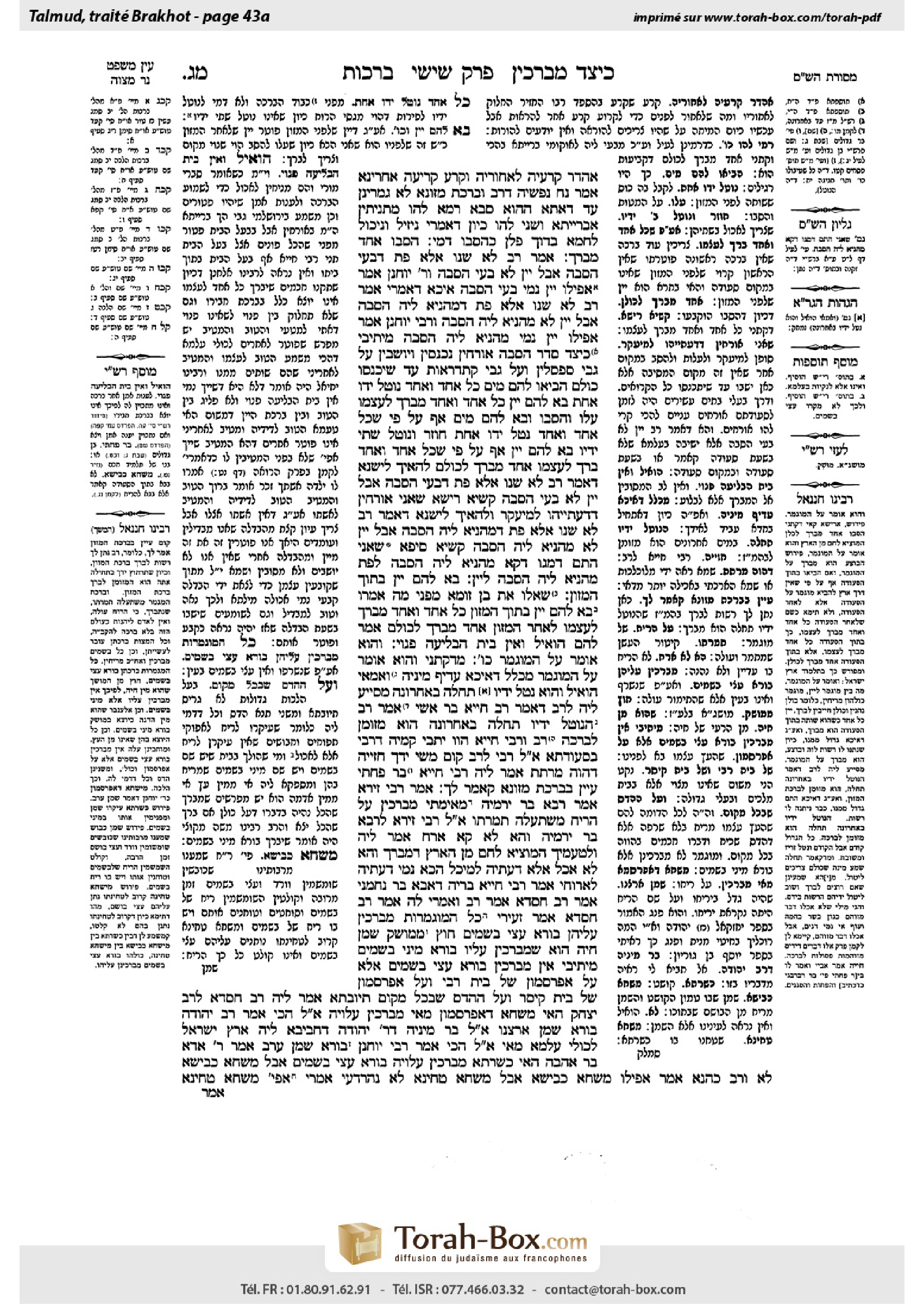
Berakhot 43a: Talmud study for Daf Yomi
Study the Talmud for Daf Yomi with scanned pages, Hebrew text, English translations from Sefaria and AI-generated French translations.
Passage selection and English or AI-generated French translation are available where the scan has annotations. Daf Study is independent of Torah-Box and Sefaria.
Browse Berakhot · ברכות · All tractatesBerakhot 43a text and translations
This page of Berakhot includes the Aramaic text, an English translation and an AI-generated French translation, alongside the scan above.
ברכות מ״ג א · Aramaic and Hebrew text
אַהְדַּר קִרְעֵיהּ לַאֲחוֹרֵיהּ, וּקְרַע קְרִיעָה אַחֲרִינָא. אֲמַר: נָח נַפְשֵׁיהּ דְּרַב, וּבִרְכַּת מְזוֹנָא לָא גָּמְרִינַן. עַד דַּאֲתָא הָהוּא סָבָא, רְמָא לְהוּ מַתְנִיתִין אַבָּרַיְיתָא, וְשַׁנִּי לְהוּ: כֵּיוָן דְּאָמְרִי ״נֵיזִיל וְנֵיכוֹל לַחְמָא בְּדוּךְ פְּלָן״ — כְּהֵסַבּוּ דָּמֵי.
הֵסַבּוּ, אֶחָד מְבָרֵךְ. אָמַר רַב: לֹא שָׁנוּ אֶלָּא פַּת דְּבָעֵי הֲסִבָּה, אֲבָל יַיִן לָא בָּעֵי הֲסִבָּה. וְרַבִּי יוֹחָנָן אָמַר: אֲפִילּוּ יַיִן נָמֵי בָּעֵי הֲסִבָּה.
אִיכָּא דְּאָמְרִי, אָמַר רַב: לֹא שָׁנוּ אֶלָּא פַּת — דְּמַהְנְיָא לֵיהּ הֲסִבָּה. אֲבָל יַיִן — לָא מַהְנְיָא לֵיהּ הֲסִבָּה. וְרַבִּי יוֹחָנָן אָמַר: אֲפִילּוּ יַיִן נָמֵי מַהְנְיָא לֵיהּ הֲסִבָּה.
מֵיתִיבִי: כֵּיצַד סֵדֶר הֲסִבָּה? — אוֹרְחִין נִכְנָסִין וְיוֹשְׁבִין עַל גַּבֵּי סַפְסָלִין וְעַל גַּבֵּי קָתֶדְרָאוֹת עַד שֶׁיִּכָּנְסוּ כּוּלָּם. הֵבִיאוּ לָהֶם מַיִם — כׇּל אֶחָד וְאֶחָד נוֹטֵל יָדוֹ אַחַת. בָּא לָהֶם יַיִן — כׇּל אֶחָד וְאֶחָד מְבָרֵךְ לְעַצְמוֹ. עָלוּ וְהֵסַבּוּ וּבָא לָהֶם מַיִם, אַף עַל פִּי שֶׁכָּל אֶחָד וְאֶחָד נָטַל יָדוֹ אַחַת, חוֹזֵר וְנוֹטֵל שְׁתֵּי יָדָיו. בָּא לָהֶם יַיִן — אַף עַל פִּי שֶׁכָּל אֶחָד וְאֶחָד בֵּרַךְ לְעַצְמוֹ, אֶחָד מְבָרֵךְ לְכוּלָּם.
לְהַאֵיךְ לִישָּׁנָא דְּאָמַר רַב לֹא שָׁנוּ אֶלָּא פַּת דְּבָעֵי הֲסִבָּה, אֲבָל יַיִן לָא בָּעֵי הֲסִבָּה — קַשְׁיָא רֵישָׁא!
שָׁאנֵי אוֹרְחִין דְּדַעְתַּיְיהוּ לְמִיעְקַר.
וּלְהַאֵיךְ לִישָּׁנָא דְּאָמַר רַב לֹא שָׁנוּ אֶלָּא פַּת, דְּמַהְנְיָא לֵיהּ הֲסִבָּה, אֲבָל יַיִן לָא מַהְנְיָא לֵיהּ הֲסִבָּה — קַשְׁיָא סֵיפָא!
שָׁאנֵי הָתָם, דְּמִגּוֹ דְּקָא מַהְנְיָא לֵיהּ הֲסִבָּה לְפַת — מַהְנְיָא לֵיהּ הֲסִבָּה לְיַיִן.
בָּא לָהֶם יַיִן בְּתוֹךְ הַמָּזוֹן. שָׁאֲלוּ אֶת בֶּן זוֹמָא: מִפְּנֵי מָה אָמְרוּ בָּא לָהֶם יַיִן בְּתוֹךְ הַמָּזוֹן — כׇּל אֶחָד וְאֶחָד מְבָרֵךְ לְעַצְמוֹ, לְאַחַר הַמָּזוֹן — אֶחָד מְבָרֵךְ לְכוּלָּם? אָמַר לָהֶם: הוֹאִיל וְאֵין בֵּית הַבְּלִיעָה פָּנוּי.
וְהוּא אוֹמֵר עַל הַמּוּגְמָר כּוּ׳. מִדְּקָתָנֵי ״וְהוּא אוֹמֵר עַל הַמּוּגְמָר״, מִכְלָל דְּאִיכָּא עֲדִיף מִינֵּיהּ, וְאַמַּאי!
הוֹאִיל וְהוּא נָטַל יָדָיו תְּחִלָּה בָּאַחֲרוֹנָה.
מְסַיַּיע לֵיהּ לְרַב, דְּאָמַר רַב חִיָּיא בַּר אָשֵׁי אָמַר רַב: הַנּוֹטֵל יָדָיו תְּחִלָּה בָּאַחֲרוֹנָה — הוּא מְזוּמָּן לַבְּרָכָה. רַב וְרַבִּי חִיָּיא הֲווֹ יָתְבִי קַמֵּיהּ דְּרַבִּי בִּסְעוֹדְתָּא. אֲמַר לֵיהּ רַבִּי לְרַב: קוּם מְשִׁי יְדָךְ. חַזְיֵיהּ דַּהֲוָה מְרַתֵּת. אֲמַר לֵיהּ רַבִּי חִיָּיא: בַּר פַּחֲתֵי, עַיֵּין בְּבִרְכַּת מְזוֹנָא קָאָמַר לָךְ.
אָמַר רַבִּי זֵירָא אָמַר רָבָא בַּר יִרְמְיָה: מֵאֵימָתַי מְבָרְכִין עַל הָרֵיחַ — מִשֶּׁתַּעֲלֶה תִּמְרָתוֹ. אֲמַר לֵיהּ רַבִּי זֵירָא לְרָבָא בַּר יִרְמְיָה: וְהָא לָא אֲרַח? אֲמַר לֵיהּ: וּלְטַעְמָיךְ, ״הַמּוֹצִיא לֶחֶם מִן הָאָרֶץ״ דִּמְבָרֵךְ וְהָא לָא אֲכַל! אֶלָּא דַּעְתֵּיהּ לְמֵיכַל, הָכָא נָמֵי דַּעְתֵּיהּ לְאוֹרוֹחֵי.
אָמַר רַבִּי חִיָּיא בְּרֵיהּ דְּאַבָּא בַּר נַחְמָנִי אָמַר רַב חִסְדָּא אָמַר רַב, וְאָמְרִי לַהּ אָמַר רַב חִסְדָּא אָמַר זְעֵירִי: כׇּל הַמּוּגְמָרוֹת מְבָרְכִין עֲלֵיהֶן ״בּוֹרֵא עֲצֵי בְּשָׂמִים״ חוּץ מִמּוּשְׁק, שֶׁמִּין חַיָּה הוּא, שֶׁמְּבָרְכִין עָלָיו ״בּוֹרֵא מִינֵי בְּשָׂמִים״.
מֵיתִיבִי: אֵין מְבָרְכִין ״בּוֹרֵא עֲצֵי בְּשָׂמִים״ אֶלָּא עַל אֲפַרְסְמוֹן שֶׁל בֵּית רַבִּי, וְעַל אֲפַרְסְמוֹן שֶׁל בֵּית קֵיסָר, וְעַל הַהֲדַס שֶׁבְּכָל מָקוֹם!
תְּיוּבְתָּא.
אֲמַר לֵיהּ רַב חִסְדָּא לְרַב יִצְחָק: הַאי מִשְׁחָא דַאֲפַרְסְמוֹן מַאי מְבָרְכִין עִלָּוֵיהּ? אָמַר לֵיהּ, הָכִי אָמַר רַב יְהוּדָה: ״בּוֹרֵא שֶׁמֶן אַרְצֵנוּ״. אָמַר לֵיהּ: בַּר מִינֵּיהּ דְּרַב יְהוּדָה דַּחֲבִיבָא לֵיהּ אֶרֶץ יִשְׂרָאֵל, לְכוּלֵּי עָלְמָא מַאי?
אָמַר לֵיהּ: הָכִי אָמַר רַבִּי יוֹחָנָן: ״בּוֹרֵא שֶׁמֶן עָרֵב״.
אָמַר רַב אַדָּא בַּר אַהֲבָה: הַאי כְּשַׁרְתָּא מְבָרְכִין עִלָּוֵיהּ ״בּוֹרֵא עֲצֵי בְּשָׂמִים״, אֲבָל מִשְׁחָא כְּבִישָׁא — לָא. וְרַב כָּהֲנָא אָמַר: אֲפִילּוּ מִשְׁחָא כְּבִישָׁא, אֲבָל מִשְׁחָא טְחִינָא — לָא. נְהַרְדָּעֵי אָמְרִי: אֲפִילּוּ מִשְׁחָא טְחִינָא.
Berakhot 43a · English translation
and reversed his cloak, so that his tear which he had rent in mourning of Rav was behind him, and in mourning, he rent another tear in his garment. He said: Rav is dead, and we have not yet learned the halakhot of the Grace after Meals. Until, this elder came and raised a contradiction from the mishna to the baraita, as cited above, and he resolved it for them: Since they said: Let us go and eat in such-and-such a place, it is considered as if they reclined.
We learned in the mishna: If they were reclined, one recites a blessing on behalf of them all. Rav said: This halakha was only taught with regard to bread that it requires reclining to enable one to recite a blessing on behalf of them all. However, wine does not require reclining. And Rabbi Yoḥanan said: Even wine requires reclining as well.
Some say that Rav said: The mishna only taught that reclining is effective and enables one to recite a blessing on behalf of them all, with regard to a group eating bread. However, with regard to a group drinking wine, reclining is ineffective and each individual must recite a blessing for himself. And Rabbi Yoḥanan said: Even with regard to wine, reclining is effective.
The Gemara raises an objection based on a Tosefta: What is the order of reclining at a meal? The guests enter and sit upon benches and chairs [katedraot] until all are assembled. Afterward, they brought them water and each and every one washes one hand in which to hold the cup of wine. When wine came before them prior to the meal, each and every one recites a blessing over the wine for himself. Then, when they entered and reclined on the divans for the meal itself, and water came before them, despite the fact that each and every one already washed one hand, they wash both hands again prior to the meal, so that they will be able to eat with both hands. If wine came before them during the meal, despite the fact that each and every one already recited a blessing for himself, one recites a blessing on behalf of them all.
If so, according to that version that Rav said: This halakha was only taught with regard to bread that it requires reclining to enable one to recite a blessing on behalf of them all. However, wine does not require reclining; the first clause of the Tosefta, which taught that each guest recites a blessing over the wine for himself, is difficult.
The Gemara answers: Guests are different, as when they are sitting in the hall prior to the meal, their intention is to leave and enter the dining room. Therefore, while there, their drinking together is not considered a joint meal.
And according to the version that Rav said: The mishna only taught that reclining is effective and enables one to recite a blessing on behalf of them all, with regard to a group eating bread. However, with regard to a group drinking wine, reclining is ineffective and each individual must recite a blessing for himself; the latter clause of the Tosefta, which taught that when drinking wine when reclining, one recites a blessing on behalf of all, is difficult.
The Gemara responds: There it is different, as since reclining is effective and enables one to recite a blessing on behalf of them all for bread, reclining is effective for wine as well.
We learned in the mishna: If wine came before them during the meal, each and every diner recites a blessing over the wine for himself. If the wine came after the meal, one recites a blessing on behalf of them all. The Tosefta relates: They asked Ben Zoma: Why did the Sages say: If wine came before them during the meal, each and every diner recites a blessing over the wine for himself; but if the wine came after the meal, one recites a blessing on behalf of them all? He said to them: This is because while eating, the throat is not available. If one recites a blessing on behalf of them all, he would be forced to wait until they all had finished eating and readied themselves to drink the wine together (Tosafot). To prevent imposing upon them, the Sages ruled that there is no need to recite the blessing together.
The mishna teaches: And he, who recited the blessing over the wine, also recites the blessing over the incense, although they bring the incense only after the meal. The Gemara asks: From the fact that the mishna teaches: And he recites the blessing over the incense, it can be inferred that there is someone who should take precedence over him, to recite the blessing. That is why the mishna must emphasize that it is he who recites the blessing. And why does the one who recited the blessing over the wine nevertheless recite the blessing over the incense?
The Gemara responds: Since he washed his hands first after the meal, prior to Grace after Meals, he also recites the blessing over the incense, as the washing of hands after the meal and the burning of the incense serve similar functions.
The Gemara comments: This supports the opinion of Rav, as Rav Ḥiyya bar Ashi says that Rav says: He who washes his hands first after the meal is designated to recite the blessing of Grace after Meals. Evidently, being given priority in performing one mitzva related to the meal results in that same person being given priority with regard to other mitzvot related to the meal. The Gemara relates: Rav and Rabbi Ḥiyya were seated before Rabbi Yehuda HaNasi at a meal. Rabbi Yehuda HaNasi said to Rav: Stand and wash your hands. Rabbi Ḥiyya saw that Rav was trembling, as Rav thought that Rabbi Yehuda HaNasi was criticizing him for eating too much or for having dirty hands. Rabbi Ḥiyya said to Rav: Son of noblemen, he is telling you to review Grace after Meals. As you will be the one reciting Grace after Meals, he told you to wash your hands first.
Having mentioned the blessing over incense, the Gemara proceeds to discuss various halakhot that deal with blessings recited over scents. Rabbi Zeira said that Rava bar Yirmeya said: From when does one recite the blessing over the scent of incense? From when its column of smoke rises after the incense has been placed upon the coals. Rabbi Zeira said to Rava bar Yirmeya: But at that point, he has not yet smelled it. Rava bar Yirmeya said to him: And according to your reasoning, the blessing: Who brings forth bread from the earth, that one recites before eating bread, at that point, he has not yet eaten from it. Rather, in that case, one recites the blessing when he intends to eat; here too, he intends to smell.
Rabbi Ḥiyya, son of Abba bar Naḥmani, said that Rav Ḥisda said that Rav said, and some say that Rav Ḥisda said that Ze’iri said: Over all the incense one recites: Who creates fragrant trees, except for musk, which is extracted from a living creature, and over which one recites: Who creates various spices.
The Gemara raises an objection based on what was taught in a baraita: One only recites: Who creates fragrant trees, over the balsam from the house of Rabbi Yehuda HaNasi, and over balsam from the house of Caesar and over myrtle everywhere. According to the previous statement, one recites that blessing over all types of incense.
The Gemara comments: Indeed, it is a conclusive refutation.
Rav Ḥisda said to Rav Yitzḥak: This balsam oil, what blessing does one recite over it? Rav Yitzḥak said to him, this is what Rav Yehuda said: One recites: Who creates the oil of our land, as balsam only grew in Eretz Yisrael, in the Jordan valley. Rav Ḥisda said to him: Except for Rav Yehuda, for whom Eretz Yisrael was extremely beloved and who therefore mentioned it in his blessing, what blessing does everyone else recite over balsam oil?
He said to him: This is what Rabbi Yoḥanan said: One recites: Who creates pleasant oil.
Rav Adda bar Ahava said: Over costus, a spice, one recites: Who creates fragrant trees, but over oil that was pressed with spices to absorb their scents, no, one does not recite that blessing. And Rav Kahana said: Even over oil pressed with spices, one recites: Who creates fragrant trees, but not over oil into which spices were ground. The Sages of Neharde’a say: Even over oil into which spices were ground, which is of even lower quality, one recites this blessing.
Berakhot 43a · Traduction française (IA)
et il retourna sa cape, de sorte que la larme qu'il avait déchirée en deuil de Rav se trouvait derrière lui, et en deuil, il déchira une autre larme dans sa robe. Il dit : Rav est mort, et nous n'avons pas encore appris les halakhot de la Bérit après le repas. Jusqu'à ce que cet homme âgé arrive et soulève une contradiction entre la michna et la baraïta, comme indiqué ci-dessus, et il la résolut pour eux : Puisqu'ils dirent : Allons manger dans telle et telle place, cela est considéré comme s'ils s'étaient allongés.
Nous avons appris dans la michna : Si ils s'étaient allongés, l'un récite une berakha au nom de tous. Rav dit : Cette halakha a été enseignée uniquement concernant le pain, car il exige l'allongement pour permettre à l'un de réciter une berakha au nom de tous. Cependant, le vin ne nécessite pas l'allongement. Et Rabbi Yoḥanan dit : Même le vin nécessite l'allongement.
Certains disent que Rav dit : La michna a enseigné uniquement que l'allongement est efficace et permet à l'un de réciter une berakha au nom de tous, concernant un groupe mangeant du pain. Cependant, concernant un groupe buvant du vin, l'allongement n'est pas efficace et chacun doit réciter une berakha pour lui-même. Et Rabbi Yoḥanan dit : Même concernant le vin, l'allongement est efficace.
Le Guemara soulève une objection basée sur une Tosefta : Quel est l'ordre de l'allongement lors d'un repas ? Les invités entrent et s'assoient sur des bancs et des chaises [katedraot] jusqu'à ce que tout le monde soit rassemblé. Ensuite, on leur apporte de l'eau et chacun lave une main pour tenir la coupe de vin. Lorsque le vin est servi avant le repas, chacun récite une berakha sur le vin pour lui-même. Puis, lorsqu'ils s'allongent sur les divans pour le repas lui-même, et que l'eau est servie, malgré le fait que chacun a déjà lavé une main, ils lavent à nouveau les deux mains avant le repas, afin de pouvoir manger avec les deux mains. Si le vin est servi pendant le repas, malgré le fait que chacun a déjà récité une berakha pour lui-même, l'un récite une berakha au nom de tous.
Si tel est le cas, selon cette version que Rav a dite : Cette halakha a été enseignée uniquement concernant le pain, car il exige l'allongement pour permettre à l'un de réciter une berakha au nom de tous. Cependant, le vin ne nécessite pas l'allongement ; la première partie de la Tosefta, qui enseignait que chaque invité récite une berakha sur le vin pour lui-même, est difficile.
Le Guemara répond : Les invités sont différents, car lorsqu'ils sont assis dans la salle avant le repas, leur intention est de partir et d'entrer dans la salle à manger. Par conséquent, pendant ce temps, leur consommation commune n'est pas considérée comme un repas commun.
Et selon la version que Rav dit : La michna a enseigné uniquement que l'allongement est efficace et permet à l'un de réciter une berakha au nom de tous, concernant un groupe mangeant du pain. Cependant, concernant un groupe buvant du vin, l'allongement n'est pas efficace et chacun doit réciter une berakha pour lui-même ; la dernière partie de la Tosefta, qui enseignait que lorsqu'on boit du vin en allongé, l'un récite une berakha au nom de tous, est difficile.
Le Guemara répond : C'est différent là-bas, car puisque l'allongement est efficace et permet à l'un de réciter une berakha au nom de tous pour le pain, l'allongement est efficace pour le vin également.
Nous avons appris dans la michna : Si le vin est servi avant le repas, chaque convive récite une berakha sur le vin pour lui-même. Si le vin est servi après le repas, l'un récite une berakha au nom de tous. La Tosefta rapporte : Ils interrogèrent Ben Zoma : Pourquoi les Sages dirent : Si le vin est servi avant le repas, chaque convive récite une berakha sur le vin pour lui-même ; mais si le vin est servi après le repas, l'un récite une berakha au nom de tous ? Il dit à ceux-ci : C'est parce que pendant l'ingestion, la gorge n'est pas disponible. Si l'un récite une berakha au nom de tous, il serait contraint d'attendre jusqu'à ce que tous aient fini d'ingérer et soient prêts à boire le vin ensemble (Tosafot). Pour éviter de les imposer, les Sages décidèrent qu'il n'était pas nécessaire de réciter la berakha ensemble.
La michna enseigne : Et celui qui a récité la berakha sur le vin récitera aussi la berakha sur l'encens, bien qu'on apporte l'encens seulement après le repas. Le Guemara demande : D'après le fait que la michna enseigne : Et il récita la berakha sur l'encens, on peut en déduire qu'il y a quelqu'un qui doit avoir la priorité pour réciter la berakha. C'est pourquoi la michna doit insister que c'est lui qui récita la berakha. Et pourquoi celui qui récita la berakha sur le vin récitera-t-il aussi la berakha sur l'encens ?
Le Guemara répond : Puisqu'il a lavé d'abord ses mains après le repas, avant la Bérit après le repas, il récita aussi la berakha sur l'encens, car le lavage des mains après le repas et la combustion de l'encens servent des fonctions similaires.
Le Guemara commente : Cela soutient l'opinion de Rav, car Rav Ḥiyya bar Ashi dit que Rav dit : Celui qui lave d'abord ses mains après le repas est désigné pour réciter la Bérit après le repas. Évidemment, être donné la priorité dans l'accomplissement d'une mitsva liée au repas entraîne que la même personne soit donnée la priorité concernant d'autres mitsvot liées au repas. Le Guemara rapporte : Rav et Rabbi Ḥiyya étaient assis devant Rabbi Yehuda HaNasi lors d'un repas. Rabbi Yehuda HaNasi dit à Rav : Levez-vous et lavez vos mains. Rabbi Ḥiyya vit que Rav tremblait, car Rav pensait que Rabbi Yehuda HaNasi le critiquait pour avoir mangé trop ou pour avoir des mains sales. Rabbi Ḥiyya dit à Rav : Fils de nobles, il te dit de réviser la Bérit après le repas. Comme tu seras celui qui récitera la Bérit après le repas, il t'a dit de laver d'abord tes mains.
Ayant mentionné la bénédiction sur l'encens, la Guemara passe à discuter divers halakhot concernant les bénédictions récitées sur les parfums. Rabbi Zéira a dit que Rava bar Yirméya a dit : À partir de quel moment l'on récite la bénédiction sur le parfum de l'encens ? À partir du moment où la colonne de fumée s'élève après que l'encens ait été placé sur les braises. Rabbi Zéira a dit à Rava bar Yirméya : Mais à ce moment-là, il n'a pas encore senti le parfum. Rava bar Yirméya a répondu à lui : Et selon votre raisonnement, la bénédiction : Qui fait sortir le pain de la terre, qu'on la récite avant de manger du pain, à ce moment-là, il n'a pas encore mangé de ce pain. Plutôt, dans ce cas-là, on récite la bénédiction lorsqu'on a l'intention de manger ; ici aussi, on a l'intention de sentir.
Rabbi Ḥiyya, fils d'Abba bar Naḥmani, a dit que Rav Ḥisda a dit que Rav a dit, et certains disent que Rav Ḥisda a dit que Zé'iri a dit : Sur tous les encens, on récite : Qui crée des arbres parfumés, sauf pour le musc, qui est extrait d'un être vivant, et sur lequel on récite : Qui crée diverses épices.
La Guemara soulève une objection basée sur ce qui a été enseigné dans une baraïta : On récite uniquement : Qui crée des arbres parfumés, sur le balsam de la maison de Rabbi Yéhuda HaNasi, et sur le balsam de la maison de César et sur le laurier partout. Selon l'affirmation précédente, on récite cette bénédiction sur tous les types d'encens.
La Guemara commente : En effet, c'est une réfutation concluante.
Rav Ḥisda a dit à Rav Yitzḥak : Cette huile de balsam, quelle bénédiction l'on récite sur elle ? Rav Yitzḥak a répondu à lui : C'est ce que Rav Yéhuda a dit : On récite : Qui crée l'huile de notre terre, car le balsam ne poussait qu'en Eretz Yisrael, dans la vallée du Jourdain. Rav Ḥisda a dit à lui : À l'exception de Rav Yéhuda, pour qui Eretz Yisrael était extrêmement chéri et qui a donc mentionné cela dans sa bénédiction, quelle bénédiction l'on récite pour tous les autres sur l'huile de balsam ?
Il a dit à lui : C'est ce que Rabbi Yoḥanan a dit : On récite : Qui crée une huile agréable.
Rav Adda bar Ahava a dit : Sur le costus, une épice, on récite : Qui crée des arbres parfumés, mais sur l'huile pressée avec des épices pour absorber leurs parfums, non, on ne récite pas cette bénédiction. Et Rav Kahana a dit : Même sur l'huile pressée avec des épices, on récite : Qui crée des arbres parfumés, mais pas sur l'huile dans laquelle des épices ont été moulues. Les Sages de Neharde’a disent : Même sur l'huile dans laquelle des épices ont été moulues, qui est de qualité encore plus basse, on récite cette bénédiction.
Traduction française générée par IA à partir de l’édition anglaise de Sefaria. Vérifie toujours un passage avec le texte source.
Text from Sefaria: William Davidson Edition - Vocalized Aramaic (CC BY NC); William Davidson Edition - English (CC BY NC).