Berakhot 43b: Talmud study for Daf Yomi
Study the Talmud for Daf Yomi with scanned pages, Hebrew text, English translations from Sefaria and AI-generated French translations.
Passage selection and English or AI-generated French translation are available where the scan has annotations. Daf Study is independent of Torah-Box and Sefaria.
Browse Berakhot · ברכות · All tractatesBerakhot 43b text and translations
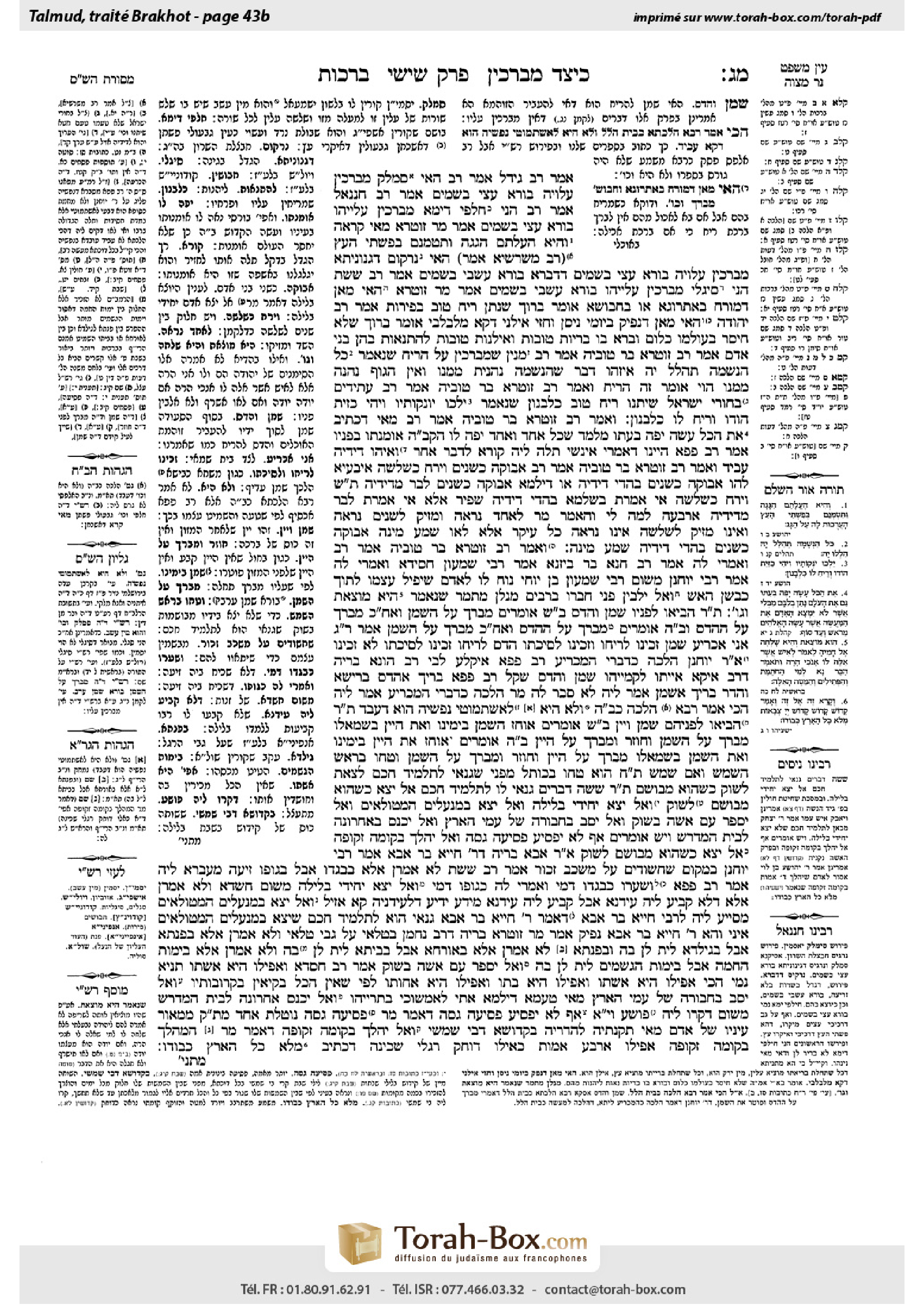
This page of Berakhot includes the Aramaic text, an English translation and an AI-generated French translation, alongside the scan above.
ברכות מ״ג ב · Aramaic and Hebrew text
אָמַר רַב גִּידֵּל אָמַר רַב: הַאי סִמְלָק — מְבָרְכִין עִלָּוֵיהּ ״בּוֹרֵא עֲצֵי בְּשָׂמִים״. אָמַר רַב חֲנַנְאֵל אָמַר רַב: הָנֵי חִלְפֵי דְיַמָּא — מְבָרְכִין עֲלַיְיהוּ ״בּוֹרֵא עֲצֵי בְּשָׂמִים״. אָמַר מָר זוּטְרָא: מַאי קְרָאָה — ״וְהִיא הֶעֱלָתַם הַגָּגָה וַתִּטְמְנֵם בְּפִשְׁתֵּי הָעֵץ״.
רַב מְשַׁרְשְׁיָא אָמַר: הַאי נַרְקוֹם דְּגִינוּנִיתָא — מְבָרְכִין עִלָּוֵיהּ ״בּוֹרֵא עֲצֵי בְשָׂמִים״. דְּדַבְרָא — ״בּוֹרֵא עִשְׂבֵי בְשָׂמִים״. אָמַר רַב שֵׁשֶׁת: הָנֵי סִיגְלֵי — מְבָרְכִין עֲלַיְיהוּ ״בּוֹרֵא עִשְׂבֵי בְשָׂמִים״. אָמַר מָר זוּטְרָא: הַאי מַאן דְּמוֹרַח בְּאֶתְרוֹגָא אוֹ בְּחַבּוּשָׁא אוֹמֵר: ״בָּרוּךְ שֶׁנָּתַן רֵיחַ טוֹב בַּפֵּירוֹת״.
אָמַר רַב יְהוּדָה: הַאי מַאן דְּנָפֵיק בְּיוֹמֵי נִיסָן וְחָזֵי אִילָנֵי דְּקָא מְלַבְלְבִי, אוֹמֵר: ״בָּרוּךְ שֶׁלֹּא חִיסֵּר בְּעוֹלָמוֹ כְּלוּם וּבָרָא בּוֹ בְּרִיּוֹת טוֹבוֹת וְאִילָנוֹת טוֹבוֹת לְהִתְנָאוֹת בָּהֶן בְּנֵי אָדָם״. אָמַר רַב זוּטְרָא בַּר טוֹבִיָּה אָמַר רַב: מִנַּיִן שֶׁמְּבָרְכִין עַל הָרֵיחַ? — שֶׁנֶּאֱמַר: ״כֹּל הַנְּשָׁמָה תְּהַלֵּל יָהּ״. אֵיזֶהוּ דָּבָר שֶׁהַנְּשָׁמָה נֶהֱנֵית מִמֶּנּוּ וְאֵין הַגּוּף נֶהֱנֶה מִמֶּנּוּ? — הֱוֵי אוֹמֵר: זֶה הָרֵיחַ.
וְאָמַר רַב זוּטְרָא בַּר טוֹבִיָּה אָמַר רַב: עֲתִידִים בַּחוּרֵי יִשְׂרָאֵל שֶׁיִּתְּנוּ רֵיחַ טוֹב כַּלְּבָנוֹן. שֶׁנֶּאֱמַר: ״יֵלְכוּ יוֹנְקוֹתָיו וִיהִי כַזַּיִת הוֹדוֹ וְרֵיחַ לוֹ כַּלְּבָנוֹן״.
וְאָמַר רַב זוּטְרָא בַּר טוֹבִיָּה אָמַר רַב: מַאי דִּכְתִיב ״אֶת הַכֹּל עָשָׂה יָפֶה בְעִתּוֹ״ — מְלַמֵּד שֶׁכָּל אֶחָד וְאֶחָד יִפָּה לוֹ הַקָּדוֹשׁ בָּרוּךְ הוּא אוּמָּנוּתוֹ בְּפָנָיו.
אָמַר רַב פָּפָּא: הַיְינוּ דְּאָמְרִי אִינָשֵׁי: ״תְּלֵה לֵיהּ קוֹרָא לְדָבָר אַחֵר, וְאִיהוּ דִּידֵיהּ עָבֵיד״.
וְאָמַר רַב זוּטְרָא בַּר טוֹבִיָּה אָמַר רַב: אֲבוּקָה כִּשְׁנַיִם, וְיָרֵחַ כִּשְׁלֹשָׁה. אִיבַּעְיָא לְהוּ: אֲבוּקָה כִּשְׁנַיִם בַּהֲדֵי דִידֵיהּ, אוֹ דִילְמָא אֲבוּקָה כִּשְׁנַיִם לְבַר מִדִּידֵיהּ? תָּא שְׁמַע: וְיָרֵחַ כִּשְׁלֹשָׁה, אִי אָמְרַתְּ בִּשְׁלָמָא בַּהֲדֵי דִידֵיהּ — שַׁפִּיר. אֶלָּא אִי אָמְרַתְּ לְבַר מִדִּידֵיהּ, אַרְבָּעָה לְמָה לִי? וְהָאָמַר מָר: לְאֶחָד נִרְאֶה וּמַזִּיק, לִשְׁנַיִם נִרְאֶה וְאֵינוֹ מַזִּיק, לִשְׁלֹשָׁה אֵינוֹ נִרְאֶה כׇּל עִיקָּר. אֶלָּא לָאו שְׁמַע מִינַּהּ אֲבוּקָה כִּשְׁנַיִם — בַּהֲדֵי דִידֵיהּ. שְׁמַע מִינַּהּ.
וְאָמַר רַב זוּטְרָא בַּר טוֹבִיָּה אָמַר רַב, וְאָמְרִי לַהּ אָמַר רַב חָנָא בַּר בִּיזְנָא אָמַר רַבִּי שִׁמְעוֹן חֲסִידָא, וְאָמְרִי לַהּ אָמַר רַבִּי יוֹחָנָן מִשּׁוּם רַבִּי שִׁמְעוֹן בֶּן יוֹחַי: נוֹחַ לוֹ לְאָדָם שֶׁיַּפִּיל עַצְמוֹ לְתוֹךְ כִּבְשַׁן הָאֵשׁ וְאַל יַלְבִּין פְּנֵי חֲבֵרוֹ בָּרַבִּים. מְנָלַן? — מִתָּמָר, שֶׁנֶּאֱמַר: ״הִיא מוּצֵאת וְגוֹ׳״.
תָּנוּ רַבָּנַן: הֵבִיאוּ לְפָנָיו שֶׁמֶן וַהֲדַס, בֵּית שַׁמַּאי אוֹמְרִים: מְבָרֵךְ עַל הַשֶּׁמֶן וְאַחַר כָּךְ מְבָרֵךְ עַל הַהֲדַס. וּבֵית הִלֵּל אוֹמְרִים: מְבָרֵךְ עַל הַהֲדַס וְאַחַר כָּךְ מְבָרֵךְ עַל הַשֶּׁמֶן. אָמַר רַבָּן גַּמְלִיאֵל: אֲנִי אַכְרִיעַ. שֶׁמֶן — זָכִינוּ לְרֵיחוֹ וְזָכִינוּ לְסִיכָתוֹ, הֲדַס — לְרֵיחוֹ זָכִינוּ לְסִיכָתוֹ לֹא זָכִינוּ. אָמַר רַבִּי יוֹחָנָן: הֲלָכָה כְּדִבְרֵי הַמַּכְרִיעַ.
רַב פָּפָּא אִיקְּלַע לְבֵי רַב הוּנָא בְּרֵיהּ דְּרַב אִיקָא. אַיְיתוֹ לְקַמַּיְיהוּ שֶׁמֶן וַהֲדַס. שְׁקַל רַב פָּפָּא בָּרֵיךְ אַהֲדַס בְּרֵישָׁא, וַהֲדַר בָּרֵיךְ אַשֶּׁמֶן. אָמַר לֵיהּ: לָא סָבַר לַהּ מָר הֲלָכָה כְּדִבְרֵי הַמַּכְרִיעַ? אָמַר לֵיהּ: הָכִי אָמַר רָבָא: הֲלָכָה כְּבֵית הִלֵּל. וְלָא הִיא, לְאִשְׁתְּמוֹטֵי נַפְשֵׁיהּ הוּא דַּעֲבַד.
תָּנוּ רַבָּנַן: הֵבִיאוּ לִפְנֵיהֶם שֶׁמֶן וְיַיִן, בֵּית שַׁמַּאי אוֹמְרִים: אוֹחֵז הַשֶּׁמֶן בִּימִינוֹ וְאֶת הַיַּיִן בִּשְׂמֹאלוֹ, מְבָרֵךְ עַל הַשֶּׁמֶן וְחוֹזֵר וּמְבָרֵךְ עַל הַיַּיִן. בֵּית הִלֵּל אוֹמְרִים: אוֹחֵז אֶת הַיַּיִן בִּימִינוֹ וְאֶת הַשֶּׁמֶן בִּשְׂמֹאלוֹ, מְבָרֵךְ עַל הַיַּיִן וְחוֹזֵר וּמְבָרֵךְ עַל הַשֶּׁמֶן, וְטָחוֹ בְּרֹאשׁ הַשַּׁמָּשׁ. וְאִם שַׁמָּשׁ תַּלְמִיד חָכָם הוּא — טָחוֹ בַּכּוֹתֶל, מִפְּנֵי שֶׁגְּנַאי לְתַלְמִיד חָכָם לָצֵאת לַשּׁוּק כְּשֶׁהוּא מְבוּשָּׂם.
תָּנוּ רַבָּנַן: שִׁשָּׁה דְּבָרִים גְּנַאי לוֹ לְתַלְמִיד חָכָם: אַל יֵצֵא כְּשֶׁהוּא מְבוּשָּׂם לַשּׁוּק, וְאַל יֵצֵא יְחִידִי בַּלַּיְלָה, וְאַל יֵצֵא בְּמִנְעָלִים הַמְטוּלָּאִים, וְאַל יְסַפֵּר עִם אִשָּׁה בַּשּׁוּק, וְאַל יָסֵב בַּחֲבוּרָה שֶׁל עַמֵּי הָאָרֶץ, וְאַל יִכָּנֵס בָּאַחֲרוֹנָה לְבֵית הַמִּדְרָשׁ. וְיֵשׁ אוֹמְרִים: אַף לֹא יַפְסִיעַ פְּסִיעָה גַּסָּה, וְאַל יְהַלֵּךְ בְּקוֹמָה זְקוּפָה.
אַל יֵצֵא כְּשֶׁהוּא מְבוּשָּׂם לַשּׁוּק: אָמַר רַבִּי אַבָּא בְּרֵיהּ דְּרַבִּי חִיָּיא בַּר אַבָּא אָמַר רַבִּי יוֹחָנָן: בְּמָקוֹם שֶׁחֲשׁוּדִים עַל מִשְׁכַּב זָכוּר. אָמַר רַב שֵׁשֶׁת: לָא אֲמַרַן אֶלָּא בְּבִגְדוֹ, אֲבָל בְּגוּפוֹ — זֵיעָה מְעַבְּרָא לֵיהּ. אָמַר רַב פָּפָּא: וּשְׂעָרוֹ כְּבִגְדוֹ דָּמֵי, וְאָמְרִי לַהּ כְּגוּפוֹ דָּמֵי.
וְאַל יֵצֵא יְחִידִי בַּלַּיְלָה: מִשּׁוּם חֲשָׁדָא. וְלָא אֲמַרַן אֶלָּא דְּלָא קְבִיעַ לֵיהּ עִידָּנָא, אֲבָל קְבִיעַ לֵיהּ עִידָּנָא — מִידָּע יְדִיעַ דִּלְעִידָּנֵיהּ קָא אָזֵיל.
וְאַל יֵצֵא בְּמִנְעָלִים הַמְטוּלָּאִים: מְסַיַּיע לֵיהּ לְרַבִּי חִיָּיא בַּר אַבָּא. דְּאָמַר רַבִּי חִיָּיא בַּר אַבָּא: גְּנַאי הוּא לְתַלְמִיד חָכָם שֶׁיֵּצֵא בְּמִנְעָלִים הַמְטוּלָּאִים. אִינִי? וְהָא רַבִּי חִיָּיא בַּר אַבָּא נָפֵיק! אָמַר מָר זוּטְרָא בְּרֵיהּ דְּרַב נַחְמָן: בִּטְלַאי עַל גַּבֵּי טְלַאי. וְלָא אֲמַרַן אֶלָּא בְּפַנְתָּא, אֲבָל בְּגִילְדָּא — לֵית לַן בַּהּ. וּבְפַנְתָּא לָא אֲמַרַן אֶלָּא בְּאוֹרְחָא, אֲבָל בְּבֵיתָא — לֵית לַן בַּהּ. וְלָא אֲמַרַן אֶלָּא בִּימוֹת הַחַמָּה, אֲבָל בִּימוֹת הַגְּשָׁמִים — לֵית לַן בַּהּ.
וְאַל יְסַפֵּר עִם אִשָּׁה בַּשּׁוּק: אָמַר רַב חִסְדָּא: וַאֲפִילּוּ הִיא אִשְׁתּוֹ. תַּנְיָא נָמֵי הָכִי: אֲפִילּוּ הִיא אִשְׁתּוֹ, וַאֲפִילּוּ הִיא בִּתּוֹ, וַאֲפִילּוּ הִיא אֲחוֹתוֹ — לְפִי שֶׁאֵין הַכֹּל בְּקִיאִין בִּקְרוֹבוֹתָיו.
וְאַל יָסֵב בַּחֲבוּרָה שֶׁל עַמֵּי הָאָרֶץ: מַאי טַעְמָא? — דִּילְמָא אָתֵי לְאִמְּשׁוֹכֵי בָּתְרַיְיהוּ.
וְאַל יִכָּנֵס בָּאַחֲרוֹנָה לְבֵית הַמִּדְרָשׁ: מִשּׁוּם דְּקָרוּ לֵיהּ ״פּוֹשֵׁעַ״.
וְיֵשׁ אוֹמְרִים, אַף לֹא יַפְסִיעַ פְּסִיעָה גַּסָּה: דְּאָמַר מָר, פְּסִיעָה גַּסָּה נוֹטֶלֶת אֶחָד מֵחֲמֵשׁ מֵאוֹת מִמְּאוֹר עֵינָיו שֶׁל אָדָם. מַאי תַּקַּנְתֵּיהּ? לַהְדְּרֵיהּ בְּקִדּוּשָׁא דְבֵי שִׁמְשֵׁי.
וְאַל יְהַלֵּךְ בְּקוֹמָה זְקוּפָה: דְּאָמַר מָר הַמְהַלֵּךְ בְּקוֹמָה זְקוּפָה אֲפִילּוּ אַרְבַּע אַמּוֹת, כְּאִילּוּ דּוֹחֵק רַגְלֵי שְׁכִינָה, דִּכְתִיב: ״מְלֹא כׇל הָאָרֶץ כְּבוֹדוֹ״.
Berakhot 43b · English translation
Rav Giddel said that Rav said: Over this jasmine [simlak], one recites: Who creates fragrant trees. Rav Ḥananel said that Rav said: Over these spikenards, which grow next to the sea, one recites: Who creates fragrant trees. Mar Zutra said: What is the verse from which we derive that even a plant with soft stalks can be called a tree? From the verse: “She had taken them up to the roof and hidden them under the trees of flax” (Joshua 2:6); evidently, even stalks of flax are called “trees.”
Rav Mesharshiya said: Over this garden daffodil one recites: Who creates fragrant trees, while over a wild daffodil that grows in the field, one recites: Who creates fragrant plants. Rav Sheshet said: Over fragrant violets one recites: Who creates fragrant plants. Mar Zutra said: One who smells a citron [etrog] or a quince recites: Blessed…who gave pleasant fragrance in fruits.
On a related topic, the Gemara cites that Rav Yehuda said: One who goes out during Nisan and sees trees that are blossoming recites: Blessed…who has withheld nothing from His world, and has created in it beautiful creatures and trees for human beings to enjoy. Rav Zutra bar Toviya said that Rav said: From where is it derived that one recites a blessing over scent? As it is stated: “Let every soul praise the Lord” (Psalms 150:6). He explains the verse: What is it from which the soul derives benefit and the body does not derive benefit from it? You must say: That is scent. Even over items from which only the soul derives benefit, one must recite a blessing and praise God.
And Rav Zutra bar Toviya said that Rav said: The young men of Israel are destined to emit a sweet scent as the Lebanon, as it is stated: “His branches shall spread and his beauty will be as the olive tree, and his fragrance as Lebanon” (Hosea 14:7).
And Rav Zutra bar Toviya said that Rav said: What is the meaning of that which is written: “He has made everything beautiful in its time, and He has placed the world in their heart, yet so man cannot find out the work that God has done from the beginning even to the end” (Ecclesiastes 3:11)? This teaches that each and every individual, God has made his work pleasant for him in his own eyes. In that way, each individual will be satisfied with his work, enabling the world to function properly.
Rav Pappa said: This is the proverb that people say: Hang a heart of palm on a pig, and he will continue to perform his standard activities. Although hearts of palm are a delicacy, a pig will roll it in the mud as is his wont. Every creature has its own particular tastes, and one cannot draw conclusions with regard to one based on the standards of another.
And Rav Zutra bar Toviya said that Rav said: For one walking on a dark path, if he has a torch in his hand, it is like two were walking on that path and the light of the moon is like three. The Gemara raises a dilemma: Is a torch like two including the one carrying the torch or perhaps a torch is like two besides him for a total of three? Come and hear a proof from that which Rav said: And the moon is like three. Granted, if you say three including him, it works out well. However, if you say three besides him, why do I need four, what purpose do they serve? Didn’t the Master say: To one walking alone, a demon can be seen and cause him harm. To two people, a demon can be seen and does not cause them harm. To three people, it cannot be seen at all. Four people are no better than three. Rather, can’t we learn from this that a torch is like two, means two including him. The Gemara comments: Indeed, conclude from this.
And Rav Zutra bar Toviya said that Rav said; and some say Rav Ḥana bar Bizna said that Rabbi Shimon Ḥasida said; and some say Rabbi Yoḥanan said in the name of Rabbi Shimon ben Yoḥai: It is preferable, from an ethical perspective, for one to throw himself into a fiery furnace rather than humiliate another in public. From where do we derive this? From Tamar, the daughter-in-law of Judah, when she was taken out to be burned, as it is stated: “As she was brought forth, she sent to her father-in-law, saying I am pregnant by the man to whom these belong, and she said examine these, to whom does this seal, cord and staff belong?” (Genesis 38:25). Despite her dire situation, she did not reveal that she was pregnant with Judah’s child; rather, she left the decision to him, to avoid humiliating him in public.
The Sages taught: If they brought before him both scented oil and a myrtle branch, Beit Shammai say: One recites a blessing over the oil first and over the myrtle branch thereafter. And Beit Hillel say: One recites a blessing over the myrtle branch first and over the oil thereafter. Rabban Gamliel said: I will decide this dispute in favor of the opinion of Beit Shammai, that one should recite a blessing over the oil first, as it is more significant. With regard to oil; we are privileged to enjoy its fragrance and we are privileged to enjoy it by anointing ourselves with it. With regard to the myrtle branch; we are privileged to enjoy its fragrance, we are not privileged to enjoy it by anointing ourselves with it. Rabbi Yoḥanan said: The halakha is in accordance with the opinion of the decisor, Rabban Gamliel.
The Gemara relates: Rav Pappa happened to come to the house of Rav Huna, son of Rav Ika. They brought before him both scented oil and a myrtle branch. Rav Pappa took and recited a blessing over the myrtle branch first and then recited a blessing over the oil. Rav Huna said to him: And does the Master not hold that the halakha is in accordance with the opinion of the decisor? If so, you should have recited a blessing over the oil first. Rav Pappa said: Rava said the following: The halakha is in accordance with the opinion of Beit Hillel. The Gemara comments: That is not so, as Rava did not issue that ruling. Rather, Rav Pappa did this in order to extricate himself from an unpleasant situation and justify his conduct.
Our Sages taught in a baraita: If they brought before them both scented oil and wine, Beit Shammai say: He grasps the oil in his right hand, since he recites a blessing over the oil first, and the wine in his left hand. He recites a blessing over the oil and then he recites a blessing over the wine. Beit Hillel say the opposite: He grasps the wine in his right hand and the oil in his left hand. He recites a blessing over the wine and then he recites a blessing over the oil. And after he has recited a blessing over the oil and anointed his hands with it, he smears it on the head of the servant so that his hands will not remain perfumed. And if the servant is a Torah scholar, he smears the oil on the wall, as it is unbecoming for a Torah scholar to go out perfumed into the marketplace.
Tangential to the mention of conduct unbecoming a Torah scholar, the Sages taught in a baraita: Six things are disgraceful for a Torah scholar: He may not go out perfumed into the marketplace; he may not go out of his house alone at night; he may not go out wearing patched shoes; he may not converse with a woman in the marketplace; he may not recline and participate in a meal in the company of ignoramuses; and he may not be the last to enter the study hall. And some say that he may not take long strides and he may not walk with an upright posture.
The Gemara elaborates on the statements of the baraita. He may not go out perfumed into the marketplace; Rabbi Abba, son of Rabbi Ḥiyya bar Abba, said that Rabbi Yoḥanan said: This prohibition only applies in a place where they are suspected of homosexuality. One who goes out into the marketplace perfumed, will arouse suspicion. Rav Sheshet said: We only said this with regard to his clothing that was perfumed, but with regard to his body, it is permitted, as his sweat causes the fragrance to dissipate. Rav Pappa said: In this regard, his hair is considered like his clothing. And some say: His hair is considered like his body.
He may not go out of his house alone at night because of suspicion of promiscuity. And therefore this was only prohibited if he does not have a set time during the night to study with his teacher, but if he has a set time, everyone knows that he is going to study with his teacher at his set time, and they will not be suspicious of him.
He may not go out wearing patched shoes. This supports the statement of Rabbi Ḥiyya bar Abba, as Rabbi Ḥiyya bar Abba said: It is disgraceful for a Torah scholar to go out wearing patched shoes. The Gemara challenges: Is that so? Didn’t Rabbi Ḥiyya bar Abba himself go out wearing patched shoes? Mar Zutra, son of Rav Naḥman, said: It is only prohibited when the shoe has a patch upon a patch. And we only said this with regard to patches on the upper part of the shoe but if the patch is on the sole, this does not apply. And with regard to patches on the upper part of the shoe, we only said this when he is out on the road, but in his house, we need not be concerned. And we only said this with regard to the summer when the patches would be visible to all, but during the rainy season, when the mud obscures the view of the patches, we need not be concerned.
He may not converse with a woman in the marketplace. Rav Ḥisda said: Even if she is his wife. This was also taught in a baraita: One may not converse with a woman in the market, even if she is his wife, even if she is his daughter and even if she is his sister, for not everyone is well-versed in the identity of his female relatives and they will suspect that he is talking to women who are not his relatives.
He may not recline and participate in a meal in the company of ignoramuses. The Gemara explains: What is the reason? Perhaps he will be drawn after them and emulate them.
He may not be the last to enter the study hall. The Gemara explains: Because they will call him negligent, in other words, careless and lazy.
And some say he may not take long strides, as the Master said: A long stride takes away one five-hundredth of a person’s eyesight. The Gemara asks: What is his remedy if he took long strides? The Gemara responds: He can restore it by drinking the wine of kiddush on Shabbat eve.
And he may not walk with an upright posture, but slightly bowed, as the Master said: One who walks with an upright posture and in an arrogant manner, even four cubits, it is as if he is pushing away the feet of the Divine Presence, as it is written: “The entire world is full of His glory” (Isaiah 6:3). One who walks in an arrogant way shows a lack of regard for the glory and honor of God that is surrounding him, and thereby chases God from that place.
Berakhot 43b · Traduction française (IA)
Rav Giddel a dit que Rav avait dit : Sur ce jasmin [simlak], on récite : Celui qui crée des arbres parfumés. Rav Ḥananel a dit que Rav avait dit : Sur ces safraniers, qui poussent près de la mer, on récite : Celui qui crée des arbres parfumés. Mar Zutra a dit : De quelle verset dérivons-nous que même une plante à tiges souples peut être appelée un arbre ? Du verset : « Elle avait pris ceux-ci et les avait portés sur le toit et les avait cachés sous les arbres de lin » (Josué 2:6) ; évidemment, même les tiges de lin sont appelées « arbres ».
Rav Mesharshiya a dit : Sur ce jasmin de jardin, on récite : Celui qui crée des arbres parfumés, tandis que sur un jasmin sauvage qui pousse dans le champ, on récite : Celui qui crée des plantes parfumées. Rav Sheshet a dit : Sur les violas parfumés, on récite : Celui qui crée des plantes parfumées. Mar Zutra a dit : Celui qui sent un citron [etrog] ou une pêche, récite : Béni… celui qui a donné un parfum agréable dans les fruits.
Sur un sujet connexe, le Guemara cite que Rav Yehuda a dit : Celui qui sort durant Nisan et voit des arbres qui fleurissent récite : Béni… celui qui n’a rien caché de son monde, et qui a créé dedans des créatures et des arbres beaux pour que les hommes les apprécient. Rav Zutra bar Toviya a dit que Rav avait dit : D’où dérive-t-on que l’on récite une berakha sur un parfum ? Comme il est dit : « Que chaque âme loue l’Éternel » (Psaumes 150:6). Il explique le verset : De quoi la âme tire-t-elle un bénéfice et le corps n’en tire pas ? Tu dois dire : C’est le parfum. Même sur des choses dont seul la âme tire un bénéfice, il faut réciter une berakha et louer l’Éternel.
Et Rav Zutra bar Toviya a dit que Rav avait dit : Les jeunes gens d’Israël sont destinés à émettre un parfum doux comme le Liban, comme il est dit : « Ses branches s’étendront et sa beauté sera comme l’olivier, et son parfum comme le Liban » (Hosée 14:7).
Et Rav Zutra bar Toviya a dit que Rav avait dit : Quelle est la signification de ce qui est écrit : « Il a rendu tout bel dans son temps, et il a mis le monde dans leur cœur, et pourtant l’homme ne peut pas découvrir l’œuvre que Dieu a faite depuis le commencement jusqu’à la fin » (Ecclésiaste 3:11) ? Cela enseigne que chaque individu, Dieu a rendu son œuvre agréable à ses yeux. Ainsi, chaque individu sera satisfait de son œuvre, permettant au monde de fonctionner correctement.
Rav Pappa a dit : C’est cette proverbe que les gens disent : Accroche un cœur de palmier à un porc, et il continuera à faire ses activités habituelles. Bien que les cœurs de palmier soient un délice, un porc les roulera dans la boue comme c’est son habitude. Chaque créature a ses propres goûts particuliers, et on ne peut pas tirer des conclusions à partir d’un en se basant sur les normes d’un autre.
Et Rav Zutra bar Toviya a dit que Rav avait dit : Pour celui qui marche sur un chemin sombre, si l'on a une torche à la main, c'est comme s'il y avait deux qui marchaient sur ce chemin et la lumière de la lune est comme trois. Le Guemara soulève un dilemme : Une torche est-elle comme deux incluant celui qui la porte ou peut-être une torche est-elle comme deux en plus de lui pour un total de trois ? Viens écouter une preuve de ce que Rav a dit : Et la lune est comme trois. Évidemment, si tu dis trois incluant lui, cela s'ajuste bien. Cependant, si tu dis trois en plus de lui, pourquoi ai-je besoin de quatre, à quoi servent-ils ? N'a-t-il pas dit le Maître : À celui qui marche seul, un démon peut être vu et causer-lui du mal. À deux personnes, un démon peut être vu et ne cause pas de mal. À trois personnes, il ne peut pas être vu du tout. Quatre personnes ne sont pas meilleurs que trois. Plutôt, ne pouvons-nous pas apprendre de cela que la torche est comme deux, c'est-à-dire deux incluant lui. Le Guemara commente : En effet, concluez-en ainsi.
Et Rav Zutra bar Toviya a dit que Rav avait dit ; et certains disent Rav Ḥana bar Bizna a dit que Rabbi Shimon Ḥasida a dit ; et certains disent Rabbi Yoḥanan a dit en nom de Rabbi Shimon ben Yoḥai : Il est préférable, du point de vue éthique, que l'on se jette dans un four à feu plutôt que d'humilier un autre en public. D'où dérivons-nous cela ? De Tamar, la belle-fille de Jéhuda, lorsqu'elle était sortie pour être brûlée, comme il est dit : « Comme elle était sortie, elle envoya à son beau-père, disant : Je suis enceinte du homme à qui ces appartiennent, et elle dit examine ces-ci, à qui appartient ce sceau, ce cordon et ce bâton ? » (Genèse 38:25). Malgré sa situation critique, elle n'a pas révélé qu'elle était enceinte du fils de Jéhuda ; plutôt, elle a laissé la décision à lui, pour éviter d'humilier lui en public.
Les Sages ont enseigné : Si on apporte devant lui à la fois l’huile parfumée et la branche de myrte, Beit Shammai disent : On récite une berakha sur l’huile d’abord et sur la branche de myrte ensuite. Et Beit Hillel disent : On récite une berakha sur la branche de myrte d’abord et sur l’huile ensuite. Rabban Gamliel a dit : Je déciderai ce débat en faveur de l’opinion de Beit Shammai, que l’on doit réciter une berakha sur l’huile d’abord, car c’est plus important. En ce qui concerne l’huile, nous avons le privilège de profiter de son parfum et nous avons le privilège de le profiter en nous y animent. En ce qui concerne la branche de myrte, nous avons le privilège de profiter de son parfum, nous n’avons pas le privilège de le profiter en nous y animent. Rabbi Yoḥanan a dit : La halakha suit l’opinion du décideur, Rabban Gamliel.
Le Guemara rapporte : Rav Pappa est arrivé par hasard chez la maison de Rav Huna, fils de Rav Ika. Ils apportèrent devant lui à la fois l’huile parfumée et la branche de myrte. Rav Pappa prit et récita une berakha sur la branche de myrte d’abord et ensuite récita une berakha sur l’huile. Rav Huna dit à lui : Et le Maître n’affirme-t-il pas que la halakha suit l’opinion du décideur ? Si c’est ainsi, tu aurais dû réciter une berakha sur l’huile d’abord. Rav Pappa dit : Rava a dit ceci : La halakha suit l’opinion de Beit Hillel. Le Guemara commente : Ce n’est pas ainsi, car Rava n’a pas émis cette décision. Plutôt, Rav Pappa a fait cela afin de s’extraire d’une situation désagréable et justifier son comportement.
Nos Sages ont enseigné dans une baraïta : Si on apporte devant eux à la fois de l'huile parfumée et du vin, Beit Shammai disent : Il tient l'huile dans sa main droite, car il bénit d'abord l'huile, et le vin dans sa main gauche. Il bénit l'huile, puis il bénit le vin. Beit Hillel disent l'inverse : Il tient le vin dans sa main droite et l'huile dans sa main gauche. Il bénit le vin, puis il bénit l'huile. Et après avoir bénit l'huile et avoir anoint ses mains avec celle-ci, il applique l'huile sur la tête du serviteur afin que ses mains ne restent pas parfumées. Et si le serviteur est un savant de la Torah, il applique l'huile sur le mur, car il est inconvenant pour un savant de la Torah de sortir parfumé dans le marché.
En lien avec la mention de la conduite inconvenante pour un savant de la Torah, les Sages ont enseigné dans une baraïta : Six choses sont honteuses pour un savant de la Torah : Il ne doit pas sortir parfumé dans le marché ; il ne doit pas sortir seul de sa maison la nuit ; il ne doit pas sortir vêtu de chaussures déchirées ; il ne doit pas parler avec une femme dans le marché ; il ne doit pas s'allonger et participer à un repas en compagnie d'ignorants ; et il ne doit pas être le dernier à entrer dans la salle de étude. Et certains disent qu'il ne doit pas marcher en longues enjambées et qu'il ne doit pas marcher avec une posture droite.
La Guemara développe les déclarations de la baraïta. Il ne doit pas sortir parfumé dans le marché ; Rabbi Abba, fils de Rabbi Ḥiyya bar Abba, a dit que Rabbi Yoḥanan a dit : Cette interdiction s'applique uniquement dans un lieu où on soupçonne l'homosexualité. Celui qui sort dans le marché parfumé, suscite le soupçon. Rav Sheshet a dit : Nous avons dit cela uniquement concernant ses vêtements parfumés, mais concernant son corps, cela est permis, car sa sueur fait disparaître le parfum. Rav Pappa a dit : En ce qui concerne cela, ses cheveux sont considérés comme ses vêtements. Et certains disent : Ses cheveux sont considérés comme son corps.
Il ne doit pas sortir seul de sa maison la nuit à cause de soupçons de promiscuité. Et c'est pourquoi cela était interdit uniquement s'il n'avait pas un moment fixe pendant la nuit pour étudier avec son maître, mais s'il avait un moment fixe, tout le monde sait qu'il va étudier avec son maître à son moment fixe, et ils ne le soupçonneront pas.
Il ne doit pas sortir vêtu de chaussures déchirées. Cela soutient la déclaration de Rabbi Ḥiyya bar Abba, car Rabbi Ḥiyya bar Abba a dit : Il est honteux pour un savant de la Torah de sortir vêtu de chaussures déchirées. La Guemara conteste : Est-ce ainsi ? N'a-t-il pas lui-même sorti vêtu de chaussures déchirées ? Mar Zutra, fils de Rav Naḥman, a dit : Cela est interdit uniquement lorsque la chaussure a un patch sur un autre patch. Et nous avons dit cela uniquement concernant les patches sur la partie supérieure de la chaussure, mais si le patch est sur la semelle, cela ne s'applique pas. Et concernant les patches sur la partie supérieure de la chaussure, nous avons dit cela uniquement lorsqu'il est dehors sur la route, mais à l'intérieur de sa maison, nous n'avons pas à nous soucier. Et nous avons dit cela uniquement concernant l'été lorsque les patches seraient visibles à tous, mais pendant la saison des pluies, lorsque la boue cache la vue des patches, nous n'avons pas à nous soucier.
Il ne doit pas parler à une femme dans le marché. Rav Ḥisda a dit : Même s'il s'agit de sa femme. Cela a également été enseigné dans une baraïta : On ne doit pas parler à une femme dans le marché, même s'il s'agit de sa femme, même s'il s'agit de sa fille et même s'il s'agit de sa sœur, car n'importe qui n'est pas bien informé sur l'identité de ses femmes proches et ils soupçoneront qu'il parle à des femmes qui ne sont pas ses proches.
Il ne doit pas s'allonger et participer à un repas en compagnie d'ignorants. La Guemara explique : Quelle est la raison ? Peut-être qu'il sera influencé par eux et qu'il imitera leur comportement.
Il ne doit pas être le dernier à entrer dans la salle de study. La Guemara explique : Parce qu'ils le qualifieront de négligent, c'est-à-dire négligent et paresseux.
Et certains disent qu'il ne doit pas marcher en longues enjambées, car le Maître a dit : Une longue enjambée enlève un cinquième de la vue d'une personne. La Guemara demande : Quel est son remède s'il a marché en longues enjambées ? La Guemara répond : Il peut le restaurer en buvant le vin de la bénédiction du Shabbat le soir.
Et il ne doit pas marcher avec une posture droite, mais légèrement courbée, car le Maître a dit : Celui qui marche avec une posture droite et avec arrogance, même quatre coudées, c'est comme s'il repousse les pieds de la Divine Présence, car il est écrit : « L'univers est rempli de Sa gloire » (Yachin 6:3). Celui qui marche avec arrogance montre un manque de respect pour la gloire et l'honneur de Dieu qui l'entoure, et il chasse Dieu de ce lieu.
Traduction française générée par IA à partir de l’édition anglaise de Sefaria. Vérifie toujours un passage avec le texte source.
Text from Sefaria: William Davidson Edition - Vocalized Aramaic (CC BY NC); William Davidson Edition - English (CC BY NC).