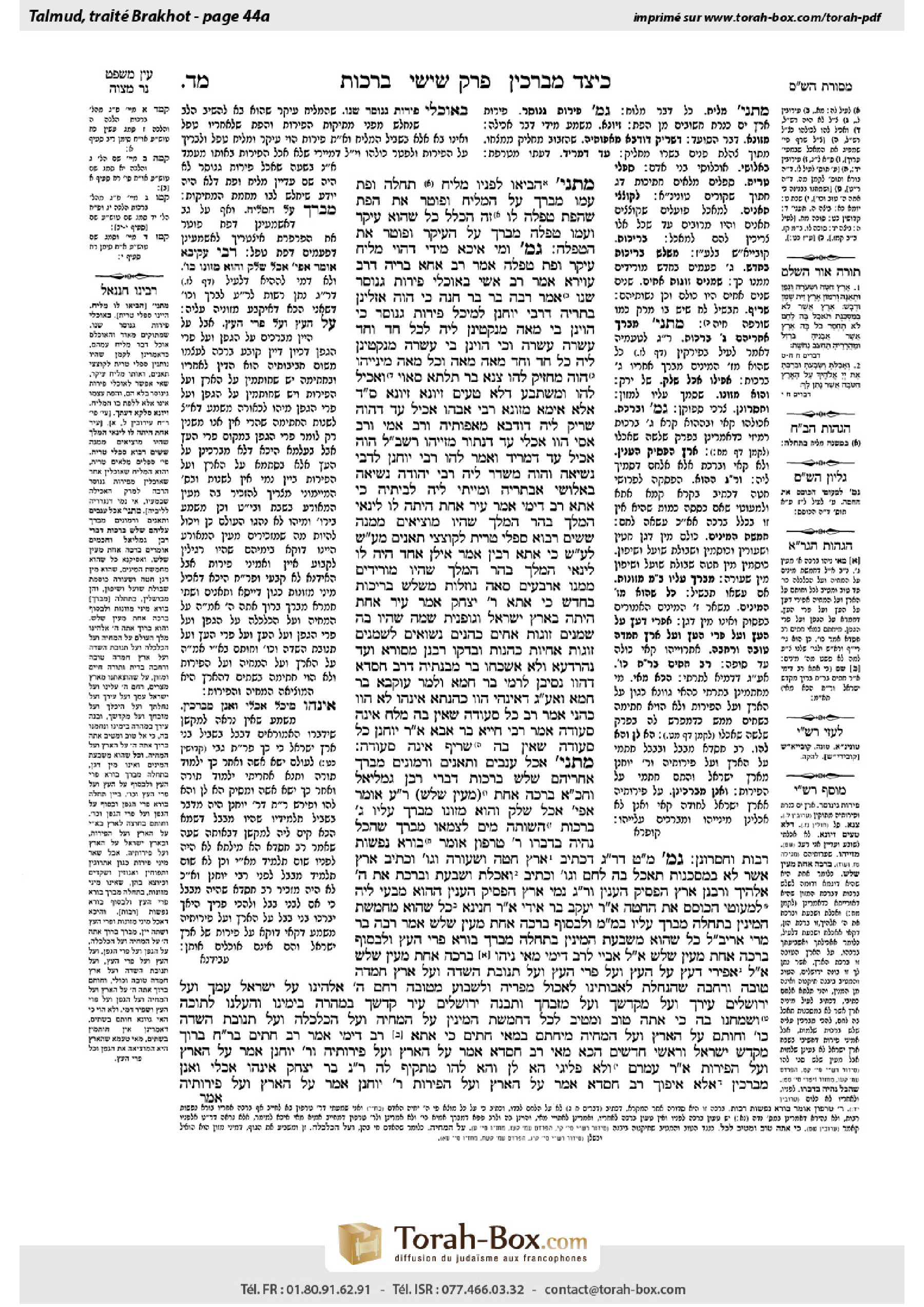
Berakhot 44a: Talmud study for Daf Yomi
Study the Talmud for Daf Yomi with scanned pages, Hebrew text, English translations from Sefaria and AI-generated French translations.
Passage selection and English or AI-generated French translation are available where the scan has annotations. Daf Study is independent of Torah-Box and Sefaria.
Browse Berakhot · ברכות · All tractatesBerakhot 44a text and translations
This page of Berakhot includes the Aramaic text, an English translation and an AI-generated French translation, alongside the scan above.
ברכות מ״ד א · Aramaic and Hebrew text
מַתְנִי׳ הֵבִיאוּ לְפָנָיו מָלִיחַ תְּחִלָּה וּפַת עִמּוֹ — מְבָרֵךְ עַל הַמָּלִיחַ וּפוֹטֵר אֶת הַפַּת, שֶׁהַפַּת טְפֵלָה לוֹ. זֶה הַכְּלָל: כׇּל שֶׁהוּא עִיקָּר וְעִמּוֹ טְפֵלָה — מְבָרֵךְ עַל הָעִיקָּר וּפוֹטֵר אֶת הַטְּפֵלָה.
גְּמָ׳ וּמִי אִיכָּא מִידֵּי דְּהָוֵי מָלִיחַ עִיקָּר וּפַת טְפֵלָה? אָמַר רַב אַחָא בְּרֵיהּ דְּרַב עַוִּירָא אָמַר רַב אָשֵׁי: בְּאוֹכְלֵי פֵּירוֹת גִּנּוֹסַר שָׁנוּ.
אָמַר רַבָּה בַּר בַּר חָנָה: כִּי הֲוָה אָזְלִינַן בָּתְרֵיהּ דְּרַבִּי יוֹחָנָן לְמֵיכַל פֵּירוֹת גִּנּוֹסַר, כִּי הֲוֵינַן בֵּי מְאָה — מְנַקְּטִינַן לֵיהּ לְכֹל חַד וְחַד עַשְׂרָה עַשְׂרָה, וְכִי הֲוֵינַן בֵּי עַשְׂרָה, מְנַקְּטִינַן לֵיהּ כֹּל חַד וְחַד מְאָה מְאָה. וְכׇל מְאָה מִינַּיְיהוּ הֲוָה מַחֲזִיק לְהוּ צַנָּא בַּר תְּלָתָא סָאוֵי וְאָכֵיל לְהוּ, וּמִשְׁתְּבַע דְּלָא טְעֵים זִיּוּנָא. זִיּוּנָא סָלְקָא דַּעְתָּךְ?! אֶלָּא אֵימָא ״מְזוֹנָא״.
רַבִּי אֲבָהוּ אָכֵיל עַד דַּהֲוָה שָׁרֵיק לֵיהּ דּוּדְבָא מֵאַפּוּתֵיהּ. וְרַב אַמֵּי וְרַב אַסִּי הֲווֹ אָכְלִי עַד דִּנְתוּר מָזַיְיהוּ. רַבִּי שִׁמְעוֹן בֶּן לָקִישׁ הֲוָה אָכֵיל עַד דְּמָרֵיד. וְאָמַר לְהוּ רַבִּי יוֹחָנָן לִדְבֵי נְשִׂיאָה וַהֲוָה מְשַׁדַּר לֵיהּ רַבִּי יְהוּדָה נְשִׂיאָה בָּאלוֹשֵׁי אַבָּתְרֵיהּ, וּמַיְיתִי לֵיהּ לְבֵיתֵיהּ.
כִּי אֲתָא רַב דִּימִי, אָמַר: עִיר אַחַת הָיְתָה לוֹ לְיַנַּאי הַמֶּלֶךְ בְּהַר הַמֶּלֶךְ, שֶׁהָיוּ מוֹצִיאִים מִמֶּנָּה שִׁשִּׁים רִבּוֹא סִפְלֵי טָרִית לְקוֹצְצֵי תְּאֵנִים מֵעֶרֶב שַׁבָּת לְעֶרֶב שַׁבָּת.
כִּי אֲתָא רָבִין אָמַר: אִילָן אֶחָד הָיָה לוֹ לְיַנַּאי הַמֶּלֶךְ בְּהַר הַמֶּלֶךְ, שֶׁהָיוּ מוֹרִידִים מִמֶּנּוּ אַרְבָּעִים סְאָה גּוֹזָלוֹת מִשָּׁלֹשׁ בְּרֵיכוֹת בְּחֹדֶשׁ. כִּי אֲתָא רַבִּי יִצְחָק אָמַר: עִיר אַחַת הָיְתָה בְּאֶרֶץ יִשְׂרָאֵל וְגוּפְנִית שְׁמָהּ, שֶׁהָיוּ בָּהּ שְׁמֹנִים זוּגוֹת אַחִים כֹּהֲנִים נְשׂוּאִים לִשְׁמֹנִים זוּגוֹת אֲחָיוֹת כֹּהֲנוֹת. וּבְדַקוּ רַבָּנַן מִסּוּרָא וְעַד נְהַרְדָּעָא וְלָא אַשְׁכַּחוּ בַּר מִבְּנָתֵיהּ דְּרַב חִסְדָּא, דַּהֲווֹ נְסִיבָן לְרָמִי בַּר חָמָא וּלְמָר עוּקְבָא בַּר חָמָא. וְאַף עַל גַּב דְּאִינְהִי הֲווֹ כָּהֲנָתָא, אִינְהוּ לָא הֲווֹ כָּהֲנֵי.
אָמַר רַב: כׇּל סְעוּדָה שֶׁאֵין בָּהּ מֶלַח, אֵינָהּ סְעוּדָה. אָמַר רַבִּי חִיָּיא בַּר אַבָּא אָמַר רַבִּי יוֹחָנָן: כׇּל סְעוּדָה שֶׁאֵין בָּהּ שְׂרִיף, אֵינָהּ סְעוּדָה.
מַתְנִי׳ אָכַל עֲנָבִים וּתְאֵנִים וְרִמּוֹנִים — מְבָרֵךְ אַחֲרֵיהֶם שָׁלֹשׁ בְּרָכוֹת, דִּבְרֵי רַבָּן גַּמְלִיאֵל. וַחֲכָמִים אוֹמְרִים: בְּרָכָה אַחַת מֵעֵין שָׁלֹשׁ. רַבִּי עֲקִיבָא אוֹמֵר: אֲפִילּוּ אָכַל שֶׁלֶק וְהוּא מְזוֹנוֹ — מְבָרֵךְ עָלָיו שָׁלֹשׁ בְּרָכוֹת. הַשּׁוֹתֶה מַיִם לִצְמָאוֹ — מְבָרֵךְ ״שֶׁהַכֹּל נִהְיָה בִּדְבָרוֹ״. רַבִּי טַרְפוֹן אוֹמֵר: ״בּוֹרֵא נְפָשׁוֹת רַבּוֹת וְחֶסְרוֹנָן״.
גְּמָ׳ מַאי טַעְמָא דְּרַבָּן גַּמְלִיאֵל? דִּכְתִיב: ״אֶרֶץ חִטָּה וּשְׂעֹרָה וְגוֹ׳״, וּכְתִיב: ״אֶרֶץ אֲשֶׁר לֹא בְמִסְכֵּנֻת תֹּאכַל בָּהּ לֶחֶם וְגוֹ׳״, וּכְתִיב: ״וְאָכַלְתָּ וְשָׂבָעְתָּ וּבֵרַכְתָּ אֶת ה׳ אֱלֹהֶיךָ״.
וְרַבָּנַן ״אֶרֶץ״ הִפְסִיק הָעִנְיָן. וְרַבָּן גַּמְלִיאֵל נָמֵי ״אֶרֶץ״ הִפְסִיק הָעִנְיָן! הָהוּא מִבְּעֵי לֵיהּ לְמַעוֹטֵי הַכּוֹסֵס אֶת הַחִטָּה.
אָמַר רַבִּי יַעֲקֹב בַּר אִידִי אָמַר רַבִּי חֲנִינָא: כׇּל שֶׁהוּא מֵחֲמֵשֶׁת הַמִּינִין, בַּתְּחִלָּה — מְבָרֵךְ עָלָיו ״בּוֹרֵא מִינֵי מְזוֹנוֹת״, וּלְבַסּוֹף — בְּרָכָה אַחַת מֵעֵין שָׁלֹשׁ.
אָמַר רַבָּה בַּר מָרִי אָמַר רַבִּי יְהוֹשֻׁעַ בֶּן לֵוִי: כׇּל שֶׁהוּא מִשִּׁבְעַת הַמִּינִין, בַּתְּחִלָּה — מְבָרֵךְ ״בּוֹרֵא פְּרִי הָעֵץ״, וּלְבַסּוֹף — בְּרָכָה אַחַת מֵעֵין שָׁלֹשׁ.
אָמַר לֵיהּ אַבָּיֵי לְרַב דִּימִי: מַאי נִיהוּ ״בְּרָכָה אַחַת מֵעֵין שָׁלֹשׁ״? אָמַר לֵיהּ: אַפֵּירֵי דְעֵץ ״עַל הָעֵץ וְעַל פְּרִי הָעֵץ, וְעַל תְּנוּבַת הַשָּׂדֶה, וְעַל אֶרֶץ חֶמְדָּה טוֹבָה וּרְחָבָה שֶׁהִנְחַלְתָּ לַאֲבוֹתֵינוּ לֶאֱכוֹל מִפִּרְיָהּ וְלִשְׂבּוֹעַ מִטּוּבָהּ. רַחֵם ה׳ אֱלֹהֵינוּ עַל יִשְׂרָאֵל עַמֶּךָ, וְעַל יְרוּשָׁלַיִם עִירֶךָ, וְעַל מִקְדָּשְׁךָ, וְעַל מִזְבְּחֶךָ. וְתִבְנֶה יְרוּשָׁלַיִם עִיר קׇדְשְׁךָ בִּמְהֵרָה בְּיָמֵינוּ. וְהַעֲלֵנוּ לְתוֹכָהּ, וְשַׂמְּחֵנוּ בָּהּ. כִּי אַתָּה טוֹב וּמֵטִיב לַכֹּל״.
דַּחֲמֵשֶׁת הַמִּינִין: ״עַל הַמִּחְיָה וְעַל הַכַּלְכָּלָה וְעַל תְּנוּבַת הַשָּׂדֶה כּוּ׳״. וְחוֹתֵם: ״עַל הָאָרֶץ וְעַל הַמִּחְיָה״.
מִיחְתָּם בְּמַאי חָתֵים? כִּי אֲתָא רַב דִּימִי אָמַר: רַב חָתֵים בְּרֹאשׁ חֹדֶשׁ ״בָּרוּךְ מְקַדֵּשׁ יִשְׂרָאֵל וְרָאשֵׁי חֳדָשִׁים״, הָכָא מַאי?
רַב חִסְדָּא אָמַר: ״עַל הָאָרֶץ וְעַל פֵּירוֹתֶיהָ״. וְרַבִּי יוֹחָנָן אָמַר: ״עַל הָאָרֶץ וְעַל הַפֵּירוֹת״. אָמַר רַב עַמְרָם, וְלָא פְּלִיגִי: הָא לַן, וְהָא לְהוּ.
מַתְקִיף לַהּ רַב נַחְמָן בַּר יִצְחָק: אִינְהוּ אָכְלִי, וַאֲנַן מְבָרְכִין?! אֶלָּא אֵיפוֹךְ: רַב חִסְדָּא אָמַר ״עַל הָאָרֶץ וְעַל הַפֵּירוֹת״, רַבִּי יוֹחָנָן אָמַר ״עַל הָאָרֶץ וְעַל פֵּירוֹתֶיהָ״.
Berakhot 44a · English translation
MISHNA: If they brought salted food before him to eat first and bread with it, he recites a blessing over the salted food and thereby exempts the bread, because the salted food is primary while the bread is secondary to it. This is the principle: Any food that is primary and a secondary food is with it, one recites a blessing over the primary and, in so doing, exempts the secondary from its own blessing.
GEMARA: The Gemara asks: And is there a circumstance where salted food is primary and bread is secondary? Generally, no meal has a salted food item as its primary component. Rav Aḥa, son of Rav Avira, said that Rav Ashi said: This halakha was taught with regard to those who eat fruits of Genosar, which are extremely sweet and which would be eaten along with salted foods in order to temper this sweetness. They would eat bread along with those salted foods.
On a related note, the Gemara employs hyperbole in praising the fruits of Genosar. Rabba bar bar Ḥana said: When we would go after Rabbi Yoḥanan to eat fruits of Genosar, when we were one hundred people together, each and every one of us would bring him ten fruits, and when we were ten people together, each and every one of us would bring him one hundred fruits, and every hundred of the fruits would require a basket of three se’a to hold them. Rabbi Yoḥanan would eat them all, and was prepared to swear that he had not tasted any food. The Gemara asks: Does it enter your mind that he claimed that he had not tasted any food? Rather, say that he had not tasted any sustenance. Due to their delicious taste, he was still not satiated.
The Gemara continues to wax hyperbolic: Rabbi Abbahu ate fruits of Genosar until the sweet, lush fruits made his skin so slippery that a fly would slip from his forehead. And Rav Ami and Rav Asi would eat them until their hair fell out. Rabbi Shimon ben Lakish would eat them until he became confused. And then Rabbi Yoḥanan would tell the household of the Nasi about his condition and Rabbi Yehuda Nesia would send the authorities after him and they would take him to his house.
On a similar note, the Gemara relates: When Rav Dimi came from Eretz Yisrael to Babylonia he said: King Yannai had a city on the King’s Mountain, from which they would take six-hundred thousand bowls of sardines for those cutting figs off the trees during the course of the week from Shabbat eve to Shabbat eve. There were so many workers, and the fruit was so sweet, that they needed such a vast quantity of salted fish to enable them to continue with their work.
On the subject of the King’s Mountain and Eretz Yisrael, when Rav Dimi came from Eretz Yisrael to Babylonia, he said: King Yannai had a tree on the King’s Mountain from which they would remove forty se’a of pigeons from three broods each month. When Rabbi Yitzḥak came from Eretz Yisrael to Babylonia he said: There was a city in Eretz Yisrael named Gufnit, in which there were eighty pairs of brothers who were priests, married to eighty pairs of sisters, who were all from priestly families. And to assess the frequency of that phenomenon, the Gemara relates: The Sages checked from Sura to Neharde’a, and with the exception of the daughters of Rav Ḥisda, who were married to Rami bar Ḥama and his brother Mar Ukva bar Ḥama, they could not find a similar case. And, even in the case that they found, although they, the sisters, were the daughters of a priest, they, the brothers were not priests. Throughout virtually the entire country of Babylonia, they could not find a similar circumstance.
On the topic of salted food, Rav said: Any meal in which there is no salt is not considered a meal. Rabbi Ḥiyya bar Abba said that Rabbi Yoḥanan said: Any meal in which there is no cooked item with gravy (Rashi) is not considered a meal.
MISHNA: One who ate from the fruit for which Eretz Yisrael was praised, grapes and figs and pomegranates, recites the three blessings of Grace after Meals, as he would after eating bread; this is the statement of Rabban Gamliel. And the Rabbis say: One need only recite one blessing abridged from the three blessings of Grace after Meals. Rabbi Akiva says: The three blessings of Grace after Meals are not restricted to bread; rather, even if one ate boiled vegetables, but it is his primary sustenance, he recites the three blessings of Grace after Meals. Additionally: One who drinks water to quench his thirst recites: By whose word all things came to be. Rabbi Tarfon says: He recites: Who creates the many forms of life and their needs.
GEMARA: The Gemara asks: What is the reason for the opinion of Rabban Gamliel? The Gemara responds: As it is written in the verse that deals in praise of Eretz Yisrael: “A land of wheat and barley, vines, figs, and pomegranates, a land of olive oil and honey” (Deuteronomy 8:8), and it is written: “A land in which you will eat bread without scarcity” (Deuteronomy 8:9), and it is written: “And you will eat and be satisfied and then you shall bless the Lord your God for the good land He has given you” (Deuteronomy 8:10). Rabban Gamliel concludes from here that the fruits for which Eretz Yisrael was praised are included in the mitzva to recite a blessing after eating. Since that Torah portion alludes to three blessings, fruit also requires three blessings.
And what do the Rabbis hold? The verse: “A land in which you will eat bread without scarcity,” concluded discussion of that matter, and the mitzva: “You will eat and be satisfied and then you shall bless,” applies only to bread. And if so, according to Rabban Gamliel as well, doesn’t “land” conclude discussion of that matter? Rather, that verse is necessary in order to exclude one who chews raw wheat from the obligation to recite Grace after Meals. Even according to Rabban Gamliel, it does not have the legal status of bread.
Rabbi Ya’akov bar Idi said that Rabbi Ḥanina said: Anything that is from the five species of grain, at the start, one recites over it: Who creates the various kinds of nourishment, and at the end, one blessing abridged from the three blessings of Grace after Meals.
Rabba bar Mari said that Rabbi Yehoshua ben Levi said: Anything that is from the seven species for which the Eretz Yisrael was praised, at the start, one recites over it: Who creates fruit of the tree, and afterward and at the end, one blessing abridged from the three blessings of Grace after Meals.
Abaye said to Rav Dimi: What is the formula of one blessing abridged from the three blessings of Grace after Meals? He said to him: Over fruits of a tree one recites:
For the tree and the fruit of the tree,
and for the produce of the field,
and for the desirable, good and spacious land that you gave as a heritage to our ancestors
that they might eat of its fruit and be satisfied with its goodness.
Have compassion, Lord our God,
upon Israel Your people and upon Jerusalem Your city,
and upon Your Temple and upon Your altar.
May You rebuild Jerusalem, Your holy city, swiftly in our time,
and may You bring us back there rejoicing in it
as You are good and do good to all.
After eating products baked from one of the five species of grain, one recites: For the nourishment and sustenance and for the produce of the field, and he concludes: For the land and for the nourishment.
However, the question was raised: In terms of conclusion, with what does he conclude the blessing? As one does not conclude a blessing with two themes, with which of the themes should he conclude the blessing? When Rav Dimi came from Eretz Yisrael to Babylonia he said: Rav would conclude the blessing on the New Moon: Blessed…Who sanctifies Israel and the New Moons. Apparently, one can conclude a blessing with two themes. What does one recite here?
Rav Ḥisda said: For the land and for its fruits. Rabbi Yoḥanan said: For the land and for the fruits. Rav Amram said: They do not disagree; rather, this blessing, for its fruits, is for us, in Babylonia, and this blessing, for the fruits, is for them, in Eretz Yisrael.
Rav Naḥman bar Yitzḥak strongly objects: They, in Eretz Yisrael, eat and we, in Babylonia, recite a blessing? How can we, residents of Babylonia, recite a blessing for the fruits of Eretz Yisrael while eating the fruits of Babylonia? Rather, reverse the opinions: Rav Ḥisda said: For the land and for the fruits, and Rabbi Yoḥanan said: For the land and for its fruits.
Berakhot 44a · Traduction française (IA)
MICHNA: Si on présente devant lui des aliments salés pour les manger en premier, accompagnés de pain, il bénit les aliments salés et ainsi exempt le pain, car les aliments salés sont primordiaux et le pain secondaire. C’est le principe : Tout aliment qui est primordial et un aliment secondaire est avec lui, on bénit le primordial et, en le faisant, on exempt le secondaire de sa propre bénédiction.
GUEMARA: La Guemara pose la question : Et y a-t-il un cas où les aliments salés sont primordiaux et le pain secondaire ? Généralement, aucun repas ne comporte un aliment salé comme composant principal. Rav Aḥa, fils de Rav Avira, a dit que Rav Ashi a dit : Cette halakha a été enseignée concernant ceux qui mangent les fruits de Genosar, qui sont extrêmement sucrés et qui sont mangés avec des aliments salés afin de tempérer cette douceur. Ils mangent du pain avec ces aliments salés.
En ce qui concerne les fruits de Genosar, la Guemara utilise une hyperbole pour les louer. Rabba bar bar Ḥana a dit : Quand nous suivions Rabbi Yoḥanan pour manger les fruits de Genosar, quand nous étions cent personnes ensemble, chacun d’entre nous apportait à Rabbi Yoḥanan dix fruits, et quand nous étions dix personnes ensemble, chacun d’entre nous apportait à Rabbi Yoḥanan cent fruits, et chaque cent fruits nécessitait un panier de trois se’a pour les contenir. Rabbi Yoḥanan mangeait tous ces fruits, et était prêt à jurer qu’il n’avait pas goûté de nourriture. La Guemara pose la question : Entrez-vous dans l’esprit que Rabbi Yoḥanan a affirmé qu’il n’avait pas goûté de nourriture ? Plutôt, dites qu’il n’avait pas goûté de sustenance. À cause de leur goût délicieux, il n’était pas rassasié.
La Guemara continue à exagérer : Rabbi Abbahu mangeait les fruits de Genosar jusqu’à ce que la douceur et la richesse des fruits rendent sa peau si glissante qu’un moustique pourrait tomber de son front. Et Rav Ami et Rav Asi mangeaient jusqu’à ce que leurs cheveux tombent. Rabbi Shimon ben Lakish mangeait jusqu’à ce qu’il se perde en confusion. Et alors Rabbi Yoḥanan racontait à la maison du Nasi son état, et Rabbi Yehuda Nesia envoyait les autorités après lui et ils le prenaient chez lui.
En ce qui concerne Rav Dimi, qui est venu de la Terre d’Israël vers Babylone, il a dit : Le roi Yannai avait une ville sur la Montagne du Roi, d’où on prenait six cent mille bols de sardines pour ceux qui coupaient les figues des arbres pendant la semaine, du vendredi soir au vendredi soir. Il y avait tant de travailleurs et la figue était si sucrée qu’on avait besoin d’une telle quantité de poissons salés pour continuer leur travail.
En ce qui concerne la Montagne du Roi et la Terre d’Israël, quand Rav Dimi est venu de la Terre d’Israël vers Babylone, il a dit : Le roi Yannai avait un arbre sur la Montagne du Roi d’où on enlevait quarante se’a de moineaux par trois générations chaque mois. Quand Rabbi Yitzḥak est venu de la Terre d’Israël vers Babylone, il a dit : Il y avait une ville en Terre d’Israël nommée Gufnit, où il y avait soixante-dix paires de frères qui étaient des prêtres, mariés à soixante-dix paires de sœurs, qui étaient toutes des familles de prêtres. Pour évaluer la fréquence de ce phénomène, la Guemara rapporte : Les Sages ont vérifié de Sura à Neharde’a, et à l’exception des filles de Rav Ḥisda, qui étaient mariées à Rami bar Ḥama et à son frère Mar Ukva bar Ḥama, ils n’ont pas trouvé de cas similaire. Et même dans le cas qu’ils ont trouvé, bien qu’elles, les sœurs, fussent les filles d’un prêtre, elles, les frères, n’étaient pas des prêtres. Presque partout dans tout le pays de Babylone, ils n’ont pas trouvé un cas similaire.
En ce qui concerne les aliments salés, Rav a dit : Tout repas où il n’y a pas de sel n’est pas considéré comme un repas. Rabbi Ḥiyya bar Abba a dit que Rabbi Yoḥanan a dit : Tout repas où il n’y a pas d’aliment cuit avec sauce (selon Rashi) n’est pas considéré comme un repas.
MICHNA : Celui qui a mangé des fruits pour lesquels la Terre d’Israël était louée, les raisins, les figues et les grenades, récite les trois bénédictions de Grace après le repas, comme s’il avait mangé du pain ; c’est l’opinion de Rabban Gamliel. Et les Rabbins disent : On doit seulement réciter une bénédiction abrégée des trois bénédictions de Grace après le repas. Rabbi Akiva dit : Les trois bénédictions de Grace après le repas ne sont pas limitées au pain ; plutôt, même si l’on a mangé des légumes bouillis, mais c’est sa nourriture principale, on récite les trois bénédictions de Grace après le repas. De plus : Celui qui boit de l’eau pour étancher sa soif récite : Par la parole dont toutes choses sont venues à l’être. Rabbi Tarfon dit : Il récite : Celui qui crée les diverses formes de vie et leurs besoins.
GUEMARA : La Guemara pose la question : Quel est le raisonnement de l’opinion de Rabban Gamliel ? La Guemara répond : Comme il est écrit dans la versette qui loue la Terre d’Israël : « Une terre de blé et de seigle, de vigne, de figues et de grenades, une terre d’huile d’olive et de miel » (Deutéronome 8:8), et il est écrit : « Une terre où tu mangeras du pain sans manquer » (Deutéronome 8:9), et il est écrit : « Et tu mangeras et tu seras rassasié, et alors tu béniras l’Eternel ton Dieu pour la bonne terre qu’Il t’a donnée » (Deutéronome 8:10). Rabban Gamliel conclut de là que les fruits pour lesquels la Terre d’Israël était louée sont inclus dans la mitsva de réciter une bénédiction après avoir mangé. Puisque cette portion de la Torah évoque trois bénédictions, les fruits nécessitent également trois bénédictions.
Et qu’en est-il selon les Rabbins ? Le verset : « Une terre où tu mangeras du pain sans manquer », conclut la discussion sur ce sujet, et la mitsva : « Tu mangeras et tu seras rassasié, et alors tu béniras », s’applique uniquement au pain. Et si c’est ainsi, selon Rabban Gamliel également, n’est-ce pas le verset « terre » qui conclut la discussion ? Plutôt, ce verset est nécessaire afin d’exclure celui qui mâche du blé cru de l’obligation de réciter la Grace après le repas. Même selon Rabban Gamliel, il n’a pas le statut juridique du pain.
Rabbi Ya’akov bar Idi a dit que Rabbi Ḥanina a dit : Tout ce qui provient des cinq espèces de céréales, au début, on récite sur lui : Celui qui crée les diverses sortes de nourriture, et à la fin, on récite une bénédiction abrégée des trois bénédictions de Grace après le repas.
Rabba bar Mari a dit que Rabbi Yéhoshua ben Levi a dit : Tout ce qui provient des sept espèces pour lesquelles l'Éretz Yisrael a été louée, au début, on récite sur cela : Qui crée les fruits des arbres, et ensuite, à la fin, on récite une berakha abrégée parmi les trois berakhot de gratitude après le repas.
Abaye a dit à Rav Dimi : Quelle est la formule de la berakha abrégée parmi les trois berakhot de gratitude après le repas ? Il lui a dit : Sur les fruits des arbres, on récite : Pour l'arbre et pour les fruits de l'arbre, Et pour la production du champ, Et pour la terre fertile, bonne et spacieuse que tu as donnée en héritage à nos pères Afin qu'ils mangent de ses fruits et soient rassasiés de sa bonté. Pitié, Seigneur notre Dieu, Sur Israël ton peuple et sur Jérusalem ta ville, Et sur ton Temple et sur ton autel. Reconstruis Jérusalem, ta sainte ville, rapidement en notre temps, Et ramène-nous là-bas avec joie, Comme tu es bon et fais le bien à tous.
Après avoir mangé des produits cuits à partir d'un des cinq grains, on récite : Pour la nourriture et la subsistance et pour la production du champ, et on conclut : Pour la terre et pour la nourriture.
Cependant, une question a été posée : En termes de conclusion, avec quoi conclut-on la berakha ? Comme on ne conclut pas une berakha avec deux thèmes, avec quel thème doit-on conclure la berakha ? Lorsque Rav Dimi est venu de l'Éretz Yisrael en Babylonie, il a dit : Rav concluait la berakha sur la nouvelle lune : Béni... Qui sanctifie Israël et les nouvelles lunes. Apparemment, on peut conclure une berakha avec deux thèmes. Quelle berakha récite-t-on ici ?
Rav Ḥisda a dit : Pour la terre et pour ses fruits. Rabbi Yoḥanan a dit : Pour la terre et pour ses fruits. Rav Amram a dit : Ils ne s'opposent pas ; plutôt, cette berakha, pour ses fruits, est pour nous, en Babylonie, et cette berakha, pour les fruits, est pour eux, en Éretz Yisrael.
Rav Naḥman bar Yitzḥak s'oppose fermement : Ils, en Éretz Yisrael, mangent et nous, en Babylonie, récitons une berakha ? Comment pouvons-nous, habitants de Babylonie, réciter une berakha sur les fruits d'Éretz Yisrael en mangeant les fruits de Babylonie ? Plutôt, inversez les opinions : Rav Ḥisda a dit : Pour la terre et pour ses fruits, et Rabbi Yoḥanan a dit : Pour la terre et pour ses fruits.
Traduction française générée par IA à partir de l’édition anglaise de Sefaria. Vérifie toujours un passage avec le texte source.
Text from Sefaria: William Davidson Edition - Vocalized Aramaic (CC BY NC); William Davidson Edition - English (CC BY NC).