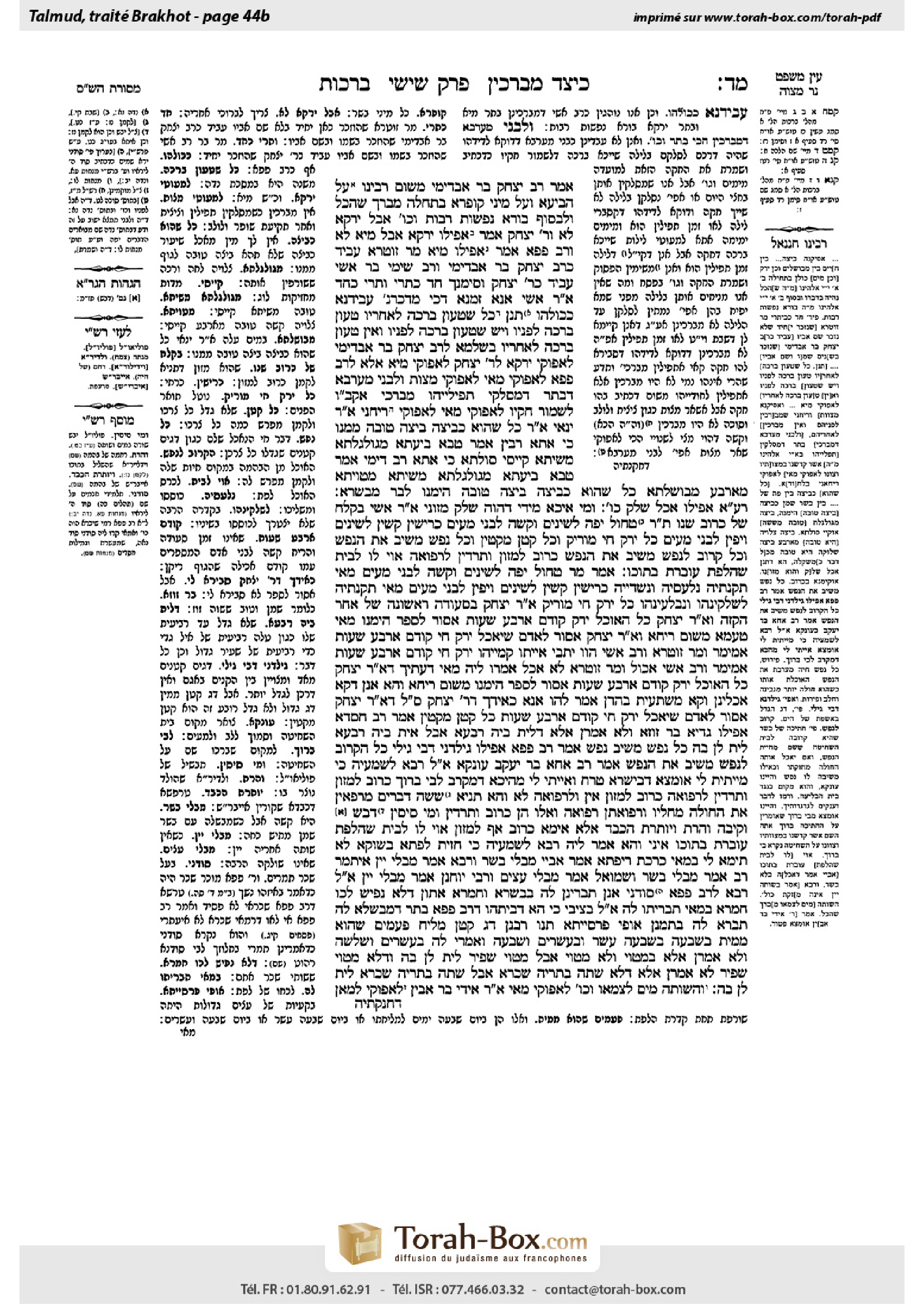
Berakhot 44b: Talmud study for Daf Yomi
Study the Talmud for Daf Yomi with scanned pages, Hebrew text, English translations from Sefaria and AI-generated French translations.
Passage selection and English or AI-generated French translation are available where the scan has annotations. Daf Study is independent of Torah-Box and Sefaria.
Browse Berakhot · ברכות · All tractatesBerakhot 44b text and translations
This page of Berakhot includes the Aramaic text, an English translation and an AI-generated French translation, alongside the scan above.
ברכות מ״ד ב · Aramaic and Hebrew text
אָמַר רַב יִצְחָק בַּר אַבְדִּימִי מִשּׁוּם רַבֵּינוּ: עַל הַבֵּיעָא וְעַל מִינֵי קוּפְרָא, בַּתְּחִלָּה מְבָרֵךְ ״שֶׁהַכֹּל״, וּלְבַסּוֹף ״בּוֹרֵא נְפָשׁוֹת רַבּוֹת וְכוּ׳״. אֲבָל יַרְקָא לָא. וְרַבִּי יִצְחָק אָמַר: אֲפִילּוּ יַרְקָא, אֲבָל מַיָּא — לָא. וְרַב פָּפָּא אָמַר: אֲפִילּוּ מַיָּא.
מָר זוּטְרָא עָבֵיד כְּרַב יִצְחָק בַּר אַבְדִּימִי, וְרַב שִׁימִי בַּר אָשֵׁי עָבֵיד כְּרַבִּי יִצְחָק. וְסִימָנָךְ: חַד כִּתְרֵי, וּתְרֵי כְּחַד.
אָמַר רַב אָשֵׁי: אֲנָא, זִמְנָא דְּכִי מִדְּכַרְנָא, עָבֵידְנָא כְּכוּלְּהוּ.
תְּנַן: כׇּל שֶׁטָּעוּן בְּרָכָה לְאַחֲרָיו — טָעוּן בְּרָכָה לְפָנָיו, וְיֵשׁ שֶׁטָּעוּן בְּרָכָה לְפָנָיו, וְאֵין טָעוּן בְּרָכָה לְאַחֲרָיו. בִּשְׁלָמָא לְרַב יִצְחָק בַּר אַבְדִּימִי, לְאַפּוֹקֵי יַרְקָא. לְרַבִּי יִצְחָק, לְאַפּוֹקֵי מַיָּא, אֶלָּא לְרַב פָּפָּא, לְאַפּוֹקֵי מַאי?
לְאַפּוֹקֵי מִצְוֹת.
וְלִבְנֵי מַעַרְבָא, דְּבָתַר דִּמְסַלְּקִי תְּפִילַּיְיהוּ מְבָרְכִי ״אֲשֶׁר קִדְּשָׁנוּ בְּמִצְוֹתָיו וְצִוָּנוּ לִשְׁמוֹר חֻקָּיו״, לְאַפּוֹקֵי מַאי?
לְאַפּוֹקֵי רֵיחָנֵי.
אָמַר רַבִּי יַנַּאי אָמַר רַבִּי: כֹּל שֶׁהוּא כְּבֵיצָה — בֵּיצָה טוֹבָה מִמֶּנּוּ. כִּי אֲתָא רָבִין אָמַר: טָבָא בֵּיעֲתָא מְגוּלְגַּלְתָּא מִשִּׁיתָּא קְיָיסֵי סוּלְתָּא. כִּי אֲתָא רַב דִּימִי אָמַר: טָבָא בֵּיעֲתָא מְגוּלְגַּלְתָּא — מִשִּׁיתָּא, מִטְּוִיתָא — מֵאַרְבַּע, מְבוּשַׁלְתָּא — כֹּל שֶׁהוּא כְּבֵיצָה, בֵּיצָה טוֹבָה הֵימֶנּוּ, לְבַר מִבִּשְׂרָא.
רַבִּי עֲקִיבָא אוֹמֵר אֲפִילּוּ אָכַל שֶׁלֶק כּוּ׳: וּמִי אִיכָּא מִידֵּי דְּהָוֵה שֶׁלֶק מְזוֹנֵי? אָמַר רַב אָשֵׁי: בְּקֶלַח שֶׁל כְּרוּב שָׁנוּ.
תָּנוּ רַבָּנַן: טְחוֹל יָפֶה לַשִּׁינַּיִם וְקָשֶׁה לִבְנֵי מֵעַיִם. כְּרֵישִׁין קָשִׁין לַשִּׁינַּיִם וְיָפִין לִבְנֵי מֵעַיִם. כׇּל יָרָק חַי מוֹרִיק, וְכׇל קָטָן מַקְטִין, וְכׇל נֶפֶשׁ מֵשִׁיב אֶת הַנֶּפֶשׁ, וְכׇל קָרוֹב לַנֶּפֶשׁ מֵשִׁיב אֶת הַנֶּפֶשׁ. כְּרוּב לְמָזוֹן, וּתְרָדִין לִרְפוּאָה. אוֹי לוֹ לַבַּיִת שֶׁהַלֶּפֶת עוֹבֶרֶת בְּתוֹכוֹ.
אָמַר מָר: טְחוֹל יָפֶה לַשִּׁינַּיִם וְקָשֶׁה לִבְנֵי מֵעַיִם. מַאי תַּקַּנְתֵּיהּ? נִלְעֲסֵיהּ וְנִשְׁדְּיֵיהּ.
כְּרֵישִׁין קָשִׁין לַשִּׁינַּיִם וְיָפִין לִבְנֵי מֵעַיִם. מַאי תַּקַּנְתֵּיהּ? לִשְׁלְקִינְהוּ וְנִבְלְעִינְהוּ.
כׇּל יָרָק חַי מוֹרִיק, אָמַר רַבִּי יִצְחָק: בִּסְעוּדָה רִאשׁוֹנָה שֶׁל אַחַר הַקָּזָה.
וְאָמַר רַבִּי יִצְחָק: כׇּל הָאוֹכֵל יָרָק קוֹדֶם אַרְבַּע שָׁעוֹת אָסוּר לְסַפֵּר הֵימֶנּוּ. מַאי טַעְמָא? מִשּׁוּם רֵיחָא. וְאָמַר רַבִּי יִצְחָק: אָסוּר לְאָדָם שֶׁיֹּאכַל יָרָק חַי קוֹדֶם אַרְבַּע שָׁעוֹת.
אַמֵּימָר וּמָר זוּטְרָא וְרַב אָשֵׁי הֲווֹ יָתְבִי, אַיְיתוֹ קַמַּיְיהוּ יָרָק חַי קוֹדֶם אַרְבַּע שָׁעוֹת. אַמֵּימָר וְרַב אָשֵׁי אֲכוּל וּמָר זוּטְרָא לָא אֲכַל. אֲמַרוּ לֵיהּ: מַאי דַּעְתָּיךְ? דְּאָמַר רַבִּי יִצְחָק כׇּל הָאוֹכֵל יָרָק קוֹדֶם אַרְבַּע שָׁעוֹת אָסוּר לְסַפֵּר הֵימֶנּוּ מִשּׁוּם רֵיחָא? וְהָא אֲנַן דְּקָא אָכְלִינַן וְקָא מִשְׁתָּעֵית בַּהֲדַן!
אָמַר לְהוּ: אֲנָא כְּאִידַּךְ דְּרַבִּי יִצְחָק סְבִירָא לִי. דְּאָמַר רַבִּי יִצְחָק: אָסוּר לְאָדָם שֶׁיֹּאכַל יָרָק חַי קוֹדֶם אַרְבַּע שָׁעוֹת.
כׇּל קָטָן מַקְטִין, אָמַר רַב חִסְדָּא: אֲפִילּוּ גַּדְיָא בַּר זוּזָא. וְלָא אֲמַרַן אֶלָּא דְּלֵית בֵּיהּ רִבְעָא, אֲבָל אִית בֵּיהּ רִבְעָא — לֵית לַן בָּהּ.
כׇּל נֶפֶשׁ מֵשִׁיב נֶפֶשׁ, אָמַר רַב פָּפָּא: אֲפִילּוּ גִּילְדָּנֵי דְּבֵי גִילֵי.
כׇּל הַקָּרוֹב לַנֶּפֶשׁ מֵשִׁיב אֶת הַנֶּפֶשׁ, אָמַר רַב אַחָא בַּר יַעֲקֹב: עוּנְקָא. אָמַר לֵיהּ רָבָא לְשַׁמָּעֵיהּ: כִּי מַיְיתֵית לִי אוּמְצָא דְּבִשְׂרָא, טְרַח וְאַיְיתִי לִי מֵהֵיכָא דִּמְקָרַב לְבֵי ״בָרוּךְ״.
כְּרוּב לְמָזוֹן וּתְרָדִין לִרְפוּאָה. כְּרוּב לְמָזוֹן אִין, וְלִרְפוּאָה לָא? וְהָא תַּנְיָא: שִׁשָּׁה דְּבָרִים מְרַפְּאִין אֶת הַחוֹלֶה מֵחׇלְיוֹ וּרְפוּאָתָן רְפוּאָה, וְאֵלּוּ הֵן: כְּרוּב וּתְרָדִין וּמֵי סִיסִין דְּבַשׁ וְקֵיבָה וְהֶרֶת וְיוֹתֶרֶת הַכָּבֵד! אֶלָּא אֵימָא ״כְּרוּב אַף לְמָזוֹן״.
אוֹי לוֹ לַבַּיִת שֶׁהַלֶּפֶת עוֹבֶרֶת בְּתוֹכוֹ, אִינִי?! וְהָא אָמַר לֵיהּ רָבָא לְשַׁמָּעֵיהּ: כִּי חָזֵית לִיפְתָּא בְּשׁוּקָא לָא תֵּימָא לִי ״בְּמַאי כָּרְכַתְּ רִיפְתָּא״!
אָמַר אַבָּיֵי: מִבְּלִי בָּשָׂר. וְרָבָא אָמַר: מִבְּלִי יַיִן. אִיתְּמַר רַב אָמַר: מִבְּלִי בָּשָׂר. וּשְׁמוּאֵל אָמַר: מִבְּלִי עֵצִים. וְרַבִּי יוֹחָנָן אָמַר: מִבְּלִי יַיִן.
אֲמַר לֵיהּ רָבָא לְרַב פָּפָּא: סוּדָנִי, אֲנַן תָּבְרִינַן לַהּ בְּבִשְׂרָא וְחַמְרָא, אַתּוּן דְּלָא נְפִישׁ לְכוּ חַמְרָא בְּמַאי תָּבְרִיתוּ לַהּ? אֲמַר לֵיהּ: בְּצִיבֵי, כִּי הָא דְּבֵיתְהוּ דְּרַב פָּפָּא בָּתַר דִּמְבַשְּׁלָא לַהּ, תָּבְרָא לַהּ בִּתְמָנָן אוּפֵי פָּרְסְיָיתָא.
תָּנוּ רַבָּנַן: דָּג קָטָן מָלִיחַ פְּעָמִים שֶׁהוּא מֵמִית בְּשִׁבְעָה, בְּשִׁבְעָה עָשָׂר, וּבְעֶשְׂרִים וְשִׁבְעָה. וְאָמְרִי לַהּ: בְּעֶשְׂרִים וּשְׁלֹשָׁה. וְלָא אֲמַרַן אֶלָּא בְּמִטְּוֵי וְלָא מִטְּוֵי, אֲבָל מִטְּוֵי שַׁפִּיר — לֵית לַן בַּהּ. וּדְלָא מִטְּוֵי שַׁפִּיר, לָא אֲמַרַן אֶלָּא דְּלָא שְׁתָה בָּתְרֵיהּ שִׁכְרָא, אֲבָל שְׁתָה בָּתְרֵיהּ שִׁכְרָא — לֵית לַן בַּהּ.
וְהַשּׁוֹתֶה מַיִם לִצְמָאוֹ וְכוּ׳: לְאַפּוֹקֵי מַאי? אֲמַר רַב אִידֵּי בַּר אָבִין: לְאַפּוֹקֵי לְמַאן
Berakhot 44b · English translation
Rav Yitzḥak bar Avdimi said in the name of Rabbeinu, Rav: Over the egg and types of meat [kupra], at the start, one recites: By Whose word all things came to be, and at the end: Who creates the many forms of life. However, after eating vegetables, no, one does not recite a blessing at all. Rabbi Yitzḥak said: Even after eating vegetables one recites a blessing; but after drinking water, no, one does not recite a blessing at all. And Rav Pappa said: Even after drinking water one must recite a blessing.
Mar Zutra acted in accordance with the opinion of Rabbi Yitzḥak bar Avdimi and did not recite a blessing after eating vegetables, while Rav Shimi bar Ashi acted in accordance with the opinion of Rabbi Yitzḥak and recited a blessing after eating vegetables. And a mnemonic by which to remember which Sage acted in accordance with which: One like two, and two like one. In other words, Mar Zutra, who is known only by his name and not by his patronymic, acted in accordance with Rav Yitzḥak bar Avdimi who is known by both his name and his patronymic. Rav Shimi bar Ashi, who is known by both his names, followed the opinion of Rabbi Yitzḥak, who is known only by his first name.
On this topic, Rav Ashi said: At times when I remember, I act in accordance with the opinions of all of them and recite a blessing even after drinking water.
We learned in a mishna: Anything that requires a blessing thereafter requires a blessing beforehand; and there are items that require a blessing beforehand and do not require a blessing thereafter. If so, granted, according to Rav Yitzḥak bar Avdimi’s opinion, it excludes vegetables from the requirement to recite a blessing thereafter. And, granted, according to Rabbi Yitzḥak’s opinion as well, it excludes water from the requirement to recite a blessing thereafter. However, according to Rav Pappa’s opinion, what does it exclude? What food requires a blessing before eating but does not require a blessing after eating?
The Gemara answers: It comes to exclude mitzvot, as one recites a blessing before performing a mitzva, but not thereafter.
The Gemara challenges: And for the residents of the West, Eretz Yisrael, who, after they remove their phylacteries, recite: Who has made us holy through His mitzvot and commanded us to keep His laws, what does the halakha in the mishna come to exclude?
The Gemara responds: It serves to exclude types of fragrances. Everyone agrees that no blessing is recited after smelling them.
Since the blessing recited over an egg was mentioned, the Gemara cites what Rabbi Yannai said that Rabbi Yehuda HaNasi said: Anything that is an egg’s equivalent in volume, an egg is superior to it. Similarly, when Ravin came from Eretz Yisrael to Babylonia he said: A lightly cooked egg is better than six log of fine flour. Similarly, when Rav Dimi came from Eretz Yisrael to Babylonia he said: A lightly cooked egg is better than six log of fine flour, a roasted egg is better than four, and with regard to a cooked egg, they said: Anything that is an egg’s equivalent, an egg is superior to it except for meat.
We learned in the mishna that Rabbi Akiva says: Even if one ate boiled vegetables, but it is his primary sustenance, he recites the three blessings of Grace after Meals, as he would after eating bread. The Gemara asks: And is there a vegetable where in its boiled state it is primary sustenance? Rav Ashi said: This was taught with regard to a cabbage stalk, which is nourishing.
Similarly, the Sages taught in a baraita dealing with types of sustenance: Meat of the spleen is beneficial for the teeth and harmful for the intestines. Leeks, however, are harmful for the teeth and beneficial for the intestines. They also said that all raw vegetables turn one’s face pale. Generally speaking, anything small that has not yet reached its full size is harmful and impedes growth, and any living creature eaten whole, e.g., a fully grown fish, restores the soul. And anything close to the soul restores the soul. Cabbage is for nourishment and beets for healing. Woe unto the house through which the turnip passes, for it is extremely harmful.
The Master said in a baraita: The spleen is beneficial for the teeth and harmful for the intestines. The Gemara asks: What is its remedy? The Gemara responds: One should chew it, spit it out, and throw it away.
Leeks are harmful for the teeth and beneficial for the intestines. The Gemara asks: What is its remedy? The Gemara responds: One should boil them and swallow them without chewing.
All raw vegetables turn one’s face pale. Rabbi Yitzḥak said: It refers here to the first meal after bloodletting, when a person should eat more substantial food.
And Rabbi Yitzḥak said: Anyone who eats vegetables before four hours of the day, it is forbidden to speak with him. The Gemara asks: What is the reason? The Gemara explains: This is because the smell of vegetables from his mouth bothers others who have not yet eaten. And in general, Rabbi Yitzḥak said: It is forbidden to eat raw vegetables before four hours of the day.
The Gemara relates that Ameimar, Mar Zutra, and Rav Ashi were sitting. They brought raw vegetables before them before four hours of the day. Ameimar and Rav Ashi ate and Mar Zutra did not eat. They said to him: What is your thinking that led you not to eat? Was it because Rabbi Yitzḥak said: Anyone who eats vegetables before four hours of the day, it is forbidden to speak with him because of the smell? Aren’t we eating and you are nevertheless speaking with us?
He said to them: I hold in accordance with the other halakha of Rabbi Yitzḥak, as Rabbi Yitzḥak said simply: It is forbidden to eat raw vegetables before four hours of the day.
Anything small impedes growth. Rav Ḥisda said: This applies even to a small goat, worth a zuz. Although the goat is worth a zuz, it is still small. And we only said this with regard to a goat that has not reached one fourth of its ultimate size. But if it has reached one fourth of its ultimate size, we need not be concerned.
And any living creature eaten whole restores the soul. Rav Pappa said: This includes even small fish that grow among the reeds, as even a small creature is beneficial if it reached its full size.
Anything close to the soul restores the soul. Rav Aḥa bar Ya’akov said: This refers to the neck, which is close to the animal’s vital organs. The Gemara relates that Rava said to his servant: When you bring me a piece of meat, make an effort to bring me a piece from the place of the blessing, the neck, where the animal was slaughtered and the slaughterer recited a blessing over the ritual slaughter.
Cabbage for nourishment and beets for healing. The Gemara asks: Is cabbage good for nourishment and not for healing? Wasn’t it taught in a baraita: Six things cure the ill person of his disease and their cure is an effective cure, and these are: Cabbage, beets, chamomile water, honey, stomach, heret, and liver. Evidently, cabbage is also good for healing. The Gemara responds: Rather, say: Cabbage is even for sustenance and all the more so for healing, which is not the case with beets.
Woe unto the house through which the turnip passes, as it is extremely damaging. The Gemara asks: Is that so? Didn’t Rava say to his servant: When you see a turnip in the market, do not ask me with what will you eat your bread today? Buy the turnip and bring it for the meal. Apparently, the turnip is a significant and appropriate food.
Abaye said: The turnip is harmful only when it is eaten without meat. And Rava said: Without wine. It was stated that Rav said: The turnip is harmful when it is eaten without meat. And Shmuel said: Without wood, meaning when it is not properly cooked. And Rabbi Yoḥanan said: Without wine.
Along the same lines, Rava said to Rav Pappa: Farmer (ge’onim) we break the harmful aspects of the turnip with meat and wine. You, who do not have a lot of wine, with what do you break its harmful aspects? Rav Pappa said to him: With wood. As that is what Rav Pappa’s wife would do. After she cooked the turnip, she would break it with eighty pieces of wood from a palm tree.
On the topic of foods, the Gemara cites what the Sages taught in a baraita: A small salted fish sometimes kills, specifically seven days, seventeen days, and twenty-seven days after it was salted. And some say: Twenty-three. And we only said this when it is roasted and not roasted well, but when it is roasted well, we need not be concerned. And when it is not roasted well, we only said this when one does not drink beer thereafter; however, when one drinks beer thereafter, we need not be concerned.
We learned in the mishna that the tanna’im disagreed with regard to one who drinks water to quench his thirst. The Gemara asks: What does this emphasis on his thirst come to exclude? Rav Idi bar Avin said: It comes to exclude one
Berakhot 44b · Traduction française (IA)
Rav Yitzḥak bar Avdimi a dit, en nom de Rabbeinu, Rav : Sur l'œuf et les types de viande [kupra], au début, on récite : Par la Parole dont toutes choses sont venues à l'être, et à la fin : Qui crée les diverses formes de vie. Cependant, après avoir mangé des légumes, on ne récite aucune bénédiction. Rabbi Yitzḥak a dit : Même après avoir mangé des légumes, on récite une bénédiction ; mais après avoir bu de l'eau, on ne récite aucune bénédiction. Et Rav Pappa a dit : Même après avoir bu de l'eau, on doit réciter une bénédiction.
Mar Zutra agissait selon l'opinion de Rabbi Yitzḥak bar Avdimi et ne récitait pas de bénédiction après avoir mangé des légumes, tandis que Rav Shimi bar Ashi agissait selon l'opinion de Rabbi Yitzḥak et récitait une bénédiction après avoir mangé des légumes. Et voici un moyen mnémotechnique pour se souvenir de quel Sage suivait quelle opinion : Un comme deux, et deux comme un. En d'autres termes, Mar Zutra, qui est connu seulement par son nom et non par son patronyme, agissait selon Rabbi Yitzḥak bar Avdimi, qui est connu à la fois par son nom et son patronyme. Rav Shimi bar Ashi, qui est connu à la fois par son nom et son patronyme, suivait l'opinion de Rabbi Yitzḥak, qui est connu seulement par son prénom.
Sur ce sujet, Rav Ashi a dit : Lorsque je me souviens, je fais selon l'opinion de tous et je récite une bénédiction même après avoir bu de l'eau.
Nous avons appris dans une Michna : Tout ce qui exige une bénédiction après exige une bénédiction avant ; et il y a des choses qui exige une bénédiction avant et ne nécessitent pas une bénédiction après. Si c'est ainsi, selon l'opinion de Rav Yitzḥak bar Avdimi, cela exclut les légumes de la nécessité de réciter une bénédiction après. Et, selon l'opinion de Rabbi Yitzḥak également, cela exclut l'eau de la nécessité de réciter une bénédiction après. Cependant, selon l'opinion de Rav Pappa, que cela exclut ? Quel aliment exige une bénédiction avant de le manger mais ne nécessite pas une bénédiction après de le manger ?
La Guemara répond : Cela vient exclure les mitsvot, car on récite une bénédiction avant d'accomplir une mitsva, mais pas après.
La Guemara conteste : Et pour les habitants de l'Ouest, Eretz Yisrael, qui, après avoir retiré leurs phylactères, récitent : Qui nous a sanctifiés par Sa mitsva et nous a commandés de garder Ses lois, que la halakha de la Michna vient-elle exclure ?
La Guemara répond : Cela sert à exclure les types d'odeurs. Tout le monde convient que l'on ne récite pas de bénédiction après en avoir senti.
Puisque la bénédiction récitée sur un œuf a été mentionnée, la Guemara cite ce que Rabbi Yannai a dit que Rabbi Yehuda HaNasi a dit : Tout ce qui est équivalent à un œuf en volume, l'œuf est supérieur à cela. De même, lorsque Ravin est venu d'Eretz Yisrael vers Babylone, il a dit : Un œuf léger est meilleur que six log de farine fine. De même, lorsque Rav Dimi est venu d'Eretz Yisrael vers Babylone, il a dit : Un œuf léger est meilleur que six log de farine fine, un œuf rôti est meilleur que quatre, et concernant un œuf cuit, ils ont dit : Tout ce qui est équivalent à un œuf, l'œuf est supérieur à cela sauf pour la viande.
Nous avons appris dans la Michna que Rabbi Akiva dit : Même si l'on a mangé des légumes bouillis, mais c'est sa nourriture principale, il récite les trois bénédictions de la grâce après les repas, comme s'il avait mangé du pain. La Guemara demande : Et y a-t-il un légume dont la forme bouillie est sa nourriture principale ? Rav Ashi a dit : Cela a été enseigné concernant un tige de chou, qui est nourrissant.
De même, les Sages ont enseigné dans une baraïta concernant les types de nourriture : La viande du foie est bénéfique pour les dents et nuisible pour les intestins. Les oignons, en revanche, sont nuisibles pour les dents et bénéfiques pour les intestins. Ils ont aussi dit que tous les légumes crus pâlissent le visage. En général, tout ce qui est petit et n'a pas encore atteint sa taille complète est nuisible et entrave la croissance, et tout animal vivant mangé entier, par exemple un poisson adulte, restaure l'âme. Et tout ce qui est proche de l'âme restaure l'âme. Le chou est pour la nourriture et les betteraves pour la guérison. Malheur à la maison par laquelle passe le navet, car il est extrêmement nuisible.
Le Maître a dit dans une baraïta : Le foie est bénéfique pour les dents et nuisible pour les intestins. La Guemara demande : Quel est son remède ? La Guemara répond : On doit le mâcher, le recracher et le jeter.
Les oignons sont nuisibles pour les dents et bénéfiques pour les intestins. La Guemara demande : Quel est son remède ? La Guemara répond : On doit les bouillir et les avaler sans mâcher.
Tous les légumes crus pâlissent le visage. Rabbi Yitzḥak a dit : Il s'agit ici du premier repas après le saignement, lorsqu'une personne devrait manger des aliments plus solides.
Et Rabbi Yitzḥak a dit : Quiconque mange des légumes avant quatre heures de la journée, il est interdit de parler avec lui. La Guemara demande : Quelle est la raison ? La Guemara explique : Cela est dû au fait que l'odeur des légumes de sa bouche gêne ceux qui n'ont pas encore mangé. Et en général, Rabbi Yitzḥak a dit : Il est interdit de manger des légumes crus avant quatre heures de la journée.
La Guemara rapporte que Ameimar, Mar Zutra et Rav Ashi étaient assis. Ils ont apporté des légumes crus devant eux avant quatre heures de la journée. Ameimar et Rav Ashi ont mangé et Mar Zutra n'a pas mangé. Ils lui ont dit : Quel est votre raisonnement qui vous a empêché de manger ? Est-ce parce que Rabbi Yitzḥak a dit : Quiconque mange des légumes avant quatre heures de la journée, il est interdit de parler avec lui à cause de l'odeur ? Ne sommes-nous pas en train de manger et vous parlez tout de même avec nous ?
Il a dit à eux : Je suis en conformité avec l'autre halakha de Rabbi Yitzḥak, car Rabbi Yitzḥak a simplement dit : Il est interdit de manger des légumes crus avant quatre heures de la journée.
Tout ce qui est petit entrave la croissance. Rav Ḥisda a dit : cela s'applique même à un petit bouc, valant un zuz. Bien que le bouc vaille un zuz, il reste petit. Et nous avons dit cela uniquement concernant un bouc qui n'a pas atteint un quart de sa taille finale. Mais si celui-ci a atteint un quart de sa taille finale, nous n'avons pas à nous en inquiéter.
Tout être vivant mangé entier restaure l'âme. Rav Pappa a dit : cela inclut même les petits poissons qui grandissent parmi les roseaux, car même un petit être est bénéfique s'il a atteint sa taille complète.
Tout ce qui est proche de l'âme restaure l'âme. Rav Aḥa bar Ya’akov a dit : cela fait référence au cou, qui est proche des organes vitaux de l'animal. La Guemara rapporte que Rava a dit à son serviteur : Lorsque tu m'apportes une pièce de viande, fais un effort pour m'apporter une pièce du lieu de la bénédiction, du cou, où l'animal a été sacrifié et le boucher a prononcé une bénédiction sur la cérémonie de sacrifice.
Le chou nourrit et les betteraves guérissent. La Guemara pose la question : le chou est-il bon pour la nourriture mais pas pour la guérison ? N'avait-on pas appris dans une baraïta : Six choses guérissent la personne malade de sa maladie et leur guérison est une guérison efficace, et ces sont : le chou, les betteraves, l'eau de camomille, le miel, le ventre, l'herbe et le foie. Évidemment, le chou est aussi bon pour la guérison. La Guemara répond : plutôt, dis : le chou est même pour la nourriture et encore davantage pour la guérison, ce qui n'est pas le cas des betteraves.
Malheur à la maison par laquelle le chou passe, car il est extrêmement nuisible. La Guemara pose la question : est-ce ainsi ? N'avait-on pas dit Rava à son serviteur : Lorsque tu vois un chou au marché, ne me demande pas avec quoi tu mangeras ton pain aujourd'hui ? Achète le chou et apporte-le pour le repas. Apparemment, le chou est un aliment important et approprié.
Abaye a dit : le chou est nuisible uniquement lorsqu'il est mangé sans viande. Et Rava a dit : sans vin. Il a été dit que Rav a dit : le chou est nuisible lorsqu'il est mangé sans viande. Et Shmuel a dit : sans bois, c'est-à-dire lorsqu'il n'est pas bien cuit. Et Rabbi Yoḥanan a dit : sans vin.
Dans le même sens, Rava a dit à Rav Pappa : les cultivateurs (géonim), nous éliminons les aspects nuisibles du chou avec de la viande et du vin. Toi, qui n'as pas beaucoup de vin, avec quoi élimines-tu ses aspects nuisibles ? Rav Pappa a dit à lui : avec du bois. Car c'est ce que faisait la femme de Rav Pappa. Après avoir cuisiné le chou, elle le brisait avec quatre-vingt morceaux de bois d'un palmier.
Sur le sujet des aliments, la Guemara cite ce que les Sages ont appris dans une baraïta : un petit poisson salé peut parfois tuer, spécifiquement sept jours, dix-sept jours et vingt-sept jours après qu'il ait été salé. Et certains disent : vingt-trois. Et nous avons dit cela uniquement lorsqu'il est grillé et non bien grillé, mais lorsqu'il est bien grillé, nous n'avons pas à nous en inquiéter. Et lorsqu'il n'est pas bien grillé, nous avons dit cela uniquement lorsqu'on ne boit pas de bière après, mais lorsqu'on boit de la bière après, nous n'avons pas à nous en inquiéter.
Nous avons appris dans la mishna que les tannaïm s'entendaient sur celui qui boit de l'eau pour étouffer sa soif. La Guemara pose la question : à quoi cette insistance sur sa soif vient-elle exclure ? Rav Idi bar Avin a dit : cela vient exclure celui qui ne ressent pas de soif.
Traduction française générée par IA à partir de l’édition anglaise de Sefaria. Vérifie toujours un passage avec le texte source.
Text from Sefaria: William Davidson Edition - Vocalized Aramaic (CC BY NC); William Davidson Edition - English (CC BY NC).