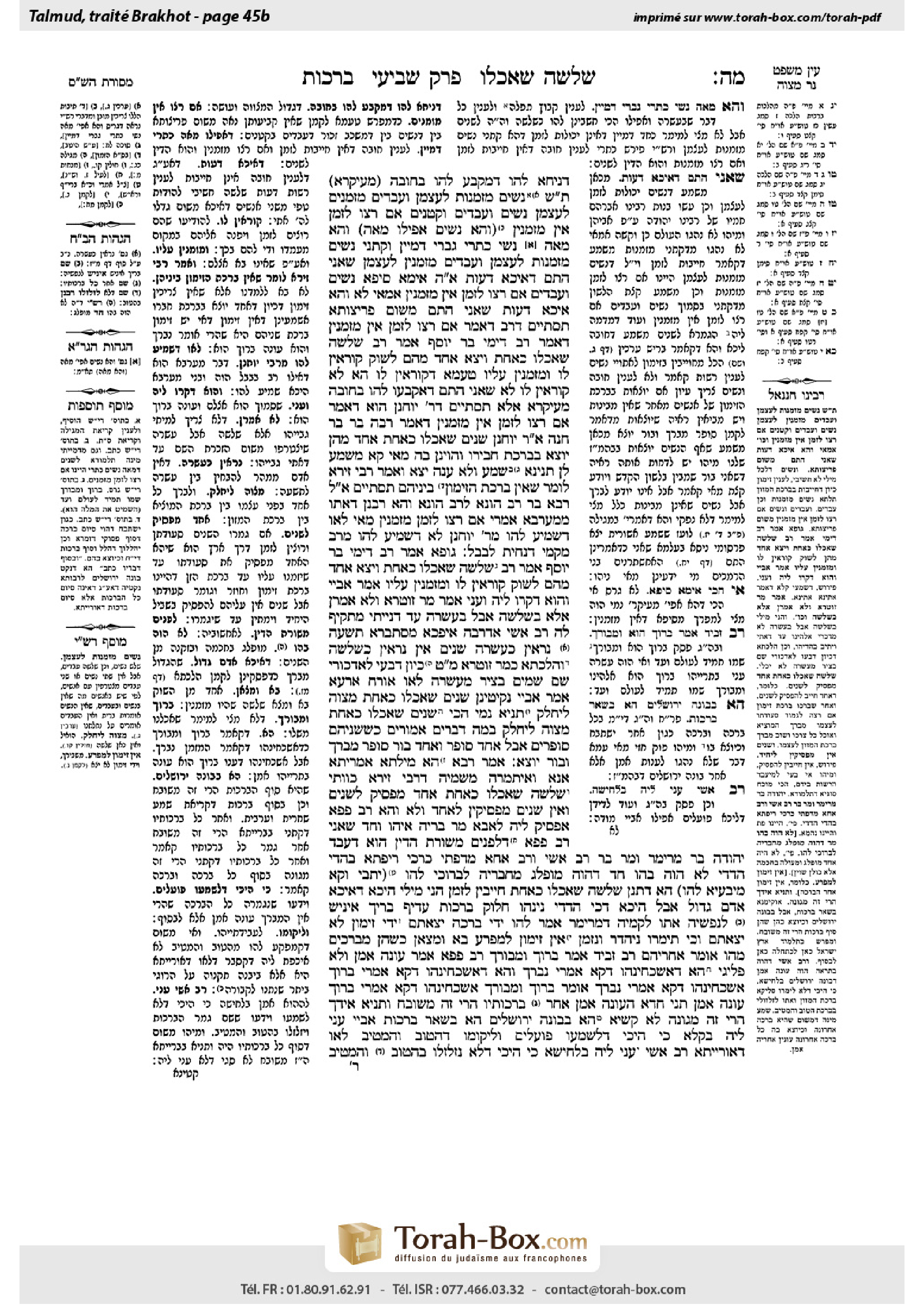
Berakhot 45b: Talmud study for Daf Yomi
Study the Talmud for Daf Yomi with scanned pages, Hebrew text, English translations from Sefaria and AI-generated French translations.
Passage selection and English or AI-generated French translation are available where the scan has annotations. Daf Study is independent of Torah-Box and Sefaria.
Browse Berakhot · ברכות · All tractatesBerakhot 45b text and translations
This page of Berakhot includes the Aramaic text, an English translation and an AI-generated French translation, alongside the scan above.
ברכות מ״ה ב · Aramaic and Hebrew text
דְּנִיחָא לְהוּ דְּמַקְבַּע לְהוּ בְּחוֹבָה מֵעִיקָּרָא.
תָּא שְׁמַע: נָשִׁים מְזַמְּנוֹת לְעַצְמָן, וַעֲבָדִים מְזַמְּנִים לְעַצְמָן, נָשִׁים וַעֲבָדִים וּקְטַנִּים אִם רָצוּ לְזַמֵּן — אֵין מְזַמְּנִין. וְהָא נָשִׁים אֲפִילּוּ מְאָה וְהָא מְאָה נָשֵׁי כִּתְרֵי גַּבְרֵי דָּמְיָין, וְקָתָנֵי נָשִׁים מְזַמְּנוֹת לְעַצְמָן וַעֲבָדִים מְזַמְּנִין לְעַצְמָן!
שָׁאנֵי הָתָם דְּאִיכָּא דֵּעוֹת.
אִי הָכִי, אֵימָא סֵיפָא: נָשִׁים וַעֲבָדִים אִם רָצוּ לְזַמֵּן — אֵין מְזַמְּנִין. אַמַּאי לָא, וְהָא אִיכָּא דֵּעוֹת!
שָׁאנֵי הָתָם מִשּׁוּם פְּרִיצוּתָא.
תִּסְתַּיֵּים, דְּרַב דְּאָמַר אִם רָצוּ לְזַמֵּן — אֵין מְזַמְּנִין. דְּאָמַר רַב דִּימִי בַּר יוֹסֵף אָמַר רַב: שְׁלֹשָׁה שֶׁאָכְלוּ כְּאַחַת וְיָצָא אֶחָד מֵהֶם לַשּׁוּק — קוֹרְאִין לוֹ וּמְזַמְּנִין עָלָיו. טַעְמָא דְּקוֹרְאִין לוֹ, הָא לֹא קוֹרְאִין לוֹ — לָא!
שָׁאנֵי הָתָם דְּאִקְּבַעוּ לְהוּ בְּחוֹבָה מֵעִיקָּרָא.
אֶלָּא תִּסְתַּיֵּים, דְּרַבִּי יוֹחָנָן הוּא דְּאָמַר אִם רָצוּ לְזַמֵּן — אֵין מְזַמְּנִין, דְּאָמַר רַבָּה בַּר בַּר חָנָה אָמַר רַבִּי יוֹחָנָן: שְׁנַיִם שֶׁאָכְלוּ כְּאַחַת — אֶחָד מֵהֶן יוֹצֵא בְּבִרְכַּת חֲבֵירוֹ.
וַהֲוֵינַן בַּהּ: מַאי קָא מַשְׁמַע לַן, תְּנֵינָא: שָׁמַע וְלֹא עָנָה — יָצָא! וְאָמַר רַבִּי זֵירָא לוֹמַר שֶׁאֵין בִּרְכַּת הַזִּימּוּן בֵּינֵיהֶם. תִּסְתַּיֵּים.
אֲמַר לֵיהּ רָבָא בַּר רַב הוּנָא לְרַב הוּנָא: וְהָא רַבָּנַן דַּאֲתוֹ מִמַּעְרְבָא אָמְרִי, אִם רָצוּ לְזַמֵּן — מְזַמְּנִין, מַאי לָאו דִּשְׁמִיעַ לְהוּ מֵרַבִּי יוֹחָנָן? לָא, דִּשְׁמִיעַ לְהוּ מֵרַב, מִקַּמֵּי דִּנְחֵית לְבָבֶל.
גּוּפָא. אָמַר רַב דִּימִי בַּר יוֹסֵף אָמַר רַב: שְׁלֹשָׁה שֶׁאָכְלוּ כְּאַחַת, וְיָצָא אֶחָד מֵהֶם לַשּׁוּק — קוֹרְאִין לוֹ, וּמְזַמְּנִין עָלָיו. אָמַר אַבָּיֵי: וְהוּא דְּקָרוּ לֵיהּ וְעָנֵי.
אָמַר מָר זוּטְרָא: וְלָא אֲמַרַן, אֶלָּא בִּשְׁלֹשָׁה, אֲבָל בַּעֲשָׂרָה עַד דְּנֵיתֵי.
מַתְקֵיף לַהּ רַב אָשֵׁי: אַדְּרַבָּא אִיפְּכָא מִסְתַּבְּרָא תִּשְׁעָה נִרְאִין כַּעֲשָׂרָה, שְׁנַיִם אֵין נִרְאִין כִּשְׁלֹשָׁה.
וְהִלְכְתָא כְּמָר זוּטְרָא. מַאי טַעְמָא? — כֵּיוָן דְּבָעֵי לְאַדְכּוֹרֵי שֵׁם שָׁמַיִם — בְּצִיר מֵעֲשָׂרָה לָאו אוֹרַח אַרְעָא.
אָמַר אַבָּיֵי: נְקִיטִינַן שְׁנַיִם שֶׁאָכְלוּ כְּאַחַת — מִצְוָה לֵיחָלֵק. תַּנְיָא נָמֵי הָכִי: שְׁנַיִם שֶׁאָכְלוּ כְּאַחַת — מִצְוָה לֵיחָלֵק. בַּמֶּה דְּבָרִים אֲמוּרִים, כְּשֶׁשְּׁנֵיהֶם סוֹפְרִים, אֲבָל אֶחָד סוֹפֵר וְאֶחָד בּוּר — סוֹפֵר מְבָרֵךְ, וּבוּר יוֹצֵא.
אָמַר רָבָא: הָא מִילְּתָא אַמְרִיתָא אֲנָא, וְאִיתַּמְרָה מִשְּׁמֵיהּ דְּרַבִּי זֵירָא כְּווֹתִי: שְׁלֹשָׁה שֶׁאָכְלוּ כְּאַחַת, אֶחָד מַפְסִיק לַשְּׁנַיִם, וְאֵין שְׁנַיִם מַפְסִיקִין לָאֶחָד.
וְלָא? וְהָא רַב פָּפָּא אַפְסֵיק לֵיהּ לְאַבָּא מָר בְּרֵיהּ אִיהוּ וְחַד! שָׁאנֵי רַב פָּפָּא, דְּלִפְנִים מִשּׁוּרַת הַדִּין הוּא דַּעֲבַד.
יְהוּדָה בַּר מָרִימָר וּמָר בַּר רַב אָשֵׁי וְרַב אַחָא מִדִּיפְתִּי כָּרְכִי רִיפְתָּא בַּהֲדֵי הֲדָדֵי, לָא הֲוָה בְּהוּ חַד דַּהֲוָה מוּפְלָג מֵחַבְרֵיהּ לְבָרוֹכֵי לְהוּ. יָתְבִי וְקָא מִיבַּעְיָא לְהוּ: הָא דִּתְנַן שְׁלֹשָׁה שֶׁאָכְלוּ כְּאַחַת חַיָּיבִין לְזַמֵּן, הָנֵי מִילֵּי הֵיכָא דְּאִיכָּא אָדָם גָּדוֹל, אֲבָל הֵיכָא דְּכִי הֲדָדֵי נִינְהוּ — חִלּוּק בְּרָכוֹת עָדִיף.
בָּרֵיךְ אִינִישׁ לְנַפְשֵׁיהּ. אֲתוֹ לְקַמֵּיהּ דְּמָרִימָר. אָמַר לְהוּ: יְדֵי בְּרָכָה יְצָאתֶם, יְדֵי זִימּוּן לֹא יְצָאתֶם. וְכִי תֵּימְרוּ: נֶיהְדַּר וּנְזַמֵּן, אֵין זִימּוּן לְמַפְרֵעַ.
בָּא וּמְצָאָן כְּשֶׁהֵן מְבָרְכִים, מַהוּ אוֹמֵר אַחֲרֵיהֶם? רַב זְבִיד אָמַר: ״בָּרוּךְ וּמְבוֹרָךְ״. רַב פָּפָּא אָמַר: עוֹנֶה ״אָמֵן״.
וְלָא פְּלִיגִי, הָא — דְּאַשְׁכְּחִינְהוּ דְּקָא אָמְרִי ״נְבָרֵךְ״, וְהָא — דְּאַשְׁכְּחִינְהוּ דְּקָא אָמְרִי ״בָּרוּךְ״. אַשְׁכְּחִינְהוּ דְּקָא אָמְרִי ״נְבָרֵךְ״ — אוֹמֵר ״בָּרוּךְ וּמְבוֹרָךְ״, אַשְׁכְּחִינְהוּ דְּקָא אָמְרִי ״בָּרוּךְ״ — עוֹנֶה ״אָמֵן״.
תָּנֵי חֲדָא: הָעוֹנֶה ״אָמֵן״ אַחַר בִּרְכוֹתָיו — הֲרֵי זֶה מְשׁוּבָּח. וְתַנְיָא אִידַּךְ: הֲרֵי זֶה מְגוּנֶּה.
לָא קַשְׁיָא, הָא — בְּ״בוֹנֶה יְרוּשָׁלַיִם״. הָא — בִּשְׁאָר בְּרָכוֹת.
אַבָּיֵי עָנֵי לֵיהּ בְּקָלָא, כִּי הֵיכִי דְּלִשְׁמְעוּ פּוֹעֲלִים וְלֵיקוּמוּ, דְּ״הַטּוֹב וְהַמֵּטִיב״ לָאו דְּאוֹרָיְיתָא. רַב אָשֵׁי עָנֵי לֵיהּ בִּלְחִישָׁא, כִּי הֵיכִי דְּלָא נְזַלְזְלוּ בְּ״הַטּוֹב וְהַמֵּטִיב״.
Berakhot 45b · English translation
in the case of a waiter, because from the outset, they prefer to establish their zimmun as an obligation rather than as an option.
The Gemara cites yet another proof. Come and hear: Women form a zimmun for themselves and slaves form a zimmun for themselves; however, women, slaves, and minors, even if they wish to form a zimmun together, they may not form a zimmun. But aren’t one hundred women considered the equivalent of two men, in that they cannot constitute a prayer quorum? And yet, the baraita teaches that women form a zimmun for themselves and Canaanite slaves form a zimmun for themselves. Apparently, like women, two men can form a zimmun on their own.
The Gemara rejects this: There it is different because, although women cannot constitute a prayer quorum, since there are three individual minds, i.e., people, three women can fulfill the verse: “Praise God with me, and we will exalt His name together.” Two men cannot.
The Gemara objects: If so, say the latter clause of this baraita: Women and slaves, if they wish to form a zimmun, they may not form a zimmun. Why not? Aren’t they individual minds, which should enable the collective praise of God?
The Gemara responds: That is not the reason that women and slaves were prohibited from forming a zimmun together. Rather, it is different there, as the Sages were concerned with regard to women and slaves joining together due to promiscuity.
In the dispute between Rav and Rabbi Yoḥanan, it is unclear which amora held which opinion. The Gemara seeks to resolve this: Conclude that Rav is the one who said: If they wanted to join together, they may not form a zimmun. As Rav Dimi bar Yosef said that Rav said: Three people who ate as one and one of them went out to the marketplace, they call him and include him in the zimmun. The reason is because they call him; by inference, if they do not call him, no, they cannot form a zimmun.
The Gemara rejects this proof: It is different there, in the case of three who ate together and one of them left, because from the outset, they established themselves as a group of three who were obligated to form a zimmun. That is why they need to call him and include him in their zimmun.
The Gemara now attempts to prove the opposite: Rather, conclude that Rabbi Yoḥanan is the one who said: If they wanted to join together, they may not form a zimmun, as Rabba bar bar Ḥana said that Rabbi Yoḥanan said: Two people who ate as one, one fulfills his obligation to recite a blessing with the recitation of the blessing of the other.
The Gemara comments: And we discussed it in an attempt to clarify the halakha. What is he teaching us? We already learned this halakha explicitly: One who heard a blessing and did not respond, nevertheless he fulfilled his obligation And Rabbi Zeira said: Rabbi Yoḥanan’s statement teaches us that there is no blessing of zimmun among them. Indeed, conclude that Rabbi Yoḥanan is the amora who held that two may not form a zimmun.
With regard to this, Rava bar Rav Huna said to his father Rav Huna: Didn’t the Sages who came from the West, from Eretz Yisrael, say that two individuals who ate together, if they wanted to join together, they may form a zimmun? What, is it not that they heard it from Rabbi Yoḥanan, who was from Eretz Yisrael? Rav Huna answered: No, this is not a proof, as it is possible that they heard this halakha from Rav before he left Eretz Yisrael and descended to Babylonia.
The Gemara now explains the matter of Rav’s statement itself: Rav Dimi bar Yosef said that Rav said: Three people who ate as one and one of them went out to the marketplace, they call him and include him in the zimmun, even if he is not beside them. And Abaye said: This is only in a case that they call him and he responds, but if he is too far away to answer he cannot be included.
Mar Zutra said: We only said this, that it is sufficient to hear and answer, with regard to a zimmun of three; but, with regard to a quorum of ten, they may not form a zimmun which includes mention of God’s name until the one who left comes and sits with them.
Rav Ashi strongly objects to this: On the contrary, the opposite is more reasonable. Nine people who ate together appear like ten, so even if one is missing, the quorum does not seem to be incomplete. Two people who ate together do not appear like three, so it would be reasonable to require the actual presence of the third.
The Gemara concludes: And the halakha is in accordance with the opinion of Mar Zutra. What is the reason? Because in a zimmun of ten they need to mention the Name of Heaven, and it is not proper conduct to invoke the Name of Heaven with fewer than ten people present.
With regard to the halakhot of zimmun, Abaye said that we have a tradition: Two people who ate as one, it is a mitzva for them to separate and for each to recite a blessing for himself. This was also taught in a baraita: Two people who ate as one, it is a mitzva for them to separate The baraita, however, adds: In what case are these matters stated? Specifically when both individuals are learned people [soferim] and capable of reciting prayers and blessings. However, if one of them was a learned person and the other an ignoramus, the learned person recites the blessing and the ignoramus thereby fulfills his obligation.
Rava said: This is a statement that I said and it was stated in the name of Rabbi Zeira in accordance with my opinion: Three people who ate as one but did not conclude their meals together, one interrupts his meal in order to join the other two in a zimmun, but two do not interrupt their meal to join the other one in a zimmun.
The Gemara challenges: And do two really not interrupt their meal to join the other one in a zimmun? Didn’t Rav Pappa interrupt his meal to enable Abba Mar, his son, to recite the zimmun blessing; and, in that case, it was Rav Pappa and one other person? The Gemara responds: The case of Rav Pappa is different, as he acted beyond the letter of the law.
The Gemara relates that three Sages, Yehuda bar Mareimar, Mar bar Rav Ashi and Rav Aḥa of Difti ate bread together. None among them was greater than the other in either age or wisdom, rendering him the obvious choice to recite the blessing on their behalf. They sat down and raised a dilemma: That which we learned in our mishna: Three people who ate as one are required to join together and recite Grace after Meals, does that apply only when there is a great man among them, but where they are on a par with each other, perhaps separating and reciting independent blessings is preferable?
Indeed, that is what they did, and each person recited the blessing for himself. Later, they came before Mareimar to ask him if they had acted correctly. Mareimar said to them: Although you fulfilled your obligation to recite a blessing over your food, you did not fulfill your obligation to form a zimmun. And if you say: Let us go back and form a zimmun, there is no retroactive zimmun. Once the blessing over the meal has been recited, one can no longer recite the zimmun.
The Gemara discusses another question: One who came and found them reciting the zimmun blessing, what does he say after them in response to the zimmun.Rav Zevid said that he says: Blessed is He and blessed is His Name for ever and all time (Tosafot). Rav Pappa said: He answers amen.
The Gemara explains that Rav Zevid and Rav Pappa do not disagree. This is in a case where he found them saying: Let us bless; and that is in a case where he found them saying: Blessed be. The Gemara specifies: Where he found them saying: Let us bless, he says: Blessed is He and blessed is His Name for ever and all time; where he found them saying: Blessed be, he answers amen.
A similar explanation resolves a difficulty in a related topic. One baraita taught: One who answers amen after his own blessings, it is praiseworthy. Another baraita taught: It is reprehensible.
The Gemara resolves this apparent contradiction: This is not difficult. This, where the first baraita says that it is praiseworthy to answer amen after his own blessing, is in the blessing: Who builds Jerusalem; this, where the second baraita deems it offensive, is in other blessings.
The Gemara relates: Abaye would answer amen aloud after reciting the blessing: Who builds Jerusalem, so the workers would hear and stand to return to work, as the ensuing blessing: Who is good and does good, is not required by Torah law, so the laborers working for the homeowner need not recite it. Rav Ashi, on the other hand, would answer amen in a whisper, so that those who heard him would not relate to the blessing: Who is good and does good, with contempt.
Berakhot 45b · Traduction française (IA)
dans le cas d'un serveur, car dès le départ, ils préfèrent établir leur zimmun comme une obligation plutôt que comme une option.
La Guemara cite une autre preuve. Viens écouter : les femmes forment un zimmun entre elles et les esclaves forment un zimmun entre eux ; cependant, les femmes, les esclaves et les mineurs, même s'ils souhaitent former un zimmun ensemble, ne peuvent pas le faire. Mais ne sont-ce pas cent femmes équivalentes à deux hommes, en ce sens qu'elles ne peuvent pas constituer un quorum de prière ? Et pourtant, la baraïta enseigne que les femmes forment un zimmun entre elles et les esclaves cananéens forment un zimmun entre eux. Apparemment, comme les femmes, deux hommes peuvent former un zimmun entre eux.
La Guemara rejette cela : c'est différent là, car bien que les femmes ne puissent pas constituer un quorum de prière, puisque trois esprits individuels, c'est-à-dire des personnes, trois femmes peuvent accomplir la parole : « Louez l'Éternel avec moi, et nous exalterons ensemble son nom. » Deux hommes ne peuvent pas.
La Guemara s'oppose à cela : si c'est ainsi, disons la fin de cette baraïta : les femmes et les esclaves, s'ils souhaitent former un zimmun, ne peuvent pas le faire. Pourquoi pas ? Ne sont-ils pas des esprits individuels, qui devraient permettre la louange collective de l'Éternel ?
La Guemara répond : ce n'est pas la raison pour laquelle les femmes et les esclaves étaient interdits de former un zimmun ensemble. Plutôt, c'est différent là, car les Sages étaient préoccupés par le fait que les femmes et les esclaves s'unissent en raison de la promiscuité.
Dans le débat entre Rav et Rabbi Yoḥanan, il est unclear quel amora a tenu quel opinion. La Guemara cherche à résoudre cela : conclure que Rav est celui qui a dit : s'ils souhaitaient s'unir, ils ne peuvent pas former un zimmun. Comme Rav Dimi bar Yosef a dit que Rav a dit : trois personnes qui ont mangé ensemble et l'une d'entre elles est sortie au marché, on l'appelle et on l'inclut dans le zimmun. La raison est qu'on l'appelle ; par déduction, si on ne l'appelle pas, non, on ne peut pas former un zimmun.
La Guemara rejette cette preuve : c'est différent là, dans le cas de trois qui ont mangé ensemble et l'un d'entre eux est parti, car dès le départ, ils ont établi eux-mêmes comme un groupe de trois qui étaient obligés de former un zimmun. C'est pourquoi ils doivent l'appeler et l'inclure dans leur zimmun.
La Guemara tente maintenant de prouver l'inverse : plutôt, conclure que Rabbi Yoḥanan est celui qui a dit : s'ils souhaitaient s'unir, ils ne peuvent pas former un zimmun, comme Rabba bar bar Ḥana a dit que Rabbi Yoḥanan a dit : deux personnes qui ont mangé ensemble, l'un accompli son obligation de réciter une bénédiction avec la récitation de la bénédiction de l'autre.
La Guemara commente : et nous avons discuté cela dans un effort pour clarifier la halakha. Qu'est-ce qu'il nous enseigne ? Nous avons déjà appris explicitement cette halakha : celui qui a entendu une bénédiction et n'a pas répondu, néanmoins il a accompli son obligation. Et Rabbi Zeira a dit : l'affirmation de Rabbi Yoḥanan nous enseigne qu'il n'y a pas de bénédiction de zimmun parmi eux. En effet, conclure que Rabbi Yoḥanan est l'amora qui a tenu que deux ne peuvent pas former un zimmun.
Concernant cela, Rava bar Rav Huna a dit à son père Rav Huna : n'ont pas dit les Sages qui sont venus de l'Ouest, d'Eretz Yisrael, que deux individus qui ont mangé ensemble, s'ils souhaitaient s'unir, peuvent former un zimmun ? Que veux-tu dire, n'est-ce pas qu'ils l'ont entendu de Rabbi Yoḥanan, qui était d'Eretz Yisrael ? Rav Huna a répondu : Non, cela n'est pas une preuve, car il est possible qu'ils aient entendu cette halakha de Rav avant qu'il ne parte d'Eretz Yisrael et ne descende en Babylone.
La Guemara explique maintenant la question de l'affirmation de Rav elle-même : Rav Dimi bar Yosef a dit que Rav a dit : trois personnes qui ont mangé ensemble et l'une d'entre elles est sortie au marché, on l'appelle et on l'inclut dans le zimmun, même s'il n'est pas à côté d'eux. Et Abaye a dit : cela est seulement dans le cas où ils l'appellent et il répond, mais s'il est trop loin pour répondre, il ne peut pas être inclus.
Mar Zutra a dit : nous avons dit cela seulement, que c'est suffisant d'entendre et de répondre, concernant un zimmun de trois ; mais, concernant un quorum de dix, ils ne peuvent pas former un zimmun qui inclut la mention du Nom de l'Éternel jusqu'à ce que celui qui est parti vienne et s'assoie avec eux.
Rav Ashi s'oppose fermement à cela : au contraire, l'opposé est plus raisonnable. Neuf personnes qui ont mangé ensemble ressemblent à dix, donc même si l'une manque, le quorum ne semble pas incomplet. Deux personnes qui ont mangé ensemble ne ressemblent pas à trois, donc il serait raisonnable de nécessiter la présence réelle du troisième.
La Guemara conclut : la halakha suit l'opinion de Mar Zutra. Quelle est la raison ? Parce qu'avec un zimmun de dix, ils doivent mentionner le Nom du Royaume des Cieux, et il n'est pas convenable d'invoquer le Nom du Royaume des Cieux avec moins de dix personnes présentes.
Concernant les halakhot du zimmun, Abaye a dit que nous avons une tradition : deux personnes qui ont mangé ensemble, il est un mitsva pour eux de se séparer et pour chacun de réciter une bénédiction pour lui-même. Cela a également été enseigné dans une baraïta : deux personnes qui ont mangé ensemble, il est un mitsva pour eux de se séparer. La baraïta, cependant, ajoute : dans quel cas ces matières sont-elles énoncées ? Spécifiquement lorsque les deux individus sont des personnes savantes [soferim] et capables de réciter des prières et des bénédictions. Cependant, si l'un d'eux était une personne savante et l'autre un ignorant, la personne savante récite la bénédiction et l'ignorant accomplit ainsi son obligation.
Rava a dit : c'est une affirmation que j'ai dite et qui a été rapportée au nom de Rabbi Zeira selon mon avis : trois personnes qui ont mangé comme une seule mais n'ont pas terminé leur repas ensemble, l'un interrompt son repas pour rejoindre les deux autres dans un zimmun, mais deux ne s'interrompent pas pour rejoindre l'autre dans un zimmun.
La Guemara pose un défi : Et deux personnes ne s'arrêtent-elles pas vraiment de manger pour participer à un zimmun avec l'autre ? N’a-t-il pas fallu que Rav Pappa interrompe sa propre mange pour permettre à Abba Mar, son fils, de réciter la bénédiction du zimmun ; et, dans ce cas, c’était Rav Pappa et une autre personne ? La Guemara répond : Le cas de Rav Pappa est différent, car il a agi au-delà de la lettre de la loi.
La Guemara rapporte que trois Sages, Yéhuda bar Méréimar, Mar bar Rav Ashi et Rav Acha de Difti, ont mangé du pain ensemble. Aucun d’entre eux n’était supérieur aux autres en âge ou en sagesse, ce qui rendait celui-ci le choix évident pour réciter la bénédiction à leur place. Ils s’assirent et posèrent un dilemme : Ce que nous avons appris dans notre mitsna : Trois personnes qui mangent comme une seule doivent se réunir et réciter la prière de remerciement après le repas, s’applique-t-il uniquement lorsque l’un d’entre eux est un homme important, mais lorsque tous sont égaux, peut-être est-il préférable de se séparer et de réciter des bénédiction indépendantes ?
En effet, c’est ce qu’ils firent, et chacun récita la bénédiction pour lui-même. Plus tard, ils se présentèrent devant Méréimar pour lui demander s’ils avaient agi correctement. Méréimar leur dit : Bien que vous ayez rempli votre obligation de réciter une bénédiction sur votre nourriture, vous n’avez pas rempli votre obligation de former un zimmun. Et si vous dites : Allons-y et formons un zimmun, il n’y a pas de zimmun rétrospectif. Une fois que la bénédiction sur le repas a été récitée, on ne peut plus réciter le zimmun.
La Guemara discute d'une autre question : Celui qui arrive et trouve qu'ils récitent la bénédiction du zimmun, que dit-il après eux en réponse au zimmun. Rav Zévid dit qu'il dit : Béni soit Il et béni soit Son nom pour toujours et à tout jamais (Tosafot). Rav Pappa dit : Il répond amen.
La Guemara explique que Rav Zévid et Rav Pappa ne sont pas en désaccord. C'est dans le cas où il les trouve dire : Qu'on bénisse ; et c'est dans le cas où il les trouve dire : Béni soit. La Guemara précise : Si il les trouve dire : Qu'on bénisse, il dit : Béni soit Il et béni soit Son nom pour toujours et à tout jamais ; si il les trouve dire : Béni soit, il répond amen.
Une explication similaire résout une difficulté dans un sujet connexe. Une baraïta enseignait : Celui qui répond amen après sa propre bénédiction, c'est louable. Une autre baraïta enseignait : C'est répréhensible.
La Guemara résout cette apparence de contradiction : Ce n'est pas difficile. Celui où la première baraïta dit que c'est louable de répondre amen après sa propre bénédiction, est dans la bénédiction : Qui reconstruit Jérusalem ; celui où la seconde baraïta considère cela comme offensant, est dans d'autres bénédictions.
La Guemara rapporte : Abaye répondait amen à haute voix après avoir récité la bénédiction : Qui reconstruit Jérusalem, afin que les travailleurs l'entendent et se lèvent pour retourner au travail, car la bénédiction suivante : Qui est bon et fait le bien, n'est pas requise par la loi divine, donc les travailleurs travaillant pour le propriétaire ne doivent pas la réciter. Rav Ashi, en revanche, répondait amen à voix basse, afin que ceux qui l'entendaient ne rapportent pas la bénédiction : Qui est bon et fait le bien, avec mépris.
Traduction française générée par IA à partir de l’édition anglaise de Sefaria. Vérifie toujours un passage avec le texte source.
Text from Sefaria: William Davidson Edition - Vocalized Aramaic (CC BY NC); William Davidson Edition - English (CC BY NC).