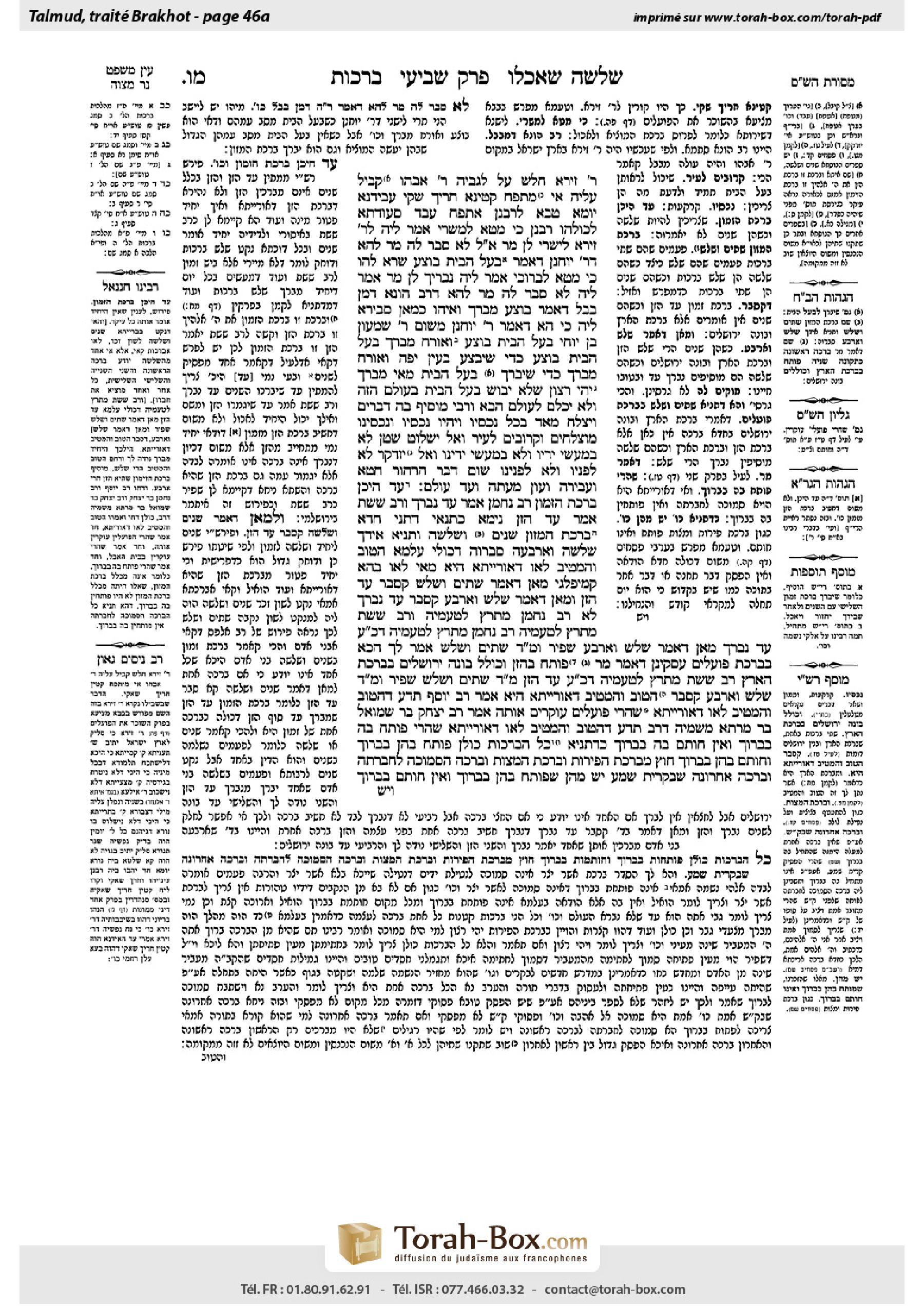
Berakhot 46a: Talmud study for Daf Yomi
Study the Talmud for Daf Yomi with scanned pages, Hebrew text, English translations from Sefaria and AI-generated French translations.
Passage selection and English or AI-generated French translation are available where the scan has annotations. Daf Study is independent of Torah-Box and Sefaria.
Browse Berakhot · ברכות · All tractatesBerakhot 46a text and translations
This page of Berakhot includes the Aramaic text, an English translation and an AI-generated French translation, alongside the scan above.
ברכות מ״ו א · Aramaic and Hebrew text
רַבִּי זֵירָא חֲלַשׁ, עָל לְגַבֵּיהּ רַבִּי אֲבָהוּ, קַבֵּיל עֲלֵיהּ: אִי מִתְּפַח קַטִּינָא חֲרִיךְ שָׁקֵי — עָבֵידְנָא יוֹמָא טָבָא לְרַבָּנַן. אִתְּפַח, עֲבַד סְעוֹדְתָּא לְכוּלְּהוּ רַבָּנַן. כִּי מְטָא לְמִשְׁרֵי אֲמַר לֵיהּ לְרַבִּי זֵירָא: לִישְׁרֵי לַן מָר. אֲמַר לֵיהּ: לָא סָבַר לַהּ מָר לְהָא דְּרַבִּי יוֹחָנָן דְּאָמַר: בַּעַל הַבַּיִת בּוֹצֵעַ? שְׁרָא לְהוּ.
כִּי מְטָא לְבָרוֹכֵי, אֲמַר לֵיהּ: נְבָרֵיךְ לַן מָר. אֲמַר לֵיהּ: לָא סָבַר לַהּ מָר לְהָא דְּרַב הוּנָא דְּמִן בָּבֶל דְּאָמַר: בּוֹצֵעַ מְבָרֵךְ?
וְאִיהוּ, כְּמַאן סְבִירָא לֵיהּ?
כִּי הָא דְּאָמַר רַבִּי יוֹחָנָן מִשּׁוּם רַבִּי שִׁמְעוֹן בֶּן יוֹחַי: בַּעַל הַבַּיִת בּוֹצֵעַ, וְאוֹרֵחַ מְבָרֵךְ. בַּעַל הַבַּיִת בּוֹצֵעַ — כְּדֵי שֶׁיִּבְצַע בְּעַיִן יָפָה. וְאוֹרֵחַ מְבָרֵךְ — כְּדֵי שֶׁיְּבָרֵךְ בַּעַל הַבַּיִת.
מַאי מְבָרֵךְ — ״יְהִי רָצוֹן שֶׁלֹּא יֵבוֹשׁ בַּעַל הַבַּיִת בָּעוֹלָם הַזֶּה, וְלֹא יִכָּלֵם לְעוֹלָם הַבָּא״.
וְרַבִּי מוֹסִיף בָּהּ דְּבָרִים: ״וְיִצְלַח מְאֹד בְּכָל נְכָסָיו, וְיִהְיוּ נְכָסָיו וּנְכָסֵינוּ מוּצְלָחִים וּקְרוֹבִים לָעִיר, וְאַל יִשְׁלוֹט שָׂטָן לֹא בְּמַעֲשֵׂי יָדָיו וְלֹא בְּמַעֲשֵׂי יָדֵינוּ, וְאַל יִזְדַּקֵּר לֹא לְפָנָיו וְלֹא לְפָנֵינוּ שׁוּם דְּבַר הִרְהוּר חֵטְא וַעֲבֵירָה וְעָוֹן מֵעַתָּה וְעַד עוֹלָם״.
עַד הֵיכָן בִּרְכַּת הַזִּמּוּן.
רַב נַחְמָן אָמַר עַד ״נְבָרֵךְ״, וְרַב שֵׁשֶׁת אָמַר, עַד ״הַזָּן״.
נֵימָא כְּתַנָּאֵי, דְּתָנֵי חֲדָא: בִּרְכַּת הַמָּזוֹן שְׁנַיִם וּשְׁלֹשָׁה, וְתַנְיָא אִידַּךְ: שְׁלֹשָׁה וְאַרְבָּעָה. סַבְרוּהָ, דְּכוּלֵּי עָלְמָא ״הַטּוֹב וְהַמֵּטִיב״ לָאו דְּאוֹרָיְיתָא הִיא, מַאי לָאו בְּהָא קָמִיפַּלְגִי: מַאן דְּאָמַר שְׁתַּיִם וְשָׁלֹשׁ קָסָבַר עַד ״הַזָּן״. — וּמַאן דְּאָמַר שָׁלֹשׁ וְאַרְבַּע קָסָבַר עַד ״נְבָרֵךְ״.
לָא, רַב נַחְמָן מְתָרֵץ לְטַעְמֵיהּ, וְרַב שֵׁשֶׁת מְתָרֵץ לְטַעְמֵיהּ:
רַב נַחְמָן מְתָרֵץ לְטַעְמֵיהּ, דְּכוּלֵּי עָלְמָא עַד ״נְבָרֵךְ״. מַאן דְּאָמַר שָׁלֹשׁ וְאַרְבַּע — שַׁפִּיר, וּמַאן דְּאָמַר שְׁתַּיִם וְשָׁלֹשׁ — אָמַר לָךְ הָכָא בְּבִרְכַּת פּוֹעֲלִים עָסְקִינַן, דְּאָמַר מָר, פּוֹתֵחַ בְּ״הַזָּן״ וְכוֹלֵל ״בּוֹנֵה יְרוּשָׁלַיִם״ בְּבִרְכַּת הָאָרֶץ.
רַב שֵׁשֶׁת מְתָרֵץ לְטַעְמֵיהּ, דְּכוּלֵּי עָלְמָא עַד ״הַזָּן״. מַאן דְּאָמַר שְׁתַּיִם וְשָׁלֹשׁ — שַׁפִּיר, וּמַאן דְּאָמַר שָׁלֹשׁ וְאַרְבַּע קָסָבַר ״הַטּוֹב וְהַמֵּטִיב״ דְּאוֹרָיְיתָא הִיא.
אָמַר רַב יוֹסֵף: תִּדַּע דְּ״הַטּוֹב וְהַמֵּטִיב״ לָאו דְּאוֹרָיְיתָא — שֶׁהֲרֵי פּוֹעֲלִים עוֹקְרִים אוֹתָהּ.
אָמַר רַב יִצְחָק בַּר שְׁמוּאֵל בַּר מָרְתָא מִשְּׁמֵיהּ דְּרַב תִּדַּע דְּ״הַטּוֹב וְהַמֵּטִיב״ לָאו דְּאוֹרָיְיתָא שֶׁהֲרֵי פּוֹתֵחַ בָּהּ בְּ״בָרוּךְ״ וְאֵין חוֹתֵם בָּהּ בְּ״בָרוּךְ״, כִּדְתַנְיָא: כׇּל הַבְּרָכוֹת כּוּלָּן פּוֹתֵחַ בָּהֶן בְּ״בָרוּךְ״ וְחוֹתֵם בָּהֶן בְּ״בָרוּךְ״, חוּץ מִבִּרְכַּת הַפֵּירוֹת וּבִרְכַּת הַמִּצְווֹת, וּבְרָכָה הַסְּמוּכָה לַחֲבֶרְתָּהּ, וּבְרָכָה אַחֲרוֹנָה שֶׁבִּקְרִיאַת שְׁמַע, יֵשׁ מֵהֶן שֶׁפּוֹתֵחַ בָּהֶן בְּ״בָרוּךְ״ וְאֵין חוֹתֵם בְּ״בָרוּךְ״,
Berakhot 46a · English translation
The Gemara recounts: Rabbi Zeira took ill. Rabbi Abbahu went to visit him and resolved: If the little man with the scorched legs, a nickname for Rabbi Zeira, is cured, I will make a festival, a feast, for the Sages. Rabbi Zeira was cured and Rabbi Abbahu made a feast for all the Sages. When it came time to break bread, Rabbi Abbahu said to Rabbi Zeira: Master, please break bread for us. Rabbi Zeira said to him: Doesn’t the Master hold in accordance with that halakha of Rabbi Yoḥanan, who said: The host breaks bread? Rabbi Abbahu broke bread for them.
When the time came to recite the blessing, Rabbi Abbahu said to Rabbi Zeira: Master, recite Grace after Meals on our behalf. Rabbi Zeira said to him: Doesn’t the Master hold in accordance with that halakha of Rabbi Huna of Babylonia, who said: He who breaks bread recites Grace after Meals?
The Gemara asks: And in accordance with whose opinion does Rabbi Abbahu hold that he asked Rabbi Zeira to recite Grace after Meals?
The Gemara answers: Rabbi Abbahu holds in accordance with that halakha that Rabbi Yoḥanan said in the name of Rabbi Shimon ben Yoḥai: The host breaks bread and a guest recites Grace after Meals. The host breaks bread so that he will break bread generously, whereas a guest might be embarrassed to break a large piece for himself and other guests; and the guest recites Grace after Meals so that he may bless the host in the course of reciting Grace after Meals, as the Gemara proceeds to explain.
What is the formula of the blessing with which the guest blesses his host?
May it be Your will that the master of the house shall not suffer shame in this world, nor humiliation in the World-to-Come.
Rabbi Yehuda HaNasi added to it elements pertaining to material success:
And may he be very successful with all his possessions,
and may his possessions and our possessions be successful and near the city,
and may Satan control neither his deeds nor our deeds,
and may no thought of sin, iniquity, or transgression stand before him or before us
from now and for evermore.
The Gemara asks: Until where does the zimmun blessing extend?
Rav Naḥman says: The blessing extends only until: Let us bless. Rav Sheshet says that the zimmun blessing extends until the end of the first blessing of Grace after Meals: Who feeds all.
The Gemara proposes: Let us say that this amoraic dispute is parallel to a dispute between the tanna’im. As one baraita taught: Grace after Meals is two and three blessings, and another baraita taught: Grace after Meals is three and four blessings. In attempting to understand these conflicting baraitot, the Sages assumed that everyone agrees that the blessing: Who is good and does good, the fourth blessing of Grace after Meals, is not required by Torah law. What then? Is it not that they disagree about this: The one who said that Grace after Meals is two and three blessings holds that the zimmun blessing extends until the end of the blessing: Who feeds all? If there is a zimmun, three blessings are recited; if there is no zimmun, only two blessings are recited, since the blessing: Who feeds all, is not recited. And the one who said that Grace after Meals is three and four blessings holds that the zimmun blessing extends only until: Let us bless, and includes no part of Grace after Meals itself. If there is a zimmun, four blessings are recited, the three blessing of Grace after Meals plus the blessing of the zimmun, while if there is not, only three blessings are recited.
This explanation distinguishing between the baraitot is rejected: No; Rav Naḥman explains in accordance with his reasoning and Rav Sheshet explains in accordance with his reasoning.
Rav Naḥman explains in accordance with his reasoning; everyone agrees that the zimmun blessing extends only until Let us bless. According to the one who said that Grace after Meals is three and four blessings, this works out well. And the one who said that Grace after Meals is two and three blessings could have said to you: Here we are dealing with the blessing recited by laborers, as the Master said that when a laborer is working, he is permitted to abridge Grace after Meals, and he begins with the blessing: Who feeds all, and includes the third blessing: Who builds Jerusalem, in the context of the second blessing, the blessing of the land.
Rav Sheshet explains in accordance with his reasoning; everyone agrees that the zimmun blessing extends until the end of the blessing: Who feeds all. According to the one who said that Grace after Meals is two and three blessings, this works out well; and the one who said that Grace after Meals is three and four blessings holds that the blessing: Who is good and does good, is required by Torah law.
With regard to the matter of the blessing: Who is good and does good, Rav Yosef said: Know that the blessing: Who is good and does good, is not required by Torah law, as laborers who recite Grace after Meals at work eliminate it. If it can be eliminated, it could not be a Torah obligation.
Rav Yitzḥak bar Shmuel bar Marta said another proof in the name of Rav: Know that the blessing: Who is good and does good, is not required by Torah law, as one who recites it begins to recite it with: Blessed, but does not conclude reciting it with: Blessed. This is the formula in all comparable blessings, as it was taught in a baraita: All blessings, one begins to recite them with: Blessed, and concludes reciting them with: Blessed, except for blessings over fruit, blessings over mitzvot, a blessing that is juxtaposed to another blessing, and the final blessing after Shema. There are among these blessings those that one who recites it begins to recite it with: Blessed, but does not conclude reciting it with: Blessed;
Berakhot 46a · Traduction française (IA)
La Guemara rapporte : Rabbi Zéira tomba malade. Rabbi Abbouha alla le voir et décida : Si le petit homme aux jambes brûlées, surnom de Rabbi Zéira, se rétablit, je ferai une fête, un banquet, pour les Sages. Rabbi Zéira se rétablit et Rabbi Abbouha organisa un banquet pour tous les Sages. Lorsque vint l'heure de casser le pain, Rabbi Abbouha dit à Rabbi Zéira : Maître, cassons le pain pour nous. Rabbi Zéira lui répondit : N'est-ce pas que le Maître suit la halakha de Rabbi Yochanan, qui dit : C'est l'hôte qui casse le pain ? Rabbi Abbouha cassa le pain pour eux.
Lorsque vint l'heure de réciter la bénédiction, Rabbi Abbouha dit à Rabbi Zéira : Maître, récitez la Bénédiction de la Grâce après le repas à notre place. Rabbi Zéira lui répondit : N'est-ce pas que le Maître suit la halakha de Rabbi Huna de Babylone, qui dit : Celui qui casse le pain récite la Bénédiction de la Grâce après le repas ?
La Guemara pose la question : Et selon l'opinion de qui Rabbi Abbouha suit-il en demandant à Rabbi Zéira de réciter la Bénédiction de la Grâce après le repas ?
La Guemara répond : Rabbi Abbouha suit l'opinion de cette halakha que Rabbi Yochanan a rapportée au nom de Rabbi Shimon ben Yochai : L'hôte casse le pain et un invité récite la Bénédiction de la Grâce après le repas. L'hôte casse le pain afin de le faire généreusement, tandis qu'un invité pourrait être gêné à casser une grande part pour lui-même et les autres invités ; et l'invité récite la Bénédiction de la Grâce après le repas afin de bénir l'hôte pendant la récitation de la Bénédiction de la Grâce après le repas, comme la Guemara va l'expliquer.
Quelle est la formule de la bénédiction avec laquelle l'invité bénit son hôte ? Que ce soit selon ta volonté, que le maître de la maison ne souffre pas de honte dans ce monde, ni de humiliation dans l'Âge à Venir.
Rabbi Yehuda HaNasi ajouta des éléments relatifs au succès matériel : Et qu'il soit très prospère avec toutes ses possessions, Et que ses possessions et nos possessions soient prospères et proches de la ville, Et que le Malin ne contrôle ni ses actes ni nos actes, Et qu'aucune pensée de péché, d'iniquité ou de transgression ne se trouve devant lui ou devant nous De maintenant et pour toujours.
La Guemara pose la question : Jusqu'où s'étend la bénédiction du zimmun ?
Rav Naḥman dit : La bénédiction s'étend seulement jusqu'à : Disons-nous. Rav Sheshet dit que la bénédiction du zimmun s'étend jusqu'à la fin de la première bénédiction de la Grâce après le repas : Celui qui nourrit tous.
La Guemara propose : Disons que ce débat entre les amoraïm est parallèle à un débat entre les tannaïm. Comme un baraïta enseignait : La Grâce après le repas est de deux et trois bénédictions, et un autre baraïta enseignait : La Grâce après le repas est de trois et quatre bénédictions. En tentant de comprendre ces baraitot contradictoires, les Sages supposèrent que tout le monde est d'accord que la bénédiction : Celui qui est bon et fait le bien, la quatrième bénédiction de la Grâce après le repas, n'est pas requise par la Loi. Et alors ? N'est-ce pas que cela ne serait pas que l'on discute sur cela : Celui qui dit que la Grâce après le repas est de deux et trois bénédictions considère que la bénédiction du zimmun s'étend jusqu'à la fin de la bénédiction : Celui qui nourrit tous ? Si il y a un zimmun, trois bénédictions sont récitées ; si il n'y en a pas, seulement deux bénédictions sont récitées, puisque la bénédiction : Celui qui nourrit tous, n'est pas récitée. Et celui qui dit que la Grâce après le repas est de trois et quatre bénédictions considère que la bénédiction du zimmun s'étend seulement jusqu'à : Disons-nous, et ne comprend pas partie de la Grâce après le repas elle-même. Si il y a un zimmun, quatre bénédictions sont récitées, les trois bénédictions de la Grâce après le repas plus la bénédiction du zimmun, tandis que si il n'y en a pas, seulement trois bénédictions sont récitées.
Cette explication distinguant entre les baraitot est rejetée : Non ; Rav Naḥman explique selon son raisonnement et Rav Sheshet explique selon son raisonnement.
Rav Naḥman explique selon son raisonnement ; tout le monde est d'accord que la bénédiction du zimmun s'étend seulement jusqu'à Disons-nous. Selon celui qui dit que la Grâce après le repas est de trois et quatre bénédictions, cela s'explique bien. Et celui qui dit que la Grâce après le repas est de deux et trois bénédictions pourrait avoir dit à vous : Ici nous sommes en train de parler de la bénédiction récitée par les ouvriers, comme le Maître dit que lorsqu'un ouvrier travaille, il est autorisé à abréger la Grâce après le repas, et il commence avec la bénédiction : Celui qui nourrit tous, et inclut la troisième bénédiction : Celui qui reconstruit Jérusalem, dans le contexte de la deuxième bénédiction, la bénédiction du pays.
Rav Sheshet explique selon son raisonnement ; tout le monde est d'accord que la bénédiction du zimmun s'étend jusqu'à la fin de la bénédiction : Celui qui nourrit tous. Selon celui qui dit que la Grâce après le repas est de deux et trois bénédictions, cela s'explique bien ; et celui qui dit que la Grâce après le repas est de trois et quatre bénédictions considère que la bénédiction : Celui qui est bon et fait le bien, est requise par la Loi.
Concernant la bénédiction : Celui qui est bon et fait le bien, Rav Yosef dit : Sache que la bénédiction : Celui qui est bon et fait le bien, n'est pas requise par la Loi, car les travailleurs qui récitent la Grâce après le repas au travail l'éliminent. Si elle peut être éliminée, elle ne pouvait pas être une obligation de la Loi.
Rav Yitzḥak bar Shmuel bar Marta dit une autre preuve au nom de Rav : Sache que la bénédiction : Celui qui est bon et fait le bien, n'est pas requise par la Loi, car celui qui la récite commence à la réciter avec : Béni, mais ne la termine pas avec : Béni. C'est la formule pour toutes les bénédictions comparables, comme il a été enseigné dans un baraïta : Toutes les bénédictions, on commence à les réciter avec : Béni, et on termine la récitation avec : Béni, sauf les bénédictions sur les fruits, les bénédictions des commandements, une bénédiction juxtaposée à une autre bénédiction, et la bénédiction finale après le Chéma. Parmi ces bénédictions, il y a celles dont on commence à les réciter avec : Béni, mais on ne les termine pas avec : Béni ;
Traduction française générée par IA à partir de l’édition anglaise de Sefaria. Vérifie toujours un passage avec le texte source.
Text from Sefaria: William Davidson Edition - Vocalized Aramaic (CC BY NC); William Davidson Edition - English (CC BY NC).