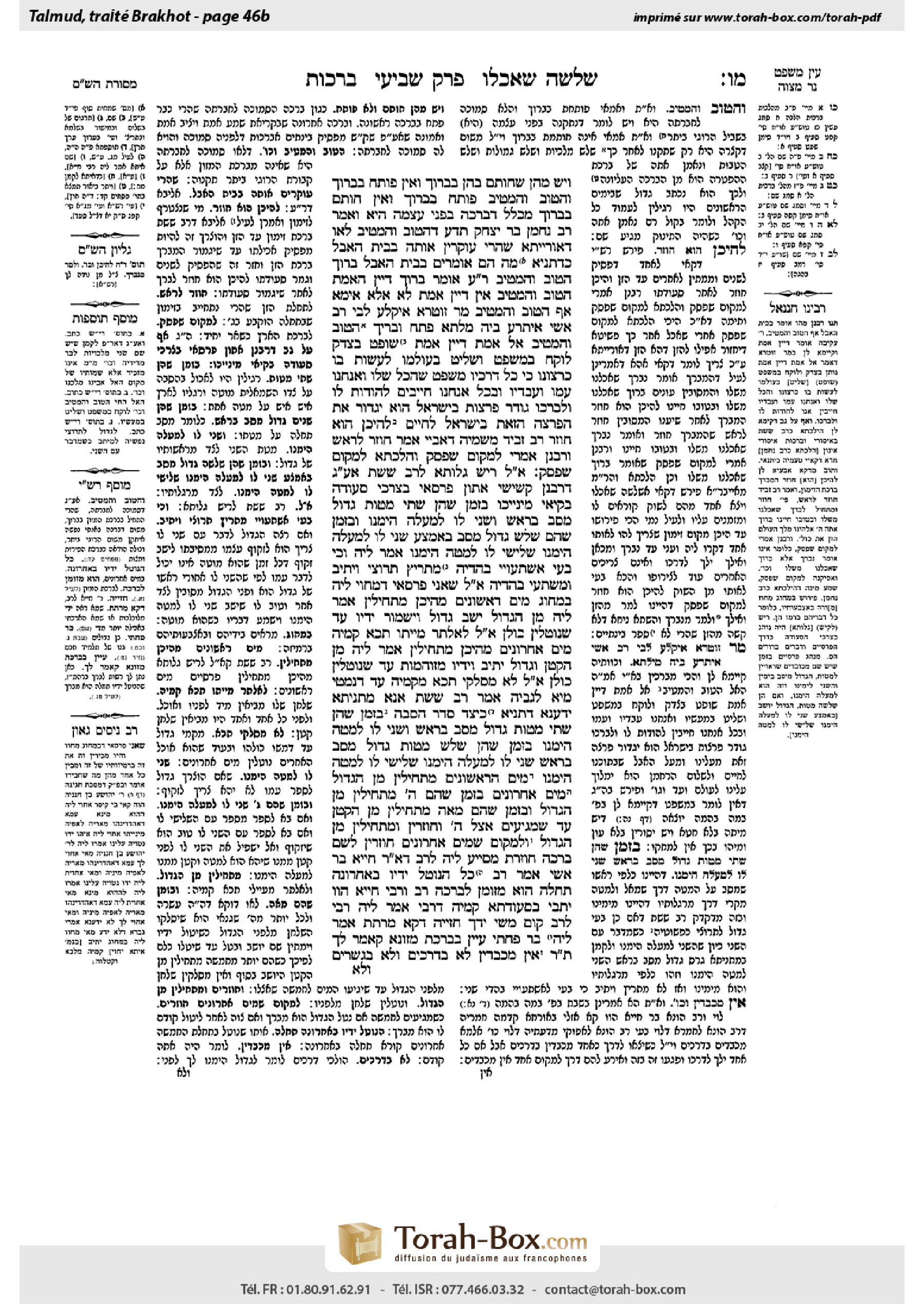
Berakhot 46b: Talmud study for Daf Yomi
Study the Talmud for Daf Yomi with scanned pages, Hebrew text, English translations from Sefaria and AI-generated French translations.
Passage selection and English or AI-generated French translation are available where the scan has annotations. Daf Study is independent of Torah-Box and Sefaria.
Browse Berakhot · ברכות · All tractatesBerakhot 46b text and translations
This page of Berakhot includes the Aramaic text, an English translation and an AI-generated French translation, alongside the scan above.
ברכות מ״ו ב · Aramaic and Hebrew text
וְיֵשׁ מֵהֶן שֶׁחוֹתֵם בָּהֶן בְּ״בָרוּךְ״ וְאֵין פּוֹתֵחַ בְּ״בָרוּךְ״. וְ״הַטּוֹב וְהַמֵּטִיב״ פּוֹתֵחַ בְּ״בָרוּךְ״ וְאֵין חוֹתֵם בְּ״בָרוּךְ״. מִכְּלָל דִּבְרָכָה בִּפְנֵי עַצְמָהּ הִיא.
וְאָמַר רַב נַחְמָן בַּר יִצְחָק: תִּדַּע דְּ״הַטּוֹב וְהַמֵּטִיב״ לָאו דְּאוֹרָיְיתָא — שֶׁהֲרֵי עוֹקְרִין אוֹתָהּ בְּבֵית הָאֵבֶל. כִּדְתַנְיָא: מָה הֵם אוֹמְרִים בְּבֵית הָאֵבֶל? — ״בָּרוּךְ הַטּוֹב וְהַמֵּטִיב״. רַבִּי עֲקִיבָא אוֹמֵר: ״בָּרוּךְ דַּיַּין הָאֱמֶת״.
״הַטּוֹב וְהַמֵּטִיב״ — אִין, ״דַּיַּין אֱמֶת״ — לָא?! אֶלָּא אֵימָא אַף ״הַטּוֹב וְהַמֵּטִיב״.
מָר זוּטְרָא אִיקְּלַע לְבֵי רַב אָשֵׁי, אִיתְּרַע בֵּיהּ מִלְּתָא, פְּתַח וּבָרֵיךְ: ״הַטּוֹב וְהַמֵּטִיב, אֵל אֱמֶת, דַּיַּין אֱמֶת, שׁוֹפֵט בְּצֶדֶק, לוֹקֵחַ בַּמִּשְׁפָּט, וְשַׁלִּיט בְּעוֹלָמוֹ לַעֲשׂוֹת בּוֹ כִּרְצוֹנוֹ, כִּי כׇל דְּרָכָיו מִשְׁפָּט, שֶׁהַכֹּל שֶׁלּוֹ וַאֲנַחְנוּ עַמּוֹ וַעֲבָדָיו, וּבַכֹּל אֲנַחְנוּ חַיָּיבִים לְהוֹדוֹת לוֹ וּלְבָרְכוֹ, גּוֹדֵר פְּרָצוֹת בְּיִשְׂרָאֵל הוּא יִגְדּוֹר אֶת הַפִּרְצָה הַזֹּאת בְּיִשְׂרָאֵל לְחַיִּים״.
לְהֵיכָן הוּא חוֹזֵר? רַב זְבִיד מִשְּׁמֵיהּ דְּאַבָּיֵי אָמַר: חוֹזֵר לָרֹאשׁ, וְרַבָּנַן אָמְרִי לַמָּקוֹם שֶׁפָּסַק, וְהִלְכְתָא לַמָּקוֹם שֶׁפָּסַק.
אֲמַר לֵיהּ רֵישׁ גָּלוּתָא לְרַב שֵׁשֶׁת: אַף עַל גַּב דְּרַבָּנַן קַשִּׁישֵׁי אַתּוּן, פָּרְסָאֵי בְּצׇרְכֵי סְעוּדָה בְּקִיאִי מִינַּיְיכוּ. בִּזְמַן שֶׁהֵן שְׁתֵּי מִטּוֹת, גָּדוֹל — מֵסֵב בָּרֹאשׁ, וְשֵׁנִי לוֹ — לְמַעְלָה הֵימֶנּוּ. וּבִזְמַן שֶׁהֵם שָׁלֹשׁ, גָּדוֹל — מֵסֵב בָּאֶמְצַע, שֵׁנִי לוֹ — לְמַעְלָה הֵימֶנּוּ, שְׁלִישִׁי לוֹ — לְמַטָּה הֵימֶנּוּ.
אֲמַר לֵיהּ, וְכִי בָּעֵי אִישְׁתַּעוֹיֵי בַּהֲדֵיהּ, מְתָרֵיץ תָּרוֹצֵי וְיָתֵיב וּמִשְׁתַּעֵי בַּהֲדֵיהּ?! אֲמַר לֵיהּ: שָׁאנֵי פָּרְסָאֵי, דְּמַחְוֵי לֵיהּ בְּמָחוֹג.
מַיִם רִאשׁוֹנִים מֵהֵיכָן מַתְחִילִין? אֲמַר לֵיהּ: מִן הַגָּדוֹל.
יֵשֵׁב גָּדוֹל וְיִשְׁמוֹר יָדָיו עַד שֶׁנּוֹטְלִין כּוּלָּן? אֲמַר לֵיהּ: לְאַלְתַּר מַיְיתוּ תַּכָּא קַמֵּיהּ.
מַיִם אַחֲרוֹנִים מֵהֵיכָן מַתְחִילִין? אֲמַר לֵיהּ: מִן הַקָּטָן.
וְגָדוֹל יָתֵיב וְיָדָיו מְזוֹהָמוֹת עַד שֶׁנּוֹטְלִין כּוּלָּן? אֲמַר לֵיהּ: לָא מְסַלְּקִי תַּכָּא מִקַּמֵּיהּ עַד דְּנִימְטֵי מַיָּא לְגַבֵּיהּ.
אֲמַר רַב שֵׁשֶׁת: אֲנָא מַתְנִיתָא יָדַעְנָא, דְּתַנְיָא: כֵּיצַד סֵדֶר הֲסִבָּה? — בִּזְמַן שֶׁהֵן שְׁתֵּי מִטּוֹת — גָּדוֹל מֵסֵב בָּרֹאשׁ, וְשֵׁנִי לוֹ לְמַטָּה הֵימֶנּוּ. בִּזְמַן שֶׁהֵן שָׁלֹשׁ מִטּוֹת — גָּדוֹל מֵסֵב בָּרֹאשׁ, שֵׁנִי לוֹ לְמַעְלָה הֵימֶנּוּ, שְׁלִישִׁי לוֹ לְמַטָּה הֵימֶנּוּ. מַיִם הָרִאשׁוֹנִים מַתְחִילִין מִן הַגָּדוֹל. מַיִם אַחֲרוֹנִים, בִּזְמַן שֶׁהֵם חֲמִשָּׁה — מַתְחִילִין מִן הַגָּדוֹל, וּבִזְמַן שֶׁהֵם מֵאָה — מַתְחִילִין מִן הַקָּטָן עַד שֶׁמַּגִּיעִים אֵצֶל חֲמִישִׁי, וְחוֹזְרִין וּמַתְחִילִין מִן הַגָּדוֹל. וְלִמְקוֹם שֶׁמַּיִם אַחֲרוֹנִים חוֹזְרִין — לְשָׁם בְּרָכָה חוֹזֶרֶת.
מְסַיַּיע לֵיהּ לְרַב, דְּאָמַר רַבִּי חִיָּיא בַּר אָשֵׁי אָמַר רַב: כׇּל הַנּוֹטֵל יָדָיו בָּאַחֲרוֹנָה תְּחִלָּה — הוּא מְזוּמָּן לִבְרָכָה.
רַב וְרַבִּי חִיָּיא הֲווֹ יָתְבִי בִּסְעוֹדְתָּא קַמֵּיהּ דְּרַבִּי, אֲמַר לֵיהּ רַבִּי לְרַב: קוּם, מְשִׁי יְדָךְ. חַזְיֵיהּ דְּקָא מְרַתֵּת. אֲמַר לֵיהּ: בַּר פַּחֲתֵי, ״עַיֵּין בְּבִרְכַּת מְזוֹנָא״ קָאָמַר לָךְ.
תָּנוּ רַבָּנַן: אֵין מְכַבְּדִין לֹא בִּדְרָכִים וְלֹא בִּגְשָׁרִים,
Berakhot 46b · English translation
and there are among these blessings that one who recites it concludes reciting it with: Blessed, but does not begin reciting it with: Blessed. The blessing: Who is good and does good, one who recites it begins to recite it with: Blessed, but does not conclude reciting it with: Blessed. This proves by inference that it is an independent blessing.
And Rav Naḥman bar Yitzḥak said: Know that the blessing: Who is good and does good, is not required by Torah law, as it is eliminated in the house of the mourner, as it was taught in a baraita according to the opinion of Rabbi Akiva: What do they say in the house of the mourner? Blessed…Who is good and does good. Rabbi Akiva says: Blessed…the true Judge.
The first opinion in the baraita is challenged: Who is good and does good, yes, it is recited in the house of the mourner, the true Judge, no, it is not recited? Rather, say: Who is good and does good, is recited as well.
The Gemara recounts: Mar Zutra happened to come to Rav Ashi’s home when an incident of mourning befell Rav Ashi. Mar Zutra began a combined blessing and recited:
Who is good and does good,
God of truth, the true Judge,
Who judges with righteousness, takes away with justice,
and is the ruler of His world to do in it as He wills,
as all His ways are just,
that all is His and we are His people and His servants,
and in everything we are obligated to thank Him and bless Him,
Who repairs the breaches in Israel,
He will repair this breach in Israel for life.
Mar Zutra included both: Who is good and does good, as well as mourning and acceptance of divine justice.
Returning to the original topic, it was mentioned above that one interrupts his meal to form a zimmun with two others who finished eating. The question is raised: To where does he return when he finishes his own meal and must begin to recite his own Grace after Meals? Rav Zevid in the name of Abaye said: He returns to the beginning and recites the entire Grace after Meals. And the Rabbis say: He returns to the place that he stopped. And the halakha is: He returns to the place that he stopped, i.e., to the beginning of the second blessing.
On the topic of meals, the Gemara relates the following: The Exilarch said to Rav Sheshet: Although you are elderly Sages, the Persians are more expert than you with regard to the required etiquette at meals. The Persian custom is that when there are two divans on which they would recline, the greater of the two people reclines first and the person second to him in importance reclines on the divan above him, alongside his head. When there are three divans, the greatest of the three reclines on the middle divan, the one second to him in importance reclines on the divan above him, and the one third to him in importance reclines on the divan below the greatest of the three.
Rav Sheshet said to the Exilarch that the custom is flawed. If the greater wishes to speak with the one second to him in importance who is reclining above his head, he must straighten up and sit and only then will he be able to speak to him. The Exilarch answered: The Persians are different, as they signal and communicate with hand gestures, especially during mealtimes, so there is no need to sit up.
Rav Sheshet asked the Exilarch about the Persian practice with regard to the first waters. When washing hands before the meal, from where do they begin? The Exilarch said to him: They begin from the greatest.
Rav Sheshet asked: If that is so, should the greatest person present sit and keep his hands clean and wait until everyone has washed so that they may all be served? The Exilarch said to him: They bring him his table [takka] immediately, as the custom was that each person ate at his own private table, and they brought the table before the greatest person present immediately after he washed so that he need not wait for the others.
Rav Sheshet asked the Exilarch about the Persian practice with regard to the final waters. When washing hands after the meal, from where do they begin? The Exilarch said to him: They begin with the least significant of the attendees.
Rav Sheshet said: If so, should the greatest person present sit with dirty hands until everyone washes his hands? The Exilarch said to him: They do not remove the table from before him until the water reaches him; he can continue eating while the others are washing.
Rav Sheshet said: In terms of conduct at a meal, I know a baraita, as it was taught: What is the order of reclining? When there are two divans on which they would recline, the greater of the two people reclines first, and the person second to him in importance reclines on the divan below him. When there are three divans, the greatest of the three reclines first, on the middle divan, the one second to him in importance reclines on the divan above him, and the one third to him in importance reclines on the divan below the greatest of the three. The first waters before the meal, they begin with the greatest person present. The final waters; when they are five people, they begin with the greatest person present. When they are more than that, even one hundred, they begin the final waters with the least significant of the attendees until they reach the five greatest present, at which point they return and begin with the greatest present. And to the place that the final waters return the blessing also reverts, and the greatest present, the first among the final five to wash his hands, recites Grace after Meals.
This baraita supports the opinion of Rav, as Rabbi Ḥiyya bar Ashi said that Rav said: Whoever washes his hands first at the end of the meal is designated to recite the blessing of Grace after Meals.
Similarly, the Gemara relates: Rav and Rabbi Ḥiyya were seated at a meal before Rabbi Yehuda HaNasi. Rabbi Yehuda HaNasi said to Rav: Stand, wash your hands. Rabbi Ḥiyya saw that Rav was trembling in fear that perhaps he had conducted himself improperly during the meal and therefore had to wash his hands. Rabbi Ḥiyya said to him: Son of noblemen, he is saying to you to review Grace after Meals, as the first to wash his hands after the meal is honored with leading the blessing.
The Gemara continues to discuss the topic of washing after a meal. The Sages taught: Although it is customary to defer to greater people, nevertheless, one shows deference neither on roads nor on bridges,
Berakhot 46b · Traduction française (IA)
Et parmi ces bénédictions, il y a celle-ci : celui qui la récite termine sa récitation en disant : béni, mais ne commence pas sa récitation en disant : béni. La bénédictions : Qui est bon et fait le bien, celui qui la récite commence sa récitation en disant : béni, mais ne termine pas sa récitation en disant : béni. Cela prouve par déduction qu'il s'agit d'une bénédictions indépendante.
Et Rav Naḥman bar Yitzḥak a dit : Sache que la bénédictions : Qui est bon et fait le bien, n'est pas requise par la loi divine, car elle a été éliminée dans la maison du veuf, comme il a été enseigné dans une baraïta selon l'opinion de Rabbi Akiva : Qu'ont-ils dit dans la maison du veuf ? Béni… Qui est bon et fait le bien. Rabbi Akiva dit : Béni… le juge véritable.
L'opinion première dans la baraïta est contestée : Qui est bon et fait le bien, oui, elle est récitée dans la maison du veuf, le juge véritable, non, elle n'est pas récitée ? Plutôt, dis : Qui est bon et fait le bien, est récitée également.
La Guemara rapporte : Mar Zutra arriva chez Rav Ashi lorsqu'un événement de deuil survint chez Rav Ashi. Mar Zutra commença une bénédictions combinée et récita : Qui est bon et fait le bien, Dieu de vérité, le juge véritable, Qui juge avec justice, ôte avec équité, et est le maître de son monde pour agir en lui comme il l'entend, ce que toutes ses voies sont justes, ce que tout est à lui et nous sommes son peuple et ses serviteurs, et en tout nous sommes obligés de le remercier et de le bénir, Qui répare les brèches en Israël, Il réparera cette brèche en Israël pour l'éternité. Mar Zutra inclut à la fois : Qui est bon et fait le bien, ainsi que le deuil et l'acceptation du jugement divin.
En revenant au sujet principal, il a été mentionné ci-dessus que l'on interrompt son repas pour former un zimmun avec deux autres qui ont terminé de manger. La question est posée : où revient-il lorsqu'il termine son propre repas et doit commencer à réciter sa propre Bénédiction de la Grâce après le repas ? Rav Zevid, dans le nom d'Abaye, a dit : Il revient au début et récite toute la Bénédiction de la Grâce après le repas. Et les Sages disent : Il revient à l'endroit où il a cessé. Et la halakha est : Il revient à l'endroit où il a cessé, c'est-à-dire au début de la deuxième bénédiction.
Sur le sujet des repas, la Guemara rapporte ce qui suit : L'Exilarch dit à Rav Sheshet : Bien que vous soyez des Sages âgés, les Perses sont plus experts que vous concernant les coutumes requis lors des repas. La coutume perse est que lorsqu'il y a deux divans sur lesquels ils se recouvent, le plus grand des deux personnes se recouvre d'abord et la personne qui lui est secondaire se recouvre sur le divan au-dessus de lui, à côté de sa tête. Lorsqu'il y a trois divans, le plus grand des trois se recouvre sur le divan du milieu, la personne qui lui est secondaire se recouvre sur le divan au-dessus de lui, et la personne qui lui est troisième se recouvre sur le divan en dessous du plus grand des trois.
Rav Sheshet dit à l'Exilarch que cette coutume est défectueuse. Si le plus grand veut parler avec celui qui lui est secondaire et qui est allongé au-dessus de sa tête, il doit se redresser et s'asseoir, et seulement alors pourra-t-il lui parler. L'Exilarch répondit : Les Perses sont différents, car ils signalent et communiquent avec des gestes de la main, surtout lors des repas, donc il n'y a pas besoin de se redresser.
Rav Sheshet demanda à l'Exilarch sur la pratique perse concernant les premières eaux. Lors du lavage des mains avant le repas, d'où commencent-ils ? L'Exilarch dit à lui : Ils commencent par le plus grand.
Rav Sheshet demanda : Si c'est ainsi, le plus grand des présents doit-il s'asseoir et garder ses mains propres jusqu'à ce que tout le monde ait lavé ses mains afin qu'ils puissent tous être servis ? L'Exilarch dit à lui : Ils lui apportent immédiatement sa table [takka], car la coutume était que chaque personne mangeait à sa propre table privée, et ils apportaient la table devant la personne la plus grande immédiatement après qu'elle avait lavé ses mains afin qu'elle n'ait pas à attendre les autres.
Rav Sheshet demanda à l'Exilarch sur la pratique perse concernant les eaux finales. Lors du lavage des mains après le repas, d'où commencent-ils ? L'Exilarch dit à lui : Ils commencent avec la personne la moins importante des participants.
Rav Sheshet dit : Si c'est ainsi, le plus grand des présents doit-il s'asseoir avec des mains sales jusqu'à ce que tout le monde lave ses mains ? L'Exilarch dit à lui : Ils ne retirent pas la table devant lui jusqu'à ce que l'eau arrive à lui ; il peut continuer à manger pendant que les autres lavent leurs mains.
Rav Sheshet dit : En termes de conduite lors d'un repas, je connais une baraïta, comme il a été enseigné : Quel est l'ordre du recouvrement ? Lorsqu'il y a deux divans sur lesquels ils se recouvent, le plus grand des deux personnes se recouvre d'abord, et la personne qui lui est secondaire se recouvre sur le divan en dessous de lui. Lorsqu'il y a trois divans, le plus grand des trois se recouvre d'abord, sur le divan du milieu, la personne qui lui est secondaire se recouvre sur le divan au-dessus de lui, et la personne qui lui est troisième se recouvre sur le divan en dessous du plus grand des trois. Les premières eaux avant le repas, ils commencent par la personne la plus importante présente. Les eaux finales ; lorsqu'il y a cinq personnes, ils commencent par la personne la plus importante présente. Lorsqu'il y a plus de cela, même cent, ils commencent les eaux finales avec la personne la moins importante des participants jusqu'à ce qu'ils atteignent les cinq personnes les plus importantes présentes, à ce moment-là ils retournent et commencent avec la personne la plus importante présente. Et à l'endroit où les eaux finales retournent, la bénédiction y retourne également, et la personne la plus importante présente, le premier parmi les cinq derniers à laver ses mains, récite la Bénédiction de la Grâce après le repas.
Cette baraïta soutient l'opinion de Rav, car Rabbi Ḥiyya bar Ashi a dit que Rav a dit : Celui qui lave ses mains en premier à la fin du repas est désigné pour réciter la bénédiction de la Grâce après le repas.
De même, la Guemara rapporte : Rav et Rabbi Ḥiyya étaient assis à un repas devant Rabbi Yehuda HaNasi. Rabbi Yehuda HaNasi dit à Rav : Levez-vous, lavez vos mains. Rabbi Ḥiyya vit que Rav tremblait d'effroi, craignant peut-être d'avoir mal agi pendant le repas et devait donc laver ses mains. Rabbi Ḥiyya dit à lui : Fils des nobles, il te dit de révisiter la Bénédiction de la Grâce après le repas, car celui qui lave les mains en premier après le repas est honoré de diriger la prière.
La Guemara continue de discuter du sujet de l'ablution après un repas. Les Sages enseignèrent : Bien que l'usage soit de se soumettre aux personnes plus importantes, néanmoins, on ne montre pas de déférence ni sur les routes ni sur les ponts,
Traduction française générée par IA à partir de l’édition anglaise de Sefaria. Vérifie toujours un passage avec le texte source.
Text from Sefaria: William Davidson Edition - Vocalized Aramaic (CC BY NC); William Davidson Edition - English (CC BY NC).