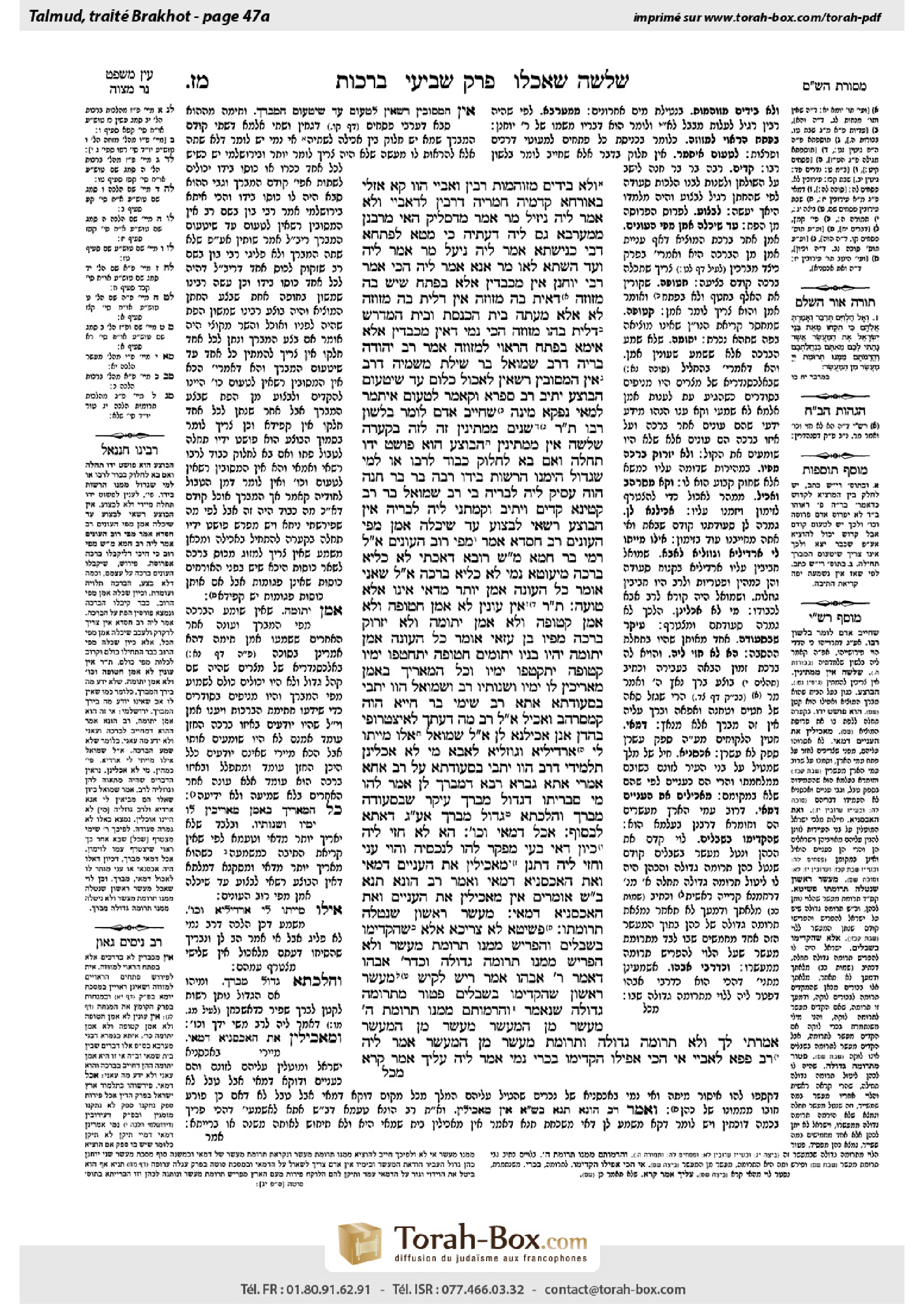
Berakhot 47a: Talmud study for Daf Yomi
Study the Talmud for Daf Yomi with scanned pages, Hebrew text, English translations from Sefaria and AI-generated French translations.
Passage selection and English or AI-generated French translation are available where the scan has annotations. Daf Study is independent of Torah-Box and Sefaria.
Browse Berakhot · ברכות · All tractatesBerakhot 47a text and translations
This page of Berakhot includes the Aramaic text, an English translation and an AI-generated French translation, alongside the scan above.
ברכות מ״ז א · Aramaic and Hebrew text
וְלֹא בְּיָדַיִם מְזוֹהָמוֹת.
רָבִין וְאַבָּיֵי הֲווֹ קָא אָזְלִי בְּאוֹרְחָא, קַדְמֵיהּ חֲמָרֵיהּ דְּרַבִּין לִדְאַבָּיֵי וְלָא אֲמַר לֵיהּ ״נֵיזִיל מָר״. אֲמַר: מִדִּסְלִיק הַאי מֵרַבָּנַן מִמַּעְרְבָא, גַּס לֵיהּ דַּעְתֵּיהּ. כִּי מְטָא לְפִתְחָא דְבֵי כְנִישְׁתָּא אֲמַר לֵיהּ: נֵיעַל מָר. אֲמַר לֵיהּ: וְעַד הַשְׁתָּא לָאו מָר אֲנָא? אֲמַר לֵיהּ, הָכִי אָמַר רַבִּי יוֹחָנָן: אֵין מְכַבְּדִין אֶלָּא בְּפֶתַח שֶׁיֵּשׁ בָּהּ מְזוּזָה.
דְּאִית בַּהּ מְזוּזָה — אִין, דְּלֵית בַּהּ מְזוּזָה — לָא, אֶלָּא מֵעַתָּה, בֵּית הַכְּנֶסֶת וּבֵית הַמִּדְרָשׁ, דְּלֵית בְּהוּ מְזוּזָה, הָכִי נָמֵי דְּאֵין מְכַבְּדִין? אֶלָּא אֵימָא: בְּפֶתַח הָרָאוּי לִמְזוּזָה.
אָמַר רַב יְהוּדָה בְּרֵיהּ דְּרַב שְׁמוּאֵל בַּר שִׁילַת מִשְּׁמֵיהּ דְּרַב: אֵין הַמְסוּבִּין רַשָּׁאִין לֶאֱכוֹל כְּלוּם עַד שֶׁיִּטְעוֹם הַבּוֹצֵעַ. יָתֵיב רַב סָפְרָא וְקָאָמַר: ״לִטְעוֹם״ אִיתְּמַר.
לְמַאי נָפְקָא מִינַּהּ? שֶׁחַיָּיב אָדָם לוֹמַר בִּלְשׁוֹן רַבּוֹ.
תָּנוּ רַבָּנַן: שְׁנַיִם מַמְתִּינִין זֶה לָזֶה בַּקְּעָרָה, שְׁלֹשָׁה — אֵין מַמְתִּינִין. הַבּוֹצֵעַ הוּא פּוֹשֵׁט יָדוֹ תְּחִלָּה, וְאִם בָּא לַחֲלוֹק כָּבוֹד לְרַבּוֹ אוֹ לְמִי שֶׁגָּדוֹל הֵימֶנּוּ — הָרְשׁוּת בְּיָדוֹ.
רַבָּה בַּר בַּר חָנָה הֲוָה עָסֵיק לֵיהּ לִבְרֵיהּ בֵּי רַב שְׁמוּאֵל בַּר רַב קַטִּינָא, קָדֵים וְיָתֵיב וְקָמַתְנֵי לֵיהּ לִבְרֵיהּ: אֵין הַבּוֹצֵעַ רַשַּׁאי לִבְצוֹעַ עַד שֶׁיִּכְלֶה ״אָמֵן״ מִפִּי הָעוֹנִים. רַב חִסְדָּא אָמַר מִפִּי רוֹב הָעוֹנִים.
אָמַר לוֹ רָמֵי בַּר חָמָא: מַאי שְׁנָא רוּבָּא — דְּאַכַּתִּי לָא כָּלְיָא בְּרָכָה, מִיעוּטָא נָמֵי לָא כָּלְיָא בְּרָכָה?
אֲמַר לֵיהּ: שֶׁאֲנִי אוֹמֵר, כׇּל הָעוֹנֶה ״אָמֵן״ יוֹתֵר מִדַּאי — אֵינוֹ אֶלָּא טוֹעֶה.
תָּנוּ רַבָּנַן: אֵין עוֹנִין לֹא ״אָמֵן״ חֲטוּפָה, וְלֹא ״אָמֵן״ קְטוּפָה, וְלֹא ״אָמֵן״ יְתוֹמָה, וְלֹא יִזְרוֹק בְּרָכָה מִפִּיו.
בֶּן עַזַּאי אוֹמֵר: כׇּל הָעוֹנֶה ״אָמֵן״ יְתוֹמָה — יִהְיוּ בָּנָיו יְתוֹמִים, חֲטוּפָה — יִתְחַטְּפוּ יָמָיו, קְטוּפָה — יִתְקַטְּפוּ יָמָיו. וְכׇל הַמַּאֲרִיךְ בְּ״אָמֵן״ — מַאֲרִיכִין לוֹ יָמָיו וּשְׁנוֹתָיו.
רַב וּשְׁמוּאֵל הֲווֹ יָתְבִי בִּסְעוֹדְתָּא. אֲתָא רַב שִׁימִי בַּר חִיָּיא, הֲוָה קָמְסַרְהֵב וְאָכֵיל. אֲמַר לֵיהּ רַב: מָה דַעְתָּךְ — לְאִיצְטְרוֹפֵי בַּהֲדַן, אֲנַן אֲכִילְנָא לַן. אֲמַר לֵיהּ שְׁמוּאֵל: אִלּוּ מַיְיתוּ לִי אַרְדִּילַיָּא וְגוֹזָלַיָּא לְאַבָּא, מִי לָא אָכְלִינַן?
תַּלְמִידֵי דְּרַב הֲווֹ יָתְבִי בִּסְעוֹדְתָּא. עָל רַב אַחָא. אָמְרִי: אֲתָא גַּבְרָא רַבָּא דִּמְבָרֵךְ לַן. אָמַר לְהוּ: מִי סָבְרִיתוּ דְּגָדוֹל מְבָרֵךְ? עִיקָּר שֶׁבַּסְּעוּדָה מְבָרֵךְ. וְהִלְכְתָא גָּדוֹל מְבָרֵךְ, אַף עַל גַּב דַּאֲתָא לְבַסּוֹף.
אָכַל דְּמַאי וְכוּ׳: הָא לָא חֲזֵי לֵיהּ! כֵּיוָן דְּאִי בָּעֵי מַפְקַר לְהוּ לְנִכְסֵיהּ וְהָוֵי עָנִי, וַחֲזֵי לֵיהּ, דִּתְנַן: מַאֲכִילִין אֶת הָעֲנִיִּים דְּמַאי, וְאֶת הָאַכְסַנְיָא דְּמַאי. וְאָמַר רַב הוּנָא: תָּנָא, בֵּית שַׁמַּאי אוֹמְרִים: אֵין מַאֲכִילִין אֶת הָעֲנִיִּים וְאֶת הָאַכְסַנְיָא דְּמַאי.
מַעֲשֵׂר רִאשׁוֹן שֶׁנִּטְּלָה תְּרוּמָתוֹ: פְּשִׁיטָא? לָא צְרִיכָא אֶלָּא שֶׁהִקְדִּימוֹ בַּשִּׁבֳּלִים, וְהִפְרִישׁ מִמֶּנּוּ תְּרוּמַת מַעֲשֵׂר, וְלֹא הִפְרִישׁ מִמֶּנּוּ תְּרוּמָה גְּדוֹלָה, וְכִדְרַבִּי אֲבָהוּ. דְּאָמַר רַבִּי אֲבָהוּ אָמַר רֵישׁ לָקִישׁ: מַעֲשֵׂר רִאשׁוֹן שֶׁהִקְדִּימוֹ בַּשִּׁבֳּלִים — פָּטוּר מִתְּרוּמָה גְּדוֹלָה, שֶׁנֶּאֱמַר: ״וַהֲרֵמֹתֶם מִמֶּנּוּ תְּרוּמַת ה׳ מַעֲשֵׂר מִן הַמַּעֲשֵׂר״ — מַעֲשֵׂר מִן הַמַּעֲשֵׂר אָמַרְתִּי לְךָ, וְלֹא תְּרוּמָה גְּדוֹלָה וּתְרוּמַת מַעֲשֵׂר מִן הַמַּעֲשֵׂר.
אֲמַר לֵיהּ רַב פָּפָּא לְאַבָּיֵי: אִי הָכִי, אֲפִילּוּ הִקְדִּימוֹ בִּכְרִי נָמֵי! אֲמַר לֵיהּ: עָלֶיךָ אָמַר קְרָא
Berakhot 47a · English translation
nor with regard to dirty hands, i.e., with regard to washing hands at the end of a meal.
The Gemara recounts: Ravin and Abaye were traveling along the road on donkeys. Ravin’s donkey preceded Abaye’s and Ravin did not say to Abaye: Let the Master go first. Abaye said to himself: Ever since this one of the Sages, Ravin, ascended from the West, Eretz Yisrael, he has become arrogant. When they reached the door of the synagogue, Ravin said to Abaye: Let the Master enter first. Abaye said to him: Until now was I not Master? Why do you only begin deferring to me now but did not do so while we were traveling? Ravin said to him: Rabbi Yoḥanan said the following: One only defers to those greater than he at a doorway that has a mezuza, as only there is it appropriate to allow him to go first.
The Gemara challenges: A doorway that has a mezuza, yes, one defers; a doorway that does not have a mezuza, no, one does not defer? If so, a synagogue or study hall that has no mezuza, there too, does one not defer at their doorways? Rather, say that this is the principle: One only shows deference at a doorway where it is worthy of affixing a mezuza, but not on a road or a bridge.
The Gemara continues with the subject of deferring to one’s superior during a meal: Rav Yehuda, son of Rav Shmuel bar Sheilat, said in the name of Rav: Those reclining at a meal may not eat anything until the one breaking bread has tasted the bread. Rav Safra sat and said: May not taste, was stated by Rav, and not: May not eat.
The Gemara asks: What difference does it make whether Rav said taste or eat? The Gemara explains that there is no difference and that Rav Safra’s insistence teaches that one must say what he was taught in the precise language employed by his teacher without altering a single detail.
The Gemara continues to discuss the subject of honors during a meal. The Sages taught: Two people who are eating from a single dish must wait for each other, but if there are three, everyone eats when he wishes and they need not wait for each other. Generally, the one who breaks bread extends his hand to take food first, but if he wishes to defer to his teacher or to one who is greater than he, he has permission to do so.
The Gemara relates: Rabba bar bar Ḥana engaged in preparations for his son’s wedding in the house of Rav Shmuel bar Rav Ketina. He arrived early and sat and taught his son the halakhot of meals: The one who breaks bread may not break the bread until amen has ended from the mouths of those responding. Rav Ḥisda said: One need only wait until amen has ended from the mouths of the majority of those responding.
Rami bar Ḥama said to him: What is different regarding the majority that one must wait until their amen ends before proceeding? That until then, the blessing has not yet concluded. If so, when the amen of the minority has not yet ended as well, the blessing has not yet concluded. Why doesn’t the one breaking bread need to wait in that case?
Rav Ḥisda said to him: Because I say that anyone who answers an amen of excessive duration is merely mistaken.
With regard to answering amen, the Sages taught: One should not respond with an abbreviated [ḥatufa] amen, in which the first syllable is not properly enunciated, and a truncated [ketufa] amen, in which the second syllable is not properly enunciated, and an orphaned [yetoma] amen, in which the respondent is unaware of the blessing to which he is responding. Similarly, one should not quickly and indifferently discharge a blessing from his mouth.
Ben Azzai says: Anyone who recites an orphaned amen, his children will be orphaned; one who recites an abbreviated amen, his days will be abbreviated and incomplete; one who recites a truncated amen, his days will be truncated. One who extends his amen, they will extend his days and years for him. Nonetheless, one should not prolong it extensively.
Returning to matters of zimmun, the Gemara relates: Rav and Shmuel were sitting at a meal when, much later, Rav Shimi bar Ḥiyya arrived and was hurrying and eating. Rav said to him: What is your thinking? Are you rushing in order to join together with us for a zimmun? We have already eaten and finished our meal before you arrived. Shmuel said to Rav: We have not really finished our meal, as if they brought me truffles or a young pigeon for Abba, Rav, wouldn’t we eat it? Since we would still eat, we have not yet finished our meal and Rabbi Shimi bar Ḥiyya can join us in the zimmun.
Rav’s students were seated at a meal when Rav Aḥa entered. The students said: A great man has come who can recite the blessing on our behalf. Rav Aḥa said to them: Do you think that the greatest recites the blessing? That is not so. Rather, one of the main participants who was present from the beginning of the meal recites the blessing. The Gemara concludes: The halakha, however, is that the greatest person present recites the blessing, even if he arrived at the end of the meal.
In the mishna, we learned that if, among the diners, one ate doubtfully tithed produce [demai], he is included among the three to obligate those with whom he ate in a zimmun. The Gemara raises an objection: But demai is not fit for his consumption. He is forbidden to eat demai. The Gemara responds: He may recite Grace after Meals over it because, if he wants, he could declare all of his property ownerless [hefker] and he would be a pauper, in which case the demai would be fit for his consumption. As we learned in a mishna: One may feed the impoverished demai and one may feed soldiers [akhsania], whose support is imposed upon the residents of the city, demai. And Rav Huna said: It was taught in a baraita that Beit Shammai say: One may not feed the impoverished and soldiers demai.
We learned in the mishna: If, among the diners, one ate first tithe from which its teruma was already taken, he may be included in a zimmun. The Gemara remarks: It is obvious that if the teruma was already taken there is no problem. Why was it necessary for the mishna to teach that one can join a zimmun? The Gemara explains: It was only necessary to teach this halakha in a case where the Levite preceded the priest while the grain was still on the stalks, and he separated the teruma of the tithes but did not separate the teruma gedola. Teruma gedola was not separated from the tithe that was eaten by the Levite. Although this should not be done ab initio, after the fact it is permitted, and one who eats first tithe produce under these circumstances may be included in a zimmun. And this is in accordance with the opinion of Rabbi Abbahu, as Rabbi Abbahu said that Reish Lakish said: First tithe in which the Levite preceded the priest while the grain was still on the stalks is exempt from teruma gedola, as it is stated: “And you shall set apart from it a gift for the Lord, even a tenth part of the tithe” (Numbers 18:26). This verse teaches that the Levite is obligated to set apart a tenth part of the tithe, i.e., the teruma of the tithe and not teruma gedola and the teruma of the tithe.
Rav Pappa said to Abaye: If so, even if the Levite preceded the priest after the kernels of grain were removed from the stalks and placed in a pile, the Levite should not have to separate teruma gedola. Abaye said to him: With regard to your claim, the verse stated:
Berakhot 47a · Traduction française (IA)
ni avec les mains sales, c'est-à-dire avec la prière des mains à la fin d'un repas.
La Guemara rapporte : Rabin et Abaye voyageaient sur des ânes. L'âne de Rabin précédait celui d'Abaye et Rabin ne disait pas à Abaye : Laisse le Maître entrer en premier. Abaye se disait : Depuis que ce Sage, Rabin, est monté du West, Eretz Yisrael, il est devenu arrogant. Lorsqu'ils arrivèrent à la porte de la synagogue, Rabin dit à Abaye : Laisse le Maître entrer en premier. Abaye lui dit : Jusqu'à présent n'étais-je pas le Maître ? Pourquoi commences-tu seulement à me faire honneur maintenant, alors que nous étions en route ? Rabin lui dit : Rabbi Yoḥanan a dit ceci : On ne fait honneur qu'aux personnes supérieures à soi à une porte ayant un mezuza, car c'est là qu'il est approprié de permettre à l'autre de passer en premier.
La Guemara soulève un doute : Une porte ayant un mezuza, oui, on fait honneur ; une porte n'ayant pas de mezuza, non, on ne fait pas honneur ? Si c'est ainsi, une synagogue ou une salle de étude n'ayant pas de mezuza, là aussi, ne fait-on pas honneur à leurs portes ? Plutôt, disons que ce principe est le suivant : On fait honneur uniquement à une porte où il est digne d'afficher un mezuza, mais pas sur une route ou un pont.
La Guemara continue sur le sujet de l'honneur à l'égard de son supérieur lors d'un repas : Rav Yehuda, fils de Rav Shmuel bar Sheilat, a dit en nom de Rav : Ceux qui s'installent pour un repas ne peuvent pas manger quoi que ce soit avant que celui qui brise le pain n'ait goûté au pain. Rav Safra a dit : Ne doit pas goûter, a été dit par Rav, et non : Ne doit pas manger.
La Guemara pose la question : Quelle différence cela fait-il que Rav ait dit goûter ou manger ? La Guemara explique que cela ne fait aucune différence et que l'insistance de Rav Safra enseigne que l'on doit dire exactement ce que l'on a appris de son maître, sans altérer le moindre détail.
La Guemara continue sur le sujet des honneurs lors d'un repas. Les Sages ont enseigné : Deux personnes qui mangent d'un même plat doivent attendre l'autre, mais s'il y a trois, chacun mange quand il veut et ils n'ont pas besoin d'attendre les uns les autres. Généralement, celui qui brise le pain tend sa main pour prendre la nourriture en premier, mais s'il veut faire honneur à son maître ou à celui qui est supérieur à lui, il a le droit de le faire.
La Guemara rapporte : Rabba bar bar Ḥana s'occupait des préparatifs pour le mariage de son fils chez Rav Shmuel bar Rav Ketina. Il est arrivé tôt et s'est assis pour enseigner à son fils les halakhot des repas : Celui qui brise le pain ne peut pas briser le pain avant que l'amen ne se soit terminé des bouches qui répondent. Rav Ḥisda a dit : Il suffit d'attendre que l'amen se soit terminé des bouches de la majorité de ceux qui répondent.
Rami bar Ḥama a dit à lui : Qu'est-ce qui diffère concernant la majorité que l'on doit attendre que leur amen se termine avant de continuer ? Que jusqu'à ce moment, la bénédiction n'a pas encore terminé. Si c'est ainsi, lorsque l'amen de la minorité n'a pas encore terminé non plus, la bénédiction n'a pas encore terminé. Pourquoi l'homme qui brise le pain n'a-t-il pas besoin d'attendre dans ce cas ?
Rav Ḥisda a dit à lui : Parce que je dis que celui qui répond à un amen de durée excessive est simplement trompeur.
Concernant la réponse à l'amen, les Sages ont enseigné : On ne doit pas répondre avec un amen abrégé, dans lequel la première syllabe n'est pas correctement articulée, et un amen tronqué, dans lequel la deuxième syllabe n'est pas correctement articulée, et un amen orphelin, dans lequel le répondant ne sait pas la bénédiction à laquelle il répond. De même, on ne doit pas rapidement et indifféremment prononcer une bénédiction.
Ben Azzai dit : Celui qui récite un amen orphelin, ses enfants seront orphelins ; celui qui récite un amen abrégé, ses jours seront abrégés et incomplets ; celui qui récite un amen tronqué, ses jours seront tronqués. Celui qui prolonge son amen, ses jours et ses années seront prolongés. Cependant, on ne doit pas le prolonger excessivement.
En revenant aux questions de zimmun, la Guemara rapporte : Rav et Shmuel étaient assis lors d'un repas lorsque, beaucoup plus tard, Rav Shimi bar Ḥiyya arriva et était pressé et mangeait. Rav dit à lui : Quelle est votre pensée ? Est-ce que vous vous hâtez pour rejoindre nos zimmun ? Nous avons déjà mangé et terminé notre repas avant que vous n'arriviez. Shmuel dit à Rav : Nous n'avons pas vraiment terminé notre repas, car si on nous avait apporté des truffes ou un jeune pigeon pour Abba, Rav, ne mangerais-nous pas ? Puisque nous mangions encore, nous n'avons pas encore terminé notre repas et Rabbi Shimi bar Ḥiyya peut rejoindre nos zimmun.
Les élèves de Rav étaient assis lors d'un repas lorsque Rav Aḥa entra. Les élèves dirent : Un grand homme est venu qui peut réciter la bénédiction à notre place. Rav Aḥa dit à eux : Croyez-vous que celui qui est le plus grand récite la bénédiction ? Ce n'est pas ainsi. Plutôt, celui qui est l'un des principaux participants présent depuis le début du repas récite la bénédiction. La Guemara conclut : La halakha est cependant que la personne la plus grande présente récite la bénédiction, même s'il est arrivé à la fin du repas.
Dans la Michna, nous avons appris que si, parmi les convives, l'un a mangé des produits titrés en doute [demai], il est inclus parmi les trois qui obligent ceux avec qui il a mangé à un zimmun. La Guemara soulève une objection : Mais le demai n'est pas adapté à sa consommation. Il est interdit de manger du demai. La Guemara répond : Il peut réciter la prière de la grâce après le repas sur cela, car s'il le veut, il pourrait déclarer toute sa propriété sans propriétaire [hefker] et il serait un pauvre, dans ce cas le demai serait adapté à sa consommation. Comme nous avons appris dans une Michna : On peut nourrir les pauvres avec du demai et on peut nourrir les soldats [akhsania], dont le soutien est imposé aux habitants de la ville, du demai. Et Rav Huna a dit : Il a été enseigné dans une baraïta que Beit Shammai disent : On ne peut pas nourrir les pauvres et les soldats du demai.
Nous avons appris dans la Michna : Si, parmi les convives, l'un a mangé la première dîme dont la terouma avait déjà été séparée, il peut être inclus dans un zimmun. La Guemara fait remarquer : Il est évident que si la terouma avait déjà été séparée, il n'y a pas de problème. Pourquoi la Michna a-t-elle eu besoin d'enseigner que l'on peut rejoindre un zimmun ? La Guemara explique : Il était seulement nécessaire d'enseigner cette halakha dans un cas où le Lévi précédait le prêtre alors que les grains étaient encore sur les épis, et il avait séparé la terouma des dîmes mais n'avait pas séparé la terouma gedola. La terouma gedola n'avait pas été séparée de la dîme qui avait été mangée par le Lévi. Bien que cela ne devrait pas être fait dès le début, après coup, cela est permis, et celui qui mange la première dîme sous ces conditions peut être inclus dans un zimmun. Et cela correspond à l'opinion de Rabbi Abbahu, car Rabbi Abbahu a dit que Reish Lakish a dit : La première dîme où le Lévi a précédé le prêtre alors que les grains étaient encore sur les épis est exemptée de terouma gedola, car il est dit : « Et tu sépareras de cela un don pour l'Éternel, c'est-à-dire dixième partie de la dîme » (Lévitique 18:26). Cette verset enseigne que le Lévi est tenu de séparer dixième partie de la dîme, c'est-à-dire la terouma de la dîme et non la terouma gedola et la terouma de la dîme.
Rav Pappa a dit à Abaye : Si c'est ainsi, même si le Lévi a précédé le prêtre après que les grains aient été retirés des épis et placés en tas, le Lévi ne devrait pas avoir à séparer la terouma gedola. Abaye a répondu à lui : En ce qui concerne votre affirmation, la verset a dit :
Traduction française générée par IA à partir de l’édition anglaise de Sefaria. Vérifie toujours un passage avec le texte source.
Text from Sefaria: William Davidson Edition - Vocalized Aramaic (CC BY NC); William Davidson Edition - English (CC BY NC).