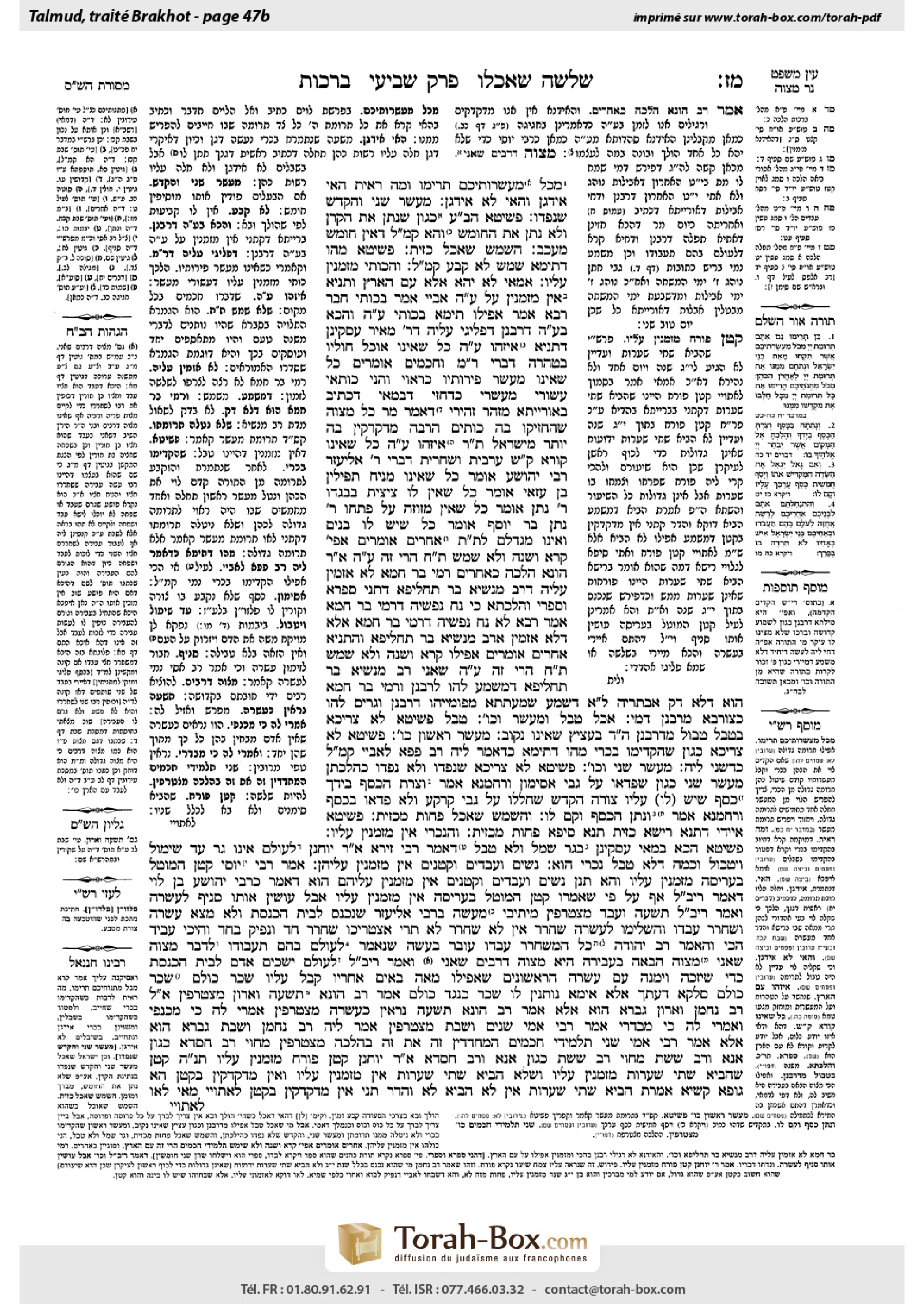
Berakhot 47b: Talmud study for Daf Yomi
Study the Talmud for Daf Yomi with scanned pages, Hebrew text, English translations from Sefaria and AI-generated French translations.
Passage selection and English or AI-generated French translation are available where the scan has annotations. Daf Study is independent of Torah-Box and Sefaria.
Browse Berakhot · ברכות · All tractatesBerakhot 47b text and translations
This page of Berakhot includes the Aramaic text, an English translation and an AI-generated French translation, alongside the scan above.
ברכות מ״ז ב · Aramaic and Hebrew text
״מִכֹּל מַעְשְׂרֹתֵיכֶם תָּרִימוּ״. וּמָה רָאִיתָ? הַאי אִידְּגַן וְהַאי לָא אִידְּגַן.
מַעֲשֵׂר שֵׁנִי וְהֶקְדֵּשׁ שֶׁנִּפְדּוּ: פְּשִׁיטָא! הָכָא בְּמַאי עָסְקִינַן — כְּגוֹן שֶׁנָּתַן אֶת הַקֶּרֶן, וְלֹא נָתַן אֶת הַחוֹמֶשׁ. וְהָא קָא מַשְׁמַע לַן דְּאֵין חוֹמֶשׁ מְעַכֵּב.
הַשַּׁמָּשׁ שֶׁאָכַל כְּזַיִת: פְּשִׁיטָא! מַהוּ דְתֵימָא: שַׁמָּשׁ לָא קָבַע — קָא מַשְׁמַע לַן.
וְהַכּוּתִי מְזַמְּנִין עָלָיו: אַמַּאי? לֹא יְהֵא אֶלָּא עַם הָאָרֶץ! וְתַנְיָא אֵין מְזַמְּנִין עַל עַם הָאָרֶץ!
אַבָּיֵי אָמַר בְּכוּתִי חָבֵר. רָבָא אָמַר: אֲפִילּוּ תֵּימָא בְּכוּתִי עַם הָאָרֶץ, וְהָכָא בְּעַם הָאָרֶץ דְּרַבָּנַן דִּפְלִיגִי עֲלֵיהּ דְּרַבִּי מֵאִיר עָסְקִינַן, דְּתַנְיָא: אֵיזֶהוּ עַם הָאָרֶץ? — כֹּל שֶׁאֵינוֹ אוֹכֵל חוּלָּיו בְּטָהֳרָה, דִּבְרֵי רַבִּי מֵאִיר. וַחֲכָמִים אוֹמְרִים: כֹּל שֶׁאֵינוֹ מְעַשֵּׂר פֵּירוֹתָיו כָּרָאוּי. וְהָנֵי כּוּתָאֵי עַשּׂוֹרֵי מְעַשְּׂרִי כְּדַחֲזֵי, דִּבְמַאי דִּכְתִיב בְּאוֹרָיְיתָא מִזְהָר זְהִירִי. דְּאָמַר מָר כׇּל מִצְוָה שֶׁהֶחֱזִיקוּ בָּהּ כּוּתִים — הַרְבֵּה מְדַקְדְּקִין בָּהּ, יוֹתֵר מִיִּשְׂרָאֵל.
תָּנוּ רַבָּנַן: אֵיזֶהוּ עַם הָאָרֶץ? — כֹּל שֶׁאֵינוֹ קוֹרֵא קְרִיאַת שְׁמַע עַרְבִית וְשַׁחֲרִית, דִּבְרֵי רַבִּי אֱלִיעֶזֶר. רַבִּי יְהוֹשֻׁעַ אוֹמֵר: כֹּל שֶׁאֵינוֹ מַנִּיחַ תְּפִילִּין. בֶּן עַזַּאי אוֹמֵר: כֹּל שֶׁאֵין לוֹ צִיצִית בְּבִגְדוֹ. רַבִּי נָתָן אוֹמֵר: כֹּל שֶׁאֵין מְזוּזָה עַל פִּתְחוֹ. רַבִּי נָתָן בַּר יוֹסֵף אוֹמֵר: כֹּל שֶׁיֵּשׁ לוֹ בָּנִים וְאֵינוֹ מְגַדְּלָם לְתַלְמוּד תּוֹרָה. אֲחֵרִים אוֹמְרִים: אֲפִילּוּ קָרָא וְשָׁנָה וְלֹא שִׁמֵּשׁ תַּלְמִידֵי חֲכָמִים הֲרֵי זֶה עַם הָאָרֶץ. אָמַר רַב הוּנָא: הֲלָכָה כַּאֲחֵרִים.
רָמֵי בַּר חָמָא לָא אַזְמֵין עֲלֵיהּ דְּרַב מְנַשְּׁיָא בַּר תַּחְלִיפָא דְּתָנֵי סִיפְרָא וְסִפְרֵי וְהִלְכְתָא. כִּי נָח נַפְשֵׁיהּ דְּרָמֵי בַּר חָמָא, אָמַר רָבָא: לָא נָח נַפְשֵׁיהּ דְּרָמֵי בַּר חָמָא אֶלָּא דְּלָא אַזְמֵין אַרַב מְנַשְּׁיָא בַּר תַּחְלִיפָא. וְהָתַנְיָא — אֲחֵרִים אוֹמְרִים אֲפִילּוּ קָרָא וְשָׁנָה וְלֹא שִׁמֵּשׁ תַּלְמִידֵי חֲכָמִים הֲרֵי זֶה עַם הָאָרֶץ? שָׁאנֵי רַב מְנַשְּׁיָא בַּר תַּחְלִיפָא דִּמְשַׁמַּע לְהוּ לְרַבָּנַן, וְרָמֵי בַּר חָמָא הוּא דְּלָא דָּק אַבָּתְרֵיהּ. לִישָּׁנָא אַחֲרִינָא: דְּשָׁמַע שְׁמַעְתָּתָא מִפּוּמַּיְיהוּ דְרַבָּנַן וְגָרֵיס לְהוּ — כְּצוֹרְבָא מֵרַבָּנָן דָּמֵי.
אָכַל טֶבֶל וּמַעֲשֵׂר וְכוּ׳: טֶבֶל פְּשִׁיטָא! לָא צְרִיכָא בְּטֶבֶל טָבוּל מִדְּרַבָּנַן. הֵיכִי דָּמֵי — בְּעָצִיץ שֶׁאֵינוֹ נָקוּב.
מַעֲשֵׂר רִאשׁוֹן כּוּ׳: פְּשִׁיטָא! לָא צְרִיכָא כְּגוֹן שֶׁהִקְדִּימוֹ בִּכְרִי. מַהוּ דְתֵימָא כְּדַאֲמַר לֵיהּ רַב פָּפָּא לְאַבָּיֵי — קָא מַשְׁמַע לַן כִּדְשַׁנִּי לֵיהּ.
מַעֲשֵׂר שֵׁנִי וְכוּ׳: פְּשִׁיטָא! לָא צְרִיכָא, שֶׁנִּפְדּוּ וְלֹא נִפְדּוּ כְּהִלְכָתָן. מַעֲשֵׂר שֵׁנִי — כְּגוֹן שֶׁפְּדָאוֹ עַל גַּבֵּי אֲסִימוֹן, וְרַחֲמָנָא אָמַר: ״וְצַרְתָּ הַכֶּסֶף בְּיָדְךָ״ — כֶּסֶף שֶׁיֵּשׁ לוֹ עָלָיו צוּרָה. הֶקְדֵּשׁ — שֶׁחִלְּלוֹ עַל גַּבֵּי קַרְקַע, וְלֹא פְּדָאוֹ בְּכֶסֶף, וְרַחֲמָנָא אָמַר: ״וְנָתַן הַכֶּסֶף וְקָם לוֹ״.
וְהַשַּׁמָּשׁ שֶׁאָכַל פָּחוֹת מִכְּזַיִת: פְּשִׁיטָא! אַיְּידִי דִּתְנָא רֵישָׁא ״כְּזַיִת״, תְּנָא סֵיפָא ״פָּחוֹת מִכְּזַיִת״.
וְהַנׇּכְרִי אֵין מְזַמְּנִין עָלָיו: פְּשִׁיטָא! הָכָא בְּמַאי עָסְקִינַן, בְּגֵר שֶׁמָּל וְלֹא טָבַל. דְּאָמַר רַבִּי זֵירָא אָמַר רַבִּי יוֹחָנָן: לְעוֹלָם אֵינוֹ גֵּר עַד שֶׁיִּמּוֹל וְיִטְבּוֹל, וְכַמָּה דְּלָא טְבַל גּוֹי הוּא.
נָשִׁים וַעֲבָדִים וּקְטַנִּים אֵין מְזַמְּנִין עֲלֵיהֶן. אָמַר רַבִּי יוֹסֵי: קָטָן הַמּוּטָּל בַּעֲרִיסָה מְזַמְּנִין עָלָיו.
וְהָא תְּנַן: נָשִׁים וַעֲבָדִים וּקְטַנִּים אֵין מְזַמְּנִין עֲלֵיהֶם!
הוּא דְּאָמַר כְּרַבִּי יְהוֹשֻׁעַ בֶּן לֵוִי. דְּאָמַר רַבִּי יְהוֹשֻׁעַ בֶּן לֵוִי: אַף עַל פִּי שֶׁאָמְרוּ קָטָן הַמּוּטָּל בַּעֲרִיסָה אֵין מְזַמְּנִין עָלָיו, אֲבָל עוֹשִׂין אוֹתוֹ סְנִיף לַעֲשָׂרָה.
וְאָמַר רַבִּי יְהוֹשֻׁעַ בֶּן לֵוִי: תִּשְׁעָה וְעֶבֶד — מִצְטָרְפִין. מֵיתִיבִי: מַעֲשֶׂה בְּרַבִּי אֱלִיעֶזֶר שֶׁנִּכְנַס לְבֵית הַכְּנֶסֶת וְלֹא מָצָא עֲשָׂרָה, וְשִׁחְרֵר עַבְדּוֹ וְהִשְׁלִימוֹ לַעֲשָׂרָה. שִׁחְרֵר — אִין, לֹא שִׁחְרֵר — לָא. תְּרֵי אִיצְטְרִיכוּ, שַׁחְרֵר חַד וְנָפֵיק בְּחַד.
וְהֵיכִי עָבֵיד הָכִי? וְהָאָמַר רַב יְהוּדָה כׇּל הַמְשַׁחְרֵר עַבְדּוֹ עוֹבֵר בַּעֲשֵׂה, שֶׁנֶּאֱמַר: ״לְעֹלָם בָּהֶם תַּעֲבֹדוּ״? לִדְבַר מִצְוָה שָׁאנֵי: מִצְוָה הַבָּאָה בַּעֲבֵרָה הִיא! — מִצְוָה דְרַבִּים שָׁאנֵי.
וְאָמַר רַבִּי יְהוֹשֻׁעַ בֶּן לֵוִי: לְעוֹלָם יַשְׁכִּים אָדָם לְבֵית הַכְּנֶסֶת כְּדֵי שֶׁיִּזְכֶּה וְיִמָּנֶה עִם עֲשָׂרָה הָרִאשׁוֹנִים, שֶׁאֲפִילּוּ מֵאָה בָּאִים אַחֲרָיו — קִבֵּל עָלָיו שְׂכַר כּוּלָּם. ״שְׂכַר כּוּלָּם״ סָלְקָא דַּעְתָּךְ?! אֶלָּא אֵימָא: נוֹתְנִין לוֹ שָׂכָר כְּנֶגֶד כּוּלָּם.
אָמַר רַב הוּנָא: תִּשְׁעָה וְאָרוֹן — מִצְטָרְפִין. אֲמַר לֵיהּ רַב נַחְמָן: וְאָרוֹן גַּבְרָא הוּא? אֶלָּא אָמַר רַב הוּנָא: תִּשְׁעָה נִרְאִין כַּעֲשָׂרָה — מִצְטָרְפִין. אָמְרִי לַהּ: כִּי מְכַנְּפִי. וְאָמְרִי לַהּ: כִּי מְבַדְּרִי.
אָמַר רַב אַמֵּי: שְׁנַיִם וְשַׁבָּת מִצְטָרְפִין. אֲמַר לֵיהּ רַב נַחְמָן: וְשַׁבָּת גַּבְרָא הוּא?! אֶלָּא אָמַר רַבִּי אַמֵּי: שְׁנֵי תַּלְמִידֵי חֲכָמִים הַמְחַדְּדִין זֶה אֶת זֶה בַּהֲלָכָה מִצְטָרְפִין. מַחְוֵי רַב חִסְדָּא: כְּגוֹן אֲנָא וְרַב שֵׁשֶׁת. מַחְוֵי רַב שֵׁשֶׁת: כְּגוֹן אֲנָא וְרַב חִסְדָּא.
אָמַר רַבִּי יוֹחָנָן: קָטָן פּוֹרֵחַ — מְזַמְּנִין עָלָיו. תַּנְיָא נָמֵי הָכִי: קָטָן שֶׁהֵבִיא שְׁתֵּי שְׂעָרוֹת — מְזַמְּנִין עָלָיו, וְשֶׁלֹּא הֵבִיא שְׁתֵּי שְׂעָרוֹת — אֵין מְזַמְּנִין עָלָיו, וְאֵין מְדַקְדְּקִין בְּקָטָן. הָא גוּפָא קַשְׁיָא, אָמְרַתְּ: הֵבִיא שְׁתֵּי שְׂעָרוֹת — אִין, לָא הֵבִיא — לָא. וַהֲדַר תָּנֵי אֵין מְדַקְדְּקִין בְּקָטָן. לְאֵתוּיֵי מַאי? לָאו
Berakhot 47b · English translation
“From all of that is given to you, you shall set apart that which is the Lord’s teruma” (Numbers 18:29). God’s teruma, teruma gedola, must be taken from all of the Levites’ gifts. The Gemara asks: And what did you see that led you to require teruma gedola from first tithe that was taken from grain in piles and not from first tithe that was taken from grain on stalks? Abaye answers: This, after it was threshed and placed into piles, is completely processed and has become grain, and that, which remained on the stalk, did not yet become grain. The verse regarding teruma gedola states: “The first of your grain” (Deuteronomy 18:4), is given to the priest. Once it is considered grain, the right of the priest takes effect and the Levite is required to separate teruma gedola.
The mishna states that if, among the diners, one ate second tithe and consecrated food that were redeemed, he may be included in a zimmun.The Gemara remarks: It is obvious that if these items were redeemed that one could participate in a zimmun. The Gemara responds: With what are we dealing here? We are dealing with a case where the consecrated property was not completely redeemed, i.e., where one gave payment for the principal, the value of the tithe, but he did not give payment for the fifth that he must add when redeeming items that he consecrated; and the mishna teaches us that failure to add the fifth does not invalidate the redemption.
We learned in the mishna: The waiter who ate at least an olive-bulk from the meal may join in a zimmun. The Gemara remarks: It is obvious. Why was it necessary for the mishna to teach this halakha? The Gemara answers: Lest you say that the waiter who stands and serves the diners did not establish himself as a participant in the meal and, therefore, cannot join the zimmun, the mishna teaches us that even the waiter is considered to have established himself as a participant in the meal.
The mishna states that a Samaritan [Kuti] may be included in a zimmun. The Gemara asks: Why? Even if you consider him a member of the Jewish people, let him be merely an am ha’aretz, one who is not scrupulous in matters of ritual purity and tithes, and it was taught in a baraita: An am ha’aretz may not be included in a zimmun.
The Gemara offers several answers: Abaye said: The mishna is referring to a Kuti who is a ḥaver, one who is scrupulous in those areas. Rava said: Even if you say that the mishna refers to a Kuti who is an am ha’aretz, and here the prohibition to include an am ha’aretz in a zimmun refers to an am ha’aretz as defined by the Rabbis who disagree with Rabbi Meir, as it was taught in a baraita: Who is an am ha’aretz? Anyone who does not eat non-sacred food in a state of ritual purity. This is the statement of Rabbi Meir. And the Rabbis say: An am ha’aretz is anyone who does not appropriately tithe his produce. And these Kutim tithe their produce appropriately, as they are scrupulous with regard to that which is written in the Torah, as the Master said: Any mitzva that the Kutim embraced and accepted upon themselves, they are even more exacting in its observance than Jews.
The Gemara cites a baraita with additional opinions with regard to the defining characteristics of an am ha’aretz: The Sages taught: Who is an am ha’aretz? One who does not recite Shema in the evening and morning. This is the statement of Rabbi Eliezer. Rabbi Yehoshua says: An am ha’aretz is one who does not don phylacteries. Ben Azzai says: An am ha’aretz is one who does not have ritual fringes on his garment. Rabbi Natan says: An am ha’aretz is one who does not have a mezuza on his doorway. Rabbi Natan bar Yosef says: An am ha’aretz is one who has children but who does not want them to study Torah, so he does not raise them to engage in Torah study. Aḥerim say: Even if one read the Bible and studied Mishna and did not serve Torah scholars to learn from them the meaning of the Torah that he studied, that is an am ha’aretz. Rav Huna said: The halakha is in accordance with the opinion of Aḥerim.
The Gemara relates: Rami bar Ḥama did not include Rav Menashya bar Taḥlifa, who studied Sifra, Sifrei, and halakhot, in a zimmun because he had merely studied and did not serve Torah scholars. When Rami bar Ḥama passed away, Rava said: Rami bar Ḥama died only because he did not include Rabbi Menashya bar Taḥlifa in a zimmun. The Gemara asks: Was it not taught in a baraita: Aḥerim say: Even if one read the Bible and studied mishna and did not serve Torah scholars, that is an am ha’aretz? Why, then, was Rami bar Ḥama punished? The Gemara answers: Rav Menashya bar Taḥlifa is different, as he served the Sages. And it was Rami bar Ḥama who was not precise in his efforts to check after him to ascertain his actions. Another version of the Gemara’s answer: Anyone who hears halakhot from the mouths of Sages and studies them is considered a Torah scholar.
The mishna states that one who ate untithed produce and first tithe etc. is not included in a zimmun. The Gemara remarks: It is obvious as one is forbidden to eat untithed produce. The Gemara responds: It was only necessary to teach this halakha with regard to a case where it is only considered untithed produce by rabbinic law, although by Torah law it was permitted. What are the circumstances? Where the produce grew in an unperforated flowerpot, as anything grown disconnected from the ground is not considered produce of the ground and is exempt by Torah law from tithing. It is only by rabbinic law that it is considered untithed.
We learned in the mishna that one who ate first tithe from which its teruma was not separated may not be included in a zimmun. The Gemara remarks: It is obvious. The Gemara responds: It was only necessary for the mishna to teach this with regard to a case where the Levite preceded the priest after the kernels of grain were placed in a pile. Lest you say as Rav Pappa said to Abaye, that in that case, too, the produce should be exempt from the obligation to separate teruma gedola, the tanna of the mishna teaches us as Abaye responded to Rav Pappa, that there is a difference between the case when the grain was on the stalks and the case when the grain was in a pile.
We also learned in the mishna that if one ate second tithe and consecrated food that had not been redeemed, he may not be included in a zimmun. The Gemara remarks: It is obvious? Why was it necessary for the mishna to teach this halakha? The Gemara responds: It was only necessary for the mishna to teach this halakha with regard to a case where they were redeemed, but not redeemed properly, i.e., second tithe that was redeemed with an unminted coin [asimon], a silver bullion that had not been engraved. And the Torah says: “And bind up [vetzarta] the money in your hand” (Deuteronomy 14:25), which the Sages interpreted as follows: Vetzarta refers to money that has a form [tzura] engraved upon it. Consecrated property; in a case where he redeemed it by exchanging it for land instead of money, and the Torah states: “He will give the money and it will be assured to him” (Leviticus 27:19).
The mishna states that a waiter who ate less than an olive-bulk may not join a zimmun. The Gemara remarks: It is obvious. Why was it necessary for the mishna to teach this halakha? The Gemara answers: Since the first clause of the mishna taught the halakha with regard to a waiter who ate an olive-bulk, the latter clause taught the halakha with regard to a waiter who ate less than an olive-bulk. Although it is obvious, in the interest of arriving at a similar formulation in the two parts of the mishna, it was included.
The mishna further states that a gentile is not included in a zimmun. The Gemara remarks: It is obvious. Why was it necessary for the mishna to teach this halakha? The Gemara answers: With what are we dealing here? We are dealing with a case of a convert who was circumcised but did not yet immerse himself in a ritual bath, as Rabbi Zeira said that Rabbi Yoḥanan said: One is never considered a proselyte until he is circumcised and immerses himself. As long as he did not immerse himself, he is a gentile.
We also learned in the mishna that women, slaves, and minors are not included in a zimmun. Rabbi Yosei said: A minor lying in a cradle is included in a zimmun.
The Gemara objects: Didn’t we learn in the mishna that women, slaves, and minors are not included in a zimmun?
The Gemara responds: Rabbi Yosei stated his opinion in accordance with the opinion of Rabbi Yehoshua ben Levi, as Rabbi Yehoshua ben Levi said: Although a minor lying in a cradle is not included in a zimmun, one may make him an adjunct to complete an assembly of ten people, enabling them to invoke God’s name in a zimmun.
On the subject of completing a zimmun, Rabbi Yehoshua ben Levi said: Nine Jews and a slave join together to form a zimmun of ten. The Gemara raises an objection: There was an incident involving Rabbi Eliezer, who entered a synagogue and did not find a quorum of ten, and he liberated his slave and he completed the quorum of ten. From this we may infer that if he freed his slave, yes, he may join the quorum of ten, but if he did not free him, no, he may not join the quorum of ten. The Gemara responds: In that case, two were required to complete the quorum; Rabbi Eliezer freed one and fulfilled his obligation with another one, who completed the quorum of ten without being freed.
With regard to this incident, the Gemara asks: How did he do that? Didn’t Rav Yehuda say: Anyone who frees his Canaanite slave violates a positive mitzva, as it is stated with regard to Canaanite slaves: “You will keep them as an inheritance for your children after you, to hold as a possession; they will serve as bondsmen for you forever” (Leviticus 25:46)? How, then, could Rabbi Eliezer have freed his slave? The Gemara answers: The case of a mitzva is different. The Gemara asks: It is a mitzva that comes through a transgression, and a mitzva fulfilled in that manner is inherently flawed. The Gemara responds: A mitzva that benefits the many is different, and one may free his slave for that purpose.
In praise of a quorum of ten, the Gemara states that Rabbi Yehoshua ben Levi said: One should always rise early to go to the synagogue in order to have the privilege and be counted among the first ten to complete the quorum, as even if one hundred people arrive after him, he receives the reward of them all, as they are all joining that initial quorum. The Gemara is perplexed: Does it enter your mind that he receives the reward of them all? Why should he take away their reward? Rather, emend the statement and say: He receives a reward equivalent to the reward of them all.
With regard to the laws of joining a quorum, Rav Huna said: Nine plus an ark in which the Torah scrolls are stored join to form a quorum of ten. Rav Naḥman said to him: Is an ark a man, that it may be counted in the quorum of ten? Rather, Rav Huna said: Nine who appear like ten may join together. There was disagreement over this: Some said this halakha as follows: Nine appear like ten when they are gathered. And some said this halakha as follows: Nine appear like ten when they are scattered, the disagreement being which formation creates the impression of a greater number of individuals.
Similarly, Rav Ami said: Two people and Shabbat join to form a zimmun. Rav Naḥman said to him: Is Shabbat a person, that it may be counted in a zimmun? Rather, Rav Ami said: Two Torah scholars who hone each other’s intellect in halakhic discourse join together and are considered three. The Gemara relates: Rav Ḥisda pointed to an example of two such Torah scholars who hone each other’s intellect: For example, me and Rav Sheshet. Similarly, Rav Sheshet pointed: For example, me and Rav Ḥisda.
With regard to a minor’s inclusion in a zimmun, Rabbi Yoḥanan said: A mature minor, i.e., one who is still a minor in terms of age, but is displaying signs of puberty, is included in a zimmun. That opinion was also taught in a baraita: A minor who grew two pubic hairs, a sign of puberty, is included in a zimmun; and one who did not grow two hairs is not included in a zimmun. And one is not exacting with regard to a minor. The Gemara comments: This baraita itself is difficult. You said that a minor who grew two hairs, yes, he is included, one who did not grow two hairs, no, he is not included, and then it taught that one is not exacting with regard to a minor. What does this last clause come to include? Is it not
Berakhot 47b · Traduction française (IA)
«De tout ce qui vous est donné, vous séparerez ce qui est du Seigneur, la terouma» (Nombres 18:29). La terouma gedola du Seigneur doit être prise de tous les dons des Lévites. La Guemara demande : Et qu'avez-vous vu qui vous a conduit à exiger la terouma gedola à partir du dîme première qui était prise des céréales en tas et non à partir de la dîme première prise des céréales sur les tiges ? Abaye répond : celle-ci, après avoir été foulée et placée en tas, est entièrement traitée et est devenue céréale, et celle-là, restant sur les tiges, n'était pas encore devenue céréale. La versette concernant la terouma gedola dit : «Le premier de vos céréales» (Deutéronome 18:4), est donné au prêtre. Une fois qu'il est considéré comme céréale, le droit du prêtre s'exerce et le Lévitique est tenu de séparer la terouma gedola.
La mitsna stipule que si, parmi les convives, l'un a mangé la dîme secondaire et les aliments consacrés qui ont été rachetés, il peut être inclus dans un zimmun. La Guemara remarque : Il est évident que si ces objets ont été rachetés, on peut participer à un zimmun. La Guemara répond : Avec quoi sommes-nous en train de parler ? Nous parlons d'un cas où la propriété consacrée n'a pas été entièrement rachetée, c'est-à-dire où l'on a payé la valeur de la dîme, mais pas la cinquième qu'il faut ajouter lors du rachat d'objets consacrés ; et la mitsna nous enseigne que l'omission de la cinquième ne rend pas le rachat invalide.
Nous avons appris dans la mitsna : Le serveur qui a mangé au moins une quantité d'olive du repas peut participer à un zimmun. La Guemara remarque : C'est évident. Pourquoi la mitsna a-t-elle eu besoin d'enseigner cette halakha ? La Guemara répond : Pour éviter que l'on dise que le serveur qui se tient et sert les convives n'a pas établi sa participation au repas et, par conséquent, ne peut pas participer au zimmun, la mitsna nous enseigne que même le serveur est considéré comme ayant établi sa participation au repas.
La mitsna indique qu'un Samaritain [Kuti] peut être inclus dans un zimmun. La Guemara demande : Pourquoi ? Même si l'on considère qu'il est membre du peuple juif, laissez-le simplement être un am ha'aretz, celui qui n'est pas rigoureux en matière de pureté rituelle et de dîmes, et il a été enseigné dans une baraïta : Un am ha'aretz ne peut pas être inclus dans un zimmun.
La Guemara propose plusieurs réponses : Abaye dit : La mitsna fait référence à un Kuti qui est un ḥaver, celui qui est rigoureux en ces domaines. Rava dit : Même si vous dites que la mitsna fait référence à un Kuti qui est un am ha'aretz, et ici l'interdiction d'inclure un am ha'aretz dans un zimmun fait référence à un am ha'aretz tel que défini par les Sages qui s'opposent à Rabbi Meir, comme il a été enseigné dans une baraïta : Qui est un am ha'aretz ? Celui qui ne mange pas de nourriture non sacrée dans un état de pureté rituelle. C'est la déclaration de Rabbi Meir. Et les Sages disent : Un am ha'aretz est celui qui ne tithéifie pas correctement ses produits. Et ces Kutim tithéifient leurs produits correctement, car ils sont rigoureux en ce qui concerne ce qui est écrit dans la Torah, comme le Maître a dit : Toute mitsva que les Kutim ont adopté et accepté, ils sont même plus exigeants dans son observance que les Juifs.
La Guemara cite une baraïta avec des opinions supplémentaires concernant les caractéristiques définissant un am ha'aretz : Les Sages ont enseigné : Qui est un am ha'aretz ? Celui qui ne récite pas le Chéma le soir et le matin. C'est la déclaration de Rabbi Eliezer. Rabbi Yéhoshua dit : Un am ha'aretz est celui qui ne porte pas les phylactères. Ben Azzai dit : Un am ha'aretz est celui qui n'a pas de franges rituelles sur sa robe. Rabbi Natan dit : Un am ha'aretz est celui qui n'a pas de mezuza sur sa porte. Rabbi Natan bar Yosef dit : Un am ha'aretz est celui qui a des enfants mais qui ne veut pas qu'ils étudient la Torah, donc il ne les éduque pas à l'étude de la Torah. D'autres disent : Même si l'on a lu la Bible et étudié la Michna et n'a pas servi des savants de la Torah pour apprendre la signification de la Torah qu'il a étudiée, c'est un am ha'aretz. Rav Huna a dit : La halakha suit l'opinion de D'autres.
La Guemara rapporte : Rami bar Ḥama n'a pas inclus Rav Menashya bar Taḥlifa, qui étudiait la Sifra, la Sifrei et les halakhot, dans un zimmun parce qu'il avait seulement étudié et n'avait pas servi les savants de la Torah. Quand Rami bar Ḥama est décédé, Rava a dit : Rami bar Ḥama est mort uniquement parce qu'il n'a pas inclus Rabbi Menashya bar Taḥlifa dans un zimmun. La Guemara demande : N'a-t-il pas été enseigné dans une baraïta : D'autres disent : Même si l'on a lu la Bible et étudié la Michna et n'a pas servi les savants de la Torah, c'est un am ha'aretz ? Pourquoi, alors, Rami bar Ḥama a-t-il été puni ? La Guemara répond : Rav Menashya bar Taḥlifa est différent, car il a servi les Sages. Et c'était Rami bar Ḥama qui n'était pas précis dans ses efforts pour le surveiller après lui pour vérifier ses actions. Une autre version de la réponse de la Guemara : Quiconque entend des halakhot des bouches des Sages et les étudie est considéré comme un savant de la Torah.
La mitsna stipule qu'une personne qui a mangé des produits non tithés et la dîme première etc. n'est pas incluse dans un zimmun. La Guemara remarque : C'est évident, car on est interdit de manger des produits non tithés. La Guemara répond : Il a fallu enseigner cette halakha uniquement dans le cas où il s'agit de produits non tithés selon la loi rabbinique, bien que selon la loi divine ils fussent permis. Quelles sont les circonstances ? Lorsque les produits ont grandi dans un pot de fleurs non percé, car tout ce qui a grandi détaché du sol n'est pas considéré comme un produit du sol et est exempt selon la loi divine de la tithéification. C'est seulement selon la loi rabbinique qu'il est considéré comme non tithé.
Nous avons appris dans la mitsna que celui qui a mangé la dîme première dont la terouma n'a pas été séparée ne peut pas être inclus dans un zimmun. La Guemara remarque : C'est évident. La Guemara répond : Il a fallu que la mitsna enseigne cela uniquement dans le cas où le Lévitique a précédé le prêtre après que les grains aient été placés en tas. Pour éviter que l'on dise comme Rav Pappa a dit à Abaye que dans ce cas également, les produits devraient être exemptés de l'obligation de séparer la terouma gedola, le tanna de la mitsna nous enseigne comme Abaye a répondu à Rav Pappa, qu'il y a une différence entre le cas où les grains étaient sur les tiges et le cas où les grains étaient en tas.
Nous avons également appris dans la Michna que si une personne a mangé la dîme secondaire et des aliments consacrés qui n'avaient pas été rachetés, il ne peut pas être inclus dans un zimmun. La Guemara fait remarquer : C'est évident ? Pourquoi la Michna avait-elle besoin d'enseigner cette halakha ? La Guemara répond : Il n'était nécessaire que la Michna enseigne cette halakha dans le cas où ils avaient été rachetés, mais pas correctement, c'est-à-dire la dîme secondaire rachetée avec une pièce non mintée [asimon], une masse d'argent non gravée. Et la Torah dit : « Et tu enfermeras [vetzarta] l'argent dans ta main » (Deutéronome 14:25), que les Sages ont interprété ainsi : Vetzarta désigne de l'argent qui a une forme [tzura] gravée dessus. La propriété consacrée ; dans le cas où il l'a rachetée en échangeant contre un terrain au lieu d'argent, et la Torah dit : « Il donnera l'argent et cela sera assuré à lui » (Lévitique 27:19).
La Michna stipule que le serviteur qui a mangé moins qu'une quantité d'olive ne peut pas participer à un zimmun. La Guemara fait remarquer : C'est évident. Pourquoi la Michna avait-elle besoin d'enseigner cette halakha ? La Guemara répond : Puisque la première partie de la Michna enseignait la halakha concernant un serviteur qui avait mangé une quantité d'olive, la seconde partie enseignait la halakha concernant un serviteur qui avait mangé moins qu'une quantité d'olive. Bien qu'il soit évident, dans l'intérêt d'arriver à une formulation similaire dans les deux parties de la Michna, cela a été inclus.
La Michna précise également que les non-Juifs ne sont pas inclus dans un zimmun. La Guemara fait remarquer : C'est évident. Pourquoi la Michna avait-elle besoin d'enseigner cette halakha ? La Guemara répond : Avec quels cas nous sommes en train de nous occuper ? Nous sommes en train de nous occuper d'un converti qui a été circoncis mais n'a pas encore été immergé dans un bain rituel, comme Rabbi Zeira a dit que Rabbi Yoḥanan avait dit : On ne considère jamais un prosélyte jusqu'à ce qu'il soit circoncis et immergé. Aussi longtemps qu'il n'a pas été immergé, il est un non-Juif.
Nous avons également appris dans la Michna que les femmes, les esclaves et les mineurs ne sont pas inclus dans un zimmun. Rabbi Yosei a dit : Un mineur allongé dans un berceau est inclus dans un zimmun.
La Guemara s'oppose : N'avons-nous pas appris dans la Michna que les femmes, les esclaves et les mineurs ne sont pas inclus dans un zimmun ?
La Guemara répond : Rabbi Yosei a exprimé son opinion conformément à l'opinion de Rabbi Yehoshua ben Levi, comme Rabbi Yehoshua ben Levi a dit : Bien que le mineur allongé dans un berceau ne soit pas inclus dans un zimmun, on peut le faire participer pour compléter un groupe de dix personnes, permettant ainsi de invoquer le nom de Dieu dans un zimmun.
Sur le sujet de la conclusion d'un zimmun, Rabbi Yehoshua ben Levi a dit : Neuf Juifs et un esclave forment un zimmun de dix. La Guemara soulève une objection : N'y a-t-il pas eu un incident concernant Rabbi Eliezer, qui est entré dans une synagogue et n'a pas trouvé un quorum de dix, et il a libéré son esclave et a ainsi complété le quorum de dix ? De cela nous pouvons déduire que si il a libéré son esclave, oui, il peut participer au quorum de dix, mais si il n'a pas libéré son esclave, non, il ne peut pas participer au quorum de dix. La Guemara répond : Dans ce cas, deux étaient nécessaires pour compléter le quorum ; Rabbi Eliezer a libéré un et a accompli son obligation avec un autre, qui a complété le quorum de dix sans être libéré.
Concernant cet incident, la Guemara pose la question : Comment a-t-il fait cela ? N'a-t-on pas dit que Rav Yehuda : Qui libère son esclave cananéen viole une mitsva positive, comme il est dit concernant les esclaves cananéens : « Vous les garderez comme une héritage pour vos enfants après vous, pour les posséder ; ils serviront comme des serviteurs pour vous toujours » (Lévitique 25:46) ? Comment alors Rabbi Eliezer a-t-il pu libérer son esclave ? La Guemara répond : Le cas d'une mitsva est différent. La Guemara pose la question : C'est une mitsva accomplie par un transgression, et une mitsva accomplie ainsi est intrinsèquement défectueuse. La Guemara répond : Une mitsva qui bénéficie à beaucoup est différente, et on peut libérer son esclave à cet effet.
En l'honneur d'un quorum de dix, la Guemara rapporte que Rabbi Yehoshua ben Levi a dit : On devrait toujours se lever tôt pour aller à la synagogue afin d'avoir le privilège et être compté parmi les premiers dix à compléter le quorum, car même si cent personnes arrivent après lui, il reçoit la récompense de toutes, car ils sont tous en train de rejoindre ce quorum initial. La Guemara est perplexe : Entre dans ton esprit que tu reçois la récompense de toutes ? Pourquoi devrais-tu enlever leur récompense ? Plutôt, corrige la déclaration et dis : Il reçoit une récompense équivalente à la récompense de toutes.
Concernant les lois de l'incorporation dans un quorum, Rav Huna a dit : Neuf personnes plus un arca dans lequel les scrolls de la Torah sont conservés forment un quorum de dix. Rav Naḥman a dit à lui : L'arc est-il un homme, qu'il puisse être compté dans le quorum de dix ? Plutôt, Rav Huna a dit : Neuf personnes qui semblent dix peuvent se joindre. Il y avait un désaccord à ce sujet : Certains ont dit cette halakha ainsi : Neuf personnes semblent dix lorsqu'elles sont réunies. Et d'autres ont dit cette halakha ainsi : Neuf personnes semblent dix lorsqu'elles sont dispersées, le désaccord étant sur la formation qui crée l'impression d'un nombre plus grand de personnes.
De même, Rav Ami a dit : Deux personnes et le Shabbat forment un zimmun. Rav Naḥman a dit à lui : Le Shabbat est-il une personne, qu'il puisse être compté dans un zimmun ? Plutôt, Rav Ami a dit : Deux savants de la Torah qui affûtent mutuellement leur intelligence dans les discussions halakhiques se joignent et sont considérés comme trois. La Guemara rapporte : Rav Ḥisda a désigné un exemple de deux tels savants de la Torah qui affûtent mutuellement leur intelligence : Par exemple, moi et Rav Sheshet. De même, Rav Sheshet a désigné : Par exemple, moi et Rav Ḥisda.
Concernant l'inclusion d'un mineur dans un zimmun, le maître Yochanan a dit : Un mineur mûr, c'est-à-dire un mineur en termes d'âge, mais qui montre des signes de puberté, est inclus dans un zimmun. Cette opinion a également été enseignée dans une baraïta : Un mineur qui a poussé deux poils pubiens, signe de puberté, est inclus dans un zimmun ; et celui qui n'a pas poussé deux poils n'est pas inclus dans un zimmun. Et l'on n'exige pas strictement envers un mineur. La Guemara commente : cette baraïta elle-même est difficile. Vous dites que le mineur qui a poussé deux poils, oui, il est inclus, celui qui n'a pas poussé deux poils, non, il n'est pas inclus, et ensuite vous avez enseigné que l'on n'exige pas strictement envers un mineur. À quoi cette dernière clause s'applique-t-elle ? N'est-ce pas pas
Traduction française générée par IA à partir de l’édition anglaise de Sefaria. Vérifie toujours un passage avec le texte source.
Text from Sefaria: William Davidson Edition - Vocalized Aramaic (CC BY NC); William Davidson Edition - English (CC BY NC).