Berakhot 48b: Talmud study for Daf Yomi
Study the Talmud for Daf Yomi with scanned pages, Hebrew text, English translations from Sefaria and AI-generated French translations.
Passage selection and English or AI-generated French translation are available where the scan has annotations. Daf Study is independent of Torah-Box and Sefaria.
Browse Berakhot · ברכות · All tractatesBerakhot 48b text and translations
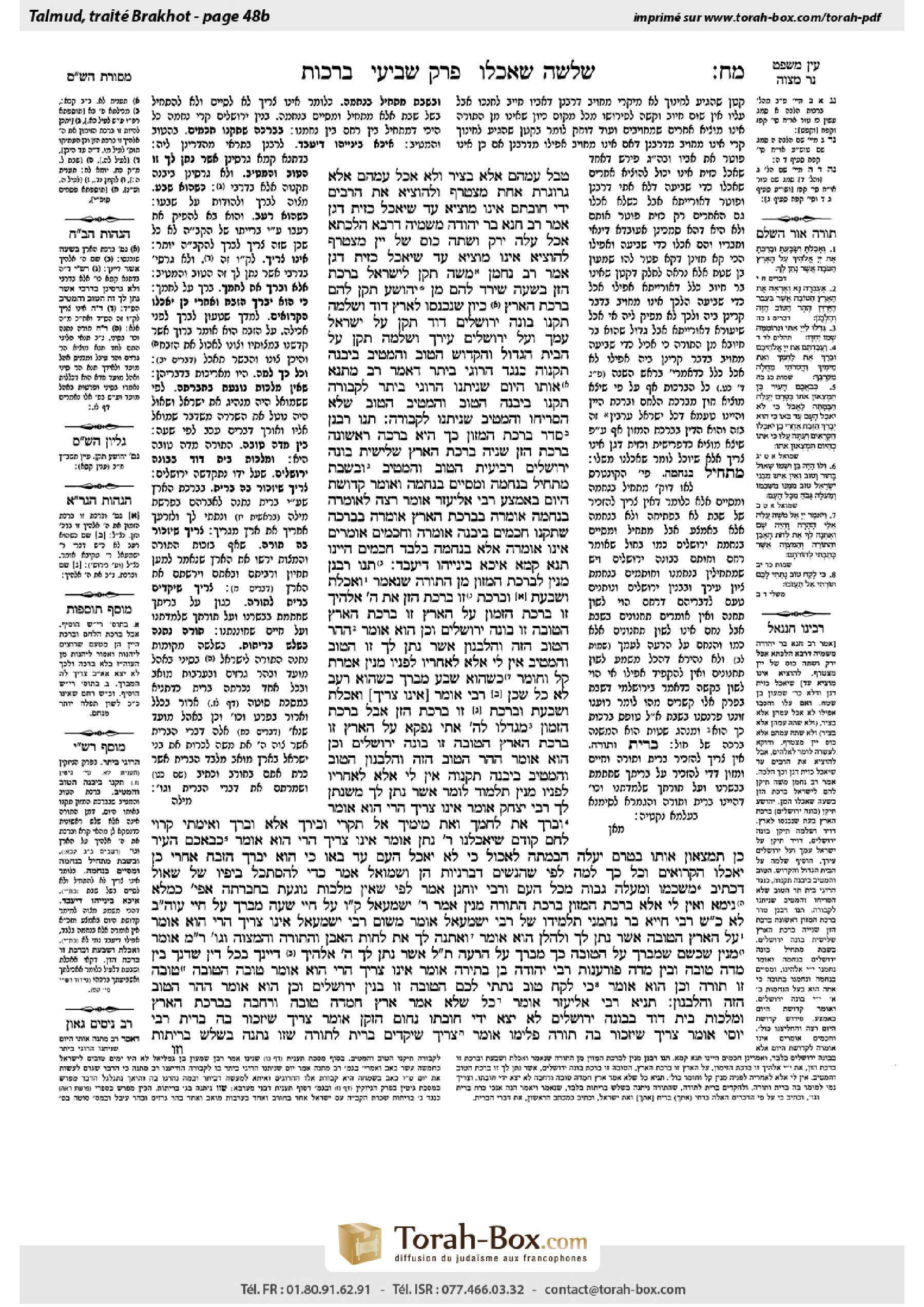
This page of Berakhot includes the Aramaic text, an English translation and an AI-generated French translation, alongside the scan above.
ברכות מ״ח ב · Aramaic and Hebrew text
טִבֵּל עִמָּהֶם אֶלָּא בְּצִיר, וְלֹא אָכַל עִמָּהֶם אֶלָּא גְּרוֹגֶרֶת אַחַת — מִצְטָרֵף. וּלְהוֹצִיא אֶת הָרַבִּים יְדֵי חוֹבָתָם — אֵינוֹ מוֹצִיא עַד שֶׁיֹּאכַל כְּזַיִת דָּגָן. אָמַר רַב חָנָא בַּר יְהוּדָה מִשְּׁמֵיהּ דְּרָבָא: הִלְכְתָא, אָכַל עֲלֵה יָרָק וְשָׁתָה כּוֹס שֶׁל יַיִן — מִצְטָרֵף. לְהוֹצִיא — אֵינוֹ מוֹצִיא עַד שֶׁיֹּאכַל כְּזַיִת דָּגָן.
אָמַר רַב נַחְמָן: מֹשֶׁה תִּקֵּן לְיִשְׂרָאֵל בִּרְכַּת ״הַזָּן״ בְּשָׁעָה שֶׁיָּרַד לָהֶם מָן. יְהוֹשֻׁעַ תִּקֵּן לָהֶם בִּרְכַּת הָאָרֶץ כֵּיוָן שֶׁנִּכְנְסוּ לָאָרֶץ. דָּוִד וּשְׁלֹמֹה תִּקְּנוּ ״בּוֹנֵה יְרוּשָׁלַיִם״. דָּוִד תִּקֵּן ״עַל יִשְׂרָאֵל עַמֶּךָ וְעַל יְרוּשָׁלַיִם עִירֶךָ״, וּשְׁלֹמֹה תִּקֵּן ״עַל הַבַּיִת הַגָּדוֹל וְהַקָּדוֹשׁ״. ״הַטּוֹב וְהַמֵּטִיב״ בְּיַבְנֶה תִּקְּנוּהָ כְּנֶגֶד הֲרוּגֵי בֵּיתָר. דְּאָמַר רַב מַתְנָא: אוֹתוֹ הַיּוֹם שֶׁנִּיתְּנוּ הֲרוּגֵי בֵּיתָר לִקְבוּרָה תִּקְנוּ בְּיַבְנֶה ״הַטּוֹב וְהַמֵּטִיב״. ״הַטּוֹב״ — שֶׁלֹּא הִסְרִיחוּ, ״וְהַמֵּטִיב״ — שֶׁנִּיתְּנוּ לִקְבוּרָה.
תָּנוּ רַבָּנַן, סֵדֶר בִּרְכַּת הַמָּזוֹן כָּךְ הִיא: בְּרָכָה רִאשׁוֹנָה — בִּרְכַּת ״הַזָּן״, שְׁנִיָּה — בִּרְכַּת הָאָרֶץ, שְׁלִישִׁית — ״בּוֹנֵה יְרוּשָׁלַיִם״, רְבִיעִית — ״הַטּוֹב וְהַמֵּטִיב״, וּבְשַׁבָּת — מַתְחִיל בְּנֶחָמָה וּמְסַיֵּים בְּנֶחָמָה, וְאוֹמֵר קְדוּשַּׁת הַיּוֹם בָּאֶמְצַע. רַבִּי אֱלִיעֶזֶר אוֹמֵר: רָצָה לְאוֹמְרָהּ בַּנֶּחָמָה — אוֹמְרָהּ, בְּבִרְכַּת הָאָרֶץ — אוֹמְרָהּ, בִּבְרָכָה שֶׁתִּקְּנוּ חֲכָמִים בְּיַבְנֶה — אוֹמְרָהּ. וַחֲכָמִים אוֹמְרִים: אֵינוֹ אוֹמְרָהּ אֶלָּא בַּנֶּחָמָה בִּלְבַד.
חֲכָמִים הַיְינוּ תַּנָּא קַמָּא? — אִיכָּא בֵּינַיְיהוּ דִּיעֲבַד.
תָּנוּ רַבָּנַן: מִנַּיִן לְבִרְכַּת הַמָּזוֹן מִן הַתּוֹרָה? — שֶׁנֶּאֱמַר: ״וְאָכַלְתָּ וְשָׂבָעְתָּ וּבֵרַכְתָּ״ — זוֹ בִּרְכַּת ״הַזָּן״, ״אֶת ה׳ אֱלֹהֶיךָ״ — זוֹ בִּרְכַּת הַזִּמּוּן, ״עַל הָאָרֶץ״ — זוֹ בִּרְכַּת הָאָרֶץ, ״הַטּוֹבָה״ — זוֹ ״בּוֹנֵה יְרוּשָׁלַיִם״, וְכֵן הוּא אוֹמֵר ״הָהָר הַטּוֹב הַזֶּה וְהַלְּבָנוֹן״. ״אֲשֶׁר נָתַן לָךְ״ — זוֹ ״הַטּוֹב וְהַמֵּטִיב״. אֵין לִי אֶלָּא לְאַחֲרָיו, לְפָנָיו מִנַּיִן? — אָמְרַתְּ קַל וָחוֹמֶר: כְּשֶׁהוּא שָׂבֵעַ מְבָרֵךְ, כְּשֶׁהוּא רָעֵב — לֹא כׇּל שֶׁכֵּן.
רַבִּי אוֹמֵר [אֵינוֹ צָרִיךְ]: ״וְאָכַלְתָּ וְשָׂבָעְתָּ וּבֵרַכְתָּ״ — זוֹ בִּרְכַּת הַזָּן, אֲבָל בִּרְכַּת הַזִּמּוּן מִ״גַּדְּלוּ לַה׳ אִתִּי״ נָפְקָא. ״עַל הָאָרֶץ״ — זוֹ בִּרְכַּת הָאָרֶץ, ״הַטּוֹבָה״ — זוֹ ״בּוֹנֵה יְרוּשָׁלַיִם״, וְכֵן הוּא אוֹמֵר ״הָהָר הַטּוֹב הַזֶּה וְהַלְּבָנוֹן״. ״הַטּוֹב וְהַמֵּטִיב״ בְּיַבְנֶה תִּקְּנוּהָ. אֵין לִי אֶלָּא לְאַחֲרָיו, לְפָנָיו מִנַּיִן? תַּלְמוּד לוֹמַר: ״אֲשֶׁר נָתַן לָךְ״ — מִשֶּׁנָּתַן לָךְ.
רַבִּי יִצְחָק אוֹמֵר: אֵינוֹ צָרִיךְ, הֲרֵי הוּא אוֹמֵר ״וּבֵרַךְ אֶת לַחְמְךָ וְאֶת מֵימֶיךָ״, אַל תִּקְרֵי ״וּבֵרַךְ״ אֶלָּא ״וּבָרֵךְ״. וְאֵימָתַי קָרוּי ״לֶחֶם״ — קוֹדֶם שֶׁיֹּאכְלֶנּוּ.
רַבִּי נָתָן אוֹמֵר: אֵינוֹ צָרִיךְ, הֲרֵי הוּא אוֹמֵר ״כְּבֹאֲכֶם הָעִיר כֵּן תִּמְצְאוּן אוֹתוֹ בְּטֶרֶם יַעֲלֶה הַבָּמָתָה לֶאֱכוֹל כִּי לֹא יֹאכַל הָעָם עַד בֹּאוֹ כִּי הוּא יְבָרֵךְ הַזֶּבַח אַחֲרֵי כֵן יֹאכְלוּ הַקְּרֻאִים״.
וְכׇל כָּךְ לָמָּה? לְפִי שֶׁהַנָּשִׁים דַּבְּרָנִיּוֹת הֵן. וּשְׁמוּאֵל אָמַר: כְּדֵי לְהִסְתַּכֵּל בְּיׇפְיוֹ שֶׁל שָׁאוּל, דִּכְתִיב: ״מִשִּׁכְמוֹ וָמַעְלָה גָּבֹהַּ מִכׇּל הָעָם״. וְרַבִּי יוֹחָנָן אָמַר: לְפִי שֶׁאֵין מַלְכוּת נוֹגַעַת בַּחֲבֶרְתָּהּ אֲפִילּוּ כִּמְלֹא נִימָא.
וְאֵין לִי אֶלָּא בִּרְכַּת הַמָּזוֹן. בִּרְכַּת הַתּוֹרָה מִנַּיִן? אָמַר רַבִּי יִשְׁמָעֵאל: קַל וָחוֹמֶר, עַל חַיֵּי שָׁעָה מְבָרֵךְ, עַל חַיֵּי עוֹלָם הַבָּא לֹא כׇּל שֶׁכֵּן. רַבִּי חִיָּיא בַּר נַחְמָנִי תַּלְמִידוֹ שֶׁל רַבִּי יִשְׁמָעֵאל אוֹמֵר מִשּׁוּם רַבִּי יִשְׁמָעֵאל: אֵינוֹ צָרִיךְ, הֲרֵי הוּא אוֹמֵר ״עַל הָאָרֶץ הַטּוֹבָה אֲשֶׁר נָתַן לָךְ״, וּלְהַלָּן הוּא אוֹמֵר: ״וְאֶתְּנָה לָךְ אֶת לֻחֹת הָאֶבֶן וְהַתּוֹרָה וְהַמִּצְוָה וְגוֹ׳״.
רַבִּי מֵאִיר אוֹמֵר: וּמִנַּיִן שֶׁכְּשֵׁם שֶׁמְּבָרֵךְ עַל הַטּוֹבָה כָּךְ מְבָרֵךְ עַל הָרָעָה? תַּלְמוּד לוֹמַר: ״אֲשֶׁר נָתַן לְךָ ה׳ אֱלֹהֶיךָ״, דַּיָּינְךָ, בְּכָל דִּין שֶׁדָּנְךָ, בֵּין מִדָּה טוֹבָה וּבֵין מִדַּת פּוּרְעָנוּת.
רַבִּי יְהוּדָה בֶּן בְּתֵירָא אוֹמֵר: אֵינוֹ צָרִיךְ, הֲרֵי הוּא אוֹמֵר ״טוֹבָה״, ״הַטּוֹבָה״. טוֹבָה — זוֹ תּוֹרָה, וְכֵן הוּא אוֹמֵר: ״כִּי לֶקַח טוֹב נָתַתִּי לָכֶם״. ״הַטּוֹבָה״ — זוֹ בִּנְיַן יְרוּשָׁלַיִם, וְכֵן הוּא אוֹמֵר ״הָהָר הַטּוֹב הַזֶּה וְהַלְּבָנוֹן״.
תַּנְיָא רַבִּי אֱלִיעֶזֶר אוֹמֵר: כׇּל שֶׁלֹּא אָמַר ״אֶרֶץ חֶמְדָּה טוֹבָה וּרְחָבָה״ בְּבִרְכַּת הָאָרֶץ, וּמַלְכוּת בֵּית דָּוִד בְּ״בוֹנֵה יְרוּשָׁלַיִם״ — לֹא יָצָא יְדֵי חוֹבָתוֹ. נַחוּם הַזָּקֵן אוֹמֵר: צָרִיךְ שֶׁיִּזְכּוֹר בָּהּ בְּרִית. רַבִּי יוֹסֵי אוֹמֵר: צָרִיךְ שֶׁיִּזְכּוֹר בָּהּ תּוֹרָה. פְּלֵימוֹ אוֹמֵר: צָרִיךְ שֶׁיַּקְדִּים בְּרִית לְתוֹרָה, שֶׁזּוֹ נִתְּנָה בְּשָׁלֹשׁ בְּרִיתוֹת,
Berakhot 48b · English translation
dipped with them a small bit of food in brine and ate with them only a single dry fig, he joins them. And to satisfy the obligation of the many, he does not satisfy their obligation until he eats an olive-bulk of grain. Rabbi Ḥana bar Yehuda said in the name of Rava that the halakha is: If one ate a vegetable leaf and drank a cup of wine, he joins the diners. However, to satisfy the obligation of others, he does not satisfy their obligation until he eats an olive-bulk of grain.
With regard to the origins of the four blessings of Grace after Meals, Rav Naḥman said:
Moses instituted for Israel the first blessing of: Who feeds all, when the manna descended for them and they needed to thank God.
Joshua instituted the blessing of the land when they entered Eretz Yisrael.
David and Solomon instituted the third blessing: Who builds Jerusalem, in the following manner:
David instituted “…on Israel Your people and on Jerusalem Your city…” as he conquered the city,
and Solomon instituted “…on the great and Holy Temple…” as he was the one who built the Temple.
They instituted the blessing: Who is good and does good, at Yavne in reference to the slain Jews of the city of Beitar at the culmination of the bar Kokheva rebellion. They were ultimately brought to burial after a period during which Hadrian refused to permit their burial. As Rav Mattana said: On the same day that the slain of Beitar were brought to burial, they instituted the blessing: Who is good and does good, at Yavne. Who is good, thanking God that the corpses did not decompose while awaiting burial, and does good, thanking God that they were ultimately brought to burial.
On the topic of the blessings of Grace after Meals, the Gemara adds that the Sages taught in a baraita that the order of Grace after Meals is as follows: The first blessing is the blessing of: Who feeds all; the second is the blessing of the land; the third is: Who builds Jerusalem; and the fourth is: Who is good and does good. On Shabbat one begins the third blessing with consolation and ends with consolation and mentions the sanctity of the day with mention of Shabbat in the middle. Rabbi Eliezer says: If one wishes to recite the supplement for the sanctity of Shabbat in the blessing of consolation: Who builds Jerusalem, he recites it there; in the blessing of the land, he recites it there; in the blessing instituted by the Sages at Yavne, Who is good and does good, he recites it there. And the Rabbis say: He may only recite the mention of the sanctity of Shabbat in the context of the blessing of consolation.
The Gemara remarks: The opinion of the Rabbis is identical with the opinion of the first tanna. Both opinions hold that the mention of Shabbat is in the third blessing. The Gemara responds: The difference between the opinion of the Rabbis and the opinion of the first tanna is with regard to after the fact. They both agree that ab initio, Shabbat should be mentioned in the third blessing. If, though, one inadvertently mentioned Shabbat in one of the other blessings mentioned by Rabbi Eliezer, the first tanna holds that he fulfilled his obligation and the Rabbis emphasize that it may only be recited in the blessing of consolation.
The Sages taught in a Tosefta: From where is it derived that Grace after Meals is from the Torah? As it is stated: “And you shall eat and be satisfied, and you shall bless the Lord, your God, for the good land that He has given you” (Deuteronomy 8:10). The Gemara explains: And you shall bless, that is the blessing of: Who feeds all. The Lord, your God, that is the zimmun blessing in which God’s name is invoked. For the land, that is the blessing of the land; good, that is the blessing: Who builds Jerusalem, and it also says: “This good mountain and Lebanon” (Deuteronomy 3:25), which is interpreted homiletically as referring to Jerusalem and the Temple. That He gave you, that is: Who is good and does good. However, I only have a Torah source for blessings after eating, i.e., Grace after Meals. From where is it derived that one is obligated to recite blessings before eating? You said that it can be derived through an a fortiori inference: When one is satisfied, he is obligated to recite a blessing and thank God for food; when he is hungry, all the more so that he should recite a blessing to offer thanks for the food he will eat.
Rabbi Yehuda HaNasi says: It is not necessary to interpret the verse this way; rather, it should be understood in a slightly different manner, as follows: “And you shall eat and be satisfied, and you shall bless,” that is the blessing of: Who feeds all; however, the zimmun blessing is derived from the verse: “Praise God with me and we will exalt His name together” (Psalms 34:3). He continues: For the land, that is the blessing of the land. Good, that is the blessing: Who builds Jerusalem, and it also says: This good mountain and Lebanon. They instituted the blessing: Who is good and does good, at Yavne and, as such, it has no biblical source. However, I only have a Torah source for blessings after eating, i.e., Grace after Meals. From where is it derived that one is obligated to recite blessings before eating? The verse states: That he gave you. A blessing must be recited over food from the moment that God gave it to you, not only afterward.
Rabbi Yitzḥak says: That source for the obligation to recite a blessing beforehand is not necessary, as it says: “And He will bless your bread and your water” (Exodus 23:25); do not read: And He will bless [uveirakh], rather: And you will bless [uvareikh]. And when is it called bread? Before it is eaten.
Rabbi Natan says: That source for the obligation to recite a blessing beforehand is not necessary, as it says when the maidens told Saul: “As soon you come into the city, find him right away, before he goes up to the high place to eat; for the people will not eat until he comes, because he will bless the sacrifice; and afterwards all those who are invited will eat; now go, for you shall find him at this time of day” (I Samuel 9:13). A blessing recited prior to eating is explicitly mentioned in that verse.
Tangentially, the Gemara asks: Why did these maidens go on so expansively while speaking to Saul? It is because women are chatterers. And Shmuel said a different reason: They spoke expansively in order to gaze upon Saul’s beauty longer, as it is written about him: “An excellent young man; no one among the Israelites was better than he; he was taller than the people from the shoulders up” (I Samuel 9:2). Rabbi Yoḥanan said that their expansiveness was initiated by God, because one sovereignty does not overlap with its counterpart, even one hairbreadth. Saul’s coronation was delayed so that Samuel’s leadership would not be curtailed.
The baraita with regard to Grace after Meals continues: I only have a Torah source for Grace after Meals. From where is the obligation to recite the blessing of the Torah derived? Several answers are offered: Rabbi Yishmael said: It is derived through an a fortiori inference from Grace after Meals: Over food, which is an aspect of temporal life, one recites a blessing, all the more so one recites a blessing over the Torah, which is eternal life. Rabbi Ḥiyya bar Naḥmani, the student of Rabbi Yishmael, says in the name of Rabbi Yishmael: This a fortiori inference is not necessary, as this halakha can be derived from the same verse from which Grace after Meals is derived, as it states: “For the good land that He gave [natan] you,” and below, with regard to the Torah, it says: “And I will give [ve’etna] you the stone tablets, and the Torah and the mitzva, which I have written, that you may teach them” (Exodus 24:12). Here, just as giving with regard to the good land requires a blessing, giving with regard to the Torah requires a blessing.
Concerning this verse, Rabbi Meir says: From where is it derived that just as one recites a blessing over the good that befalls him he recites a blessing over the bad? The verse states: “That the Lord, your God gave you.” “Your God” is a reference to the attribute of divine justice; your Judge, in whatever judgment that He judges you, whether it is a positive measure of goodness or a measure of calamity.
Rabbi Yehuda ben Beteira says: Proof for a blessing over the Torah from a different verse is not necessary, as it says: “For the good [hatova] land.” Two different matters are derived from different aspects of the word hatova: Tova, that is Torah, as it says: “For I have given you good [tov] teachings, do not forsake My Torah” (Proverbs 4:2); hatova, that is the building of Jerusalem, as it says: “This good mountain [hatov] and Lebanon.”
With regard to the formula of Grace after Meals, the Gemara continues: It was taught in a baraita: Rabbi Eliezer says: Anyone who did not say: A desirable, good, and spacious land in the blessing of the land, and who did not mention the royal house of David in the blessing: Who builds Jerusalem, did not fulfill his obligation. Naḥum the Elder says: One must mention the covenant of circumcision in the blessing of the land. Rabbi Yosei says: One must mention the Torah in the blessing of the land. Pelimu, one of the last tanna’im, says: He must make mention of the covenant of circumcision preceding mention of the Torah, as this, the Torah, was given to the Jewish people with three covenants,
Berakhot 48b · Traduction française (IA)
Celui qui a trempé un petit morceau de nourriture dans l'eau salée et a mangé seulement une figue sèche avec eux, entre dans leur groupe. Et pour satisfaire l'obligation des nombreux, il ne satisfait pas leur obligation jusqu'à ce qu'il ait mangé une quantité de grain égale à une olive. Rabbi Ḥana bar Yehuda a dit en nom de Rava que la halakha est : Si l'on a mangé une feuille de légume et bu un verre de vin, il entre dans le groupe des convives. Cependant, pour satisfaire l'obligation des autres, il ne satisfait leur obligation qu'après avoir mangé une quantité de grain égale à une olive.
En ce qui concerne les origines des quatre bénédictions de grâce après le repas, Rav Naḥman a dit : Moïse a institué pour Israël la première bénédiction : Celui qui nourrit tous, lorsqu'il y avait la chute du manna et qu'ils avaient besoin de remercier Dieu. Josué a institué la bénédiction de la terre lorsqu'ils entrèrent en Terre d'Israël. David et Salomon ont institué la troisième bénédiction : Celui qui reconstruit Jérusalem, de la manière suivante : David a institué « sur Israël ton peuple et sur Jérusalem ta ville » lorsqu'il conquiert la ville, et Salomon a institué « sur le grand et saint temple » lorsqu'il était celui qui avait construit le temple. Ils ont institué la bénédiction : Celui qui est bon et fait le bien, à Yavne en référence aux Juifs tués dans la ville de Béitar à la fin de la rébellion de Bar Kochba. Ils furent finalement enterrés après une période durant laquelle Hadrien refusait de permettre leur inhumation. Comme Rav Mattana a dit : Le même jour où les morts de Béitar furent enterrés, ils instituèrent la bénédiction : Celui qui est bon et fait le bien, à Yavne. Celui qui est bon, remercie Dieu que les corps n'avaient pas pourri en attendant d'être enterrés, et celui qui fait le bien, remercie Dieu qu'ils furent finalement enterrés.
Sur le sujet des bénédictions de grâce après le repas, le Guemara ajoute que les Sages ont enseigné dans une baraïta que l'ordre des bénédictions de grâce après le repas est le suivant : La première bénédiction est la bénédiction : Celui qui nourrit tous ; la deuxième est la bénédiction de la terre ; la troisième est : Celui qui reconstruit Jérusalem ; et la quatrième est : Celui qui est bon et fait le bien. Le sabbat, on commence la troisième bénédiction avec la consolation et on termine avec la consolation, et on mentionne la sainteté du jour en milieu de bénédiction. Rabbi Eliezer dit : Si l'on veut réciter la supplémentaire pour la sainteté du sabbat dans la bénédiction de la consolation : Celui qui reconstruit Jérusalem, on la récite là ; dans la bénédiction de la terre, on la récite là ; dans la bénédiction instituée par les Sages à Yavne, Celui qui est bon et fait le bien, on la récite là. Et les Rabbins disent : On peut seulement réciter la mention de la sainteté du sabbat dans le contexte de la bénédiction de la consolation.
Le Guemara remarque : L'opinion des Rabbins est identique à l'opinion du premier tanna. Les deux opinions considèrent que la mention du sabbat est dans la troisième bénédiction. Le Guemara répond : La différence entre l'opinion des Rabbins et celle du premier tanna est concernant l'après-coup. Ils s'accordent sur le fait que dès le départ, le sabbat devrait être mentionné dans la troisième bénédiction. Cependant, si l'on a mentionné accidentellement le sabbat dans l'une des autres bénédictions mentionnées par Rabbi Eliezer, le premier tanna considère que l'on a accompli son obligation et les Rabbins insistent sur le fait qu'elle ne peut être récitée que dans la bénédiction de la consolation.
Les Sages ont enseigné dans une Tosefta : D'où est tiré que la prière de grâce après le repas provient de la Torah ? Comme il est dit : « Et vous mangerez et vous serez rassasiés, et vous bénirez l'Éternel, votre Dieu, pour la bonne terre qu'Il vous a donnée » (Deutéronome 8:10). Le Guemara explique : « Et vous bénirez », c'est la bénédiction : Celui qui nourrit tous. « L'Éternel, votre Dieu », c'est la bénédiction du zimmun dans laquelle le nom de Dieu est invoqué. « Pour la terre », c'est la bénédiction de la terre ; « bon », c'est la bénédiction : Celui qui reconstruit Jérusalem, et il est dit aussi : « Ce bon mont et le Liban » (Deutéronome 3:25), ce qui est interprété de manière allégorique pour désigner Jérusalem et le Temple. « Que Il vous a donnée », c'est : Celui qui est bon et fait le bien. Cependant, je n'ai qu'une source talmudique pour les bénédictions après le repas, c'est-à-dire la prière de grâce après le repas. D'où est tiré que l'on est tenu de réciter des bénédictions avant de manger ? Vous dites que cela peut être tiré par une inférence a fortiori : Lorsqu'on est rassasié, on est tenu de réciter une bénédiction et de remercier Dieu pour la nourriture ; lorsqu'on est affamé, encore plus encore, on devrait réciter une bénédiction pour remercier Dieu de la nourriture qu'on va manger.
Rabbi Yehuda HaNasi dit : Il n'est pas nécessaire d'interpréter cette verset ainsi ; plutôt, il devrait être compris d'une manière légèrement différente, comme suit : « Et vous mangerez et vous serez rassasiés, et vous bénirez », c'est la bénédiction : Celui qui nourrit tous ; cependant, la bénédiction du zimmun est tirée de la verset : « Louez l'Éternel avec moi et nous exalterons son nom ensemble » (Psaumes 34:3). Il continue : Pour la terre, c'est la bénédiction de la terre. Bon, c'est la bénédiction : Celui qui reconstruit Jérusalem, et il est dit aussi : Ce bon mont et le Liban. Ils ont institué la bénédiction : Celui qui est bon et fait le bien, à Yavne et, ainsi, elle n'a pas de source biblique. Cependant, je n'ai qu'une source talmudique pour les bénédictions après le repas, c'est-à-dire la grâce après le repas. D'où est tiré que l'on est tenu de réciter des bénédictions avant de manger ? La verset dit : Que Il vous a donné. Une bénédiction doit être récitée sur la nourriture dès le moment où Dieu vous l'a donnée, pas seulement après.
Rabbi Yitzḥak dit : Cette source pour l'obligation de réciter une bénédiction avant est inutile, car il est dit : « Et Il bénira votre pain et votre eau » (Exode 23:25) ; ne lisez pas : Et Il bénira [uveirakh], mais : Et vous bénirez [uvareikh]. Et quand est-ce appelé pain ? Avant qu'il ne soit mangé.
Rabbi Natan dit : Cette source pour l'obligation de réciter une bénédiction avant est inutile, car il est dit lorsque les jeunes filles dirent à Saül : « Aussitôt que vous entrerez dans la ville, trouvez-le tout de suite, avant qu'il ne monte sur le haut lieu pour manger ; car le peuple ne mangera pas avant qu'il ne vienne, car il bénira le sacrifice ; et après cela, tous ceux qui sont invités mangeront ; maintenant, allez, car vous trouverez lui à cette heure » (I Rois 9:13). Une bénédiction récitée avant de manger est explicitement mentionnée dans cette verset.
Parallèlement, la Guemara pose la question : Pourquoi ces jeunes femmes parlaient-elles si longuement lorsqu'elles parlaient à Saül ? C'est parce que les femmes sont des bavards. Et Shmuel dit une autre raison : Elles parlaient longuement afin de contempler plus longtemps la beauté de Saül, comme il est écrit à son sujet : « Un jeune homme excellent, aucun Israélite ne surpassait celui-ci, il était plus grand que les autres du haut de la taille » (I Samuel 9:2). Rabbi Yoḥanan dit que leur longue conversation était initiée par Dieu, car une souveraineté ne se chevauche pas avec son homologue, même d'un cheveu. La couronne de Saül a été retardée afin que la direction de Samuel ne soit pas limitée.
La baraïta concernant la prière de béatitude après le repas continue : Je n'ai qu'une source talmudique pour la prière de béatitude après le repas. D'où dérive l'obligation de réciter la bénédiction sur la Torah ? Plusieurs réponses sont données : Rabbi Yishmael dit : Cela est déduit par une inférence a fortiori à partir de la prière de béatitude après le repas : Sur la nourriture, qui est un aspect de la vie temporelle, on récite une bénédiction, encore plus sur la Torah, qui est la vie éternelle. Rabbi Ḥiyya bar Naḥmani, l'élève de Rabbi Yishmael, dit en nom de Rabbi Yishmael : Cette inférence a fortiori n'est pas nécessaire, car cette halakha peut être déduite de la même versette à partir de laquelle la prière de béatitude après le repas est déduite, car il est écrit : « Pour le bon pays qu'Il t'a donné [natan] », et plus bas, concernant la Torah, il dit : « Et je te donnerai [ve’etna] les tables de pierre, la Torah et la mitsva, que j'ai écrites, afin que tu les enseignes » (Exode 24:12). Ici, tout comme donner concernant le bon pays exige une bénédiction, donner concernant la Torah exige une bénédiction.
Concernant cette versette, Rabbi Meir dit : D'où dérive-t-il que l'on récite une bénédiction sur le bien qui arrive à l'homme et l'on récite une bénédiction sur le mal ? La versette dit : « Que l'Éternel, ton Dieu, t'a donné. » « Ton Dieu » fait référence à l'attribut de la justice divine ; ton Juge, dans tout jugement qu'Il te juge, qu'il s'agisse d'une mesure positive de bien ou d'une mesure de calamité.
Rabbi Yehuda ben Beteira dit : La preuve d'une bénédiction sur la Torah à partir d'une autre versette n'est pas nécessaire, car il est écrit : « Pour le bon [hatova] pays. » Deux choses différentes sont déduites à partir de deux aspects du mot hatova : Tova, c'est-à-dire la Torah, comme il est dit : « Car j'ai donné à toi des enseignements bons [tov], ne délaisse pas ma Torah » (Proverbes 4:2) ; hatova, c'est-à-dire la construction de Jérusalem, comme il est dit : « Ce bon mont [hatov] et le Liban. »
Concernant la formule de la prière de béatitude après le repas, la Guemara continue : Il a été enseigné dans une baraïta : Rabbi Eliezer dit : Quiconque n'a pas dit : Un pays désirable, bon et spacieux, dans la bénédiction du pays, et qui n'a pas mentionné la maison royale de David dans la bénédiction : Qui reconstruit Jérusalem, n'a pas accompli son obligation. Naḥum le Vieux dit : On doit mentionner la circoncision dans la bénédiction du pays. Rabbi Yosei dit : On doit mentionner la Torah dans la bénédiction du pays. Pelimu, l'un des derniers tannaïm, dit : Il doit mentionner la circoncision avant la Torah, car cette Torah a été donnée au peuple juif avec trois covenants,
Traduction française générée par IA à partir de l’édition anglaise de Sefaria. Vérifie toujours un passage avec le texte source.
Text from Sefaria: William Davidson Edition - Vocalized Aramaic (CC BY NC); William Davidson Edition - English (CC BY NC).