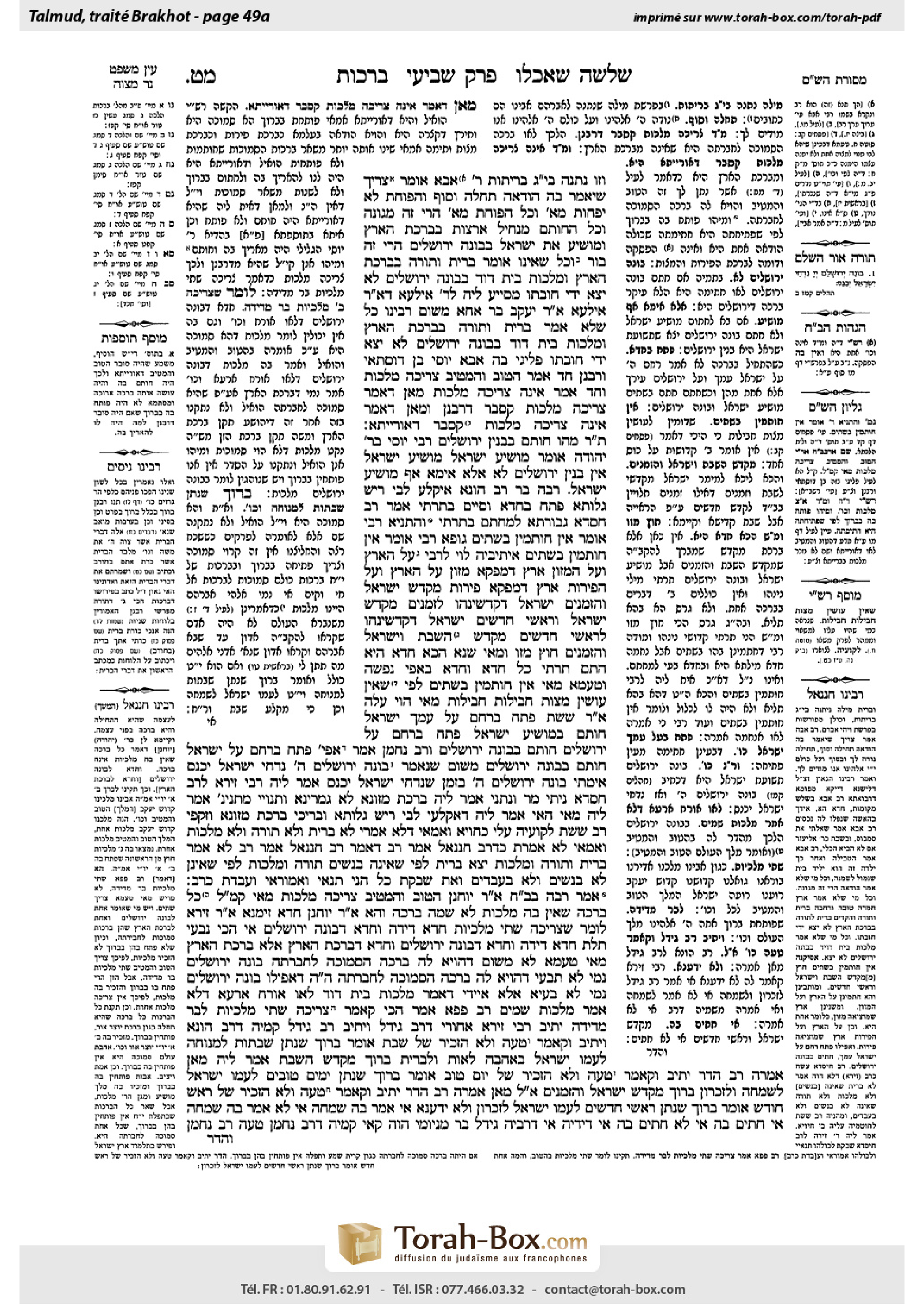
Berakhot 49a: Talmud study for Daf Yomi
Study the Talmud for Daf Yomi with scanned pages, Hebrew text, English translations from Sefaria and AI-generated French translations.
Passage selection and English or AI-generated French translation are available where the scan has annotations. Daf Study is independent of Torah-Box and Sefaria.
Browse Berakhot · ברכות · All tractatesBerakhot 49a text and translations
This page of Berakhot includes the Aramaic text, an English translation and an AI-generated French translation, alongside the scan above.
ברכות מ״ט א · Aramaic and Hebrew text
וְזוֹ נִתְּנָה בִּשְׁלֹשׁ עֶשְׂרֵה בְּרִיתוֹת.
רַבִּי אַבָּא אוֹמֵר: צָרִיךְ שֶׁיֹּאמַר בָּהּ הוֹדָאָה תְּחִלָּה וָסוֹף. וְהַפּוֹחֵת לֹא יִפְחוֹת מֵאַחַת. וְכׇל הַפּוֹחֵת מֵאַחַת — הֲרֵי זֶה מְגוּנֶּה.
וְכׇל הַחוֹתֵם ״מַנְחִיל אֲרָצוֹת״ בְּבִרְכַּת הָאָרֶץ, וּ״מוֹשִׁיעַ אֶת יִשְׂרָאֵל״ בְּ״בוֹנֵה יְרוּשָׁלָיִם״ — הֲרֵי זֶה בּוּר. וְכׇל שֶׁאֵינוֹ אוֹמֵר בְּרִית וְתוֹרָה בְּבִרְכַּת הָאָרֶץ, וּמַלְכוּת בֵּית דָּוִד בְּ״בוֹנֵה יְרוּשָׁלָיִם״ — לֹא יָצָא יְדֵי חוֹבָתוֹ.
מְסַיַּיע לֵיהּ לְרַבִּי אִילְעָא, דְּאָמַר רַבִּי אִילְעָא אָמַר רַבִּי יַעֲקֹב בַּר אַחָא מִשּׁוּם רַבֵּינוּ: כׇּל שֶׁלֹּא אָמַר בְּרִית וְתוֹרָה בְּבִרְכַּת הָאָרֶץ וּמַלְכוּת בֵּית דָּוִד בְּ״בוֹנֵה יְרוּשָׁלָיִם״ — לֹא יָצָא יְדֵי חוֹבָתוֹ.
פְּלִיגִי בַּהּ אַבָּא יוֹסֵי בֶּן דּוֹסְתַּאי וְרַבָּנַן. חַד אָמַר: ״הַטּוֹב וְהַמֵּטִיב״ צְרִיכָה מַלְכוּת, וְחַד אָמַר: אֵינָהּ צְרִיכָה מַלְכוּת. מַאן דְּאָמַר צְרִיכָה מַלְכוּת קָסָבַר דְּרַבָּנַן. וּמַאן דְּאָמַר אֵינָהּ צְרִיכָה מַלְכוּת קָסָבַר דְּאוֹרָיְיתָא.
תָּנוּ רַבָּנַן: מַהוּ חוֹתֵם בְּבִנְיַן יְרוּשָׁלַיִם, רַבִּי יוֹסֵי בְּרַבִּי יְהוּדָה אוֹמֵר: ״מוֹשִׁיעַ יִשְׂרָאֵל״. ״מוֹשִׁיעַ יִשְׂרָאֵל״ — אִין, ״בּוֹנֵה יְרוּשָׁלָיִם״ — לָא? אֶלָּא אֵימָא: אַף ״מוֹשִׁיעַ יִשְׂרָאֵל״.
רַבָּה בַּר רַב הוּנָא אִיקְּלַע לְבֵי רֵישׁ גָּלוּתָא, פְּתַח בַּחֲדָא וְסַיֵּים בְּתַרְתֵּי. אָמַר רַב חִסְדָּא: גְּבוּרְתָּא לְמֶחְתַּם בְּתַרְתֵּי! וְהָתַנְיָא רַבִּי אוֹמֵר: אֵין חוֹתְמִין בִּשְׁתַּיִם!
גּוּפָא. רַבִּי אוֹמֵר: אֵין חוֹתְמִין בִּשְׁתַּיִם. אֵיתִיבֵיהּ לֵוִי לְרַבִּי, ״עַל הָאָרֶץ וְעַל הַמָּזוֹן״! — אֶרֶץ דְּמַפְּקָא מָזוֹן. ״עַל הָאָרֶץ וְעַל הַפֵּירוֹת״! — אֶרֶץ דְּמַפְּקָא פֵּירוֹת.
״מְקַדֵּשׁ יִשְׂרָאֵל וְהַזְּמַנִּים״! — יִשְׂרָאֵל דְּקַדְּשִׁינְהוּ לִזְמַנִּים. ״מְקַדֵּשׁ יִשְׂרָאֵל וְרָאשֵׁי חֳדָשִׁים״! — יִשְׂרָאֵל דְּקַדְּשִׁינְהוּ לְרָאשֵׁי חֳדָשִׁים.
״מְקַדֵּשׁ הַשַּׁבָּת וְיִשְׂרָאֵל וְהַזְּמַנִּים״! — חוּץ מִזּוֹ.
וּמַאי שְׁנָא? הָכָא חֲדָא הִיא, הָתָם תַּרְתֵּי, כׇּל חֲדָא וַחֲדָא בְּאַפֵּי נַפְשָׁהּ.
וְטַעְמָא מַאי אֵין חוֹתְמִין בִּשְׁתַּיִם? לְפִי שֶׁאֵין עוֹשִׂין מִצְוֹת חֲבִילוֹת חֲבִילוֹת.
מַאי הָוֵי עֲלַהּ?
אָמַר רַב שֵׁשֶׁת: פָּתַח בְּ״רַחֵם עַל עַמְּךָ יִשְׂרָאֵל״ — חוֹתֵם בְּמוֹשִׁיעַ יִשְׂרָאֵל. פָּתַח בְּ״רַחֵם עַל יְרוּשָׁלָיִם״ — חוֹתֵם בְּ״בוֹנֵה יְרוּשָׁלָיִם״. וְרַב נַחְמָן אָמַר: אֲפִילּוּ פָּתַח בְּ״רַחֵם עַל יִשְׂרָאֵל״ — חוֹתֵם בְּ״בוֹנֵה יְרוּשָׁלָיִם״, מִשּׁוּם שֶׁנֶּאֱמַר ״בּוֹנֵה יְרוּשָׁלַיִם ה׳ נִדְחֵי יִשְׂרָאֵל יְכַנֵּס״: אֵימָתַי בּוֹנֵה יְרוּשָׁלַיִם ה׳ — בִּזְמַן שֶׁנִּדְחֵי יִשְׂרָאֵל יְכַנֵּס.
אֲמַר לֵיהּ רַבִּי זֵירָא לְרַב חִסְדָּא: נֵיתֵי מָר וְנִתְנֵי. אֲמַר לֵיהּ: בִּרְכַּת מְזוֹנָא לָא גְּמִירְנָא, וְתַנּוֹיֵי מַתְנֵינָא. אֲמַר לֵיהּ: מַאי הַאי? אֲמַר לֵיהּ: דְּאִקְּלַעִי לְבֵי רֵישׁ גָּלוּתָא, וּבָרֵיכִי בִּרְכַּת מְזוֹנָא, וְזַקְפֵיהּ רַב שֵׁשֶׁת לְקוֹעֵיהּ עֲלַי כְּחִוְיָא. וְאַמַּאי? דְּלָא אֲמַרִי לֹא בְּרִית וְלֹא תּוֹרָה וְלֹא מַלְכוּת. וְאַמַּאי לָא אֲמַרְתְּ? כִּדְרַב חֲנַנְאֵל אָמַר רַב, דְּאָמַר רַב חֲנַנְאֵל אָמַר רַב: לֹא אָמַר בְּרִית וְתוֹרָה וּמַלְכוּת — יָצָא. בְּרִית — לְפִי שֶׁאֵינָהּ בְּנָשִׁים. תּוֹרָה וּמַלְכוּת — לְפִי שֶׁאֵינָן לֹא בְּנָשִׁים וְלֹא בַּעֲבָדִים. וְאַתְּ שְׁבַקְתְּ כֹּל הָנֵי תַּנָּאֵי וְאָמוֹרָאֵי, וַעֲבַדְתְּ כְּרַב?!
אָמַר רַבָּה בַּר בַּר חָנָה אָמַר רַבִּי יוֹחָנָן: ״הַטּוֹב וְהַמֵּטִיב״ צְרִיכָה מַלְכוּת. מַאי קָא מַשְׁמַע לַן, כׇּל בְּרָכָה שֶׁאֵין בָּהּ מַלְכוּת — לֹא שְׁמָהּ בְּרָכָה? וְהָא אַמְרַהּ רַבִּי יוֹחָנָן חֲדָא זִימְנָא! אָמַר רַבִּי זֵירָא: לוֹמַר שֶׁצְּרִיכָה שְׁתֵּי מַלְכֻיוֹת, חֲדָא דִּידַהּ וַחֲדָא דְּ״בוֹנֵה יְרוּשָׁלָיִם״.
אִי הָכִי נִיבְעֵי תְּלָת: חֲדָא דִּידַהּ, וַחֲדָא דְּ״בוֹנֵה יְרוּשָׁלָיִם״, וַחֲדָא דְּבִרְכַּת הָאָרֶץ! אֶלָּא בִּרְכַּת הָאָרֶץ מַאי טַעְמָא לָא? מִשּׁוּם דְּהָוְיָיא לַהּ בְּרָכָה הַסְּמוּכָה לַחֲבֶרְתָּהּ, ״בּוֹנֵה יְרוּשָׁלָיִם״ נָמֵי לָא תִּבְעֵי, דְּהָוְיָא לַהּ בְּרָכָה הַסְּמוּכָה לַחֲבֶרְתָּהּ!
הוּא הַדִּין דַּאֲפִילּוּ ״בּוֹנֵה יְרוּשָׁלָיִם״ נָמֵי לָא בָּעֲיָא. אַיְּידֵי דְּאָמַר מַלְכוּת בֵּית דָּוִד, לָאו אוֹרַח אַרְעָא דְּלָא אָמַר מַלְכוּת שָׁמַיִם. רַב פָּפָּא אָמַר, הָכִי קָאָמַר: צְרִיכָה שְׁתֵּי מַלְכֻיוֹת לְבַר מִדִּידַהּ.
יָתֵיב רַבִּי זֵירָא אֲחוֹרֵי דְּרַב גִּידֵּל, וְיָתֵיב רַב גִּידֵּל קַמֵּיהּ דְּרַב הוּנָא, וְיָתֵיב וְקָאָמַר: טָעָה וְלֹא הִזְכִּיר שֶׁל שַׁבָּת, אוֹמֵר: ״בָּרוּךְ שֶׁנָּתַן שַׁבָּתוֹת לִמְנוּחָה לְעַמּוֹ יִשְׂרָאֵל בְּאַהֲבָה לְאוֹת וְלִבְרִית, בָּרוּךְ מְקַדֵּשׁ הַשַּׁבָּת״. אֲמַר לֵיהּ: מַאן אַמְרַהּ? רַב.
הֲדַר יָתֵיב וְקָאָמַר: טָעָה וְלֹא הִזְכִּיר שֶׁל יוֹם טוֹב, אוֹמֵר: ״בָּרוּךְ שֶׁנָּתַן יָמִים טוֹבִים לְעַמּוֹ יִשְׂרָאֵל לְשִׂמְחָה וּלְזִכָּרוֹן, בָּרוּךְ מְקַדֵּשׁ יִשְׂרָאֵל וְהַזְּמַנִּים״. אֲמַר לֵיהּ: מַאן אַמְרַהּ? רַב.
הֲדַר יָתֵיב וְקָאָמַר: טָעָה וְלֹא הִזְכִּיר שֶׁל רֹאשׁ חוֹדֶשׁ אוֹמֵר ״בָּרוּךְ שֶׁנָּתַן רָאשֵׁי חֳדָשִׁים לְעַמּוֹ יִשְׂרָאֵל לְזִכָּרוֹן״. וְלָא יָדַעְנָא אִי אָמַר בָּהּ ״שִׂמְחָה״ אִי לָא אָמַר בָּהּ ״שִׂמְחָה״, אִי חָתֵים בָּהּ, אִי לָא חָתֵים בָּהּ, אִי דִּידֵיהּ אִי דְּרַבֵּיהּ.
גִּידֵּל בַּר מִנְיוֹמֵי הֲוָה קָאֵי קַמֵּיהּ דְּרַב נַחְמָן, טְעָה רַב נַחְמָן
Berakhot 49a · English translation
and that, the covenant of circumcision, was given with thirteen covenants, as the word brit, covenant, appears thirteen times in the portion dealing with the circumcision of Abraham (Genesis 17:1–14).
Rabbi Abba says: One must mention thanks in the blessing of thanksgiving in Grace after Meals at the beginning and the end of the blessing. And one who decreases the number of expressions of thanksgiving may not decrease their number to fewer than one, and if anyone decreases their number to fewer than one, it is reprehensible.
The Gemara added that the conclusions of the blessing of the land and the blessing: Who builds Jerusalem, may also not be changed. Anyone who concludes the blessing of the land: Who bequeaths lands and concludes the blessing: Who builds Jerusalem, with the formula: Who redeems Israel, is an ignoramus, as he thereby corrupts the intention of the blessing. And anyone who does not mention covenant and Torah in the blessing of the land and the royal house of David in the blessing: Who builds Jerusalem, did not fulfill his obligation.
The Gemara notes: This baraita supports the opinion of Rabbi Il’a, as Rabbi Il’a said that Rabbi Ya’akov bar Aḥa said in the name of Rabbeinu, Rabbi Yehuda HaNasi: Anyone who did not mention covenant and Torah in the blessing of the land and the royal house of David in the blessing: Who builds Jerusalem, did not fulfill his obligation.
Abba Yosei ben Dostai and the Rabbis disagreed whether or not God’s sovereignty must be invoked in the blessing: Who is good and does good. One said: Who is good and does good, requires mention of God’s sovereignty, and one said: It does not require mention of God’s sovereignty. The Gemara explains: The one who said that it requires mention of God’s sovereignty holds that this blessing was instituted by the Sages, so it is not a continuation of the previous blessings. As an independent blessing, God’s sovereignty must be mentioned. The one who said that it does not require mention of God’s sovereignty holds that the obligation to recite this blessing is by Torah law. Therefore, it is a continuation of the previous blessings.
The Sages taught in a baraita: With what formula does he conclude the third blessing of Grace after Meals, which discusses the building of Jerusalem? Rabbi Yosei son of Rabbi Yehuda says: He concludes it with: Who redeems Israel. This is perplexing: Is that to say that with: Who redeems Israel, yes, he concludes the blessing; with: The building of Jerusalem, no, he does not conclude the blessing? The Gemara responds: Rather, say that Rabbi Yosei son of Rabbi Yehuda said the following: One who recites the blessing concludes either with: The building of Jerusalem, or even with: Who redeems Israel.
The Gemara recounts: Rabba bar Rav Huna happened to come to the house of the Exilarch. While reciting the blessing: Who builds Jerusalem in Grace after Meals, he opened with one theme: Have compassion on Jerusalem, and concluded with two themes: Both the building of Jerusalem and Who redeems Israel. Rav Ḥisda said derisively: It takes great fortitude to conclude with two themes. How could you conclude with two themes? Wasn’t it taught in a baraita that Rabbi Yehuda HaNasi says: One may not conclude with two themes? Each blessing has its own particular ending.
The Gemara discusses the matter itself: Rabbi Yehuda HaNasi says: One may not conclude with two themes. Levi, his student, raised an objection to the opinion of Rabbi Yehuda HaNasi based on the standard conclusions of various blessings. The second blessing of Grace after Meals concludes: For the land and for the food. Rabbi Yehuda HaNasi explained that the conclusion to that blessing is actually a single theme: The land that produces food. Levi raised a similar objection from the blessing that concludes: For the land and for the fruit. Rabbi Yehuda HaNasi explained that there, too, it means: The land that produces fruit.
Levi cited two other blessings: Who sanctifies Israel and the seasons. It means: Who sanctifies Israel, who sanctify the seasons. Who sanctifies Israel and the New Moon. It means: Who sanctifies Israel, who sanctify the New Moons.
Levi cited an additional blessing that concludes with two themes, the blessing recited when Shabbat coincides with a Festival: Who sanctifies Shabbat, Israel, and the seasons. Rabbi Yehuda HaNasi answered: Except for that one.
The Gemara asks: What is different about this blessing? The Gemara answers: Here, the blessing thanks God for one matter, the sanctity of the day. However, there, in the conclusion of the third blessing of Grace after Meals, the building of Jerusalem and redemption of Israel are two themes, and each one is distinct from the other.
The Gemara asks: And what is the reason that one does not conclude a blessing with two themes? The Gemara responds: Because there is a general principle: One does not perform mitzvot in bundles; rather, each mitzva must have its own blessing.
The Gemara has yet to arrive at a clear conclusion regarding the conclusion of the third blessing of Grace after Meals. The Gemara asks: What conclusion was reached about it?
Rav Sheshet said: If he opened with: Have compassion on Your people, Israel, mentioning redemption of Israel at the start, he concludes with: Who redeems Israel; if he opened with: Have compassion on Jerusalem, he concludes with: Who builds Jerusalem. Rav Naḥman said: Even if he opened with: Have compassion on Israel, he concludes with: Who builds Jerusalem, because it is stated: “The Lord builds Jerusalem; He gathers in the exiles of Israel” (Psalms 147:2). This verse is interpreted to mean: When does God build Jerusalem? When He gathers in the exiles of Israel. The rebuilding of Jerusalem symbolizes Israel’s redemption.
On a similar topic, the Gemara relates: Rabbi Zeira said to Rav Ḥisda: Let the Master come and teach Mishna. He responded: I have not yet learned Grace after Meals, and I will teach Mishna? He responded: What is this? Why do you say that you have not yet learned Grace after Meals? He said to him: I happened to come to the house of the Exilarch and recited Grace after Meals, and Rav Sheshet stiffened his neck over me like a snake, i.e., he got angry and challenged me. Rabbi Zeira asked: And why did Rav Sheshet become angry with you? He answered: I did not mention covenant, Torah, or sovereignty in Grace after Meals. Rabbi Zeira wondered: And why did you not mention those themes? He answered that he did so in accordance with the opinion that Rav Ḥananel said that Rav said, as Rav Ḥananel said that Rav said: If one does not mention covenant, Torah or sovereignty in Grace after Meals, he nevertheless fulfilled his obligation because these themes are not applicable to all of Israel. Covenant does not apply to women; Torah and sovereignty apply neither to women nor to slaves. Rabbi Zeira said to him: Rav Sheshet should have been angry with you. And you abandoned all of these tanna’im and amora’im who disagree with him, and followed Rav? Evidently, many tanna’im and amora’im hold that covenant, Torah, and sovereignty must be mentioned in the second blessing of Grace after Meals.
Rabba bar bar Ḥana said that Rabbi Yoḥanan said: The blessing: Who is good and does good, requires mention of God’s sovereignty. The Gemara asks: What is he teaching us that we did not already know? If you say that he is teaching us that any blessing that does not contain mention of God’s sovereignty is not considered a blessing, didn’t Rabbi Yoḥanan already say that halakha once? Rabbi Zeira said: Rabba bar bar Ḥana is saying that the blessing: Who is good and does good, requires two mentions of sovereignty, one for itself and one for the blessing: Who builds Jerusalem.
The Gemara asks: If so, that God’s sovereignty must be mentioned a second time in the blessing: Who is good and does good, to compensate for the fact that it was not mentioned in the blessing: Who builds Jerusalem, it should require three mentions; one of its own, one for the blessing: Who builds Jerusalem, and one for the blessing of the land, in which sovereignty is also not mentioned. Rather, in the blessing of the land, what is the reason that sovereignty is not mentioned? Because it is a blessing juxtaposed to another preceding blessing. Who builds Jerusalem, should also not require its own mention of God’s sovereignty, as it is a blessing juxtaposed to another preceding blessing.
The Gemara responds: The same is true even with regard to the blessing: Who builds Jerusalem, that it does not require mention of sovereignty. However, since he mentioned the royal house of David in the blessing, it would not be proper if he did not mention God’s sovereignty as well. On the other hand, Rav Pappa said: The blessing: Who is good and does good, requires two mentions of sovereignty besides its own; one to compensate for its lack of mention in the blessing: Who builds Jerusalem, and one for the blessing of the land.
The Gemara recounts: Rabbi Zeira sat behind Rav Giddel in the study hall, and Rav Giddel sat before Rav Huna, and he sat and he said: One who erred and did not mention the formula for Shabbat in Grace after Meals, says the following abridged version instead: Blessed…Who gave Shabbatot for rest to His people Israel with love, as a sign and a covenant; Blessed…Who sanctifies the Shabbat. Rav Huna said to him: Who said this halakha? He answered: Rav.
Again Rav Giddel sat and said: One who erred and did not mention the formula for Festivals in Grace after Meals, says: “Blessed…Who gave Festivals to His people Israel for joy and for commemoration; Blessed…Who sanctifies Israel and the seasons.” Rav Huna said to him: Who said this halakha? He answered: Rav.
Again Rav Giddel sat and said: If one erred and did not mention the New Moon, he says: “Blessed…Who gave the New Moon to His people Israel for commemoration. Rabbi Zeira, who related this incident, said: I do not know whether he mentioned joy in the formula or whether he did not mention joy, whether he concluded this formula with a blessing as he did in the parallel formulas for Shabbat and Festivals or if he did not conclude it with a blessing; and whether this halakha is his or whether it is his teacher Rav’s statement.
The Gemara relates: Giddel bar Manyumi was standing before Rav Naḥman, Rav Naḥman erred and did not mention the special formula for Shabbat in Grace after Meals,
Berakhot 49a · Traduction française (IA)
et ce pacte de circoncision, il fut donné avec treize pactes, car le mot « brit », pacte, apparaît treize fois dans la portion traitant de la circoncision d'Abraham (Genèse 17:1–14).
Rabbi Abba dit : On doit mentionner la gratitude dans la berakha de gratitude de la prière de grâce après le repas, au début et à la fin de la berakha. Celui qui diminue le nombre d'expressions de gratitude ne doit pas le réduire à moins d'une, et celui qui le réduit à moins d'une est blâmable.
La Guemara ajoute que les conclusions de la berakha de la terre et de la berakha : Qui construit Jérusalem ne doivent pas être changées. Celui qui conclut la berakha de la terre : Qui hérite des terres et conclut la berakha : Qui construit Jérusalem avec la formule : Qui rachète Israël est un ignorant, car il corrompt l'intention de la berakha. Et celui qui ne mentionne pas le pacte et la Torah dans la berakha de la terre et le roi David dans la berakha : Qui construit Jérusalem n'a pas rempli son obligation.
La Guemara note que ce baraïta soutient l'opinion de Rabbi Il’a, car Rabbi Il’a a dit que Rabbi Ya’akov bar Aḥa a dit au nom de Rabbeinu, Rabbi Yehuda HaNasi : Celui qui n’a pas mentionné le pacte et la Torah dans la berakha de la terre et le roi David dans la berakha : Qui construit Jérusalem n’a pas rempli son obligation.
Abba Yosei ben Dostai et les Rabbins s’opposaient sur le fait que la souveraineté de Dieu doive être invoquée dans la berakha : Qui est bon et fait le bien. L’un disait : Qui est bon et fait le bien exige la mention de la souveraineté de Dieu, et l’autre disait : Ce n’est pas nécessaire. La Guemara explique : Celui qui disait qu’il était nécessaire maintient que cette berakha fut instituée par les Sages, donc ce n’est pas une continuation des berakhot précédentes. En tant que berakha indépendante, la souveraineté de Dieu doit être mentionnée. Celui qui disait qu’il n’était pas nécessaire maintient que l’obligation de réciter cette berakha est de droit divin. Donc, c’est une continuation des berakhot précédentes.
Les Sages enseignèrent dans un baraïta : Avec quelle formule conclut-on la troisième berakha de la prière de grâce après le repas, qui traite de la construction de Jérusalem ? Rabbi Yosei fils de Rabbi Yehuda dit : Il la conclut avec : Qui rachète Israël. Cela est troublant : Est-ce dire que avec : Qui rachète Israël, oui, il conclut la berakha ; avec : La construction de Jérusalem, non, il ne conclut pas la berakha ? La Guemara répond : Plutôt, disons que Rabbi Yosei fils de Rabbi Yehuda a dit ceci : Celui qui récite la berakha conclut soit avec : La construction de Jérusalem, soit même avec : Qui rachète Israël.
La Guemara rapporte : Rabba bar Rav Huna arriva par hasard chez le prince exilé. Tandis qu'il récitait la berakha : Qui construit Jérusalem dans la prière de grâce après le repas, il commença avec un thème : Aie pitié de Jérusalem, et conclut avec deux thèmes : La construction de Jérusalem et Qui rachète Israël. Rav Ḥisda dit ironiquement : Il faut une grande force pour conclure avec deux thèmes. Comment pouvais-tu conclure avec deux thèmes ? N'était-ce pas enseigné dans un baraïta que Rabbi Yehuda HaNasi dit : On ne doit pas conclure avec deux thèmes ? Chaque berakha a sa propre conclusion.
La Guemara discute de la question elle-même : Rabbi Yehuda HaNasi dit : On ne doit pas conclure avec deux thèmes. Levi, son élève, souleva une objection contre l'opinion de Rabbi Yehuda HaNasi, en se basant sur les conclusions standard de diverses berakhot. La deuxième berakha de la prière de grâce après le repas conclut : Pour la terre et pour la nourriture. Rabbi Yehuda HaNasi expliqua que la conclusion de cette berakha est en réalité un seul thème : La terre qui produit la nourriture. Levi souleva une objection similaire à partir de la berakha qui conclut : Pour la terre et pour les fruits. Rabbi Yehuda HaNasi expliqua que là aussi, cela signifie : La terre qui produit les fruits.
Levi cita deux autres berakhot : Qui sanctifie Israël et les saisons. Cela signifie : Qui sanctifie Israël, qui sanctifie les saisons. Qui sanctifie Israël et la nouvelle lune. Cela signifie : Qui sanctifie Israël, qui sanctifie les nouvelles lunes.
Levi cita une autre berakha qui conclut avec deux thèmes, la berakha récitée lorsque le Sabbat coïncide avec un festival : Qui sanctifie le Sabbat, Israël et les saisons. Rabbi Yehuda HaNasi répondit : Sauf celui-là.
La Guemara demande : Qu'est-ce qui diffère dans cette berakha ? La Guemara répond : Ici, la berakha remercie Dieu pour une seule chose, la sainteté du jour. Cependant, là, dans la conclusion de la troisième berakha de la prière de grâce après le repas, la construction de Jérusalem et le rachat d'Israël sont deux thèmes, et chacun est distinct de l'autre.
La Guemara demande : Et quelle est la raison pour laquelle on ne conclut pas une berakha avec deux thèmes ? La Guemara répond : Parce qu'il y a un principe général : On ne fait pas des mitsvot par paquets ; plutôt, chaque mitsva doit avoir sa propre berakha.
La Guemara n'a pas encore atteint une conclusion claire concernant la conclusion de la troisième berakha de la prière de grâce après le repas. La Guemara demande : Quelle conclusion a-t-elle été atteinte à ce sujet ?
Rav Sheshet dit : S'il commence avec : Aie pitié de votre peuple, Israël, en mentionnant le rachat d'Israël au début, il conclut avec : Qui rachète Israël ; s'il commence avec : Aie pitié de Jérusalem, il conclut avec : Qui construit Jérusalem. Rav Naḥman dit : Même s'il commence avec : Aie pitié d'Israël, il conclut avec : Qui construit Jérusalem, car il est dit : « L'Éternel construit Jérusalem ; Il rassemble les exilés d'Israël » (Psaumes 147:2). Cette verset est interprété pour signifier : Quand Dieu construit Jérusalem ? Quand Il rassemble les exilés d'Israël. La reconstruction de Jérusalem symbolise le rachat d'Israël.
Sur un sujet similaire, la Guemara rapporte : Rabbi Zeira dit à Rav Ḥisda : Que le Maître vienne et enseigne la Michna. Il répondit : Je n'ai pas encore appris le Chéma après le repas, et je vais enseigner la Michna ? Il répondit : Qu'est-ce que cela signifie ? Pourquoi dis-tu que tu n'as pas encore appris le Chéma après le repas ? Il dit à lui : J'ai eu l'occasion de venir chez l'Exilarch et de réciter le Chéma après le repas, et Rav Sheshet a tourné le dos à ma manière comme un serpent, c'est-à-dire qu'il s'est fâché et m'a défiant. Rabbi Zeira demanda : Et pourquoi Rav Sheshet t'est-il donc fâché ? Il répondit : Je n'ai pas mentionné le pacte, la Torah ou la souveraineté dans le Chéma après le repas. Rabbi Zeira s'interrogea : Et pourquoi n'as-tu pas mentionné ces thèmes ? Il répondit qu'il le faisait selon l'opinion que Rav Ḥananel avait dit que Rav avait dit, comme Rav Ḥananel avait dit que Rav avait dit : Si l'on ne mentionne pas le pacte, la Torah ou la souveraineté dans le Chéma après le repas, on a tout de même accompli son obligation, car ces thèmes ne s'appliquent pas à tout Israël. Le pacte ne s'applique pas aux femmes ; la Torah et la souveraineté n'ont pas d'application aux femmes ni aux esclaves. Rabbi Zeira dit à lui : Rav Sheshet aurait dû être fâché contre toi. Et tu as abandonné tous ces tanna’im et amora’im qui s'opposent à lui, et tu as suivi Rav ? Évidemment, beaucoup de tanna’im et d'amora’im pensent que le pacte, la Torah et la souveraineté doivent être mentionnés dans la deuxième bénédiction du Chéma après le repas.
Rabba bar bar Ḥana dit que Rabbi Yoḥanan dit : La bénédiction : Qui est bon et fait le bien, exige la mention de la souveraineté de Dieu. La Guemara demande : Qu'est-ce qu'il nous enseigne là que nous ne savions pas déjà ? Si tu dis qu'il nous enseigne que toute bénédiction qui ne contient pas la mention de la souveraineté de Dieu n'est pas considérée comme une bénédiction, n'a-t-il pas déjà dit cela une fois en matière de halakha ? Rabbi Zeira dit : Rabba bar bar Ḥana dit que la bénédiction : Qui est bon et fait le bien, exige deux mentions de la souveraineté, une pour elle-même et une pour la bénédiction : Qui reconstruit Jérusalem.
La Guemara demande : Si c'est ainsi, que la souveraineté de Dieu doit être mentionnée une seconde fois dans la bénédiction : Qui est bon et fait le bien, pour compenser le fait qu'elle n'était pas mentionnée dans la bénédiction : Qui reconstruit Jérusalem, il devrait exiger trois mentions ; une pour elle-même, une pour la bénédiction : Qui reconstruit Jérusalem, et une pour la bénédiction de la terre, dans laquelle la souveraineté n'est pas non plus mentionnée. En revanche, dans la bénédiction de la terre, quelle est la raison pour laquelle la souveraineté n'est pas mentionnée ? Parce qu'il s'agit d'une bénédiction placée à côté d'une autre bénédiction précédente. Qui reconstruit Jérusalem devrait aussi ne pas exiger sa propre mention de la souveraineté de Dieu, car il s'agit d'une bénédiction placée à côté d'une autre bénédiction précédente.
La Guemara répond : C'est pareil pour la bénédiction : Qui reconstruit Jérusalem, qui ne nécessite pas non plus la mention de la souveraineté de Dieu. Cependant, puisqu'il a mentionné la maison royale de David dans la bénédiction, il ne serait pas convenable qu'il ne mentionne pas la souveraineté de Dieu également. D'un autre côté, Rav Pappa dit : La bénédiction : Qui est bon et fait le bien, exige deux mentions de la souveraineté de Dieu en plus de la sienne ; une pour compenser son absence de mention dans la bénédiction : Qui reconstruit Jérusalem, et une pour la bénédiction de la terre.
La Guemara rapporte : Rabbi Zeira était assis derrière Rav Giddel dans la salle de study, et Rav Giddel était assis devant Rav Huna, et il s'assit et dit : Celui qui s'est trompé et n'a pas mentionné la formule du Shabbat dans le Chéma après le repas, dit la version abrégée suivante à la place : Béni… Qui a donné les Shabbats pour le repos à Son peuple Israël avec de l'amour, comme un signe et un pacte ; Béni… Qui sanctifie le Shabbat. Rav Huna dit à lui : Qui a dit cette halakha ? Il répondit : Rav.
Encore Rav Giddel s'assit et dit : Celui qui s'est trompé et n'a pas mentionné la formule des Fêtes dans le Chéma après le repas, dit : « Béni… Qui a donné les Fêtes à Son peuple Israël pour la joie et la commémoration ; Béni… Qui sanctifie Israël et les saisons. » Rav Huna dit à lui : Qui a dit cette halakha ? Il répondit : Rav.
Encore Rav Giddel s'assit et dit : Si l'on s'est trompé et n'a pas mentionné la nouvelle lune, il dit : « Béni… Qui a donné la nouvelle lune à Son peuple Israël pour la commémoration. » Rabbi Zeira, qui rapporta cet incident, dit : Je ne sais pas s'il a mentionné la joie dans la formule ou s'il ne l'a pas mentionné, s'il a conclu cette formule avec une bénédiction comme il le faisait dans les formules parallèles pour le Shabbat et les Fêtes ou s'il ne l'a pas conclu avec une bénédiction ; et si cette halakha est la sienne ou si c'est la parole de son maître Rav.
La Guemara rapporte : Giddel bar Manyumi était devant Rav Naḥman, Rav Naḥman s'était trompé et n'avait pas mentionné la formule spéciale du Shabbat dans le Chéma après le repas,
Traduction française générée par IA à partir de l’édition anglaise de Sefaria. Vérifie toujours un passage avec le texte source.
Text from Sefaria: William Davidson Edition - Vocalized Aramaic (CC BY NC); William Davidson Edition - English (CC BY NC).