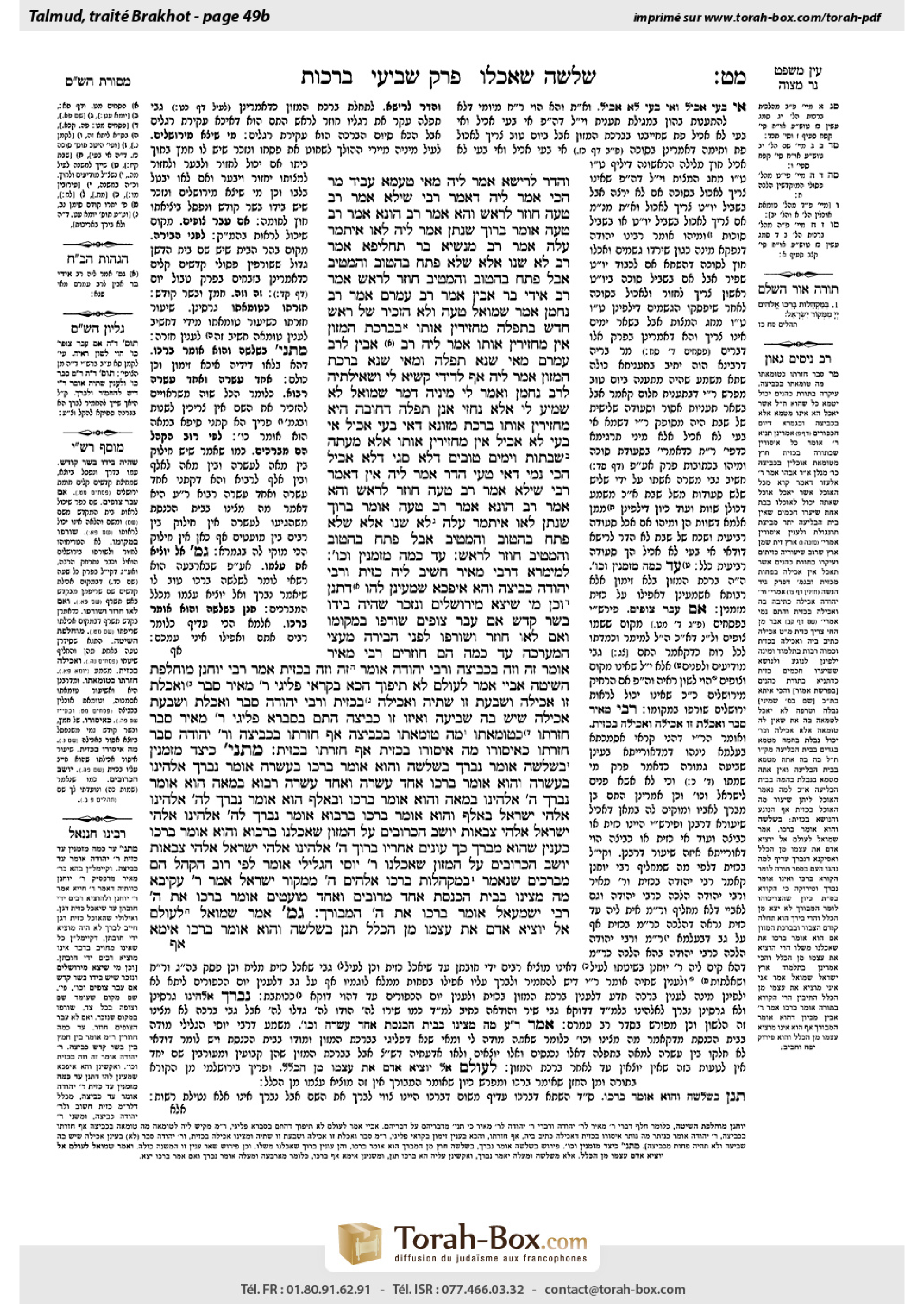
Berakhot 49b: Talmud study for Daf Yomi
Study the Talmud for Daf Yomi with scanned pages, Hebrew text, English translations from Sefaria and AI-generated French translations.
Passage selection and English or AI-generated French translation are available where the scan has annotations. Daf Study is independent of Torah-Box and Sefaria.
Browse Berakhot · ברכות · All tractatesBerakhot 49b text and translations
This page of Berakhot includes the Aramaic text, an English translation and an AI-generated French translation, alongside the scan above.
ברכות מ״ט ב · Aramaic and Hebrew text
וַהֲדַר לְרֵישָׁא. אֲמַר לֵיהּ: מַאי טַעְמָא עָבֵיד מָר הָכִי? אֲמַר לֵיהּ, דְּאָמַר רַבִּי שֵׁילָא אָמַר רַב: טָעָה — חוֹזֵר לָרֹאשׁ.
וְהָא אָמַר רַב הוּנָא אָמַר רַב: טָעָה — אוֹמֵר ״בָּרוּךְ שֶׁנָּתַן״! אֲמַר לֵיהּ: לָאו אִיתְּמַר עֲלַהּ, אָמַר רַב מְנַשְּׁיָא בַּר תַּחְלִיפָא אָמַר רַב: לֹא שָׁנוּ אֶלָּא שֶׁלֹּא פָּתַח בְּ״הַטּוֹב וְהַמֵּטִיב״, אֲבָל פָּתַח בְּ״הַטּוֹב וְהַמֵּטִיב״ — חוֹזֵר לָרֹאשׁ.
אָמַר רַב אִידִי בַּר אָבִין אָמַר רַב עַמְרָם אָמַר רַב נַחְמָן אָמַר שְׁמוּאֵל: טָעָה וְלֹא הִזְכִּיר שֶׁל רֹאשׁ חֹדֶשׁ בַּתְּפִלָּה — מַחֲזִירִין אוֹתוֹ. בְּבִרְכַּת הַמָּזוֹן — אֵין מַחֲזִירִין אוֹתוֹ.
אֲמַר לֵיהּ רַב אָבִין לְרַב עַמְרָם: מַאי שְׁנָא תְּפִלָּה וּמַאי שְׁנָא בִּרְכַּת הַמָּזוֹן? אֲמַר לֵיהּ: אַף לְדִידִי קַשְׁיָא לִי וּשְׁאֵילְתֵּיהּ לְרַב נַחְמָן, וַאֲמַר לִי: מִינֵּיהּ דְּמָר שְׁמוּאֵל לָא שְׁמִיעַ לִי, אֶלָּא נֶחְזֵי אֲנַן: תְּפִלָּה דְּחוֹבָה הִיא — מַחֲזִירִין אוֹתוֹ. בִּרְכַּת מְזוֹנָא, דְּאִי בָּעֵי אָכֵיל אִי בָּעֵי לָא אָכֵיל — אֵין מַחֲזִירִין אוֹתוֹ.
אֶלָּא מֵעַתָּה שַׁבָּתוֹת וְיָמִים טוֹבִים, דְּלָא סַגִּי דְּלָא אָכֵיל — הָכִי נָמֵי דְּאִי טָעֵי הָדַר? — אֲמַר לֵיהּ: אִין, דְּאָמַר רַבִּי שֵׁילָא אָמַר רַב: טָעָה — חוֹזֵר לָרֹאשׁ. וְהָא אָמַר רַב הוּנָא אָמַר רַב: טָעָה — אוֹמֵר ״בָּרוּךְ שֶׁנָּתַן״! — לָאו אִיתְּמַר עֲלַהּ: לֹא שָׁנוּ אֶלָּא שֶׁלֹּא פָּתַח בְּ״הַטּוֹב וְהַמֵּטִיב״, אֲבָל פָּתַח בְּ״הַטּוֹב וְהַמֵּטִיב״ — חוֹזֵר לָרֹאשׁ.
עַד כַּמָּה מְזַמְּנִין וְכוּ׳.
לְמֵימְרָא דְּרַבִּי מֵאִיר חָשֵׁיב לֵיהּ כְּזַיִת, וְרַבִּי יְהוּדָה כְּבֵיצָה? וְהָא אִיפְּכָא שָׁמְעִינַן לְהוּ, דִּתְנַן: וְכֵן מִי שֶׁיָּצָא מִיְּרוּשָׁלַיִם וְנִזְכַּר שֶׁהָיָה בְּיָדוֹ בְּשַׂר קֹדֶשׁ, אִם עָבַר צוֹפִים — שׂוֹרְפוֹ בִּמְקוֹמוֹ, וְאִם לָאו — חוֹזֵר וְשׂוֹרְפוֹ לִפְנֵי הַבִּירָה מֵעֲצֵי הַמַּעֲרָכָה.
עַד כַּמָּה הֵם חוֹזְרִים? רַבִּי מֵאִיר אוֹמֵר: זֶה וְזֶה בִּכְבֵיצָה. וְרַבִּי יְהוּדָה אוֹמֵר: זֶה וְזֶה בִּכְזַיִת.
אָמַר רַבִּי יוֹחָנָן: מוּחְלֶפֶת הַשִּׁיטָה. אַבָּיֵי אָמַר: לְעוֹלָם לָא תֵּיפוֹךְ. הָכָא בִּקְרָאֵי פְּלִיגִי, רַבִּי מֵאִיר סָבַר: ״וְאָכַלְתָּ״ — זוֹ אֲכִילָה, ״וְשָׂבָעְתָּ״ — זוֹ שְׁתִיָּה, וַאֲכִילָה בִּכְזַיִת. וְרַבִּי יְהוּדָה סָבַר: ״וְאָכַלְתָּ וְשָׂבָעְתָּ״ — אֲכִילָה שֶׁיֵּשׁ בָּהּ שְׂבִיעָה, וְאֵיזוֹ זוֹ — כְּבֵיצָה.
הָתָם בִּסְבָרָא פְּלִיגִי, רַבִּי מֵאִיר סָבַר: חֲזָרָתוֹ כְּטוּמְאָתוֹ, מָה טוּמְאָתוֹ בִּכְבֵיצָה — אַף חֲזָרָתוֹ בִּכְבֵיצָה. וְרַבִּי יְהוּדָה סָבַר: חֲזָרָתוֹ כְּאִיסּוּרוֹ, מָה אִיסּוּרוֹ בִּכְזַיִת — אַף חֲזָרָתוֹ בִּכְזַיִת.
מַתְנִי׳ כֵּיצַד מְזַמְּנִין? בִּשְׁלֹשָׁה — אוֹמֵר: ״נְבָרֵךְ״, בִּשְׁלֹשָׁה וָהוּא — אוֹמֵר: ״בָּרְכוּ״.
בַּעֲשָׂרָה — אוֹמֵר ״נְבָרֵךְ אֱלֹהֵינוּ״, בַּעֲשָׂרָה וָהוּא — אוֹמֵר ״בָּרְכוּ״. אֶחָד עֲשָׂרָה וְאֶחָד עֲשָׂרָה רִבּוֹא.
בְּמֵאָה — הוּא אוֹמֵר ״נְבָרֵךְ ה׳ אֱלֹהֵינוּ״, בְּמֵאָה וָהוּא — אוֹמֵר ״בָּרְכוּ״. וּבְאֶלֶף — הוּא אוֹמֵר ״נְבָרֵךְ לַה׳ אֱלֹהֵינוּ אֱלֹהֵי יִשְׂרָאֵל״, בְּאֶלֶף וָהוּא — אוֹמֵר ״בָּרְכוּ״. בְּרִבּוֹא — אוֹמֵר ״נְבָרֵךְ לַה׳ אֱלֹהֵינוּ אֱלֹהֵי יִשְׂרָאֵל אֱלֹהֵי צְבָאוֹת יוֹשֵׁב הַכְּרוּבִים עַל הַמָּזוֹן שֶׁאָכַלְנוּ״, בְּרִבּוֹא וָהוּא — אוֹמֵר ״בָּרְכוּ״.
כָּעִנְיָן שֶׁהוּא מְבָרֵךְ, כָּךְ עוֹנִים אַחֲרָיו ״בָּרוּךְ ה׳ אֱלֹהֵינוּ אֱלֹהֵי יִשְׂרָאֵל אֱלֹהֵי צְבָאוֹת יוֹשֵׁב הַכְּרוּבִים עַל הַמָּזוֹן שֶׁאָכַלְנוּ״.
רַבִּי יוֹסֵי הַגְּלִילִי אוֹמֵר: לְפִי רוֹב הַקָּהָל הֵם מְבָרְכִים, שֶׁנֶּאֱמַר ״בְּמַקְהֵלוֹת בָּרְכוּ אֱלֹהִים ה׳ מִמְּקוֹר יִשְׂרָאֵל״. אָמַר רַבִּי עֲקִיבָא: מַה מָּצִינוּ בְּבֵית הַכְּנֶסֶת, אֶחָד מְרוּבִּים וְאֶחָד מוּעָטִים אוֹמֵר ״בָּרְכוּ אֶת ה׳״. רַבִּי יִשְׁמָעֵאל אוֹמֵר: ״בָּרְכוּ אֶת ה׳ הַמְבוֹרָךְ״.
גְּמָ׳ אָמַר שְׁמוּאֵל: לְעוֹלָם אַל יוֹצִיא אָדָם אֶת עַצְמוֹ מִן הַכְּלָל.
תְּנַן: בִּשְׁלֹשָׁה וָהוּא — אוֹמֵר ״בָּרְכוּ״!
אֵימָא:
Berakhot 49b · English translation
and he returned to the beginning of Grace after Meals and repeated it. Giddel bar Manyumi said to Rav Naḥman: Why did the master act in that manner? He said: As Rabbi Sheila said that Rav said: If one erred, he returns to the beginning.
Giddel bar Manyumi challenged: Didn’t Rav Huna say that Rav said: If one erred, he recites: Blessed…Who gave? Rav Naḥman said to him: Wasn’t it stated about this that Rabbi Menashya bar Taḥlifa said that Rav said: They only taught that one recites the short blessing in a case where he did not yet begin reciting: Who is good and does good; however, if he already began reciting: Who is good and does good, he must return to the beginning of Grace after Meals?
Rav Idi bar Avin said that Rav Amram said that Rav Naḥman said that Shmuel said: If one erred and did not mention the formula for the New Moon in his Amida prayer, we require him to return to the beginning of the prayer and repeat it. However, if one erred and forgot to mention the New Moon in Grace after Meals, we do not require him to return to the beginning and repeat it.
Rav Avin said to Rav Amram about this: What is the difference between the Amida prayer and Grace after Meals? He said to him: That question was also difficult for me and I asked Rav Naḥman about it, and he said to me: I did not hear the reason from Mar Shmuel himself, but let us see if we can analyze it ourselves. For the Amida prayer, which is an obligation, we require him to return to the beginning of the prayer and repeat it. For Grace after Meals, which is not an obligation, as if he wants to eat, he eats and if he wants not to eat, he does not eat, we do not require him to return to the beginning and repeat it. Grace after Meals is not a full-fledged obligation; it is dependent upon eating, which is optional. Consequently, failure to mention the New Moon in Grace after Meals is not a source of concern.
The Gemara asks: If so, on Shabbatot and Festivals, when there is a mitzva to eat and when it is not possible to refrain from eating, there too, if he erred and failed to mention them in Grace after Meals, would you say that he must return to the beginning and repeat it? He said: Yes. As Rabbi Sheila said that Rav said: If one erred, he returns to the beginning of Grace after Meals. The Gemara asks: Didn’t Rav Huna say that Rav said: If one erred, he recites: Blessed…Who gave? The Gemara rejects this: Wasn’t it stated about this: They only taught that one recites the short blessing in a case where he did not yet begin reciting: Who is good and does good; however, if he already began reciting: Who is good and does good, he must return to the beginning of Grace after Meals.
There is a dispute in the mishna: How much must one eat to obligate those with whom they ate in a zimmun? An olive-bulk; Rabbi Yehuda says: An egg-bulk.
The Gemara asks: Is that to say that Rabbi Meir considers an olive-bulk significant and Rabbi Yehuda considers an egg-bulk significant? Didn’t we hear them say the opposite elsewhere? As we learned in a mishna: And similarly, one who left Jerusalem and remembered that there was consecrated meat in his hand, which may not be removed from Jerusalem, if he passed Mount Scopus, or anywhere that is a comparable distance from the Temple Mount, he burns the sanctified meat at the site where he is located; and if he has not yet traveled that distance, he must return to burn it before the Temple with the wood of the arrangement that was designated for burning consecrated items that were disqualified.
The mishna continues: How much meat must be in their possession in order to obligate them to return? Rabbi Meir says: One must return for an egg-bulk of this, sanctified meat, and that, leaven mentioned there previously. And Rabbi Yehuda says: One must return for an olive-bulk of this and that. Their opinions there seem to contradict their opinions in our mishna.
To resolve this contradiction, Rabbi Yoḥanan said: The opinions are reversed in one of these sources and must be emended. Abaye said: Actually do not reverse them. Here, with regard to zimmun, they disagree with regard to the interpretation of verses. Rabbi Meir holds: “And you shall eat,” that is eating; “and be satisfied,” that is drinking after eating. The halakha is in accordance with the standard halakhic principle that eating is defined as the consumption of an olive-bulk. And Rabbi Yehuda holds: “And you shall eat and be satisfied,” refers to eating that includes satisfaction. And what is considered eating with satisfaction? The consumption of an egg-bulk.
On the other hand, there, in the case of leaven and sanctified foods, they disagree not with regard to the interpretation of verses, but with regard to logical reasoning. Rabbi Meir holds: The requirement to return consecrated food is analogous to its ritual impurity, and just as its susceptibility to ritual impurity is only when it is the size of an egg-bulk, so too, the requirement to return it is only when it is the size of an egg-bulk. And Rabbi Yehuda holds: The requirement to return consecrated food is analogous to its prohibition, and just as its prohibition is only when it is the size of an olive-bulk, so too, the requirement to return it is only when it is the size of an olive-bulk.
MISHNA: The mishna delineates distinctions in the halakhot of the zimmun blessing, based on the number of people present. How does one recite the zimmun? In a group of three people, the one reciting the zimmun says: Let us bless the One from Whose food we have eaten. In a group of three people and him, the one reciting the zimmun says: Bless the One from Whose food we have eaten, as even without him there are enough people to recite the zimmun.
With the increase in the number of participants, the blessing is more complex. In a group of ten people, the one reciting the zimmun says: Let us bless our God. In a group of ten people and him, the one reciting the zimmun says: Bless our God. This formula is recited both in a group of ten and in a group of one hundred thousand.
In a group of one hundred people, the one reciting the zimmun says: Let us bless the Lord our God. In a group of one hundred people and him, the one reciting the zimmun says: Bless the Lord our God. In a group of one thousand people, the one reciting the zimmun says: Let us bless the Lord our God, the God of Israel. In a group of one thousand people and him, he says: Bless the Lord our God, the God of Israel. In a group of ten thousand people, the one reciting the zimmun says: Let us bless the Lord our God, the God of Israel, the God of Hosts, Who sits upon the cherubs, for the food that we have eaten. In a group of ten thousand people and him, the one reciting the zimmun says: Bless the Lord our God, the God of Israel, the God of Hosts, Who sits upon the cherubs, for the food that we have eaten.
The principle is that just as he recites the blessing, so too those present recite in response: Blessed be the Lord our God, the God of Israel, the God of Hosts, Who sits upon the cherubs, for the food that we have eaten.
On a similar note, Rabbi Yosei HaGelili says: According to the size of the crowd, they recite the blessing, as it is stated: “Bless you God in full assemblies, even the Lord, you who are from the fountain of Israel” (Psalms 68:27). Rabbi Akiva said that there are no distinctions based on the size of the crowd: What do we find in the synagogue? Both when there are many and when there are few, as long as there is a quorum of ten, the prayer leader says: Bless [barekhu] the Lord. Rabbi Yishmael said that in the synagogue, one recites: Bless the Lord the blessed One.
GEMARA: Shmuel said: One should never exclude himself from the collective.
The Gemara raises a challenge from what we learned in our mishna: In a group of three people and him, the one reciting the zimmun says: Bless the One from Whose food we have eaten. He thereby excludes himself from the collective.
The Gemara answers: Say that the meaning of the mishna is:
Berakhot 49b · Traduction française (IA)
et il revint au début de la Bérit des Bénédictions et le répéta. Gidél bar Manyumi dit à Rava Naḥman : Pourquoi le maître a-t-il agi ainsi ? Il dit : Selon ce que Rabbi Shéila a dit que Rava a dit : Si l'on s'est trompé, on revient au début.
Gidél bar Manyumi contesta : N'a-t-il pas dit Rava Huna que Rava a dit : Si l'on s'est trompé, on récite : Béni... Qui a donné ? Rava Naḥman dit à lui : N'a-t-il pas été dit à ce sujet que Rabbi Menashya bar Taḥlifa a dit que Rava a dit : Ils n'ont enseigné que l'on récite la prière courte dans le cas où l'on n'a pas encore commencé à réciter : Qui est bon et fait le bien ; cependant, si l'on a déjà commencé à réciter : Qui est bon et fait le bien, il faut revenir au début de la Bérit des Bénédictions.
Rava Idi bar Avin dit que Rava Amram a dit que Rava Naḥman a dit que Shmuel a dit : Si l'on s'est trompé et n'a pas mentionné la formule de la Nouvelle Lune dans sa prière Amida, on exige qu'il revienne au début de la prière et la répète. Cependant, si l'on s'est trompé et a oublié de mentionner la Nouvelle Lune dans la Bérit des Bénédictions, on ne requiert pas qu'il revienne au début et la répète.
Rav Avin dit à Rav Amram à ce sujet : Quelle est la différence entre la prière Amida et la Bérit des Bénédictions ? Il dit à lui : Cette question m'a également posé difficulté et j'ai demandé à Rav Naḥman à ce sujet, et il m'a dit : Je n'ai pas entendu la raison directement de Mar Shmuel lui-même, mais voyons si nous pouvons l'analyser nous-mêmes. Pour la prière Amida, qui est une obligation, on exige qu'il revienne au début de la prière et la répète. Pour la Bérit des Bénédictions, qui n'est pas une obligation, comme s'il veut manger, il mange et s'il ne veut pas manger, il ne mange pas, on ne requiert pas qu'il revienne au début et la répète. La Bérit des Bénédictions n'est pas une obligation pleine et entière ; elle dépend de la nourriture, qui est optionnelle. Ainsi, l'oubli de mentionner la Nouvelle Lune dans la Bérit des Bénédictions n'est pas une source de préoccupation.
Le Guemara pose la question : Si c'est ainsi, lors des Shabbats et des Fêtes, lorsqu'il y a une mitsva de manger et lorsqu'il n'est pas possible de se dispenser de manger, là aussi, si l'on s'est trompé et a oublié de mentionner cela dans la Bérit des Bénédictions, diriez-vous qu'il faut revenir au début et le répéter ? Il dit : Oui. Comme Rabbi Shéila a dit que Rava a dit : Si l'on s'est trompé, on revient au début de la Bérit des Bénédictions. Le Guemara pose la question : N'a-t-il pas dit Rava Huna que Rava a dit : Si l'on s'est trompé, on récite : Béni... Qui a donné ? Le Guemara rejette cela : N'a-t-il pas été dit à ce sujet : Ils n'ont enseigné que l'on récite la prière courte dans le cas où l'on n'a pas encore commencé à réciter : Qui est bon et fait le bien ; cependant, si l'on a déjà commencé à réciter : Qui est bon et fait le bien, il faut revenir au début de la Bérit des Bénédictions.
Il y a un désaccord dans la michna : Combien doit-on manger pour obliger ceux avec qui l'on a mangé dans un zimmun ? Une quantité d'olive ; Rabbi Yéhuda dit : Une quantité d'œuf.
La Guemara pose la question : Est-ce que cela signifie que le maître Méri considère un volume d'olive comme significatif et que le maître Yéhuda considère un volume d'œuf comme significatif ? N'avons-nous pas entendu ailleurs qu'ils disaient l'opposé ? Comme nous l'avons appris dans une mitsva : Et de même, celui qui est parti de Jérusalem et se souvient qu'il avait en main de la viande consacrée, qui ne doit pas être retirée de Jérusalem, s'il passe la montagne de Skopus, ou n'importe où qui est une distance comparable à celle du mont Sinaï, il brûle la viande consacrée au lieu où il se trouve ; et s'il n'a pas encore parcouru cette distance, il doit retourner brûler la viande avant le Temple avec le bois de l'ordre désigné pour brûler les objets consacrés qui sont devenus impurs.
La mitsva continue : Quelle quantité de viande doit-on avoir en possession pour être tenu de retourner ? Le maître Méri dit : On doit retourner pour un volume d'œuf de cette viande consacrée, et celui-là, le pain aisé mentionné précédemment. Et le maître Yéhuda dit : On doit retourner pour un volume d'olive de cette et celle. Leurs opinions là semblaient s'opposer à leurs opinions dans notre mitsva.
Pour résoudre cette contradiction, le maître Yochanan dit : Les opinions sont inversées dans l'une de ces sources et doivent être corrigées. Abaye dit : En réalité, ne les inversez pas. Ici, concernant le zimmun, ils divergent concernant l'interprétation des versets. Le maître Méri dit : « Et vous mangerez », c'est-à-dire manger ; « et vous serez rassasiés », c'est-à-dire boire après avoir mangé. La halakha suit le principe halakhique standard selon lequel manger est défini comme la consommation d'un volume d'olive. Et le maître Yéhuda dit : « Et vous mangerez et serez rassasiés », fait référence à manger qui inclut la satisfaction. Et qu'est-ce qui constitue manger avec satisfaction ? La consommation d'un volume d'œuf.
D'un autre côté, là, concernant le pain aisé et les aliments consacrés, ils divergent non pas concernant l'interprétation des versets, mais concernant la raison logique. Le maître Méri dit : La nécessité de retourner les aliments consacrés est analogue à leur impureté rituelle, et tout comme leur susceptibilité à l'impureté rituelle n'est que lorsqu'ils sont de la taille d'un volume d'œuf, de même la nécessité de les retourner n'est que lorsqu'ils sont de la taille d'un volume d'œuf. Et le maître Yéhuda dit : La nécessité de retourner les aliments consacrés est analogue à leur interdiction, et tout comme leur interdiction n'est que lorsqu'ils sont de la taille d'un volume d'olive, de même la nécessité de les retourner n'est que lorsqu'ils sont de la taille d'un volume d'olive.
MICHNA : La mitsva établit des distinctions dans les halakhot de la bénédiction du zimmun, en fonction du nombre de personnes présentes. Comment l'on récite le zimmun ? Dans un groupe de trois personnes, celui qui récite le zimmun dit : Qu'Il nous bénisse, celui dont nous avons mangé. Dans un groupe de trois personnes et lui, celui qui récite le zimmun dit : Bénisse le Tout-Puissant, celui dont nous avons mangé, car même sans lui, il y a assez de personnes pour réciter le zimmun.
Avec l'augmentation du nombre de participants, la bénédiction devient plus complexe. Dans un groupe de dix personnes, celui qui récite le zimmun dit : Qu'Il nous bénisse, notre Dieu. Dans un groupe de dix personnes et lui, celui qui récite le zimmun dit : Bénisse notre Dieu. Cette formule est récitée à la fois dans un groupe de dix et dans un groupe de cent mille.
Dans un groupe de cent personnes, celui qui récite le zimmun dit : Bénissons l'Éternel notre Dieu. Dans un groupe de cent personnes et lui, celui qui récite le zimmun dit : Béni soit l'Éternel notre Dieu. Dans un groupe de mille personnes, celui qui récite le zimmun dit : Bénissons l'Éternel notre Dieu, le Dieu d'Israël. Dans un groupe de mille personnes et lui, il dit : Béni soit l'Éternel notre Dieu, le Dieu d'Israël. Dans un groupe de dix mille personnes, celui qui récite le zimmun dit : Bénissons l'Éternel notre Dieu, le Dieu d'Israël, le Dieu des armées, Qui siège sur les chérubins, pour la nourriture que nous avons mangée. Dans un groupe de dix mille personnes et lui, celui qui récite le zimmun dit : Béni soit l'Éternel notre Dieu, le Dieu d'Israël, le Dieu des armées, Qui siège sur les chérubins, pour la nourriture que nous avons mangée.
Le principe est que tout comme il récite la bénédiction, ceux présents récitent en réponse : Béni soit l'Éternel notre Dieu, le Dieu d'Israël, le Dieu des armées, Qui siège sur les chérubins, pour la nourriture que nous avons mangée.
Sur un point similaire, le Rabbi Yosei HaGelili dit : Selon la taille du groupe, ils récitent la bénédiction, comme il est dit : « Béni soit Dieu en assemblées pleines, l'Éternel, celui qui vient de la source d'Israël » (Psaumes 68:27). Le Rabbi Akiva dit que l'on ne fait pas de distinction selon la taille du groupe : Qu'observons-nous dans la synagogue ? Que ce soit lorsqu'il y a beaucoup de personnes ou peu, tant qu'il y a un quorum de dix, le chef de prière dit : Béni soit l'Éternel. Le Rabbi Yishmael dit que dans la synagogue, on récite : Béni soit l'Éternel, le Bienheureux.
GUEMARA : Shmuel dit : On ne doit jamais se désengager du groupe.
La Guemara soulève un défi à partir de ce que nous avons appris dans notre mitsva : Dans un groupe de trois personnes et lui, celui qui récite le zimmun dit : Béni soit celui dont la nourriture nous a été donnée. Il se désengage ainsi du groupe.
La Guemara répond : Dites que le sens de la mitsva est :
Traduction française générée par IA à partir de l’édition anglaise de Sefaria. Vérifie toujours un passage avec le texte source.
Text from Sefaria: William Davidson Edition - Vocalized Aramaic (CC BY NC); William Davidson Edition - English (CC BY NC).