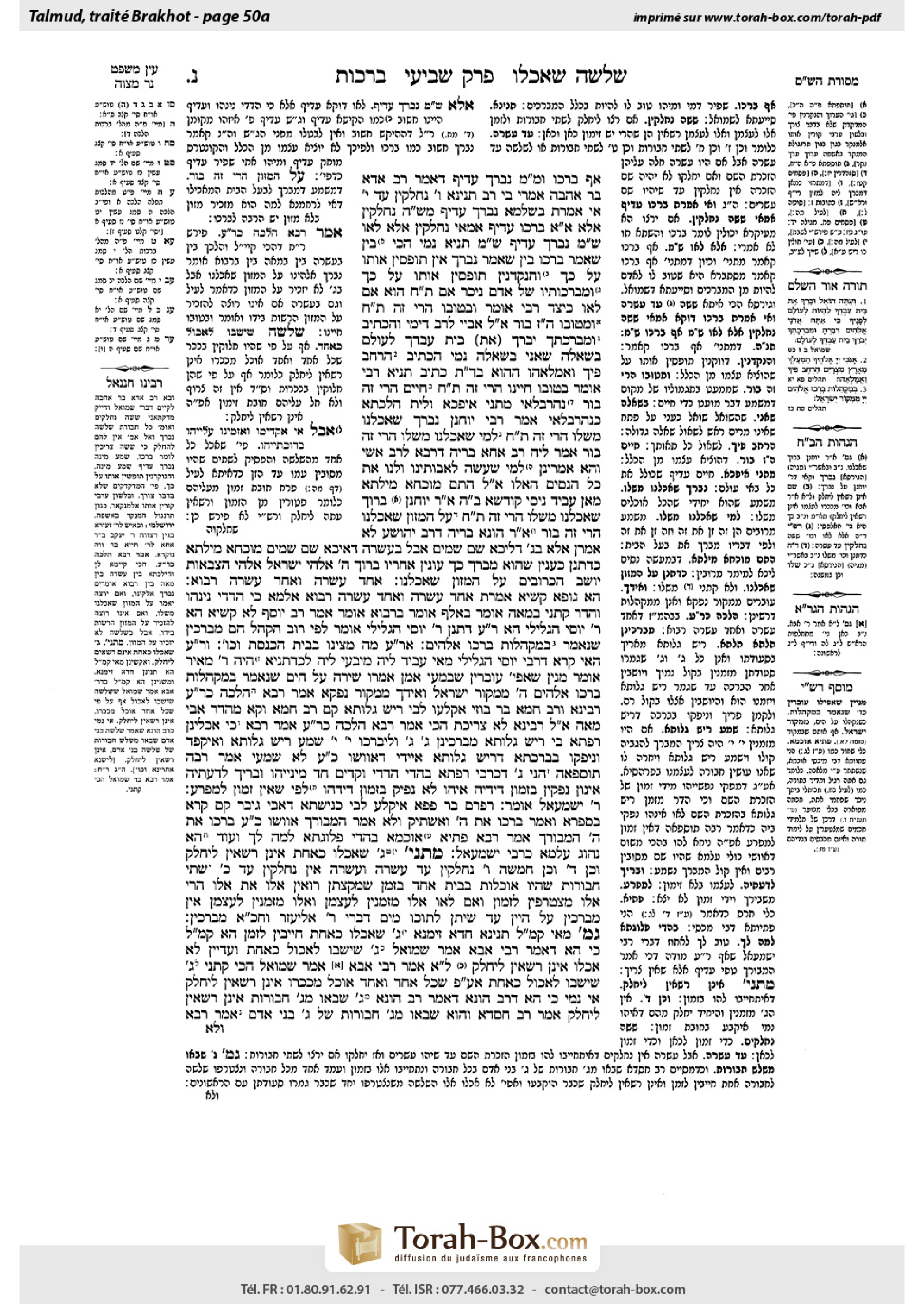
Berakhot 50a: Talmud study for Daf Yomi
Study the Talmud for Daf Yomi with scanned pages, Hebrew text, English translations from Sefaria and AI-generated French translations.
Passage selection and English or AI-generated French translation are available where the scan has annotations. Daf Study is independent of Torah-Box and Sefaria.
Browse Berakhot · ברכות · All tractatesBerakhot 50a text and translations
This page of Berakhot includes the Aramaic text, an English translation and an AI-generated French translation, alongside the scan above.
ברכות נ׳ א · Aramaic and Hebrew text
אַף ״בָּרְכוּ״, וּמִכׇּל מָקוֹם ״נְבָרֵךְ״ עֲדִיף, דְּאָמַר רַב אַדָּא בַּר אַהֲבָה, אָמְרִי בֵּי רַב, תְּנֵינָא: שִׁשָּׁה נֶחְלָקִין עַד עֲשָׂרָה.
אִי אָמְרַתְּ בִּשְׁלָמָא ״נְבָרֵךְ״ עֲדִיף — מִשּׁוּם הָכִי נֶחְלָקִין, אֶלָּא אִי אָמְרַתְּ ״בָּרְכוּ״ עֲדִיף — אַמַּאי נֶחְלָקִין! אֶלָּא לָאו שְׁמַע מִינַּהּ ״נְבָרֵךְ״ עֲדִיף. שְׁמַע מִינַּהּ.
תַּנְיָא נָמֵי הָכִי: בֵּין שֶׁאָמַר ״בָּרְכוּ״ בֵּין שֶׁאָמַר ״נְבָרֵךְ״ — אֵין תּוֹפְסִין אוֹתוֹ עַל כָּךְ, וְהַנַּקְדָּנִין תּוֹפְסִין אוֹתוֹ עַל כָּךְ. וּמִבִּרְכוֹתָיו שֶׁל אָדָם נִיכָּר אִם תַּלְמִיד חָכָם הוּא אִם לָאו. כֵּיצַד? רַבִּי אוֹמֵר: ״וּבְטוּבוֹ״ — הֲרֵי זֶה תַּלְמִיד חָכָם, ״וּמִטּוּבוֹ״ — הֲרֵי זֶה בּוּר.
אֲמַר לֵיהּ אַבָּיֵי לְרַב דִּימִי: וְהָכְתִיב: ״וּמִבִּרְכָתְךָ יְבֹרַךְ (אֶת) בֵּית עַבְדְּךָ לְעוֹלָם״! — בִּשְׁאֵלָה שָׁאנֵי. בִּשְׁאֵלָה נָמֵי, הָכְתִיב: ״הַרְחֶב פִּיךָ וַאֲמַלְּאֵהוּ״! — הַהוּא, בְּדִבְרֵי תוֹרָה כְּתִיב.
תַּנְיָא, רַבִּי אוֹמֵר: ״בְּטוּבוֹ חָיִינוּ״ — הֲרֵי זֶה תַּלְמִיד חָכָם, ״חַיִּים״ — הֲרֵי זֶה בּוּר. נְהַרְבְּלָאֵי מַתְנִי אִיפְּכָא, וְלֵית הִילְכָתָא כִּנְהַרְבְּלָאֵי.
אָמַר רַבִּי יוֹחָנָן: ״נְבָרֵךְ שֶׁאָכַלְנוּ מִשֶּׁלּוֹ״ — הֲרֵי זֶה תַּלְמִיד חָכָם, ״לְמִי שֶׁאָכַלְנוּ מִשֶּׁלּוֹ״ — הֲרֵי זֶה בּוּר.
אֲמַר לֵיהּ רַב אַחָא בְּרֵיהּ דְּרָבָא לְרַב אָשֵׁי: וְהָא אָמְרִינַן ״לְמִי שֶׁעָשָׂה לַאֲבוֹתֵינוּ וְלָנוּ אֶת כׇּל הַנִּסִּים הָאֵלּוּ״. אֲמַר לֵיהּ: הָתָם מוֹכְחָא מִילְּתָא, מַאן עָבֵיד נִיסֵּי — קוּדְשָׁא בְּרִיךְ הוּא.
אָמַר רַבִּי יוֹחָנָן: ״בָּרוּךְ שֶׁאָכַלְנוּ מִשֶּׁלּוֹ״ — הֲרֵי זֶה תַּלְמִיד חָכָם, ״עַל הַמָּזוֹן שֶׁאָכַלְנוּ״ — הֲרֵי זֶה בּוּר.
אָמַר רַב הוּנָא בְּרֵיהּ דְּרַב יְהוֹשֻׁעַ: לָא אֲמַרַן אֶלָּא בִּשְׁלֹשָׁה, דְּלֵיכָּא שֵׁם שָׁמַיִם, אֲבָל בַּעֲשָׂרָה, דְּאִיכָּא שֵׁם שָׁמַיִם — מוֹכְחָא מִילְּתָא, כְּדִתְנַן: כָּעִנְיָן שֶׁהוּא מְבָרֵךְ, כָּךְ עוֹנִין אַחֲרָיו: ״בָּרוּךְ ה׳ אֱלֹהֵי יִשְׂרָאֵל אֱלֹהֵי הַצְּבָאוֹת יוֹשֵׁב הַכְּרוּבִים עַל הַמָּזוֹן שֶׁאָכַלְנוּ״.
אֶחָד עֲשָׂרָה, וְאֶחָד עֲשָׂרָה רִבּוֹא. הָא גוּפָא קַשְׁיָא, אָמְרַתְּ אֶחָד עֲשָׂרָה וְאֶחָד עֲשָׂרָה רִבּוֹא, אַלְמָא כִּי הֲדָדֵי נִינְהוּ, וַהֲדַר קָתָנֵי בְּמֵאָה אוֹמֵר, בְּאֶלֶף אוֹמֵר, בְּרִבּוֹא אוֹמֵר!
אָמַר רַב יוֹסֵף: לָא קַשְׁיָא, הָא רַבִּי יוֹסֵי הַגְּלִילִי, הָא רַבִּי עֲקִיבָא. דִּתְנַן, רַבִּי יוֹסֵי הַגְּלִילִי אוֹמֵר: לְפִי רוֹב הַקָּהָל הֵם מְבָרְכִין, שֶׁנֶּאֱמַר: ״בְּמַקְהֵלוֹת בָּרְכוּ אֱלֹהִים״.
אָמַר רַבִּי עֲקִיבָא: מַה מָּצִינוּ בְּבֵית הַכְּנֶסֶת וְכוּ׳. וְרַבִּי עֲקִיבָא, הַאי קְרָא דְּרַבִּי יוֹסֵי הַגְּלִילִי מַאי עָבֵיד לֵיהּ? מִיבְּעֵי לֵיהּ לְכִדְתַנְיָא, הָיָה רַבִּי מֵאִיר אוֹמֵר: מִנַּיִן שֶׁאֲפִילּוּ עוּבָּרִין שֶׁבִּמְעֵי אִמָּן אָמְרוּ שִׁירָה עַל הַיָּם — שֶׁנֶּאֱמַר: ״בְּמַקְהֵלוֹת בָּרְכוּ אֱלֹהִים ה׳ מִמְּקוֹר יִשְׂרָאֵל״. וְאִידַּךְ? מִ״מְּקוֹר״ נָפְקָא.
אָמַר רָבָא: הֲלָכָה כְּרַבִּי עֲקִיבָא. רָבִינָא וְרַב חָמָא בַּר בּוּזִי אִקְּלַעוּ לְבֵי רֵישׁ גָּלוּתָא. קָם רַב חָמָא וְקָא מְהַדַּר אַבֵּי מְאָה. אֲמַר לֵיהּ רָבִינָא: לָא צְרִיכַתְּ, הָכִי אָמַר רָבָא: הֲלָכָה כְּרַבִּי עֲקִיבָא.
אָמַר רָבָא: כִּי אָכְלִינַן רִפְתָּא בֵּי רֵישׁ גָּלוּתָא, מְבָרְכִינַן שְׁלֹשָׁה שְׁלֹשָׁה. וְלִיבָרְכוּ עֲשָׂרָה עֲשָׂרָה! — שְׁמַע רֵישׁ גָּלוּתָא וְאִיקְּפַד. וְנִיפְּקוּ בְּבִרְכְּתָא דְּרֵישׁ גָּלוּתָא! — אַיְּידֵי דְּאָוְושׁוּ כּוּלֵּי עָלְמָא, לָא שָׁמְעִי.
אָמַר רַבָּה תּוֹסְפָאָה: הָנֵי שְׁלֹשָׁה דְּכָרְכִי רִפְתָּא בַּהֲדֵי הֲדָדֵי, וּקְדֵים חַד מִינַּיְיהוּ וּבָרֵיךְ לְדַעְתֵּיהּ — אִינּוּן נָפְקִין בְּזִמּוּן דִּידֵיהּ, אִיהוּ לָא נָפֵיק בְּזִמּוּן דִּידְהוּ — לְפִי שֶׁאֵין זִמּוּן לְמַפְרֵעַ.
רַבִּי יִשְׁמָעֵאל אוֹמֵר. רַפְרָם בַּר פָּפָּא אִקְּלַע לְבֵי כְּנִישְׁתָּא דַּאֲבִי גִיבָּר, קָם קְרָא בְּסִפְרָא וַאֲמַר ״בָּרְכוּ אֶת ה׳״, וְאִשְׁתִּיק, וְלָא אֲמַר ״הַמְבוֹרָךְ״. אֲוַושׁוּ כּוּלֵּי עָלְמָא: ״בָּרְכוּ אֶת ה׳ הַמְבוֹרָךְ״. אֲמַר רָבָא: פַּתְיָא אוּכָּמָא, בַּהֲדֵי פְּלוּגְתָּא לְמָה לְךָ? וְעוֹד, הָא נְהוּג עָלְמָא כְּרַבִּי יִשְׁמָעֵאל.
מַתְנִי׳ שְׁלֹשָׁה שֶׁאָכְלוּ כְּאַחַת — אֵינָן רַשָּׁאִין לֵיחָלֵק. וְכֵן אַרְבָּעָה, וְכֵן חֲמִשָּׁה. שִׁשָּׁה — נֶחְלָקִין, עַד עֲשָׂרָה. וַעֲשָׂרָה — אֵין נֶחֱלָקִין, עַד עֶשְׂרִים.
שְׁתֵּי חֲבוּרוֹת שֶׁהָיוּ אוֹכְלוֹת בְּבַיִת אֶחָד, בִּזְמַן שֶׁמִּקְצָתָן רוֹאִין אֵלּוּ אֶת אֵלּוּ — הֲרֵי אֵלּוּ מִצְטָרְפִין לְזִמּוּן, וְאִם לָאו — אֵלּוּ מְזַמְּנִין לְעַצְמָן וְאִלּוּ מְזַמְּנִין לְעַצְמָן.
אֵין מְבָרְכִין עַל הַיַּיִן עַד שֶׁיִּתֵּן לְתוֹכוֹ מַיִם, דִּבְרֵי רַבִּי אֱלִיעֶזֶר. וַחֲכָמִים אוֹמְרִים: מְבָרְכִין.
גְּמָ׳ מַאי קָא מַשְׁמַע לַן? תְּנֵינָא חֲדָא זִימְנָא, שְׁלֹשָׁה שֶׁאָכְלוּ כְּאַחַת חַיָּיבִין לְזַמֵּן!
הָא קָא מַשְׁמַע לַן, כִּי הָא דְּאָמַר רַבִּי אַבָּא אָמַר שְׁמוּאֵל: שְׁלֹשָׁה שֶׁיָּשְׁבוּ לֶאֱכוֹל כְּאַחַת, וַעֲדַיִן לֹא אָכְלוּ — אֵינָן רַשָּׁאִין לֵיחָלֵק.
לִישָּׁנָא אַחֲרִינָא: אָמַר רַבִּי אַבָּא אָמַר שְׁמוּאֵל, הָכִי קָתָנֵי: שְׁלֹשָׁה שֶׁיָּשְׁבוּ לֶאֱכוֹל כְּאַחַת, אַף עַל פִּי שֶׁכָּל אֶחָד וְאֶחָד אוֹכֵל מִכִּכָּרוֹ, אֵינָן רַשָּׁאִין לֵיחָלֵק. אִי נָמֵי כִּי הָא דְּרַב הוּנָא, דְּאָמַר רַב הוּנָא: שְׁלֹשָׁה שֶׁבָּאוּ מִשָּׁלֹשׁ חֲבוּרוֹת, אֵינָן רַשָּׁאִין לֵיחָלֵק.
אָמַר רַב חִסְדָּא: וְהוּא שֶׁבָּאוּ מִשָּׁלֹשׁ חֲבוּרוֹת שֶׁל שְׁלֹשָׁה בְּנֵי אָדָם.
אָמַר רָבָא:
Berakhot 50a · English translation
He may even say: Bless; nevertheless: Let us bless, is preferable as Rav Adda bar Ahava said that they said in the school of Rav: We learned: A group of six to ten people may divide into two groups, each forming its own zimmun. However, a group of ten, which invokes God’s name in the zimmun, may not divide into two groups as that would negate the opportunity to invoke God’s name.
The Gemara proceeds: Granted, if you say: Let us bless is preferable, that is why six people who ate together may divide into two groups. However, if you say: Bless is preferable, why are they permitted to divide into two groups? Neither group would be able to say: Bless. Rather, mustn’t one conclude from this: Let us bless is preferable as the one reciting the zimmun does not exclude himself from the group? The Gemara sums up the discussion: Indeed, conclude from this that that is the case.
That was also taught in the Tosefta: Both if he said: Bless, and if he said: Let us bless, we do not reprimand him for doing so; and the punctilious reprimand him for doing so. And the Gemara says: As a rule, from the style of one’s blessings it is obvious whether or not he is a Torah scholar. How so? For example, Rabbi Yehuda HaNasi says: In a zimmun, one who recites: Blessed be the One from Whose food we have eaten and by Whose goodness we live, he is a Torah scholar. However, one who recites: Blessed be the One from Whose food we have eaten and from Whose goodness we live, he is an ignoramus, as that expression insinuates that only some of God’s goodness was bestowed upon him, which is tantamount to a denial of God’s loving-kindness.
Abaye said to Rav Dimi: Isn’t it written that King David articulated his prayer in that manner: “Be pleased, therefore, to bless Your servant’s house, that it abide before You forever; for You, Lord God, have spoken. And from Your blessing may Your servant’s house be blessed forever” (II Samuel 7:29). David said: From Your blessing. The Gemara answers: In a case of request it is different, as it is inappropriate to demand the full bounty of God’s blessing. The Gemara questions this: In a case of request, too, is it not written that a request for the full bounty of God’s blessing is granted: “Open your mouth wide, that I will fill it” (Psalms 81:11)? What one receives corresponds to what he requests. The Gemara answered: That verse is written with regard to matters of Torah, where it is wholly appropriate to make excessive requests.
On the topic of the zimmun formula, it was taught in a baraita: Rabbi Yehuda HaNasi says: One who recites in a zimmun: And by His goodness we live, he is a Torah scholar. However, one who recites: And by His goodness they live, he is a fool, as he excluded himself from the collective. The Sages of Neharbela taught the opposite. In their opinion, they live is preferable because it is a more inclusive formula, whereas, we live is more limited and personal. Nonetheless, the Gemara concludes: The halakha is not in accordance with the opinion of the Sages of Neharbela.
On a similar note, Rabbi Yoḥanan said: One who recites in a zimmun: Let us bless the One Whose food we have eaten, he is a Torah scholar. However, one who recites: Let us bless to Him from Whose food we have eaten, he is an ignoramus, as it appears that the blessing is directed to the host of the meal.
Rabbi Aḥa the son of Rava questioned this and said to Rav Ashi: Don’t we say during the Passover seder: To He Who performed all of these miracles for our ancestors and for us, using the expression: To He Who? Rav Ashi said to him: There, in the case of miracles performed for our ancestors and for us, it is self-evident that the blessing refers to God. Who performs miracles? The Holy One, blessed be He. In the case of food, however, it is not self-evident, as the host of the meal also provided the food that was eaten.
Rabbi Yoḥanan said with regard to the formula of the zimmun that one who recites in a zimmun: Blessed be the One from Whose food we have eaten, he is a Torah scholar. However, one who recites: For the food we have eaten, he is an ignoramus, as it appears that he is blessing the host of the meal. If he was blessing God, why would he restrict the blessing to food (Tosafot)?
Rav Huna, son of Rav Yehoshua said: We only said this halakha with regard to a zimmun of three, where there is no mention of God’s name. In a zimmun of ten, however, where there is mention of God’s name, it is self-evident to whom the blessing refers, as we learned in our mishna: Just as he recites the blessing, so too do those present recite in response: Blessed be the Lord our God, the God of Israel, the God of Hosts, Who sits upon the cherubs, for the food that we have eaten.
We learned in our mishna with regard to the formula of zimmun: This formula is recited both in a group of ten and in a group of one hundred thousand. The Gemara raises an objection: The mishna itself is difficult. On one hand, you said: This formula is recited both in a group of ten and in a group of one hundred thousand; consequently, the two cases are the same. On the other hand, it is then taught: In a group of one hundred people, the one reciting the zimmun says; in a group of one thousand people, the one reciting the zimmun says; in a group of ten thousand people, the one reciting the zimmun says. Evidently, the formula depends on the number of people.
Rav Yosef said: This is not difficult, as these two statements are the opinions of different Sages. This is the opinion of Rabbi Yosei HaGelili, and that is the opinion of Rabbi Akiva. As we learned in our mishna: Rabbi Yosei HaGelili says: According to the size of the crowd, they recite the blessing, as it is stated: “Bless you God in full assemblies, even the Lord, you who are from the fountain of Israel” (Psalms 68:27).
We also learned in our mishna that Rabbi Akiva said that there are no distinctions based on the size of the crowd: What do we find in the synagogue? Both when there are many and when there are few, as long as there is a quorum of ten, the prayer leader says: Bless the Lord. In the case of Grace after Meals as well, the formula remains the same regardless of the number of people participating in the zimmun. The Gemara asks: And Rabbi Akiva, what does he do with that verse cited by Rabbi Yosei HaGelili? The Gemara answers: He needs it to derive that which was taught in a baraita: Rabbi Meir says: From where is it derived that even fetuses in their mother’s womb recited the song at the Red Sea? As it is stated in the chapter of Psalms that describes the exodus from Egypt: “In assemblies, bless God, the Lord, from the source of Israel,” and fetuses are included in these assemblies. The Gemara asks: And from where does the other Sage, Rabbi Yosei HaGelili, derive the matter of the singing of the fetuses? The Gemara answers: He derives it from “from the source of Israel,” which he interprets as an allusion to the womb.
Rava said: The halakha is in accordance with the opinion of Rabbi Akiva. The Gemara recounts that Ravina and Rav Ḥama bar Buzi happened to come to a banquet at the house of the Exilarch. At the end of the meal, Rav Ḥama rose and was seeking to gather a group of one hundred participants in the meal so that the zimmun for one hundred could be recited. Ravina said to him: You need not do so, as Rava declared the following: The halakha is in accordance with the opinion of Rabbi Akiva and the formula remains the same regardless of the number of people participating in the zimmun, as long as there are at least ten.
The Gemara discusses Rava’s conduct at meals at the house of the Exilarch. Rava said: When we would eat bread at the house of the Exilarch, we would recite the Grace after Meals blessing in groups of three. The Gemara asks: Let them recite the blessing in groups of ten. The Gemara answers: Then the Exilarch would hear and become angry upon seeing a large group of Sages reciting Grace after Meals before he completed his meal. The Gemara asks: Why could they not satisfy their obligation with the Exilarch’s blessing? The Gemara answers: Since everyone is making noise, they do not hear and would not fulfill their obligation.
Rabba Tosefa’a said: These three people, who break bread together and one of them went ahead and recited Grace after Meals on his own without a zimmun, they, the other two diners, fulfill their obligation with his participation in their zimmun; he, however, does not fulfill his obligation with his participation in their zimmun because there is no retroactive zimmun, and once he recited his blessing, participating in the zimmun accomplishes nothing for him.
The mishna states that Rabbi Akiva holds that in the synagogue, one recites: Bless the Lord, while Rabbi Yishmael said that he recites: Bless the Lord the blessed One. Rafram bar Pappa happened to come to the synagogue of Abei Givar when he rose to read from the Torah scroll and recited: Bless the Lord, and was silent, and did not recite: The blessed One. Because Rafram bar Pappa followed the principle that the halakha is in accordance with the opinion of Rabbi Akiva, and those present were not accustomed to that ruling, everyone in the synagogue cried out: Bless the Lord the blessed One. Rava said to Rafram bar Pappa: You black pot, a fond nickname for a Torah scholar who invests great effort in Torah study and worship of God, why are you involving yourself in this tannaitic dispute? Although Rabbi Akiva and Rabbi Yishmael disagree, Rabbi Yishmael’s formula, in which Rabbi Akiva’s formula is included, is acceptable to both. Furthermore, standard practice is in accordance with the opinion of Rabbi Yishmael.
MISHNA: Three people who ate as one are not permitted to divide and recite Grace after Meals individually; rather, they recite the zimmun together. And the same is true of four who ate together, and the same is true of five. However, a group of six, up to but not including ten people who ate as one, may divide into two groups, each reciting its own zimmun. And a group of ten may not divide into two groups until there are twenty people present. The general principle is that a group may not divide unless the smaller groups will be able to recite the same zimmun formula that the whole group would have recited.
The mishna states a halakha with regard to two groups joining together: Two groups that were eating in one house, when some members of each group can see each other, they may combine to form a zimmun. And if not, these recite a zimmun for themselves and those recite a zimmun for themselves.
The mishna also speaks of the blessing over wine: One does not recite a blessing over wine until he adds water to it, that is the statement of Rabbi Eliezer. Undiluted wine is too strong to drink and a blessing is inappropriate. And the Rabbis say: Since it is possible to drink undiluted wine, one recites a blessing over it.
GEMARA: At the beginning of the mishna, we learned that three people who ate together may not disperse. The Gemara asks: What does this mishna teach us? We already learned this once: Three people who ate as one are required to form a zimmun.
The Gemara answers: This teaches us that halakha which Rabbi Abba said that Shmuel said: Three individuals who sat to eat as one, and they have not yet begun to eat, nevertheless, they are not permitted to divide and recite Grace after Meals individually.
The Gemara cites another version: Rabbi Abba said that Shmuel said that this is what the mishna teaches: Three individuals who sat to eat as one, even though they do not share a meal, but each and every one of them eats from his own loaf, they are considered a single group in terms of zimmun, and are not permitted to divide. Alternatively, perhaps the mishna comes to teach that halakha of Rav Huna, as Rav Huna said: Three individuals who came from three different groups and sat together to continue their meals also form a zimmun and are not permitted to divide.
Rav Ḥisda said: And that is only the halakha in a case where the three individuals came from three groups of three people each, so that each original group was independently obligated to recite the zimmun, and that obligation never lapsed.
Rava qualified this, and said:
Berakhot 50a · Traduction française (IA)
Il peut même dire : Béni ; cependant : Bénissons, est préférable, comme Rav Adda bar Ahava a dit que l'on avait appris dans l'école de Rav : Nous avons appris : Un groupe de six à dix personnes peut se diviser en deux groupes, chacun formant son propre zimmun. Cependant, un groupe de dix personnes, qui invoque le nom de Dieu dans le zimmun, ne peut pas se diviser en deux groupes, car cela annulerait l'opportunité d'invoquer le nom de Dieu.
La Guemara poursuit : Cela est admis, si vous dites : Bénissons est préférable, c'est pourquoi six personnes qui ont mangé ensemble peuvent se diviser en deux groupes. Cependant, si vous dites : Béni est préférable, pourquoi sont-ils autorisés à se diviser en deux groupes ? Aucun des groupes ne pourrait dire : Béni. Plutôt, ne devrait-on pas conclure de cela : Bénissons est préférable, car celui qui récite le zimmun ne s'exclut pas du groupe ? La Guemara résume la discussion : En effet, concluez de cela que c'est ainsi.
Cela a également été enseigné dans la Tosefta : Que ce soit s'il a dit : Béni, ou s'il a dit : Bénissons, nous ne le réprimandons pas pour cela ; et le punctilieux le réprimande. Et la Guemara dit : En général, d'après le style de ses bénédictions, on peut savoir si l'on est un savant de la Torah ou non. Comment ? Par exemple, Rabbi Yehuda HaNasi dit : Celui qui récite dans un zimmun : Béni soit Celui dont nous avons mangé et par Sa bonté nous vivons, est un savant de la Torah. Cependant, celui qui récite : Béni soit Celui dont nous avons mangé et de Sa bonté nous vivons, est un ignorant, car cette expression suggère que seule une partie de la bonté de Dieu a été donnée à lui, ce qui équivaut à une négation de la bonté de Dieu.
Abaye dit à Rav Dimi : N'est-il pas écrit que le roi David a formulé sa prière ainsi : « Sois donc content, afin de bénir la maison de ton serviteur, qu'elle demeure devant toi éternellement ; car toi, Seigneur Dieu, as parlé. Et de ta bénédiction que la maison de ton serviteur soit bénie éternellement » (II Samuel 7:29). David dit : De ta bénédiction. La Guemara répond : Dans le cas d'une demande, c'est différent, car il n'est pas approprié de demander la pleine récompense de la bénédiction de Dieu. La Guemara questionne cela : Dans le cas d'une demande, n'est-il pas écrit que la demande de la pleine récompense de la bénédiction de Dieu est accordée : « Ouvre large ta bouche, je la remplirai » (Psaumes 81:11) ? Ce que l'on reçoit correspond à ce que l'on demande. La Guemara répondit : Cette verset est écrite concernant les affaires de la Torah, où il est tout à fait approprié de faire des demandes excessives.
Sur le sujet de la formule du zimmun, il a été enseigné dans une baraïta : Rabbi Yehuda HaNasi dit : Celui qui récite dans un zimmun : Et par Sa bonté nous vivons, est un savant de la Torah. Cependant, celui qui récite : Et par Sa bonté ils vivent, est un ignorant, car il s'exclut lui-même du collectif. Les Sages de Neharbela enseignaient l'opposé. Selon leur avis, ils vivent est préférable, car c'est une formule plus inclusive, tandis que nous vivons est plus limité et personnel. Cependant, la Guemara conclut : La halakha ne suit pas l'opinion des Sages de Neharbela.
Sur un point similaire, Rabbi Yoḥanan dit : Celui qui récite dans un zimmun : Bénissons Celui dont nous avons mangé, est un savant de la Torah. Cependant, celui qui récite : Bénissons à Lui de Celui dont nous avons mangé, est un ignorant, car cela semble indiquer que la bénédiction est dirigée vers l'hôte de la fête.
Rabbi Aḥa, fils de Rava, a posé cette question à Rav Ashi : N'avons-nous pas dit lors de la cérémonie de Pessah : À Celui Qui a accompli tous ces miracles pour nos ancêtres et pour nous, en utilisant l'expression : À Celui Qui ? Rav Ashi répondit à lui : Là, dans le cas de miracles accomplis pour nos ancêtres et pour nous, il est évident que la bénédiction fait référence à Dieu. Qui accompli des miracles ? Le Saint, béni soit-Il. Dans le cas des aliments, cependant, il n'est pas évident, car l'hôte de la fête a également fourni les aliments qui ont été mangés.
Rabbi Yoḥanan dit concernant la formule du zimmun que celui qui récite dans un zimmun : Béni soit Celui dont nous avons mangé, est un savant de la Torah. Cependant, celui qui récite : Pour les aliments que nous avons mangés, est un ignorant, car cela semble indiquer qu'il bénit l'hôte de la fête. Si il bénissait Dieu, pourquoi restreint-il la bénédiction aux aliments (Tosafot) ?
Rabbi Huna, fils de Rabbi Yehoshua, dit : Nous avons dit cette halakha uniquement concernant un zimmun de trois personnes, où il n'y a pas mention du nom de Dieu. Cependant, dans un zimmun de dix personnes, où il y a mention du nom de Dieu, il est évident à qui la bénédiction fait référence, comme nous avons appris dans notre mishna : Tout comme il récite la bénédiction, ainsi ceux présents récitent en réponse : Béni soit le Seigneur notre Dieu, le Dieu d'Israël, le Dieu des armées, qui siège sur les chérubim, pour les aliments que nous avons mangés.
Nous avons appris dans notre michna concernant la formule du zimmun : Cette formule est récitée à la fois dans un groupe de dix et dans un groupe de cent mille. La Guemara soulève une objection : La michna elle-même est difficile. D'un côté, vous dites : Cette formule est récitée à la fois dans un groupe de dix et dans un groupe de cent mille ; par conséquent, les deux cas sont identiques. De l'autre côté, il est ensuite enseigné : Dans un groupe de cent personnes, celui qui récite le zimmun le fait ; dans un groupe de mille personnes, celui qui récite le zimmun le fait ; dans un groupe de dix mille personnes, celui qui récite le zimmun le fait. Évidemment, la formule dépend du nombre de personnes.
Rav Yosef dit : Ce n'est pas difficile, car ces deux déclarations sont les opinions de différents Sages. C'est l'opinion de Rabbi Yosei HaGelili, et celle-ci est l'opinion de Rabbi Akiva. Comme nous avons appris dans notre michna : Rabbi Yosei HaGelili dit : Selon la taille de la foule, ils récitent la bénédiction, car il est dit : « Béni soit Dieu en assemblées pleines, même le Seigneur, toi qui es issu de la source d'Israël » (Psaumes 68:27).
Nous avons également appris dans notre mitsva que Rabbi Akiva affirmait qu'il n'y a pas de distinctions selon la taille du groupe : Qu'observons-nous dans la synagogue ? Quand il y a beaucoup de personnes ou peu, tant que le nombre est de dix, le leader de la prière dit : Béni soit l'Éternel. De même, dans le cas de la prière de grâce après le repas, la formule reste la même indépendamment du nombre de personnes participant au zimmun. La Guemara demande : Et Rabbi Akiva, que fait-il avec cette versette citée par Rabbi Yosei HaGelili ? La Guemara répond : Il a besoin d'elle pour déduire ce qui a été enseigné dans une baraïta : Rabbi Meir dit : D'où tire-t-on que même les fœtus dans le ventre de leur mère chantaient à la mer Rouge ? Comme il est dit dans le chapitre des Psaumes décrivant l'Exode d'Égypte : « Dans les assemblées, bénis l'Éternel, le Seigneur, de la source d'Israël », et les fœtus sont inclus dans ces assemblées. La Guemara demande : Et d'où le Sage suivant, Rabbi Yosei HaGelili, tire-t-il la question du chant des fœtus ? La Guemara répond : Il en tire la conclusion à partir de « de la source d'Israël », qu'il interprète comme une allusion au ventre.
Rava dit : La halakha suit l'opinion de Rabbi Akiva. La Guemara rapporte qu'au cours d'un banquet chez l'Exilarch, Ravina et Rav Ḥama bar Buzi se trouvaient présents. À la fin du repas, Rav Ḥama se levait et cherchait à rassembler un groupe de cent participants au repas afin que le zimmun pour cent puisse être récité. Ravina lui dit : Tu n'as pas besoin de le faire, car Rava a déclaré que la halakha suit l'opinion de Rabbi Akiva et que la formule reste la même indépendamment du nombre de personnes participant au zimmun, à condition qu'il y ait au moins dix personnes.
La Guemara discute du comportement de Rava lors des repas chez l'Exilarch. Rava dit : Quand nous mangions du pain chez l'Exilarch, nous récitions la prière de grâce après le repas par groupes de trois. La Guemara demande : Pourquoi ne pas réciter la prière par groupes de dix ? La Guemara répond : Alors l'Exilarch aurait vu un grand groupe de Sages réciter la prière de grâce après le repas avant qu'il ait terminé son repas et il serait devenu en colère. La Guemara demande : Pourquoi ne pouvaient-ils pas s'acquitter de leur obligation avec la bénédiction de l'Exilarch ? La Guemara répond : Parce que tout le monde faisait du bruit, ils ne pouvaient pas entendre et ne remplissaient donc pas leur obligation.
Rabba Tosefa’a dit : Ces trois personnes, qui ont partagé un repas ensemble et dont l'une a récité la prière de grâce après le repas seule sans zimmun, les deux autres convives remplissent leur obligation grâce à sa participation au zimmun ; elle, cependant, ne remplissait pas son obligation grâce à sa participation au zimmun, car il n'y a pas de zimmun rétroactif, et une fois qu'elle a récité sa bénédiction, participer au zimmun ne lui apportait rien.
La mitsva stipule que Rabbi Akiva considère que dans la synagogue, on récite : Béni soit l'Éternel, tandis que Rabbi Yishmael dit qu'on récite : Béni soit l'Éternel, le béni. Rafram bar Pappa est venu à la synagogue d'Abei Givar lorsqu'il s'est levé pour lire du livre de la Torah et a récité : Béni soit l'Éternel, sans dire : Le béni. Parce que Rafram bar Pappa suivait le principe que la halakha suit l'opinion de Rabbi Akiva, et que les personnes présentes n'étaient pas habituées à cette décision, tout le monde dans la synagogue a crié : Béni soit l'Éternel, le béni. Rava a dit à Rafram bar Pappa : Tu es un chaudron noir, un surnom affectueux pour un savant de la Torah qui investit beaucoup d'efforts dans l'étude de la Torah et la prière à Dieu, pourquoi t'impliques-tu dans ce débat tannaitique ? Bien que Rabbi Akiva et Rabbi Yishmael diffèrent, la formule de Rabbi Yishmael, dans laquelle la formule de Rabbi Akiva est incluse, est acceptable pour les deux. De plus, la pratique courante suit l'opinion de Rabbi Yishmael.
MICHNA : Trois personnes qui ont mangé ensemble ne sont pas autorisées à se séparer et à réciter chacun leur propre prière de grâce après le repas ; elles doivent réciter le zimmun ensemble. De même, c'est le cas pour quatre personnes qui ont mangé ensemble, et pour cinq. Cependant, un groupe de six, jusqu'à neuf personnes qui ont mangé ensemble, peut se diviser en deux groupes, chacun récitant son propre zimmun. Et un groupe de dix ne peut se diviser en deux groupes qu'en présence de vingt personnes. Le principe général est que le groupe ne peut se diviser que si les petits groupes peuvent réciter la même formule du zimmun que le groupe entier aurait récité.
La mitsva stipule une halakha concernant deux groupes qui se rejoignent : Deux groupes qui mangeaient dans une même maison, lorsque certains membres de chaque groupe peuvent voir les autres, ils peuvent se combiner pour former un zimmun. Et si ce n'est pas le cas, ils récitent un zimmun pour eux-mêmes et ceux-ci récitent un zimmun pour eux-mêmes.
La mitsva parle également de la bénédiction sur le vin : On ne récite pas une bénédiction sur le vin jusqu'à ce qu'on y ajoute de l'eau, selon la déclaration de Rabbi Eliezer. Le vin non dilué est trop fort à boire et une bénédiction n'est pas appropriée. Et les Rabbins disent : Comme il est possible de boire du vin non dilué, on récite une bénédiction sur lui.
GUEMARA : Au début de la mitsva, nous avons appris que trois personnes qui ont mangé ensemble ne peuvent pas se disperser. La Guemara demande : Qu'enseigne cette mitsva ? Nous avons déjà appris cela une fois : Trois personnes qui ont mangé ensemble sont tenues de former un zimmun.
La Guemara répond : Cela nous enseigne la halakha que Rabbi Abba a dit que Shmuel a dit : Trois individus qui ont pris place pour manger ensemble, et qui n'ont pas encore commencé à manger, ne sont toutefois pas autorisés à se séparer et à réciter chacun leur propre prière de grâce après le repas.
La Guemara cite une autre version : Rabbi Abba dit que Shmuel a dit que ceci est ce que la mishna enseigne : trois individus qui s'asseyent pour manger ensemble, même s'ils ne partagent pas un repas, mais chacun mange de son propre pain, sont considérés comme un seul groupe en termes de zimmun, et ne peuvent pas se diviser. Alternativement, peut-être la mishna vise à enseigner la halakha de Rav Huna, car Rav Huna a dit : trois individus qui sont venus de trois groupes différents et s'assiedent ensemble pour continuer leur repas forment également un zimmun et ne peuvent pas se diviser.
Rav Ḥisda a dit : Et cela est valable uniquement dans le cas où les trois individus sont venus de trois groupes de trois personnes chacun, de sorte que chaque groupe original était tenu de réciter le zimmun, et cette obligation n'a jamais été abandonnée.
Rava a précisé cela et a dit :
Traduction française générée par IA à partir de l’édition anglaise de Sefaria. Vérifie toujours un passage avec le texte source.
Text from Sefaria: William Davidson Edition - Vocalized Aramaic (CC BY NC); William Davidson Edition - English (CC BY NC).