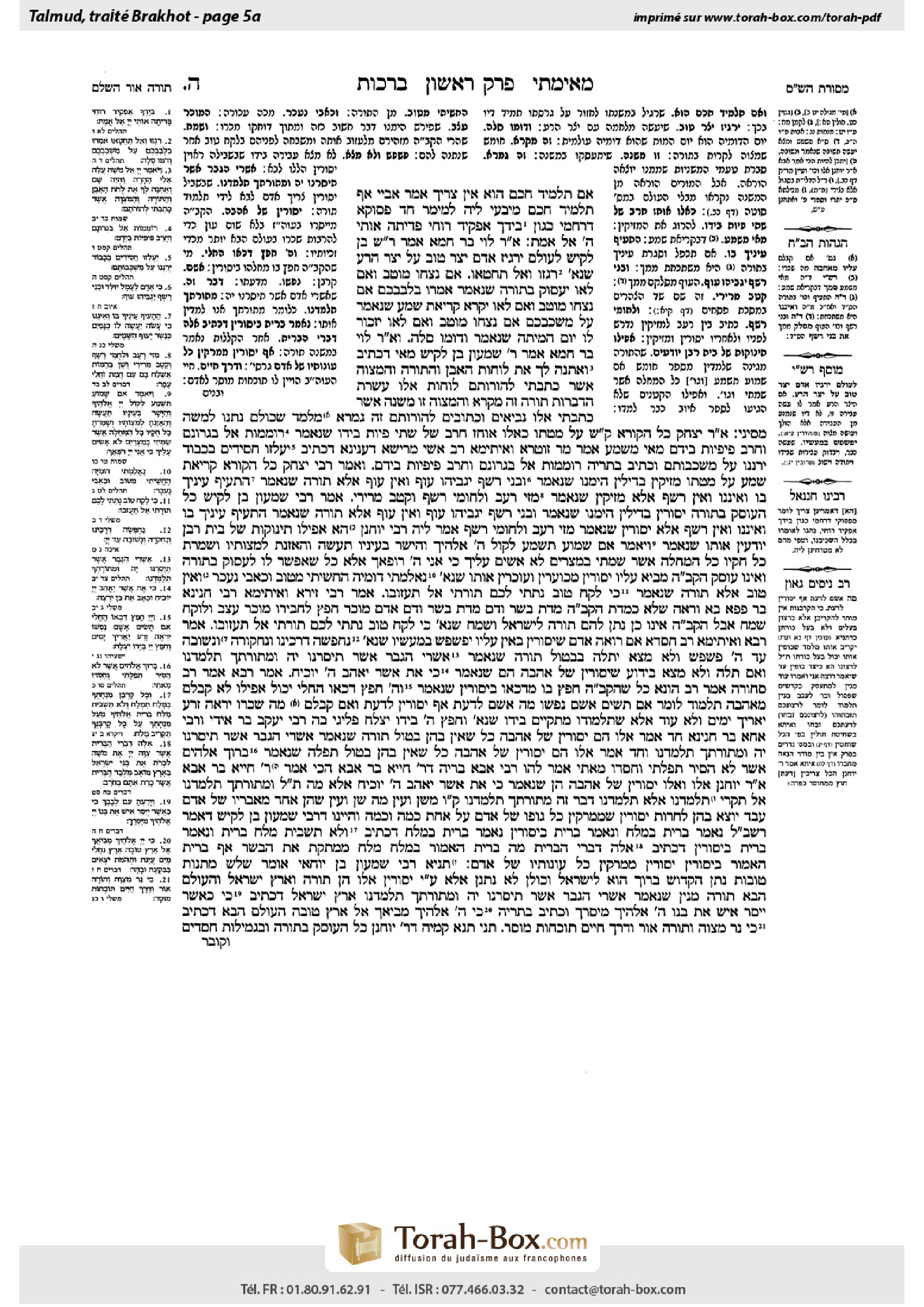
Berakhot 5a: Talmud study for Daf Yomi
Study the Talmud for Daf Yomi with scanned pages, Hebrew text, English translations from Sefaria and AI-generated French translations.
Passage selection and English or AI-generated French translation are available where the scan has annotations. Daf Study is independent of Torah-Box and Sefaria.
Browse Berakhot · ברכות · All tractatesBerakhot 5a text and translations
This page of Berakhot includes the Aramaic text, an English translation and an AI-generated French translation, alongside the scan above.
ברכות ה׳ א · Aramaic and Hebrew text
אִם תַּלְמִיד חָכָם הוּא — אֵין צָרִיךְ. אָמַר אַבָּיֵי: אַף תַּלְמִיד חָכָם מִיבְּעֵי לֵיהּ לְמֵימַר חַד פְּסוּקָא דְרַחֲמֵי, כְּגוֹן: ״בְּיָדְךָ אַפְקִיד רוּחִי, פָּדִיתָה אוֹתִי ה׳ אֵל אֱמֶת״.
אָמַר רַבִּי לֵוִי בַּר חָמָא, אָמַר רַבִּי שִׁמְעוֹן בֶּן לָקִישׁ: לְעוֹלָם יַרְגִּיז אָדָם יֵצֶר טוֹב עַל יֵצֶר הָרַע, שֶׁנֶּאֱמַר: ״רִגְזוּ וְאַל תֶּחֱטָאוּ״ אִם נִצְּחוֹ — מוּטָב, וְאִם לָאו — יַעֲסוֹק בַּתּוֹרָה, שֶׁנֶּאֱמַר: ״אִמְרוּ בִלְבַבְכֶם״. אִם נִצְּחוֹ — מוּטָב, וְאִם לָאו — יִקְרָא קְרִיאַת שְׁמַע, שֶׁנֶּאֱמַר: ״עַל מִשְׁכַּבְכֶם״. אִם נִצְּחוֹ — מוּטָב, וְאִם לָאו — יִזְכּוֹר לוֹ יוֹם הַמִּיתָה, שֶׁנֶּאֱמַר: ״וְדֹמּוּ סֶלָה״.
וְאָמַר רַבִּי לֵוִי בַּר חָמָא, אָמַר רַבִּי שִׁמְעוֹן בֶּן לָקִישׁ, מַאי דִּכְתִיב ״וְאֶתְּנָה לְךָ אֶת לֻחֹת הָאֶבֶן וְהַתּוֹרָה וְהַמִּצְוָה אֲשֶׁר כָּתַבְתִּי לְהוֹרֹתָם״. ״לֻחֹת״ — אֵלּוּ עֲשֶׂרֶת הַדִּבְּרוֹת, ״תּוֹרָה״ — זֶה מִקְרָא, ״וְהַמִּצְוָה״ — זוֹ מִשְׁנָה, ״אֲשֶׁר כָּתַבְתִּי״ — אֵלּוּ נְבִיאִים וּכְתוּבִים, ״לְהוֹרוֹתָם״ — זֶה תַּלְמוּד, מְלַמֵּד שֶׁכּוּלָּם נִתְּנוּ לְמֹשֶׁה מִסִּינַי.
אָמַר רַבִּי יִצְחָק: כׇּל הַקּוֹרֵא קְרִיאַת שְׁמַע עַל מִטָּתוֹ, כְּאִלּוּ אוֹחֵז חֶרֶב שֶׁל שְׁתֵּי פִיּוֹת בְּיָדוֹ. שֶׁנֶּאֱמַר: ״רוֹמְמוֹת אֵל בִּגְרוֹנָם וְחֶרֶב פִּיפִיּוֹת בְּיָדָם״, מַאי מַשְׁמַע? אָמַר מָר זוּטְרָא וְאִיתֵּימָא רַב אָשֵׁי: מֵרֵישָׁא דְעִנְיָנָא, דִּכְתִיב: ״יַעְלְזוּ חֲסִידִים בְּכָבוֹד יְרַנְּנוּ עַל מִשְׁכְּבוֹתָם״. וּכְתִיב בָּתְרֵיהּ: ״רוֹמְמוֹת אֵל בִּגְרוֹנָם וְחֶרֶב פִּיפִיּוֹת בְּיָדָם״.
וְאָמַר רַבִּי יִצְחָק: כׇּל הַקּוֹרֵא קְרִיאַת שְׁמַע עַל מִטָּתוֹ — מַזִּיקִין בְּדֵילִין הֵימֶנּוּ. שֶׁנֶּאֱמַר: ״וּבְנֵי רֶשֶׁף יַגְבִּיהוּ עוּף״, וְאֵין ״עוּף״ אֶלָּא תּוֹרָה, שֶׁנֶּאֱמַר: ״הֲתָעִיף עֵינֶיךָ בּוֹ וְאֵינֶנּוּ״. וְאֵין ״רֶשֶׁף״ אֶלָּא מַזִּיקִין, שֶׁנֶּאֱמַר: ״מְזֵי רָעָב וּלְחֻמֵי רֶשֶׁף וְקֶטֶב מְרִירִי״.
אָמַר רַבִּי שִׁמְעוֹן בֶּן לָקִישׁ: כׇּל הָעוֹסֵק בַּתּוֹרָה — יִסּוּרִין בְּדֵילִין הֵימֶנּוּ, שֶׁנֶּאֱמַר: ״וּבְנֵי רֶשֶׁף יַגְבִּיהוּ עוּף״. וְאֵין ״עוּף״ אֶלָּא תּוֹרָה, שֶׁנֶּאֱמַר ״הֲתָעִיף עֵינֶיךָ בּוֹ וְאֵינֶנּוּ״, וְאֵין ״רֶשֶׁף״ אֶלָּא יִסּוּרִין, שֶׁנֶּאֱמַר: ״מְזֵי רָעָב וּלְחֻמֵי רֶשֶׁף״.
אָמַר לֵיהּ רַבִּי יוֹחָנָן: הָא אֲפִילּוּ תִּינוֹקוֹת שֶׁל בֵּית רַבָּן, יוֹדְעִין אוֹתוֹ, שֶׁנֶּאֱמַר ״וַיֹּאמֶר אִם שָׁמוֹעַ תִּשְׁמַע לְקוֹל ה׳ אֱלֹהֶיךָ וְהַיָּשָׁר בְּעֵינָיו תַּעֲשֶׂה וְהַאֲזַנְתָּ לְמִצְוֹתָיו וְשָׁמַרְתָּ כׇּל חֻקָּיו כׇּל הַמַּחֲלָה אֲשֶׁר שַׂמְתִּי בְמִצְרַיִם לֹא אָשִׂים עָלֶיךָ כִּי אֲנִי ה׳ רוֹפְאֶךָ״. אֶלָּא: כׇּל שֶׁאֶפְשָׁר לוֹ לַעֲסוֹק בַּתּוֹרָה וְאֵינוֹ עוֹסֵק — הַקָּדוֹשׁ בָּרוּךְ הוּא מֵבִיא עָלָיו יִסּוּרִין מְכוֹעָרִין וְעוֹכְרִין אוֹתוֹ, שֶׁנֶּאֱמַר: ״נֶאֱלַמְתִּי דוּמִיָּה הֶחֱשֵׁיתִי מִטּוֹב וּכְאֵבִי נֶעְכָּר״, וְאֵין ״טוֹב״ אֶלָּא תּוֹרָה, שֶׁנֶּאֱמַר: ״כִּי לֶקַח טוֹב נָתַתִּי לָכֶם תּוֹרָתִי אַל תַּעֲזֹבוּ״.
אָמַר רַבִּי זֵירָא וְאִיתֵּימָא רַבִּי חֲנִינָא בַּר פָּפָּא: בֹּא וּרְאֵה שֶׁלֹּא כְּמִדַּת הַקָּדוֹשׁ בָּרוּךְ הוּא מִדַּת בָּשָׂר וָדָם. מִדַּת בָּשָׂר וָדָם, אָדָם מוֹכֵר חֵפֶץ לַחֲבֵירוֹ, מוֹכֵר עָצֵב, וְלוֹקֵחַ שָׂמֵחַ, אֲבָל הַקָּדוֹשׁ בָּרוּךְ הוּא אֵינוֹ כֵּן, נָתַן לָהֶם תּוֹרָה לְיִשְׂרָאֵל — וְשָׂמַח, שֶׁנֶּאֱמַר: ״כִּי לֶקַח טוֹב נָתַתִּי לָכֶם תּוֹרָתִי אַל תַּעֲזֹבוּ״.
אָמַר רָבָא, וְאִיתֵּימָא רַב חִסְדָּא: אִם רוֹאֶה אָדָם שֶׁיִּסּוּרִין בָּאִין עָלָיו — יְפַשְׁפֵּשׁ בְּמַעֲשָׂיו, שֶׁנֶּאֱמַר: ״נַחְפְּשָׂה דְרָכֵינוּ וְנַחְקֹרָה וְנָשׁוּבָה עַד ה׳״. פִּשְׁפֵּשׁ וְלֹא מָצָא — יִתְלֶה בְּבִטּוּל תּוֹרָה, שֶׁנֶּאֱמַר: ״אַשְׁרֵי הַגֶּבֶר אֲשֶׁר תְּיַסְּרֶנּוּ יָּהּ וּמִתּוֹרָתְךָ תְלַמְּדֶנּוּ״.
וְאִם תָּלָה וְלֹא מָצָא — בְּיָדוּעַ שֶׁיִּסּוּרִין שֶׁל אַהֲבָה הֵם, שֶׁנֶּאֱמַר: ״כִּי אֶת אֲשֶׁר יֶאֱהַב ה׳ יוֹכִיחַ״.
אָמַר רָבָא, אָמַר רַב סְחוֹרָה, אָמַר רַב הוּנָא: כׇּל שֶׁהַקָּדוֹשׁ בָּרוּךְ הוּא חָפַץ בּוֹ — מְדַכְּאוֹ בְּיִסּוּרִין, שֶׁנֶּאֱמַר: ״וַה׳ חָפֵץ דַּכְּאוֹ הֶחֱלִי״.
יָכוֹל אֲפִילּוּ לֹא קִבְּלָם מֵאַהֲבָה? — תַּלְמוּד לוֹמַר: ״אִם תָּשִׂים אָשָׁם נַפְשׁוֹ״, מָה אָשָׁם לְדַעַת, אַף יִסּוּרִין — לְדַעַת.
וְאִם קִבְּלָם מַה שְּׂכָרוֹ: ״יִרְאֶה זֶרַע יַאֲרִיךְ יָמִים״. וְלֹא עוֹד אֶלָּא שֶׁתַּלְמוּדוֹ מִתְקַיֵּים בְּיָדוֹ, שֶׁנֶּאֱמַר: ״וְחֵפֶץ ה׳ בְּיָדוֹ יִצְלָח״.
פְּלִיגִי בַּהּ רַבִּי יַעֲקֹב בַּר אִידִי וְרַבִּי אַחָא בַּר חֲנִינָא. חַד אָמַר: אֵלּוּ הֵם יִסּוּרִין שֶׁל אַהֲבָה — כׇּל שֶׁאֵין בָּהֶן בִּטּוּל תּוֹרָה, שֶׁנֶּאֱמַר: ״אַשְׁרֵי הַגֶּבֶר אֲשֶׁר תְּיַסְּרֶנּוּ יָּהּ וּמִתּוֹרָתְךָ תְלַמְּדֶנּוּ״.
וְחַד אָמַר: אֵלּוּ הֵן יִסּוּרִין שֶׁל אַהֲבָה — כׇּל שֶׁאֵין בָּהֶן בִּטּוּל תְּפִלָּה, שֶׁנֶּאֱמַר: ״בָּרוּךְ אֱלֹהִים אֲשֶׁר לֹא הֵסִיר תְּפִלָּתִי וְחַסְדּוֹ מֵאִתִּי״.
אָמַר לְהוּ רַבִּי אַבָּא בְּרֵיהּ דְּרַבִּי חִיָּיא בַּר אַבָּא, הָכִי אָמַר רַבִּי חִיָּיא בַּר אַבָּא, אָמַר רַבִּי יוֹחָנָן: אֵלּוּ וָאֵלּוּ יִסּוּרִין שֶׁל אַהֲבָה הֵן, שֶׁנֶּאֱמַר ״כִּי אֶת אֲשֶׁר יֶאֱהַב ה׳ יוֹכִיחַ״.
אֶלָּא מַה תַּלְמוּד לוֹמַר ״וּמִתּוֹרָתְךָ תְלַמְּדֶנּוּ״ — אַל תִּקְרֵי ״תְלַמְּדֶנּוּ״, אֶלָּא תְלַמְּדֵנוּ. דָּבָר זֶה — מִתּוֹרָתְךָ תְּלַמְּדֵנוּ.
קַל וָחוֹמֶר מִשֵּׁן וָעַיִן. מַה שֵּׁן וָעַיִן שֶׁהֵן אֶחָד מֵאֵבָרָיו שֶׁל אָדָם — עֶבֶד יוֹצֵא בָּהֶן לְחֵרוּת, יִסּוּרִין שֶׁמְּמָרְקִין כׇּל גּוּפוֹ שֶׁל אָדָם — עַל אַחַת כַּמָּה וְכַמָּה.
וְהַיְינוּ דְּרַבִּי שִׁמְעוֹן בֶּן לָקִישׁ, דְּאָמַר רַבִּי שִׁמְעוֹן בֶּן לָקִישׁ: נֶאֱמַר ״בְּרִית״ בְּמֶלַח, וְנֶאֱמַר ״בְּרִית״ בְּיִסּוּרִין, נֶאֱמַר ״בְּרִית״ בְּמֶלַח, דִּכְתִיב: ״וְלֹא תַשְׁבִּית מֶלַח בְּרִית״ וְנֶאֱמַר ״בְּרִית״ בְּיִסּוּרִין, דִּכְתִיב: ״אֵלֶּה דִבְרֵי הַבְּרִית״, מַה ״בְּרִית״ הָאָמוּר בְּמֶלַח — מֶלַח מְמַתֶּקֶת אֶת הַבָּשָׂר, אַף ״בְּרִית״ הָאָמוּר בְּיִסּוּרִין — יִסּוּרִין מְמָרְקִין כׇּל עֲוֹנוֹתָיו שֶׁל אָדָם.
תַּנְיָא, רַבִּי שִׁמְעוֹן בֶּן יוֹחַאי אוֹמֵר: שָׁלֹשׁ מַתָּנוֹת טוֹבוֹת נָתַן הַקָּדוֹשׁ בָּרוּךְ הוּא לְיִשְׂרָאֵל, וְכוּלָּן לֹא נְתָנָן אֶלָּא עַל יְדֵי יִסּוּרִין, אֵלּוּ הֵן: תּוֹרָה וְאֶרֶץ יִשְׂרָאֵל וְהָעוֹלָם הַבָּא.
תּוֹרָה מִנַּיִן — שֶׁנֶּאֱמַר: ״אַשְׁרֵי הַגֶּבֶר אֲשֶׁר תְּיַסְּרֶנּוּ יָּהּ וּמִתּוֹרָתְךָ תְלַמְּדֶנּוּ״.
אֶרֶץ יִשְׂרָאֵל, דִּכְתִיב: ״כִּי כַּאֲשֶׁר יְיַסֵּר אִישׁ אֶת בְּנוֹ ה׳ אֱלֹהֶיךָ מְיַסְּרֶךָּ״, וּכְתִיב בָּתְרֵיהּ: ״כִּי ה׳ אֱלֹהֶיךָ מְבִיאֲךָ אֶל אֶרֶץ טוֹבָה״.
הָעוֹלָם הַבָּא, דִּכְתִיב: ״כִּי נֵר מִצְוָה וְתוֹרָה אוֹר וְדֶרֶךְ חַיִּים תּוֹכְחוֹת מוּסָר״.
תָּנֵי תַּנָּא קַמֵּיהּ דְּרַבִּי יוֹחָנָן: כׇּל הָעוֹסֵק בְּתוֹרָה וּבִגְמִילוּת חֲסָדִים
Berakhot 5a · English translation
If one is a Torah scholar, he need not recite Shema on his bed since he is always engaged in the study of Torah and will likely fall asleep engrossed in matters of Torah. Abaye said: Even a Torah scholar must recite at least one verse of prayer, such as: “Into Your hand I trust my spirit; You have redeemed me, Lord, God of truth” (Psalms 31:6).
Incidental to the verse, “Tremble, and do not sin,” the Gemara mentions that Rabbi Levi bar Ḥama said that Rabbi Shimon ben Lakish said: One should always incite his good inclination against his evil inclination, i.e., that one must constantly struggle so that his evil inclination does not lead him to transgression, as it is stated: "Tremble, and do not sin."
If one succeeds and subdues his evil inclination, excellent, but if he does not succeed in subduing it, he should study Torah, as alluded to in the verse: “Say to your heart.”
If he subdues his evil inclination, excellent; if not, he should recite Shema, which contains the acceptance of the yoke of God, and the concept of reward and punishment, as it is stated in the verse: “Upon your bed,” which alludes to Shema, where it says: “When you lie down.”
If he subdues his evil inclination, excellent; if not, he should remind himself of the day of death, whose silence is alluded to in the continuation of the verse: “And be still, Selah.”
And Rabbi Levi bar Ḥama said that Rabbi Shimon ben Lakish said: God said to Moses, “Ascend to Me on the mountain and be there, and I will give you the stone tablets and the Torah and the mitzva that I have written that you may teach them” (Exodus 24:12), meaning that God revealed to Moses not only the Written Torah, but all of Torah, as it would be transmitted through the generations.
The “tablets” are the ten commandments that were written on the tablets of the Covenant,
the “Torah” is the five books of Moses.
The “mitzva” is the Mishna, which includes explanations for the mitzvot and how they are to be performed.
“That I have written” refers to the Prophets and Writings, written with divine inspiration.
“That you may teach them” refers to the Talmud, which explains the Mishna.
These explanations are the foundation for the rulings of practical halakha. This verse teaches that all aspects of Torah were given to Moses from Sinai.
The Gemara continues its treatment of the recitation of Shema upon one’s bed. Rabbi Yitzḥak said: Anyone who recites Shema on his bed, it is as if he holds a double-edged sword, guarding him from all evil, as it is stated: “High praises of God in their mouths, and a double-edged sword in their hands” (Psalms 149:6). The Gemara asks: From where is it inferred that this verse from Psalms refers to the recitation of Shema? Mar Zutra, and some say Rav Ashi, said: We derive it from the preceding verse, as it is written: “Let the pious exult in glory; let them joyously sing upon their beds.” The praise of God from one’s bed is the recitation of Shema. And it is written thereafter: “High praises of God in their mouths, and a double-edged sword in their hands.”
And Rabbi Yitzḥak said: Anyone who recites Shema upon his bed, demons stay away from him. This is alluded to, as it is stated: “But man is born into trouble, and the sparks [reshef ] fly [uf ] upward” (Job 5:7). The verse is explained: The word fly [uf ] means nothing other than Torah, as Torah is difficult to grasp and easy to lose, like something that floats away, as it is stated: “Will you set your eyes upon it? It is gone; for riches certainly make themselves wings, like an eagle that flies into the heavens” (Proverbs 23:5). The word “sparks” means nothing other than demons, as it is stated: “Wasting of hunger, and the devouring of the sparks [reshef] and bitter destruction [ketev meriri], and the teeth of beasts I will send upon them, with the venom of crawling things of the dust” (Deuteronomy 32:24). Here we see reshef listed along with ketev meriri, both of which are understood by the Sages to be names of demons.
Regarding this unclear verse, Rabbi Shimon ben Lakish said: If one engages in Torah study, suffering stays away from him, as it is stated: “And the sparks fly upward.” And fly means nothing other than Torah, as it is stated: “Will you set your eyes upon it? It is gone; and sparks means nothing other than suffering, as it is stated: “Wasting of hunger, and the devouring of the sparks,” equating devouring sparks with wasting hunger, as both are types of suffering. From here, we derive that through Torah, fly, one is able to distance himself, upward, from suffering, sparks.
Rabbi Yoḥanan said to him: Even schoolchildren, who learn only the Written Torah, know this concept as it is stated: “And He said you shall surely hear the voice of the Lord your God, and what is upright in His eyes you shall do and you shall listen to His mitzvot and guard His statutes; any disease that I have placed upon Egypt I will not place upon you for I am the Lord your healer” (Exodus 15:26). Rather, one must interpret the verse: Anyone who is able to engage in Torah study yet does not engage in that study, not only does the Holy One, Blessed be He, fail to protect him, but He brings upon him hideous afflictions, that embarrass him and trouble him, as it is stated: “I was mute with silence; I was silent from good, and my pain was strong” (Psalms 39:3). The word good means nothing other than Torah, as it is stated: “For I have given you a good portion, My Torah, do not abandon it” (Proverbs 4:2). The verse should be understood: “I have been silent from the study of Torah, and my pain was strong.”
With regard to the verse: “For I have given you a good portion,” Rabbi Zeira, and some say Rabbi Ḥanina bar Pappa, said: Come and see how the characteristics of the Holy One, Blessed be He, are unlike the characteristics of flesh and blood. It is characteristic of flesh and blood that when one sells an object to another person, the seller grieves the loss of his possession and the buyer rejoices. With regard to the Holy One, Blessed be He, however, this is not so. He gave the Torah to Israel and rejoiced, as it is stated: “For I have given you a good portion, My Torah, do not abandon it.” A good portion is understood as a good purchase; although God sold Torah to Israel, He rejoices in the sale and praises the object before its new owner (Rabbi Yoshiyahu Pinto).
Previously, the Gemara discussed suffering that results from one’s transgressions. The Gemara shifts the focus and discusses suffering that does not result from one’s transgressions and the suffering of the righteous. Rava, and some say Rav Ḥisda, said: If a person sees that suffering has befallen him, he should examine his actions. Generally, suffering comes about as punishment for one’s transgressions, as it is stated: “We will search and examine our ways, and return to God” (Lamentations 3:40). If he examined his ways and found no transgression for which that suffering is appropriate, he may attribute his suffering to dereliction in the study of Torah. God punishes an individual for dereliction in the study of Torah in order to emphasize the gravity of the issue, as it is stated: “Happy is the man whom You punish, Lord, and teach out of Your law” (Psalms 94:12). This verse teaches us that his suffering will cause him to return to Your law.
And if he did attribute his suffering to dereliction in the study of Torah, and did not find this to be so, he may be confident that these are afflictions of love, as it is stated: “For whom the Lord loves, He rebukes, as does a father the son in whom he delights” (Proverbs 3:12).
So too, Rava said that Rav Seḥora said that Rav Huna said: Anyone in whom the Holy One, Blessed be He, delights, He oppresses him with suffering, as it is stated: “Yet in whom the Lord delights, He oppresses him with disease; to see if his soul would offer itself in guilt, that he might see his children, lengthen his days, and that the desire of the Lord might prosper by his hand” (Isaiah 53:10). This verse illustrates that in whomever God delights, he afflicts with illness.
I might have thought that God delights in him even if he does not accept his suffering with love. Therefore the verse teaches: “If his soul would offer itself in guilt.” Just as a guilt-offering is brought knowingly, as it is one of the sacrifices offered willingly, without coercion, so too his suffering must be accepted knowingly.
And if one accepts that suffering with love, what is his reward? As the second part of the verse states: “That he might see his children, lengthen his days.” Moreover, in addition to these earthly rewards, his Torah study will endure and his Torah study will be successful, as it is stated: “The purpose of the Lord,” the Torah, the revelation of God’s will, “might prosper by his hand.”
With regard to the acceptance of affliction with love and what exactly this entails, Rabbi Ya’akov bar Idi and Rabbi Aḥa bar Ḥanina disagree. One of them said: Afflictions of love are any that do not cause dereliction in the study of Torah, i.e., any which do not afflict his body to the extent that he is unable to study Torah, as it is stated: “Happy is the man whom You afflict, Lord, and teach from Your Torah.” Afflictions of love are when You “teach from Your Torah.”
And one said: Afflictions of love are any that do not cause dereliction in the recitation of prayer, as it is stated: “Blessed is God Who did not turn away my prayer” (Psalms 66:20). Despite his suffering, the afflicted is still capable of praying to God.
Rabbi Abba, son of Rabbi Ḥiyya bar Abba, said: My father, Rabbi Ḥiyya bar Abba, said that Rabbi Yoḥanan said as follows: Both, even afflictions that cause dereliction in the study of Torah and those that cause dereliction in the recitation of prayer, are afflictions of love, as with regard to one who suffers without transgression it is stated: “For whom He loves, He rebukes,” and inability to study Torah and to pray are among his afflictions.
What then, is the meaning when the verse states: “And teach him from Your Torah”? Do not read and teach to mean and teach him, rather, and teach us. You teach us the value of this affliction from Your Torah.
This is taught through an a fortiori inference from the law concerning the tooth and eye of a slave: The tooth and eye are each a single limb of a person and if his master damages either, the slave thereby obtains his freedom; suffering that cleanses a person’s entire body all the more so that one attains freedom, atonement, from his sins.
And that is the statement of Rabbi Shimon ben Lakish, as Rabbi Shimon ben Lakish said: The word covenant is used with regard to salt, and the word covenant is used with regard to afflictions. The word covenant is used with regard to salt, as it is written: “The salt of the covenant with your God should not be excluded from your meal-offering; with all your sacrifices you must offer salt” (Leviticus 2:13). And the word covenant is used with regard to afflictions, as it is written: “These are the words of the covenant” (Deuteronomy 28:69). Just as, in the covenant mentioned with regard to salt, the salt sweetens the taste of the meat and renders it edible, so too in the covenant mentioned with regard to suffering, the suffering cleanses a person’s transgressions, purifying him for a more sublime existence.
Additionally, it was taught in a baraita with regard to affliction: Rabbi Shimon ben Yoḥai says: The Holy One, Blessed be He, gave Israel three precious gifts, all of which were given only by means of suffering, which purified Israel so that they may merit to receive them. These gifts are: Torah, Eretz Yisrael, and the World-to-Come.
From where is it derived that Torah is only acquired by means of suffering? As it is said: “Happy is the man whom You afflict, Lord,” after which it is said: “And teach from Your Torah.”
Eretz Yisrael, as it is written: “As a man rebukes his son, so the Lord your God rebukes you” (Deuteronomy 8:5), and it is written thereafter: “For the Lord your God will bring you to a good land” (Deuteronomy 8:7).
The World-to-Come, as it is written: “For the mitzva is a lamp, the Torah is light, and the reproofs of instruction are the way of life” (Proverbs 6:23). One may arrive at the lamp of mitzva and the light of Torah that exists in the World-to-Come only by means of the reproofs of instruction in this world.
A tanna taught the following baraita before Rabbi Yoḥanan: If one engages in Torah and acts of charity
Berakhot 5a · Traduction française (IA)
Si l'on est un savant de la Torah, il n'a pas besoin de réciter le Chéma sur son lit, car il est toujours engagé dans l'étude de la Torah et s'endormira probablement absorbé par des questions de Torah. Abaye a dit : même un savant de la Torah doit réciter au moins un verset de prière, tel que : « Je confie mon âme entre tes mains ; tu as racheté mon âme, Seigneur, Dieu de vérité » (Psaumes 31:6).
En lien avec le verset : « Tremble, et ne péche pas », la Guemara mentionne que Rabbi Levi bar Ḥama a dit que Rabbi Shimon ben Lakish a dit : on doit toujours inciter son inclination bonne contre son inclination mauvaise, c'est-à-dire qu'on doit constamment lutter afin que son inclination mauvaise ne le conduise pas à la transgression, comme il est dit : « Tremble, et ne péche pas ». Si l'on réussit et domine son inclination mauvaise, c'est excellent, mais si l'on ne réussit pas à la dominer, on doit étudier la Torah, comme cela est suggéré dans le verset : « Dis à ton cœur ». Si l'on domine son inclination mauvaise, c'est excellent ; si non, on doit réciter le Chéma, qui contient l'acceptation du joug du Royaume des Cieux, et la notion de récompense et de punition, comme il est dit dans le verset : « Sur ton lit », ce qui fait allusion au Chéma, où il dit : « Quand tu t'endormiras ». Si l'on domine son inclination mauvaise, c'est excellent ; si non, on doit se rappeler la journée de la mort, dont le silence est suggéré dans la continuation du verset : « Et sois silencieux, Selah ».
Et Rabbi Levi bar Ḥama a dit que Rabbi Shimon ben Lakish a dit : Dieu a dit à Moïse : « Monte vers Moi sur la montagne et sois là, et je te donnerai les tables et la Torah et la mitsva que j'ai écrites afin que tu les enseignes » (Exode 24:12), ce qui signifie que Dieu a révélé à Moïse non seulement la Torah écrite, mais toute la Torah, comme elle serait transmise à travers les générations. Les « tables » sont les dix commandements inscrits sur les tables de l'Alliance, la « Torah » est les cinq livres de Moïse, la « mitsva » est la Michna, qui comprend les explications des mitsvot et la manière dont elles doivent être accomplies. « Que j'ai écrites » fait référence aux Prophètes et aux Ecritures, écrites sous l'inspiration divine. « Que tu les enseignes » fait référence au Talmud, qui explique la Michna. Ces explications sont la base des décisions des halakha pratiques. Ce verset enseigne que toutes les dimensions de la Torah furent données à Moïse depuis Sinaï.
Le Guemara continue son traitement de la récitation du Chéma sur son lit. Rabbi Yitzḥak a dit : quiconque récite le Chéma sur son lit, c'est comme s'il tenait un cimeter double, le protégeant contre tout mal, comme il est dit : « Des louanges élevées à Dieu dans leurs bouches, et un cimeter double dans leurs mains » (Psaumes 149:6). Le Guemara demande : d'où infère-t-on que ce verset des Psaumes fait référence à la récitation du Chéma ? Mar Zutra, et certains disent Rav Ashi, a dit : on l'infère du verset précédent, comme il est écrit : « Que les justes exultent en gloire ; qu'ils chantent joyeusement sur leur lit ». La louange de Dieu depuis son lit est la récitation du Chéma. Et il est écrit ensuite : « Des louanges élevées à Dieu dans leurs bouches, et un cimeter double dans leurs mains ».
Et Rabbi Yitzḥak a dit : quiconque récite le Chéma sur son lit, les démons s'éloignent de lui. Cela est allusion, comme il est dit : « Mais l'homme est né dans l'ennui, et les étincelles [reshef] montent [uf] vers le haut » (Job 5:7). Le verset est expliqué : le mot « montent » signifie autre chose que la Torah, comme la Torah est difficile à saisir et facile à perdre, comme quelque chose qui flotte, comme il est dit : « Veux-tu fixer tes yeux sur elle ? Elle est partie ; car les richesses font des ailes, comme un aigle qui vole vers les cieux » (Proverbes 23:5). Le mot « étincelles » signifie autre chose que les démons, comme il est dit : « La faim qui détruit, et la dévoration des étincelles [reshef] et de la destruction amère [ketev meriri], et les dents des bêtes je les enverrai sur eux, avec la venin des créatures rampantes de la poussière » (Deutéronome 32:24). Ici, nous voyons reshef listé avec ketev meriri, tous deux compris par les Sages comme des noms de démons.
Concernant ce verset ambigu, Rabbi Shimon ben Lakish a dit : si l'on s'engage dans l'étude de la Torah, la souffrance s'éloigne de lui, comme il est dit : « Et les étincelles montent ». Et « montent » signifie autre chose que la Torah, comme il est dit : « Veux-tu fixer tes yeux sur elle ? Elle est partie ; et « étincelles » signifie autre chose que la souffrance, comme il est dit : « La dévoration des étincelles », égalant la dévoration des étincelles à la dévoration de la faim, comme les deux sont des types de souffrance. D'où l'on déduit que par la Torah, « montent », on est capable de s'éloigner, vers le haut, de la souffrance, les étincelles.
Rabbi Yoḥanan a dit à lui : même les enfants d'école, qui apprennent seulement la Torah écrite, connaissent cette notion, comme il est dit : « Et il dit : écoute la voix du Seigneur ton Dieu, et ce qui est droit à Ses yeux tu le feras et tu l'écouteras, Ses commandements, et tu observeras Ses lois ; toute maladie que j'ai mis sur Égypte je ne la mettrai pas sur toi, car je suis le Seigneur ton médecin » (Exode 15:26). En réalité, on doit interpréter le verset : quiconque est capable d'étudier la Torah et ne l'étudie pas, non seulement le Saint, le Bienheureux, ne le protège pas, mais Il lui fait subir des affections hideuses, qui l'humilient et l'embarrassent, comme il est dit : « J'étais muet de silence ; j'étais silencieux de Torah, et ma douleur était forte » (Psaumes 39:3). Le mot « Torah » signifie autre chose que le bien, comme il est dit : « Car je t'ai donné une bonne portion, Ma Torah, ne l'abandonne pas » (Proverbes 4:2). Le verset doit être compris : « J'ai été silencieux de l'étude de la Torah, et ma douleur était forte ».
Concernant le verset : « Car je t'ai donné une bonne portion », Rabbi Zeira, et certains disent Rabbi Ḥanina bar Pappa, a dit : viens voir comment les caractéristiques du Saint, le Bienheureux, sont différentes des caractéristiques des êtres humains. C'est la caractéristique des êtres humains que lorsqu'on vend un objet à un autre, le vendeur souffre de la perte de son possession et l'acheteur se réjouit. Concernant le Saint, le Bienheureux, cependant, cela n'est pas ainsi. Il a donné la Torah à Israël et s'est réjouit, comme il est dit : « Car je t'ai donné une bonne portion, Ma Torah, ne l'abandonne pas ». Une bonne portion est comprise comme une bonne acquisition ; bien que Dieu ait vendu la Torah à Israël, Il s'est réjouit de la vente et a loué l'objet devant son nouveau propriétaire (Rabbi Yoshiyahu Pinto).
Précédemment, la Guemara a discuté de la souffrance qui résulte des transgressions d'une personne. La Guemara change ensuite de sujet et aborde la souffrance qui ne provient pas des transgressions d'une personne et la souffrance des justes. Rava, et certains disent Rav Ḥisda, a dit : Si une personne constate que la souffrance lui est tombée dessus, il doit examiner ses actions. Généralement, la souffrance provient comme punition pour les transgressions, comme il est dit : « Nous chercherons et examinerons nos voies, et nous retournerons vers Dieu » (Lamentations 3:40). Si il a examiné ses voies et n'a trouvé aucune transgression pour laquelle cette souffrance est appropriée, il peut attribuer sa souffrance à l'abandon dans l'étude de la Torah. Dieu punit un individu pour l'abandon dans l'étude de la Torah afin de souligner l'importance de la question, comme il est dit : « Heureux l'homme que tu punis, Seigneur, et que tu enseignes selon ta loi » (Psaumes 94:12). Cette verset nous apprend que sa souffrance le fera revenir à ta loi.
Et si il a attribué sa souffrance à l'abandon dans l'étude de la Torah, et n'a pas trouvé cela être le cas, il peut être sûr que ces sont des afflictions d'amour, comme il est dit : « Car celui que l'Éternel aime, Il le réprimande, comme fait un père avec son fils dont il est fier » (Proverbes 3:12).
De même, Rava a dit que Rav Seḥora a dit que Rav Huna a dit : Quiconque plaît à l'Éternel, Celui qui est béni, Il l'afflige avec la souffrance, comme il est dit : « Et en celui que l'Éternel aime, Il l'afflige avec la maladie ; pour voir si son âme se dévouerait en culpabilité, afin qu'il voie ses enfants, prolonge ses jours, et que la volonté de l'Éternel prospère par sa main » (Isaïe 53:10). Cette verset montre que dans celui que Dieu aime, Il afflige avec la maladie.
Je pouvais penser que Dieu se réjouit envers lui même s'il ne accepte pas sa souffrance avec de l'amour. Par conséquent, le verset enseigne : « Si son âme se dévouerait en culpabilité. » Tout comme un sacrifice de culpabilité est offert volontairement, comme l'un des sacrifices offerts sans contrainte, de même sa souffrance doit être acceptée volontairement.
Et si l'on accepte cette souffrance avec de l'amour, quelle est sa récompense ? Comme la deuxième partie du verset indique : « Afin qu'il voie ses enfants, prolonge ses jours. » De plus, en plus de ces récompenses terrestres, son étude de la Torah durera et sera réussie, comme il est dit : « La finalité de l'Éternel », la Torah, la révélation de la volonté de Dieu, « prospère par sa main. »
En ce qui concerne l'acceptation de la souffrance avec de l'amour et ce que cela implique exactement, Rabbi Ya’akov bar Idi et Rabbi Aḥa bar Ḥanina sont en désaccord. L'un d'eux a dit : Les afflictions d'amour sont celles qui ne provoquent pas l'abandon dans l'étude de la Torah, c'est-à-dire celles qui ne frappent pas son corps à tel point qu'il ne peut plus étudier la Torah, comme il est dit : « Heureux l'homme que tu affliges, Seigneur, et que tu enseignes selon ta Torah. » Les afflictions d'amour sont quand tu « enseignes selon ta Torah. »
Et l'autre a dit : Les afflictions d'amour sont celles qui ne provoquent pas l'abandon dans la prière, comme il est dit : « Béni soit Dieu qui n'a pas détourné ma prière » (Psaumes 66:20). Malgré sa souffrance, l'affligé est encore capable de prier Dieu.
Rabbi Abba, fils de Rabbi Ḥiyya bar Abba, a dit : Mon père, Rabbi Ḥiyya bar Abba, a dit que Rabbi Yoḥanan a dit comme suit : Les deux, même les afflictions qui provoquent l'abandon dans l'étude de la Torah et celles qui provoquent l'abandon dans la prière, sont des afflictions d'amour, comme concernant celui qui souffre sans transgression, il est dit : « Pour celui qu'il aime, Il le réprimande », et l'incapacité d'étudier la Torah et de prier sont parmi ses afflictions.
Quel est alors le sens lorsque le verset dit : « Et enseigne-le selon ta Torah » ? Ne lis pas et enseigne pour signifier et enseigne-nous, plutôt, et enseigne-nous. Tu nous enseignes la valeur de cette affliction selon ta Torah.
Cela est enseigné par une inférence a fortiori à partir de la loi concernant la dent et l'œil d'un esclave : La dent et l'œil sont chacun un membre unique d'une personne et si son maître endommage l'un d'eux, l'esclave obtient ainsi sa liberté ; la souffrance qui purifie tout le corps de la personne encore plus que cela permet d'atteindre la liberté, l'atonement, de ses péchés.
Et c'est la déclaration de Rabbi Shimon ben Lakish, comme Rabbi Shimon ben Lakish a dit : Le mot alliance est utilisé concernant le sel, et le mot alliance est utilisé concernant les afflictions. Le mot alliance est utilisé concernant le sel, comme il est écrit : « Le sel de l'alliance avec ton Dieu ne doit pas être exclu de ton offrande de table ; avec toutes tes offrandes, tu dois offrir du sel » (Lévitique 2:13). Et le mot alliance est utilisé concernant les afflictions, comme il est écrit : « Ces sont les paroles de l'alliance » (Deutéronome 28:69). Tout comme, dans l'alliance mentionnée concernant le sel, le sel rend la viande plus douce et la rend mangeable, de même, dans l'alliance mentionnée concernant la souffrance, la souffrance purifie les transgressions d'une personne, le rendant propre à une existence plus sublime.
De plus, il a été enseigné dans une baraïta concernant l'affliction : Rabbi Shimon ben Yoḥai dit : L'Éternel, béni soit Il, a donné à Israël trois précieux cadeaux, tous donnés uniquement par la souffrance, qui a purifié Israël afin qu'ils méritent de les recevoir. Ces cadeaux sont : la Torah, la Terre d'Israël, et le Monde à Venir.
D'où est-il tiré que la Torah est acquise uniquement par la souffrance ? Comme il est dit : « Heureux l'homme que tu affliges, Seigneur », après quoi il est dit : « Et enseigne-le selon ta Torah. »
La Terre d'Israël, comme il est écrit : « Comme un père réprimande son fils, ainsi l'Éternel votre Dieu réprimande vous » (Dèvarim 8:5), et il est écrit ensuite : « Car l'Éternel votre Dieu vous conduira dans une bonne terre » (Dèvarim 8:7).
Le Monde à Venir, comme il est écrit : "La mitsva est une lampe, la Torah est la lumière, et les réprimandes de l'enseignement sont le chemin de la vie" (Proverbes 6:23). On peut arriver à la lampe de la mitsva et à la lumière de la Torah qui existe dans le Monde à Venir seulement par les réprimandes de l'enseignement de ce monde.
Un tanna a enseigné la suivante baraïta devant Rabbi Yoḥanan : Si l'on étudie la Torah et l'on pratique les œuvres de charité
Traduction française générée par IA à partir de l’édition anglaise de Sefaria. Vérifie toujours un passage avec le texte source.
Text from Sefaria: William Davidson Edition - Vocalized Aramaic (CC BY NC); William Davidson Edition - English (CC BY NC).