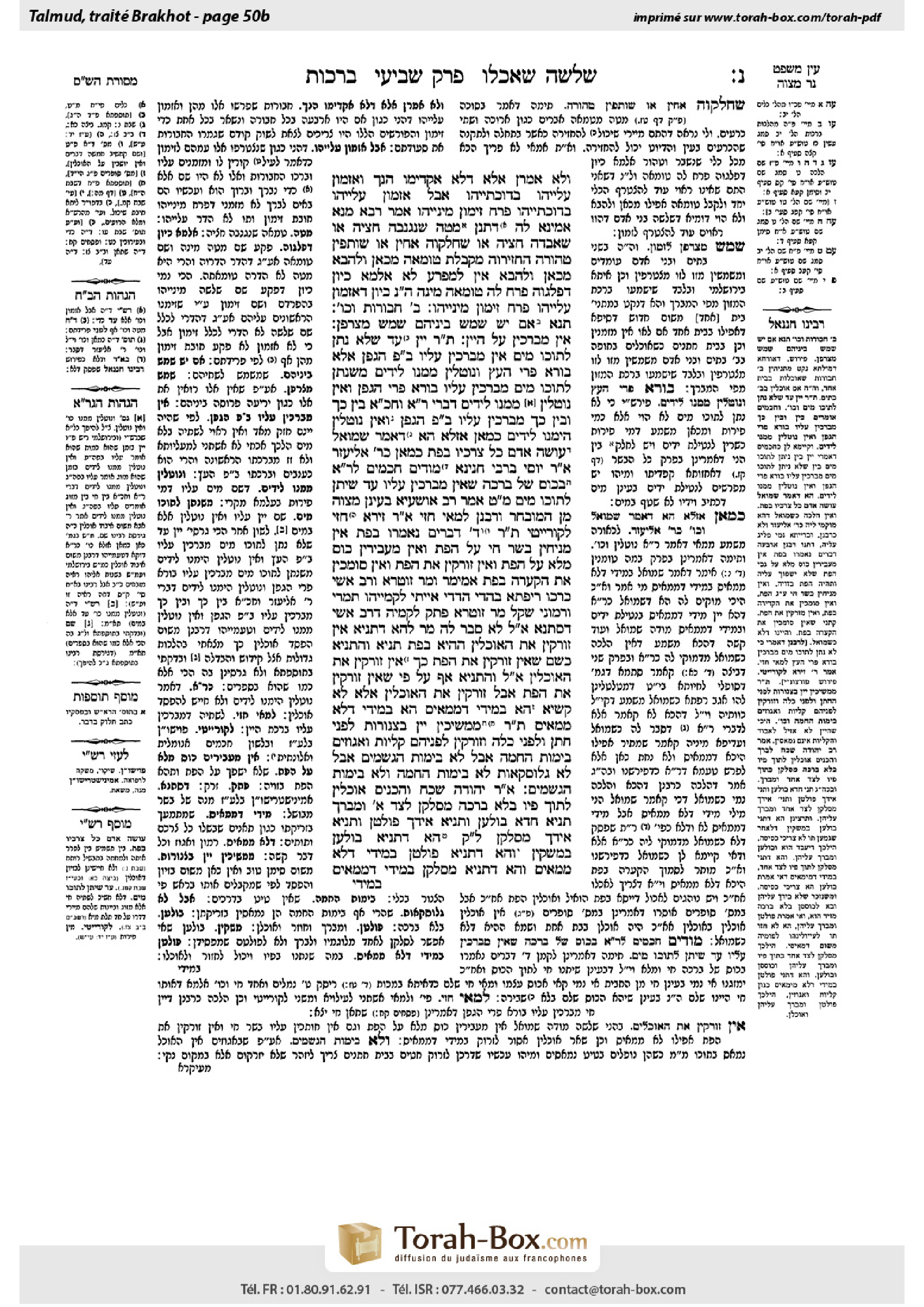
Berakhot 50b: Talmud study for Daf Yomi
Study the Talmud for Daf Yomi with scanned pages, Hebrew text, English translations from Sefaria and AI-generated French translations.
Passage selection and English or AI-generated French translation are available where the scan has annotations. Daf Study is independent of Torah-Box and Sefaria.
Browse Berakhot · ברכות · All tractatesBerakhot 50b text and translations
This page of Berakhot includes the Aramaic text, an English translation and an AI-generated French translation, alongside the scan above.
ברכות נ׳ ב · Aramaic and Hebrew text
וְלָא אֲמַרַן אֶלָּא דְּלָא אַקְדִּימוּ הָנָךְ וְאַזְמוּן עֲלַיְיהוּ בְּדוּכְתַּיְיהוּ, אֲבָל אַזְמוּן עֲלַיְיהוּ בְּדוּכְתַּיְיהוּ — פְּרַח זִימּוּן מִינַּיְיהוּ.
אָמַר רָבָא: מְנָא אָמֵינָא לַהּ — דִּתְנַן: מִטָּה שֶׁנִּגְנְבָה חֶצְיָהּ, אוֹ שֶׁאָבְדָה חֶצְיָהּ, אוֹ שֶׁחֲלָקוּהָ אַחִין אוֹ שׁוּתָּפִין — טְהוֹרָה. הֶחֱזִירוּהָ — מְקַבֶּלֶת טוּמְאָה מִכָּאן וּלְהַבָּא.
מִכָּאן וּלְהַבָּא — אִין, לְמַפְרֵעַ — לָא. אַלְמָא, כֵּיוָן דְּפַלְגוּהָ — פְּרַח לַהּ טוּמְאָה מִינַּהּ. הָכָא נָמֵי כֵּיוָן דְּאַזְמוּן עֲלַיְיהוּ, פְּרַח זִימּוּן מִינַּיְיהוּ.
שְׁתֵּי חֲבוּרוֹת וְכוּ׳. תָּנָא: אִם יֵשׁ שַׁמָּשׁ בֵּינֵיהֶם — שַׁמָּשׁ מְצָרְפָן.
אֵין מְבָרְכִין עַל הַיַּיִן. תָּנוּ רַבָּנַן: יַיִן עַד שֶׁלֹּא נָתַן לְתוֹכוֹ מַיִם — אֵין מְבָרְכִין עָלָיו ״בּוֹרֵא פְּרִי הַגֶּפֶן״ אֶלָּא ״בּוֹרֵא פְּרִי הָעֵץ״. וְנוֹטְלִין מִמֶּנּוּ לַיָּדַיִם. מִשֶּׁנָּתַן לְתוֹכוֹ מַיִם — מְבָרְכִין עָלָיו ״בּוֹרֵא פְּרִי הַגֶּפֶן״, וְאֵין נוֹטְלִין מִמֶּנּוּ לַיָּדַיִם, דִּבְרֵי רַבִּי אֱלִיעֶזֶר. וַחֲכָמִים אוֹמְרִים: בֵּין כָּךְ וּבֵין כָּךְ, מְבָרְכִין עָלָיו ״בּוֹרֵא פְּרִי הַגֶּפֶן״ וְאֵין נוֹטְלִין הֵימֶנּוּ לַיָּדַיִם.
כְּמַאן אָזְלָא הָא דְּאָמַר שְׁמוּאֵל: עוֹשֶׂה אָדָם כׇּל צְרָכָיו בְּפַת, כְּמַאן? כְּרַבִּי אֱלִיעֶזֶר.
אָמַר רַבִּי יוֹסֵי בְּרַבִּי חֲנִינָא: מוֹדִים חֲכָמִים לְרַבִּי אֱלִיעֶזֶר בְּכוֹס שֶׁל בְּרָכָה שֶׁאֵין מְבָרְכִין עָלָיו עַד שֶׁיִּתֵּן לְתוֹכוֹ מַיִם. מַאי טַעְמָא? אָמַר רַב אוֹשַׁעְיָא: בָּעֵינַן מִצְוָה מִן הַמּוּבְחָר.
וְרַבָּנַן, לְמַאי חֲזֵי? אָמַר רַבִּי זֵירָא חֲזֵי לְקוּרְיָיטֵי.
תָּנוּ רַבָּנַן: אַרְבָּעָה דְּבָרִים נֶאֶמְרוּ בְּפַת: אֵין מַנִּיחִין בָּשָׂר חַי עַל הַפַּת. וְאֵין מַעֲבִירִין כּוֹס מָלֵא עַל הַפַּת. וְאֵין זוֹרְקִין אֶת הַפַּת. וְאֵין סוֹמְכִין אֶת הַקְּעָרָה בְּפַת.
אַמֵּימָר וּמָר זוּטְרָא וְרַב אָשֵׁי כְּרַכוּ רִיפְתָּא בַּהֲדֵי הֲדָדֵי, אַיְּיתִי לְקַמַּיְיהוּ תַּמְרֵי וְרִמּוֹנֵי. שְׁקַל מָר זוּטְרָא פְּתַק לְקַמֵּיהּ דְּרַב אָשֵׁי דַּסְתָּנָא. אֲמַר לֵיהּ: לָא סָבַר לַהּ מָר לְהָא דְּתַנְיָא אֵין זוֹרְקִין אֶת הָאוֹכָלִין? הַהִיא בְּפַת תַּנְיָא. וְהָתַנְיָא: כְּשֵׁם שֶׁאֵין זוֹרְקִין אֶת הַפַּת, כָּךְ אֵין זוֹרְקִין אֶת הָאוֹכָלִין! אֲמַר לֵיהּ: וְהָתַנְיָא: אַף עַל פִּי שֶׁאֵין זוֹרְקִין אֶת הַפַּת, אֲבָל זוֹרְקִין אֶת הָאוֹכָלִין!
אֶלָּא לָא קַשְׁיָא, הָא — בְּמִידֵּי דְּמִמְּאִיס, הָא — בְּמִידֵּי דְּלָא מִמְּאִיס.
תָּנוּ רַבָּנַן: מַמְשִׁיכִין יַיִן בְּצִנּוֹרוֹת לִפְנֵי חָתָן וְלִפְנֵי כַּלָּה, וְזוֹרְקִין לִפְנֵיהֶם קְלָיוֹת וֶאֱגוֹזִים בִּימוֹת הַחַמָּה, אֲבָל לֹא בִּימוֹת הַגְּשָׁמִים. אֲבָל לֹא גְּלוּסְקָאוֹת לֹא בִּימוֹת הַחַמָּה וְלָא בִּימוֹת הַגְּשָׁמִים.
אָמַר רַב יְהוּדָה: שָׁכַח וְהִכְנִיס אוֹכָלִין לְתוֹךְ פִּיו בְּלֹא בְּרָכָה — מְסַלְּקָן לְצַד אֶחָד וּמְבָרֵךְ.
תַּנְיָא חֲדָא: בּוֹלְעָן, וְתַנְיָא אִידַּךְ: פּוֹלְטָן, וְתַנְיָא אִידַּךְ: מְסַלְּקָן.
לָא קַשְׁיָא. הָא דְּתַנְיָא בּוֹלְעָן בְּמַשְׁקִין. וְהָא דְּתַנְיָא פּוֹלְטָן בְּמִידֵּי דְּלָא מִמְּאִיס. וְהָא דְּתַנְיָא מְסַלְּקָן בְּמִידֵּי דְּמִמְּאִיס.
Berakhot 50b · English translation
We only said this halakha in a case where those members of the previous groups did not include them in the zimmun in their original place, but in a case where they included them in the zimmun in their original place, their obligation to participate in a zimmun has left them. The obligation incumbent upon these three individuals to form a zimmun stems from their obligation to form a zimmun with the members of their original groups. If their groups already included them in a zimmun, their obligation as individuals has lapsed and they can no longer form another zimmun.
In order to explain the general principle contained in this halakhic ruling, Rava said: From where do I derive to say this halakha? As we learned in a mishna: A ritually impure bed, half of which was stolen or half of which was lost, or it was divided by brothers after they inherited it from their father, or was divided by partners, it is ritually pure. This is true with regard to any ritually impure utensil that was broken or divided; it is no longer a utensil and is therefore ritually pure. However, if they restored it and reattached the parts, it is susceptible to ritual impurity from here on.
Rava infers: From here on, yes, it is susceptible to ritual impurity, retroactively, no, it does not reassume its previous status of ritual impurity. Apparently, once they divided it, the ritual impurity left it. Although it was restored, it does not reassume its previous status of ritual impurity. Here, too, once they included them in the zimmun, their obligation left them and they do not reassume their previous obligation.
The mishna explained the circumstances in which two groups that were eating in one house may combine to form a zimmun. The Gemara adds: It was taught: If there is a common waiter among them, serving both groups, the waiter joins them into a single group, even if they cannot see each other.
In the mishna, we learned: One does not recite a blessing over wine until he adds water to it, that is the statement of Rabbi Eliezer. And the Rabbis say: One recites a blessing over it. Regarding this, the Sages taught in the Tosefta: Over wine, until he added water to it, one does not recite: Who creates fruit of the vine; rather, he recites: Who creates fruit of the tree, as it is merely fruit juice and not wine. Moreover, since it is not halakhically considered wine, one ritually washes his hands with it. Once he added water to it, however, it is considered wine, and one recites over it: Who creates fruit of the vine, and one does not ritually wash his hands with it, that is the statement of Rabbi Eliezer. The Rabbis say: In either case, whether water has been added or not, it is considered wine for all intents and purposes, and one recites over it: Who creates fruit of the vine, and one may not ritually wash his hands from it.
In accordance with whose opinion is that halakha which Shmuel said: A person may perform all his needs with bread? He may use it for purposes other than food, and he need not be concerned that he is treating the food contemptuously. In accordance with whose opinion among the tannaitic opinions cited above? The Gemara answers: It is in accordance with the opinion of Rabbi Eliezer, who permits one to wash his hands with undiluted wine.
Rabbi Yosei bar Rabbi Ḥanina said: The Rabbis agree with Rabbi Eliezer with regard to a cup of blessing, e.g., the cup of wine over which Grace after Meals is recited, that one does not recite a blessing over it until he adds water to it. What is the reason? Rav Oshaya said: We require that a mitzva be performed in the best possible manner.
With regard the issue of wine itself, the Gemara asks: And according to the Rabbis, for what is undiluted wine, which is virtually undrinkable, fit? Rabbi Zeira said: It is good for koraiytei, a medicinal drink made of wine and oil.
The Gemara continues to discuss the topic of using food. The Sages taught: Four things were said with regard to bread: One may not place raw meat on bread so the blood will not drip onto the bread and render it inedible; and one may not pass a full cup of wine over bread lest the wine drip on it and ruin the bread; and one may not throw bread; and one may not prop up a dish with a piece of bread. The basis for these laws is the need to treat bread with respect.
The Gemara recounts: Ameimar, Mar Zutra and Rav Ashi ate bread together when they brought dates and pomegranates before them. Mar Zutra took fruit and threw a portion before Rav Ashi. Rav Ashi was astounded and said to him: Does the Master not hold with that which was taught in a baraita: One may not throw food? He responded: That was taught with regard to bread, not other foods. Rav Ashi challenged him again: Wasn’t it taught in a baraita: Just as one may not throw bread, so too one may not throw other foods? Mar Zutra said to him: Wasn’t the opposite taught in another baraita: Although one may not throw bread, he may throw other foods?
Rather, that is not difficult, as the two baraitot address two different cases. This baraita, in which it is taught that one may not throw other foods, refers to a food item that becomes disgusting when thrown, whereas that baraita, in which it is taught that one may throw other foods, refers to a food item that does not become disgusting when thrown.
Similarly, the Sages taught: One may draw wine through pipes before a bride and groom as a blessed omen, and one may throw roasted grain and nuts before them in the summer, but not in the rainy season, as in the summer they can be retrieved and eaten, which is not the case in the rainy season. But one may not throw cakes, neither in the summer nor in the rainy season.
Rav Yehuda said: If one forgot and put food items in his mouth without reciting a blessing, he moves them to one side of his mouth and recites the blessing.
The Gemara notes that there are three baraitot on this topic: It was taught in one baraita: He swallows them. It was taught in another baraita: He spits them out. Another baraita taught: He moves them to the side of his mouth.
The Gemara explains: That is not difficult, as each baraita addresses a different case. This baraita in which it was taught: He swallows them refers to liquids, as there is no alternative. This baraita in which it was taught: He spits them out, refers to a food item that does not become disgusting and if he removes it from his mouth he can subsequently eat it. This baraita in which it was taught: He moves them to the side of his mouth, refers to a food item that becomes disgusting, in which case it is sufficient to move it to the side.
Berakhot 50b · Traduction française (IA)
Nous avons dit cette halakha uniquement dans un cas où les membres des groupes précédents n'ont pas inclus ceux-ci dans le zimmun à leur lieu d'origine, mais dans un cas où ils les ont inclus dans le zimmun à leur lieu d'origine, leur obligation de participer à un zimmun a disparu. L'obligation qui pèse sur ces trois individus de former un zimmun provient de leur obligation de former un zimmun avec les membres de leurs groupes d'origine. Si leurs groupes ont déjà inclus ceux-ci dans un zimmun, leur obligation individuelle a pris fin et ils ne peuvent plus former un autre zimmun.
Afin d'expliquer le principe général contenu dans cette décision halakhique, Rava dit : D'où dérive-t-on cette halakha ? Comme nous avons appris dans une mitsva : Un lit impur, dont la moitié a été volée ou perdue, ou qui a été divisé par des frères après avoir hérité de leur père, ou divisé par des partenaires, est pur. Cela est vrai pour tout ustensile impur qui a été brisé ou divisé ; il n'est plus considéré comme un ustensile et est donc pur. Cependant, si on a restauré et réattaché les parties, il devient susceptible d'impureté rituelle à partir de ce moment-là.
Rava déduit : À partir de ce moment-là, oui, il est susceptible d'impureté rituelle, rétroactivement, non, il ne reprend pas son statut antérieur d'impureté rituelle. Apparemment, une fois qu'ils l'ont divisé, l'impureté rituelle l'a quitté. Bien qu'il ait été restauré, il ne reprend pas son statut antérieur d'impureté rituelle. De même, une fois qu'ils ont inclus ceux-ci dans le zimmun, leur obligation les a quittés et ils ne reprendront pas leur obligation antérieure.
La mitsna explique les circonstances dans lesquelles deux groupes mangeant dans la même maison peuvent se combiner pour former un zimmun. La Guemara ajoute : Il a été enseigné : Si l'un d'eux a un serveur commun servant les deux groupes, le serveur les unit en un seul groupe, même s'ils ne peuvent pas se voir.
Dans la mitsna, nous avons appris : On ne récite pas une berakha sur le vin jusqu'à ce qu'on y ait ajouté de l'eau, selon la déclaration de Rabbi Eliezer. Et les Sages disent : On récite une berakha sur lui. À ce sujet, les Sages ont enseigné dans la Tosefta : Sur le vin, jusqu'à ce qu'on y ait ajouté de l'eau, on ne récite pas : Qui crée les fruits de la vigne ; on récite plutôt : Qui crée les fruits des arbres, car c'est simplement du jus de fruit et non du vin. De plus, puisqu'il n'est pas considéré halakhiquement comme du vin, on rituellement lave ses mains avec lui. Cependant, une fois qu'on y a ajouté de l'eau, il est considéré comme du vin, et on récite sur lui : Qui crée les fruits de la vigne, et on ne rituellement lave ses mains avec lui, selon Rabbi Eliezer. Les Sages disent : Dans tous les cas, que de l'eau ait été ajoutée ou non, il est considéré comme du vin pour tous les effets, et on récite sur lui : Qui crée les fruits de la vigne, et on ne rituellement lave ses mains avec lui.
Selon l'opinion de qui est-ce que cette halakha, que Shmuel a dit : Une personne peut accomplir toutes ses besognes avec du pain ? Il peut l'utiliser à d'autres fins que la nourriture, et il n'a pas à craindre de traiter la nourriture avec mépris. Selon l'opinion de qui parmi les opinions tannaitiques citées ci-dessus ? La Guemara répond : C'est selon l'opinion de Rabbi Eliezer, qui permet à une personne de laver ses mains avec du vin non dilué.
Rabbi Yosei bar Rabbi Ḥanina a dit : Les Sages sont d'accord avec Rabbi Eliezer concernant un verre de bénédiction, c'est-à-dire le verre de vin sur lequel on récite la berakha après le repas, que l'on ne récite pas une berakha sur lui jusqu'à ce qu'on y ait ajouté de l'eau. Quelle est la raison ? Rav Oshaya a dit : Nous exigeons que la mitsva soit accomplie dans le meilleur des modes possibles.
Concernant la question du vin lui-même, la Guemara pose la question : Et selon les Sages, à quoi sert le vin non dilué, qui est presque inbibable ? Rabbi Zeira a dit : Il est bon pour les koraiytei, un breuvage médical composé de vin et d'huile.
La Guemara continue à discuter du sujet de l'utilisation des aliments. Les Sages ont enseigné : Quatre choses ont été dites concernant le pain : On ne doit pas placer de viande crue sur le pain afin que le sang ne s'écoule pas sur le pain et ne le rende non comestible ; et on ne doit pas passer un verre plein de vin sur le pain de peur que le vin s'écoule sur lui et dégrade le pain ; et on ne doit pas jeter du pain ; et on ne doit pas appuyer un plat avec un morceau de pain. La base de ces lois est le besoin de traiter le pain avec respect.
La Guemara rapporte : Ameimar, Mar Zutra et Rav Ashi mangeaient du pain ensemble lorsqu'ils présentaient des dattes et des grenades devant eux. Mar Zutra a pris des fruits et a jeté une portion devant Rav Ashi. Rav Ashi a été stupéfait et a dit à lui : Le Maître ne tient-il pas à l'opinion qui a été enseignée dans une baraïta : On ne doit pas jeter les aliments ? Il a répondu : Cela a été enseigné concernant le pain, pas d'autres aliments. Rav Ashi a contesté à nouveau : N'était-il pas enseigné dans une baraïta : Comme on ne doit pas jeter le pain, de même on ne doit pas jeter d'autres aliments ? Mar Zutra a dit à lui : N'était-ce pas enseigné dans une autre baraïta : Bien que l'on ne doive pas jeter le pain, l'on peut jeter d'autres aliments ?
Plutôt, cela n'est pas difficile, car les deux baraitot abordent deux cas différents. Cette baraïta, dans laquelle il est enseigné que l'on peut jeter d'autres aliments, fait référence à un aliment qui devient dégoûtant lorsqu'il est jeté, tandis que celle dans laquelle il est enseigné que l'on peut jeter d'autres aliments fait référence à un aliment qui ne devient pas dégoûtant lorsqu'il est jeté.
De même, les Sages ont enseigné : On peut faire couler du vin à travers des tuyaux devant le marié et la mariée comme un présage béni, et on peut jeter des grains grillés et des noix devant eux en été, mais pas en saison des pluies, car en été ils peuvent être récupérés et mangés, ce qui n'est pas le cas en saison des pluies. Cependant, on ne peut pas jeter des gâteaux, ni en été ni en saison des pluies.
Rav Yehuda a dit : Si l'on oublie et qu'on place des aliments dans sa bouche sans réciter une berakha, on déplace les aliments d'un côté de sa bouche et récite la berakha.
La Guemara note que trois baraitot sont mentionnées sur ce sujet : Il a été enseigné dans une baraïta : Il les avale. Il a été enseigné dans une autre baraïta : Il les éjecte. Une autre baraïta enseigne : Il les déplace vers le côté de sa bouche.
La Guemara explique : Ce n'est pas difficile, car chaque baraïta traite d'un cas différent. Cette baraïta dans laquelle il a été enseigné : Il les avale, fait référence aux liquides, car il n'y a pas d'autre alternative. Cette baraïta dans laquelle il a été enseigné : Il les éjecte, fait référence à un aliment qui ne devient pas dégoûtant, et s'il le retire de sa bouche, il peut ensuite le manger. Cette baraïta dans laquelle il a été enseigné : Il les déplace vers le côté de sa bouche, fait référence à un aliment qui devient dégoûtant, dans ce cas, il suffit de le déplacer vers le côté.
Traduction française générée par IA à partir de l’édition anglaise de Sefaria. Vérifie toujours un passage avec le texte source.
Text from Sefaria: William Davidson Edition - Vocalized Aramaic (CC BY NC); William Davidson Edition - English (CC BY NC).