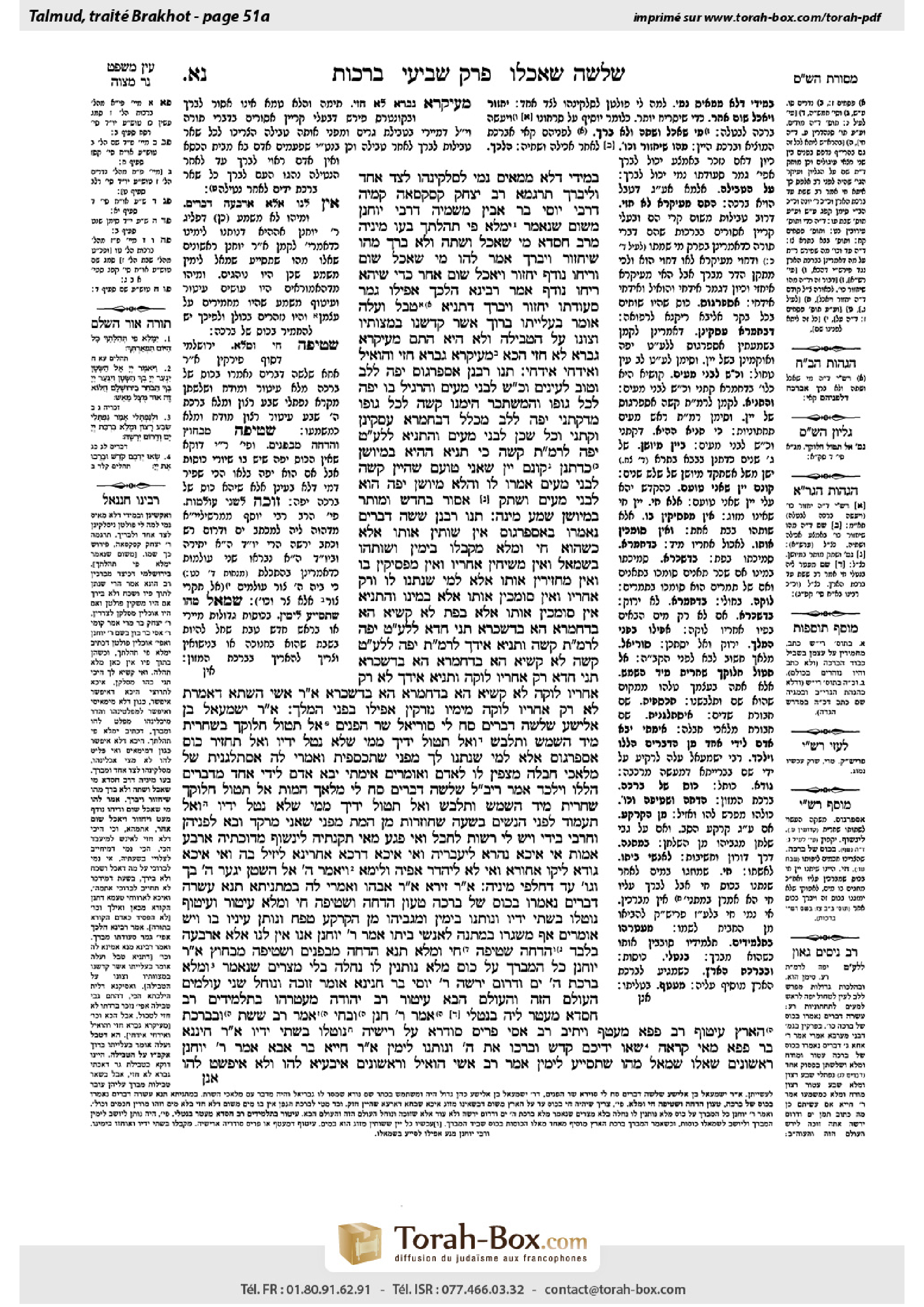
Berakhot 51a: Talmud study for Daf Yomi
Study the Talmud for Daf Yomi with scanned pages, Hebrew text, English translations from Sefaria and AI-generated French translations.
Passage selection and English or AI-generated French translation are available where the scan has annotations. Daf Study is independent of Torah-Box and Sefaria.
Browse Berakhot · ברכות · All tractatesBerakhot 51a text and translations
This page of Berakhot includes the Aramaic text, an English translation and an AI-generated French translation, alongside the scan above.
ברכות נ״א א · Aramaic and Hebrew text
בְּמִידֵּי דְּלָא מִמְּאִיס נָמֵי, לְסַלְּקִינְהוּ לְצַד אֶחָד וְלִיבָרֵךְ? תַּרְגְּמַהּ רַב יִצְחָק קַסְקְסָאָה קַמֵּיהּ דְּרַבִּי יוֹסֵי בַּר אָבִין מִשְּׁמֵיהּ דְּרַבִּי יוֹחָנָן: מִשּׁוּם שֶׁנֶּאֱמַר ״יִמָּלֵא פִי תְּהִלָּתֶךָ״.
בְּעוֹ מִינֵּיהּ מֵרַב חִסְדָּא: מִי שֶׁאָכַל וְשָׁתָה וְלֹא בֵּרַךְ, מַהוּ שֶׁיַּחֲזוֹר וִיבָרֵךְ? אֲמַר לְהוּ: מִי שֶׁאָכַל שׁוּם וְרֵיחוֹ נוֹדֵף, יַחְזוֹר וְיֹאכַל שׁוּם אַחֵר כְּדֵי שֶׁיְּהֵא רֵיחוֹ נוֹדֵף?!
אָמַר רָבִינָא: הִלְכָּךְ אֲפִילּוּ גָּמַר סְעוּדָּתוֹ, יַחְזוֹר וִיבָרֵךְ. דְּתַנְיָא: טָבַל וְעָלָה, אוֹמֵר בַּעֲלִיָּיתוֹ ״בָּרוּךְ אֲשֶׁר קִדְּשָׁנוּ בְּמִצְוֹתָיו וְצִוָּנוּ עַל הַטְּבִילָה״.
וְלָא הִיא, הָתָם — מֵעִיקָּרָא גַּבְרָא לָא חֲזֵי, הָכָא — מֵעִיקָּרָא גַּבְרָא חֲזֵי, וְהוֹאִיל וְאִידְּחִי — אִידְּחִי.
תָּנוּ רַבָּנַן: אִסְפָּרָגוֹס — יָפֶה לַלֵּב וְטוֹב לָעֵינַיִם, וְכׇל שֶׁכֵּן לִבְנֵי מֵעַיִם. וְהָרָגִיל בּוֹ — יָפֶה לְכׇל גּוּפוֹ. וְהַמִּשְׁתַּכֵּר הֵימֶנּוּ — קָשֶׁה לְכׇל גּוּפוֹ.
מִדְּקָתָנֵי יָפֶה לַלֵּב, מִכְּלָל דִּבְחַמְרָא עָסְקִינַן, וְקָתָנֵי: וְכׇל שֶׁכֵּן לִבְנֵי מֵעַיִם. וְהָתַנְיָא: לְלַעַ״ט — יָפֶה, לְרָמַ״ת — קָשֶׁה!
כִּי תַּנְיָא הַהִיא, בִּמְיוּשָּׁן. כְּדִתְנַן: קֻוֽנָּם יַיִן שֶׁאֲנִי טוֹעֵם, שֶׁהַיַּיִן קָשֶׁה לִבְנֵי מֵעַיִם. אָמְרוּ לוֹ: וַהֲלֹא מְיוּשָּׁן יָפֶה הוּא לִבְנֵי מֵעַיִם! וְשָׁתַק — אָסוּר בְּחָדָשׁ, וּמוּתָּר בִּמְיוּשָּׁן. שְׁמַע מִינַּהּ.
תָּנוּ רַבָּנַן: שִׁשָּׁה דְּבָרִים נֶאֶמְרוּ בְּאִסְפָּרָגוֹס: אֵין שׁוֹתִין אוֹתוֹ אֶלָּא כְּשֶׁהוּא חַי וּמָלֵא; מְקַבְּלוֹ בְּיָמִין וְשׁוֹתֵהוּ בִּשְׂמֹאל; וְאֵין מְשִׂיחִין אַחֲרָיו, וְאֵין מַפְסִיקִין בּוֹ; וְאֵין מַחֲזִירִין אוֹתוֹ אֶלָּא לְמִי שֶׁנָּתְנוּ לוֹ; וְרָק אַחֲרָיו; וְאֵין סוֹמְכִין אוֹתוֹ אֶלָּא בְּמִינוֹ.
וְהָתַנְיָא אֵין סוֹמְכִין אוֹתוֹ אֶלָּא בְּפַת! לָא קַשְׁיָא, הָא — בִּדְחַמְרָא, הָא — בִּדְשִׁכְרָא.
תָּנֵי חֲדָא לְלַעַ״ט יָפֶה, לְרָמַ״ת קָשֶׁה. וְתַנְיָא אִידַּךְ: לְרָמַ״ת יָפֶה, לְלַעַ״ט קָשֶׁה! לָא קַשְׁיָא, הָא — בִּדְחַמְרָא, הָא — בִּדְשִׁכְרָא.
תָּנֵי חֲדָא: רָק אַחֲרָיו — לוֹקֶה. וְתַנְיָא אִידַּךְ: לֹא רָק אַחֲרָיו — לוֹקֶה! לָא קַשְׁיָא, הָא — בִּדְחַמְרָא, הָא — בִּדְשִׁכְרָא.
אָמַר רַב אָשֵׁי: הַשְׁתָּא דְּאָמְרַתְּ לֹא רָק אַחֲרָיו לוֹקֶה, מֵימָיו נִזְרָקִין אֲפִילּוּ בִּפְנֵי הַמֶּלֶךְ.
אָמַר רַבִּי יִשְׁמָעֵאל בֶּן אֱלִישָׁע: שְׁלֹשָׁה דְּבָרִים סָח לִי סוּרִיאֵל שַׂר הַפָּנִים: אַל תִּטּוֹל חֲלוּקְךָ בְּשַׁחֲרִית מִיַּד הַשַּׁמָּשׁ וְתִלְבַּשׁ. וְאַל תִּטּוֹל יָדֶיךָ מִמִּי שֶׁלֹּא נָטַל יָדָיו. וְאַל תַּחֲזִיר כּוֹס אִסְפָּרָגוֹס אֶלָּא לְמִי שֶׁנְּתָנוֹ לְךָ — מִפְּנֵי שֶׁתַּכְסְפִית, וְאָמְרִי לַהּ, אִסְתַּלְגָּנִית שֶׁל מַלְאֲכֵי חַבָּלָה מְצַפִּין לוֹ לָאָדָם, וְאוֹמְרִים: אֵימָתַי יָבֹא אָדָם לִידֵי אֶחָד מִדְּבָרִים הַלָּלוּ וְיִלָּכֵד.
אָמַר רַבִּי יְהוֹשֻׁעַ בֶּן לֵוִי, שְׁלֹשָׁה דְּבָרִים סָח לִי מַלְאַךְ הַמָּוֶת: אַל תִּטּוֹל חֲלוּקְךָ שַׁחֲרִית מִיַּד הַשַּׁמָּשׁ וְתִלְבַּשׁ. וְאַל תִּטּוֹל יָדֶיךָ מִמִּי שֶׁלֹּא נָטַל יָדָיו. וְאַל תַּעֲמוֹד לִפְנֵי הַנָּשִׁים בְּשָׁעָה שֶׁחוֹזְרוֹת מִן הַמֵּת, מִפְּנֵי שֶׁאֲנִי מְרַקֵּד וּבָא לִפְנֵיהֶן וְחַרְבִּי בְּיָדַי וְיֵשׁ לִי רְשׁוּת לְחַבֵּל.
וְאִי פָּגַע, מַאי תַּקַּנְתֵּיהּ? לִינְשׁוֹף מִדּוּכְתֵּיהּ אַרְבַּע אַמּוֹת, אִי אִיכָּא נַהֲרָא — לֶיעְבְּרֵיהּ, וְאִי אִיכָּא דַּרְכָּא אַחֲרִינָא — לֵיזִיל בַּהּ, וְאִי אִיכָּא גּוּדָא — לֵיקוּ אֲחוֹרָא, וְאִי לָא — לַיהְדַּר אַפֵּיהּ וְלֵימָא: ״וַיֹּאמֶר ה׳ אֶל הַשָּׂטָן יִגְעַר ה׳ בְּךָ וְגוֹ׳״ עַד דְּחָלְפִי מִינֵּיהּ.
אָמַר רַבִּי זֵירָא אָמַר רַבִּי אֲבָהוּ, וְאָמְרִי לַהּ בְּמַתְנִיתָא תָּנָא: עֲשָׂרָה דְּבָרִים נֶאֶמְרוּ בְּכוֹס שֶׁל בְּרָכָה: טָעוּן הַדָּחָה וּשְׁטִיפָה. חַי וּמָלֵא. עִיטּוּר וְעִיטּוּף. נוֹטְלוֹ בִּשְׁתֵּי יָדָיו, וְנוֹתְנוֹ בַּיָּמִין. וּמַגְבִּיהוֹ מִן הַקַּרְקַע טֶפַח, וְנוֹתֵן עֵינָיו בּוֹ. וְיֵשׁ אוֹמְרִים: אַף מְשַׁגְּרוֹ בְּמַתָּנָה לְאַנְשֵׁי בֵיתוֹ.
אָמַר רַבִּי יוֹחָנָן: אָנוּ אֵין לָנוּ אֶלָּא אַרְבָּעָה בִּלְבַד: הֲדָחָה, שְׁטִיפָה, חַי, וּמָלֵא. תָּנָא: הֲדָחָה — מִבִּפְנִים, וּשְׁטִיפָה — מִבַּחוּץ.
אָמַר רַבִּי יוֹחָנָן: כׇּל הַמְבָרֵךְ עַל כּוֹס מָלֵא — נוֹתְנִין לוֹ נַחֲלָה בְּלִי מְצָרִים, שֶׁנֶּאֱמַר: ״וּמָלֵא בִּרְכַּת ה׳ יָם וְדָרוֹם יְרָשָׁה״. רַבִּי יוֹסֵי בַּר חֲנִינָא אוֹמֵר: זוֹכֶה וְנוֹחֵל שְׁנֵי עוֹלָמִים, הָעוֹלָם הַזֶּה וְהָעוֹלָם הַבָּא.
עִיטּוּר. רַב יְהוּדָה מְעַטְּרֵהוּ בְּתַלְמִידִים, רַב חִסְדָּא מְעַטַּר לֵיהּ בְּנַטְלֵי. אָמַר רַבִּי חָנָן: וּבְחַי. אָמַר רַב שֵׁשֶׁת: וּבְבִרְכַּת הָאָרֶץ.
עִיטּוּף. רַב פָּפָּא מִעַטַּף וְיָתֵיב. רַב אַסִּי פָּרֵיס סוּדָרָא עַל רֵישֵׁיהּ.
נוֹטְלוֹ בִּשְׁתֵּי יָדָיו. אָמַר רַבִּי חִינָּנָא בַּר פָּפָּא: מַאי קְרָאָה? — ״שְׂאוּ יְדֵיכֶם קֹדֶשׁ וּבָרְכוּ אֶת ה׳״.
וְנוֹתְנוֹ לַיָּמִין. אָמַר רַבִּי חִיָּיא בַּר אַבָּא אָמַר רַבִּי יוֹחָנָן: רִאשׁוֹנִים שָׁאֲלוּ: שְׂמֹאל מַהוּ שֶׁתְּסַיֵּיעַ לַיָּמִין? אָמַר רַב אָשֵׁי: הוֹאִיל וְרִאשׁוֹנִים אִיבַּעְיָא לְהוּ וְלֹא אִיפְּשִׁט לְהוּ,
Berakhot 51a · English translation
The Gemara asks: With regard to a food item that does not become disgusting as well, let him shift it to the side and recite the blessing. Why need he spit it out? Rav Yitzḥak Kaskesa’a explained before Rabbi Yosei bar Avin, in the name of Rabbi Yoḥanan: One spits it out because it is stated: “My mouth will be filled with Your praise” (Psalms 71:8), meaning that one should recite God’s praises with his entire mouth, not merely half.
They raised a dilemma before Rav Ḥisda: One who ate and drank and did not recite a blessing, what is the ruling? Does he return and recite the blessing that he should have recited beforehand before he continues eating or not? In response, Rav Ḥisda said to them an analogy: Should one who ate garlic and the odor on his breath smells return and eat another garlic so that the odor on his breath will smell? That is to say, one must recite a blessing. Should one who committed a transgression and failed to recite a blessing before eating, remedy his situation by continuing to eat without reciting a blessing (Talmidei Rabbeinu Yona)?
Ravina said: Therefore, even if one finished his meal, he must return and recite a blessing. He cites a proof, as it was taught in a baraita with regard to the laws of immersion: One who was ritually impure who immersed himself in a ritual bath and emerged, as he emerges he recites: Blessed…Who has made us holy through His mitzvot and has commanded us about ritual immersion. Evidently, in certain cases, one may recite the blessing after completing the act.
The Gemara rejects the parallel between the cases: That is not so, as there, in the case of immersion, initially, before he immersed himself, the man was unfit to recite the blessing because he was ritually impure; here, in the case where one did not recite a blessing before eating, initially he was fit to recite the blessing, and since he did not recite the blessing before he ate and he concluded his meal and is, therefore, excluded from reciting the blessing, he is completely excluded and has no way to remedy the situation.
Tangential to the laws concerning wine that the Gemara cited earlier, the Sages taught: Asparagus, wine or other alcoholic beverages that they were accustomed to drink early in the morning before eating, is agreeable for the heart and beneficial for the eyes, and all the more so for the intestines. And in extolling the virtues of this drink, the Gemara says: One who is accustomed to drink it, it is agreeable for his entire body. However, one must be careful, as one who drinks excessively and becomes drunk, it is harmful for his entire body.
The Gemara discusses this: From the fact that it was taught that asparagus is agreeable for the heart, it may be inferred that we are dealing with asparagus made from wine, which is known to be agreeable for the heart. And we learned: And all the more so, asparagus is beneficial for the intestines. Wasn’t it taught in a baraita: For L-E-T, which is an acronym for lev, heart; einayim, eyes; teḥol, spleen, it is beneficial, but for R-M-T, rosh, head; me’ayim, intestines; taḥtoniot, hemorrhoids, it is harmful. Apparently, asparagus is harmful for one’s intestines.
The Gemara responds: That baraita, in which it was taught that asparagus is beneficial to one’s intestines, refers to asparagus made with old wine. As we learned in the mishna concerning the laws of vows that one who vowed: Wine is konam for me to taste because it is harmful to the intestines, and those who heard him said to him: But isn’t old wine beneficial to the intestines? If he was silent and did not argue the point, he is forbidden to drink new wine because of his vow, but he is permitted to drink old wine. Conclude from this that old wine is beneficial for the intestines.
The Sages taught: Six things were said with regard to asparagus: One only drinks it undiluted and from a full cup; he receives it from the attendant in his right hand and drinks it with his left hand; one should not converse after drinking it and one does not stop while drinking it, but should drink it all at once; one only returns it to the one who gave it to him; and he spits after drinking it; and one may only supplement it with its own kind, meaning that after drinking asparagus, one should only eat something that is used to make similar beverages, e.g., dates after date beer, etc.
The Gemara challenges: Wasn’t it taught in a baraita that one may only supplement asparagus with bread? The Gemara responds: That is not difficult. This baraita, in which it was taught that one supplements it with bread, refers to asparagus made of wine, while that baraita, in which it was taught that one supplements it with its own kind, refers to asparagus made of beer.
It was taught in one baraita that asparagus is beneficial for L-E-T, heart, eyes, and spleen, and harmful for R-M-T, head, intestines, and hemorrhoids. And it was taught in another baraita that asparagus is beneficial for R-M-T, head, intestines, and hemorrhoids, and harmful for L-E-T, heart, eyes, and spleen. The Gemara responds: That is not difficult. This baraita, in which it was taught that asparagus is beneficial for L-E-T, refers to asparagus made of wine, while that baraita, in which it was taught that asparagus is harmful for L-E-T, refers to asparagus made of beer.
The Gemara resolves a contradiction between two other baraitot in the same manner. It was taught in one baraita that if he spit after drinking asparagus, he suffers an illness. And it was taught in another baraita that if he did not spit after drinking asparagus, he suffers an illness. The Gemara responds: That is not difficult. This baraita, in which it was taught that if he spit after drinking it he suffers an illness, refers to asparagus made of wine, while that baraita, in which it was taught that if he did not spit he suffers an illness, refers to asparagus made of beer.
Rav Ashi said: Now that you said that if he did not spit after drinking it he suffers an illness, its water, the saliva in his mouth after drinking asparagus, may be expelled even when standing before the king, as failure to do so will endanger him.
Rabbi Yishmael ben Elisha said: Suriel, the heavenly ministering angel of the Divine Presence, told me three things from on high: Do not take your cloak in the morning from the hand of your servant and wear it; do not ritually wash your hands from one who has not ritually washed his own hands; and only return a cup of asparagus to the one who gave it to you. Why is this? Because a band of demons and some say a band of angels of destruction lie in wait for a person and say: When will a person encounter one of these circumstances and be captured?
Similarly, the Gemara relates that Rabbi Yehoshua ben Levi said: The Angel of Death told me three things: Do not take your cloak in the morning from the hand of your servant and wear it; do not ritually wash your hands from one who has not ritually washed his own hands; and do not stand before the women when they return from the burial of the deceased, because I dance and come before them and my sword is in hand, and I have license to destroy.
The Gemara asks: And if one encounters women returning from a funeral, what is his remedy? The Gemara answers: Let him jump four cubits from where he stands; if there is a river, let him cross it; if there is another path, let him go down it; if there is a wall, let him stand behind it; and if not, he should turn his face around and recite the verse: “And the Lord said to the Satan: The Lord rebukes you, Satan, the Lord that has chosen Jerusalem rebukes you; is not this man a brand plucked from the fire?” (Zechariah 3:2), until they pass him.
Rabbi Zeira said that Rabbi Abbahu said, and some say that this halakha was taught in a baraita: Ten things were said with regard to a cup of blessing, e.g., the cup of wine over which Grace after Meals is recited: It requires rinsing and washing; it must be undiluted wine, and full; it requires adorning and wrapping; he takes it in his two hands and places it in his right hand, and he lifts it at least one handbreadth from the ground, and when reciting the blessing he fixes his eyes upon it. And some say: He also sends it as a gift to members of his household.
Rabbi Yoḥanan said: We only have four of those ten things: Rinsing, washing, the wine must be undiluted, and the cup must be full. In explanation, it was taught: Rinsing is from the inside of the cup, and washing is from the outside of the cup.
Rabbi Yoḥanan said: Anyone who recites a blessing over a full cup, they give him a boundless inheritance, as it is stated: “And full of the blessing of the Lord, possess the sea and the south” (Deuteronomy 33:23), indicating that one whose cup is full will receive God’s blessing and will inherit from all sides. Rabbi Yosei bar Ḥanina says: He merits and inherits two worlds, this world and the World-to-Come.
The Gemara continues explaining the ten things said with regard to the cup of blessing: The Sages would adorn the cup of blessing in different ways. Rav Yehuda would adorn it with students, as when he recited the blessing he would surround himself with students to accord honor to the blessing. Rav Ḥisda, however, would adorn it with other cups; he would surround the cup of blessing with other cups. Rabbi Ḥanan said: And specifically with undiluted wine. Rav Sheshet said: And in the blessing of the land.
The Sages also had different customs with regard to wrapping. Rav Pappa would wrap himself in his prayer shawl and sit and recite Grace after Meals. Rav Asi spread a cloth on his head as an sign of respect.
With regard to what was said that he takes it in his two hands, Rabbi Ḥinnana bar Pappa said: What is the verse that proves this? As it is stated: “Lift your hands in holiness and bless the Lord” (Psalms 134:2).
As for what was said after he takes it in his two hands: And he places it in his right hand, Rabbi Ḥiyya bar Abba said that Rabbi Yoḥanan said: The early Sages asked: What is the ruling, may the left hand assist the right when taking the cup? Rav Ashi said: Since the early Sages raised this dilemma and it was not resolved for them,
Berakhot 51a · Traduction française (IA)
Le Guemara pose la question : Concernant un aliment qui ne devient pas dégoûtant, il faut le déplacer vers le côté et réciter la bénédiction. Pourquoi doit-on le cracher ? Rav Yitzḥak Kaskesa’a expliqua devant Rabbi Yosei bar Avin, en nom de Rabbi Yoḥanan : On le crache car il est dit : « Mon bouche sera remplie de tes louanges » (Psaumes 71:8), ce qui signifie qu'on doit réciter les louanges de Dieu avec toute sa bouche, et non seulement la moitié.
Ils soulevèrent un dilemme devant Rav Ḥisda : Celui qui a mangé et bu sans réciter une bénédiction, quelle est la décision ? Doit-il revenir et réciter la bénédiction qu'il aurait dû réciter auparavant avant de continuer à manger ou non ? En réponse, Rav Ḥisda dit à ceux-ci une analogie : Doit-on que celui qui a mangé de l'ail et dont l'odeur du souffle est forte, revienne et mange un autre ail afin que l'odeur de son souffle soit forte ? C'est-à-dire qu'on doit réciter une bénédiction. Doit-on que celui qui a commis un péché et n'a pas récité une bénédiction avant de manger, corrige sa situation en continuant à manger sans réciter une bénédiction (Talmidei Rabbeinu Yona) ?
Ravina dit : Par conséquent, même si l'on a terminé son repas, il faut revenir et réciter une bénédiction. Il cite une preuve, car il fut enseigné dans une baraïta concernant les lois de l'immersion : Celui qui était impur rituellement, s'est immergé dans un mikvé et en est sorti, lorsqu'il en sort, il récite : Béni… Celui qui nous a sanctifiés par Ses commandements et nous a ordonné l'immersion rituelle. Évidemment, dans certains cas, on peut réciter la bénédiction après avoir accompli l'acte.
Le Guemara rejette cette comparaison : Ce n'est pas ainsi, car là, dans le cas de l'immersion, initialement, avant qu'il ne s'immerge, l'homme était inapte à réciter la bénédiction car il était impur rituellement ; ici, dans le cas où l'on n'a pas récité une bénédiction avant de manger, initialement, l'homme était apte à réciter la bénédiction, et puisqu'il n'a pas récité la bénédiction avant de manger et qu'il a terminé son repas et est donc exclu de réciter la bénédiction, il est totalement exclu et n'a plus de moyen de corriger la situation.
En marge des lois concernant le vin que le Guemara cita plus tôt, les Sages enseignèrent : L'asperge, le vin ou d'autres boissons alcooliques qu'ils étaient habitués à boire tôt le matin avant de manger, est agréable pour le cœur et bénéfique pour les yeux, et encore plus pour les intestins. Et en exaltant les vertus de cette boisson, le Guemara dit : Celui qui est habitué à boire cela, cela est agréable pour son corps entier. Cependant, on doit être prudent, car celui qui boit excessivement et devient ivre, cela est nuisible pour son corps entier.
Le Guemara discute cela : D'après le fait qu'il fut enseigné que l'asperge est agréable pour le cœur, on peut en déduire qu'il s'agit d'asperge fait avec du vin, qui est connu pour être agréable pour le cœur. Et nous apprenons : Et encore plus, l'asperge est bénéfique pour les intestins. N'était-ce pas enseigné dans une baraïta : Pour L-E-T, qui est un acronyme pour lev, cœur ; einayim, yeux ; teḥol, rate, il est bénéfique, mais pour R-M-T, rosh, tête ; me'ayim, intestins ; taḥtoniot, hémorroïdes, il est nuisible. Apparemment, l'asperge est nuisible pour les intestins.
Le Guemara répond : Cette baraïta, dans laquelle il fut enseigné que l'asperge est bénéfique pour les intestins, fait référence à l'asperge fait avec du vin ancien. Comme nous apprenons dans la mitsva concernant les vœux, celui qui vœut : Le vin est konam pour moi à goûter car il est nuisible pour les intestins, et ceux qui l'ont entendu lui dirent : N'est-ce pas que le vin ancien est bénéfique pour les intestins ? Si il reste silencieux et ne conteste pas ce point, il est interdit de boire du vin nouveau à cause de son vœu, mais il est permis de boire du vin ancien. Concluez-en que le vin ancien est bénéfique pour les intestins.
Les Sages enseignèrent : Six choses furent dites concernant l'asperge : On le boit seulement non dilué et à partir d'un bol plein ; on le reçoit de l'attendant à la main droite et on le boit avec la main gauche ; on ne doit pas parler après avoir bu et on ne doit pas s'arrêter pendant qu'on boit, mais on doit boire tout d'un coup ; on le remet seulement à celui qui l'a donné ; et on crache après avoir bu ; et on peut seulement le compléter avec son propre genre, c'est-à-dire qu'après avoir bu l'asperge, on doit seulement manger quelque chose qui est utilisé pour faire des boissons similaires, par exemple, des dattes après du vin de dattes, etc.
Le Guemara conteste : N'était-ce pas enseigné dans une baraïta que l'asperge peut être complété seulement avec du pain ? Le Guemara répond : Ce n'est pas difficile. Cette baraïta, dans laquelle il fut enseigné que l'asperge peut être complété avec du pain, fait référence à l'asperge fait de vin, tandis que celle, dans laquelle il fut enseigné que l'asperge peut être complété avec son propre genre, fait référence à l'asperge fait de bière.
Il fut enseigné dans une baraïta que l'asperge est bénéfique pour le L-E-T, le cœur, les yeux et la rate, et nuisible pour le R-M-T, la tête, les intestins et les hémorroïdes. Et il fut enseigné dans une autre baraïta que l'asperge est bénéfique pour le R-M-T, la tête, les intestins et les hémorroïdes, et nuisible pour le L-E-T, le cœur, les yeux et la rate. La Guemara répond : Ce n'est pas difficile. Cette baraïta, dans laquelle il fut enseigné que l'asperge est bénéfique pour le L-E-T, fait référence à l'asperge fait de vin, tandis que celle, dans laquelle il fut enseigné que l'asperge est nuisible pour le L-E-T, fait référence à l'asperge fait de bière.
La Guemara résout une contradiction entre deux autres baraitot de la même manière. Il fut enseigné dans une baraïta que si l'on crache après avoir bu l'asperge, on souffre d'une maladie. Et il fut enseigné dans une autre baraïta que si l'on ne crache pas après avoir bu l'asperge, on souffre d'une maladie. La Guemara répond : Ce n'est pas difficile. Cette baraïta, dans laquelle il fut enseigné que si l'on crache après avoir bu l'asperge, on souffre d'une maladie, fait référence à l'asperge fait de vin, tandis que celle, dans laquelle il fut enseigné que si l'on ne crache pas, on souffre d'une maladie, fait référence à l'asperge fait de bière.
Rav Ashi a dit : Maintenant que vous avez dit que s'il ne crache pas après avoir bu, il souffrira d'une maladie, la salive dans sa bouche après avoir bu de l'asperge peut être expulsée même lorsqu'il est devant le roi, car l'ignorer mettrait en danger sa vie.
Rabbi Yishmael ben Elisha a dit : Suriel, l'ange ministre céleste de la Divine Présence, m'a dit trois choses du haut : Ne prends pas ton manteau le matin des mains de ton serviteur et porte-le ; ne laves pas rituellement tes mains d'une personne qui n'a pas lui-même lavé rituellement ses mains ; et ne remets qu'un verre d'asperge à celui qui t'a donné. Pourquoi ? Parce qu'un groupe de démons et certains disent un groupe d'anges de destruction attendent un homme et disent : Quand un homme rencontrera l'une de ces circonstances, sera-t-il capturé ?
De même, la Guemara rapporte que Rabbi Yehoshua ben Levi a dit : L'Ange de la Mort m'a dit trois choses : Ne prends pas ton manteau le matin des mains de ton serviteur et porte-le ; ne laves pas rituellement tes mains d'une personne qui n'a pas lui-même lavé rituellement ses mains ; et ne reste pas devant les femmes lorsqu'elles reviennent d'enterrer un mort, car je danse et je viens devant elles et mon épée est en main, et j'ai le droit de détruire.
La Guemara demande : Et si l'on rencontre des femmes revenant d'un enterrement, quelle est sa solution ? La Guemara répond : Qu'il saute quatre coudées du lieu où il se trouve ; s'il y a un fleuve, qu'il le traverse ; s'il y a un autre chemin, qu'il y aille ; s'il y a un mur, qu'il se tienne derrière ; et s'il n'y a pas, qu'il tourne le visage et récite le verset : « Et l'Éternel dit à Satan : L'Éternel t'adjure, Satan, l'Éternel qui a choisi Jérusalem t'adjure ; n'est-ce pas ce homme un brand plucké du feu ? » (Zacharie 3:2), jusqu'à ce qu'elles passent devant lui.
Rabbi Zeira a dit que Rabbi Abbahu a dit, et certains disent que cette halakha a été enseignée dans une baraïta : Dix choses ont été dites concernant un verre de bénédiction, c'est-à-dire le verre de vin sur lequel on récite le Chéma après les repas : Il exige un rincage et un lavage ; il doit être du vin non dilué et plein ; il exige une décoration et un emballage ; il le prend dans ses deux mains et le place dans sa main droite, et il le soulève au moins un tefach du sol, et lorsqu'il récite la bénédiction, il fixe ses yeux sur lui. Et certains disent : Il le donne également en cadeau à ses membres de la famille.
Rabbi Yoḥanan a dit : Nous n'avons que quatre de ces dix choses : Le rincage, le lavage, le vin doit être non dilué, et le verre doit être plein. En explication, il a été enseigné : Le rincage est à l'intérieur du verre, et le lavage est à l'extérieur du verre.
Rabbi Yoḥanan a dit : Quiconque récite une bénédiction sur un verre plein, lui est donné une héritage sans bornes, car il est dit : « Et plein de la bénédiction de l'Éternel, possède la mer et le sud » (Deutéronome 33:23), indiquant que celui dont le verre est plein recevra la bénédiction de Dieu et héritera de tous les côtés. Rabbi Yosei bar Ḥanina a dit : Il mérite et hérite deux mondes, ce monde et le Monde à Venir.
La Guemara continue d'expliquer les dix choses dites concernant le verre de bénédiction : Les Sages décoraient le verre de bénédiction de différentes manières. Rav Yehuda le décorait avec des élèves, car lorsqu'il récitait la bénédiction, il entourait lui-même des élèves pour accorder de l'honneur à la bénédiction. Rav Ḥisda, en revanche, le décorait avec d'autres verres ; il entourait le verre de bénédiction d'autres verres. Rabbi Ḥanan a dit : Et spécifiquement avec du vin non dilué. Rav Sheshet a dit : Et dans la bénédiction de la terre.
Les Sages avaient aussi des coutumes différents concernant l'emballage. Rav Pappa s'emballait dans sa chasidique et s'asseyait pour réciter le Chéma. Rav Asi étalait un tissu sur sa tête comme signe de respect.
Concernant ce qui a été dit qu'il le prend dans ses deux mains, Rabbi Ḥinnana bar Pappa a dit : Quel est le verset qui prouve cela ? Comme il est dit : « Lève tes mains en sainteté et bénis l'Éternel » (Psaumes 134:2).
Quant à ce qui a été dit après qu'il le prenne dans ses deux mains : Et il le place dans sa main droite, Rabbi Ḥiyya bar Abba a dit que Rabbi Yoḥanan a dit : Les Sages anciens ont posé la question : Quel est le jugement, peut la main gauche aider la main droite lors de la prise du verre ? Rav Ashi a dit : Puisque les Sages anciens ont soulevé ce dilemme et qu'il n'a pas été résolu pour eux,
Traduction française générée par IA à partir de l’édition anglaise de Sefaria. Vérifie toujours un passage avec le texte source.
Text from Sefaria: William Davidson Edition - Vocalized Aramaic (CC BY NC); William Davidson Edition - English (CC BY NC).