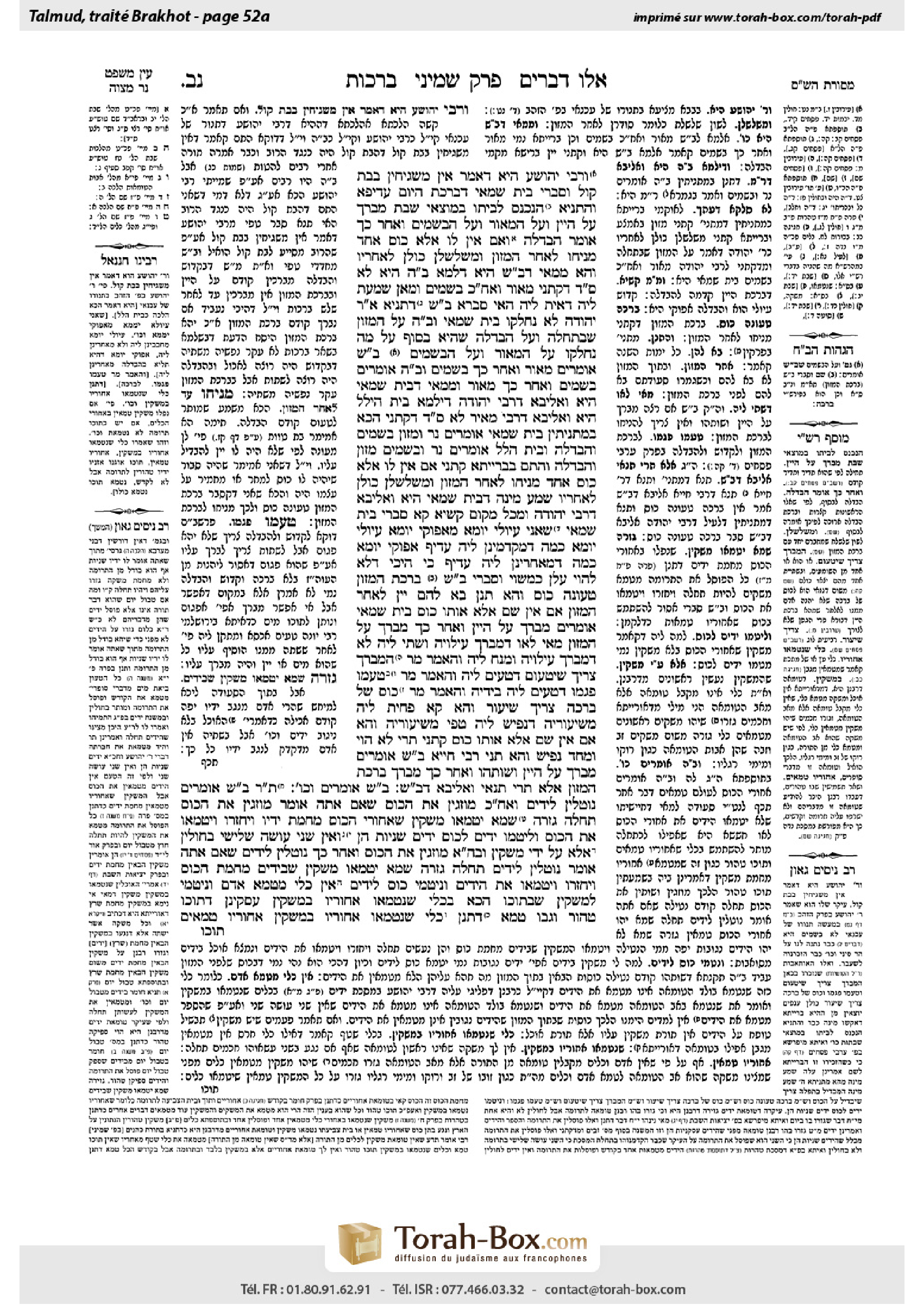
Berakhot 52a: Talmud study for Daf Yomi
Study the Talmud for Daf Yomi with scanned pages, Hebrew text, English translations from Sefaria and AI-generated French translations.
Passage selection and English or AI-generated French translation are available where the scan has annotations. Daf Study is independent of Torah-Box and Sefaria.
Browse Berakhot · ברכות · All tractatesBerakhot 52a text and translations
This page of Berakhot includes the Aramaic text, an English translation and an AI-generated French translation, alongside the scan above.
ברכות נ״ב א · Aramaic and Hebrew text
וְרַבִּי יְהוֹשֻׁעַ הִיא, דְּאָמַר: אֵין מַשְׁגִּיחִין בְּבַת קוֹל.
וְסָבְרִי בֵּית שַׁמַּאי דְּבִרְכַּת הַיּוֹם עֲדִיפָא? וְהָתַנְיָא: הַנִּכְנָס לְבֵיתוֹ בְּמוֹצָאֵי שַׁבָּת, מְבָרֵךְ עַל הַיַּיִן וְעַל הַמָּאוֹר וְעַל הַבְּשָׂמִים, וְאַחַר כָּךְ אוֹמֵר הַבְדָּלָה. וְאִם אֵין לוֹ אֶלָּא כּוֹס אֶחָד, מַנִּיחוֹ לְאַחַר הַמָּזוֹן וּמְשַׁלְשְׁלָן כּוּלָּן לְאַחֲרָיו.
וְהָא, מִמַּאי דְּבֵית שַׁמַּאי הִיא? דִּלְמָא בֵּית הִלֵּל הִיא?!
לָא סָלְקָא דַּעְתָּךְ, דְּקָתָנֵי מָאוֹר וְאַחַר כָּךְ בְּשָׂמִים, וּמַאן שָׁמְעַתְּ לֵיהּ דְּאִית לֵיהּ הַאי סְבָרָא — בֵּית שַׁמַּאי, דְּתַנְיָא אָמַר רַבִּי יְהוּדָה: לֹא נֶחְלְקוּ בֵּית שַׁמַּאי וּבֵית הִלֵּל עַל הַמָּזוֹן שֶׁבִּתְחִלָּה וְעַל הַבְדָּלָה שֶׁהִיא בַּסּוֹף, עַל מָה נֶחְלְקוּ — עַל הַמָּאוֹר וְעַל הַבְּשָׂמִים. בֵּית שַׁמַּאי אוֹמְרִים: מָאוֹר וְאַחַר כָּךְ בְּשָׂמִים, וּבֵית הִלֵּל אוֹמְרִים: בְּשָׂמִים וְאַחַר כָּךְ מָאוֹר.
וּמִמַּאי דְּבֵית שַׁמַּאי הִיא וְאַלִּיבָּא דְּרַבִּי יְהוּדָה, דִּילְמָא בֵּית הִלֵּל הִיא וְאַלִּיבָּא דְּרַבִּי מֵאִיר?!
לָא סָלְקָא דַּעְתָּךְ, דְּקָתָנֵי הָכָא בְּמַתְנִיתִין, בֵּית שַׁמַּאי אוֹמְרִים: נֵר וּמָזוֹן בְּשָׂמִים וְהַבְדָּלָה, וּבֵית הִלֵּל אוֹמְרִים: נֵר וּבְשָׂמִים מָזוֹן וְהַבְדָּלָה, וְהָתָם בְּבָרַיְיתָא קָתָנֵי אִם אֵין לוֹ אֶלָּא כּוֹס אֶחָד, מַנִּיחוֹ לְאַחַר הַמָּזוֹן, וּמְשַׁלְשְׁלָן כּוּלָּן לְאַחֲרָיו. שְׁמַע מִינַּהּ דְּבֵית שַׁמַּאי הִיא וְאַלִּיבָּא דְּרַבִּי יְהוּדָה.
וּמִכׇּל מָקוֹם קַשְׁיָא. קָא סָבְרִי בֵּית שַׁמַּאי שָׁאנֵי עַיּוֹלֵי יוֹמָא מֵאַפּוֹקֵי יוֹמָא. עַיּוֹלֵי יוֹמָא, כַּמָּה דְּמַקְדְּמִינַן לֵיהּ עֲדִיף. אַפּוֹקֵי יוֹמָא, כַּמָּה דִּמְאַחֲרִינַן לֵיהּ עֲדִיף, כִּי הֵיכִי דְּלָא לֶהֱוֵי עֲלַן כְּמַשּׂוֹי.
וְסָבְרִי בֵּית שַׁמַּאי בִּרְכַּת הַמָּזוֹן טְעוּנָה כּוֹס? וְהָא תְּנַן: בָּא לָהֶם יַיִן לְאַחַר הַמָּזוֹן, אִם אֵין שָׁם אֶלָּא אוֹתוֹ כּוֹס, בֵּית שַׁמַּאי אוֹמְרִים: מְבָרֵךְ עַל הַיַּיִן וְאַחַר כָּךְ מְבָרֵךְ עַל הַמָּזוֹן, מַאי לָאו דִּמְבָרֵךְ עִילָּוֵיהּ וְשָׁתֵי לֵיהּ? לָא, דִּמְבָרֵךְ עִילָּוֵיהּ וּמַנַּח לֵיהּ.
וְהָאָמַר מָר הַמְבָרֵךְ צָרִיךְ שֶׁיִּטְעוֹם! — דְּטָעֵים לֵיהּ. וְהָאָמַר מָר טְעָמוֹ פְּגָמוֹ! — דְּטָעֵים לֵיהּ בִּידֵיהּ.
וְהָאָמַר מָר כּוֹס שֶׁל בְּרָכָה צָרִיךְ שִׁעוּר, וְהָא קָא פָּחֵית לֵיהּ מִשִּׁיעוּרֵיהּ! — דִּנְפִישׁ לֵיהּ טְפֵי מִשִּׁיעוּרֵיהּ.
וְהָא אִם אֵין שָׁם אֶלָּא אוֹתוֹ כּוֹס קָתָנֵי! — תְּרֵי לָא הָוֵי וּמֵחַד נְפִישׁ.
וְהָא תָּנֵי רַבִּי חִיָּיא: בֵּית שַׁמַּאי אוֹמְרִים מְבָרֵךְ עַל הַיַּיִן וְשׁוֹתֵהוּ וְאַחַר כָּךְ מְבָרֵךְ בִּרְכַּת הַמָּזוֹן! אֶלָּא תְּרֵי תַּנָּאֵי, וְאַלִּיבָּא דְּבֵית שַׁמַּאי.
בֵּית שַׁמַּאי אוֹמְרִים וְכוּ׳.
תָּנוּ רַבָּנַן, בֵּית שַׁמַּאי אוֹמְרִים: נוֹטְלִין לַיָּדַיִם וְאַחַר כָּךְ מוֹזְגִין אֶת הַכּוֹס, שֶׁאִם אַתָּה אוֹמֵר מוֹזְגִין אֶת הַכּוֹס תְּחִלָּה, גְּזֵרָה שֶׁמָּא יִטָּמְאוּ מַשְׁקִין שֶׁאֲחוֹרֵי הַכּוֹס מֵחֲמַת יָדָיו, וְיַחְזְרוּ וִיטַמְּאוּ אֶת הַכּוֹס.
וְלִיטַּמּוּ יָדַיִם לְכוֹס!
יָדַיִם שְׁנִיּוֹת הֵן, וְאֵין שֵׁנִי עוֹשֶׂה שְׁלִישִׁי בְּחוּלִּין אֶלָּא עַל יְדֵי מַשְׁקִין.
וּבֵית הִלֵּל אוֹמְרִים: מוֹזְגִין אֶת הַכּוֹס וְאַחַר כָּךְ נוֹטְלִין לַיָּדַיִם. שֶׁאִם אַתָּה אוֹמֵר נוֹטְלִין לַיָּדַיִם תְּחִלָּה, גְּזֵרָה שֶׁמָּא יִטָּמְאוּ מַשְׁקִין שֶׁבַּיָּדַיִם מֵחֲמַת הַכּוֹס, וְיַחְזְרוּ וִיטַמְּאוּ אֶת הַיָּדַיִם.
וְנִיטַּמֵּי כּוֹס לְיָדַיִם! — אֵין כְּלִי מְטַמֵּא אָדָם.
וְנִיטַּמֵּי לְמַשְׁקִין שֶׁבְּתוֹכוֹ! — הָכָא בִּכְלִי שֶׁנִּטְמְאוּ אֲחוֹרָיו בְּמַשְׁקִין עָסְקִינַן, דְּתוֹכוֹ טָהוֹר וְגַבּוֹ טָמֵא. דִּתְנַן: כְּלִי שֶׁנִּטְמְאוּ אֲחוֹרָיו בְּמַשְׁקִין אֲחוֹרָיו טְמֵאִים
Berakhot 52a · English translation
and this Tosefta is in accordance with the opinion of Rabbi Yehoshua, who said, with regard to the Divine Voice that emerged and proclaimed that the halakha is in accordance with the opinion of Rabbi Eliezer in the case of the oven of akhnai (Bava Metzia 59b), that one disregards a Heavenly Voice. Just as he disregarded the Divine Voice in his dispute with Rabbi Eliezer, so too, one disregards the Divine Voice that proclaimed that the halakha is in accordance with the opinion of Beit Hillel.
As to the substance of these statements, the Gemara asks: Do Beit Shammai hold that the blessing over the day takes precedence? Wasn’t it taught in a baraita: One who enters his house at the conclusion of Shabbat recites a blessing over the wine, then over the candle, then over the spices, and recites havdala thereafter? And if he has only one cup of wine, he leaves it for after the last Shabbat meal and arranges all of the blessings: Grace after Meals, the blessings of havdala and the blessing over wine together thereafter. Evidently, the blessing over wine precedes the primary havdala blessing.
The Gemara asks: And this baraita, from where is it ascertained that it is in accordance with the opinion of Beit Shammai? Perhaps it is in accordance with the opinion of Beit Hillel. Beit Shammai’s opinion cannot be challenged with an unattributed baraita.
The Gemara responds: It cannot enter your mind that this baraita is in accordance with the opinion of Beit Hillel, as it was taught at the beginning of the baraita: Light and spices thereafter. And who, did you hear, adopts that reasoning? Beit Shammai. As it was taught in a Tosefta that Rabbi Yehuda said: Beit Shammai and Beit Hillel did not dispute that Grace after Meals is recited first and that havdala is recited last. With regard to what did they disagree? With regard to the blessings recited in the middle of havdala, the blessings over the light and over the spices. Beit Shammai say: Light and spices thereafter; and Beit Hillel say: Spices and light thereafter. Therefore, the baraita, where it is taught that the blessing over the candle precedes the blessing over the spices, must be according to Beit Shammai and it says that wine precedes havdala.
The Gemara presents another challenge: And from where do you ascertain that this baraita is the opinion of Beit Shammai in accordance with the interpretation of Rabbi Yehuda? Perhaps it is the opinion of Beit Hillel in accordance with the interpretation of Rabbi Meir.
The Gemara responds: It cannot enter your mind that this baraita is the opinion of Beit Hillel in accordance with the interpretation of Rabbi Meir. As it was taught here in the mishna, which like all unattributed mishnayot is in accordance with the opinion of Rabbi Meir: Beit Shammai say: One recites the blessing over the candle, then the Grace after Meals blessing, then the blessing over the spices, and finally the blessing of havdala. And Beit Hillel say: The order is candle, spices, Grace after Meals, and havdala. And there, in the baraita, it was taught: And if he has only one cup of wine, he leaves it for after the last Shabbat meal and arranges all of the blessings: Grace after Meals, the blessings of havdala, and the blessing over wine together thereafter. According to the baraita, all of the blessings follow Grace after Meals. Since the baraita and the mishna do not correspond, conclude from here that the baraita is the opinion of Beit Shammai, in accordance with the interpretation of Rabbi Yehuda.
And, nevertheless, after the Gemara has proven that the baraita corresponds to the opinion of Beit Shammai as interpreted by Rabbi Yehuda, the contradiction between Beit Shammai’s statement in the baraita and their statement in the Tosefta is difficult. The Gemara responds: Beit Shammai hold that the arrival of the day of Shabbat or a Festival is different from the departure of the day. As with regard to the arrival of the day, the more that we can advance it, the better; with regard to the departure of the day, the more we postpone it, the better, so that Shabbat should not be like a burden to us. Consequently, although Beit Shammai situate kiddush before the blessing over the wine, they agree that one should recite havdala after the blessing over the wine.
The above discussion referred to Beit Shammai’s opinion with regard to Grace after Meals recited over a cup of wine. The Gemara poses the question: And do Beit Shammai hold that Grace after Meals requires a cup of wine? Didn’t we learn in the mishna: Wine came before the diners after the meal; if only that cup of wine is there, Beit Shammai say: One recites a blessing over the wine and recites a blessing over the food, Grace after Meals, thereafter. What? Is it not that he recites a blessing over the wine and drinks it, leaving Grace after Meals without wine? The Gemara rejects this: No. The mishna means that he recites a blessing over the cup of wine and leaves it to drink from it after Grace after Meals.
The Gemara raises a difficulty: Didn’t the Master say that one who recites a blessing is required to taste? The Gemara answers: Indeed, this refers to a case where he tasted it. The Gemara raises a difficulty: Didn’t the Master say that one who tasted the cup of wine disqualified it and it is no longer suitable to be used for a cup of blessing? The Gemara answers: This does not refer to a case where he drank the wine; but rather, where he tasted it with his hand or poured a bit into another cup and drank from it.
The Gemara raises a difficulty: Didn’t the Master say: A cup of blessing requires a minimum measure of wine? By drinking the wine, doesn’t he diminish the cup from containing its minimum measure? The Gemara answers: This refers to a case where the cup contained more than the required measure of wine.
The Gemara asks: Wasn’t it taught explicitly: If he has only one cup of wine? If there is more than the required measure of wine, he does not have only one cup. The Gemara responds: Indeed, there are not two cups, but there is more than one.
The Gemara raises another difficulty: Didn’t Rabbi Ḥiyya teach in a baraita that Beit Shammai say: He recites a blessing over the wine and drinks it, and recites Grace after Meals thereafter? Evidently, according to Beit Shammai, wine is not required for Grace after Meals. Rather, it must be that two tanna’im hold in accordance with Beit Shammai and differ with regard to their opinion.
We learned in our mishna that Beit Shammai and Beit Hillel disagree over whether the washing of the hands or mixing water with the wine takes precedence. Beit Shammai say: One washes his hands and mixes water with the wine in the cup thereafter, and Beit Hillel say: One mixes water with the wine in the cup and only washes his hands thereafter.
The Sages taught a Tosefta where this issue is discussed in greater detail: Beit Shammai say: One washes his hands and mixes water with the wine in the cup thereafter, as if you say that one mixes water with the wine in the cup first, his hands will remain ritually impure, as the Sages decreed that unwashed hands have second degree ritual impurity status as if they touched something rendered ritually impure by a creeping animal. Consequently, there is room for concern that the liquid that inevitably drips on the outside of the cup might become ritually impure due to his hands, and those liquids will in turn render the cup ritually impure. Consequently, Beit Shammai said that the hands must be washed first in order to prevent that result.
The Gemara asks: If the concern is with regard to ritual impurity to the cup, why mention the liquids on the outside of the cup? Let his hands render the cup ritually impure directly.
The Gemara answers: Hands have second degree ritual impurity status, and there is a general halakhic principle that an object of second degree ritual impurity status cannot confer third degree ritual impurity status upon non-sacred items, as opposed to teruma or consecrated food, except by means of liquids. By rabbinic decree, liquids that come into contact with second degree ritual impurity assume first degree ritual impurity status and, consequently, can render non-sacred items impure.
And Beit Hillel say: One mixes water with the wine in the cup and only washes his hands thereafter, as if you say that one washes his hands first, there is a decree lest the liquid from the outside of the cup that dampened one’s hands will be rendered ritually impure due to the cup which is liable to be impure, and the liquid will in turn render his hands ritually impure.
The Gemara asks: Let the cup render his hands ritually impure directly, without any liquid? The Gemara responds that, according to a general principle in the halakhot of ritual impurity, a vessel does not render a person ritually impure. The cup alone does not render his hands ritually impure.
The Gemara asks: If the back of the cup is ritually impure, let it render the liquids that are within the cup ritually impure? The Gemara answers: Here we are dealing with a vessel that only the outside of which has been rendered ritually impure by liquids by rabbinic law and not by Torah law. In that case, the inside of the cup is pure and the outside is impure. As we learned in a mishna: A vessel whose outer side is rendered ritually impure by liquid, only the outer side of the vessel is impure,
Berakhot 52a · Traduction française (IA)
et cette Tosefta correspond à l'opinion du Rabbi Yéhoshua, qui a dit, concernant la Voix Divine qui s'est élevée et qui a proclamé que la halakha suit l'opinion du Rabbi Eliezer dans le cas de l'fourneau d'akhnai (Bava Métsia 59b), que l'on néglige la Voix Divine. Tout comme il a négligé la Voix Divine dans son débat avec le Rabbi Eliezer, ainsi l'on néglige la Voix Divine qui a proclamé que la halakha suit l'opinion de Beit Hillel.
En ce qui concerne le fond de ces déclarations, le Guemara pose la question : Beit Shammai considère-t-il que la bénédiction sur la journée a la priorité ? N'était-ce pas enseigné dans une baraïta : Celui qui entre chez lui à la fin du Shabbat récite une bénédiction sur le vin, puis sur la bougie, puis sur les épices, et récite ensuite la séparation (havdala) ? Et si l'on a seulement une seule coupe de vin, il la laisse pour après le dernier repas du Shabbat et dispose toutes les bénédictions : la bénédiction de la prière après le repas, les bénédictions de la séparation et la bénédiction sur le vin ensemble après. Il est évident que la bénédiction sur le vin précède la bénédiction principale de la séparation.
Le Guemara pose la question : Et cette baraïta, d'où est-elle déduite pour être en accord avec l'opinion de Beit Shammai ? Peut-être qu'elle est en accord avec l'opinion de Beit Hillel. L'opinion de Beit Shammai ne peut pas être contestée par une baraïta non attribuée.
Le Guemara répond : Il ne peut pas entrer dans votre esprit que cette baraïta est conforme à l'opinion de Beit Hillel, car elle a été enseignée au début de la baraïta : Lumière et épices ensuite. Et qui, avez-vous entendu, adopter cette raison ? Beit Shammai. Comme il a été enseigné dans une Tosefta que le Rabbi Yéhuda a dit : Beit Shammai et Beit Hillel n'ont pas disputé sur le fait que la prière de bénédiction après le repas est récitée en premier et que la séparation est récitée en dernier. Sur quel point ont-ils disputé ? Sur les bénédictions récitées au milieu de la séparation, les bénédictions sur la lumière et sur les épices. Beit Shammai disent : Lumière et épices ensuite ; et Beit Hillel disent : Épices et lumière ensuite. Ainsi, cette baraïta, où il est enseigné que la bénédiction sur la bougie précède la bénédiction sur les épices, doit être selon l'opinion de Beit Shammai et dit que le vin précède la séparation.
Le Guemara présente un autre défi : Et d'où déduisez-vous que cette baraïta est l'opinion de Beit Shammai selon l'interprétation du Rabbi Yéhuda ? Peut-être qu'elle est l'opinion de Beit Hillel selon l'interprétation du Rabbi Méir.
Le Guemara répond : Il ne peut pas entrer dans votre esprit que cette baraïta est l'opinion de Beit Hillel selon l'interprétation du Rabbi Méir. Comme il a été enseigné ici dans la mishna, qui comme toutes les mishnayot non attribuées est selon l'opinion du Rabbi Méir : Beit Shammai disent : On récite la bénédiction sur la bougie, puis la bénédiction de la prière après le repas, puis la bénédiction sur les épices, et enfin la bénédiction de la séparation. Et Beit Hillel disent : L'ordre est bougie, épices, prière après le repas, et séparation. Et là, dans la baraïta, il a été enseigné : Et si l'on a seulement une seule coupe de vin, il la laisse pour après le dernier repas du Shabbat et dispose toutes les bénédictions : la prière après le repas, les bénédictions de la séparation et la bénédiction sur le vin ensemble après. Selon la baraïta, toutes les bénédictions suivent la prière après le repas. Puisque la baraïta et la mishna ne correspondent pas, concluez d'ici que la baraïta est l'opinion de Beit Shammai, selon l'interprétation du Rabbi Yéhuda.
Et pourtant, après que le Guemara ait prouvé que la baraïta correspond à l'opinion de Beit Shammai selon l'interprétation du Rabbi Yéhuda, la contradiction entre l'affirmation de Beit Shammai dans la baraïta et leur affirmation dans la Tosefta est difficile. Le Guemara répond : Beit Shammai considèrent que l'arrivée du jour du Shabbat ou d'un festival est différente de la sortie du jour. Comme concernant l'arrivée du jour, plus on peut l'avancer, mieux c'est ; concernant la sortie du jour, plus on le reporte, mieux c'est, afin que le Shabbat ne soit pas une charge pour nous. Ainsi, bien que Beit Shammai situent le kiddush avant la bénédiction sur le vin, ils acceptent que l'on récite la séparation après la bénédiction sur le vin.
La discussion ci-dessus concernait l'opinion de Beit Shammai concernant la prière de béatitude après le repas récitée sur une coupe de vin. Le Guemara pose la question : Et Beit Shammai considèrent-ils que la prière de béatitude après le repas nécessite une coupe de vin ? N'avons-nous pas appris dans la Michna : Le vin est venu avant les convives après le repas ; si seule cette coupe de vin est là, Beit Shammai disent : On récite une bénédiction sur le vin et on récite une bénédiction sur la nourriture, la prière de béatitude, ensuite. Quoi ? N'est-ce pas que l'on récite une bénédiction sur le vin et qu'on le boit, laissant la prière de béatitude sans vin ? Le Guemara rejette cela : Non. La Michna signifie qu'on récite une bénédiction sur la coupe de vin et qu'on la laisse pour boire après la prière de béatitude.
Le Guemara soulève une difficulté : N'a-t-il pas dit le Maître que celui qui récite une bénédiction doit goûter ? Le Guemara répond : En effet, cela fait référence à un cas où il a goûté. Le Guemara soulève une difficulté : N'a-t-il pas dit le Maître que celui qui a goûté la coupe de vin l'a disqualifiée et qu'elle n'est plus adaptée à être utilisée comme une coupe de bénédiction ? Le Guemara répond : Cela ne fait pas référence à un cas où il a bu le vin ; mais plutôt, où il a goûté avec sa main ou a versé une partie dans une autre coupe et a bu de celle-ci.
Le Guemara soulève une difficulté : N'a-t-il pas dit le Maître : Une coupe de bénédiction nécessite une mesure minimale de vin ? En buvant le vin, n'entraîne-t-il pas la diminution de la coupe pour qu'elle ne contienne plus sa mesure minimale ? Le Guemara répond : Cela fait référence à un cas où la coupe contenait plus que la mesure requise de vin.
Le Guemara pose la question : N'était-ce pas enseigné explicitement : Si l'on a seulement une seule coupe de vin ? Si l'on a plus que la mesure requise de vin, l'on n'a pas seulement une seule coupe. Le Guemara répond : En effet, il n'y a pas deux coupes, mais il y a plus d'une.
La Guemara soulève une autre difficulté : N’a-t-on pas appris dans une baraïta que Rabbi Ḥiyya a enseigné que Beit Shammai disent : On récite une berakha sur le vin et on le boit, puis on récite la berakha de la prière après le repas ? Évidemment, selon Beit Shammai, le vin n’est pas requis pour la prière après le repas. En réalité, il faut que deux tannaïm adoptent l’opinion de Beit Shammai et diffèrent sur leur propre opinion.
Nous avons appris dans notre mitsna que Beit Shammai et Beit Hillel s’opposent sur la question de savoir si le lavage des mains ou le mélange d’eau avec le vin a priorité. Beit Shammai disent : On lave ses mains et on mélange de l’eau avec le vin dans le verre ensuite, et Beit Hillel disent : On mélange de l’eau avec le vin dans le verre et on lave ses mains ensuite seulement.
Les Sages ont enseigné une Tosefta où cette question est discutée plus en détail : Beit Shammai disent : On lave ses mains et on mélange de l’eau avec le vin dans le verre ensuite, comme si l’on disait que si l’on mélange d’abord de l’eau avec le vin dans le verre, ses mains resteront impures rituellement, car les Sages ont décrété que les mains non lavées ont un statut d’impureté rituelle de deuxième degré, comme si elles avaient touché quelque chose rendu impur rituellement par un animal rampant. Par conséquent, il y a lieu de craindre que le liquide qui inévitablement coule sur l’extérieur du verre devienne impur rituellement en raison de ses mains, et ces liquides rendront à leur tour le verre impur rituellement. Par conséquent, Beit Shammai a dit que les mains doivent être lavées en premier lieu afin d’éviter ce résultat.
La Guemara demande : Si la préoccupation est liée à l’impureté rituelle du verre, pourquoi mentionner les liquides sur l’extérieur du verre ? Que les mains rendent directement le verre impur rituellement.
La Guemara répond : Les mains ont un statut d’impureté rituelle de deuxième degré, et il existe un principe halakhique général selon lequel un objet de deuxième degré d’impureté rituelle ne peut pas transmettre un statut d’impureté rituelle de troisième degré aux objets non sacrés, contrairement à la terouma ou aux aliments consacrés, sauf par le biais des liquides. Par décret rabbinique, les liquides qui entrent en contact avec un statut d’impureté rituelle de deuxième degré acquièrent un statut d’impureté rituelle de premier degré et, par conséquent, peuvent rendre les objets non sacrés impurs.
Et Beit Hillel disent : On mélange de l’eau avec le vin dans le verre et on lave ses mains ensuite seulement, comme si l’on disait que si l’on lave d’abord ses mains, il y a un décret pour éviter que le liquide provenant de l’extérieur du verre qui a humecté ses mains ne devienne impur rituellement en raison du verre, qui est susceptible d’être impur, et que ce liquide rendra à son tour ses mains impurs rituellement.
La Guemara demande : Que le verre rende directement ses mains impures rituellement, sans aucun liquide ? La Guemara répond que, selon un principe général dans les halakhot de l’impureté rituelle, un objet ne rend pas un homme impur rituellement. Le verre seul ne rend pas ses mains impures rituellement.
La Guemara demande : Si l’arrière du verre est impur rituellement, que cela rende les liquides qui sont à l’intérieur du verre impurs rituellement ? La Guemara répond : Ici, nous sommes en présence d’un objet dont seulement l’extérieur a été rendu impur rituellement par des liquides selon la loi rabbinique et non selon la loi de la Torah. Dans ce cas, l’intérieur du verre est pur et l’extérieur est impur. Comme nous avons appris dans une mitsva : Un objet dont l’extérieur a été rendu impur rituellement par des liquides, n’est impur que l’extérieur de l’objet,
Traduction française générée par IA à partir de l’édition anglaise de Sefaria. Vérifie toujours un passage avec le texte source.
Text from Sefaria: William Davidson Edition - Vocalized Aramaic (CC BY NC); William Davidson Edition - English (CC BY NC).