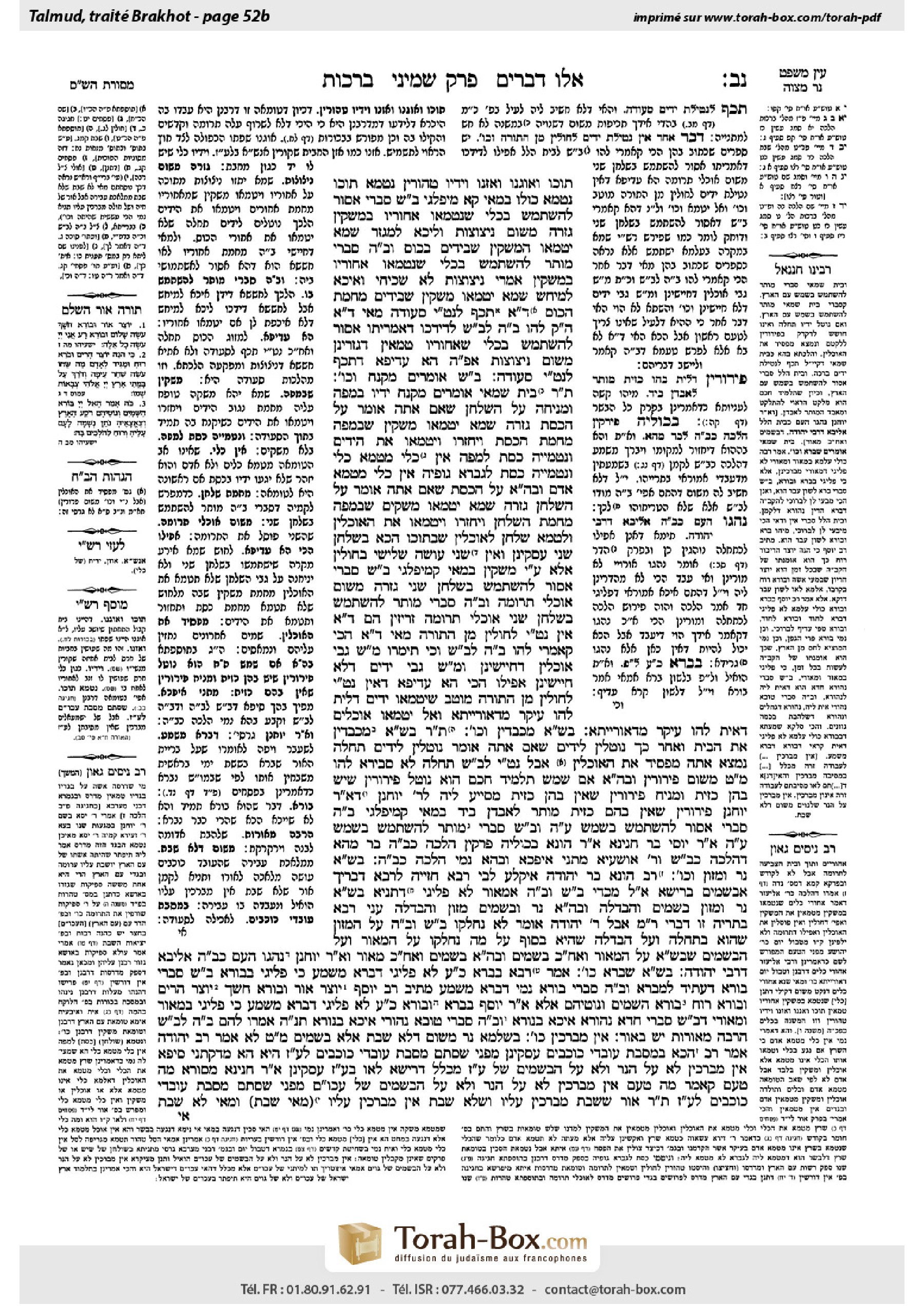
Berakhot 52b: Talmud study for Daf Yomi
Study the Talmud for Daf Yomi with scanned pages, Hebrew text, English translations from Sefaria and AI-generated French translations.
Passage selection and English or AI-generated French translation are available where the scan has annotations. Daf Study is independent of Torah-Box and Sefaria.
Browse Berakhot · ברכות · All tractatesBerakhot 52b text and translations
This page of Berakhot includes the Aramaic text, an English translation and an AI-generated French translation, alongside the scan above.
ברכות נ״ב ב · Aramaic and Hebrew text
תּוֹכוֹ וְאוֹגְנוֹ וְאׇזְנוֹ וְיָדָיו טְהוֹרִין. נִטְמָא תּוֹכוֹ — נִטְמָא כּוּלּוֹ.
בְּמַאי קָא מִיפַּלְגִי?
בֵּית שַׁמַּאי סָבְרִי אָסוּר לְהִשְׁתַּמֵּשׁ בִּכְלִי שֶׁנִּטְמְאוּ אֲחוֹרָיו בְּמַשְׁקִין, גְּזֵרָה מִשּׁוּם נִיצוֹצוֹת. וְלֵיכָּא לְמִגְזַר שֶׁמָּא יִטָּמְאוּ הַמַּשְׁקִין שֶׁבַּיָּדַיִם בַּכּוֹס.
וּבֵית הִלֵּל סָבְרִי מוּתָּר לְהִשְׁתַּמֵּשׁ בִּכְלִי שֶׁנִּטְמְאוּ אֲחוֹרָיו בְּמַשְׁקִין, אָמְרִי נִיצוֹצוֹת לָא שְׁכִיחִי, וְאִיכָּא לְמֵיחַשׁ שֶׁמָּא יִטָּמְאוּ מַשְׁקִין שֶׁבַּיָּדַיִם מֵחֲמַת הַכּוֹס.
דָּבָר אַחֵר: תֵּכֶף לִנְטִילַת יָדַיִם סְעוּדָה.
מַאי ״דָּבָר אַחֵר״? הָכִי קָאָמְרִי לְהוּ בֵּית הִלֵּל לְבֵית שַׁמַּאי: לְדִידְכוּ דְּאָמְרִיתוּ אָסוּר לְהִשְׁתַּמֵּשׁ בִּכְלִי שֶׁאֲחוֹרָיו טְמֵאִין דְּגָזְרִינַן מִשּׁוּם נִיצוֹצוֹת, אֲפִילּוּ הָכִי הָא עֲדִיפָא, דְּתֵכֶף לִנְטִילַת יָדַיִם סְעוּדָה.
בֵּית שַׁמַּאי אוֹמְרִים מְקַנֵּחַ וְכוּ׳.
תָּנוּ רַבָּנַן: בֵּית שַׁמַּאי אוֹמְרִים: מְקַנֵּחַ יָדָיו בַּמַּפָּה וּמַנִּיחָהּ עַל הַשֻּׁלְחָן. שֶׁאִם אַתָּה אוֹמֵר עַל הַכֶּסֶת, גְּזֵרָה שֶׁמָּא יִטָּמְאוּ מַשְׁקִין שֶׁבַּמַּפָּה מֵחֲמַת הַכֶּסֶת, וְיַחְזְרוּ וִיטַמְּאוּ אֶת הַיָּדַיִם.
וּנְטַמְּיַיהּ כֶּסֶת לְמַפָּה! — אֵין כְּלִי מְטַמֵּא כְּלִי.
וּנְטַמְּיֵיהּ כֶּסֶת לְגַבְרָא גּוּפֵיהּ! — אֵין כְּלִי מְטַמֵּא אָדָם.
וּבֵית הִלֵּל אוֹמְרִים: עַל הַכֶּסֶת. שֶׁאִם אַתָּה אוֹמֵר עַל הַשֻּׁלְחָן, גְּזֵרָה שֶׁמָּא יִטָּמְאוּ מַשְׁקִין שֶׁבַּמַּפָּה מֵחֲמַת הַשּׁוּלְחָן וְיַחְזְרוּ וִיטַמְּאוּ אֶת הָאוֹכָלִין.
וּלְטַמֵּא שֻׁלְחָן לָאוֹכָלִין שֶׁבְּתוֹכוֹ! — הָכָא בְּשֻׁלְחָן שֵׁנִי עָסְקִינַן, וְאֵין שֵׁנִי עוֹשֶׂה שְׁלִישִׁי בְּחוּלִּין אֶלָּא עַל יְדֵי מַשְׁקִין.
בְּמַאי קָמִיפַּלְגִי? בֵּית שַׁמַּאי סָבְרִי אָסוּר לְהִשְׁתַּמֵּשׁ בְּשֻׁלְחָן שֵׁנִי, גְּזֵרָה מִשּׁוּם אוֹכְלֵי תְרוּמָה.
וּבֵית הִלֵּל סָבְרִי מוּתָּר לְהִשְׁתַּמֵּשׁ בְּשֻׁלְחָן שֵׁנִי, אוֹכְלֵי תְרוּמָה זְרִיזִין הֵם.
דָּבָר אַחֵר: אֵין נְטִילַת יָדַיִם לְחוּלִּין מִן הַתּוֹרָה.
מַאי ״דָּבָר אַחֵר״? הָכִי קָאָמְרִי לְהוּ בֵּית הִלֵּל לְבֵית שַׁמַּאי: וְכִי תֵּימְרוּ מַאי שְׁנָא גַּבֵּי אוֹכָלִין דְּחָיְישִׁינַן וּמַאי שְׁנָא גַּבֵּי יָדַיִם דְּלָא חָיְישִׁינַן? אֲפִילּוּ הָכִי הָא עֲדִיפָא, דְּאֵין נְטִילַת יָדַיִם לְחוּלִּין מִן הַתּוֹרָה. מוּטָב שֶׁיִּטָּמְאוּ יָדַיִם דְּלֵית לְהוּ עִיקָּר מִדְּאוֹרָיְיתָא, וְאַל יִטָּמְאוּ אוֹכְלִים דְּאִית לְהוּ עִיקָּר מִדְּאוֹרָיְיתָא.
בֵּית שַׁמַּאי אוֹמְרִים מְכַבְּדִין וְכוּ׳.
תָּנוּ רַבָּנַן: בֵּית שַׁמַּאי אוֹמְרִים מְכַבְּדִין אֶת הַבַּיִת וְאַחַר כָּךְ נוֹטְלִין לַיָּדַיִם, שֶׁאִם אַתָּה אוֹמֵר נוֹטְלִין לַיָּדַיִם תְּחִלָּה, נִמְצָא אַתָּה מַפְסִיד אֶת הָאוֹכָלִין. אֲבָל נְטִילַת יָדַיִם לְבֵית שַׁמַּאי תְּחִלָּה לָא סְבִירָא לְהוּ. מַאי טַעְמָא? — מִשּׁוּם פֵּירוּרִין.
וּבֵית הִלֵּל אוֹמְרִים: אִם שַׁמָּשׁ תַּלְמִיד חָכָם הוּא, נוֹטֵל פֵּירוּרִין שֶׁיֵּשׁ בָּהֶם כְּזַיִת, וּמַנִּיחַ פֵּירוּרִין שֶׁאֵין בָּהֶן כְּזַיִת.
מְסַיַּיע לֵיהּ לְרַבִּי יוֹחָנָן. דְּאָמַר רַבִּי יוֹחָנָן: פֵּירוּרִין שֶׁאֵין בָּהֶם כְּזַיִת — מוּתָּר לְאַבְּדָן בַּיָּד.
בְּמַאי קָמִיפַּלְגִי? בֵּית הִלֵּל סָבְרִי אָסוּר לְהִשְׁתַּמֵּשׁ בְּשַׁמָּשׁ עַם הָאָרֶץ. וּבֵית שַׁמַּאי סָבְרִי מוּתָּר לְהִשְׁתַּמֵּשׁ בְּשַׁמָּשׁ עַם הָאָרֶץ.
אָמַר רַבִּי יוֹסֵי בַּר חֲנִינָא אָמַר רַב הוּנָא: בְּכוּלֵּיהּ פִּרְקִין הֲלָכָה כְּבֵית הִלֵּל, בַּר מֵהָא דַּהֲלָכָה כְּבֵית שַׁמַּאי, וְרַבִּי אוֹשַׁעְיָא מַתְנִי אִיפְּכָא, וּבְהָא נָמֵי הֲלָכָה כְּבֵית הִלֵּל.
בֵּית שַׁמַּאי אוֹמְרִים: נֵר וּמָזוֹן וְכוּ׳.
רַב הוּנָא בַּר יְהוּדָה אִיקְּלַע לְבֵי רָבָא. חַזְיֵיהּ לְרָבָא דְּבָרֵיךְ אַבְּשָׂמִים בְּרֵישָׁא. אֲמַר לֵיהּ: מִכְּדִי בֵּית שַׁמַּאי וּבֵית הִלֵּל אַמָּאוֹר לָא פְּלִיגִי, דְּתַנְיָא בֵּית שַׁמַּאי אוֹמְרִים: נֵר וּמָזוֹן, בְּשָׂמִים וְהַבְדָּלָה. וּבֵית הִלֵּל אוֹמְרִים: נֵר וּבְשָׂמִים, מָזוֹן וְהַבְדָּלָה!
עָנֵי רָבָא בָּתְרֵיהּ: זוֹ דִּבְרֵי רַבִּי מֵאִיר, אֲבָל רַבִּי יְהוּדָה אוֹמֵר לֹא נֶחְלְקוּ בֵּית שַׁמַּאי וּבֵית הִלֵּל עַל הַמָּזוֹן שֶׁהוּא בַּתְּחִילָּה וְעַל הַבְדָּלָה שֶׁהִיא בַּסּוֹף, עַל מָה נֶחְלְקוּ — עַל הַמָּאוֹר וְעַל הַבְּשָׂמִים, שֶׁבֵּית שַׁמַּאי אוֹמְרִים עַל הַמָּאוֹר וְאַחַר כָּךְ בְּשָׂמִים, וּבֵית הִלֵּל אוֹמְרִים בְּשָׂמִים וְאַחַר כָּךְ מָאוֹר.
וְאָמַר רַבִּי יוֹחָנָן נָהֲגוּ הָעָם כְּבֵית הִלֵּל אַלִּיבָּא דְּרַבִּי יְהוּדָה.
בֵּית שַׁמַּאי אוֹמְרִים שֶׁבָּרָא כּוּ׳.
אָמַר רָבָא: בְּ״בָרָא״ כּוּלֵּי עָלְמָא לָא פְּלִיגִי דְּבָרָא מַשְׁמַע. כִּי פְּלִיגִי בְּ״בוֹרֵא״, בֵּית שַׁמַּאי סָבְרִי ״בּוֹרֵא״ דַּעֲתִיד לְמִבְרָא, וּבֵית הִלֵּל סָבְרִי ״בּוֹרֵא״ נָמֵי דִּבְרָא מַשְׁמַע.
מֵתִיב רַב יוֹסֵף: ״יוֹצֵר אוֹר וּבוֹרֵא חֹשֶׁךְ״, ״יוֹצֵר הָרִים וּבוֹרֵא רוּחַ״, ״בּוֹרֵא הַשָּׁמַיִם וְנוֹטֵיהֶם״. אֶלָּא אָמַר רַב יוֹסֵף: בְּ״בָרָא״ וּ״בוֹרֵא״ כּוּלֵּי עָלְמָא לָא פְּלִיגִי דְּבָרָא מַשְׁמַע, כִּי פְּלִיגִי בִּ״מְאוֹר״ וּ״מְאוֹרֵי״. דְּבֵית שַׁמַּאי סָבְרִי חֲדָא נְהוֹרָא אִיכָּא בְּנוּרָא, וּבֵית הִלֵּל סָבְרִי טוּבָא נְהוֹרֵי אִיכָּא בְּנוּרָא. תַּנְיָא נָמֵי הָכִי, אָמְרוּ לָהֶם בֵּית הִלֵּל לְבֵית שַׁמַּאי: הַרְבֵּה מְאוֹרוֹת יֵשׁ בָּאוֹר.
אֵין מְבָרְכִין כּוּ׳. בִּשְׁלָמָא נֵר מִשּׁוּם דְּלֹא שָׁבַת, אֶלָּא בְּשָׂמִים מַה טַּעַם לֹא?
אָמַר רַב יְהוּדָה אָמַר רַב: הָכָא בִּמְסִבַּת גּוֹיִם עָסְקִינַן, מִפְּנֵי שֶׁסְּתָם מְסִבַּת גּוֹיִם לַעֲבוֹדָה זָרָה הִיא.
הָא מִדְּקָתָנֵי סֵיפָא אֵין מְבָרְכִין לֹא עַל הַנֵּר וְלֹא עַל הַבְּשָׂמִים שֶׁל עֲבוֹדָה זָרָה, מִכְלָל דְּרֵישָׁא לָאו בַּעֲבוֹדָה זָרָה עָסְקִינַן!
אָמַר רַבִּי חֲנִינָא מִסּוּרָא: ״מַה טַּעַם״ קָאָמַר: מַה טַּעַם אֵין מְבָרְכִין עַל הַנֵּר וְלֹא עַל הַבְּשָׂמִים שֶׁל גּוֹיִם — מִפְּנֵי שֶׁסְּתָם מְסִבַּת גּוֹיִם לַעֲבוֹדָה זָרָה.
תָּנוּ רַבָּנַן: אוּר שֶׁשָּׁבַת — מְבָרְכִין עָלָיו, וְשֶׁלֹּא שָׁבַת — אֵין מְבָרְכִין עָלָיו. מַאי ״שָׁבַת״ וּמַאי ״לֹא שָׁבַת״?
Berakhot 52b · English translation
while its inner side, and its rim, the edge of the vessel that protrudes outwards, and its ear-shaped handle, and its straight handles are pure. However, if the inside of the vessel became ritually impure, it is all ritually impure.
Although the decrees of Beit Hillel and Beit Shammai are different, they are based on realistic contingencies and on concerns shared by both parties. The Gemara seeks to clarify: With regard to what do they disagree? What is the crux of their dispute?
The Gemara explains: Beit Shammai hold: It is prohibited to use a vessel the outer side of which has been rendered ritually impure by liquids. This prohibition stems from a decree of the Sages, due to concern for drips of liquid that would fall from inside the vessel to its outer side, as those drips themselves would be rendered ritually impure by virtue of their contact with the outer side of the vessel. And Beit Shammai hold that there is no reason to issue a decree due to the concern of Beit Hillel lest the liquid on one’s hands will be rendered ritually impure by the cup, as Beit Shammai hold that the use of a vessel of that kind is prohibited.
And Beit Hillel hold: One is permitted to use a vessel the outer side of which has been rendered ritually impure by liquid, as they say: Drips are uncommon, and decrees are not issued on the basis of an uncommon case. Because Beit Hillel permit the use of a vessel of that kind, there is concern lest the liquid on one’s hands will be rendered ritually impure due to the cup.
Alternatively, Beit Hillel hold that one mixes the water with the wine in the cup and then washes his hands due to the principle: Immediately after the washing of the hands comes the meal. Therefore, he mixes the water and wine in the cup, then he washes his hands, and then he immediately proceeds to the meal.
The Gemara asks: What is the point of Beit Hillel adding: Alternatively? The Gemara answers: Beit Hillel said to Beit Shammai as follows: Even according to you, who said that it is prohibited to use a vessel the outer side of which is ritually impure as we issued a decree due to concern for drips, even so, our opinion is preferable to yours, as our opinion adheres to the principle: Immediately after the washing of the hands comes the meal.
We learned in the mishna that Beit Hillel and Beit Shammai disagree over where the cloth that one used to dry his hands should be placed. Beit Shammai say: After washing, one dries his hands with a cloth and places it on the table. And Beit Hillel say: One places it on the cushion upon which he is sitting.
In a Tosefta, the Sages taught in greater detail: Beit Shammai say: After washing, one dries his hands with a cloth and places it on the table, as if you say that he should place the cloth on the cushion, there is room to issue a decree lest the liquids on the cloth, which is wet because he used it to dry his hands, become ritually impure due to their contact with the cushion, and the liquids would in turn render the hands of anyone who touches the towel ritually impure.
The Gemara asks: Even without the liquid, let the cushion render the towel ritually impure directly? The Gemara answers: There is a principle: A vessel does not render another vessel ritually impure.
The Gemara asks: Let the cushion render the man sitting upon it ritually impure. The Gemara answers: There, too, there is a general principle: A vessel does not render a person ritually impure.
And Beit Hillel say: One places it on the cushion upon which he is sitting, as if you say that he should place it on the table, there is room to issue a decree lest the liquids on the towel might be rendered ritually impure by their contact with the table, and those liquids in turn will render the food placed on the table ritually impure.
The Gemara asks: Let the table render the food upon it ritually impure directly. The Gemara explains: Here we are dealing with a table that has second degree ritual impurity status, and an object of second degree ritual impurity status can only confer third degree ritual impurity status upon non-sacred items by means of liquids. By rabbinic decree, liquids that come into contact with second degree ritual impurity assume first degree ritual impurity status and, consequently, can render non-sacred items impure.
The Gemara seeks to clarify: With regard to what do they disagree? The Gemara answers: The basis of their dispute is that Beit Shammai hold: It is prohibited to use a table that has second degree ritual impurity status for purposes of eating because of a decree due to those who eat teruma. A table with that status renders teruma ritually impure through contact. To prevent priests who partake of teruma from unwittingly eating off a table of that sort, a decree was issued prohibiting its use even with non-sacred foods.
And Beit Hillel hold: It is permitted to use a table that has second degree ritual impurity status, and we are not concerned about the priests. As those who eat teruma are vigilant and would ascertain the status of a table before eating.
Alternatively, Beit Hillel hold that there is no requirement of washing of the hands for non-sacred items by Torah law.
The Gemara asks: What is the point of Beit Hillel adding the additional reason introduced with: Alternatively? The Gemara answers: Beit Hillel said to Beit Shammai as follows: And if you say, what is the difference with regard to food that we are concerned that it might be rendered ritually impure by the cloth on the table; and what is the difference with regard to hands that we are not concerned that they might be rendered ritually impure by the cloth placed on the cushion? Beit Hillel continue: We can respond that even so, this is preferable, as there is no requirement of washing of the hands for non-sacred items by Torah law. It is preferable that hands, whose impurity has no basis in Torah law, will become ritually impure with second degree ritual impurity status, and food, whose impurity has a basis in Torah law, will not become ritually impure.
We learned in the mishna that Beit Hillel and Beit Shammai disagree over whether cleaning the place where one ate or washing one’s hands should be performed first after the meal. Beit Shammai say: One sweeps the area of the house where the meal took place and he washes his hands with the final waters thereafter. And Beit Hillel say: One washes his hands and sweeps the house thereafter.
The Sages taught in a Tosefta where this issue is discussed in greater detail: Beit Shammai say: One sweeps the area of the house where the meal took place and washes his hands thereafter, as if you say that one washes his hands first, the water is liable to splash on the remaining crumbs and you will have ruined the food. But Beit Shammai do not hold that the washing of the hands is first. What is the reason? Due to concern, lest the crumbs will be made disgusting.
And Beit Hillel say: If the attendant is a Torah scholar, he removes the crumbs that are an olive-bulk from the table at the end of the meal and leaves only crumbs that are not an olive-bulk, as food that is less than an olive-bulk is not considered food and there is no prohibition to ruin it.
This supports the opinion of Rabbi Yoḥanan, as Rabbi Yoḥanan said: Crumbs that are less than an olive-bulk in size, one may destroy them with his hand without violating the prohibition against ruining food.
Here too the Gemara poses the question: With regard to what do they disagree? The Gemara answers: The basis of their argument is that Beit Hillel hold: One is forbidden to use the services of a waiter who is an am ha’aretz. Therefore, there is no room for concern that food will be ruined as only crumbs remain on the table. And Beit Shammai hold: One is permitted to use the services of an attendant who is an am ha’aretz. Food will remain on the table and, therefore, there is room for concern that food will be ruined. The solution is to clean the food off the table and only then wash one’s hands.
Rabbi Yosei bar Ḥanina said that Rav Huna said: In our entire chapter, the halakha is in accordance with the opinion of Beit Hillel, except for this case, where the halakha is in accordance with the opinion of Beit Shammai. And Rabbi Oshaya would teach the opposite and reverse the opinions of Beit Hillel and Beit Shammai as they appear in our mishna, and in this case as well, the halakha is in accordance with the opinion of Beit Hillel.
We learned in the mishna that Beit Shammai say: One recites the blessing over the candle, then the Grace after Meals blessing, then the blessing over the spices, and finally the blessing of havdala. And Beit Hillel say: The order is candle, spices, Grace after Meals, and havdala.
The Gemara relates that Rav Huna bar Yehuda happened to come to Rava’s house. He saw that Rava recited a blessing over the spices first. Rav Huna bar Yehuda said to him: Now since Beit Hillel and Beit Shammai do not disagree with regard to the blessing over light, as we learned in our mishna that Beit Shammai say: One recites the blessing over the candle, then the Grace after Meals blessing, then the blessing over the spices, and finally the blessing of havdala. And Beit Hillel say: The order is candle, and spices, Grace after Meals, and havdala, why did you recite the blessing over the spices first?
Rava answered after him: Indeed, that is the statement of Rabbi Meir. However, Rabbi Yehuda says in a baraita that Beit Hillel and Beit Shammai neither disagree with regard to Grace after Meals that it is recited first, nor with regard to havdala, which is recited last. With regard to what do they disagree? They disagree with regard to the light and the spices. Beit Shammai say: One recites a blessing over light and over spices thereafter, and Beit Hillel say: One recites a blessing over spices and over light thereafter.
And Rabbi Yoḥanan said: The people were accustomed to conduct themselves in accordance with the opinion of Beit Hillel according to the interpretation of Rabbi Yehuda. The blessing over the spices is recited first.
The mishna cited a dispute between Beit Hillel and Beit Shammai with regard to the formula of the blessing over fire in havdala. Beit Shammai say: Who created [bara] the light of fire. And Beit Hillel say: Who creates [boreh] the lights of fire.
Regarding this, Rava says: With regard to the word bara, everyone agrees that it means created in the past. Where they disagree is with regard to the word boreh. Beit Shammai hold: Boreh means that God will create in the future, and Beit Hillel hold: Boreh also means that He has created in the past.
Rav Yosef raised an objection: How can there be a dispute over the meaning of the word boreh? In the following verses it is clear that it refers to acts of creation in the past: “Who forms light and creates [boreh] darkness” (Isaiah 45:7), “Who forms mountains and creates [boreh] wind” (Amos 4:13), or “Who creates [boreh] the heavens and stretches them out” (Isaiah 42:5). Rather, said Rav Yosef: With regard to both bara and boreh, everyone agrees that they mean created. Where they disagree is with regard to the light of the fire or the lights of the fire. As Beit Shammai hold that there is one light in a fire, and Beit Hillel hold that there are many lights in a fire, as a flame consists of red, green, and white light. That was also taught in a baraita: Beit Hillel said to Beit Shammai: There are many lights in the fire.
We learned in the mishna that one may neither recite a blessing over the candle nor over the spices of gentiles. The Gemara asks: Granted, the prohibition against the recitation of a blessing over a candle of gentiles in havdala, as the flame of the candle did not rest. Because it was burning during Shabbat, one should not recite a blessing over it at the conclusion of Shabbat. However, what is the reason that one may not recite a blessing over spices of gentiles?
Rav Yehuda said that Rav said: Here we are dealing with a party arranged by gentiles and the spices used at that party were prohibited because the parties of gentiles are generally devoted to idolatry.
The Gemara asks: But from that which was taught in the latter clause of the mishna: One may neither recite a blessing over the candle nor over the spices of idolatry, infer by implication that in the first clause of our mishna we are not dealing with idolatry? There must be a different reason why the spices of gentiles are prohibited.
Rabbi Ḥanina of Sura said: These two halakhot are complementary, and the mishna states the halakha employing the style of: What is the reason. The mishna should be understood as follows: What is the reason that one may neither recite a blessing over the candle nor over the spices of gentiles? Because the parties of gentiles are generally devoted to idolatry and one may neither recite a blessing over the candle nor over the spices of idolatry.
The Sages taught in a baraita: Over fire that rested, one may recite a blessing in havdala, and over fire that did not rest, one may not recite a blessing. The Gemara asks: What is meant by rested, and what is meant by did not rest?ב
Berakhot 52b · Traduction française (IA)
alors que son intérieur, son bord, la bordure du récipient qui dépasse vers l'extérieur, son manche en forme d'oreille et ses manches droits sont purs. Cependant, si l'intérieur du récipient est devenu impur rituellement, tout est impur rituellement.
Bien que les décrets de Beit Hillel et de Beit Shammai diffèrent, ils s'appuient sur des contingences réalistes et sur des préoccupations partagées par les deux parties. La Guemara cherche à clarifier : Sur quel point se déclarent-ils en désaccord ? Quel est le point crucial de leur débat ?
La Guemara explique : Beit Shammai affirme : Il est interdit d'utiliser un récipient dont le côté extérieur a été rendu impur rituellement par des liquides. Cette interdiction provient d'un décret des Sages, en raison de la crainte que des gouttes de liquide tombent de l'intérieur du récipient vers son côté extérieur, car ces gouttes elles-mêmes deviendraient impures rituellement en raison de leur contact avec le côté extérieur du récipient. Et Beit Shammai affirme qu'il n'y a pas de raison de prendre un tel décret en raison de la préoccupation de Beit Hillel que le liquide sur ses mains puisse devenir impur rituellement grâce au récipient, car Beit Shammai affirme que l'utilisation d'un récipient de ce type est interdite.
Et Beit Hillel affirme : On est autorisé à utiliser un récipient dont le côté extérieur a été rendu impur rituellement par un liquide, car ils disent : Les gouttes sont rares, et les décrets ne sont pas édictés sur la base d'un cas rare. Puisque Beit Hillel autorise l'utilisation d'un récipient de ce type, il y a une crainte que le liquide sur ses mains devienne impur rituellement en raison du récipient.
Une autre possibilité, Beit Hillel affirme : On mélange l'eau avec le vin dans le récipient et ensuite on lave ses mains en vertu du principe : Immédiatement après le lavage des mains vient le repas. Ainsi, on mélange l'eau et le vin dans le récipient, puis on lave ses mains, et ensuite on commence immédiatement le repas.
La Guemara demande : Quel est le but de Beit Hillel d'ajouter : Une autre possibilité ? La Guemara répond : Beit Hillel a dit à Beit Shammai ceci : Même selon vous, qui affirmez qu'il est interdit d'utiliser un récipient dont le côté extérieur est impur rituellement, car nous avons édicté un décret en raison de la crainte des gouttes, même ainsi, notre opinion est préférable à la vôtre, car notre opinion suit le principe : Immédiatement après le lavage des mains vient le repas.
Nous avons appris dans la Michna que Beit Hillel et Beit Shammai se disputent sur l'endroit où placer le linge utilisé pour sécher ses mains. Beit Shammai disent : Après le lavage, on sèche ses mains avec un linge et on le place sur la table. Et Beit Hillel disent : On le place sur le coussin sur lequel on est assis.
Dans une Tosefta, les Sages ont enseigné plus en détail : Beit Shammai disent : Après le lavage, on sèche ses mains avec un linge et on le place sur la table, car si l'on disait qu'on devrait placer le linge sur le coussin, il y a lieu d'émettre un décret afin que les liquides sur le linge, qui est humide parce qu'on l'a utilisé pour sécher ses mains, ne deviennent pas impurs rituellement en raison de leur contact avec le coussin, et ces liquides rendraient à leur tour les mains de toute personne qui touche le linge impurs rituellement.
La Guemara demande : Même sans le liquide, le coussin rendrait le linge impur rituellement directement ? La Guemara répond : Il y a un principe : Un récipient ne rend pas un autre récipient impur rituellement.
La Guemara demande : Le coussin rendrait la personne assise dessus impure rituellement ? La Guemara répond : Là encore, il y a un principe général : Un récipient ne rend pas une personne impure rituellement.
Et Beit Hillel disent : On le place sur le coussin sur lequel on est assis, car si l'on disait qu'on devrait le placer sur la table, il y a lieu d'émettre un décret afin que les liquides sur le linge ne deviennent pas impurs rituellement en raison de leur contact avec la table, et ces liquides rendraient à leur tour les aliments placés sur la table impurs rituellement.
La Guemara demande : La table rendrait les aliments placés dessus impurs rituellement directement. La Guemara explique : Ici, nous parlons d'une table ayant un statut d'impureté rituelle de deuxième degré, et un objet ayant un statut d'impureté rituelle de deuxième degré peut seulement transmettre un statut d'impureté rituelle de troisième degré aux objets non sacrés par le biais des liquides. Par décret rabbinique, les liquides qui entrent en contact avec un statut d'impureté rituelle de deuxième degré acquièrent un statut d'impureté rituelle de premier degré et, par conséquent, peuvent rendre les objets non sacrés impurs.
La Guemara cherche à clarifier : Sur quel point se déclarent-ils en désaccord ? La Guemara répond : La base de leur débat est que Beit Shammai affirme : Il est interdit d'utiliser une table ayant un statut d'impureté rituelle de deuxième degré pour manger, en raison d'un décret concernant ceux qui mangent la terouma. Une table ayant ce statut rend la terouma impure rituellement par contact. Pour empêcher les prêtres qui mangent la terouma de manger accidentellement sur une telle table, un décret a été édicté interdisant son utilisation même avec des aliments non sacrés.
Et Beit Hillel affirment : Il est permis d'utiliser une table ayant un statut d'impureté rituelle de deuxième degré, et nous ne nous inquiétons pas des prêtres. Car ceux qui mangent la terouma sont vigilants et vérifient le statut de la table avant de manger.
Une autre possibilité, Beit Hillel affirme que la loi divine ne requiert pas le lavage des mains pour les objets non sacrés.
La Guemara pose la question : Quel est l'objet de l'ajout supplémentaire fait par Beit Hillel, introduit avec : "ou bien" ? La Guemara répond : Beit Hillel a dit à Beit Shammai ceci : Et si tu dis, quelle est la différence concernant la nourriture, que nous craignons qu'elle ne devienne impure rituellement par le tissu sur la table ; et quelle est la différence concernant les mains, que nous ne craignons pas qu'elles ne deviennent impures rituellement par le tissu placé sur le coussin ? Beit Hillel continue : Nous pouvons répondre que même ainsi, cela est préférable, car il n'y a pas de commandement de lavage des mains pour les objets non sacrés selon la Loi. Il est préférable que les mains, dont l'impureté n'a pas de fondement dans la Loi, deviennent impures rituellement à un niveau secondaire, et la nourriture, dont l'impureté a un fondement dans la Loi, ne deviendra pas impure rituellement.
Nous avons appris dans la michna que Beit Hillel et Beit Shammai s'opposent sur l'ordre de nettoyer la place où l'on a mangé ou de laver ses mains après le repas. Beit Shammai disent : On nettoie la zone de la maison où le repas s'est déroulé et on lave ses mains avec l'eau finale ensuite. Et Beit Hillel disent : On lave ses mains et on nettoie la maison ensuite.
Les Sages ont enseigné dans une Tosefta où cette question est discutée plus en détail : Beit Shammai disent : On nettoie la zone de la maison où le repas s'est déroulé et on lave ses mains ensuite, comme si l'on disait que l'on lave ses mains d'abord, l'eau risque de se répandre sur les restes de nourriture et on ruinera la nourriture. Mais Beit Shammai ne considèrent pas que le lavage des mains soit d'abord. Quelle est la raison ? À cause de la crainte, de peur que les restes ne deviennent répugnants.
Et Beit Hillel disent : Si le serviteur est un savant de la Torah, il retire les restes qui sont une olivette de la table à la fin du repas et laisse seulement des restes qui ne sont pas une olivette, car la nourriture qui est inférieure à une olivette n'est pas considérée comme de la nourriture et il n'y a pas de prohibition de la ruiner.
Cela soutient l'opinion de Rabbi Yoḥanan, car Rabbi Yoḥanan a dit : Les restes qui sont inférieurs à une olivette en taille, on peut les détruire avec sa main sans violer la prohibition de ruiner la nourriture.
Ici aussi, la Guemara pose la question : Sur quel point s'opposent-ils ? La Guemara répond : La base de leur argument est que Beit Hillel considère que l'on est interdit d'utiliser les services d'un serviteur qui est un am ha'aretz. Par conséquent, il n'y a pas de crainte que la nourriture soit ruinée, car il ne reste que des restes sur la table. Et Beit Shammai considère que l'on est autorisé à utiliser les services d'un serviteur qui est un am ha'aretz. La nourriture restera sur la table et, par conséquent, il y a une crainte que la nourriture soit ruinée. La solution est de nettoyer la nourriture de la table et seulement alors de laver ses mains.
Rabbi Yosei bar Ḥanina a dit que Rav Huna a dit : Dans tout notre chapitre, la halakha suit l'opinion de Beit Hillel, sauf dans ce cas, où la halakha suit l'opinion de Beit Shammai. Et Rabbi Oshaya enseignait l'inverse et inversait les opinions de Beit Hillel et de Beit Shammai telles qu'elles apparaissent dans notre michna, et dans ce cas également, la halakha suit l'opinion de Beit Hillel.
Nous avons appris dans la michna que Beit Shammai disent : On récite la bénédiction sur la bougie, puis la bénédiction de la prière après le repas, puis la bénédiction sur les épices, et enfin la bénédiction de havdala. Et Beit Hillel disent : L'ordre est bougie, épices, prière après le repas, et havdala.
La Guemara rapporte que Rav Huna bar Yehuda est venu chez Rava. Il a vu que Rava récitait d'abord la bénédiction sur les épices. Rav Huna bar Yehuda a dit à lui : Maintenant, puisque Beit Hillel et Beit Shammai ne s'opposent pas concernant la bénédiction sur la lumière, comme nous avons appris dans notre michna que Beit Shammai disent : On récite la bénédiction sur la bougie, puis la bénédiction de la prière après le repas, puis la bénédiction sur les épices, et enfin la bénédiction de havdala. Et Beit Hillel disent : L'ordre est bougie, épices, prière après le repas, et havdala, pourquoi as-tu récité d'abord la bénédiction sur les épices ?
Rava répondit après lui : En effet, c'est l'opinion de Rabbi Meir. Cependant, Rabbi Yehuda dit dans une baraïta que Beit Hillel et Beit Shammai ne s'opposent ni sur la prière de béatitude après le repas qui est récitée d'abord, ni sur havdala, qui est récitée en dernier. Sur quel point s'opposent-ils ? Ils s'opposent sur la lumière et les épices. Beit Shammai disent : On récite une bénédiction sur la lumière et sur les épices ensuite, et Beit Hillel disent : On récite une bénédiction sur les épices et sur la lumière ensuite.
Et Rabbi Yoḥanan dit : Le peuple était habitué à agir selon l'opinion de Beit Hillel selon l'interprétation de Rabbi Yehuda. La bénédiction sur les épices est récitée d'abord.
La michna cite un débat entre Beit Hillel et Beit Shammai concernant la formule de la bénédiction sur le feu dans havdala. Beit Shammai disent : Qui a créé [bara] la lumière du feu. Et Beit Hillel disent : Qui crée [boreh] les lumières du feu.
À ce sujet, Rava dit : Concernant le mot bara, tout le monde est d'accord sur le fait qu'il signifie créé dans le passé. C'est sur le mot boreh qu'ils s'opposent. Beit Shammai considèrent que boreh signifie que Dieu créera à l'avenir, et Beit Hillel considèrent que boreh signifie également qu'Il a créé dans le passé.
Rav Yosef souleva une objection : Comment peut-il y avoir un débat sur la signification du mot boreh ? Dans les versets suivants, il est clair qu'il s'agit d'actes de création du passé : « Qui forme la lumière et crée [boreh] l'obscurité » (Isaïe 45:7), « Qui forme les montagnes et crée [boreh] le vent » (Amos 4:13), ou « Qui crée [boreh] les cieux et les étire » (Isaïe 42:5). En réalité, dit Rav Yosef : Concernant les deux termes bara et boreh, tout le monde est d'accord sur le fait qu'ils signifient créer. Le débat porte sur la lumière du feu ou les lumières du feu. Beit Shammai affirme qu'il y a une seule lumière dans un feu, et Beit Hillel affirme qu'il y a plusieurs lumières dans un feu, car une flamme est composée de lumière rouge, verte et blanche. Cela a également été enseigné dans une baraïta : Beit Hillel dit à Beit Shammai : Il y a plusieurs lumières dans le feu.
Nous avons appris dans la Michna que l'on ne peut pas réciter une berakha sur la bougie ni sur les épices des non-juifs. La Guemara demande : D'accord, l'interdiction de réciter une berakha sur une bougie des non-juifs dans la Havdala, car la flamme de la bougie n'a pas reposé. Puisqu'elle brûlait pendant le Shabbat, on ne devrait pas réciter une berakha sur elle à la fin du Shabbat. Cependant, quelle est la raison qui empêche de réciter une berakha sur les épices des non-juifs ?
Rav Yehuda a dit que Rav a dit : Nous sommes ici en présence d'une fête organisée par des non-juifs et les épices utilisées à cette fête étaient interdites, car les fêtes des non-juifs sont généralement dédiées à l'idolâtrie.
La Guemara demande : Mais à partir de ce qui a été enseigné dans la seconde partie de la mitsna : On ne peut pas réciter une berakha sur la bougie ni sur les épices de l'idolâtrie, on peut en déduire par implication que dans la première partie de notre mitsna nous ne sommes pas en présence d'idolâtrie ? Il doit y avoir une autre raison pour laquelle les épices des non-juifs sont interdites.
Rabbi Ḥanina de Sura a dit : Ces deux halakhot sont complémentaires, et la mitsna énonce la halakha en utilisant le style : Quelle est la raison. La mitsna devrait être comprise ainsi : Quelle est la raison qui empêche de réciter une berakha sur la bougie ni sur les épices des non-juifs ? Parce que les fêtes des non-juifs sont généralement dédiées à l'idolâtrie et qu'on ne peut pas réciter une berakha sur la bougie ni sur les épices de l'idolâtrie.
Les Sages ont enseigné dans une baraïta : Sur un feu qui a reposé, on peut réciter une berakha dans la Havdala, et sur un feu qui n'a pas reposé, on ne peut pas réciter une berakha. La Guemara demande : Qu'entend-on par feu qui a reposé, et qu'entend-on par feu qui n'a pas reposé ?
Traduction française générée par IA à partir de l’édition anglaise de Sefaria. Vérifie toujours un passage avec le texte source.
Text from Sefaria: William Davidson Edition - Vocalized Aramaic (CC BY NC); William Davidson Edition - English (CC BY NC).