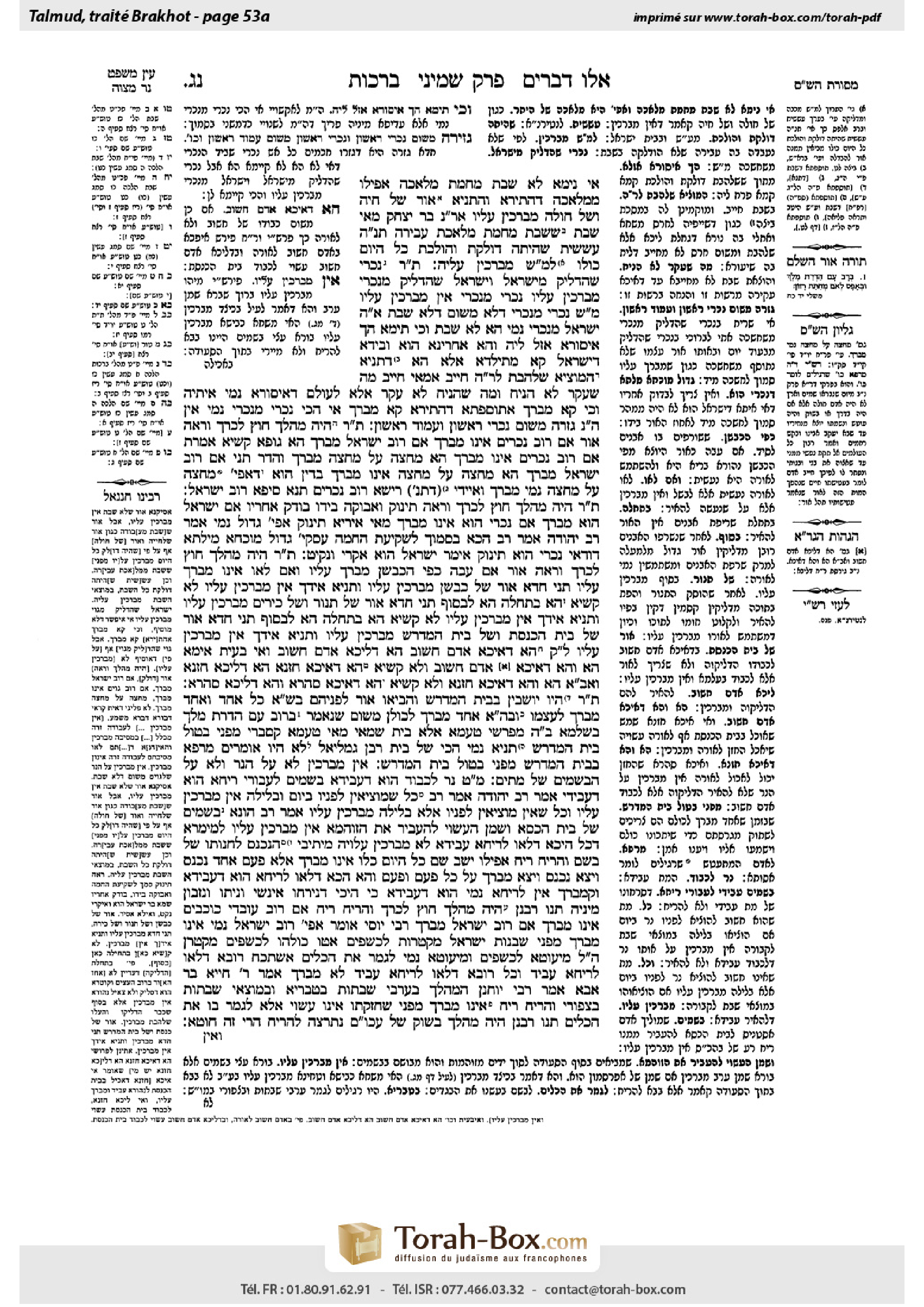
Berakhot 53a: Talmud study for Daf Yomi
Study the Talmud for Daf Yomi with scanned pages, Hebrew text, English translations from Sefaria and AI-generated French translations.
Passage selection and English or AI-generated French translation are available where the scan has annotations. Daf Study is independent of Torah-Box and Sefaria.
Browse Berakhot · ברכות · All tractatesBerakhot 53a text and translations
This page of Berakhot includes the Aramaic text, an English translation and an AI-generated French translation, alongside the scan above.
ברכות נ״ג א · Aramaic and Hebrew text
אִי נֵימָא לֹא שָׁבַת מֵחֲמַת מְלָאכָה אֲפִילּוּ מִמְּלָאכָה דְּהֶתֵּירָא, וְהָתַנְיָא: אוּר שֶׁל חַיָּה וְשֶׁל חוֹלֶה — מְבָרְכִין עָלָיו!
אָמַר רַב נַחְמָן בַּר יִצְחָק: מַאי ״שָׁבַת״ — שֶׁשָּׁבַת מֵחֲמַת מְלֶאכֶת עֲבֵירָה. תַּנְיָא נָמֵי הָכִי: עֲשָׁשִׁית שֶׁהָיְתָה דּוֹלֶקֶת וְהוֹלֶכֶת כׇּל הַיּוֹם כּוּלּוֹ, לְמוֹצָאֵי שַׁבָּת מְבָרְכִין עָלֶיהָ.
תָּנוּ רַבָּנַן: גּוֹי שֶׁהִדְלִיק מִיִּשְׂרָאֵל, וְיִשְׂרָאֵל שֶׁהִדְלִיק מִגּוֹי מְבָרְכִין עָלָיו. גּוֹי מִגּוֹי — אֵין מְבָרְכִין עָלָיו.
מַאי שְׁנָא גּוֹי מִגּוֹי דְּלָא — מִשּׁוּם דְּלֹא שָׁבַת? אִי הָכִי, יִשְׂרָאֵל מִגּוֹי נָמֵי הָא לֹא שָׁבַת!
וְכִי תֵּימָא הַךְ אִיסּוּרָא אֲזַל לֵיהּ, וְהָא אַחֲרִינָא הוּא, וּבִידָא דְיִשְׂרָאֵל קָא מִתְיַלְדָא — אֶלָּא הָא דְּתַנְיָא: הַמּוֹצִיא שַׁלְהֶבֶת לִרְשׁוּת הָרַבִּים — חַיָּיב. אַמַּאי חַיָּיב? מַה שֶּׁעָקַר לֹא הִנִּיחַ, וּמַה שֶּׁהִנִּיחַ לֹא עָקַר!
אֶלָּא לְעוֹלָם דְּאִיסּוּרָא נָמֵי אִיתֵיהּ, וְכִי קָא מְבָרֵךְ — אַתּוֹסֶפְתָּא דְּהֶתֵּירָא קָא מְבָרֵךְ, אִי הָכִי, גּוֹי מִגּוֹי נָמֵי!
אֵין הָכִי נָמֵי, גְּזֵירָה מִשּׁוּם גּוֹי רִאשׁוֹן וְעַמּוּד רִאשׁוֹן.
תָּנוּ רַבָּנַן: הָיָה מְהַלֵּךְ חוּץ לַכְּרַךְ וְרָאָה אוּר, אִם רוֹב גּוֹיִם — אֵינוֹ מְבָרֵךְ, אִם רוֹב יִשְׂרָאֵל — מְבָרֵךְ.
הָא גוּפָא קַשְׁיָא, אָמְרַתְּ אִם רוֹב גּוֹיִם — אֵינוֹ מְבָרֵךְ, הָא מֶחֱצָה עַל מֶחֱצָה — מְבָרֵךְ, וַהֲדַר תָּנֵי אִם רוֹב יִשְׂרָאֵל — מְבָרֵךְ, הָא מֶחֱצָה עַל מֶחֱצָה — אֵינוֹ מְבָרֵךְ!
בְּדִין הוּא דַּאֲפִילּוּ מֶחֱצָה עַל מֶחֱצָה נָמֵי מְבָרֵךְ, וְאַיְּידִי דִּתְנָא רֵישָׁא ״רוֹב גּוֹיִם״, תְּנָא סֵיפָא ״רוֹב יִשְׂרָאֵל״.
תָּנוּ רַבָּנַן: הָיָה מְהַלֵּךְ חוּץ לַכְּרַךְ וְרָאָה תִּינוֹק וַאֲבוּקָה בְּיָדוֹ, בּוֹדֵק אַחֲרָיו; אִם יִשְׂרָאֵל הוּא — מְבָרֵךְ, אִם נָכְרִי הוּא — אֵינוֹ מְבָרֵךְ.
מַאי אִירְיָא תִּינוֹק? אֲפִילּוּ גָּדוֹל נָמֵי!
אָמַר רַב יְהוּדָה אָמַר רַב: הָכָא בְּסָמוּךְ לִשְׁקִיעַת הַחַמָּה עָסְקִינַן. גָּדוֹל, מוֹכְחָא מִילְּתָא דְּוַדַּאי נָכְרִי הוּא. תִּינוֹק, אֵימַר יִשְׂרָאֵל הוּא, אִקְּרִי וּנְקֵיט.
תָּנוּ רַבָּנַן: הָיָה מְהַלֵּךְ חוּץ לַכְּרַךְ וְרָאָה אוּר, אִם עָבֶה כְּפִי הַכִּבְשָׁן — מְבָרֵךְ עָלָיו. וְאִם לָאו אֵינוֹ מְבָרֵךְ עָלָיו.
תָּנֵי חֲדָא: אוּר שֶׁל כִּבְשָׁן מְבָרְכִין עָלָיו, וְתַנְיָא אִידַּךְ: אֵין מְבָרְכִין עָלָיו!
לָא קַשְׁיָא: הָא בַּתְּחִלָּה, הָא לְבַסּוֹף.
תָּנֵי חֲדָא: אוּר שֶׁל תַּנּוּר וְשֶׁל כִּירַיִם מְבָרְכִין עָלָיו, וְתַנְיָא אִידַּךְ: אֵין מְבָרְכִין עָלָיו!
לָא קַשְׁיָא: הָא בַּתְּחִלָּה, הָא לְבַסּוֹף.
תָּנֵי חֲדָא: אוּר שֶׁל בֵּית הַכְּנֶסֶת וְשֶׁל בֵּית הַמִּדְרָשׁ מְבָרְכִין עָלָיו, וְתַנְיָא אִידַּךְ: אֵין מְבָרְכִין עָלָיו!
לָא קַשְׁיָא: הָא דְּאִיכָּא אָדָם חָשׁוּב, הָא דְּלֵיכָּא אָדָם חָשׁוּב.
וְאִי בָּעֵית אֵימָא הָא וְהָא דְּאִיכָּא אָדָם חָשׁוּב, וְלָא קַשְׁיָא: הָא דְּאִיכָּא חַזָּנָא, הָא דְּלֵיכָּא חַזָּנָא.
וְאִי בָּעֵית אֵימָא הָא וְהָא דְּאִיכָּא חַזָּנָא, וְלָא קַשְׁיָא: הָא דְּאִיכָּא סֵהֲרָא, וְהָא דְּלֵיכָּא סֵהֲרָא.
תָּנוּ רַבָּנַן: הָיוּ יוֹשְׁבִין בְּבֵית הַמִּדְרָשׁ וְהֵבִיאוּ אוּר לִפְנֵיהֶם, בֵּית שַׁמַּאי אוֹמְרִים: כׇּל אֶחָד וְאֶחָד מְבָרֵךְ לְעַצְמוֹ. וּבֵית הִלֵּל אוֹמְרִים: אֶחָד מְבָרֵךְ לְכוּלָּן — מִשּׁוּם שֶׁנֶּאֱמַר: ״בְּרׇב עָם הַדְרַת מֶלֶךְ״.
בִּשְׁלָמָא בֵּית הִלֵּל מְפָרְשִׁי טַעְמָא, אֶלָּא בֵּית שַׁמַּאי מַאי טַעְמָא? קָסָבְרִי מִפְּנֵי בִּיטּוּל בֵּית הַמִּדְרָשׁ.
תַּנְיָא נָמֵי הָכִי: שֶׁל בֵּית רַבָּן גַּמְלִיאֵל לֹא הָיוּ אוֹמְרִים ״מַרְפֵּא״ בְּבֵית הַמִּדְרָשׁ, מִפְּנֵי בִּיטּוּל בֵּית הַמִּדְרָשׁ.
אֵין מְבָרְכִין לֹא עַל הַנֵּר וְלֹא עַל הַבְּשָׂמִים שֶׁל מֵתִים. מַאי טַעְמָא? נֵר — לְכָבוֹד הוּא דַּעֲבִידָא, בְּשָׂמִים לְעַבּוֹרֵי רֵיחָא הוּא דַּעֲבִידִי.
אָמַר רַב יְהוּדָה אָמַר רַב: כֹּל שֶׁמּוֹצִיאִין לְפָנָיו בַּיּוֹם וּבַלַּיְלָה — אֵין מְבָרְכִין עָלָיו. וְכֹל שֶׁאֵין מוֹצִיאִין לְפָנָיו אֶלָּא בַּלַּיְלָה — מְבָרְכִין עָלָיו.
אָמַר רַב הוּנָא: בְּשָׂמִים שֶׁל בֵּית הַכִּסֵּא, וְשֶׁמֶן הֶעָשׂוּי לְהַעֲבִיר אֶת הַזּוּהֲמָא — אֵין מְבָרְכִין עָלָיו.
לְמֵימְרָא דְּכֹל הֵיכָא דְּלָאו לְרֵיחָא עֲבִידָא לָא מְבָרְכִין עִלָּוֵיהּ? מֵתִיבִי: הַנִּכְנָס לַחֲנוּתוֹ שֶׁל בַּשָּׂם וְהֵרִיחַ רֵיחַ, אֲפִילּוּ יָשַׁב שָׁם כׇּל הַיּוֹם כּוּלּוֹ אֵינוֹ מְבָרֵךְ אֶלָּא פַּעַם אַחַת. נִכְנַס וְיָצָא, נִכְנַס וְיָצָא — מְבָרֵךְ עַל כׇּל פַּעַם וּפַעַם. וְהָא הָכָא דְּלָאו לְרֵיחָא הוּא דַּעֲבִידָא, וְקָמְבָרֵךְ!
אִין, לְרֵיחָא נָמֵי הוּא דַּעֲבִידָא, כִּי הֵיכִי דְּנֵירְחוּ אִינָשֵׁי וְנֵיתוּ וְנִזְבּוֹן מִינֵּיהּ.
תָּנוּ רַבָּנַן: הָיָה מְהַלֵּךְ חוּץ לַכְּרַךְ וְהֵרִיחַ רֵיחַ, אִם רוֹב גּוֹיִם — אֵינוֹ מְבָרֵךְ, אִם רוֹב יִשְׂרָאֵל — מְבָרֵךְ. רַבִּי יוֹסֵי אוֹמֵר: אֲפִילּוּ רוֹב יִשְׂרָאֵל — נָמֵי אֵינוֹ מְבָרֵךְ, מִפְּנֵי שֶׁבְּנוֹת יִשְׂרָאֵל מְקַטְּרוֹת לִכְשָׁפִים.
אַטּוּ כּוּלְּהוּ לִכְשָׁפִים מְקַטְּרָן?! — הָוֵה לַהּ מִיעוּטָא לִכְשָׁפִים, וּמִיעוּטָא נָמֵי לְגַמֵּר אֶת הַכֵּלִים. אִשְׁתְּכַח רוּבָּא דְּלָאו לְרֵיחָא עֲבִיד, וְכׇל רוּבָּא דְּלָאו לְרֵיחָא עֲבִיד לָא מְבָרֵךְ.
אָמַר רַבִּי חִיָּיא בַּר אַבָּא אָמַר רַבִּי יוֹחָנָן: הַמְהַלֵּךְ בְּעַרְבֵי שַׁבָּתוֹת בִּטְבֶרְיָא וּבְמוֹצָאֵי שַׁבָּתוֹת בְּצִפּוֹרִי וְהֵרִיחַ רֵיחַ, אֵינוֹ מְבָרֵךְ, מִפְּנֵי שֶׁחֶזְקָתוֹ אֵינוֹ עָשׂוּי אֶלָּא לְגַמֵּר בּוֹ אֶת הַכֵּלִים.
תָּנוּ רַבָּנַן: הָיָה מְהַלֵּךְ בַּשּׁוּק שֶׁל עֲבוֹדָה זָרָה נִתְרַצָּה לְהָרִיחַ — הֲרֵי זֶה חוֹטֵא.
Berakhot 53a · English translation
If we say that did not rest means that it did not rest from labor, even from labor that is permitted? Wasn’t it taught in a baraita that over light that was kindled on Shabbat for a woman giving birth or a dangerously ill person, for whom one is permitted to perform prohibited labor on Shabbat, one may recite a blessing during havdala at the conclusion of Shabbat?
Rav Naḥman bar Yitzḥak said: What is meant by rested? Light that rested from labor of transgression on Shabbat. However, if the light burned for the entire Shabbat or was kindled on Shabbat in a permissible manner, one may recite a blessing over it. That halakha was also taught in a baraita: A lantern that was continuously burning throughout the entire day of Shabbat, one may recite a blessing over it at the conclusion of Shabbat.
The Sages taught in a baraita: A gentile who lit a candle from a candle that was in the possession of a Jew or if a Jew lit a candle from a gentile, one may recite a blessing over it at the conclusion of Shabbat. However, if a gentile lit a candle from a gentile, one may not recite a blessing over it.
The Gemara asks: What is different about a candle that a gentile lit from a gentile, that one may not recite a blessing over it? Because the light did not rest on Shabbat. If so, the light of a Jew who lit a candle from a gentile also did not rest on Shabbat.
And if you say that this prohibited flame has gone and this flame is a new and different one which came into being in the possession of a Jew, as a flame is not a concrete, static object, but rather it constantly recreates itself; however, this halakha that was taught in a Tosefta in tractate Shabbat states: One who carries out a flame from the private to the public domain on Shabbat is liable for carrying out from one domain to another. If the flame is constantly recreating itself, why is he liable? That flame which he lifted from the private domain he did not place in the public domain and that which he placed he did not lift. One is only liable for carrying out on Shabbat if he lifted an object from one domain and placed that same object in another domain. Since one who carries out a flame on Shabbat is considered liable, evidently, despite any change that it may undergo, the flame is essentially considered a single entity.
Rather, actually that prohibited flame is also extant, and when one recites the blessing, he recites the blessing over the permitted addition to that flame. The Gemara asks: If so, even if a gentile lit a candle from a gentile as well, the flame should be considered essentially new; one should be able to recite a blessing over the addition.
The Gemara answers: Yes, it is indeed so. Fundamentally, there is no reason to prohibit doing so. However, the Sages issued a decree because of the first gentile, who did not light the flame from another gentile, and the first pillar of flame that was kindled on Shabbat. Consequently, they prohibited all somewhat similar cases, including when a gentile lights a flame from another gentile.
The Sages taught in a baraita: If one was walking outside the city, saw fire there, and wanted to recite the blessing over it as part of havdala, if the city has a majority of gentiles he may not recite the blessing over the fire, but if the city has a majority of Jews, he may recite the blessing.
The Gemara notes: The matter itself is difficult in this baraita. You said in the baraita that if the town has a majority of gentiles he may not recite the blessing. By inference, if the town population was half gentiles and half Jews, one may recite a blessing. And then you teach that if the town has a majority of Jews, he may recite the blessing. By inference, if the town population was half gentiles and half Jews, one may not recite a blessing. The inferences from two sections of the baraita are contradictory.
The Gemara responds: By right, the baraita should have taught that even if the town population was half gentiles and half Jews, one may recite a blessing, but since in the first clause it taught: The majority of gentiles, in the latter clause it used the same expression and taught: The majority of Jews.
And the Sages taught: One who was walking outside the city at the conclusion of Shabbat and saw a child with a torch in his hand, he must check after his background. If the child is a Jew, he may recite a blessing over this flame, but if the child is a gentile, he may not recite a blessing over it.
The Gemara asks: Why was it taught specifically with regard to a child? Even if he were an adult, one would also need to investigate whether he was a Jew or a gentile in order to determine whether or not he may recite a blessing over the torch.
Rav Yehuda said that Rav said: Here we are dealing with a case where, although it was the conclusion of Shabbat, it was still soon after sunset. Therefore, in the case of an adult, it is self-evident that he is a gentile, as a Jew would not be so quick to take fire in his hand immediately after Shabbat. In the case of a child, however, say that perhaps he is a Jew and it happened that he took the torch.
And the Sages taught: One who was walking outside the city at the conclusion of Shabbat and saw a fire, if the fire is at least as thick as the opening of a furnace, one may recite a blessing over it, as a fire of that kind is kindled for the light it produces as well. And if it is not at least that thick, one may not recite a blessing over it.
It was taught in one baraita: During havdala, one may recite a blessing over the fire of a furnace; and it was taught in another baraita: One may not recite a blessing over the fire of a furnace. There is an apparent contradiction between the baraitot.
The Gemara responds: This is not difficult, as this baraita which prohibits reciting the blessing is speaking at the beginning when the furnace was just kindled and the fire is designated solely to heat the objects in the furnace; that baraita, which permits reciting the blessing, is speaking at the end, when the fire is no longer needed to heat the objects in the furnace, and its light is used for other purposes.
The Gemara cites a similar contradiction between baraitot: It was taught in one baraita: During havdala, one may recite a blessing over the fire of an oven or a stove; and it was taught in another baraita: One may not recite a blessing over it.
The Gemara responds: This is not difficult, as a similar distinction between the baraitot may be suggested. This baraita, which prohibits reciting the blessing, is speaking at the beginning, when the oven or stove was just kindled and the fire is designated solely to heat the objects on the stove or in the oven; that baraita, which permits reciting the blessing, is speaking at the end, when the fire is no longer needed to heat the objects on the stove or in the oven and its light is used for other purposes.
The Gemara cites another contradiction: It was taught in one baraita: During havdala, one may recite a blessing over the light of a synagogue or a study hall; and it was taught in another baraita: One may not recite a blessing over it.
The Gemara responds: This is not difficult, as this baraita, which prohibits reciting the blessing, is speaking in a case where there is an important person in the synagogue and the fire is kindled in his honor and not to provide light; that baraita, which permits reciting the blessing, is speaking in a case where there is no important person present and the fire is kindled to provide light.
And if you wish, say instead that this baraita and that baraita are speaking in a case where there is an important person present in the synagogue, and this is not difficult because the contradiction can be resolved as follows: This baraita, which permits reciting the blessing, is speaking in a case where there is a caretaker in the synagogue who uses the light; that baraita, which prohibits reciting the blessing, is speaking in a case where there is no caretaker and the light is kindled for purposes of honor.
And if you wish, say instead that this baraita and that baraita are both referring to a case where there is a caretaker present in the synagogue, and this is not difficult because the contradiction can be resolved as follows: This baraita, which prohibits reciting the blessing, is speaking in a case where there is moonlight, so the caretaker did not light the fire to provide light as the moonlight is sufficient; that baraita, which permits reciting the blessing, is speaking in a case where there is no moonlight, and the caretaker lights the fire to provide light.
The Sages taught in a baraita: People were seated in the study hall and they brought fire before them at the conclusion of Shabbat. Beit Shammai say: Each and every individual recites a blessing for himself; and Beit Hillel say: One recites a blessing on behalf of everyone and the others answer amen. Beit Hillel’s reasoning is as it is stated: “The splendor of the King is in the multitude of the people” (Proverbs 14:28). When everyone joins together to hear the blessing, the name of God is glorified.
The Gemara asks: Granted, Beit Hillel, they explain their reasoning, but what is the reason for the opinion of Beit Shammai to prohibit reciting the blessing communally? The Gemara answers: They hold that it is prohibited due to the fact that it will lead to suspension of study in the study hall. Waiting for someone to recite the blessing will interrupt Torah study for several minutes.
This concern for disrupting Torah study was also taught in a baraita: The members of the house of Rabban Gamliel would not say good health when someone sneezed in the study hall, due to the fact that it would lead to suspension of study in the study hall.
We learned in the mishna: One may neither recite a blessing over the candle nor over the spices designated to honor the dead. The Gemara explains: What is the reason? Because a candle of the dead is kindled for the purpose of honoring the dead, not for light; the spices are to neutralize the bad odor, not for their pleasant fragrance.
And Rav Yehuda said that Rav said: Any deceased before whom a candle is taken out both by day and by night, it is evident that the candle is for the purpose of honoring the deceased; therefore, one may not recite a blessing over it. And any deceased before whom a candle is taken out only by night, it is evident that the purpose of the candle is for its light alone, and one may recite a blessing over it.
Similarly, Rav Huna said: Over spices used to deodorize the bathroom and fragrant oil intended to remove filth, one may not recite a blessing as they are not used for their pleasant fragrance.
The Gemara asks: Is that to say that any case where it is not used for its pleasant fragrance, one may not recite a blessing over it? The Gemara raises an objection based on the Tosefta: One who enters the store of a perfumer, and smelled a fragrance, even if he sat there throughout the entire day, he only recites a blessing once. However, if one entered and exited, entered and exited, he recites a blessing on each and every occasion. Isn’t it a case here, where the spices are not intended for fragrance, as they are not used to improve the scent in the store, and, nevertheless, one recites a blessing?
The Gemara responds: Yes, in this case the spices are also intended for fragrance; they are used to generate a scent in the store so that people will smell them and come and purchase from him.
The Sages taught in a baraita: One who was walking outside a city and smelled a scent; if the majority of the town’s residents are gentiles he may not recite a blessing over the scent, but if the majority are Jews, he may recite a blessing. Rabbi Yosei says: Even if the majority are Jews, one may not recite a blessing, as the daughters of Israel burn incense to witchcraft and the spices were certainly made for witchcraft, not for their fragrance.
The Gemara asks: Is that to say that they all burn incense to witchcraft? Rather, there is a minority of people who burn incense to witchcraft, and a different minority who burn spices in order to perfume their garments with incense. A majority, therefore, exists that does not use it for fragrance, and in a case where the majority does not use it for fragrance, one does not recite a blessing.
Similarly, Rabbi Ḥiyya bar Abba said that Rabbi Yoḥanan said: One who walks on Shabbat eve in Tiberias or at the conclusion of Shabbat in Tzippori, and smelled the scent of incense may not recite a blessing, as the presumption is that it was intended to perfume garments.
On a related note, the Gemara cites the following: The Sages taught in a baraita: One who was walking in the marketplace of idolators and willingly smelled the incense wafting there, he is a sinner, as he should not have the intention to smell it.
Berakhot 53a · Traduction française (IA)
Si nous disons que « n’a pas reposé » signifie qu’il n’a pas reposé du travail, même du travail permis ? N’a-t-il pas été enseigné dans une baraïta que concernant une lumière allumée le shabbat pour une femme en accouchement ou une personne gravement malade, pour qui l’on est autorisé à accomplir un travail interdit le shabbat, l’on peut réciter une bénédiction lors de la séparation du shabbat ?
Rav Naḥman bar Yitzḥak a dit : De quoi s’agit-il lorsqu’on dit « reposé » ? De lumière qui a reposé du travail de transgression le shabbat. Cependant, si la lumière brûlait tout le shabbat ou avait été allumée de manière permise, l’on peut réciter une bénédiction sur elle. Cette halakha a également été enseignée dans une baraïta : Une lanterne qui brûlait continuellement tout le jour du shabbat, l’on peut réciter une bénédiction sur elle à la fin du shabbat.
Les Sages ont enseigné dans une baraïta : Un non-Juif qui allume une bougie à partir d’une bougie appartenant à un Juif ou si un Juif allume une bougie à partir d’un non-Juif, l’on peut réciter une bénédiction sur elle à la fin du shabbat. Cependant, si un non-Juif allume une bougie à partir d’un non-Juif, l’on ne peut pas réciter une bénédiction sur elle.
Le Guemara pose la question : Qu’est-ce qui diffère dans une bougie allumée par un non-Juif à partir d’un non-Juif, qui ne permet pas de réciter une bénédiction sur elle ? Parce que la lumière n’a pas reposé le shabbat. Si c’est ainsi, la lumière d’un Juif qui allume une bougie à partir d’un non-Juif n’a pas non plus reposé le shabbat.
Et si vous dites que ce feu interdit est parti et que ce feu est un nouveau feu différent qui est entré en possession d’un Juif, comme un feu n’est pas un objet concret et statique, mais plutôt qu’il se réinvente constamment ; cependant, cette halakha qui a été enseignée dans une Tosefta dans le traité de Shabbat stipule : Celui qui transporte un feu du domaine privé au domaine public le shabbat est puni pour avoir transporté d’un domaine à un autre. Si le feu se réinvente constamment, pourquoi est-il puni ? Ce feu qu’il a levé du domaine privé, il ne l’a pas placé dans le domaine public, et ce feu qu’il a placé, il ne l’a pas levé. On est seulement puni pour avoir transporté le shabbat si l’on a levé un objet d’un domaine et l’a placé dans un autre domaine. Puisque celui qui transporte un feu le shabbat est considéré comme puni, évidemment, malgré tout changement qu’il puisse subir, le feu est considéré comme un seul et même objet.
En réalité, ce feu interdit existe également, et lorsqu’on récite la bénédiction, on récite la bénédiction sur l’ajout permis à ce feu. Le Guemara pose la question : Si c’est ainsi, même si un non-Juif allume une bougie à partir d’un non-Juif, le feu devrait être considéré comme nouveau fondamentalement ; on devrait pouvoir réciter une bénédiction sur l’ajout.
Le Guemara répond : Oui, c’est effectivement ainsi. Fondamentalement, il n’y a pas de raison de prohiber cela. Cependant, les Sages ont émis un décret à cause du premier non-Juif, qui n’a pas allumé le feu à partir d’un autre non-Juif, et du premier pilier de feu allumé le shabbat. Ainsi, ils ont prohibé tous les cas semblables, y compris lorsqu’un non-Juif allume un feu à partir d’un autre non-Juif.
Les Sages ont enseigné dans une baraïta : Si l’on marchait en dehors de la ville, voyait du feu là et voulait réciter la bénédiction sur lui en tant que partie de la séparation du shabbat, si la ville a une majorité de non-Juifs, l’on ne peut pas réciter la bénédiction sur le feu, mais si la ville a une majorité de Juifs, l’on peut réciter la bénédiction.
Le Guemara note : La question elle-même est difficile dans cette baraïta. Vous avez dit dans la baraïta que si la ville a une majorité de non-Juifs, l’on ne peut pas réciter la bénédiction. Par conséquent, si la population de la ville était moitié non-Juifs et moitié Juifs, l’on pourrait réciter la bénédiction. Et puis vous enseignez que si la ville a une majorité de Juifs, l’on peut réciter la bénédiction. Par conséquent, si la population de la ville était moitié non-Juifs et moitié Juifs, l’on ne pourrait pas réciter la bénédiction. Les inférences issues de deux sections de la baraïta sont contradictoires.
Le Guemara répond : D'après la loi, la baraïta aurait dû enseigner que même si la population de la ville était moitié non-Juifs et moitié Juifs, l'on pouvait réciter une bénédiction, mais puisque dans la première clause elle a enseigné : La majorité de non-Juifs, dans la dernière clause elle a utilisé la même expression et enseigné : La majorité de Juifs.
Et les Sages ont enseigné : Celui qui marchait en dehors de la ville à la fin du shabbat et voyait un enfant avec une torche dans la main, il devait vérifier son origine. Si l'enfant était un Juif, l'on pouvait réciter la bénédiction sur cette flamme, mais si l'enfant était un non-Juif, l'on ne pouvait pas réciter la bénédiction sur elle.
Le Guemara pose la question : Pourquoi a-t-il été enseigné spécifiquement concernant un enfant ? Même s'il était un adulte, l'on aurait également besoin d'investiguer s'il était un Juif ou un non-Juif afin de déterminer si l'on pouvait réciter la bénédiction sur la torche.
Rav Yehuda a dit que Rav a dit : Ici, nous sommes en présence d’un cas où, bien que ce fût la fin du shabbat, il était encore bientôt le coucher du soleil. Par conséquent, dans le cas d’un adulte, il est évident qu’il est un non-Juif, car un Juif ne serait pas aussi rapide à prendre du feu dans sa main immédiatement après le shabbat. Cependant, dans le cas d’un enfant, disons qu’il est possible qu’il soit un Juif et qu’il ait pu prendre la torche.
Et les Sages ont enseigné : Celui qui marchait en dehors de la ville à la fin du shabbat et voyait un feu, si le feu est aussi épais qu’une ouverture de forge, l’on peut réciter une bénédiction sur lui, car un feu de ce genre est allumé pour la lumière qu’il produit. Et si ce n’est pas aussi épais, l’on ne peut pas réciter une bénédiction sur lui.
Il a été enseigné dans une baraïta : Lors de la havdala, l’on peut réciter une bénédiction sur le feu d’une forge ; et il a été enseigné dans une autre baraïta : L’on ne peut pas réciter une bénédiction sur le feu d’une forge. Il y a une contradiction apparente entre ces baraitot.
La Guemara répond : Ce n'est pas difficile, car cette baraïta qui interdit de réciter la berakha est parlant au début, lorsque le four venait juste d'être allumé et que le feu était destiné uniquement à réchauffer les objets dans le four ; cette baraïta, qui permet de réciter la berakha, est parlant à la fin, lorsque le feu n'était plus nécessaire pour réchauffer les objets dans le four et que sa lumière était utilisée à d'autres fins.
La Guemara cite une contradiction similaire entre des baraitot : Il a été enseigné dans une baraïta : Lors de la Havdala, on peut réciter une berakha sur le feu d'un four ou d'une cuisinière ; et il a été enseigné dans une autre baraïta : On ne peut pas réciter une berakha sur ce feu.
La Guemara répond : Ce n'est pas difficile, car une distinction similaire entre les baraitot peut être suggérée. Cette baraïta, qui interdit de réciter la berakha, est parlant au début, lorsque le four ou la cuisinière venait juste d'être allumé et que le feu était destiné uniquement à réchauffer les objets sur la cuisinière ou dans le four ; cette baraïta, qui permet de réciter la berakha, est parlant à la fin, lorsque le feu n'était plus nécessaire pour réchauffer les objets sur la cuisinière ou dans le four et que sa lumière était utilisée à d'autres fins.
La Guemara cite une autre contradiction : Il a été enseigné dans une baraïta : Lors de la Havdala, on peut réciter une berakha sur la lumière d'une synagogue ou d'une salle de study ; et il a été enseigné dans une autre baraïta : On ne peut pas réciter une berakha sur cette lumière.
La Guemara répond : Ce n'est pas difficile, car cette baraïta, qui interdit de réciter la berakha, est parlant dans un cas où il y a une personne importante dans la synagogue et le feu est allumé en son honneur et non pour fournir de la lumière ; cette baraïta, qui permet de réciter la berakha, est parlant dans un cas où il n'y a pas de personne importante présente et le feu est allumé pour fournir de la lumière.
Et si vous le souhaitez, dites plutôt que cette baraïta et celle-ci sont parlant dans un cas où il y a une personne importante présente dans la synagogue, et ce n'est pas difficile car la contradiction peut être résolue comme suit : cette baraïta, qui permet de réciter la berakha, est parlant dans un cas où il y a un gardien dans la synagogue qui utilise la lumière ; cette baraïta, qui interdit de réciter la berakha, est parlant dans un cas où il n'y a pas de gardien et la lumière est allumée à des fins d'honneur.
Et si vous le souhaitez, dites plutôt que cette baraïta et celle-ci sont toutes deux relatives à un cas où il y a un gardien présent dans la synagogue, et ce n'est pas difficile car la contradiction peut être résolue comme suit : cette baraïta, qui interdit de réciter la berakha, est relative à un cas où il y a un clair de lune, donc le gardien n'a pas allumé le feu pour fournir de la lumière car le clair de lune est suffisant ; cette baraïta, qui permet de réciter la berakha, est relative à un cas où il n'y a pas de clair de lune, et le gardien allume le feu pour fournir de la lumière.
Les Sages ont enseigné dans une baraïta : Des gens étaient assis dans la salle de study et ils ont apporté du feu devant eux à la fin du Shabbat. Beit Shammai disent : Chacun récite une berakha pour soi-même ; et Beit Hillel disent : On récite une berakha pour tout le monde et les autres répondent amen. La raison de Beit Hillel est comme il est dit : « La splendeur du Roi est dans la multitude du peuple » (Proverbes 14:28). Lorsque tout le monde s'assemble pour entendre la berakha, le nom de Dieu est glorifié.
La Guemara demande : D'accord, Beit Hillel, ils expliquent leur raisonnement, mais quelle est la raison de l'opinion de Beit Shammai qui interdit de réciter la berakha collectivement ? La Guemara répond : Ils considèrent que c'est interdit en raison du fait que cela entraînerait l'interuption des études dans la salle de study. Attendre que quelqu'un récite la berakha interromprait les études de la Torah pendant plusieurs minutes.
Cette préoccupation pour ne pas interrompre les études de la Torah a également été enseignée dans une baraïta : Les membres de la maison de Rabban Gamliel ne disaient pas « bonjour » lorsqu'une personne éternuait dans la salle de study, en raison du fait que cela entraînerait l'interuption des études dans la salle de study.
Nous avons appris dans la mishna : On ne peut ni réciter une berakha sur la bougie ni sur les épices destinés à honorer les morts. La Guemara explique : Quelle est la raison ? Parce que la bougie des morts est allumée à l'effet d'honorer les morts, pas pour la lumière ; les épices sont destinés à neutraliser l'odeur désagréable, pas pour leur parfum agréable.
Et Rav Yehuda a dit que Rav a dit : Toute personne décédée devant laquelle une bougie est allumée à la fois de jour et de nuit, il est évident que la bougie est destinée à honorer le défunt ; donc on ne peut pas réciter une berakha sur elle. Et toute personne décédée devant laquelle une bougie est allumée uniquement la nuit, il est évident que le but de la bougie est la lumière seule, et on peut réciter une berakha sur elle.
De même, Rav Huna a dit : Sur les épices utilisés pour déodoriser la salle de bain et l'huile parfumée destinée à éliminer la saleté, on ne peut pas réciter une berakha, car ils ne sont pas utilisés pour leur parfum agréable.
La Guemara demande : Est-ce que cela signifie que tout cas où il n'est pas utilisé pour son parfum agréable, on ne peut pas réciter une berakha sur lui ? La Guemara soulève une objection basée sur la Tosefta : Celui qui entre dans la boutique d'un parfumeur, et a senti un parfum, même s'il y a resté toute la journée, il récite une berakha une seule fois. Cependant, si l'on entre et sort, entre et sort, il récite une berakha à chaque occasion. N'est-ce pas un cas ici, où les épices ne sont pas destinés à leur parfum, car ils ne sont pas utilisés pour améliorer l'odeur dans la boutique, et pourtant, on récite une berakha ?
La Guemara répond : Oui, dans ce cas les épices sont également destinés à leur parfum ; ils sont utilisés pour générer un parfum dans la boutique afin que les gens puissent le sentir et viennent acheter.
Les Sages ont enseigné dans une baraïta : Celui qui marchait en dehors d'une ville et sentait une odeur ; si la majorité des habitants de la ville sont des non-Juifs, il ne doit pas bénir l'odeur, mais si la majorité sont des Juifs, il peut bénir. Rabbi Yosei dit : Même si la majorité sont des Juifs, on ne doit pas bénir, car les filles d'Israël brûlent de l'encens pour la sorcellerie et les épices ont certainement été faites pour la sorcellerie, pas pour leur parfum.
Le Guemara demande : Est-ce que cela signifie que tous brûlent de l'encens pour la sorcellerie ? Plutôt, il existe une minorité de personnes qui brûlent de l'encens pour la sorcellerie, et une autre minorité qui brûle des épices afin de parfumer leurs vêtements avec de l'encens. Une majorité existe donc qui ne l'utilise pas pour le parfum, et dans un cas où la majorité ne l'utilise pas pour le parfum, on ne doit pas bénir.
De même, Rabbi Chiya bar Abba a dit que Rabbi Yochanan a dit : Celui qui marche le soir du Shabbat à Tibériade ou à la fin du Shabbat à Tzipporé, et qui sent l'odeur de l'encens, ne doit pas bénir, car on suppose qu'il était destiné à parfumer les vêtements.
En ce qui concerne cela, la Guemara cite ce qui suit : Les Sages ont enseigné dans une baraïta : Celui qui marchait dans le marché des idolâtres et a volontairement senti l'encens qui flottait là, il est coupable, car il ne devrait pas avoir l'intention de le sentir.
Traduction française générée par IA à partir de l’édition anglaise de Sefaria. Vérifie toujours un passage avec le texte source.
Text from Sefaria: William Davidson Edition - Vocalized Aramaic (CC BY NC); William Davidson Edition - English (CC BY NC).