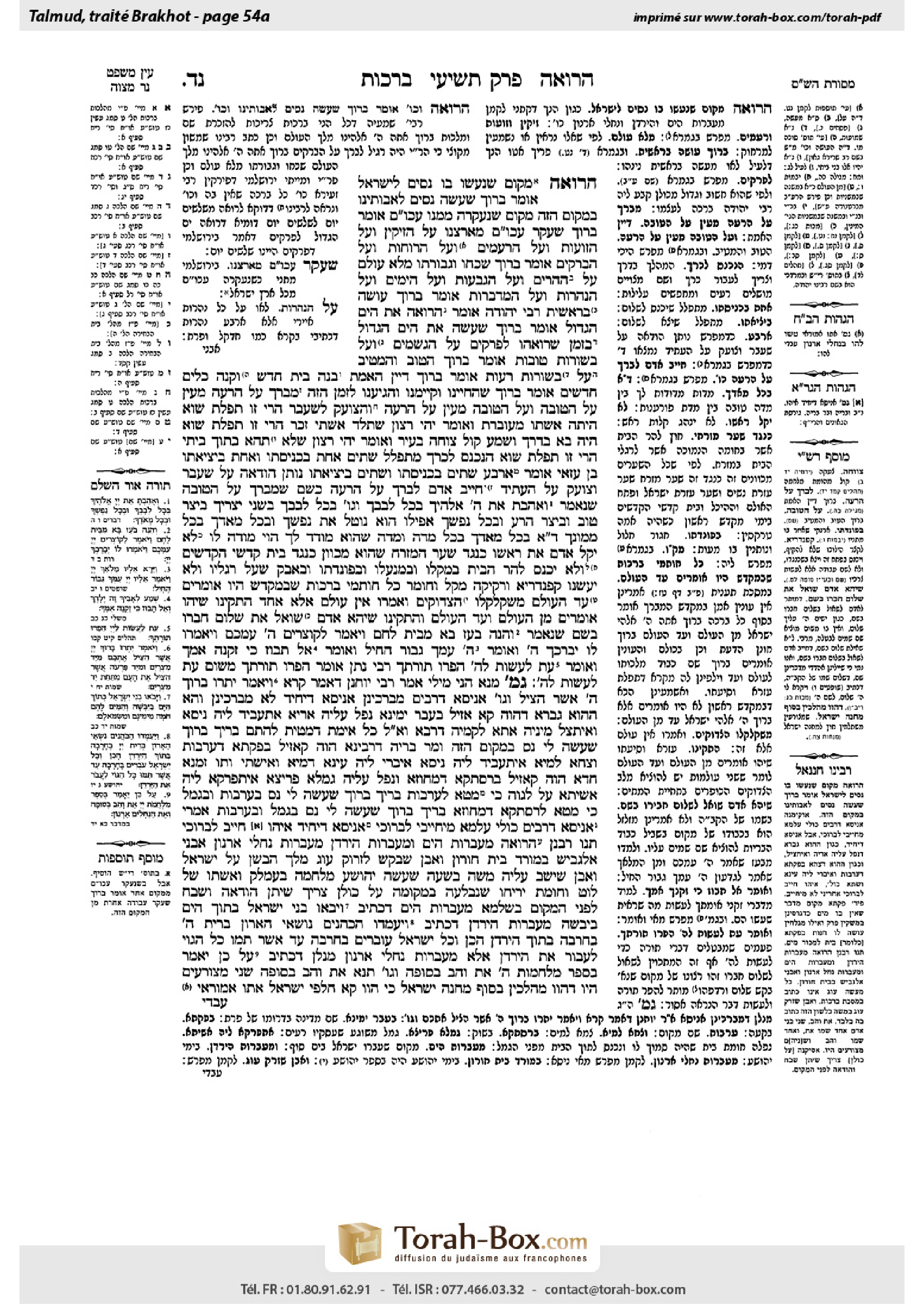
Berakhot 54a: Talmud study for Daf Yomi
Study the Talmud for Daf Yomi with scanned pages, Hebrew text, English translations from Sefaria and AI-generated French translations.
Passage selection and English or AI-generated French translation are available where the scan has annotations. Daf Study is independent of Torah-Box and Sefaria.
Browse Berakhot · ברכות · All tractatesBerakhot 54a text and translations
This page of Berakhot includes the Aramaic text, an English translation and an AI-generated French translation, alongside the scan above.
ברכות נ״ד א · Aramaic and Hebrew text
מַתְנִי׳ הָרוֹאֶה מָקוֹם שֶׁנַּעֲשׂוּ בּוֹ נִסִּים לְיִשְׂרָאֵל, אוֹמֵר: ״בָּרוּךְ … שֶׁעָשָׂה נִסִּים לַאֲבוֹתֵינוּ בַּמָּקוֹם הַזֶּה״. מָקוֹם שֶׁנֶּעֶקְרָה מִמֶּנּוּ עֲבוֹדָה זָרָה, אוֹמֵר: ״בָּרוּךְ … שֶׁעָקַר עֲבוֹדָה זָרָה מֵאַרְצֵנוּ״.
עַל הַזִּיקִין, וְעַל הַזְּוָעוֹת, וְעַל הָרְעָמִים, וְעַל הָרוּחוֹת, וְעַל הַבְּרָקִים אוֹמֵר: ״בָּרוּךְ … שֶׁכֹּחוֹ וּגְבוּרָתוֹ מָלֵא עוֹלָם״. עַל הֶהָרִים, וְעַל הַגְּבָעוֹת, וְעַל הַיַּמִּים, וְעַל הַנְּהָרוֹת, וְעַל הַמִּדְבָּרוֹת אוֹמֵר: ״בָּרוּךְ … עוֹשֵׂה בְּרֵאשִׁית״. רַבִּי יְהוּדָה, אוֹמֵר: הָרוֹאֶה אֶת הַיָּם הַגָּדוֹל, אוֹמֵר: ״בָּרוּךְ שֶׁעָשָׂה אֶת הַיָּם הַגָּדוֹל״ — בִּזְמַן שֶׁרוֹאֵהוּ לִפְרָקִים.
עַל הַגְּשָׁמִים, וְעַל בְּשׂוֹרוֹת טוֹבוֹת אוֹמֵר: ״בָּרוּךְ הַטּוֹב וְהַמֵּטִיב״. עַל בְּשׂוֹרוֹת רָעוֹת אוֹמֵר: ״בָּרוּךְ דַּיַּין הָאֱמֶת״. בָּנָה בַּיִת חָדָשׁ, וְקָנָה כֵּלִים חֲדָשִׁים, אוֹמֵר: ״בָּרוּךְ … שֶׁהֶחֱיָינוּ וְקִיְּימָנוּ וְהִגִּיעָנוּ לַזְּמַן הַזֶּה״. מְבָרֵךְ עַל הָרָעָה מֵעֵין עַל הַטּוֹבָה, וְעַל הַטּוֹבָה מֵעֵין עַל הָרָעָה.
וְהַצּוֹעֵק לְשֶׁעָבַר — הֲרֵי זוֹ תְּפִלַּת שָׁוְא. הָיְתָה אִשְׁתּוֹ מְעוּבֶּרֶת, וְאוֹמֵר: ״יְהִי רָצוֹן שֶׁתֵּלֵד אִשְׁתִּי זָכָר״ — הֲרֵי זוֹ תְּפִלַּת שָׁוְא. הָיָה בָּא בַּדֶּרֶךְ וְשָׁמַע קוֹל צְוָחָה בָּעִיר, וְאוֹמֵר: ״יְהִי רָצוֹן שֶׁלֹּא תְּהֵא בְּתוֹךְ בֵּיתִי״ — הֲרֵי זוֹ תְּפִלַּת שָׁוְא.
הַנִּכְנָס לִכְרַךְ מִתְפַּלֵּל שְׁתַּיִם, אַחַת בִּכְנִיסָתוֹ, וְאַחַת בִּיצִיאָתוֹ. בֶּן עַזַּאי אוֹמֵר: אַרְבַּע, שְׁתַּיִם בִּכְנִיסָתוֹ, וּשְׁתַּיִם בִּיצִיאָתוֹ. נוֹתֵן הוֹדָאָה עַל שֶׁעָבַר וְצוֹעֵק עַל הֶעָתִיד.
חַיָּיב אָדָם לְבָרֵךְ עַל הָרָעָה כְּשֵׁם שֶׁמְּבָרֵךְ עַל הַטּוֹבָה, שֶׁנֶּאֱמַר: ״וְאָהַבְתָּ אֵת ה׳ אֱלֹהֶיךָ בְּכׇל לְבָבְךָ וְגוֹ׳״. ״בְּכָל לְבָבְךָ״ — בִּשְׁנֵי יְצָרֶיךָ, בְּיֵצֶר טוֹב וּבְיֵצֶר הָרָע. ״וּבְכׇל נַפְשְׁךָ״ — אֲפִילּוּ הוּא נוֹטֵל אֶת נַפְשְׁךָ. ״וּבְכׇל מְאֹדֶךָ״ — בְּכָל מָמוֹנְךָ. דָּבָר אַחֵר: ״בְּכָל מְאֹדֶךָ״ — בְּכָל מִדָּה וּמִדָּה שֶׁהוּא מוֹדֵד לְךָ הֱוֵי מוֹדֶה לוֹ.
לֹא יָקֵל אָדָם אֶת רֹאשׁוֹ כְּנֶגֶד שַׁעַר הַמִּזְרָח שֶׁהוּא מְכוּוָּן כְּנֶגֶד בֵּית קׇדְשֵׁי הַקֳּדָשִׁים. וְלֹא יִכָּנֵס לְהַר הַבַּיִת בְּמַקְלוֹ, וּבְמִנְעָלוֹ, וּבְפוּנְדָּתוֹ, וּבְאָבָק שֶׁעַל רַגְלָיו. וְלָא יַעֲשֶׂנּוּ קַפַּנְדַּרְיָא. וּרְקִיקָה — מִקַּל וָחוֹמֶר.
כׇּל חוֹתְמֵי בְּרָכוֹת שֶׁבַּמִּקְדָּשׁ הָיוּ אוֹמְרִים ״עַד הָעוֹלָם״. מִשֶּׁקִּלְקְלוּ הַמִּינִין וְאָמְרוּ אֵין עוֹלָם אֶלָּא אֶחָד, הִתְקִינוּ שֶׁיְּהוּ אוֹמְרִים ״מִן הָעוֹלָם וְעַד הָעוֹלָם״.
וְהִתְקִינוּ שֶׁיְּהֵא אָדָם שׁוֹאֵל אֶת שְׁלוֹם חֲבֵרוֹ בַּשֵּׁם, שֶׁנֶּאֱמַר: ״וְהִנֵּה בֹעַז בָּא מִבֵּית לֶחֶם וַיֹּאמֶר לַקּוֹצְרִים ה׳ עִמָּכֶם וַיֹּאמְרוּ לוֹ יְבָרֶכְךָ ה׳״. וְאוֹמֵר: ״ה׳ עִמְּךָ גִּבּוֹר הֶחָיִל״. וְאוֹמֵר: ״אַל תָּבוּז כִּי זָקְנָה אִמֶּךָ״. וְאוֹמֵר: ״עֵת לַעֲשׂוֹת לַה׳ הֵפֵרוּ תּוֹרָתֶךָ״. רַבִּי נָתָן אוֹמֵר: ״הֵפֵרוּ תּוֹרָתֶךָ״ מִשּׁוּם ״עֵת לַעֲשׂוֹת לַה׳״.
גְּמָ׳ מְנָא הָנֵי מִילֵּי? אָמַר רַבִּי יוֹחָנָן, דְּאָמַר קְרָא: ״וַיֹּאמֶר יִתְרוֹ בָּרוּךְ ה׳ אֲשֶׁר הִצִּיל וְגוֹ׳״.
אַנִּיסָּא דְרַבִּים מְבָרְכִינַן, אַנִּיסָּא דְיָחִיד לָא מְבָרְכִינַן?! וְהָא הָהוּא גַּבְרָא דַּהֲוָה קָא אָזֵיל בַּעֲבַר יַמִּינָא. נְפַל עֲלֵיהּ אַרְיָא, אִתְעֲבִיד לֵיהּ נִיסָּא וְאִיתַּצַּל מִינֵּיהּ. אֲתָא לְקַמֵּיהּ דְּרָבָא, וַאֲמַר לֵיהּ: כׇּל אִימַּת דְּמָטֵית לְהָתָם — בָּרֵיךְ ״בָּרוּךְ שֶׁעָשָׂה לִי נֵס בַּמָּקוֹם הַזֶּה״.
וּמָר בְּרֵיהּ דְּרָבִינָא הֲוָה קָאָזֵיל בְּפַקְתָּא דַעֲרָבוֹת וּצְחָא לְמַיָּא. אִתְעֲבִיד לֵיהּ נִיסָּא, אִיבְּרִי לֵיהּ עֵינָא דְמַיָּא, וְאִישְׁתִּי.
וְתוּ, זִמְנָא חֲדָא הֲוָה קָאָזֵיל בְּרַסְתְּקָא דְמָחוֹזָא וּנְפַל עֲלֵיהּ גַּמְלָא פְּרִיצָא. אִיתְפָּרַקָא לֵיהּ אָשִׁיתָא, עָל לְגַוַּהּ. כִּי מְטָא לַעֲרָבוֹת בָּרֵיךְ: ״בָּרוּךְ … שֶׁעָשָׂה לִי נֵס בַּעֲרָבוֹת וּבְגָמָל״. כִּי מְטָא לְרַסְתְּקָא דְמָחוֹזָא בָּרֵיךְ: ״בָּרוּךְ … שֶׁעָשָׂה לִי נֵס בְּגָמָל וּבַעֲרָבוֹת״! אָמְרִי: אַנִּיסָּא דְרַבִּים — כּוּלֵּי עָלְמָא מִיחַיְּיבִי לְבָרוֹכֵי, אַנִּיסָּא דְיָחִיד — אִיהוּ חַיָּיב לְבָרוֹכֵי.
תָּנוּ רַבָּנַן: הָרוֹאֶה מַעְבְּרוֹת הַיָּם, וּמַעְבְּרוֹת הַיַּרְדֵּן, מַעְבְּרוֹת נַחֲלֵי אַרְנוֹן, אַבְנֵי אֶלְגָּבִישׁ בְּמוֹרַד בֵּית חוֹרוֹן, וְאֶבֶן שֶׁבִּקֵּשׁ לִזְרוֹק עוֹג מֶלֶךְ הַבָּשָׁן עַל יִשְׂרָאֵל, וְאֶבֶן שֶׁיָּשַׁב עָלֶיהָ מֹשֶׁה בְּשָׁעָה שֶׁעָשָׂה יְהוֹשֻׁעַ מִלְחָמָה בַּעֲמָלֵק, וְאִשְׁתּוֹ שֶׁל לוֹט, וְחוֹמַת יְרִיחוֹ שֶׁנִּבְלְעָה בִּמְקוֹמָהּ — עַל כּוּלָּן צָרִיךְ שֶׁיִּתֵּן הוֹדָאָה וָשֶׁבַח לִפְנֵי הַמָּקוֹם.
בִּשְׁלָמָא מַעְבְּרוֹת הַיָּם, דִּכְתִיב: ״וַיָּבֹאוּ בְנֵי יִשְׂרָאֵל בְּתוֹךְ הַיָּם בַּיַּבָּשָׁה״. מַעְבְּרוֹת הַיַּרְדֵּן, דִּכְתִיב: ״וַיַּעַמְדוּ הַכֹּהֲנִים נֹשְׂאֵי הָאָרוֹן בְּרִית ה׳ בֶּחָרָבָה בְּתוֹךְ הַיַּרְדֵּן הָכֵן וְכׇל יִשְׂרָאֵל עֹבְרִים בֶּחָרָבָה עַד אֲשֶׁר תַּמּוּ כׇּל הַגּוֹי לַעֲבוֹר אֶת הַיַּרְדֵּן״.
אֶלָּא מַעְבְּרוֹת נַחֲלֵי אַרְנוֹן מְנָלַן? — דִּכְתִיב: ״עַל כֵּן יֵאָמַר בְּסֵפֶר מִלְחֲמֹת ה׳ אֶת וָהֵב בְּסוּפָה וְגוֹ׳״. תָּנָא: ״אֶת וָהֵב בְּסוּפָה״ — שְׁנֵי מְצוֹרָעִים הָיוּ, דַּהֲווֹ מְהַלְּכִין בְּסוֹף מַחֲנֵה יִשְׂרָאֵל. כִּי הֲווֹ קָא חָלְפִי יִשְׂרָאֵל אֲתוֹ אֱמוֹרָאֵי
Berakhot 54a · English translation
This mishna, which includes all of this chapter’s mishnayot, contains a series of blessings and halakhot that are not recited at specific times, but rather in response to various experiences and events.
MISHNA: One who sees a place where miracles occurred on Israel’s behalf recites: Blessed…Who performed miracles for our forefathers in this place. One who sees a place from which idolatry was eradicated recites: Blessed…Who eradicated idolatry from our land.
One who sees conspicuous natural occurrences recites a blessing. For zikin and zeva’ot, which the Gemara will discuss below, for thunder, gale force winds, and lightning, manifestations of the power of the Creator, one recites: Blessed…Whose strength and power fill the world. For extraordinary (Rambam) mountains, hills, seas, rivers, and deserts, one recites: Blessed…Author of creation. Consistent with his opinion that a separate blessing should be instituted for each individual species, Rabbi Yehuda says: One who sees the great sea recites a special blessing: Blessed…Who made the great sea. As with all blessings of this type, one only recites it when he sees the sea intermittently, not on a regular basis.
For rain and other good tidings, one recites the special blessing: Blessed…Who is good and Who does good. Even for bad tidings, one recites a special blessing: Blessed…the true Judge. Similarly, when one built a new house or purchased new vessels, he recites: Blessed…Who has given us life, sustained us, and brought us to this time. The mishna articulates a general principle: One recites a blessing for the bad that befalls him just as he does for the good. In other words, one recites the appropriate blessing for the trouble that he is experiencing at present despite the fact that it may conceal some positive element in the future. Similarly, one must recite a blessing for the good that befalls him just as for the bad.
The mishna states: And one who cries out over the past in an attempt to change that which has already occurred, it is a vain prayer. For example, one whose wife was pregnant and he says: May it be God’s will that my wife will give birth to a male child, it is a vain prayer. Or one who was walking on the path home and he heard the sound of a scream in the city, and he says: May it be God’s will that this scream will not be from my house, it is a vain prayer. In both cases, the event already occurred.
The Sages also said: One who enters a large city, the Gemara explains below that this is in a case where entering the city is dangerous, recites two prayers: One upon his entrance, that he may enter in peace, and one upon his exit, that he may leave in peace. Ben Azzai says: He recites four prayers, two upon his entrance and two upon his exit. In addition to praying that he may enter and depart in peace, he gives thanks for the past and cries out in prayer for the future.
The mishna articulates a general principle: One is obligated to recite a blessing for the bad that befalls him just as he recites a blessing for the good that befalls him, as it is stated: “And you shall love the Lord your God with all your heart, with all your soul, and with all your might” (Deuteronomy 6:5). The mishna explains this verse as follows: “With all your heart” means with your two inclinations, with your good inclination and your evil inclination, both of which must be subjugated to the love of God. “With all your soul” means even if God takes your soul. “And with all your might” means with all your money, as money is referred to in the Bible as might. Alternatively, it may be explained that “with all your might” means with every measure that He metes out to you; whether it is good or troublesome, thank Him.
The mishna teaches several Temple-related halakhot. One may not act irreverently or conduct himself flippantly opposite the eastern gate of the Temple Mount, which is aligned opposite the Holy of Holies. In deference to the Temple, one may not enter the Temple Mount with his staff, his shoes, his money belt [punda], or even the dust on his feet. One may not make the Temple a shortcut to pass through it, and through an a fortiori inference, all the more so one may not spit on the Temple Mount.
The mishna relates: At the conclusion of all blessings recited in the Temple, those reciting the blessing would say: Blessed are You Lord, God of Israel, until everlasting [haolam], the world. But when the Sadducees strayed and declared that there is but one world and there is no World-to-Come, the Sages instituted that at the conclusion of the blessing one recites: From everlasting [haolam] to everlasting [haolam].
The Sages also instituted that one should greet another in the name of God, i.e., one should mention God’s name in his greeting, as it is stated: “And presently Boaz came from Bethlehem and said to the harvesters, The Lord is with you, and they said to him, May the Lord bless you” (Ruth 2:4). And it says: “And the angel of God appeared to him and said to him, God is with you, mighty man of valor” (Judges 6:12). And it says: “And despise not your mother when she is old” (Proverbs 23:22), i.e., one must not neglect customs which he inherits. And lest you say that mentioning God’s name is prohibited, it says: “It is time to work for the Lord; they have made void Your Torah” (Psalms 119:126), i.e., it is occasionally necessary to negate biblical precepts in order to perform God’s will, and greeting another is certainly God’s will. Rabbi Natan says another interpretation of the verse: “Make void Your Torah” because “it is the time to work for the Lord,” i.e., occasionally it is necessary to negate biblical precepts in order to bolster the Torah.
GEMARA: With regard to the obligation to recite a blessing for a miracle, the Gemara asks: From where are these matters derived? Rabbi Yoḥanan said: The verse states: “And Jethro said: Blessed be the Lord, Who delivered you out of the hand of the Egyptians, and out of the hand of Pharaoh; Who delivered the people from under the hand of the Egyptians” (Exodus 18:10); a blessing is recited for a miracle.
The Gemara asks: For a miracle that occurs for the multitudes we recite a blessing, but for a miracle that befalls an individual person we do not recite a blessing? Wasn’t there an incident where a certain man was walking along the right side of the Euphrates River when a lion attacked him, a miracle was performed for him, and he was rescued? He came before Rava, who said to him: Every time that you arrive there, to the site of the miracle, recite the blessing, “Blessed…Who performed a miracle for me in this place.”
And once when Mar, son of Ravina, was walking in a valley of willows and was thirsty for water, a miracle was performed for him and a spring of water was created for him, and he drank.
Furthermore, once when Mar, son of Ravina, was walking in the marketplace [risteka] of Meḥoza and a wild camel [gamla peritza] attacked him. The wall cracked open, he went inside it, and he was rescued. Ever since, when he came to the willows he recited: Blessed…Who performed a miracle for me in the willows and with the camel. And, when he came to the marketplace of Meḥoza he recited: Blessed…Who performed a miracle for me with the camel and in the willows, indicating that one recites a blessing even for a miracle that occurs to an individual. The Sages say: On a miracle performed on behalf of the multitudes, everyone is obligated to recite a blessing; on a miracle performed on behalf of an individual, only the individual is obligated to recite a blessing.
The Sages taught in a baraita a list of places where one is required to recite a blessing due to miracles that were performed there: One who sees the crossings of the Red Sea, where Israel crossed; and the crossings of the Jordan; and the crossings of the streams of Arnon; the hailstones of Elgavish on the descent of Beit Ḥoron; the rock that Og, King of Bashan, sought to hurl upon Israel; and the rock upon which Moses sat when Joshua waged war against Amalek; and Lot’s wife; and the wall of Jericho that was swallowed up in its place. On all of these miracles one must give thanks and offer praise before God.
The Gemara elaborates: Granted, the miracles at the crossings of the sea are recorded explicitly in the Torah, as it is stated: “And the Israelites went into the sea on dry ground and the water was a wall for them on their right and on their left” (Exodus 14:22). So too, the miracle at the crossings of the Jordan, as it is stated: “The priests who bore the ark of God’s covenant stood on dry land within the Jordan, while all Israel crossed on dry land until the entire nation finished crossing the Jordan” (Joshua 3:17).
However, from where do we derive the miracle that occurred at the crossing of the streams of Arnon? As it is stated: “Wherefore it is said in the Book of the Wars of the Lord: Vahev in Sufa, and the valleys of Arnon. And the slope of the valleys that incline toward the seat of Ar, and lean upon the border of Moab” (Numbers 21:14–15). It was taught: “Vahev in Sufa”; there were two lepers, one named Et and the second named Hev, who were walking at the rear of the camp of Israel. As Israel passed, the Emorites came
Berakhot 54a · Traduction française (IA)
Cette mésorah, qui inclut toutes les mésorahs de ce chapitre, contient une série de bénédictions et de halakhot qui ne sont pas récitées à des moments spécifiques, mais plutôt en réponse à diverses expériences et événements. MICHNA : Celui qui voit un lieu où des miracles ont eu lieu en faveur d'Israël récite : Béni... Qui a accompli des miracles pour nos pères dans ce lieu. Celui qui voit un lieu d'où l'idolâtrie a été éradiquée récite : Béni... Qui a éradiqué l'idolâtrie de notre terre.
Celui qui voit des phénomènes naturels marquants récite une bénédiction. Pour les zikin et les zeva’ot, dont la Guemara parlera plus bas, pour la foudre, les vents violents et la lumière éclatante, manifestations de la puissance du Créateur, on récite : Béni... dont la force et la puissance remplissent le monde. Pour les montagnes, collines, mers, rivières et déserts extraordinaires, on récite : Béni... Créateur de la création. Conformément à son opinion que une bénédiction séparée devrait être instituée pour chaque espèce individuelle, Rabbi Yehuda dit : Celui qui voit la grande mer récite une bénédiction spéciale : Béni... Qui a créé la grande mer. Comme pour toutes les bénédictions de ce type, on les récite seulement lorsqu'on voit la mer de manière intermittente, pas de manière régulière.
Pour la pluie et d'autres bonnes nouvelles, on récite la bénédiction spéciale : Béni... Qui est bon et Qui fait le bien. Même pour les mauvaises nouvelles, on récite une bénédiction spéciale : Béni... le Juge véritable. De même, lorsqu'on construit une nouvelle maison ou qu'on achète de nouveaux ustensiles, on récite : Béni... Qui nous a donné la vie, nous a sustentés et nous a conduits jusqu'à ce moment. La mésorah énonce un principe général : On récite une bénédiction pour le mal qui arrive à l'individu de la même manière qu'on le fait pour le bien. En d'autres termes, on récite la bénédiction appropriée pour la difficulté que l'on éprouve actuellement, même si cela peut dissimuler un élément positif pour l'avenir. De même, on doit réciter une bénédiction pour le bien qui arrive à l'individu de la même manière que pour le mal.
La mésorah dit : Et celui qui prie sur le passé en tentant de changer ce qui a déjà eu lieu, c'est une prière vaine. Par exemple, celui dont la femme était enceinte et qui dit : Que soit la volonté de Dieu que sa femme donne naissance à un fils, c'est une prière vaine. Ou celui qui marchait sur le chemin du retour et qui entendait le son d'un cri dans la ville, et qui dit : Que soit la volonté de Dieu que ce cri ne vienne pas de ma maison, c'est une prière vaine. Dans les deux cas, l'événement a déjà eu lieu.
Les Sages ont aussi dit : Celui qui entre dans une grande ville, la Guemara explique plus bas que cela est dans un cas où l'entrée dans la ville est dangereuse, récite deux prières : une lors de son entrée, qu'il entre en paix, et une lors de son départ, qu'il sorte en paix. Ben Azzai dit : Il récite quatre prières, deux lors de son entrée et deux lors de son départ. En plus de prier qu'il entre et sorte en paix, il rend grâce pour le passé et prie en prière pour l'avenir.
La mésorah énonce un principe général : On est tenu de réciter une bénédiction pour le mal qui arrive à l'individu de la même manière qu'on récite une bénédiction pour le bien qui arrive à l'individu, comme il est dit : « Et tu aimeras le Seigneur ton Dieu avec tout ton cœur, avec toute ton âme, et avec toute ta force » (Deutéronome 6:5). La mésorah explique cette verset ainsi : « Avec tout ton cœur » signifie avec tes deux inclinations, avec ta bonne inclination et ta mauvaise inclination, toutes deux doivent être soumises à l'amour de Dieu. « Avec toute ton âme » signifie même si Dieu prend ton âme. « Et avec toute ta force » signifie avec toute la mesure qu'Il t'assigne, que ce soit bon ou pénible, remercie-le.
La Michna enseigne plusieurs halakhot liées au Temple. On ne doit pas agir avec légèreté ou se comporter de manière flippante face à la porte orientale du mont du Temple, qui est alignée face à la Sainte des Saints. En raison du Temple, on ne doit pas entrer sur le mont du Temple avec son bâton, ses chaussures, sa ceinture d'argent [punda], ou même la poussière sur ses pieds. On ne doit pas utiliser le Temple comme un raccourci pour le traverser, et par une inférence a fortiori, encore plus on ne doit pas cracher sur le mont du Temple.
La Michna relate : À la fin de toutes les bénédictions récitées dans le Temple, ceux qui récitaient la bénédiction disaient : Béni es-tu, Seigneur, Dieu d'Israël, jusqu'à l'éternel [haolam], le monde. Mais lorsque les Sadducéens se sont écartés et ont déclaré qu'il n'y a qu'un monde et pas un Monde à Venir, les Sages ont institué que, à la fin de la bénédiction, on récite : De l'éternel [haolam] à l'éternel [haolam].
Les Sages ont aussi institué que l'on doive saluer un autre en nom de Dieu, c'est-à-dire qu'on doive mentionner le nom de Dieu dans son salut, comme il est dit : « Et présentement Boaz vint de Bethléem et dit aux moissonneurs : Le Seigneur est avec vous, et ils dirent à lui : Que le Seigneur vous bénisse » (Ruth 2:4). Et il dit : « Et l'ange du Seigneur apparut à lui et dit à lui : Le Seigneur est avec toi, homme de valeur » (Juges 6:12). Et il dit : « Et ne méprisez pas votre mère lorsqu'elle est vieille » (Proverbes 23:22), c'est-à-dire qu'on ne doit pas négliger les coutumes qu'on hérite. Et afin que vous ne disiez pas que mentionner le nom de Dieu est interdit, il dit : « Il est temps de travailler pour le Seigneur ; ils ont rendu vide Votre Torah » (Psaumes 119:126), c'est-à-dire qu'il est parfois nécessaire de négater des préceptes bibliques afin d'accomplir la volonté de Dieu, et saluer un autre est certainement la volonté de Dieu. Rabbi Natan dit une autre interprétation de la verset : « Rendre vide Votre Torah » parce que « c'est le temps de travailler pour le Seigneur », c'est-à-dire qu'il est parfois nécessaire de négater des préceptes bibliques afin de renforcer la Torah.
GUEMARA : En ce qui concerne l'obligation de réciter une bénédiction pour un miracle, la Guemara demande : D'où sont-ils dérivés ces enseignements ? Rabbi Yoḥanan dit : Le verset dit : « Et Jethro dit : Béni soit le Seigneur, Qui a tiré vous hors de la main des Égyptiens, et hors de la main de Pharaon ; Qui a tiré le peuple hors de la main des Égyptiens » (Exode 18:10) ; une bénédiction est récitée pour un miracle.
La Guemara pose la question : Pour un miracle qui arrive aux multitudes, nous récitons une berakha, mais pour un miracle qui arrive à une personne individuelle, nous ne récitons pas de berakha ? N’y a-t-il pas eu un cas où un certain homme marchait sur le côté droit du fleuve Euphrate lorsqu’un lion l’attaqua, un miracle fut accompli pour lui et il fut sauvé ? Il vint devant Rava, qui lui dit : Chaque fois que tu arrives là, au lieu du miracle, récite la berakha : « Béni… Celui qui a accompli un miracle pour moi dans ce lieu. »
Et une fois, quand Mar, fils de Ravina, marchait dans un vallon de saules et avait soif d’eau, un miracle fut accompli pour lui et une source d’eau fut créée pour lui, et il but.
De plus, une fois, quand Mar, fils de Ravina, marchait dans le marché [risteka] de Meḥoza et un chameau sauvage [gamla peritza] l’attaqua. Le mur s’ouvrit, il entra dedans et fut sauvé. Depuis lors, quand il arrivait aux saules, il récitait : « Béni… Celui qui a accompli un miracle pour moi dans les saules et avec le chameau. » Et quand il arrivait au marché de Meḥoza, il récitait : « Béni… Celui qui a accompli un miracle pour moi avec le chameau et dans les saules », indiquant qu’on récite une berakha même pour un miracle qui arrive à une personne individuelle. Les Sages disent : Pour un miracle accompli aux multitudes, tout le monde est tenu de réciter une berakha ; pour un miracle accompli pour une personne individuelle, seul celui-ci est tenu de réciter une berakha.
Les Sages enseignent dans une baraïta une liste des lieux où l’on est tenu de réciter une berakha en raison des miracles accomplis là : celui qui voit les traversées de la Mer Rouge, où Israël traversa ; et les traversées du Jourdain ; et les traversées des rivières d’Arnon ; les grêles d’Elgavish sur la descente de Beit Ḥoron ; la pierre que Og, roi de Bashan, voulait jeter sur Israël ; et la pierre sur laquelle Moïse s’assit quand Josué menait la guerre contre Amalek ; et la femme de Lot ; et le mur de Jéricho qui fut avalé à sa place. Sur tous ces miracles, on doit rendre grâce et louer Dieu.
La Guemara développe : C’est évident, les miracles des traversées de la mer sont explicitement mentionnés dans la Torah, comme il est dit : « Et les Israélites entrèrent dans la mer sur terre ferme et l’eau fut une muraille pour eux à leur droite et à leur gauche » (Exode 14:22). De même, le miracle des traversées du Jourdain, comme il est dit : « Les prêtres qui portaient l’arc du Pacte de Dieu se tenaient sur terre ferme dans le Jourdain, tandis qu’Israël traversait sur terre ferme jusqu’à ce que toute la nation ait fini de traverser le Jourdain » (Josué 3:17).
Cependant, d’où tirons-nous le miracle qui s’est produit lors de la traversée des rivières d’Arnon ? Comme il est dit : « C’est pourquoi il est dit dans le Livre des Guerres du Seigneur : Vahev en Sufa, et les vallées d’Arnon. Et la pente des vallées qui s’inclinent vers le siège d’Ar, et s’appuient sur la frontière de Moab » (Nombres 21:14–15). Il fut enseigné : « Vahev en Sufa » ; il y avait deux lépreux, l’un s’appelait Et et l’autre Hev, qui marchaient à l’arrière du camp d’Israël. Alors que Israël passait, les Emérites vinrent
Traduction française générée par IA à partir de l’édition anglaise de Sefaria. Vérifie toujours un passage avec le texte source.
Text from Sefaria: William Davidson Edition - Vocalized Aramaic (CC BY NC); William Davidson Edition - English (CC BY NC).