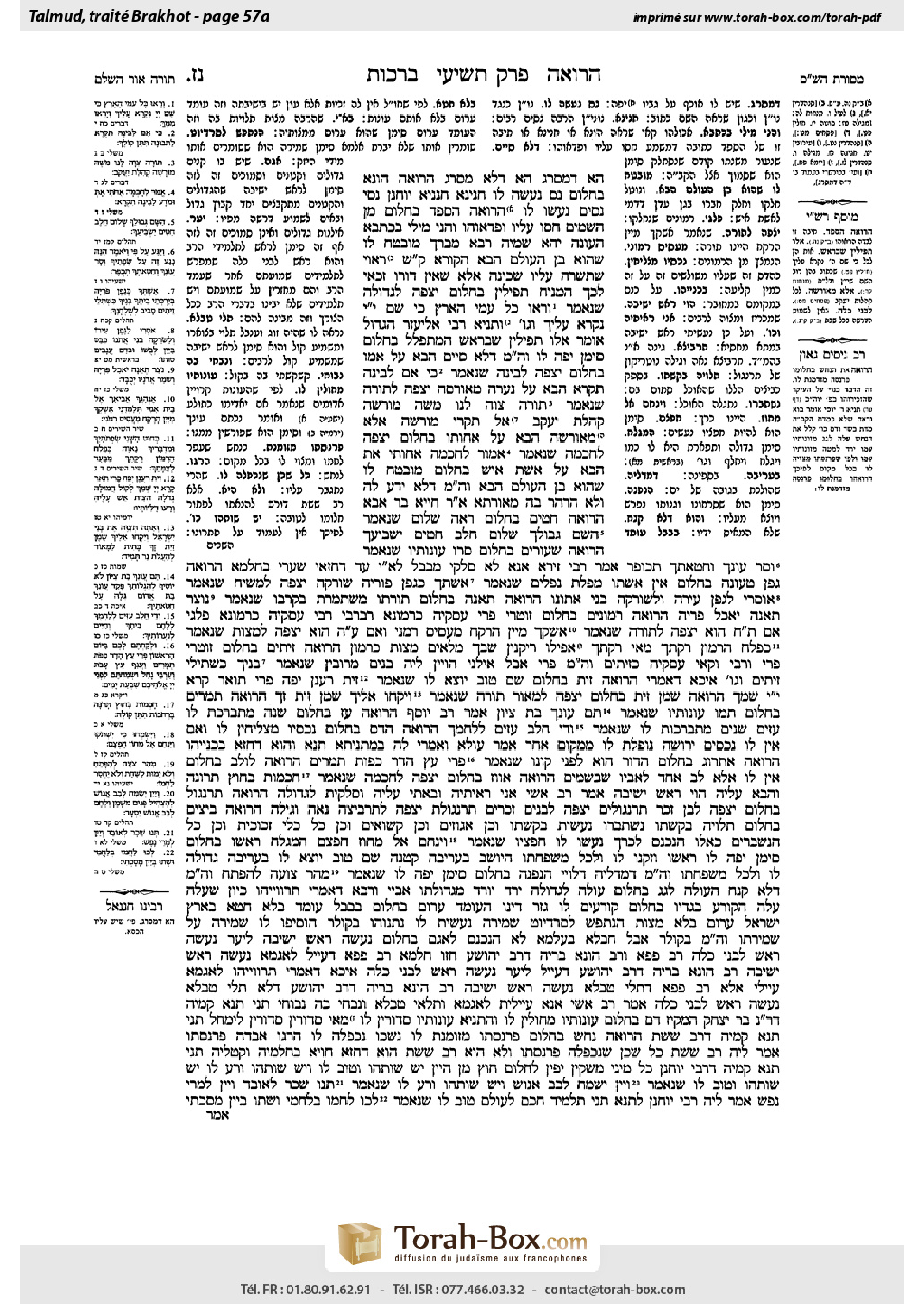
Berakhot 57a: Talmud study for Daf Yomi
Study the Talmud for Daf Yomi with scanned pages, Hebrew text, English translations from Sefaria and AI-generated French translations.
Passage selection and English or AI-generated French translation are available where the scan has annotations. Daf Study is independent of Torah-Box and Sefaria.
Browse Berakhot · ברכות · All tractatesBerakhot 57a text and translations
This page of Berakhot includes the Aramaic text, an English translation and an AI-generated French translation, alongside the scan above.
ברכות נ״ז א · Aramaic and Hebrew text
הָא דִּמְסָרַג, הָא דְּלָא מְסָרַג. הָרוֹאֶה הוּנָא בַּחֲלוֹם — נֵס נַעֲשָׂה לוֹ. חֲנִינָא, חֲנַנְיָא, יוֹחָנָן — נִסֵּי נִסִּים נַעֲשׂוּ לוֹ. הָרוֹאֶה הֶסְפֵּד בַּחֲלוֹם — מִן הַשָּׁמַיִם חָסוּ עָלָיו וּפְדָאוּהוּ. וְהָנֵי מִילֵּי בִּכְתָבָא.
הָעוֹנֶה ״יְהֵא שְׁמֵיהּ רַבָּא מְבָרַךְ״ — מוּבְטָח לוֹ שֶׁהוּא בֶּן הָעוֹלָם הַבָּא. הַקּוֹרֵא קְרִיאַת שְׁמַע — רָאוּי שֶׁתִּשְׁרֶה עָלָיו שְׁכִינָה, אֶלָּא שֶׁאֵין דּוֹרוֹ זַכַּאי לְכָךְ.
הַמַּנִּיחַ תְּפִילִּין בַּחֲלוֹם — יְצַפֶּה לִגְדוּלָּה, שֶׁנֶּאֱמַר: ״וְרָאוּ כׇּל עַמֵּי הָאָרֶץ כִּי שֵׁם ה׳ נִקְרָא עָלֶיךָ וְגוֹ׳״. וְתַנְיָא, רַבִּי אֱלִיעֶזֶר הַגָּדוֹל אוֹמֵר: אֵלּוּ תְּפִילִּין שֶׁבָּרֹאשׁ. הַמִּתְפַּלֵּל בַּחֲלוֹם — סִימָן יָפֶה לוֹ. וְהָנֵי מִילֵּי דְּלָא סַיֵּים.
הַבָּא עַל אִמּוֹ בַּחֲלוֹם — יְצַפֶּה לְבִינָה, שֶׁנֶּאֱמַר: ״כִּי אִם לַבִּינָה תִקְרָא״. הַבָּא עַל נַעֲרָה מְאוֹרָסָה — יְצַפֶּה לְתוֹרָה, שֶׁנֶּאֱמַר: ״תּוֹרָה צִוָּה לָנוּ מֹשֶׁה מוֹרָשָׁה קְהִלַּת יַעֲקֹב״, אַל תִּקְרֵי ״מוֹרָשָׁה״ אֶלָּא ״מְאוֹרָשָׂה״. הַבָּא עַל אֲחוֹתוֹ בַּחֲלוֹם — יְצַפֶּה לְחׇכְמָה, שֶׁנֶּאֱמַר: ״אֱמֹר לַחׇכְמָה אֲחֹתִי אָתְּ״. הַבָּא עַל אֵשֶׁת אִישׁ בַּחֲלוֹם — מוּבְטָח לוֹ שֶׁהוּא בֶּן הָעוֹלָם הַבָּא. וְהָנֵי מִילֵּי דְּלָא יָדַע לַהּ וְלָא הַרְהַר בַּהּ מֵאוּרְתָּא.
אָמַר רַבִּי חִיָּיא בַּר אַבָּא: הָרוֹאֶה חִטִּים בַּחֲלוֹם — רָאָה שָׁלוֹם, שֶׁנֶּאֱמַר: ״הַשָּׂם גְּבוּלֵךְ שָׁלוֹם חֵלֶב חִטִּים יַשְׂבִּיעֵךְ״. הָרוֹאֶה שְׂעוֹרִים בַּחֲלוֹם — סָרוּ עֲוֹנוֹתָיו, שֶׁנֶּאֱמַר: ״וְסָר עֲוֹנֶךָ וְחַטָּאתְךָ תְּכֻפָּר״. אָמַר רַבִּי זֵירָא: אֲנָא לָא סְלַקִי מִבָּבֶל לְאֶרֶץ יִשְׂרָאֵל עַד דַּחֲזַאי שְׂעָרֵי בְּחֶלְמָא.
הָרוֹאֶה גֶּפֶן טְעוּנָה בַּחֲלוֹם — אֵין אִשְׁתּוֹ מַפֶּלֶת נְפָלִים, שֶׁנֶּאֱמַר: ״אֶשְׁתְּךָ כְּגֶפֶן פֹּרִיָּה״. שׂוֹרֵקָה — יְצַפֶּה לַמָּשִׁיחַ, שֶׁנֶּאֱמַר: ״אֹסְרִי לַגֶּפֶן עִירֹה וְלַשֹּׂרֵקָה בְּנִי אֲתֹנוֹ״.
הָרוֹאָה תְּאֵנָה בַּחֲלוֹם — תּוֹרָתוֹ מִשְׁתַּמֶּרֶת בְּקִרְבּוֹ, שֶׁנֶּאֱמַר: ״נוֹצֵר תְּאֵנָה יֹאכַל פִּרְיָהּ״. הָרוֹאֶה רִמּוֹנִים בַּחֲלוֹם, זוּטְרֵי — פָּרֵי עִסְקֵיהּ כְּרִמּוֹנָא, רַבְרְבֵי — רָבֵי עִסְקֵיהּ כְּרִמּוֹנָא. פַּלְגֵי, אִם תַּלְמִיד חָכָם הוּא — יְצַפֶּה לְתוֹרָה, שֶׁנֶּאֱמַר: ״אַשְׁקְךָ מִיַּיִן הָרֶקַח מֵעֲסִיס רִמֹּנִי״. וְאִם עַם הָאָרֶץ הוּא — יְצַפֶּה לְמִצְוֹת, שֶׁנֶּאֱמַר: ״כְּפֶלַח הָרִמּוֹן רַקָּתֵךְ״. מַאי רַקָּתֵךְ — אֲפִילּוּ רֵיקָנִין שֶׁבָּךְ, מְלֵאִים מִצְוֹת כְּרִמּוֹן.
הָרוֹאֶה זֵיתִים בַּחֲלוֹם, זוּטְרֵי — פָּרֵי וְרָבֵי וְקָאֵי עִסְקֵיהּ כְּזֵיתִים. וְהָנֵי מִילֵּי פֵּרֵי, אֲבָל אִילָנֵי — הָוְיִין לֵיהּ בָּנִים מְרוּבִּין, שֶׁנֶּאֱמַר: ״בָּנֶיךָ כִּשְׁתִלֵי זֵיתִים וְגוֹ׳״. אִיכָּא דְּאָמְרִי הָרוֹאֶה זַיִת בַּחֲלוֹם — שֵׁם טוֹב יוֹצֵא לוֹ, שֶׁנֶּאֱמַר: ״זַיִת רַעֲנָן יְפֵה פְרִי תֹאַר קָרָא ה׳ שְׁמֵךְ״. הָרוֹאֶה שֶׁמֶן זַיִת בַּחֲלוֹם — יְצַפֶּה לִמְאוֹר תּוֹרָה, שֶׁנֶּאֱמַר: ״וְיִקְחוּ אֵלֶיךָ שֶׁמֶן זַיִת זָךְ״. הָרוֹאֶה תְּמָרִים בַּחֲלוֹם — תַּמּוּ עֲוֹנוֹתָיו, שֶׁנֶּאֱמַר: ״תַּם עֲוֹנֵךְ בַּת צִיּוֹן״.
אָמַר רַב יוֹסֵף, הָרוֹאֶה עֵז בַּחֲלוֹם — שָׁנָה מִתְבָּרֶכֶת לוֹ, עִזִּים — שָׁנִים מִתְבָּרְכוֹת לוֹ, שֶׁנֶּאֱמַר: ״וְדֵי חֲלֵב עִזִּים לְלַחְמְךָ״. הָרוֹאֶה הֲדַס בַּחֲלוֹם — נְכָסָיו מַצְלִיחִין לוֹ. וְאִם אֵין לוֹ נְכָסִים — יְרוּשָּׁה נוֹפֶלֶת לוֹ מִמָּקוֹם אַחֵר. אָמַר עוּלָּא, וְאָמְרִי לַהּ בְּמַתְנִיתָא תָּנָא: וְהוּא דַּחֲזָא בְּכַנַּיְיהוּ. הָרוֹאֶה אֶתְרוֹג בַּחֲלוֹם — הָדוּר הוּא לִפְנֵי קוֹנוֹ, שֶׁנֶּאֱמַר: ״פְּרִי עֵץ הָדָר כַּפֹּת תְּמָרִים״. הָרוֹאֶה לוּלָב בַּחֲלוֹם — אֵין לוֹ אֶלָּא לֵב אֶחָד לְאָבִיו שֶׁבַּשָּׁמַיִם.
הָרוֹאֶה אַוּוֹז בַּחֲלוֹם — יְצַפֶּה לְחׇכְמָה שֶׁנֶּאֱמַר: ״חׇכְמוֹת בַּחוּץ תָּרֹנָּה״. וְהַבָּא עָלֶיהָ הָוֵי רֹאשׁ יְשִׁיבָה. אָמַר רַב אָשֵׁי: אֲנִי רְאִיתִיהָ, וּבָאתִי עָלֶיהָ, וּסְלֵקִית לִגְדוּלָּה.
הָרוֹאֶה תַּרְנְגוֹל בַּחֲלוֹם — יְצַפֶּה לְבֵן זָכָר. תַּרְנְגוֹלִים — יְצַפֶּה לְבָנִים זְכָרִים. תַּרְנְגוֹלֶת — יְצַפֶּה לְתַרְבִּיצָה נָאָה וְגִילָה. הָרוֹאֶה בֵּיצִים בַּחֲלוֹם — תְּלוּיָה בַּקָּשָׁתוֹ. נִשְׁתַּבְּרוּ — נַעֲשֵׂית בַּקָּשָׁתוֹ. וְכֵן אֱגוֹזִים, וְכֵן קִשּׁוּאִים, וְכֵן כׇּל כְּלֵי זְכוּכִית, וְכֵן כׇּל הַנִּשְׁבָּרִים כָּאֵלּוּ.
הַנִּכְנָס לַכְּרַךְ — נַעֲשׂוּ לוֹ חֲפָצָיו, שֶׁנֶּאֱמַר: ״וַיַּנְחֵם אֶל מְחוֹז חֶפְצָם״. הַמְגַלֵּחַ רֹאשׁוֹ בַּחֲלוֹם — סִימָן יָפֶה לוֹ. רֹאשׁוֹ וּזְקָנוֹ — לוֹ וּלְכׇל מִשְׁפַּחְתּוֹ.
הַיּוֹשֵׁב בַּעֲרֵיבָה קְטַנָּה — שֵׁם טוֹב יוֹצֵא לוֹ. בַּעֲרֵיבָה גְּדוֹלָה — לוֹ וּלְכׇל מִשְׁפַּחְתּוֹ. וְהָנֵי מִילֵּי דְּמִדַּלְיָה דַּלּוֹיֵי.
הַנִּפְנֶה בַּחֲלוֹם — סִימָן יָפֶה לוֹ, שֶׁנֶּאֱמַר: ״מִהַר צֹעֶה לְהִפָּתֵחַ״. וְהָנֵי מִילֵּי דְּלָא קַנַּח.
הָעוֹלֶה לַגַּג בַּחֲלוֹם — עוֹלֶה לִגְדוּלָּה. יָרַד — יוֹרֵד מִגְּדוּלָּתוֹ. אַבָּיֵי וְרָבָא דְּאָמְרִי תַּרְוַויְיהוּ: כֵּיוָן שֶׁעָלָה — עָלָה. הַקּוֹרֵעַ בְּגָדָיו בַּחֲלוֹם — קוֹרְעִים לוֹ גְּזַר דִּינוֹ. הָעוֹמֵד עָרוֹם בַּחֲלוֹם, בְּבָבֶל — עוֹמֵד בְּלֹא חֵטְא. בְּאֶרֶץ יִשְׂרָאֵל — עָרוֹם בְּלֹא מִצְוֹת. הַנִּתְפָּס לְסַרְדְּיוֹט — שְׁמִירָה נַעֲשֵׂית לוֹ. נְתָנוּהוּ בְּקוֹלָר — הוֹסִיפוּ לוֹ שְׁמִירָה עַל שְׁמִירָתוֹ. וְהָנֵי מִילֵּי בְּקוֹלָר, אֲבָל חַבְלָא בְּעָלְמָא — לָא.
הַנִּכְנָס לַאֲגַם בַּחֲלוֹם — נַעֲשֶׂה רֹאשׁ יְשִׁיבָה. לְיַעַר — נַעֲשֶׂה רֹאשׁ לִבְנֵי כַלָּה.
רַב פָּפָּא וְרַב הוּנָא בְּרֵיהּ דְּרַב יְהוֹשֻׁעַ חֲזוֹ חֶלְמָא: רַב פָּפָּא דְּעָיֵיל לְאַגְמָא — נַעֲשָׂה רֹאשׁ יְשִׁיבָה. רַב הוּנָא בְּרֵיהּ דְּרַב יְהוֹשֻׁעַ דְּעָיֵיל לְיַעַר — נַעֲשָׂה רֹאשׁ לִבְנֵי כַּלָּה. אִיכָּא דְּאָמְרִי תַּרְוַויְיהוּ לְאַגְמָא עָיְילִי, אֶלָּא רַב פָּפָּא דִּתְלֵי טַבְלָא — נַעֲשָׂה רֹאשׁ יְשִׁיבָה, רַב הוּנָא בְּרֵיהּ דְּרַב יְהוֹשֻׁעַ דְּלָא תְּלֵי טַבְלָא — נַעֲשָׂה רֹאשׁ לִבְנֵי כַּלָּה. אָמַר רַב אָשֵׁי: אֲנָא עֲיַילִית לְאַגְמָא וּתְלַאי טַבְלָא וְנַבַּחִי בַּהּ נַבּוֹחֵי.
תָּנֵי תַּנָּא קַמֵּיהּ דְּרַב נַחְמָן בַּר יִצְחָק: הַמַּקִּיז דָּם בַּחֲלוֹם — עֲוֹנוֹתָיו מְחוּלִין לוֹ.
וְהָתַנְיָא: עֲוֹנוֹתָיו סְדוּרִין לוֹ! מַאי סְדוּרִין — סְדוּרִין לִימָּחֵל.
תָּנֵי תַּנָּא קַמֵּיהּ דְּרַב שֵׁשֶׁת: הָרוֹאֶה נָחָשׁ בַּחֲלוֹם פַּרְנָסָתוֹ מְזוּמֶּנֶת לוֹ. נְשָׁכוֹ — נִכְפְּלָה לוֹ. הֲרָגוֹ — אָבְדָה פַּרְנָסָתוֹ. אֲמַר לֵיהּ רַב שֵׁשֶׁת: כׇּל שֶׁכֵּן שֶׁנִּכְפְּלָה פַּרְנָסָתוֹ. וְלָא הִיא, רַב שֵׁשֶׁת הוּא דַּחֲזָא חִוְיָא בְּחֶלְמֵיהּ וְקַטְלֵיהּ.
תָּנֵי תַּנָּא קַמֵּיהּ דְּרַבִּי יוֹחָנָן: כׇּל מִינֵי מַשְׁקִין יָפִין לַחֲלוֹם חוּץ מִן הַיַּיִן, יֵשׁ שׁוֹתֵהוּ וְטוֹב לוֹ, וְיֵשׁ שׁוֹתֵהוּ וְרַע לוֹ. יֵשׁ שׁוֹתֵהוּ וְטוֹב לוֹ — שֶׁנֶּאֱמַר: ״וְיַיִן יְשַׂמַּח לְבַב אֱנוֹשׁ״, וְיֵשׁ שׁוֹתֵהוּ וְרַע לוֹ — שֶׁנֶּאֱמַר: ״תְּנוּ שֵׁכָר לְאוֹבֵד וְיַיִן לְמָרֵי נָפֶשׁ״.
אֲמַר לֵיהּ רַבִּי יוֹחָנָן לְתַנָּא: תְּנִי: תַּלְמִיד חָכָם לְעוֹלָם טוֹב לוֹ, שֶׁנֶּאֱמַר: ״לְכוּ לַחֲמוּ בְלַחֲמִי וּשְׁתוּ בְּיַיִן מָסָכְתִּי״.
Berakhot 57a · English translation
This opinion, that seeing an elephant is a good omen, refers to a case where one saw it saddled, while this opinion, that it is a bad omen, refers to a case where the elephant is not saddled. One who sees a man named Huna in a dream, it is a sign that a miracle will be performed for him, because the letter nun in the name Huna represents the word nes, miracle. One who sees a man named Ḥanina, Ḥananya, or Yoḥanan, it is a sign that many miracles will be performed for him, since the letter nun appears twice in those names. One who sees a eulogy in a dream, it is a sign that the heavens had mercy upon him, and spared him from a divine death sentence and there will be no need to eulogize him in reality. The Gemara restricts this statement and says that this only applies if he saw the eulogy written and not yet delivered.
One who answers in a dream: May His great name be blessed from kaddish is assured that he is one who has a place in the World-to-Come. One who sees himself reciting Shema in a dream is worthy of having the Divine Presence rest upon him, but his generation is unworthy, and, therefore, the Divine Presence does not actually rest upon him.
One who sees himself don phylacteries in a dream should anticipate greatness, as it is stated: “And all the peoples of the earth shall see that the name of the Lord is called upon you; and they shall be afraid of you” (Deuteronomy 28:10). And it was taught in a baraita that Rabbi Eliezer the Great says: That the Name of the Lord is called upon you, refers to phylacteries of the head, as they represent God’s name upon man. One who sees himself pray in a dream, it is an auspicious omen. However, the Gemara adds a caveat and says: This only applies in a case where he saw in the dream that he had not yet finished his prayer and is therefore still close to God. If, in the dream, he had already finished his prayer, it is not an omen.
One who sees that he had relations with his mother [em] in a dream, he should anticipate attaining understanding, as it is stated: “Yea if [im] you call for understanding” (Proverbs 2:3), and in this homiletic interpretation im is considered to be the equivalent of em. One who sees that he had relations with a betrothed young woman in a dream, he should anticipate Torah, as it is stated: “Moses commanded us Torah, an inheritance [morasha] of the congregation of Jacob” (Deuteronomy 33:4). Do not read it as morasha; rather, read it as me’orasa, betrothed. One who sees that he had relations with his sister in a dream, should anticipate wisdom, as it is stated: “Say unto wisdom: You are my sister” (Proverbs 7:4). One who sees that he had relations with a married woman in a dream is assured that he is one who has a place in the World-to-Come. He receives his place as well as that of another person in the Garden of Eden, as the married woman represents a portion belonging to someone else. However, the Gemara adds a caveat and says: This only applies in a case where he did not know her and was not thinking about her that evening; rather, he saw an unidentified woman in his dream by chance.
Rabbi Ḥiyya bar Abba said: One who sees wheat in a dream has seen peace, as it is stated: “He makes your borders peace; He gives you in plenty the fat of wheat” (Psalms 147:14). And one who sees barley [se’orim] in a dream has received a sign that his iniquities are taken away, as it is stated: “And your iniquity is taken away [vesar avonekh], and your sin expiated” (Isaiah 6:7); se’orim is an acronym for sar avon. Rabbi Zeira said: I did not ascend from Babylonia to Eretz Yisrael until I saw barley in my dream.
One who sees a vine laden with grapes in a dream, it is an omen that his wife will not miscarry, as it is stated: “Your wife shall be as a fruitful vine, in the innermost parts of your house” (Psalms 128:3). One who sees a planted vine branch in a dream should anticipate the Messiah, as it is stated: “Binding his foal unto the vine and his donkey’s colt unto the vine branch” (Genesis 49:11).
One who sees a fig tree in a dream, it is a sign that his Torah is preserved within him, as it is stated: “One who keeps the fig tree shall eat the fruit thereof” (Proverbs 27:18). One who sees pomegranates in a dream, if they were small, his business will flourish like the seeds of the pomegranate, which are numerous; and if they were large, his business will increase like a pomegranate. One who saw slices of pomegranates in his dream, if he is a Torah scholar, he should anticipate Torah, as it is stated: “I would cause you to drink of spiced wine, of the juice of my pomegranate” (Song of Songs 8:2), which is traditionally understood as an allusion to Torah. And if the dreamer is an ignoramus, he should anticipate mitzvot, as it is stated: “Your temples are like a split pomegranate” (Song of Songs 4:3). As the Gemara previously interpreted homiletically: What is the meaning of the word “Your temples [rakatekh]”? Even the most ignorant [reikanin] among you, Israel, are full of mitzvot like a pomegranate.
One who sees olives in a dream, and they were small, it is a sign that his business will flourish, increase and be durable like olives. However, the Gemara adds a caveat, saying that this applies only when he sees the fruit of an olive tree; but, one who sees olive trees, it is a sign that he will have many children, as it is stated: “Your children like olive plants, round about your table” (Psalms 128:3). Some say that one who sees an olive tree in a dream, it is a sign that a good reputation will spread for him, as it is stated: “The Lord called your name a leafy olive tree, fair with goodly fruit” (Jeremiah 11:16). One who sees olive oil in a dream should anticipate the light of Torah, as it is stated: “That they bring unto you pure olive oil beaten for the light” (Exodus 27:20). One who sees palm trees [temarim] in a dream has seen a sign that his transgressions have ceased, as it is stated: “Your iniquity is finished, O daughter of Zion” (Lamentations 4:22), as the Gemara likens temara, date, to tam ra, evil has ceased.
Rav Yosef says: One who sees a goat in a dream, it is a sign that his year will be blessed; one who sees goats, his years will be blessed, as it is stated: “And there will be goats’ milk enough for your food, for the food of your household; and sustenance for your maidens” (Proverbs 27:27). One who sees myrtle in a dream, it is a sign that his property will be successful. And if he does not own property, it is a sign that he will receive an inheritance. Ulla said, and some say it was taught in a baraita: This applies exclusively to a case where he saw them on their stem. One who sees a citron [etrog] in a dream has seen a sign that he is honored [hadur] before his Creator, as it is stated with regard to the citron: “The fruit of goodly trees [hadar], branches of palm trees” (Leviticus 23:40). One who sees a palm branch [lulav] in a dream, it is a sign that he has but one heart for his Father in heaven. Lulav is interpreted homiletically as lo lev, he has a heart.
One who sees a goose in a dream should anticipate wisdom, as it is stated: “Wisdoms cry aloud in the streets, she utters her voice in the broad places” (Proverbs 1:20); geese tend to sound their voices. One who dreams that he has relations with the goose will become head of the yeshiva. Rav Ashi said: I saw a goose and had relations with it in my dream and I ascended to greatness and became head of the yeshiva.
One who sees a rooster in a dream should anticipate a male child. One who sees multiple roosters should expect male children. One who sees a hen [tarnegolet] should anticipate a beautiful garden and reason to rejoice [tarbitza na’a vegila], as tarnegolet is interpreted as an acronym for tarbitza na’a vegila. One who sees eggs in a dream, it is a sign that his request is pending, as egg in Aramaic is beya, which is similar to the term for request. If one saw that the eggs broke, it is a sign that his request has already been granted, as that which was hidden inside the shell was revealed. The same is true of nuts, and the same is true of cucumbers, and the same is true of all glass vessels, and the same is true of anything similarly fragile that broke in his dream, it is a sign that his request was granted.
One who dreams that he entered a city, it is a sign that his desires will be fulfilled, as it is stated: “And He led them unto their desired haven” (Psalms 107:30). One who shaves his head in a dream, it is a good omen for him, as the removal of undesired hairs is a sign of renewal and greatness. If he shaved his head and his beard in a dream, it is a good omen for him and his entire family.
One who sits in a small boat in a dream, it is a sign that a good reputation will spread for him. If he sees himself sitting in a large boat in a dream, a good reputation will spread for him and his entire family. The Gemara notes that this only applies where the boat was floating high on the waves.
One who defecates in a dream, it is a good omen for him, as it is stated: “He that is bent down shall speedily be loosed; and he shall not go down dying into the pit, neither shall his bread fail” (Isaiah 51:14). The Gemara notes that this only applies where he does not wipe and get his hands dirty.
One who climbs up to the roof in a dream, it is a sign that he will ascend to greatness. If, after he climbed up, he climbed back down, it is a sign that he will descend from the greatness he achieved. Abaye and Rava both said: Once one ascended to the roof in his dream, he ascended, and even if he dreams that he descended, it remains a good omen for him. One who rips his clothing in a dream, it is a sign that they rip up his sentence. One who stands naked in Babylonia in a dream, it is a sign that he stands free of transgression. Although living outside Israel is itself a transgression, his nakedness symbolizes that he has been absolved of that sin. If one dreamed that he stood naked in Eretz Yisrael, it is a sign that he is naked without mitzvot. One who dreams that he was apprehended and guarded by a soldier [sardeyot], it is a sign that protection was provided him by heaven. If he sees that he is wearing a neck chain [kolar], it is a sign that they have increased his level of protection. However, the Gemara notes that this only applies to a case where his neck was placed in a neck chain; if his neck was simply placed in a noose, it does not indicate heavenly protection.
One who enters a marsh in a dream, it is a sign that he will become head of a yeshiva, as he appears to be standing alone with all the bulrushes, large and small, surrounding him like the head of a yeshiva, around whom all the students gather. One who dreams that he entered a forest and sees only large trees around him, it is a sign that he will be made head of only the advanced students [kalla], where he will explain the lessons only to the outstanding students in the yeshiva, each of whom is himself a great tree, set apart from the others.
The Gemara relates: Rav Pappa and Rav Huna, son of Rav Yehoshua, each saw a dream: Rav Pappa, who saw that he entered a marsh in his dream, was appointed head of a yeshiva. Rav Huna, son of Rav Yehoshua, who saw that he entered a forest in his dream, was appointed head of the advanced students. Some say that both of them dreamed that they entered a marsh, but Rav Pappa, who dreamed that a drum hung from his neck, was appointed head of the yeshiva, as banging a drum symbolizes the head of a yeshiva who sounds his voice in public. Rav Huna, son of Rav Yehoshua, who did not dream that a drum hung around his neck, was only appointed head of the advanced students. Rav Ashi said: I dreamed that I entered a marsh and hung a drum and beat it, and Rav Ashi became head of the yeshiva.
The tanna who recited mishnayot before Rav Naḥman bar Yitzḥak taught: One who lets blood in a dream, it is a sign that his transgressions have been forgiven, because red, the color of blood, is a metaphor for sin: “Though your sins be as scarlet…though they be red like crimson” (Isaiah 1:18). Consequently, bloodletting can symbolize transgressions leaving him.
The Gemara asks: Was it not taught in a baraita: One who sees that he is letting-blood in a dream, it is a sign that his transgressions are enumerated before him? The Gemara answers: What is meant by enumerated? This means that they are enumerated to be forgiven.
The tanna who recited mishnayot before Rav Sheshet taught: One who sees a snake in a dream, it is a sign that his livelihood is accessible to him just as dust is readily accessible to a snake. If one saw that the snake bit him in his dream, it is a sign that his livelihood will double. If he killed the snake, it is a sign that he will lose his livelihood. Rav Sheshet said to the tanna: On the contrary, if one dreamed that he killed the snake it is a sign that all the more so his livelihood will double. The Gemara remarks: But that is not so. Rav Sheshet saw a snake in his dream and killed it, so he sought to interpret his dream positively.
The tanna who recited mishnayot before Rabbi Yoḥanan taught: One who sees any kind of drink in a dream it is a good omen, except for wine, as there is one who drinks it in a dream and it is a good omen for him, and there is one who drinks it in a dream and it is a bad omen for him. The Gemara elaborates: There is one who drinks wine and it is a good omen for him, as it is stated: “And wine that makes glad the heart of man” (Psalms 104:15), and there is one who drinks it in a dream and it is a bad omen for him, as it is stated: “Give strong drink unto him that is ready to perish and wine unto the bitter in soul” (Proverbs 31:6).
Rabbi Yoḥanan said to the tanna: You should teach that for a Torah scholar, a dream of wine is always a good omen, as it is stated: “Come, eat of my bread and drink of the wine which I have mingled” (Proverbs 9:5).
Berakhot 57a · Traduction française (IA)
Cette opinion, selon laquelle voir un éléphant est un bon présage, se réfère à un cas où l'on a vu l'éléphant sellé, tandis que cette opinion, selon laquelle c'est un mauvais présage, se réfère à un cas où l'éléphant n'est pas sellé. Celui qui voit un homme nommé Huna en rêve, cela signifie qu'un miracle sera accompli pour lui, car la lettre nun dans le nom Huna représente le mot nes, miracle. Celui qui voit un homme nommé Ḥanina, Ḥananya ou Yoḥanan, cela signifie que de nombreux miracles seront accomplis pour lui, car la lettre nun apparaît deux fois dans ces noms. Celui qui voit un panégyrique en rêve, cela signifie que les cieux ont eu pitié de lui et l'ont préservé d'une sentence divine de mort, et qu'il n'y aura donc pas besoin de le plaindre en réalité. La Guemara restreint cette déclaration et dit que cela s'applique uniquement si l'on a vu le panégyrique écrit et non encore prononcé.
Celui qui répond en rêve : Que Son grand nom soit béni, à partir de kaddish, est assuré qu'il a une place dans le Monde à Venir. Celui qui voit lui-même réciter le Chéma en rêve est digne de voir la Présence Divine s'installer sur lui, mais sa génération est indigné, et par conséquent, la Présence Divine ne s'installe pas effectivement sur lui.
Celui qui voit lui-même porter les phylactères en rêve devrait s'attendre à la grandeur, car il est dit : « Et tous les peuples de la terre verront que le nom du Seigneur est invoqué sur vous ; et ils craindront vous » (Deutéronome 28:10). Et il a été enseigné dans une baraïta que Rabbi Eléazar le Grand dit : Que le nom du Seigneur est invoqué sur vous, se réfère aux phylactères de la tête, car ils représentent le nom de Dieu sur l'homme. Celui qui voit lui-même prier en rêve, c'est un présage favorable. Cependant, la Guemara ajoute une réserve et dit : cela s'applique uniquement dans le cas où l'on a vu en rêve qu'il n'avait pas encore terminé sa prière et était donc encore proche de Dieu. Si, en rêve, il avait déjà terminé sa prière, ce n'est pas un présage.
Celui qui voit qu'il a eu des relations avec sa mère [em] en rêve, il devrait s'attendre à atteindre la compréhension, car il est dit : « Yea si [im] vous appelez pour la compréhension » (Proverbes 2:3), et dans cette interprétation homiletique, im est considéré comme équivalent à em. Celui qui voit qu'il a eu des relations avec une jeune femme fiancée en rêve, il devrait s'attendre à la Torah, car il est dit : « Moïse a commandé à nous la Torah, une héritage [morasha] du congrès de Jacob » (Deutéronome 33:4). Ne le lisez pas comme morasha, mais comme me’orasa, fiancée. Celui qui voit qu'il a eu des relations avec sa sœur en rêve, il devrait s'attendre à la sagesse, car il est dit : « Dites à la sagesse : Tu es ma sœur » (Proverbes 7:4). Celui qui voit qu'il a eu des relations avec une femme mariée en rêve est assuré qu'il a une place dans le Monde à Venir. Il reçoit sa place ainsi que celle d'une autre personne dans le Jardin d'Éden, car la femme mariée représente une part appartenant à quelqu'un d'autre. Cependant, la Guemara ajoute une réserve et dit : cela s'applique uniquement dans le cas où il ne connaissait pas cette femme et ne pensait pas à elle cette nuit ; plutôt, il a vu une femme inconnue en rêve par hasard.
Rabbi Ḥiyya bar Abba a dit : Celui qui voit du blé en rêve a vu la paix, car il est dit : « Il fait de vos frontières la paix ; Il vous donne en abondance la graisse du blé » (Psaumes 147:14). Et celui qui voit du seigle [se’orim] en rêve a reçu un signe que ses péchés sont effacés, car il est dit : « Et votre iniquité est effacée [vesar avonekh], et votre péché expié » (Isaïe 6:7) ; se’orim est un acronyme pour sar avon. Rabbi Zeira a dit : Je n'ai pas descendu de Babylone vers la Terre d'Israël jusqu'à ce que j'aie vu du seigle en rêve.
Celui qui voit un vignoble chargé de raisins en rêve, c'est un présage que sa femme ne fera pas de fausse couche, car il est dit : « Votre femme sera comme une vigne fructueuse, dans les parties intimes de votre maison » (Psaumes 128:3). Celui qui voit une branche de vigne plantée en rêve devrait s'attendre au Messie, car il est dit : « Enchaînant son petit cheval à la vigne et son petit âne à la branche de vigne » (Genèse 49:11).
Celui qui voit un arbre à figues en rêve, c'est un signe que sa Torah est préservée en lui, car il est dit : « Celui qui garde l'arbre à figues mangera ses fruits » (Proverbes 27:18). Celui qui voit des grenades en rêve, si elles étaient petites, son affaire prospérera comme les graines de grenade, qui sont nombreuses ; et si elles étaient grandes, son affaire augmentera comme une grenade. Celui qui a vu des tranches de grenades en rêve, si c'est un savant de la Torah, il devrait s'attendre à la Torah, car il est dit : « Je ferai que vous buviez du vin aromatisé, du jus de ma grenade » (Cantique des Cantiques 8:2), ce qui est traditionnellement compris comme une allusion à la Torah. Et si le rêveur est un ignorant, il devrait s'attendre aux commandements, car il est dit : « Vos temples sont comme une grenade éclatée » (Cantique des Cantiques 4:3). Comme la Guemara a interprété précédemment de manière homiletique : Quelle est la signification du mot « Vos temples [rakatekh] » ? Même le plus ignorant [reikanin] parmi vous, Israël, est plein de commandements comme une grenade.
Celui qui voit des olives en rêve, et qu'elles étaient petites, c'est un signe que son affaire prospérera, augmentera et sera durable comme des olives. Cependant, la Guemara ajoute une réserve, disant que cela s'applique uniquement lorsqu'il voit les fruits d'un arbre à olives ; mais celui qui voit des arbres à olives en rêve, c'est un signe qu'il aura beaucoup d'enfants, car il est dit : « Vos enfants comme des arbres à olives, autour de votre table » (Psaumes 128:3). Certains disent que celui qui voit un arbre à olives en rêve, c'est un signe qu'une bonne réputation se répandra pour lui, car il est dit : « Le Seigneur a appelé votre nom un arbre à olives feuillu, beau avec de bons fruits » (Jérémie 11:16). Celui qui voit de l'huile d'olive en rêve devrait s'attendre à la lumière de la Torah, car il est dit : « Que vous apportiez à vous de l'huile d'olive pure battue pour la lumière » (Exode 27:20). Celui qui voit des palmiers [temarim] en rêve a vu un signe que ses transgressions ont cessé, car il est dit : « Votre iniquité est terminée, ô fille de Jérusalem » (Lamentations 4:22), car la Guemara compare temarim, date, à tam ra, le mal a cessé.
Rav Yosef dit : Celui qui voit un bouc dans un rêve, c'est un signe que sa année sera bénie ; celui qui voit des boucs, ses années seront bénies, comme il est dit : « Et il y aura assez de lait de bouc pour votre nourriture, pour la nourriture de votre maison ; et subsistance pour vos servantes » (Proverbes 27:27). Celui qui voit un laurier dans un rêve, c'est un signe que ses biens seront prospères. Et s'il ne possède pas de biens, c'est un signe qu'il recevra une héritage. Ulla dit, et certains disent qu'il a été enseigné dans une baraïta : cela s'applique uniquement à un cas où il les a vus sur leur tige. Celui qui voit un citron [etrog] dans un rêve a vu un signe qu'il est honoré [hadur] devant son Créateur, comme il est dit concernant le citron : « Le fruit des arbres beaux [hadar], les branches des palmiers » (Lévitique 23:40). Celui qui voit une branche de palmier [lulav] dans un rêve, c'est un signe qu'il a un seul cœur pour son Père céleste. La lulav est interprétée homiletiquement comme lo lev, il a un cœur.
Celui qui voit un canard dans un rêve devrait anticiper la sagesse, comme il est dit : « La sagesse crie dans les rues, elle émet sa voix dans les lieux larges » (Proverbes 1:20) ; les canards ont tendance à émettre leur voix. Celui qui rêve qu'il a des relations avec le canard deviendra chef de l'yeshiva. Rav Ashi dit : J'ai vu un canard et j'ai eu des relations avec lui dans mon rêve et j'ai monté à la grandeur et suis devenu chef de l'yeshiva.
Celui qui voit un coq dans un rêve devrait anticiper un fils masculin. Celui qui voit plusieurs coqs devrait s'attendre à des fils masculins. Celui qui voit une poule [tarnegolet] devrait anticiper un beau jardin et une raison de joie [tarbitza na’a vegila], car tarnegolet est interprété comme un acronyme pour tarbitza na’a vegila. Celui qui voit des œufs dans un rêve, c'est un signe que sa demande est en attente, car l'œuf en araméen est beya, ce qui est semblable au terme pour demande. Si l'on voit que les œufs se sont brisés, c'est un signe que sa demande a déjà été accordée, car ce qui était caché à l'intérieur de la coquille est devenu visible. La même chose est vraie des noix, des concombres, de tous les récipients en verre, et de toute chose similairement fragile qui s'est brisée dans son rêve, c'est un signe que sa demande a été accordée.
Celui qui rêve qu'il entre dans une ville, c'est un signe que ses désirs seront accomplis, comme il est dit : « Et Il les conduisit vers leur désiré repos » (Psaumes 107:30). Celui qui se rase la tête dans un rêve, c'est un bon présage pour lui, car l'élimination des poils indésirables est un signe de renouveau et de grandeur. Si l'on se rase la tête et la barbe dans un rêve, c'est un bon présage pour lui et toute sa famille.
Celui qui s'assoit dans un petit bateau dans un rêve, c'est un signe qu'une bonne réputation s'étendra pour lui. Si l'on voit qu'il s'assoit dans un grand bateau dans un rêve, une bonne réputation s'étendra pour lui et toute sa famille. La Guemara note que cela s'applique uniquement dans le cas où le bateau flottait haut sur les vagues.
Celui qui défèce dans un rêve, c'est un bon présage pour lui, comme il est dit : « Celui qui est penché sera libéré rapidement ; et il ne descendra pas mourant dans le puits, ni ne manquera-t-il de pain » (Isaïe 51:14). La Guemara note que cela s'applique uniquement dans le cas où il ne nettoie pas et ne se souille pas les mains.
Celui qui monte sur le toit dans un rêve, c'est un signe qu'il montera à la grandeur. Si, après qu'il ait monté, il descend, c'est un signe qu'il descendra de la grandeur qu'il a atteinte. Abaye et Rava ont tous les deux dit : Une fois qu'on a monté sur le toit dans son rêve, on monte, et même si l'on rêve qu'on descend, cela reste un bon présage pour lui. Celui qui déchire ses vêtements dans un rêve, c'est un signe qu'ils déchirent sa sentence. Celui qui se tient nu en Babylone dans un rêve, c'est un signe qu'il se tient libre des transgressions. Bien que vivre en dehors d'Israël soit lui-même une transgression, sa nudité symbolise qu'il a été absous de ce péché. Si l'on rêve qu'il se tient nu en Terre d'Israël, c'est un signe qu'il est nu sans mitsvot. Celui qui rêve qu'il a été appréhendé et gardé par un soldat [sardeyot], c'est un signe que la protection a été fournie par le ciel. Si l'on voit qu'il porte une chaîne au cou [kolar], c'est un signe qu'ils ont augmenté son niveau de protection. Cependant, la Guemara note que cela s'applique uniquement dans le cas où son cou a été placé dans une chaîne au cou ; si son cou a simplement été placé dans un nœud, cela ne signifie pas la protection céleste.
Celui qui entre dans un marais dans un rêve, c'est un signe qu'il deviendra chef d'une yeshiva, car il semble être seul avec tous les roseaux, grands et petits, qui l'entourent comme le chef d'une yeshiva, autour duquel tous les élèves se rassemblent. Celui qui rêve qu'il entre dans une forêt et voit seulement des grands arbres autour de lui, c'est un signe qu'il sera fait chef seulement des élèves avancés [kalla], où il expliquera les leçons seulement aux élèves exceptionnels de la yeshiva, chacun d'eux étant lui-même un grand arbre, séparé des autres.
La Guemara rapporte : Rav Pappa et Rav Huna, fils de Rav Yehoshua, chacun virent un rêve : Rav Pappa, qui vit qu'il entrait dans un marais dans son rêve, fut nommé chef d'une yeshiva. Rav Huna, fils de Rav Yehoshua, qui vit qu'il entrait dans une forêt dans son rêve, fut nommé chef des élèves avancés. Certains disent que tous les deux rêvèrent qu'ils entraient dans un marais, mais Rav Pappa, qui rêva qu'un tambour était suspendu à son cou, fut nommé chef de la yeshiva, car frapper un tambour symbolise le chef d'une yeshiva qui sonne sa voix en public. Rav Huna, fils de Rav Yehoshua, qui ne rêva pas qu'un tambour était autour de son cou, fut seulement nommé chef des élèves avancés. Rav Ashi dit : J'ai rêvé que j'entrais dans un marais, que j'accrochais un tambour et que je le frappais, et Rav Ashi devint chef de la yeshiva.
Le tanna qui a récité des mishnayot devant Rav Naḥman bar Yitzḥak enseigna : Celui qui perd du sang dans un rêve, c'est un signe que ses transgressions ont été pardonnées, car le rouge, la couleur du sang, est une métaphore pour le péché : « Bien que vos péchés soient comme le rouge, bien qu'ils soient rouges comme le sang » (Isaïe 1:18). Par conséquent, le saignement peut symboliser les transgressions qui le quittent.
La Guemara pose la question : N’a-t-il pas été enseigné dans une baraïta : Celui qui voit qu’il saigne dans un rêve, c’est un signe que ses transgressions sont énumérées devant lui ? La Guemara répond : De quoi cette énumération ? Cela signifie qu’elles sont énumérées afin d’être pardonnées.
Le tanna qui avait récité les mishnayot devant Rav Sheshet enseignait : Celui qui voit un serpent dans un rêve, c’est un signe que son mode de vie est accessible à lui, tout comme la poussière est facilement accessible au serpent. Si l’on voit que le serpent l’a mordu dans son rêve, c’est un signe que son mode de vie doublera. Si l’on tue le serpent dans son rêve, c’est un signe qu’il perdra son mode de vie. Rav Sheshet dit au tanna : Au contraire, si l’on rêve qu’il tue le serpent, c’est un signe que son mode de vie doublera encore davantage. La Guemara remarque : Mais cela n’est pas vrai. Rav Sheshet avait vu un serpent dans son rêve et l’avait tué, donc il cherchait à interpréter son rêve de manière positive.
Le tanna qui avait récité les mishnayot devant Rabbi Yoḥanan enseignait : Celui qui voit toute sorte de boisson dans un rêve, c’est un bon présage, sauf le vin, car il y a celui qui boit du vin dans un rêve et c’est un bon présage pour lui, et celui qui boit du vin dans un rêve et c’est un mauvais présage pour lui. La Guemara développe : Il y a celui qui boit du vin et c’est un bon présage pour lui, car il est dit : « Et le vin qui réjouit le cœur de l’homme » (Psaumes 104:15), et il y a celui qui boit du vin dans un rêve et c’est un mauvais présage pour lui, car il est dit : « Donnez un breuvage fort à celui qui est prêt à périr et du vin à celui dont l’âme est amère » (Proverbes 31:6).
Rabbi Yoḥanan dit au tanna : Vous devriez enseigner que pour un savant de la Torah, un rêve de vin est toujours un bon présage, car il est dit : « Viens, mange de mon pain et bois du vin que j’ai mélangé » (Proverbes 9:5).
Traduction française générée par IA à partir de l’édition anglaise de Sefaria. Vérifie toujours un passage avec le texte source.
Text from Sefaria: William Davidson Edition - Vocalized Aramaic (CC BY NC); William Davidson Edition - English (CC BY NC).