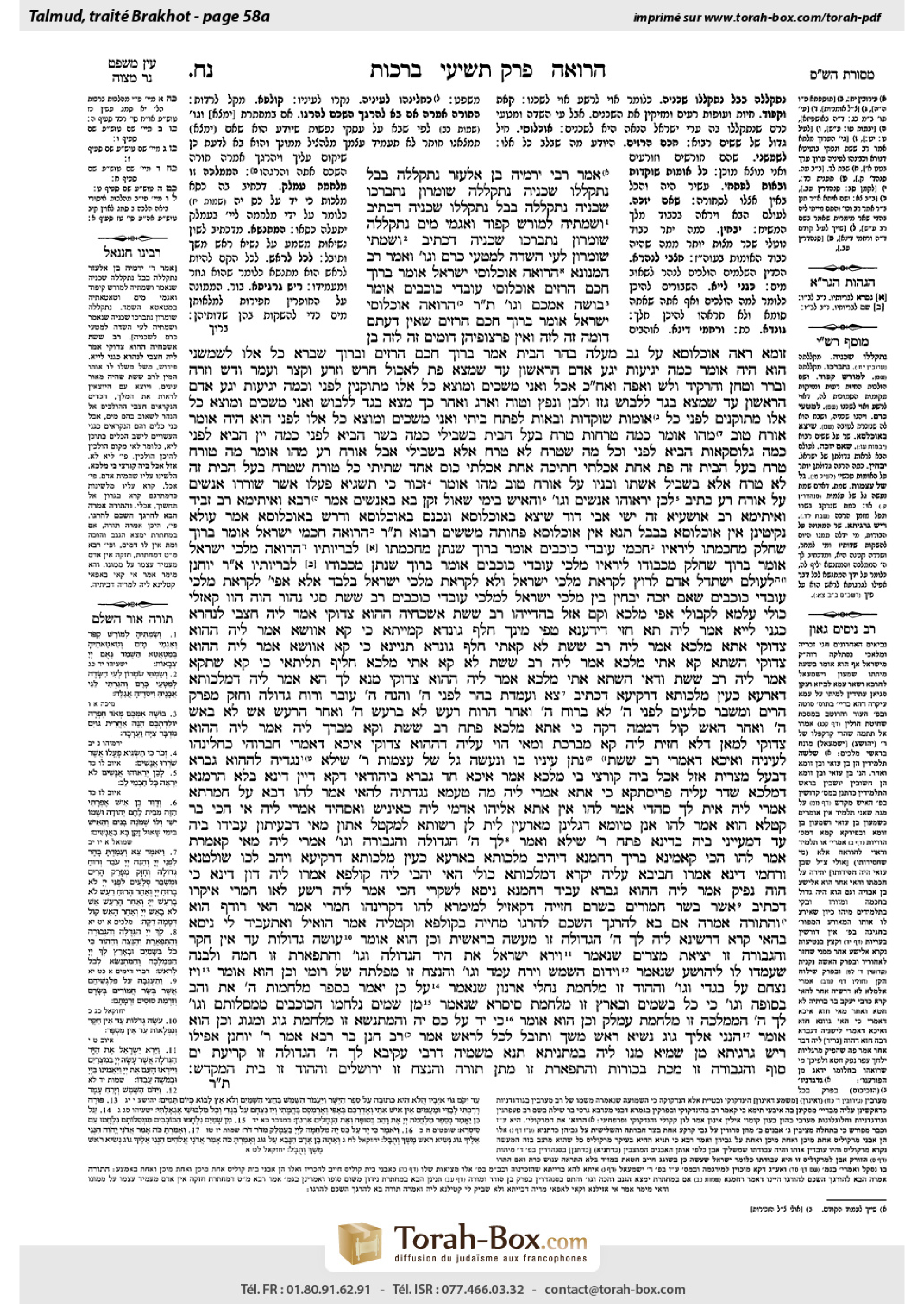
Berakhot 58a: Talmud study for Daf Yomi
Study the Talmud for Daf Yomi with scanned pages, Hebrew text, English translations from Sefaria and AI-generated French translations.
Passage selection and English or AI-generated French translation are available where the scan has annotations. Daf Study is independent of Torah-Box and Sefaria.
Browse Berakhot · ברכות · All tractatesBerakhot 58a text and translations
This page of Berakhot includes the Aramaic text, an English translation and an AI-generated French translation, alongside the scan above.
ברכות נ״ח א · Aramaic and Hebrew text
אָמַר רַבִּי יִרְמְיָה בֶּן אֶלְעָזָר: נִתְקַלְּלָה בָּבֶל — נִתְקַלְּלוּ שְׁכֵנֶיהָ. נִתְקַלְּלָה שׁוֹמְרוֹן — נִתְבָּרְכוּ שְׁכֵנֶיהָ: נִתְקַלְּלָה בָּבֶל — נִתְקַלְּלוּ שְׁכֵנֶיהָ, דִּכְתִיב: ״וְשַׂמְתִּיהָ לְמוֹרַשׁ קִפֹּד וְאַגְמֵי מָיִם״. נִתְקַלְּלָה שׁוֹמְרוֹן נִתְבָּרְכוּ שְׁכֵנֶיהָ — דִּכְתִיב: ״וְשַׂמְתִּי שֹׁמְרוֹן לְעִי הַשָּׂדֶה לְמַטָּעֵי כָרֶם וְגוֹ׳״.
וְאָמַר רַב הַמְנוּנָא: הָרוֹאֶה אוּכְלוּסֵי יִשְׂרָאֵל, אוֹמֵר: ״בָּרוּךְ … חֲכַם הָרָזִים״. אוּכְלוּסֵי גּוֹיִם, אוֹמֵר: ״בּוֹשָׁה אִמְּכֶם וְגוֹ׳״.
תָּנוּ רַבָּנַן: הָרוֹאֶה אוּכְלוּסֵי יִשְׂרָאֵל, אוֹמֵר: ״בָּרוּךְ … חֲכַם הָרָזִים״ — שֶׁאֵין דַּעְתָּם דּוֹמָה זֶה לָזֶה, וְאֵין פַּרְצוּפֵיהֶן דּוֹמִים זֶה לָזֶה. בֶּן זוֹמָא רָאָה אוּכְלוּסָא עַל גַּב מַעֲלָה בְּהַר הַבַּיִת, אָמַר: ״בָּרוּךְ … חֲכַם הָרָזִים וּבָרוּךְ … שֶׁבָּרָא כׇּל אֵלּוּ לְשַׁמְּשֵׁנִי״.
הוּא הָיָה אוֹמֵר: כַּמָּה יְגִיעוֹת יָגַע אָדָם הָרִאשׁוֹן עַד שֶׁמָּצָא פַּת לֶאֱכוֹל: חָרַשׁ, וְזָרַע, וְקָצַר, וְעִמֵּר, וְדָשׁ, וְזָרָה, וּבָרַר, וְטָחַן, וְהִרְקִיד, וְלָשׁ, וְאָפָה, וְאַחַר כָּךְ אָכַל. וַאֲנִי מַשְׁכִּים וּמוֹצֵא כׇּל אֵלּוּ מְתוּקָּנִין לְפָנַי. וְכַמָּה יְגִיעוֹת יָגַע אָדָם הָרִאשׁוֹן עַד שֶׁמָּצָא בֶּגֶד לִלְבּוֹשׁ: גָּזַז, וְלִבֵּן, וְנִפֵּץ, וְטָוָה, וְאָרַג, וְאַחַר כָּךְ מָצָא בֶּגֶד לִלְבּוֹשׁ, וַאֲנִי מַשְׁכִּים וּמוֹצֵא כׇּל אֵלֶּה מְתוּקָּנִים לְפָנַי. כׇּל אוּמּוֹת שׁוֹקְדוֹת וּבָאוֹת לְפֶתַח בֵּיתִי, וַאֲנִי מַשְׁכִּים וּמוֹצֵא כׇּל אֵלּוּ לְפָנַי.
הוּא הָיָה אוֹמֵר: אוֹרֵחַ טוֹב מַהוּ אוֹמֵר? — כַּמָּה טְרָחוֹת טָרַח בַּעַל הַבַּיִת בִּשְׁבִילִי, כַּמָּה בָּשָׂר הֵבִיא לְפָנַי, כַּמָּה יַיִן הֵבִיא לְפָנַי, כַּמָּה גְּלוּסְקָאוֹת הֵבִיא לְפָנַי, וְכׇל מַה שֶּׁטָּרַח — לֹא טָרַח אֶלָּא בִּשְׁבִילִי. אֲבָל אוֹרֵחַ רַע מַהוּ אוֹמֵר? — מַה טּוֹרַח טָרַח בַּעַל הַבַּיִת זֶה? פַּת אַחַת אָכַלְתִּי, חֲתִיכָה אַחַת אָכַלְתִּי, כּוֹס אֶחָד שָׁתִיתִי, כׇּל טוֹרַח שֶׁטָּרַח בַּעַל הַבַּיִת זֶה — לֹא טָרַח אֶלָּא בִּשְׁבִיל אִשְׁתּוֹ וּבָנָיו.
עַל אוֹרֵחַ טוֹב מַהוּ אוֹמֵר? — ״זְכֹר כִּי תַשְׂגִּיא פׇעֳלוֹ אֲשֶׁר שֹׁרְרוּ אֲנָשִׁים״. עַל אוֹרֵחַ רַע כְּתִיב: ״לָכֵן יְרֵאוּהוּ אֲנָשִׁים וְגוֹ׳״.
״וְהָאִישׁ בִּימֵי שָׁאוּל זָקֵן בָּא בַאֲנָשִׁים״. אָמַר רָבָא, וְאִיתֵּימָא רַב זְבִיד, וְאִיתֵּימָא רַב אוֹשַׁעְיָא: זֶה יִשַׁי אֲבִי דָּוִד שֶׁיָּצָא בְּאוּכְלוּסָא, וְנִכְנַס בְּאוּכְלוּסָא, וְדָרַשׁ בְּאוּכְלוּסָא. אָמַר עוּלָּא: נְקִיטִינַן אֵין אוּכְלוּסָא בְּבָבֶל. תָּנָא: אֵין אוּכְלוּסָא פְּחוּתָה מִשִּׁשִּׁים רִבּוֹא.
תָּנוּ רַבָּנַן: הָרוֹאֶה חַכְמֵי יִשְׂרָאֵל, אוֹמֵר ״בָּרוּךְ … שֶׁחָלַק מֵחׇכְמָתוֹ לִירֵאָיו״. חַכְמֵי אוּמּוֹת הָעוֹלָם, אוֹמֵר: ״בָּרוּךְ … שֶׁנָּתַן מֵחׇכְמָתוֹ לְבָשָׂר וָדָם״. הָרוֹאֶה מַלְכֵי יִשְׂרָאֵל, אוֹמֵר: ״בָּרוּךְ … שֶׁחָלַק מִכְּבוֹדוֹ לִירֵאָיו״. מַלְכֵי אוּמּוֹת הָעוֹלָם, אוֹמֵר: ״בָּרוּךְ … שֶׁנָּתַן מִכְּבוֹדוֹ לְבָשָׂר וָדָם״.
אָמַר רַבִּי יוֹחָנָן: לְעוֹלָם יִשְׁתַּדֵּל אָדָם לָרוּץ לִקְרַאת מַלְכֵי יִשְׂרָאֵל. וְלֹא לִקְרַאת מַלְכֵי יִשְׂרָאֵל בִּלְבַד, אֶלָּא אֲפִילּוּ לִקְרַאת מַלְכֵי אוּמּוֹת הָעוֹלָם, שֶׁאִם יִזְכֶּה — יַבְחִין בֵּין מַלְכֵי יִשְׂרָאֵל לְמַלְכֵי אוּמּוֹת הָעוֹלָם.
רַב שֵׁשֶׁת סַגִּי נְהוֹר הֲוָה. הֲווֹ קָאָזְלִי כּוּלֵּי עָלְמָא לְקַבּוֹלֵי אַפֵּי מַלְכָּא, וְקָם אֲזַל בַּהֲדַיְיהוּ רַב שֵׁשֶׁת. אַשְׁכְּחֵיהּ הָהוּא מִינָא, אֲמַר לֵיהּ: חַצְבֵי לְנַהְרָא, כַּגְנֵי לְיָיא? אֲמַר לֵיהּ: תָּא חֲזִי דְּיָדַעְנָא טְפֵי מִינָּךְ. חֲלַף גּוּנְדָּא קַמַּיְיתָא. כִּי קָא אָוְושָׁא, אֲמַר לֵיהּ הָהוּא מִינָא: אֲתָא מַלְכָּא. אֲמַר לֵיהּ רַב שֵׁשֶׁת: לָא קָאָתֵי. חֲלַף גּוּנְדָּא תִּנְיָינָא. כִּי קָא אָוְושָׁא, אֲמַר לֵיהּ הָהוּא מִינָא: הַשְׁתָּא קָא אָתֵי מַלְכָּא. אֲמַר לֵיהּ רַב שֵׁשֶׁת: לָא קָא אָתֵי מַלְכָּא. חָלֵיף תְּלִיתַאי. כִּי קָא שָׁתְקָא, אֲמַר לֵיהּ רַב שֵׁשֶׁת: וַדַּאי הַשְׁתָּא אָתֵי מַלְכָּא.
אֲמַר לֵיהּ הָהוּא מִינָא: מְנָא לָךְ הָא? אֲמַר לֵיהּ: דְּמַלְכוּתָא דְאַרְעָא כְּעֵין מַלְכוּתָא דִרְקִיעָא, דִּכְתִיב: ״צֵא וְעָמַדְתָּ בָהָר לִפְנֵי ה׳ וְהִנֵּה ה׳ עֹבֵר וְרוּחַ גְּדוֹלָה וְחָזָק מְפָרֵק הָרִים וּמְשַׁבֵּר סְלָעִים לִפְנֵי ה׳ לֹא בָרוּחַ ה׳ וְאַחַר הָרוּחַ רַעַשׁ לֹא בָרַעַשׁ ה׳. וְאַחַר הָרַעַשׁ אֵשׁ לֹא בָאֵשׁ ה׳ וְאַחַר הָאֵשׁ קוֹל דְּמָמָה דַקָּה״.
כִּי אֲתָא מַלְכָּא, פָּתַח רַב שֵׁשֶׁת וְקָא מְבָרֵךְ לֵיהּ. אֲמַר לֵיהּ הָהוּא מִינָא: לְמַאן דְּלָא חָזֵית לֵיהּ קָא מְבָרְכַתְּ? וּמַאי הֲוִי עֲלֵיהּ דְּהָהוּא מִינָא? אִיכָּא דְּאָמְרִי: חַבְרוֹהִי כַּחְלִינְהוּ לְעֵינֵיהּ, וְאִיכָּא דְּאָמְרִי: רַב שֵׁשֶׁת נָתַן עֵינָיו בּוֹ, וְנַעֲשָׂה גַּל שֶׁל עֲצָמוֹת.
רַבִּי שֵׁילָא נַגְּדֵיהּ לְהָהוּא גַּבְרָא דִּבְעַל גּוֹיָה. אֲזַל אֲכַל בֵּיהּ קוּרְצֵי בֵּי מַלְכָּא, אֲמַר: אִיכָּא חַד גַּבְרָא בִּיהוּדָאֵי דְּקָא דָּיֵין דִּינָא בְּלָא הַרְמָנָא דְמַלְכָּא. שַׁדַּר עֲלֵיהּ פְּרִיסְתְּקָא. כִּי אֲתָא אָמְרִי לֵיהּ: מַאי טַעְמָא נַגֵּדְתֵּיהּ לְהַאי? אֲמַר לְהוּ: דְּבָא עַל חֲמָרְתָא. אָמְרִי לֵיהּ: אִית לְךָ סָהֲדִי? אֲמַר לְהוּ: אִין. אֲתָא אֵלִיָּהוּ אִדְּמִי לֵיהּ כְּאִינִישׁ, וְאַסְהֵיד. אָמְרִי לֵיהּ: אִי הָכִי, בַּר קְטָלָא הוּא! אֲמַר לְהוּ: אֲנַן מִיּוֹמָא דִּגְלֵינַן מֵאַרְעִין לֵית לַן רְשׁוּתָא לְמִקְטַל. אַתּוּן, מַאי דְּבָעֵיתוּן עֲבִידוּ בֵּיהּ.
עַד דִּמְעַיְּינִי בֵּיהּ בְּדִינָא, פְּתַח רַבִּי שֵׁילָא וַאֲמַר: ״לְךָ ה׳ הַגְּדֻלָּה וְהַגְּבוּרָה וְגוֹ׳״. אָמְרִי לֵיהּ: מַאי קָאָמְרַתְּ? אֲמַר לְהוּ, הָכִי קָאָמֵינָא: ״בְּרִיךְ רַחֲמָנָא דְּיָהֵיב מַלְכוּתָא בְּאַרְעָא כְּעֵין מַלְכוּתָא דִרְקִיעָא, וִיהַב לְכוּ שׁוּלְטָנָא וְרָחֲמִי דִּינָא״. אֲמַרוּ: חַבִּיבָא עֲלֵיהּ יְקָרָא דְמַלְכוּתָא כּוּלֵּי הַאי! יָהֲבִי לֵיהּ קוּלְפָא אֲמַרוּ לֵיהּ: דּוּן דִּינָא.
כִּי הֲוָה נָפֵיק, אֲמַר לֵיהּ הַהוּא גַּבְרָא: עָבֵיד רַחֲמָנָא נִיסָּא לְשַׁקָּרֵי הָכִי? אֲמַר לֵיהּ: רָשָׁע, לָאו חֲמָרֵי אִיקְּרוּ? דִּכְתִיב: ״אֲשֶׁר בְּשַׂר חֲמוֹרִים בְּשָׂרָם״. חַזְיֵיהּ דְּקָאָזֵיל לְמֵימְרָא לְהוּ דִּקְרִינְהוּ חֲמָרֵי, אֲמַר: הַאי רוֹדֵף הוּא. וְהַתּוֹרָה אָמְרָה: אִם בָּא לְהׇרְגְּךָ — הַשְׁכֵּם לְהׇרְגוֹ. מַחְיֵיהּ בְּקוּלְפָא וְקַטְלֵיהּ.
אֲמַר: הוֹאִיל וְאִתְעֲבִיד לִי נִיסָּא בְּהַאי קְרָא, דָּרֵישְׁנָא לֵיהּ: ״לְךָ ה׳ הַגְּדֻלָּה״ — זוֹ מַעֲשֵׂה בְרֵאשִׁית, וְכֵן הוּא אוֹמֵר: ״עֹשֶׂה גְדֹלוֹת עַד אֵין חֵקֶר״. ״וְהַגְּבוּרָה״ — זוֹ יְצִיאַת מִצְרַיִם, שֶׁנֶּאֱמַר: ״וַיַּרְא יִשְׂרָאֵל אֶת הַיָּד הַגְּדֹלָה וְגוֹ׳״. ״וְהַתִּפְאֶרֶת״ — זוֹ חַמָּה וּלְבָנָה שֶׁעָמְדוּ לוֹ לִיהוֹשֻׁעַ, שֶׁנֶּאֱמַר: ״וַיִּדֹּם הַשֶּׁמֶשׁ וְיָרֵחַ עָמָד וְגוֹ׳״. ״וְהַנֵּצַח״ — זוֹ מַפַּלְתָּהּ שֶׁל רוֹמִי. וְכֵן הוּא אוֹמֵר: ״וְיֵז נִצְחָם עַל בְּגָדַי וְגוֹ׳״. ״וְהַהוֹד״ — זוֹ מִלְחֶמֶת נַחֲלֵי אַרְנוֹן, שֶׁנֶּאֱמַר: ״עַל כֵּן יֵאָמַר בְּסֵפֶר מִלְחֲמֹת ה׳ אֶת וָהֵב בְּסוּפָה וְגוֹ׳״. ״כִּי כֹל בַּשָּׁמַיִם וּבָאָרֶץ״ — זוֹ מִלְחֶמֶת סִיסְרָא, שֶׁנֶּאֱמַר: ״מִן שָׁמַיִם נִלְחָמוּ הַכּוֹכָבִים מִמְּסִלּוֹתָם וְגוֹ׳״. ״לְךָ ה׳ הַמַּמְלָכָה״ — זוֹ מִלְחֶמֶת עֲמָלֵק, וְכֵן הוּא אוֹמֵר: ״כִּי יָד עַל כֵּס יָהּ״. ״וְהַמִּתְנַשֵּׂא״ — זוֹ מִלְחֶמֶת גּוֹג וּמָגוֹג, וְכֵן הוּא אוֹמֵר: ״הִנְנִי אֵלֶיךָ גּוֹג נְשִׂיא רֹאשׁ מֶשֶׁךְ וְתֻבָל״. ״לְכֹל לְרֹאשׁ״ — אָמַר רַב חָנָן בַּר רָבָא אָמַר רַבִּי יוֹחָנָן: אֲפִילּוּ רֵישׁ גַּרְגִּיתָא מִן שְׁמַיָּא מַנּוּ לֵיהּ.
בְּמַתְנִיתָא תַּנָּא מִשְּׁמֵיהּ דְּרַבִּי עֲקִיבָא: ״לְךָ ה׳ הַגְּדֻלָּה״ — זוֹ קְרִיעַת יַם סוּף. ״וְהַגְּבוּרָה״ — זוֹ מַכַּת בְּכוֹרוֹת. ״וְהַתִּפְאֶרֶת״ — זוֹ מַתַּן תּוֹרָה. ״וְהַנֵּצַח״ — זוֹ יְרוּשָׁלַיִם. ״וְהַהוֹד״ — זוֹ בֵּית הַמִּקְדָּשׁ.
Berakhot 58a · English translation
With regard to Babylonia, the Gemara cites what Rabbi Yirmeya ben Elazar said: When Babylonia was cursed, its neighbors were cursed along with it. When Samaria was cursed, its neighbors were blessed. When Babylonia was cursed its neighbors were cursed along with it, as it is written: “I will also make it a possession for the bittern, a wading bird, and pools of water” (Isaiah 14:23); not only will it be destroyed, but the site will become a habitat for destructive, environmentally harmful creatures. When Samaria was cursed, however, its neighbors were blessed, as it is written: “Therefore I will make Samaria a heap in the field, a place for the planting of vineyards” (Micah 1:6); although destroyed, it will serve a beneficial purpose.
And Rav Hamnuna said: One who sees multitudes of Israel, six hundred thousand Jews, recites: Blessed…Who knows all secrets. One who sees multitudes of gentiles recites: “Your mother shall be sore ashamed, she that bore you shall be confounded; behold, the hindermost of the nations shall be a wilderness, a dry land, and a desert” (Jeremiah 50:12).
The Sages taught in a Tosefta: One who sees multitudes of Israel recites: Blessed…Who knows all secrets. Why is this? He sees a whole nation whose minds are unlike each other and whose faces are unlike each other, and He Who knows all secrets, God, knows what is in each of their hearts. The Gemara relates: Ben Zoma once saw a multitude [okhlosa] of Israel while standing on a stair on the Temple Mount. He immediately recited: Blessed…Who knows all secrets and Blessed…Who created all these to serve me.
Explaining his custom, he would say: How much effort did Adam the first man exert before he found bread to eat: He plowed, sowed, reaped, sheaved, threshed, winnowed in the wind, separated the grain from the chaff, ground the grain into flour, sifted, kneaded, and baked and only thereafter he ate. And I, on the other hand, wake up and find all of these prepared for me. Human society employs a division of labor, and each individual benefits from the service of the entire world. Similarly, how much effort did Adam the first man exert before he found a garment to wear? He sheared, laundered, combed, spun and wove, and only thereafter he found a garment to wear. And I, on the other hand, wake up and find all of these prepared for me. Members of all nations, merchants and craftsmen, diligently come to the entrance of my home, and I wake up and find all of these before me.
Ben Zoma would say: A good guest, what does he say? How much effort did the host expend on my behalf, how much meat did the host bring before me. How much wine did he bring before me. How many loaves [geluskaot] did he bring before me. All the effort that he expended, he expended only for me. However, a bad guest, what does he say? What effort did the host expend? I ate only one piece of bread, I ate only one piece of meat and I drank only one cup of wine. All the effort that the home owner expended he only expended on behalf of his wife and children.
With regard to a good guest, what does he say? “Remember that you magnify his work, whereof men have sung” (Job 36:24); he praises and acknowledges those who helped him. With regard to a bad guest it is written: “Men do therefore fear him; he regards not any who are wise of heart” (Job 37:24).
On the topic of multitudes, the Gemara cites another verse: “And the man in the days of Saul was old, and came among men” (I Samuel 17:12). Rava, and some say Rav Zevid, and some say Rav Oshaya, said: This refers to Yishai, father of David, who always went out with multitudes, and entered with multitudes, and taught Torah with multitudes. Ulla said: We hold there is no multitude in Babylonia. The Sage taught: A multitude is no fewer than six hundred thousand people.
The Sages taught: One who sees the Sages of Israel recites: Blessed…Who has shared of His wisdom with those who revere Him. One who sees Sages of the nations of the world recites: Blessed…Who has given of His wisdom to flesh and blood. One who sees kings of Israel recites: Blessed…Who has shared of His glory with those who revere Him. One who sees kings of the other nations of the world recites: Blessed…Who has given of His glory to flesh and blood.
Rabbi Yoḥanan said: One should always strive to run toward kings of Israel to greet them. And not only should he run toward kings of Israel, but also toward kings of the nations of the world, so that if he will be privileged to witnesses the glory of the Messiah (Rashi) and the World-to-Come, he will distinguish between the kings of Israel and the kings of the nations of the world.
The Gemara relates: Rav Sheshet was blind. Everyone was going to greet the king and Rav Sheshet stood up and went along with them. This heretic found him there and said to him: The intact jugs go to the river, where do the broken jugs go? Why is a blind person going to see the king? Rav Sheshet said to him: Come see that I know more than you do. The first troop passed, and when the noise grew louder, this heretic said to him: The king is coming. Rav Sheshet said to him: The king is not coming. The second troop passed, and when the noise grew louder, this heretic said to him: Now the king is coming. Rav Sheshet said to him: The king is not coming. The third troop passed, and when there was silence, Rav Sheshet said to him: Certainly now the king is coming.
This heretic said to him: How do you know this? Rav Sheshet said to him: Royalty on earth is like royalty in the heavens, as it is written with regard to God’s revelation to Elijah the Prophet on Mount Horeb:
“And He said: Go forth, and stand upon the mount before the Lord.
And, behold, the Lord passed by, and a great and strong wind rent the mountains, and broke in pieces the rocks before the Lord;
but the Lord was not in the wind;
and after the wind an earthquake;
but the Lord was not in the earthquake;
and after the earthquake a fire;
but the Lord was not in the fire;
and after the fire a still small voice.
And it was so, when Elijah heard it, that he wrapped his face in his mantle and went out, and stood in the entrance of the cave” (I Kings 19:11–13). God’s revelation was specifically at the moment of silence.
When the king came, Rav Sheshet began to bless him. The heretic mockingly said to him: Do you bless someone you do not see? The Gemara asks: And what ultimately happened to this heretic? Some say that his friends gouged out his eyes, and some say that Rav Sheshet fixed his gaze upon him, and the heretic became a pile of bones.
As for the connection between divine and earthly royalty, the Gemara cites another story: Rabbi Sheila ordered that a man who had relations with a gentile woman be flogged. That man went to inform the king and said: There is one man among the Jews who renders judgment without the king’s authority [harmana]. The king sent a messenger [peristaka] for Rabbi Sheila to bring him to trial. When Rabbi Sheila came, they said to him: Why did you order flogging for this man? He said to them: Because he had relations with a female donkey. According to Persian law this was an extremely heinous crime, so they said to him: Do you have witnesses that he did so? He replied: Yes, and Elijah the prophet came and appeared as a person and testified. They said to Rabbi Sheila: If so, he is liable for the death penalty; why did you not sentence him to death? He replied: Since the day we were exiled from our land we do not have the authority to execute, but you, do with him as you wish.
As they considered the sentence, Rabbi Sheila praised God for saving him from danger: “Yours, O Lord, is the greatness, power, glory, triumph, and majesty; for all that is in heaven and on earth is Yours; Yours is the kingdom, O Lord, and You are exalted as head above all” (I Chronicles 29:11). They asked him: What did you say? He told them: This is what I said: Blessed is the Merciful One who grants kingdom on earth that is a microcosm of the kingdom in heaven, and granted you dominion and love of justice. They said to him: Indeed, the honor of royalty is so dear to you. They gave him a staff to symbolize his license to sit in judgment and said to him: Judge.
As he was leaving, that man said to Rabbi Sheila: Does God perform such miracles for liars? He replied: Scoundrel! Aren’t gentiles called donkeys? As it is written: “Whose flesh is as the flesh of donkeys” (Ezekiel 23:20). Rabbi Sheila saw that he was going to tell the Persian authorities that he called them donkeys. He said: This man has the legal status of a pursuer. He seeks to have me killed. And the Torah said: If one comes to kill you, kill him first. He struck him with the staff and killed him.
Rabbi Sheila said: Since a miracle was performed on my behalf with this verse that I cited, I will interpret it homiletically: Yours, O Lord, is the greatness; that is the act of creation, and so it says: “Who does great things past finding out” (Job 9:10);
And the power; that is the exodus from Egypt, as it is stated: “And Israel saw the great work which the Lord did to the Egyptians” (Exodus 14:31);
And the glory; that is the sun and the moon that stood still for Joshua, as it is stated: “And the sun stood still, and the moon stayed, until the nation had avenged themselves of their enemies” (Joshua 10:13);
And the triumph; that is the downfall of Rome, and so it says describing the downfall of Edom, whom the Sages identified as the forefather of Rome: “Their lifeblood is dashed against My garments and I have stained all My raiment” (Isaiah 63:3);
And the majesty; this is the war of the valleys of Arnon, as it is stated: “Wherefore it is said in the book of the Wars of the Lord: Vahev in Sufa, and the valleys of Arnon” (Numbers 21:14);
For all that is in the heaven and in the earth is Yours; this is the war of Sisera, as it is stated: “They fought from heaven, the stars in their courses fought against Sisera” (Judges 5:20).
Yours is the kingdom, O Lord; this is the war of Amalek, and so it says: “And he said: The hand upon the throne of the Lord: the Lord will have war with Amalek from generation to generation” (Exodus 17:16), as then God will sit on His throne.
And you are exalted; this is the war of Gog and Magog, and so it says: “I am against you, O Gog, the chief prince of Meshekh and Tubal” (Ezekiel 38:3); and:
As head above all; Rav Ḥanan bar Rava said that Rabbi Yoḥanan said: All leadership and authority, even the most insignificant, the one responsible for distributing water, is appointed by heaven.
It was taught in a baraita in the name of Rabbi Akiva:
Yours, O Lord, is the greatness; this is the splitting of the Red Sea;
the power; this is the plague of the firstborn;
the glory; this is the giving of the Torah;
the triumph; this is Jerusalem;
and the majesty; this is the Temple.
Berakhot 58a · Traduction française (IA)
Concernant Babylone, la Guemara cite ce que Rabbi Yirmeya ben Elazar a dit : Lorsque Babylone fut maudite, ses voisins furent maudits avec elle. Lorsque Samarie fut maudite, ses voisins furent béni. Lorsque Babylone fut maudite, ses voisins furent maudits avec elle, comme il est écrit : « Je ferai aussi de lui une possession pour le bécasseau, pour l'oiseau marcheur, et pour les étangs d'eau » (Michée 1:6) ; non seulement il sera détruit, mais le site deviendra un habitat pour des créatures destructrices et nuisibles. Lorsque Samarie fut maudite, cependant, ses voisins furent béni, comme il est écrit : « Par conséquent, je ferai de Samarie une montagne dans le champ, un lieu pour la plantation de vignes » (Michée 1:6) ; bien que détruit, il servira un but utile.
Et Rav Hamnuna dit : Celui qui voit une multitude d'Israël, six cent mille Juifs, récite : Béni… Celui qui connaît tous les secrets. Celui qui voit une multitude de païens récite : « Votre mère sera honteuse, celle qui vous a porté sera confondue ; regardez, les derniers des nations seront un désert, une terre aride et une steppe » (Jérémie 50:12).
Les Sages enseignèrent dans une Tosefta : Celui qui voit une multitude d'Israël récite : Béni… Celui qui connaît tous les secrets. Pourquoi ? Il voit une nation entière dont les esprits sont différents les uns des autres et dont les visages sont différents les uns des autres, et celui qui connaît tous les secrets, Dieu, connaît ce qui est dans le cœur de chacun d'eux. La Guemara rapporte : Ben Zoma a vu une multitude [okhlosa] d'Israël en se tenant sur les marches du Mont du Temple. Il a immédiatement récité : Béni… Celui qui connaît tous les secrets et Béni… Celui qui a créé toutes ces choses pour servir de moi.
En expliquant sa coutume, il disait : Quel effort a-t-il fallu à Adam, le premier homme, avant qu'il ne trouve du pain à manger : Il a labouré, semé, moissonné, ramassé, battu, séparé le grain de la paille, moulé le grain en farine, tamisé, pétri et cuit, et seulement après cela il a mangé. Et moi, en revanche, je me réveille et je trouve toutes ces choses préparées pour moi. La société humaine utilise une division du travail, et chaque individu bénéficie du service du monde entier. De même, quel effort a-t-il fallu à Adam, le premier homme, avant qu'il ne trouve une robe à porter ? Il a rasé, lavé, brossé, tissé et tissé, et seulement après cela il a trouvé une robe à porter. Et moi, en revanche, je me réveille et je trouve toutes ces choses préparées pour moi. Les membres de toutes les nations, les marchands et les artisans, travaillent diligemment à l'entrée de ma maison, et je me réveille et je trouve toutes ces choses devant moi.
Ben Zoma disait : Un bon hôte, qu'est-ce qu'il dit ? Quel effort a-t-il dépensé pour moi, combien de viande a-t-il apporté devant moi. Combien de vin a-t-il apporté devant moi. Combien de pains [geluskaot] a-t-il apporté devant moi. Tous les efforts qu'il a dépensés, il les a dépensés uniquement pour moi. Cependant, un mauvais hôte, qu'est-ce qu'il dit ? Quel effort a-t-il dépensé ? J'ai mangé seulement un morceau de pain, j'ai mangé seulement un morceau de viande et j'ai bu seulement une coupe de vin. Tous les efforts que l'homme a dépensés, il les a dépensés uniquement pour sa femme et ses enfants.
Concernant un bon hôte, qu'est-ce qu'il dit ? « Souviens-toi que tu magnifies son œuvre, dont les hommes ont chanté » (Job 36:24) ; il loue et reconnaît ceux qui l'ont aidé. Concernant un mauvais hôte, il est écrit : « Les hommes craignent donc lui ; il ne considère pas celui qui est sage de cœur » (Job 37:24).
Sur le sujet des multitudes, la Guemara cite un autre verset : « Et l'homme dans les jours de Saül était vieux, et vint parmi les hommes » (I Samuel 17:12). Rava, et certains disent Rav Zevid, et certains disent Rav Oshaya, dit : Cela fait référence à Yishai, père de David, qui sortait toujours avec des multitudes, entrait avec des multitudes, et enseignait la Torah avec des multitudes. Ulla dit : Nous tenons qu'il n'y a pas de multitude en Babylone. Le Sage enseigna : Une multitude est au moins six cent mille personnes.
Les Sages enseignèrent : Celui qui voit les Sages d'Israël récite : Béni soit Celui qui a partagé de Sa sagesse avec ceux qui Le craignent. Celui qui voit les Sages des nations du monde récite : Béni soit Celui qui a donné de Sa sagesse à la chair et au sang. Celui qui voit les rois d'Israël récite : Béni soit Celui qui a partagé de Sa gloire avec ceux qui Le craignent. Celui qui voit les rois des autres nations du monde récite : Béni soit Celui qui a donné de Sa gloire à la chair et au sang.
Rabbi Yoḥanan dit : On doit toujours chercher à courir vers les rois d'Israël pour les saluer. Et non seulement doit-on courir vers les rois d'Israël, mais aussi vers les rois des nations du monde, afin que si l'on est privilégié de témoigner la gloire du Messie (Rashi) et du Monde à Venir, on puisse distinguer entre les rois d'Israël et les rois des nations du monde.
La Guemara rapporte : Rav Sheshet était aveugle. Tout le monde allait saluer le roi et Rav Sheshet se leva et alla avec eux. Ce hérétique le trouva là et lui dit : Les outres intactes vont au fleuve, où vont les outres cassées ? Pourquoi un homme aveugle va-t-il voir le roi ? Rav Sheshet lui dit : Viens voir que je sais plus que toi. Le premier groupe passa, et quand le bruit s'intensifia, ce hérétique dit à lui : Le roi arrive. Rav Sheshet lui dit : Le roi n'arrive pas. Le deuxième groupe passa, et quand le bruit s'intensifia, ce hérétique dit à lui : Maintenant le roi arrive. Rav Sheshet lui dit : Le roi n'arrive pas. Le troisième groupe passa, et quand il y eut un silence, Rav Sheshet dit à lui : Certainement maintenant le roi arrive.
Ce hérétique lui demanda : Comment sais-tu cela ? Rav Sheshet lui répondit : La royauté sur terre est comme la royauté au ciel, comme il est écrit concernant la révélation de Dieu à l'Évéque Elie sur le mont Horeb : "Et il dit : Marche, et stationne sur la montagne devant l'Éternel. Et voici, l'Éternel passa, et un grand et puissant vent déchira les montagnes, et brisa les roches devant l'Éternel; mais l'Éternel n'était pas dans le vent; et après le vent, un tremblement de terre; mais l'Éternel n'était pas dans le tremblement de terre; et après le tremblement de terre, un feu; mais l'Éternel n'était pas dans le feu; et après le feu, une voix douce et discrète. Et cela fut, quand Elie l'entendit, qu'il enveloppa son visage dans son manteau et sortit, et s'arrêta à l'entrée de la caverne" (I Rois 19:11–13). La révélation de Dieu fut précisément au moment du silence.
Quand le roi arriva, Rav Sheshet commença à bénir. L'hérétique moqua en disant : Tu bénis quelqu'un que tu ne vois pas ? La Guemara demande : Et que fut finalement le sort de cet hérétique ? Certains disent qu'il fut éborgné par ses amis, d'autres disent que Rav Sheshet fixa son regard sur lui, et l'hérétique devint une montagne de os.
En ce qui concerne la relation entre la royauté divine et la royauté terrestre, la Guemara cite une autre histoire : Rabbi Sheila ordonna de flageller un homme qui avait des relations avec une femme païenne. Cet homme alla informer le roi et dit : Il y a un seul homme parmi les Juifs qui rend jugement sans l'autorité du roi [harmana]. Le roi envoya un messager [peristaka] pour que Rabbi Sheila vienne le juger. Quand Rabbi Sheila arriva, on lui demanda : Pourquoi as-tu ordonné la flagellation de cet homme ? Il répondit : Parce qu'il a eu des relations avec une jument. Selon la loi perse, c'était un crime extrêmement grave, donc on lui demanda : As-tu des témoins ? Il répondit : Oui, et l'Évéque Elie est apparu comme un homme et a témoigné. On dit à Rabbi Sheila : Si c'est ainsi, il est coupable de la peine de mort ; pourquoi n'as-tu pas condamné à la mort ? Il répondit : Depuis que nous avons été exilés de notre terre, nous n'avons plus l'autorité d'exécuter, mais vous, faites de lui ce que vous voulez.
Alors qu'ils considéraient la sentence, Rabbi Sheila loua Dieu pour avoir sauvé de la péril : "Vôtre, ô Seigneur, est la grandeur, la puissance, la gloire, la victoire et la majesté ; car tout ce qui est au ciel et sur la terre est à toi ; Vôtre est le royaume, ô Seigneur, et tu es exalté comme chef au-dessus de tous" (I Chroniques 29:11). On lui demanda : Qu'as-tu dit ? Il leur dit : C'est ce que j'ai dit : Béni soit le Miséricordieux qui accorde un royaume sur la terre qui est un microcosme du royaume au ciel, et qui t'a confié le pouvoir et l'amour de la justice. On dit à lui : En effet, l'honneur du royaume est si cher à tes yeux. On lui donna un bâton pour symboliser son autorité de juger et lui dit : Juge.
Alors qu'il partait, cet homme dit à Rabbi Sheila : Dieu fait-il de tels miracles pour les menteurs ? Il répondit : Vaurien ! Les païens ne sont-ils pas appelés des ânes ? Comme il est écrit : "Qui a la chair comme celle des ânes" (Ezéchiel 23:20). Rabbi Sheila vit qu'il allait raconter aux autorités perses qu'il les appelait des ânes. Il dit : Cet homme a le statut juridique d'un poursuivant. Il cherche à me tuer. Et la Torah dit : Si l'un vient te tuer, tue-le d'abord. Il le frappa avec le bâton et le tua.
Rabbi Sheila dit : Puisque un miracle a été accompli en mon nom avec cette verset que j'ai cité, je l'interprèterai de manière allégorique : Vôtre, ô Seigneur, est la grandeur ; c'est l'acte de création, et ainsi il est dit : "Qui fait de grandes choses au-delà de la compréhension" (Job 9:10) ; Et la puissance ; c'est l'Exode d'Égypte, comme il est dit : "Et Israël vit la grande œuvre que l'Éternel fit aux Égyptiens" (Exode 14:31) ; Et la gloire ; c'est le soleil et la lune qui se sont arrêtés pour Josué, comme il est dit : "Et le soleil s'arrêta, et la lune resta, jusqu'à ce que le peuple ait vengé ses ennemis" (Josué 10:13) ; Et la victoire ; c'est la chute de Rome, et ainsi il est dit décrivant la chute d'Edom, que les Sages identifiaient comme le patriarche de Rome : "Leur sang est répandu contre mes vêtements et j'ai taché toutes mes robes" (Isaïe 63:3) ; Et la majesté ; c'est la guerre des vallées d'Arnon, comme il est dit : "Où il est dit dans le livre des guerres de l'Éternel : Vahev en Sufa, et les vallées d'Arnon" (Nombres 21:14) ; Pour tout ce qui est au ciel et sur la terre est à toi ; c'est la guerre de Sisera, comme il est dit : "Ils combattaient du ciel, les étoiles dans leurs courses combattaient contre Sisera" (Juges 5:20) ; Vôtre est le royaume, ô Seigneur ; c'est la guerre d'Amalek, et ainsi il est dit : "Et il dit : La main sur le trône de l'Éternel : l'Éternel aura la guerre contre Amalek de génération en génération" (Exode 17:16), car alors Dieu siéra sur son trône. Et tu es exalté ; c'est la guerre de Gog et de Magog, et ainsi il est dit : "Je suis contre toi, ô Gog, le prince principal de Meschek et de Tubal" (Ezéchiel 38:3) ; et : Comme chef au-dessus de tous ; Rav Hanan bar Rava dit que Rabbi Yochanan dit : Toute autorité et toute puissance, même la plus insignifiante, celle qui est responsable de la distribution de l'eau, est appointée par le ciel.
Il a été enseigné dans une baraïta en nom de Rabbi Akiva : Vôtre, ô Seigneur, est la grandeur ; c'est la division de la Mer Rouge ; la puissance ; c'est la plaie des premiers-nés ; la gloire ; c'est la donnée de la Torah ; la victoire ; c'est Jérusalem ; Et la majesté ; c'est le Temple.
Traduction française générée par IA à partir de l’édition anglaise de Sefaria. Vérifie toujours un passage avec le texte source.
Text from Sefaria: William Davidson Edition - Vocalized Aramaic (CC BY NC); William Davidson Edition - English (CC BY NC).