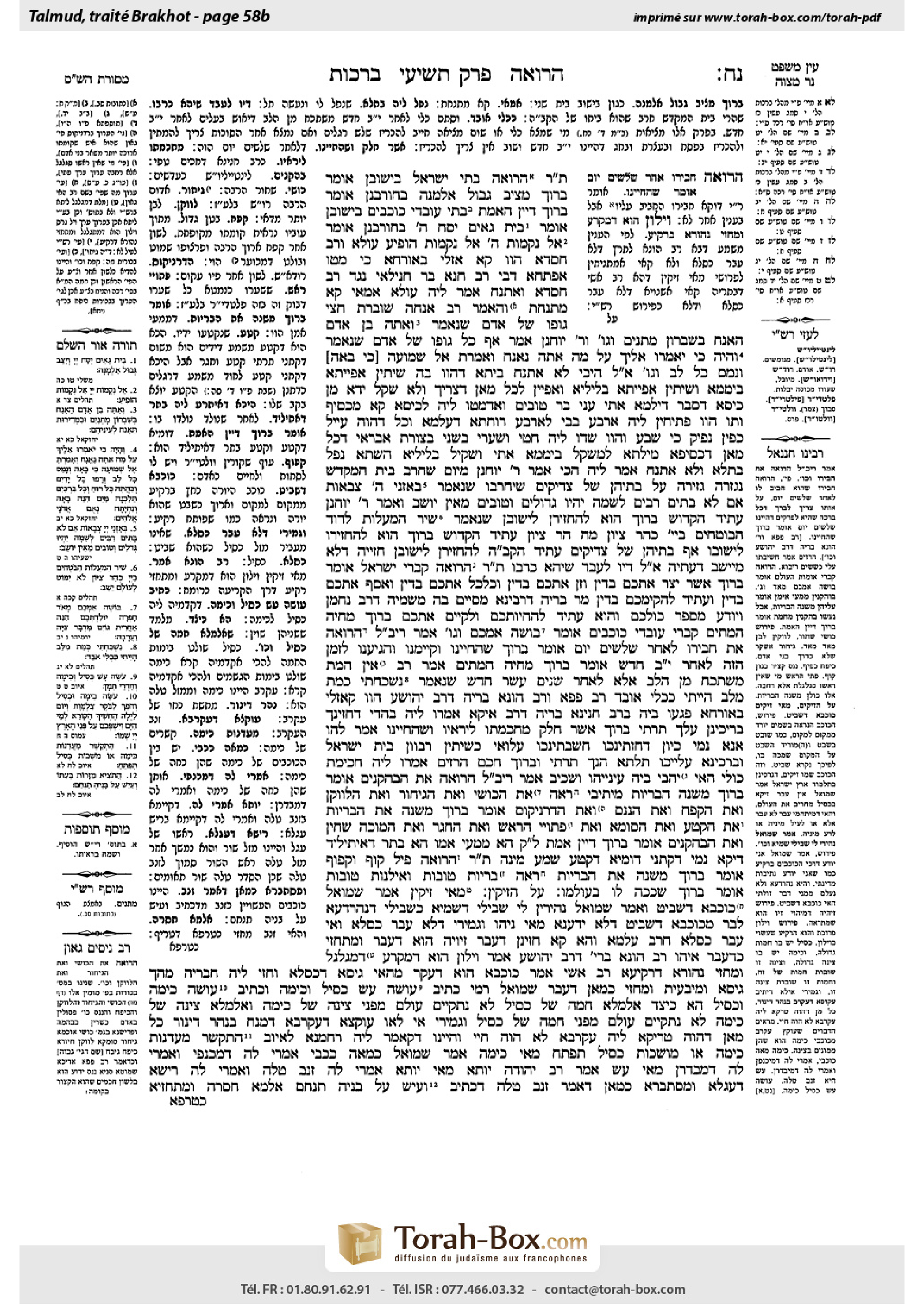
Berakhot 58b: Talmud study for Daf Yomi
Study the Talmud for Daf Yomi with scanned pages, Hebrew text, English translations from Sefaria and AI-generated French translations.
Passage selection and English or AI-generated French translation are available where the scan has annotations. Daf Study is independent of Torah-Box and Sefaria.
Browse Berakhot · ברכות · All tractatesBerakhot 58b text and translations
This page of Berakhot includes the Aramaic text, an English translation and an AI-generated French translation, alongside the scan above.
ברכות נ״ח ב · Aramaic and Hebrew text
תָּנוּ רַבָּנַן: הָרוֹאֶה בָּתֵּי יִשְׂרָאֵל בְּיִשּׁוּבָן, אוֹמֵר: ״בָּרוּךְ … מַצִּיב גְּבוּל אַלְמָנָה״. בְּחוּרְבָּנָן, אוֹמֵר: ״בָּרוּךְ דַּיַּין הָאֱמֶת״. בָּתֵּי אוּמּוֹת הָעוֹלָם בְּיִשּׁוּבָן, אוֹמֵר: ״בֵּית גֵּאִים יִסַּח ה׳״. בְּחוּרְבָּנָן, אוֹמֵר: ״אֵל נְקָמוֹת ה׳ אֵל נְקָמוֹת הוֹפִיעַ״.
עוּלָּא וְרַב חִסְדָּא הֲווֹ קָא אָזְלִי בְּאוֹרְחָא. כִּי מְטוֹ אַפִּתְחָא דְּבֵי רַב חָנָא בַּר חֲנִילַאי נְגַד רַב חִסְדָּא וְאִתְּנַח. אֲמַר לֵיהּ עוּלָּא: אַמַּאי קָא מִתְּנַחַתְּ? וְהָאָמַר רַב: אֲנָחָה שׁוֹבֶרֶת חֲצִי גּוּפוֹ שֶׁל אָדָם, שֶׁנֶּאֱמַר: ״וְאַתָּה בֶן אָדָם הֵאָנַח בְּשִׁבְרוֹן מׇתְנַיִם וְגוֹ׳״. וְרַבִּי יוֹחָנָן אָמַר אַף כׇּל גּוּפוֹ שֶׁל אָדָם, שֶׁנֶּאֱמַר: ״וְהָיָה כִּי יֹאמְרוּ אֵלֶיךָ עַל מָה אַתָּה נֶאֱנָח וְאָמַרְתָּ אֶל שְׁמוּעָה כִי בָאָה וְנָמֵס כׇּל לֵב וְגוֹ׳״.
אֲמַר לֵיהּ: הֵיכִי לָא אֶתְּנַח — בֵּיתָא דַּהֲווֹ בַּהּ שִׁיתִּין אָפְיָיתָא בִּימָמָא וְשִׁיתִּין אָפְיָיתָא בְּלֵילְיָא, וְאָפְיָין לְכׇל מַאן דִּצְרִיךְ, וְלָא שְׁקַל יְדָא מִן כִּיסָא, דִּסְבַר דִּילְמָא אָתֵי עָנֵי בַּר טוֹבִים וְאַדְּמָטוּ לֵיהּ לְכִיסָא קָא מִכְּסִיף. וְתוּ, הֲווֹ פְּתִיחִין לֵיהּ אַרְבַּע בָּבֵי לְאַרְבַּע רוּחָתָא דְעָלְמָא, וְכֹל דַּהֲוָה עָיֵיל כָּפֵין נָפֵיק כִּי שָׂבַע. וַהֲווֹ שָׁדוּ לֵיהּ חִטֵּי וּשְׂעָרֵי בִּשְׁנֵי בַצּוֹרֶת אַבָּרַאי, דְּכׇל מַאן דִּכְסִיפָא מִילְּתָא לְמִשְׁקַל בִּימָמָא, אָתֵי וְשָׁקֵיל בְּלֵילְיָא. הַשְׁתָּא נְפַל בְּתִלָּא — וְלָא אֶתְּנַח?
אֲמַר לֵיהּ: הָכִי אָמַר רַבִּי יוֹחָנָן — מִיּוֹם שֶׁחָרַב בֵּית הַמִּקְדָּשׁ נִגְזְרָה גְּזֵירָה עַל בָּתֵּיהֶן שֶׁל צַדִּיקִים שֶׁיֶּחֶרְבוּ, שֶׁנֶּאֱמַר: ״בְּאׇזְנָי ה׳ צְבָאוֹת אִם לֹא בָּתִּים רַבִּים לְשַׁמָּה יִהְיוּ גְּדֹלִים וְטוֹבִים מֵאֵין יוֹשֵׁב״. וְאָמַר רַבִּי יוֹחָנָן: עָתִיד הַקָּדוֹשׁ בָּרוּךְ הוּא לְהַחֲזִירָן לְיִשּׁוּבָן, שֶׁנֶּאֱמַר: ״שִׁיר הַמַּעֲלוֹת לְדָוִד הַבֹּטְחִים בַּה׳ כְּהַר צִיּוֹן״. מָה הַר צִיּוֹן עָתִיד הַקָּדוֹשׁ בָּרוּךְ הוּא לְהַחֲזִירוֹ לְיִשּׁוּבוֹ, אַף בָּתֵּיהֶן שֶׁל צַדִּיקִים עָתִיד הַקָּדוֹשׁ בָּרוּךְ הוּא לְהַחֲזִירָן לְיִשּׁוּבָן. חַזְיֵיהּ דְּלָא מְיַישְּׁבָא דַּעְתֵּיהּ. אֲמַר לֵיהּ: דַּיּוֹ לְעֶבֶד שֶׁיְּהֵא כְּרַבּוֹ.
תָּנוּ רַבָּנַן: הָרוֹאֶה קִבְרֵי יִשְׂרָאֵל, אוֹמֵר: ״בָּרוּךְ … אֲשֶׁר יָצַר אֶתְכֶם בַּדִּין, וְזָן אֶתְכֶם בַּדִּין, וְכִלְכֵּל אֶתְכֶם בַּדִּין, וְאָסַף אֶתְכֶם בַּדִּין, וְעָתִיד לַהֲקִימְכֶם בַּדִּין״. מָר בְּרֵיהּ דְּרָבִינָא מְסַיֵּים בַּהּ, מִשְּׁמֵיהּ דְּרַב נַחְמָן: ״וְיוֹדֵעַ מִסְפַּר כּוּלְּכֶם, וְהוּא עָתִיד לְהַחְיוֹתְכֶם וּלְקַיֵּים אֶתְכֶם. בָּרוּךְ … מְחַיֵּה הַמֵּתִים״. קִבְרֵי גוֹיִם, אוֹמֵר: ״בּוֹשָׁה אִמְּכֶם וְגוֹ׳״.
אָמַר רַבִּי יְהוֹשֻׁעַ בֶּן לֵוִי: הָרוֹאֶה אֶת חֲבֵירוֹ לְאַחַר שְׁלֹשִׁים יוֹם, אוֹמֵר: ״בָּרוּךְ … שֶׁהֶחֱיָינוּ וְקִיְּימָנוּ וְהִגִּיעָנוּ לַזְּמַן הַזֶּה״. לְאַחַר שְׁנֵים עָשָׂר חֹדֶשׁ, אוֹמֵר: ״בָּרוּךְ … מְחַיֵּה הַמֵּתִים״. אָמַר רַב: אֵין הַמֵּת מִשְׁתַּכֵּחַ מִן הַלֵּב אֶלָּא לְאַחַר שְׁנֵים עָשָׂר חֹדֶשׁ. שֶׁנֶּאֱמַר: ״נִשְׁכַּחְתִּי כְּמֵת מִלֵּב הָיִיתִי כִּכְלִי אוֹבֵד״.
רַב פָּפָּא וְרַב הוּנָא בְּרֵיהּ דְּרַב יְהוֹשֻׁעַ הֲווֹ קָאָזְלִי בְּאוֹרְחָא. פְּגַעוּ בֵּיהּ בְּרַב חֲנִינָא בְּרֵיהּ דְּרַב אִיקָא. אֲמַרוּ לֵיהּ: בַּהֲדֵי דַּחֲזֵינָךְ בָּרֵיכִינַן עֲלָךְ תַּרְתֵּי: ״בָּרוּךְ … אֲשֶׁר חָלַק מֵחׇכְמָתוֹ לִירֵאָיו״ וְ״שֶׁהֶחֱיָינוּ״. אֲמַר לְהוּ: אֲנָא נָמֵי, כֵּיוָן דַּחֲזִתִינְכוּ חַשֵּׁבְתִּינְכוּ עִלָּוַאי כְּשִׁיתִּין רִבְּווֹן בֵּית יִשְׂרָאֵל, וּבָרֵיכְנָא עֲלַיְיכוּ תְּלָתָא: הָנָךְ תַּרְתֵּי, וּ״בָרוּךְ … חֲכַם הָרָזִים״. אֲמַרוּ לֵיהּ: חֲכִימַתְּ כּוּלֵּי הַאי! יָהֲבִי בֵּיהּ עֵינַיְיהוּ, וּשְׁכֵיב.
אָמַר רַבִּי יְהוֹשֻׁעַ בֶּן לֵוִי: הָרוֹאֶה אֶת הַבַּהֲקָנִים, אוֹמֵר: ״בָּרוּךְ … מְשַׁנֶּה הַבְּרִיּוֹת״. מֵיתִיבִי: רָאָה אֶת הַכּוּשִׁי, וְאֶת הַגִּיחוֹר, וְאֶת הַלַּוְוקָן, וְאֶת הַקִּפֵּחַ, וְאֶת הַנַּנָּס, וְאֶת הַדַּרְנִיקוֹס, אוֹמֵר: ״בָּרוּךְ … מְשַׁנֶּה אֶת הַבְּרִיּוֹת״. אֶת הַקִּטֵּעַ, וְאֶת הַסּוֹמֵא, וְאֶת פְּתוּיֵי הָרֹאשׁ, וְאֶת הַחִגֵּר, וְאֶת הַמּוּכֵּה שְׁחִין, וְאֶת הַבַּהֲקָנִים, אוֹמֵר: ״בָּרוּךְ … דַּיֵּין אֱמֶת״!
לָא קַשְׁיָא: הָא מִמְּעֵי אִמּוֹ, הָא בָּתַר דְּאִיתְיְלִיד. דַּיְקָא נָמֵי, דְּקָתָנֵי דּוּמְיָא דְּקִטֵּעַ. שְׁמַע מִינַּהּ.
תָּנוּ רַבָּנַן: הָרוֹאָה פִּיל, קוֹף וְקִפֹוף, אוֹמֵר: ״בָּרוּךְ … מְשַׁנֶּה אֶת הַבְּרִיּוֹת״. רָאָה בְּרִיּוֹת טוֹבוֹת, וְאִילָנוֹת טוֹבוֹת, אוֹמֵר: ״בָּרוּךְ … שֶׁכָּכָה לוֹ בְּעוֹלָמוֹ״.
עַל הַזִּיקִין: מַאי זִיקִין? אָמַר שְׁמוּאֵל: כּוֹכְבָא דְּשָׁבֵיט. וְאָמַר שְׁמוּאֵל: נְהִירִין לִי שְׁבִילֵי דִשְׁמַיָּא כִּשְׁבִילֵי דִנְהַרְדָּעָא, לְבַר מִכּוֹכְבָא דְּשָׁבֵיט דְּלָא יָדַעְנָא מַאי נִיהוּ. וּגְמִירִי דְּלָא עָבַר כִּסְלָא, וְאִי עָבַר כִּסְלָא — חָרֵב עָלְמָא. וְהָא קָא חָזֵינַן דְּעָבַר! — זִיוֵיהּ הוּא דְּעָבַר, וּמִתְחֲזֵי כִּדְעָבַר אִיהוּ. רַב הוּנָא בְּרֵיהּ דְּרַב יְהוֹשֻׁעַ אָמַר: וִילוֹן הוּא דְּמִקְּרַע, דְּמִגַּלְגַּל וּמִחֲזֵי נְהוֹרָא דְרָקִיעַ. רַב אָשֵׁי אָמַר: כּוֹכְבָא הוּא דְּעָקַר מֵהַאי גִּיסָא דְכִסְלָא וְחָזֵי לֵיהּ חַבְרֵיהּ מֵהַךְ גִּיסָא, וּמִיבְּעִית, וּמִחֲזֵי כְּמַאן דְּעָבַר.
שְׁמוּאֵל רָמֵי. כְּתִיב ״עֹשֶׂה עָשׁ כְּסִיל וְכִימָה״, וּכְתִיב: ״עֹשֵׂה כִימָה וּכְסִיל״. הָא כֵּיצַד? אִלְמָלֵא חַמָּה שֶׁל כְּסִיל, לֹא נִתְקַיֵּים עוֹלָם מִפְּנֵי צִינָּה שֶׁל כִּימָה, וְאִלְמָלֵא צִינָּה שֶׁל כִּימָה — לֹא נִתְקַיֵּים עוֹלָם מִפְּנֵי חַמָּה שֶׁל כְּסִיל.
וּגְמִירִי אִי לָאו עוּקְצָא דְעַקְרַבָּא דְּמַנַּח בִּנְהַר דִּינוּר, כֹּל מַאן דַּהֲוָה טָרְקָא לֵיהּ עַקְרַבָּא לָא הֲוָה חָיֵי. וְהַיְינוּ דְּקָאָמַר לֵיהּ רַחֲמָנָא לְאִיּוֹב: ״הַתְקַשֵּׁר מַעֲדַנּוֹת כִּימָה אוֹ מֹשְׁכוֹת כְּסִיל תְּפַתֵּחַ״.
מַאי ״כִּימָה״? אָמַר שְׁמוּאֵל: כִּמְאָה כֹּכְבֵי. אָמְרִי לַהּ דִּמְכַנְּפִי, וְאָמְרִי לַהּ דִּמְבַדְּרָן.
מַאי ״עָשׁ״? אָמַר רַב יְהוּדָה: יוֹתָא. מַאי ״יוֹתָא״? אָמְרִי לַהּ זְנַב טָלֶה. וְאָמְרִי לַהּ רֵישָׁא דְעִגְלָא. וּמִסְתַּבְּרָא כְּמַאן דְּאָמַר זְנַב טָלֶה, דִּכְתִיב: ״וְעַיִשׁ עַל בָּנֶיהָ תַנְחֵם״. אַלְמָא חָסְרָה וּמִתְחַזְיָא
Berakhot 58b · English translation
The Sages taught: One who sees the houses of Israel inhabited and tranquil recites: Blessed…Who establishes the border of the widow. One who sees them in ruins he recites: Blessed…the true Judge. One who sees the houses of the nations of the world inhabited recites: “The Lord will destroy the house of the proud, but He will establish the border of the widow” (Proverbs 15:25). And if he sees them in ruins he recites: “God of vengeance, Lord, God of vengeance, shine forth” (Psalms 94:1).
The Gemara relates that Ulla and Rav Ḥisda were once walking along the road when they came upon the doorway of the house of Rav Ḥana bar Ḥanilai. Rav Ḥisda groaned and sighed. Ulla asked him: Why are you sighing? Didn’t Rav say: Sighing breaks half of one’s body? As it is stated: “Sigh, therefore, you son of man; with the breaking of your loins” (Ezekiel 21:11); sighing breaks a person down to his loins. And Rabbi Yoḥanan said that sighing breaks even one’s entire body, as it is stated: “And it shall be, when they say unto you: Why are you sighing? That you shall say: Because of the tidings, for it comes; and every heart shall melt, and all hands shall be slack, and every spirit shall be faint, and all knees shall drip with water” (Ezekiel 21:12).
Rav Ḥisda said to Ulla: How can I not sigh? We see this house where there were sixty cooks during the day and sixty cooks at night who would cook for anyone in need, and Rav Ḥana never removed his hand from his pocket because he thought: Perhaps a well-born poor person might come and in the time that passed until he put his hand in his pocket to give him charity, the poor person would be embarrassed. Moreover, that house had four doors open in all four directions, and anyone who entered hungry left satiated. And they would scatter wheat and barley outside during years of drought so that anyone who was embarrassed to take the grain during the day could come and take it at night. Now that the house has fallen in ruins, how can I not sigh?
Ulla said to Rav Ḥisda: You have nothing about which to sigh, as Rabbi Yoḥanan said as follows: From the day that the Temple was destroyed a decree was issued upon the houses of the righteous that they would be destroyed, as it is stated: “In mine ears said the Lord of hosts: Of a truth many houses shall be desolate, even great and fair, without inhabitant” (Isaiah 5:9). And Rabbi Yoḥanan said: In the future, in the end of days, the Holy One, Blessed be He, will restore them to their original locations and their inhabited state, as it is stated: “A Song of Ascents of David. They who trust in the Lord are as Mount Zion, which cannot be moved but abides forever” (Psalms 125:1). From this verse one may infer that just as in the future the Holy One, Blessed be He, will restore Mount Zion to its inhabited state, so too, in the future the Holy One, Blessed be He, will restore the houses of the righteous to their inhabited state, so you have no reason to sigh. Seeing that he was still not satisfied, Ulla said to him: It is enough for a servant to be like his master. Since God leaves His home, the Holy Temple, in ruins, one should not be distraught over the destruction of the houses of the righteous.
The Sages taught in a baraita: One who sees graves of Israel recites:
Blessed…Who formed you in judgment,
and Who nourished you in judgment,
and Who sustained you in judgment,
and collected your soul in judgment,
and in the future will raise you from the dead in judgment.
And Mar, son of Ravina, concludes the formula of this blessing in the name of Rav Naḥman:
And Who knows the number of you all,
and Who in the future will restore you to life and sustain you.
Blessed…Who revives the dead.
One who sees graves of gentiles recites: “Your mother shall be sore ashamed, she who bore you shall be confounded; behold, the hindermost of the nations shall be a wilderness, a dry land, and a desert” (Jeremiah 50:12).
Rabbi Yehoshua ben Levi said: One who sees his friend after thirty days have passed since last seeing him recites: Blessed…Who has given us life, sustained us and brought us to this time. One who sees his friend after twelve months recites: Blessed…Who revives the dead. As Rav said: A dead person is only forgotten from the heart after twelve months have elapsed, as it is stated: “I am forgotten as a dead man out of mind; I am like a lost vessel” (Psalms 31:13), and with regard to the laws of lost objects, it is human nature to despair of recovering a lost object after twelve months (see Bava Metzia 28a).
The Gemara relates: Rav Pappa and Rav Huna, son of Rav Yehoshua, were once walking along the road when they met Rav Ḥanina the son of Rav Ika. They said to him: When we saw you we recited two blessings over meeting you: Blessed…Who has shared of His wisdom to those who revere Him, and: Who has given us life…as they had not seen him in over a month. He said to them: I too, once I saw you, considered you in my eyes as equivalent to six hundred thousand of the house of Israel, and I recited three blessings over you. I recited those two that you recited, as well as: Blessed…Who knows all secrets, which is the blessing recited upon seeing six hundred thousand Israelites. They said to him: Are you all that clever? They fixed their gaze upon him and he died.
The Gemara continues to discuss the obligation to recite a blessing over unusual phenomena. Rabbi Yehoshua ben Levi said: One who sees spotted people recites: Blessed…Who makes creatures different. The Gemara raises a challenge: One who saw a person with unusually black skin, a person with unusually red skin, a person with unusually white skin [lavkan], an unusually tall and thin person, a dwarf, or one with warts [darnikos] recites: Blessed…Who makes creatures different. However, one who sees an amputee, a blind person, a flat-headed person, a lame person, one afflicted with boils, or spotted people recites: Blessed…the true Judge, not: Who makes creatures different.
The Gemara answers: This is not difficult. This, where Rabbi Yehoshua ben Levi says to recite: Who makes creatures different, refers to a case where the individual was spotted from when he was in his mother’s womb, since birth. While this, where one recites: The true Judge, refers to a case where the individual only became spotted after he was born. The Gemara remarks: The language of the baraita is also precise as it draws a parallel to other cases, as it taught that a spotted person is similar to an amputee, which, in general, is a handicap incurred after birth. The Gemara concludes: Indeed, conclude from this.
The Sages taught: One who sees an elephant, a monkey, or a vulture (Rashi) recites: Blessed…Who makes creatures different. One who saw beautiful or otherwise outstanding creatures or beautiful trees recites: Blessed…Who has such things in His world.
We learned in the mishna that over zikin, one recites: Whose strength and power fill the world. The Gemara asks: What are zikin? Shmuel said: A comet. Shmuel also said: The paths of the sky are as clear to me as the paths of my city, Neharde’a, except for comets, that I do not know what they are. And we learn through tradition that a comet does not pass the Orion constellation, and if it does pass Orion, the world will be destroyed. The Gemara asks: Don’t we see that comets pass Orion? The Gemara rejects this: The aura of the comet passes Orion and it appears as though the comet itself passes. Rav Huna, son of Rav Yehoshua, said a different answer: It is merely that vilon, one of the firmaments, rips and furls and the light of the next firmament is seen, and this appears like a comet. Rav Ashi said another explanation: It is not a comet that passes Orion, but a star that is uprooted from one side of Orion, and another star, from the other side of Orion, sees it and gets startled and shudders, and appears as if it is passing.
On the subject of stars, the Gemara notes that Shmuel raised a contradiction between the implications of two verses with regard to constellations. On the one hand it is written: “Who makes Ursa Major, Orion, and Pleiades, and the chambers of the south” (Job 9:9); Orion precedes Pleiades. And on the other hand it is written: “He Who makes Pleiades and Orion” (Amos 5:8); Pleiades precedes Orion. So how is this reconciled? The Gemara replies: Were it not for Orion’s heat, the universe could not exist because of the cold of Pleiades; and conversely, were it not for the cold of Pleiades, the universe could not exist because of the heat of Orion.
And we learned a tradition that if the tail of the constellation Scorpio did not rest in the River of Fire, anyone stung by a scorpion would not survive. And that is what the All-Merciful said to Job of the relationship between heat and cold among the stars: “Can you bind the chains of the Pleiades or loosen the bands of Orion?” (Job 38:31); God alternates intensifying the power of different constellations in order to raise or lower the temperature.
With regard to Pleiades, the Gemara asks: What is Pleiades [Kima]? Why is it called by that name? Shmuel said: Because it is approximately a hundred [keme’a] stars, as that is the number of stars in that constellation; some say that they are concentrated and some say that they are dispersed.
With regard to the verse: “Who makes Ursa Major, Orion, and Pleiades” (Job 9:9), the Gemara asks: What is Ursa Major [Ash]? Rav Yehuda said: It is the star called Yota. This name was unfamiliar as well, so the Gemara asks: What is Yota? There is disagreement; some say that Yota is the group of stars comprising the tail of Aries, while others say that Yota belongs to the head of Taurus. The Gemara concludes: And it stands to reason in accordance with the opinion of the one who said that Yota is the group of stars comprising the tail of Aries, as it is written: “Or can you guide Ursa Major with her sons?” (Job 38:32); apparently it was incomplete and the tail appears
Berakhot 58b · Traduction française (IA)
Les Sages enseignèrent : Celui qui voit les maisons d'Israël habitées et tranquilles prie : béni…Celui qui établit la frontière de la veuve. Celui qui les voit en ruine prie : béni…le Juge véritable. Celui qui voit les maisons des nations du monde habitées prie : « L'Éternel détruira la maison du orgueilleux, mais Il établira la frontière de la veuve » (Proverbes 15:25). Et s'il les voit en ruine, il prie : « Dieu de vengeance, Seigneur, Dieu de vengeance, éclaire-toi » (Psaumes 94:1).
Le Guemara rapporte que Ulla et Rav Ḥisda étaient un jour en chemin lorsqu'ils rencontrèrent la porte de la maison de Rav Ḥana bar Ḥanilai. Rav Ḥisda soupira et gémit. Ulla lui demanda : Pourquoi soupires-tu ? N'a-t-il pas dit Rav : Le soupir brise la moitié du corps d'une personne ? Comme il est dit : « Soupire donc, ô fils de l'homme, avec la rupture de tes reins » (Ezéchiel 21:11) ; le soupir brise une personne jusqu'à ses reins. Et Rabbi Yoḥanan dit que le soupir brise même tout le corps d'une personne, comme il est dit : « Et il arrivera, lorsqu'ils diront à toi : Pourquoi soupires-tu ? Tu diras : À cause des nouvelles, car elles viennent ; et chaque cœur s'effondrera, et toutes les mains s'affaibliront, et chaque esprit s'effondrera, et toutes les genoux couleront de larmes » (Ezéchiel 21:12).
Rav Ḥisda dit à Ulla : Comment ne pas soupirer ? Nous voyons cette maison où il y avait soixante cuisiniers pendant la journée et soixante cuisiniers la nuit qui cuisinaient pour quiconque avait besoin, et Rav Ḥana ne retirait jamais sa main de sa poche, car il pensait : Peut-être un pauvre de bonne famille viendra et, pendant le temps qui s'écoulait jusqu'à ce qu'il mette sa main dans sa poche pour lui donner une charité, le pauvre s'embarrasserait. De plus, cette maison avait quatre portes ouvertes dans les quatre directions, et quiconque entrait affamé sortait rassasié. Et ils dispersaient du blé et de l'orge en dehors pendant les années de sécheresse afin que quiconque s'embarrassait de prendre le grain pendant la journée puisse venir le prendre la nuit. Maintenant que cette maison est en ruine, comment ne pas soupirer ?
Ulla dit à Rav Ḥisda : Tu n'as rien sur quoi soupirer, car Rabbi Yoḥanan a dit ainsi : Depuis la journée où le Temple a été détruit, un décret a été émis sur les maisons des justes qu'elles seraient détruites, comme il est dit : « L'Éternel des armées a dit à mes oreilles : En vérité, beaucoup de maisons seront désertes, même grandes et belles, sans habitant » (Isaïe 5:9). Et Rabbi Yoḥanan a dit : À l'avenir, à la fin des jours, le Saint, le Béni soit-Il, restaurera ceux-ci à leur lieu d'origine et à leur état habité, comme il est dit : « Chant des montées de David. Ceux qui confient en l'Éternel sont comme Sion, qui ne peut être bouleversé mais subsiste éternellement » (Psaumes 125:1). De ce verset on peut déduire que, comme à l'avenir le Saint, le Béni soit-Il, restaurera Sion à son état habité, ainsi aussi à l'avenir le Saint, le Béni soit-Il, restaurera les maisons des justes à leur état habité, donc tu n'as pas de raison de soupirer. Vu qu'il n'était pas encore satisfait, Ulla dit à lui : Il suffit à un serviteur d'être comme son maître. Puisque Dieu quitte sa demeure, le Saint Temple, en ruine, on ne devrait pas être attristé par la destruction des maisons des justes.
Les Sages enseignèrent dans une baraïta : Celui qui voit les tombes d'Israël prie : Béni…Celui qui t'a formé en jugement, Et Celui qui t'a nourri en jugement, Et Celui qui t'a sustenté en jugement, Et Celui qui a rassemblé ton âme en jugement, Et dans l'avenir établira ta résurrection en jugement. Et Mar, fils de Ravina, conclut la formule de ce bénédiction en nom de Rav Naḥman : Et Celui qui connaît le nombre de vous tous, Et Celui qui dans l'avenir vous restaurera à la vie et vous sustentera. Béni…Celui qui réanime les morts. Celui qui voit les tombes des gentils prie : « Ta mère sera très honteuse, celle qui t'a porté sera confondue ; regarde, l'arrière des nations sera un désert, une terre aride, et une steppe » (Jérémie 50:12).
Rabbi Yehoshua ben Levi dit : Celui qui voit son ami après trente jours depuis la dernière fois qu'il l'a vu prie : Béni…Celui qui nous a donné la vie, nous a sustenté et nous a conduit à ce moment. Celui qui voit son ami après un an prie : Béni…Celui qui réanime les morts. Comme Rav a dit : Un mort est oublié du cœur après un an s'est écoulé, comme il est dit : « Je suis oublié comme un mort hors de l'esprit ; je suis comme un vase perdu » (Psaumes 31:13), et concernant les lois des objets perdus, c'est la nature humaine de désespérer de récupérer un objet perdu après un an (voir Bava Metzia 28a).
Le Guemara rapporte : Rav Pappa et Rav Huna, fils de Rav Yehoshua, étaient un jour en chemin lorsqu'ils rencontrèrent Rav Ḥanina, fils de Rav Ika. Ils lui dirent : Lorsque nous t'avons vu, nous avons prié deux bénédiction sur le fait de te rencontrer : Béni…Celui qui a partagé Sa sagesse avec ceux qui L'adorent, et : Béni…Celui qui nous a donné la vie…car nous n'avions pas vu toi depuis plus d'un mois. Il lui dit : Moi aussi, une fois que j'ai vu vous, j'ai considéré vous comme équivalent à six cent mille de la maison d'Israël, et j'ai prié trois bénédiction sur vous. J'ai prié ceux deux que vous avez prié, ainsi que : Béni…Celui qui connaît tous les secrets, qui est la bénédiction priée sur la vue de six cent mille Israélites. Ils lui dirent : Es-tu si intelligent ? Ils fixèrent leur regard sur lui et il mourut.
Le Guemara continue à discuter de l'obligation de prier une bénédiction sur des phénomènes inhabituels. Rabbi Yehoshua ben Levi dit : Celui qui voit des personnes marquées prie : Béni…Celui qui fait des créatures différentes. Le Guemara soulève un défi : Celui qui a vu une personne avec une peau extrêmement noire, une personne avec une peau extrêmement rouge, une personne avec une peau extrêmement blanche [lavkan], une personne extrêmement grande et maigre, un nain, ou une personne avec des verrues [darnikos] prie : Béni…Celui qui fait des créatures différentes. Cependant, celui qui voit un amputé, un aveugle, un crâne plat, un boiteux, une personne atteinte de vésicules, ou des personnes marquées prie : Béni…le Juge véritable, pas : Celui qui fait des créatures différentes.
Le Guemara répond : Cela n'est pas difficile. Cela concerne le cas où Rabbi Yéhoshua ben Lévi dit de réciter : Celui qui fait des créatures différentes, ce qui fait référence à un cas où la personne était tachetée dès lors qu'elle était dans le ventre de sa mère, à la naissance. Tandis que cela, où l'on récite : Le Juge véritable, fait référence à un cas où la personne est devenue tachetée après sa naissance. Le Guemara remarque : La formulation de la baraïta est aussi précise, car elle établit un parallèle avec d'autres cas, car elle enseigne que la personne tachetée est semblable à un amputé, qui, en général, est un handicap acquis après la naissance. Le Guemara conclut : En effet, concluez-en là-dessus.
Les Sages enseignèrent : Celui qui voit un éléphant, un singe ou un aigle (selon Rashi) récite : Béni… Celui qui fait des créatures différentes. Celui qui a vu des créatures belles ou autrement remarquables ou des arbres beaux récite : Béni… Qui a de telles choses dans Son monde.
Nous avons appris dans la mitsna que sur les zikin, on récite : Dont la force et la puissance remplissent le monde. Le Guemara pose la question : Quels sont les zikin ? Shmuel dit : Une comète. Shmuel a aussi dit : Les chemins du ciel sont aussi clairs pour moi que les chemins de ma ville, Nehardea, sauf les comètes, dont je ne sais pas ce qu'elles sont. Et nous apprenons par tradition que la comète ne traverse pas la constellation d'Orion, et si elle traverse Orion, le monde sera détruit. Le Guemara pose la question : Ne voyons-nous pas que les comètes traversent Orion ? Le Guemara rejette cela : L'aura de la comète traverse Orion et cela semble que la comète elle-même traverse. Rav Huna, fils de Rav Yéhoshua, a dit une autre réponse : C'est simplement que vilon, l'une des firmaments, se déchire et se plie, et la lumière de la prochaine firmament est vue, et cela apparaît comme une comète. Rav Ashi a dit une autre explication : Ce n'est pas une comète qui traverse Orion, mais une étoile arrachée d'un côté d'Orion, et une autre étoile, de l'autre côté d'Orion, la voit et s'effraie et tremble, et cela semble comme si elle traversait.
Sur le sujet des étoiles, la Guemara note que Shmuel a soulevé une contradiction entre les implications de deux versets concernant les constellations. D'une part, il est écrit : « Celui qui fait Ursa Major, Orion et les Pléiades, et les chambres du sud » (Job 9:9) ; Orion précède les Pléiades. D'autre part, il est écrit : « Celui qui fait les Pléiades et Orion » (Amos 5:8) ; les Pléiades précèdent Orion. Comment cette contradiction est-elle résolue ? La Guemara répond : S'il n'y avait pas la chaleur d'Orion, le monde ne pourrait pas exister à cause du froid des Pléiades ; et inversement, s'il n'y avait pas le froid des Pléiades, le monde ne pourrait pas exister à cause de la chaleur d'Orion.
Et nous avons appris une tradition que si la queue de la constellation du Scorpion ne reposait pas dans le Fleuve de Feu, personne piqueté par un scorpion ne survivrait. Et c'est ce que l'Éternel Miséricordieux a dit à Job concernant la relation entre le chaud et le froid parmi les étoiles : « Peux-tu attacher les chaînes des Pléiades ou détacher les bandes d'Orion ? » (Job 38:31) ; Dieu alterne l'intensité de la puissance de différentes constellations afin d'augmenter ou de diminuer la température.
Concernant les Pléiades, la Guemara pose la question : Qu'est-ce que les Pléiades [Kima] ? Pourquoi est-elle appelée ainsi ? Shmuel dit : Parce qu'elle comprend environ cent [keme’a] étoiles, car c'est le nombre d'étoiles dans cette constellation ; certains disent qu'elles sont concentrées et d'autres qu'elles sont dispersées.
Concernant le verset : « Celui qui fait Ursa Major, Orion et les Pléiades » (Job 9:9), le Guemara pose la question : Qu'est-ce que Ursa Major [Ash] ? Rav Yéhuda dit : C'est l'étoile appelée Yota. Ce nom était inconnu également, donc le Guemara pose la question : Qu'est-ce que Yota ? Il y a un désaccord ; certains disent que Yota est le groupe d'étoiles composant la queue du bélier, tandis que d'autres disent que Yota appartient à la tête du taureau. Le Guemara conclut : Et cela s'explique selon l'opinion de celui qui a dit que Yota est le groupe d'étoiles composant la queue du bélier, car il est écrit : « Peux-tu guider Ursa Major avec ses fils ? » (Job 38:32) ; apparemment, cela était incomplet et la queue apparaît
Traduction française générée par IA à partir de l’édition anglaise de Sefaria. Vérifie toujours un passage avec le texte source.
Text from Sefaria: William Davidson Edition - Vocalized Aramaic (CC BY NC); William Davidson Edition - English (CC BY NC).