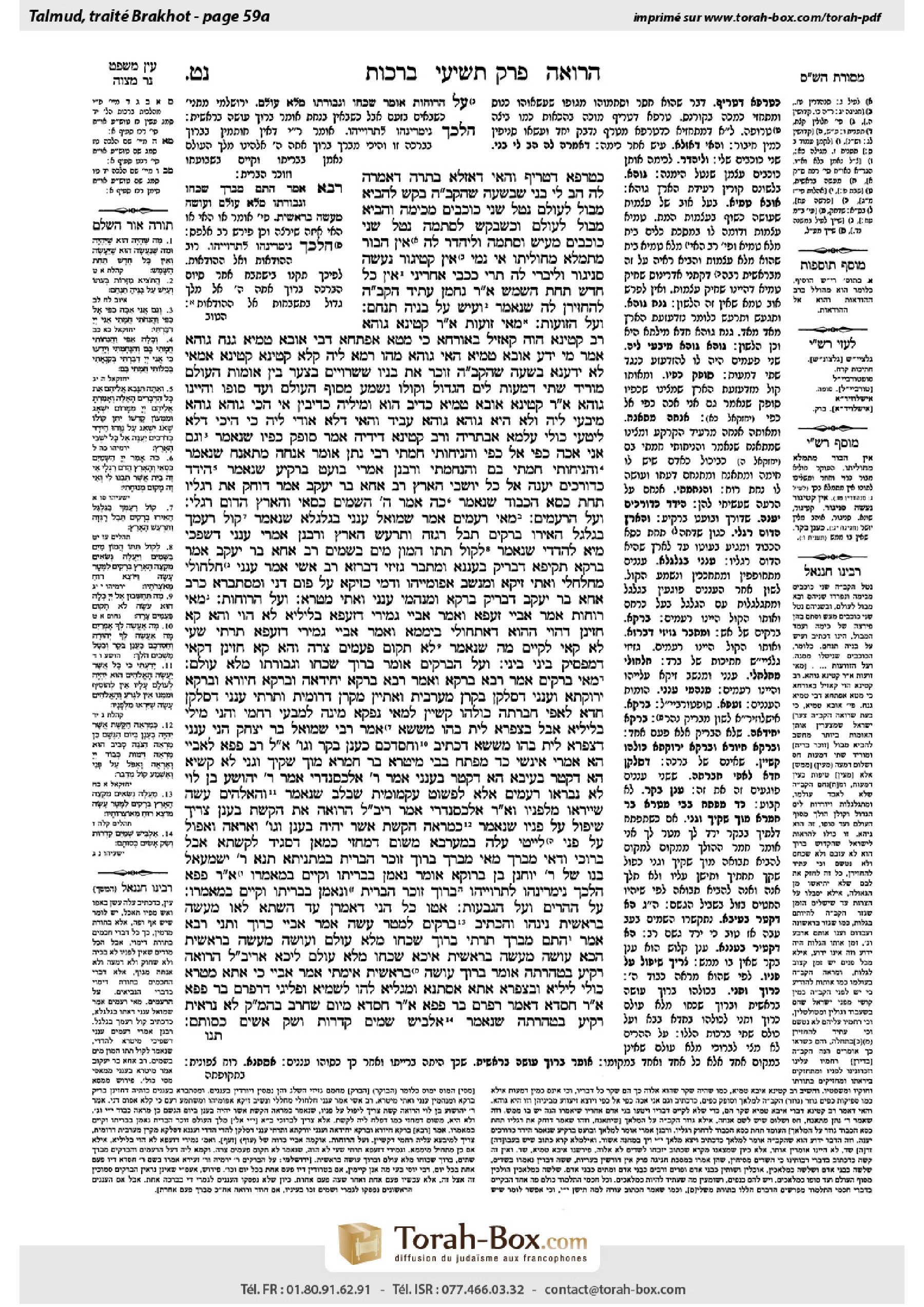
Berakhot 59a: Talmud study for Daf Yomi
Study the Talmud for Daf Yomi with scanned pages, Hebrew text, English translations from Sefaria and AI-generated French translations.
Passage selection and English or AI-generated French translation are available where the scan has annotations. Daf Study is independent of Torah-Box and Sefaria.
Browse Berakhot · ברכות · All tractatesBerakhot 59a text and translations
This page of Berakhot includes the Aramaic text, an English translation and an AI-generated French translation, alongside the scan above.
ברכות נ״ט א · Aramaic and Hebrew text
כְּטִרְפָּא דִּטְרִיף. וְהַאי דְּאָזְלָא בָּתְרַהּ, דְּאָמְרָה לַהּ: הַב לִי בְּנַי. שֶׁבְּשָׁעָה שֶׁהַקָּדוֹשׁ בָּרוּךְ הוּא בִּקֵּשׁ לְהָבִיא מַבּוּל לְעוֹלָם נָטַל שְׁנֵי כּוֹכָבִים מִכִּימָה וְהֵבִיא מַבּוּל לָעוֹלָם. וּכְשֶׁבִּקֵּשׁ לְסׇתְמָהּ, נָטַל שְׁנֵי כּוֹכָבִים מֵעַיִשׁ וּסְתָמָהּ.
וְלַיהְדַּר לַהּ? — אֵין הַבּוֹר מִתְמַלֵּא מֵחוּלְיָתוֹ. אִי נָמֵי — אֵין קָטֵיגוֹר נַעֲשָׂה סָנֵיגוֹר.
וְלִיבְרֵי לַהּ תְּרֵי כֹּכְבֵי אַחֲרִינֵי! — ״אֵין כׇּל חָדָשׁ תַּחַת הַשָּׁמֶשׁ״. אָמַר רַב נַחְמָן: עָתִיד הַקָּדוֹשׁ בָּרוּךְ הוּא לְהַחֲזִירָן לָהּ, שֶׁנֶּאֱמַר: ״וְעַיִשׁ עַל בָּנֶיהָ תַנְחֵם״.
וְעַל הַזְּוָעוֹת. מַאי זְוָעוֹת? אָמַר רַב קַטִּינָא: גּוּהָא. רַב קַטִּינָא הֲוָה קָאָזֵיל בְּאוֹרְחָא. כִּי מְטָא אַפִּתְחָא דְּבֵי אוֹבָא טַמְיָא גְּנַח גּוּהָא. אָמַר: מִי יָדַע אוֹבָא טַמְיָא הַאי גּוּהָא מַהוּ? רְמָא לֵיהּ קָלָא: קַטִּינָא קַטִּינָא, אַמַּאי לָא יָדַעְנָא? בְּשָׁעָה שֶׁהַקָּדוֹשׁ בָּרוּךְ הוּא זוֹכֵר אֶת בָּנָיו שֶׁשְּׁרוּיִים בְּצַעַר בֵּין אוּמּוֹת הָעוֹלָם מוֹרִיד שְׁתֵּי דְמָעוֹת לַיָּם הַגָּדוֹל, וְקוֹלוֹ נִשְׁמָע מִסּוֹף הָעוֹלָם וְעַד סוֹפוֹ, וְהַיְינוּ גּוּהָא.
אָמַר רַב קַטִּינָא: אוֹבָא טַמְיָא כַּדִּיב הוּא, וּמִילֵּיהּ כְּדִיבִין. אִי הָכִי — גּוּהָא גּוּהָא מִיבְּעֵי לֵיהּ? וְלָא הִיא, גּוּהָא גּוּהָא עָבֵיד, וְהַאי דְּלָא אוֹדִי לֵיהּ, כִּי הֵיכִי דְּלָא לִיטְעֵי כּוּלֵּי עָלְמָא אַבָּתְרֵיהּ.
וְרַב קַטִּינָא דִּידֵיהּ אָמַר: סוֹפֵק כַּפָּיו, שֶׁנֶּאֱמַר: ״וְגַם אֲנִי אַכֶּה כַפִּי אֶל כַּפִּי וַהֲנִיחֹתִי חֲמָתִי״. רַבִּי נָתָן אוֹמֵר: אֲנָחָה מִתְאַנֵּחַ, שֶׁנֶּאֱמַר: ״וַהֲנִיחוֹתִי חֲמָתִי בָּם וְהִנֶּחָמְתִּי״. וְרַבָּנַן אָמְרִי: בּוֹעֵט בָּרָקִיעַ, שֶׁנֶּאֱמַר: ״הֵידָד כְּדֹרְכִים יַעֲנֶה אֶל כׇּל יֹשְׁבֵי הָאָרֶץ״. רַב אַחָא בַּר יַעֲקֹב אָמַר: דּוֹחֵק אֶת רַגְלָיו תַּחַת כִּסֵּא הַכָּבוֹד, שֶׁנֶּאֱמַר: ״כֹּה אָמַר ה׳ הַשָּׁמַיִם כִּסְאִי וְהָאָרֶץ הֲדֹם רַגְלָי״.
וְעַל הָרְעָמִים. מַאי רְעָמִים? אָמַר שְׁמוּאֵל: עֲנָנֵי בְּגַלְגַּלָּא. שֶׁנֶּאֱמַר: ״קוֹל רַעַמְךָ בַּגַּלְגַּל הֵאִירוּ בְרָקִים תֵּבֵל רָגְזָה וַתִּרְעַשׁ הָאָרֶץ״. וְרַבָּנַן אָמְרִי: עֲנָנֵי דְּשָׁפְכִי מַיָּא לַהֲדָדֵי, שֶׁנֶּאֱמַר: ״לְקוֹל תִּתּוֹ הֲמוֹן מַיִם בַּשָּׁמַיִם״. רַב אַחָא בַּר יַעֲקֹב אָמַר: בַּרְקָא תַּקִּיפָא דְּבָרֵיק בַּעֲנָנָא, וּמְתַבַּר גְּזִיזֵי דְבַרְזָא. רַב אָשֵׁי אָמַר: עֲנָנֵי חַלְחוֹלֵי מְחַלְחֲלִי, וְאָתֵי זִיקָא וּמְנַשֵּׁב אַפּוּמַּיְיהוּ, וְדָמֵי כְּזִיקָּא עַל פּוּם דַּנֵּי. וּמִסְתַּבְּרָא כְּרַב אַחָא בַּר יַעֲקֹב, דְּבָרֵיק בַּרְקָא, וּמְנַהֲמֵי עֲנָנֵי, וְאָתֵי מִטְרָא.
וְעַל הָרוּחוֹת. מַאי רוּחוֹת? אָמַר אַבָּיֵי: זַעְפָּא. וְאָמַר אַבָּיֵי: גְּמִירִי, דְּזַעְפָּא בְּלֵילְיָא לָא הָוֵי. וְהָא קָא חֲזֵינַן דְּהָוֵי! — הָהוּא, דְּאַתְחֵיל בִּימָמָא. וְאָמַר אַבָּיֵי: גְּמִירִי, דְּזַעְפָּא תַּרְתֵּי שָׁעֵי לָא קָאֵי, לְקַיֵּים מַה שֶּׁנֶּאֱמַר: ״לֹא תָקוּם פַּעֲמַיִם צָרָה״. וְהָא קָא חָזֵינַן דְּקָאֵי! — דְּמַפְסֵיק בֵּינֵי בֵּינֵי.
וְעַל הַבְּרָקִים אוֹמֵר ״בָּרוּךְ … שֶׁכֹּחוֹ וּגְבוּרָתוֹ מָלֵא עוֹלָם״. מַאי בְּרָקִים? אָמַר רָבָא: בַּרְקָא. וְאָמַר רָבָא: בַּרְקָא יְחִידָאָה, וּבַרְקָא חִיוָּרָא, וּבַרְקָא יְרוּקְתָּא, וַעֲנָנֵי דְּסָלְקָן בְּקֶרֶן מַעֲרָבִית וְאָתְיָין מִקֶּרֶן דְּרוֹמִית, וְתַרְתֵּי עֲנָנֵי דְּסָלְקָן חֲדָא לְאַפֵּי חֲבֶרְתָּהּ — כּוּלְּהוּ קַשְׁיָין.
לְמַאי נָפְקָא מִינַּהּ? לְמִבְעֵי רַחֲמֵי. וְהָנֵי מִילֵּי בְּלֵילְיָא, אֲבָל בְּצַפְרָא — לֵית בְּהוּ מְשָׁשָׁא.
אָמַר רַבִּי שְׁמוּאֵל בַּר יִצְחָק: הָנֵי עֲנָנֵי דְצַפְרָא לֵית בְּהוּ מְשָׁשָׁא, דִּכְתִיב: ״וְחַסְדְּכֶם כַּעֲנַן בֹּקֶר וְגוֹ׳״. אֲמַר לֵיהּ רַב פָּפָּא לְאַבָּיֵי, הָא אָמְרִי אִינָשֵׁי: כַּד מִפְתָּח בָּבֵי מִיטְרָא, בַּר חַמָּרָא, מוּךְ שַׂקָּיךְ וּגְנִי! לָא קַשְׁיָא: הָא דִּקְטִר בְּעֵיבָא, הָא דִּקְטִר בַּעֲנָנֵי.
אָמַר רַבִּי אֲלֶכְּסַנְדְּרִי אָמַר רַבִּי יְהוֹשֻׁעַ בֶּן לֵוִי: לֹא נִבְרְאוּ רְעָמִים אֶלָּא לִפְשׁוֹט עַקְמוּמִית שֶׁבַּלֵּב, שֶׁנֶּאֱמַר: ״וְהָאֱלֹהִים עָשָׂה שֶׁיִּרְאוּ מִלְּפָנָיו״. וְאָמַר רַבִּי אֲלֶכְּסַנְדְּרִי אָמַר רַבִּי יְהוֹשֻׁעַ בֶּן לֵוִי: הָרוֹאֶה אֶת הַקֶּשֶׁת בֶּעָנָן צָרִיךְ שֶׁיִּפּוֹל עַל פָּנָיו, שֶׁנֶּאֱמַר: ״כְּמַרְאֵה הַקֶּשֶׁת אֲשֶׁר יִהְיֶה בֶעָנָן וְגוֹ׳ וָאֶרְאֶה וָאֶפֹּל עַל פָּנַי״. לָיְיטִי עֲלַהּ בְּמַעְרְבָא, מִשּׁוּם דְּמִחֲזֵי כְּמַאן דְּסָגֵיד לְקַשְׁתָּא. אֲבָל בָּרוֹכֵי וַדַּאי מְבָרֵךְ. מַאי מְבָרֵךְ? — ״בָּרוּךְ … זוֹכֵר הַבְּרִית״. בְּמַתְנִיתָא תָּנָא, רַבִּי יִשְׁמָעֵאל בְּנוֹ שֶׁל רַבִּי יוֹחָנָן בֶּן בְּרוֹקָא אוֹמֵר: ״נֶאֱמָן בִּבְרִיתוֹ וְקַיָּים בְּמַאֲמָרוֹ״. אָמַר רַב פָּפָּא: הִלְכָּךְ נֵימְרִינְהוּ לְתַרְוַיְיהוּ: ״בָּרוּךְ … זוֹכֵר הַבְּרִית, וְנֶאֱמָן בִּבְרִיתוֹ וְקַיָּים בְּמַאֲמָרוֹ״.
עַל הֶהָרִים וְעַל הַגְּבָעוֹת. אַטּוּ כׇּל הָנֵי דַּאֲמַרַן עַד הַשְׁתָּא, לָאו מַעֲשֵׂה בְרֵאשִׁית נִינְהוּ? וְהָכְתִיב ״בְּרָקִים לַמָּטָר עָשָׂה״! אָמַר אַבָּיֵי: כְּרוֹךְ וּתְנִי. רָבָא אָמַר: הָתָם מְבָרֵךְ תַּרְתֵּי — ״בָּרוּךְ … שֶׁכֹּחוֹ מָלֵא עוֹלָם״, וְ״עוֹשֶׂה מַעֲשֵׂה בְרֵאשִׁית״. הָכָא ״עוֹשֶׂה מַעֲשֵׂה בְרֵאשִׁית״ — אִיכָּא, ״שֶׁכֹּחוֹ מָלֵא עוֹלָם״ לֵיכָּא.
אָמַר רַבִּי יְהוֹשֻׁעַ בֶּן לֵוִי: הָרוֹאֶה רָקִיעַ בְּטׇהֳרָתָהּ, אוֹמֵר: ״בָּרוּךְ … עוֹשֵׂה בְרֵאשִׁית״. אִימַּתִּי? אָמַר אַבָּיֵי: כִּי אָתֵי מִטְרָא כּוּלֵּי לֵילְיָא, וּבְצַפְרָא אָתֵי אִסְתָּנָא וּמְגַלְּיָא לְהוּ לִשְׁמַיָּא.
וּפְלִיגָא דְּרַפְרָם בַּר פָּפָּא אָמַר רַב חִסְדָּא. דְּאָמַר רַפְרָם בַּר פָּפָּא אָמַר רַב חִסְדָּא: מִיּוֹם שֶׁחָרַב בֵּית הַמִּקְדָּשׁ לֹא נִרְאֵית רָקִיעַ בְּטׇהֳרָתָהּ, שֶׁנֶּאֱמַר: ״אַלְבִּישׁ שָׁמַיִם קַדְרוּת וְשַׂק אָשִׂים כְּסוּתָם״.
Berakhot 59a · English translation
as if it was appended onto it. The Gemara explains: And the fact that Ursa Major follows Pleiades, it is as if Ursa Major is saying to Pleiades: Give me back my children, my two stars. As it is related: When the Holy One, Blessed be He, sought to bring a flood into the world, He took two stars from Pleiades and brought the flood upon the world. And afterward, when He wished to fill the void, He took two stars from Ursa Major and filled the void with them. Consequently, the constellation of Ursa Major attempts to persuade Pleiades, seeking to get its stars back.
The Gemara asks: And return it, why did the Holy One, Blessed be He, not restore the original two stars to Pleiades? The Gemara answers: A pit cannot be filled by its own earth; when a pit is excavated, the earth that was excavated from it is insufficient to refill it. Alternatively, one could say that a prosecutor cannot become an advocate; since these stars caused the flood it is not appropriate that they facilitate the end of the flood.
The Gemara argues: Then God should have created two other new stars for Pleiades. The Gemara responds: “There is nothing new under the sun” (Ecclesiastes 1:9). Rav Naḥman said: In the future, the Holy One, Blessed be He, will restore those same stars to Ursa Major, as it is stated: “Or can you guide [tanḥem] Ursa Major with her sons?” (Job 38:32), which is interpreted homiletically in the sense of consolation [tanḥumim] apparently due to the restoration of those stars.
And we learned in the mishna that over zeva’ot one recites the blessing: Whose strength and power fill the world. The Gemara asks: What are zeva’ot? Rav Ketina said: An earthquake. The Gemara relates: Rav Ketina was once walking along the road when he came to the entrance of the house of a necromancer and an earthquake rumbled. He said: Does this necromancer know what is this earthquake? The necromancer raised his voice and said: Ketina, Ketina, why would I not know? Certainly this earthquake occurred because when the Holy One, Blessed be He, remembers His children who are suffering among the nations of the world, He sheds two tears into the great sea. The sound of their reverberation is heard from one end of the earth to the other. And that is an earthquake.
Rav Ketina said: The necromancer is a liar and his statements are lies. If so, it would necessitate an earthquake followed by another earthquake, one for each tear. The Gemara remarks: That is not so, as it indeed causes an earthquake followed by another earthquake; and the fact that Rav Ketina did not admit that the necromancer was correct was so that everyone would not mistakenly follow him.
Rav Ketina also stated his own explanation for the earthquake: Because God claps His hands together in anger, as it is stated: “I will also smite My hands together and I will satisfy My fury; I, the Lord, have spoken it” (Ezekiel 21:22). Rabbi Natan says: The earthquake is caused because God sighs over the dire straits in which Israel finds itself, as it is stated: “Thus shall My anger spend itself, and I will satisfy My fury upon them, and I will be eased” (Ezekiel 5:13). And the Rabbis say: An earthquake is caused when God kicks the firmament, causing a rumbling, as it is stated: “The Lord roars from on high, from His holy dwelling He makes His voice heard. He roars mightily over His dwelling place, He cries out like those who tread grapes, against all the inhabitants of the earth” (Jeremiah 25:30). Rav Aḥa bar Ya’akov said: An earthquake is caused when God forces His feet beneath the throne of glory and the world quakes, as it is stated: “The heaven is My throne, and the earth is My footstool” (Isaiah 66:1).
We also learned in the mishna that over thunder one recites: Whose strength and power fill the world. The Gemara asks: What causes thunder? Shmuel said: When the clouds located in the curvature of the firmament collide with the firmament itself, they produce this sound, as it is stated: “The voice of Your thunder was in the whirlwind; the lightning lighted up the world; the earth trembled and shook” (Psalms 77:19). And the Rabbis say: Thunder is the sound of clouds pouring water into one another, as it is stated: “At the sound of His giving a multitude of waters in the heavens” (Jeremiah 10:13). Rav Aḥa bar Ya’akov said: Thunder is caused by a powerful lightning bolt that flashes in the cloud and shatters the hailstones. Rav Ashi said: Because the clouds are hollow, and when the wind comes and blows across their mouths, it sounds like wind blowing in the mouth of a jug. The Gemara concludes: And it stands to reason in accordance with the opinion of Rav Aḥa bar Ya’akov; as lightning flashes, the clouds rumble, and the rain comes.
We also learned in the mishna that over wind one recites the blessing: Whose strength and power fill the world. The Gemara asks: What are these winds? Abaye said: These are gale force winds. Abaye said: We learned through tradition that there are no gale force winds at night. The Gemara asks: Don’t we see that there are gale force winds at night? The Gemara answers: This gale force wind that blows at night does not begin blowing at night; rather, it begins blowing during the day. And Abaye said: We learned through tradition that a gale force wind does not last two hours, to fulfill that which is stated: “Trouble shall not rise up a second time” (Nahum 1:9). The Gemara asks: Don’t we see that it does last longer than two hours? The Gemara answers: Actually, it does not last longer than two hours. The fact that we sense that it does last longer is due to cases where it does not blow uninterruptedly, but it briefly stops in between.
We also learned in the mishna that over lightning one recites: Blessed…Whose strength and power fill the world. The Gemara asks: What is this lightning? Rava said: A bright light. And Rava said: A single bolt of lightning, white lightning, green lightning, clouds that rise in the western corner and come from the southern corner, and two clouds that rise with one facing the other are all signs of trouble.
The Gemara asks: What practical difference is there in the knowledge that they are signs of trouble? The Gemara answers: So that we may pray for God’s mercy, that they cause us no harm. The Gemara remarks that this only applies when these phenomena appear at night. In the morning, however, they are insignificant.
Rabbi Shmuel bar Yitzḥak said: Morning clouds dissipate immediately so they have no substance, as it is written: “For your goodness is as a morning cloud, and as the dew that early passes away” (Hosea 6:4). With regard to this, Rav Pappa said to Abaye: But don’t people say the maxim: If there is rain when people open their doors in the morning, donkey-driver, fold your sack and go to sleep, as rain will continue to fall all day. Apparently morning clouds indicate that there will be rain all day. The Gemara responds: This is not difficult, as this, that suggests that there will be considerable rain, refers to a case where the sky is covered with thick clouds, while this opinion, where Rabbi Shmuel bar Yitzḥak said that morning clouds have no substance and will not produce much rain, refers to a case where the sky is covered with flimsy clouds which will certainly pass.
Rabbi Alexandri said that Rabbi Yehoshua ben Levi said: Thunder was created only to impose fear and straighten the crookedness of the heart, as it is stated: “And God has so made it, that men should fear before Him” (Ecclesiastes 3:14). And Rabbi Alexandri said that Rabbi Yehoshua ben Levi said: One who sees a rainbow in a cloud must fall upon his face, as it is stated: “As the appearance of the bow that is in the cloud in the day of rain, so was the appearance of the brightness round about. This was the appearance of the likeness of the glory of the Lord. And when I saw it, I fell upon my face” (Ezekiel 1:28). The colors of the rainbow symbolize the glory of God and one may not stare at them. Yet, in the West, Eretz Yisrael, they would curse one who fell upon his face when seeing a rainbow because it appears as one who is bowing to the rainbow. As far as blessing is concerned, however, all agree that one certainly recites a blessing. What blessing does one recite? Blessed…Who remembers the covenant with Noah. It was taught in a baraita that Rabbi Yishmael, son of Rabbi Yoḥanan ben Beroka, says that the blessing is: Blessed…Who is faithful to His covenant and fulfills His word. Rav Pappa said: Therefore we will say them both combined: Blessed…Who remembers the covenant and is faithful to His covenant and fulfills His word.
We learned in the mishna that over mountains and hills one recites: Blessed…Author of creation. The Gemara asks: Is that to say that all those that we mentioned until now, such as lightning, are not acts of creation? Among God’s praise for creation of the world and forming the mountains, is it not also written: “He makes lightning for the rain” (Psalms 135:7)? Abaye said: Combine the two statements and teach that in all the cases in our mishna, one recites these two blessings. Rava said: There, over lightning and thunder, one recites two blessings: Blessed…Whose power fills the world, and: Author of creation. Here, however, over mountains and hills, one recites the blessing: Author of creation, but need not recite: Whose power fills the world.
Rabbi Yehoshua ben Levi said: One who sees the firmament in its purity recites: Blessed…Author of creation. The Gemara asks: When does the firmament appear in its purity? Abaye said: When rain falls all night and in the morning a northern wind blows, exposing the heavens.
The Gemara notes: And in this they disagree with Rafram bar Pappa who said that Rav Ḥisda said, as Rafram bar Pappa said that Rav Ḥisda said: Since the day the Temple was destroyed the firmament has not been seen in its purity, as it is said: “I clothe the heavens with blackness and I make sackcloth their covering” (Isaiah 50:3).
Berakhot 59a · Traduction française (IA)
comme s'il était accolé à lui. La Guemara explique : Et le fait que la Grande Ourse suit les Pléiades, c'est comme si la Grande Ourse disait aux Pléiades : Rends-moi mes enfants, mes deux étoiles. Comme il est rapporté : Lorsque le Saint, le Très Haut, voulait apporter une inondation dans le monde, Il a pris deux étoiles des Pléiades et a fait l'inondation sur le monde. Et après, lorsqu'Il voulait remplir le vide, Il a pris deux étoiles de la Grande Ourse et a rempli le vide avec elles. Ainsi, la constellation de la Grande Ourse tente de convaincre les Pléiades, cherchant à récupérer ses étoiles.
La Guemara demande : Et rends-le, pourquoi le Saint, le Très Haut, n'a-t-il pas restauré les deux étoiles originelles aux Pléiades ? La Guemara répond : Un trou ne peut être comblé par son propre sol ; lorsque un trou est excavé, le sol excavé n'est pas suffisant pour le remplir. Alternativement, on pourrait dire qu'un accusateur ne peut pas devenir un avocat ; puisque ces étoiles ont causé l'inondation, il n'est pas approprié qu'elles facilitent la fin de l'inondation.
La Guemara argue : Alors Dieu aurait dû créer deux autres étoiles nouvelles pour les Pléiades. La Guemara répond : « Il n'y a rien de nouveau sous le soleil » (Ecclésiaste 1:9). Rav Naḥman dit : À l'avenir, le Saint, le Très Haut, restaurera ces mêmes étoiles à la Grande Ourse, comme il est dit : « Ou peux-tu guider [tanḥem] la Grande Ourse avec ses fils ? » (Job 38:22), ce qui est interprété homélatiquement dans le sens de consolations [tanḥumim] visiblement en raison de la restauration de ces étoiles.
Et nous avons appris dans la mitsna que sur les zeva'ot on récite la bénédiction : Qui est la force et la puissance qui remplissent le monde. La Guemara demande : Quels sont les zeva'ot ? Rav Ketina dit : Un séisme. La Guemara rapporte : Rav Ketina marchait un jour sur la route lorsqu'il est arrivé à l'entrée de la maison d'un nécromant et un séisme a tremblé. Il a dit : Ce nécromant sait-il ce que c'est ce séisme ? Le nécromant a levé la voix et a dit : Ketina, Ketina, pourquoi ne le saurais-je pas ? Cet séisme s'est produit certainement parce que lorsque le Saint, le Très Haut, se souvient de Ses enfants qui souffrent parmi les nations du monde, Il verse deux larmes dans la grande mer. Le son de leur résonance est entendu de l'un bout de la terre à l'autre. Et c'est un séisme.
Rav Ketina dit : Le nécromant est un menteur et ses paroles sont des mensonges. Si tel est le cas, cela nécessiterait un séisme suivi d'un autre séisme, un pour chaque larme. La Guemara remarque : Ce n'est pas ainsi, car en effet, cela provoque un séisme suivi d'un autre séisme ; et le fait que Rav Ketina n'ait pas admis que le nécromant avait raison était afin que personne ne suive faussement son exemple.
Rav Ketina a également donné son propre explication du séisme : Parce que Dieu frappe Ses mains en colère, comme il est dit : « Je frapperai aussi Mes mains ensemble et Je satisferai Ma colère ; Je, l'Éternel, ai parlé » (Ezéchiel 21:22). Rabbi Natan dit : Le séisme est causé par le soupir de Dieu sur les difficultés dans lesquelles Israël se trouve, comme il est dit : « Ainsi Ma colère s'épuisera, et Je satisferai Ma colère sur eux, et Je me rafraîchirai » (Ezéchiel 5:13). Et les Rabbins disent : Un séisme est causé lorsque Dieu frappe le firmament, provoquant un tremblement, comme il est dit : « L'Éternel rugit du haut, de Son sanctuaire Il fait entendre Sa voix ; Il rugit puissamment sur Son sanctuaire, Il crie comme ceux qui tressent du raisin, contre tous les habitants de la terre » (Jérémie 25:30). Rav Aḥa bar Ya’akov dit : Un séisme est causé lorsque Dieu force Ses pieds sous le trône de gloire et le monde tremble, comme il est dit : « Le ciel est Mon trône, et la terre est Mon escabeau » (Isaïe 66:1).
Nous avons également appris dans la mitsna que sur la foudre on récite : Qui est la force et la puissance qui remplissent le monde. La Guemara demande : Qu'est-ce qui cause la foudre ? Shmuel dit : Lorsque les nuages situés dans la courbure du firmament heurtent le firmament lui-même, ils produisent ce son, comme il est dit : « La voix de Ta foudre était dans le tourbillon ; la lumière du ciel éclaira le monde ; la terre trembla et secoua » (Psaumes 77:19). Et les Rabbins disent : La foudre est le son des nuages qui versent de l'eau les uns dans les autres, comme il est dit : « À l'écoute de Sa voix, Il fait descendre une multitude d'eau dans les cieux » (Jérémie 10:13). Rav Aḥa bar Ya’akov dit : La foudre est causée par un éclair puissant qui brille dans le nuage et brise les grêlons. Rav Ashi dit : Parce que les nuages sont creux, et lorsque le vent vient et souffle à travers leurs bouches, cela sonne comme le vent qui souffle dans la bouche d'un tonnelet. La Guemara conclut : Et cela est logique selon l'opinion de Rav Aḥa bar Ya’akov ; lorsque l'éclair brille, les nuages grondent et la pluie arrive.
Nous avons également appris dans la mitsna que sur le vent on récite la bénédiction : Qui est la force et la puissance qui remplissent le monde. La Guemara demande : Quels sont ces vents ? Abaye dit : Ce sont des vents forts. Abaye dit : Nous avons appris par tradition qu'il n'y a pas de vents forts la nuit. La Guemara demande : Ne voyons-nous pas que des vents forts existent la nuit ? La Guemara répond : Ce vent fort qui souffle la nuit ne commence pas à souffler la nuit ; plutôt, il commence à souffler pendant la journée. Et Abaye dit : Nous avons appris par tradition qu'un vent fort ne dure pas deux heures, afin de remplir ce qui est dit : « La détresse ne se lèvera pas une seconde fois » (Nahum 1:9). La Guemara demande : Ne voyons-nous pas qu'il dure plus de deux heures ? La Guemara répond : En réalité, il ne dure pas plus de deux heures. Le fait que nous sentons qu'il dure plus longtemps est dû aux cas où il ne souffle pas sans interruption, mais s'arrête brièvement entre temps.
Nous avons également appris dans la Michna que sur la foudre on récite : Béni… Qui est la force et la puissance qui remplissent le monde. La Guemara demande : Qu'est-ce que cette foudre ? Rava dit : Une lumière brillante. Et Rava dit : Un éclair unique, un éclair blanc, un éclair vert, des nuages qui montent dans l'angle ouest et viennent de l'angle sud, et deux nuages qui montent l'un face à l'autre sont tous des signes de malheur.
La Guemara pose la question : Quelle différence pratique y a-t-il à savoir qu'ils sont des signes de malheur ? La Guemara répond : Afin que nous puissions prier pour la miséricorde de Dieu, afin qu'ils ne nous fassent pas de mal. La Guemara remarque que cela s'applique uniquement lorsque ces phénomènes apparaissent la nuit. Le matin, cependant, ils sont insignifiants.
Rabbi Shmuel bar Yitzḥak a dit : Les nuages du matin se dissipent immédiatement, donc ils n'ont pas de substance, comme il est écrit : « Car ta bonté est comme un nuage du matin, et comme la rosée qui s'évapore tôt » (Lévitique 6:4). En ce qui concerne cela, Rav Pappa a dit à Abaye : Mais ne dit-on pas la maxime : Si il pleut lorsque les gens ouvrent leurs portes le matin, conducteur de chameau, plie ton sac et va te coucher, car il pleuvra toute la journée. Apparemment, les nuages du matin indiquent qu'il pleuvra toute la journée. La Guemara répond : Ce n'est pas difficile, car cela, qui suggère qu'il pleuvra beaucoup, fait référence à un cas où le ciel est couvert de nuages épais, tandis que cette opinion, où Rabbi Shmuel bar Yitzḥak dit que les nuages du matin n'ont pas de substance et ne produiront pas beaucoup de pluie, fait référence à un cas où le ciel est couvert de nuages fragiles qui passeront certainement.
Rabbi Alexandri a dit que Rabbi Yehoshua ben Levi a dit : Le tonnerre a été créé uniquement pour imposer la crainte et pour corriger le cœur déviant, comme il est dit : « Et Dieu a ainsi fait, afin que les hommes craignent devant Lui » (Ecclésiaste 3:14). Et Rabbi Alexandri a dit que Rabbi Yehoshua ben Levi a dit : Celui qui voit un arc-en-ciel dans un nuage doit tomber à genoux, comme il est dit : « Comme l'apparence de l'arc qui est dans le nuage en temps de pluie, ainsi était l'apparence de la lumière autour de moi. C'était l'apparence de la ressemblance de la gloire du Seigneur. Et quand j'ai vu cela, je suis tombé à genoux » (Ezéchiel 1:28). Les couleurs de l'arc-en-ciel symbolisent la gloire de Dieu et on ne doit pas les regarder. Cependant, en Occident, en Terre d'Israël, on maudissait celui qui tombait à genoux en voyant un arc-en-ciel, car cela semblait un hommage à l'arc-en-ciel. En ce qui concerne la bénédiction, cependant, tous s'accordent à dire qu'on doit certainement réciter une bénédiction. Quelle bénédiction réciter ? Béni… Celui qui rappelle le pacte avec Noé. Il a été enseigné dans une baraïta que Rabbi Yishmael, fils de Rabbi Yoḥanan ben Beroka, dit que la bénédiction est : Béni… Celui qui est fidèle à son pacte et qui accompli sa parole. Rav Pappa a dit : Par conséquent, nous dirons les deux combinées : Béni… Celui qui rappelle le pacte et qui est fidèle à son pacte et qui accompli sa parole.
Nous avons appris dans la Michna que sur les montagnes et les collines on récite : Béni… Créateur. La Guemara pose la question : Est-ce que cela signifie que tous ceux que nous avons mentionnés jusqu'à présent, tels que la foudre, ne sont pas des actes de création ? Parmi les louanges de Dieu pour la création du monde et la formation des montagnes, n'est-il pas aussi écrit : « Il fait la foudre pour la pluie » (Psaumes 135:7) ? Abaye a dit : Combinons les deux déclarations et enseignons que dans tous les cas de notre Michna, on récite ces deux bénédictions. Rava a dit : Là, sur la foudre et le tonnerre, on récite deux bénédictions : Béni… Dont la puissance remplit le monde, et : Créateur. Ici, cependant, sur les montagnes et les collines, on récite la bénédiction : Créateur, mais on n'a pas besoin de réciter : Dont la puissance remplit le monde.
Rabbi Yehoshua ben Levi a dit : Celui qui voit le firmament dans sa pureté récite : Béni… Créateur. La Guemara pose la question : Quand le firmament apparaît-il dans sa pureté ? Abaye a dit : Quand il pleut toute la nuit et qu'un vent du nord souffle le matin, les cieux sont exposés.
La Guemara note : Et dans cela ils s'opposent à Rafram bar Pappa qui a dit que Rav Ḥisda a dit, comme Rafram bar Pappa a dit que Rav Ḥisda a dit : Depuis que le Temple a été détruit, le firmament n'a pas été vu dans sa pureté, comme il est dit : « Je vêts les cieux de noir et je fais leur couverture de tissu de sac » (Yachout 50:3).
Traduction française générée par IA à partir de l’édition anglaise de Sefaria. Vérifie toujours un passage avec le texte source.
Text from Sefaria: William Davidson Edition - Vocalized Aramaic (CC BY NC); William Davidson Edition - English (CC BY NC).