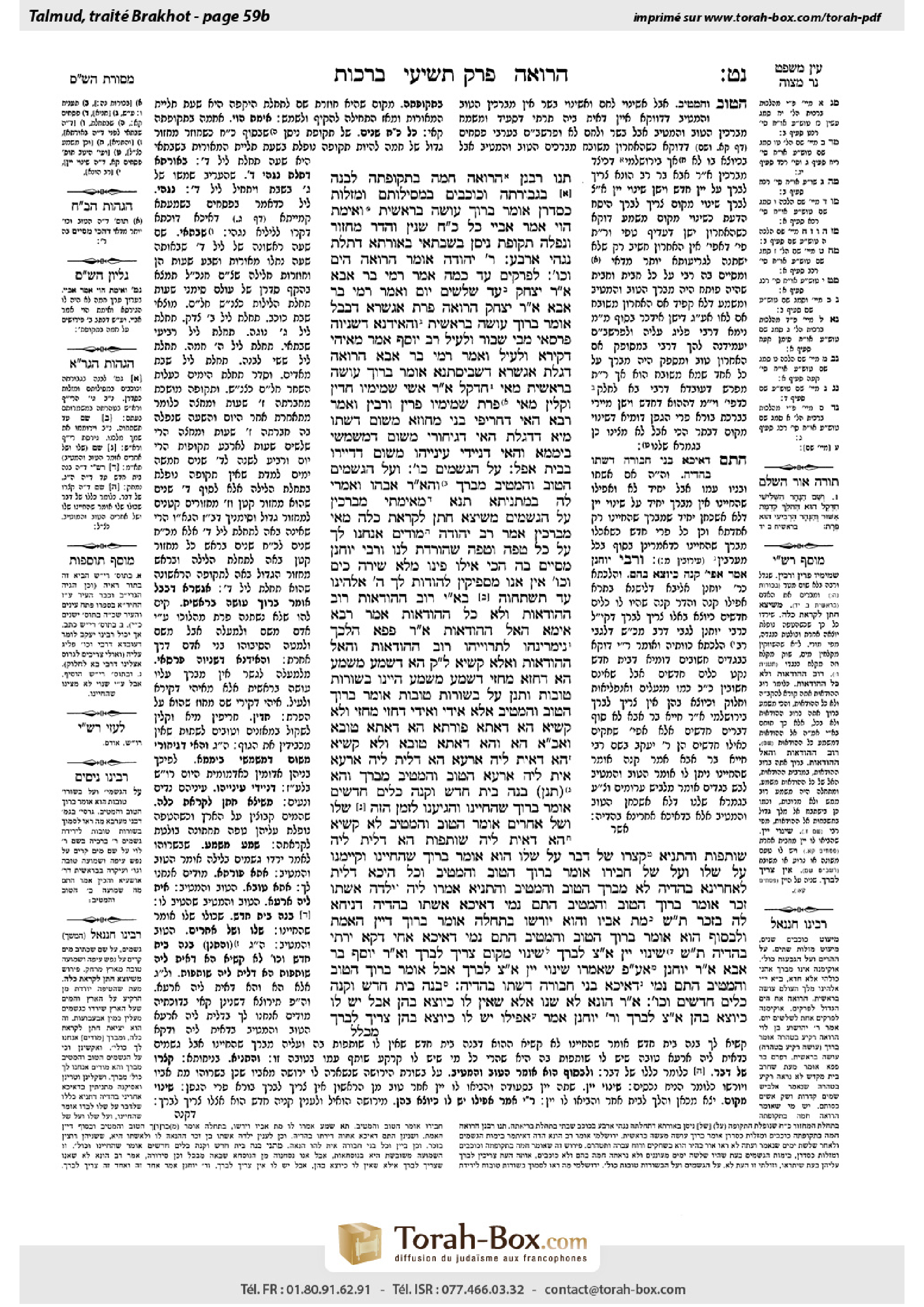
Berakhot 59b: Talmud study for Daf Yomi
Study the Talmud for Daf Yomi with scanned pages, Hebrew text, English translations from Sefaria and AI-generated French translations.
Passage selection and English or AI-generated French translation are available where the scan has annotations. Daf Study is independent of Torah-Box and Sefaria.
Browse Berakhot · ברכות · All tractatesBerakhot 59b text and translations
This page of Berakhot includes the Aramaic text, an English translation and an AI-generated French translation, alongside the scan above.
ברכות נ״ט ב · Aramaic and Hebrew text
תָּנוּ רַבָּנַן: הָרוֹאֶה חַמָּה בִּתְקוּפָתָהּ, לְבָנָה בִּגְבוּרָתָהּ, וְכוֹכָבִים בִּמְסִילּוֹתָם, וּמַזָּלוֹת כְּסִדְרָן, אוֹמֵר: ״בָּרוּךְ … עוֹשֵׂה בְרֵאשִׁית״. וְאֵימַת הָוֵי? אָמַר אַבָּיֵי: כׇּל עֶשְׂרִין וּתְמָנְיָא שְׁנִין, וְהָדַר מַחְזוֹר וְנָפְלָה תְּקוּפַת נִיסָן, בְּשַׁבְּתַאי בְּאוּרְתָּא דִּתְלָת נַגְהֵי אַרְבַּע.
רַבִּי יְהוּדָה אוֹמֵר הָרוֹאֶה הַיָּם וְכוּ׳ לִפְרָקִים. עַד כַּמָּה? אָמַר רָמֵי בַּר אַבָּא אָמַר רַב יִצְחָק: עַד שְׁלֹשִׁים יוֹם.
וְאָמַר רָמֵי בַּר אַבָּא אָמַר רַב יִצְחָק: הָרוֹאֶה פְּרָת אַגִּשְׁרָא דְבָבֶל, אוֹמֵר: ״בָּרוּךְ … עוֹשֵׂה בְרֵאשִׁית״. וְהָאִידָּנָא דְּשַׁנְיוּהּ פָּרְסָאֵי — מִבֵּי שַׁבּוּר וּלְעֵיל. רַב יוֹסֵף אָמַר: מֵאִיהִי דְקִירָא וּלְעֵיל. וְאָמַר רָמֵי בַּר אַבָּא: הָרוֹאֶה דִּגְלַת אַגִּשְׁרָא דְּשָׁבִיסְתְּנָא, אוֹמֵר: ״בָּרוּךְ … עוֹשֵׂה בְּרֵאשִׁית״.
מַאי ״חִדֶּקֶל״ — אָמַר רַב אָשֵׁי: שֶׁמֵּימָיו חַדִּין וְקַלִּין. מַאי ״פְּרָת״? — שֶׁמֵּימָיו פָּרִין וְרָבִין.
וְאָמַר רָבָא: הַאי דַּחֲרִיפֵי בְּנֵי מָחוֹזָא — מִשּׁוּם דְּשָׁתוּ מַיָּא דְּדִגְלַת. הַאי דְּגִיחוֹרֵי — מִשּׁוּם דִּמְשַׁמְּשִׁי בִּימָמָא. וְהַאי דְּנָיְידִי עֵינַיְיהוּ — מִשּׁוּם דְּדָיְירוּ בְּבַיִת אָפֵל.
עַל הַגְּשָׁמִים כּוּ׳. וְעַל הַגְּשָׁמִים ״הַטּוֹב וְהַמֵּטִיב״ מְבָרֵךְ? וְהָאָמַר רַבִּי אֲבָהוּ, וְאָמְרִי לַהּ בְּמַתְנִיתָא תָּנָא: מֵאֵימָתַי מְבָרְכִין עַל הַגְּשָׁמִים — מִשֶּׁיֵּצֵא חָתָן לִקְרַאת כַּלָּה.
מַאי מְבָרְכִין? אָמַר רַב יְהוּדָה: ״מוֹדִים אֲנַחְנוּ לָךְ עַל כׇּל טִפָּה וְטִפָּה שֶׁהוֹרַדְתָּ לָנוּ״. וְרַבִּי יוֹחָנָן מְסַיֵּים בַּהּ הָכִי: ״אִילּוּ פִינוּ מָלֵא שִׁירָה כַּיָּם וְכוּ׳ אֵין אֲנַחְנוּ מַסְפִּיקִין לְהוֹדוֹת לְךָ ה׳ אֱלֹהֵינוּ״, עַד ״תִּשְׁתַּחֲוֶה״. ״בָּרוּךְ אַתָּה ה׳ רוֹב הַהוֹדָאוֹת״.
״רוֹב הַהוֹדָאוֹת״ וְלָא כׇּל הַהוֹדָאוֹת? אָמַר רָבָא: אֵימָא — ״הָאֵל הַהוֹדָאוֹת״. אָמַר רַב פָּפָּא: הִלְכָּךְ נֵימְרִינְהוּ לְתַרְוַיְיהוּ, ״רוֹב הַהוֹדָאוֹת״ וְ״הָאֵל הַהוֹדָאוֹת״.
וְאֶלָּא קַשְׁיָא! — לָא קַשְׁיָא, הָא דִּשְׁמַע מִשְׁמָע, הָא דַּחֲזָא מִחְזֵי.
דִּשְׁמַע מִשְׁמָע הַיְינוּ בְּשׂוֹרוֹת טוֹבוֹת, וּתְנַן: עַל בְּשׂוֹרוֹת טוֹבוֹת אוֹמֵר ״בָּרוּךְ הַטּוֹב וְהַמֵּטִיב״!
אֶלָּא: אִידֵּי וְאִידֵּי דַּחֲזָא מִחְזֵי, וְלָא קַשְׁיָא: הָא דַּאֲתָא פּוּרְתָּא, הָא דַּאֲתָא טוּבָא. וְאִיבָּעֵית אֵימָא: הָא וְהָא דַּאֲתָא טוּבָא, וְלָא קַשְׁיָא — הָא דְּאִית לֵיהּ אַרְעָא, הָא דְּלֵית לֵיהּ אַרְעָא.
אִית לֵיהּ אַרְעָא ״הַטּוֹב וְהַמֵּטִיב״ מְבָרֵךְ?! וְהָא תְּנַן: בָּנָה בַּיִת חָדָשׁ, וְקָנָה כֵּלִים חֲדָשִׁים, אוֹמֵר: ״בָּרוּךְ … שֶׁהֶחֱיָינוּ וְהִגִּיעָנוּ לַזְּמַן הַזֶּה״. שֶׁלּוֹ וְשֶׁל אֲחֵרִים — אוֹמֵר: ״הַטּוֹב וְהַמֵּטִיב״?
לָא קַשְׁיָא: הָא דְּאִית לֵיהּ שׁוּתָּפוּת, הָא דְּלֵית לֵיהּ שׁוּתָּפוּת. וְהָתַנְיָא: קׇצְרוֹ שֶׁל דָּבָר, עַל שֶׁלּוֹ הוּא אוֹמֵר: ״בָּרוּךְ … שֶׁהֶחֱיָינוּ וְקִיְּימָנוּ״, עַל שֶׁלּוֹ וְעַל שֶׁל חֲבֵירוֹ — אוֹמֵר: ״בָּרוּךְ … הַטּוֹב וְהַמֵּטִיב״.
וְכׇל הֵיכָא דְּלֵית לְאַחֲרִינָא בַּהֲדֵיהּ לָא מְבָרֵךְ ״הַטּוֹב וְהַמֵּטִיב״? וְהָתַנְיָא: אָמְרוּ לֵיהּ יָלְדָה אִשְׁתּוֹ זָכָר, אוֹמֵר ״בָּרוּךְ … הַטּוֹב וְהַמֵּטִיב״! הָתָם נָמֵי, דְּאִיכָּא אִשְׁתּוֹ בַּהֲדֵיהּ דְּנִיחָא לַהּ בְּזָכָר.
תָּא שְׁמַע: מֵת אָבִיו וְהוּא יוֹרְשׁוֹ, בַּתְּחִלָּה אוֹמֵר: ״בָּרוּךְ … דַּיַּין הָאֱמֶת״, וּלְבַסּוֹף הוּא אוֹמֵר: ״בָּרוּךְ … הַטּוֹב וְהַמֵּטִיב״. הָתָם נָמֵי דְּאִיכָּא אֲחֵי דְּקָא יָרְתִי בַּהֲדֵיהּ.
תָּא שְׁמַע: שִׁינּוּי יַיִן אֵינוֹ צָרִיךְ לְבָרֵךְ, שִׁינּוּי מָקוֹם צָרִיךְ לְבָרֵךְ. וְאָמַר רַבִּי יוֹסֵף בַּר אַבָּא אָמַר רַבִּי יוֹחָנָן אַף עַל פִּי שֶׁאָמְרוּ שִׁינּוּי יַיִן אֵינוֹ צָרִיךְ לְבָרֵךְ, אֲבָל אוֹמֵר: ״בָּרוּךְ … הַטּוֹב וְהַמֵּטִיב״! הָתָם נָמֵי, דְּאִיכָּא בְּנֵי חֲבוּרָה דְּשָׁתוּ בַּהֲדֵיהּ.
בָּנָה בַּיִת חָדָשׁ וְקָנָה כֵּלִים חֲדָשִׁים וְכוּ׳. אָמַר רַב הוּנָא: לֹא שָׁנוּ אֶלָּא שֶׁאֵין לוֹ כַּיּוֹצֵא בָּהֶן, אֲבָל יֵשׁ לוֹ כַּיּוֹצֵא בָּהֶן — אֵינוֹ צָרִיךְ לְבָרֵךְ. וְרַבִּי יוֹחָנָן אָמַר: אֲפִילּוּ יֵשׁ לוֹ כַּיּוֹצֵא בָּהֶן, צָרִיךְ לְבָרֵךְ.
Berakhot 59b · English translation
The Sages taught: One who sees the sun in the beginning of its cycle, the moon in its might, the planets in their orbit, or the signs of the zodiac aligned in their order recites: Blessed…Author of creation. The Gemara asks: And when is it that the sun is at the beginning of its cycle? Abaye said: Every twenty-eight years when the cycle is complete and returns to its genesis, and the Nisan, vernal, equinox, when the spring days and nights are of equal length, falls within the constellation of Saturn on the night of the third and eve of the fourth day of the week, as then their arrangement returns to be as it was when the constellations were first placed in the heavens.
We learned in the mishna that Rabbi Yehuda said: One who sees the great sea intermittently recites: Blessed…Who has made the great sea. The Gemara asks: How much is intermittently? Rami bar Abba said that Rav Yitzḥak said: Thirty days.
And Rami bar Abba said that Rav Yitzḥak said: One who sees the Euphrates River near the bridge of Babylonia recites: Blessed…Author of creation. The Gemara adds: And now that the Persians have rerouted the course of the river, one only recites the blessing from Beit Shavor upriver. Downriver, it no longer flows as it did at creation, so there one does not recite the blessing: Author of creation. Rav Yosef said: One only recites the blessing from Ihi Dekira upriver. And Rami bar Abba said: One who sees the Tigris on the bridge of Shabistana recites: Blessed…Author of creation.
The Gemara proceeds to explain the names of these rivers. What is the source of the name Ḥidekel [Tigris]? Rav Ashi said: Its name is an acronym derived from the fact that its waters are sharp [ḥadin] and light [kalin] and therefore good for drinking. What is the source of the name Perat [Euphrates]? It is so named because its waters are fruitful [parin] and multiply [ravin]; there are many fish in it.
As for the Tigris River, Rava said: The inhabitants of the city Meḥoza are sharp because they drink the water of the Tigris; they are red because they engage in conjugal relations in the daytime; and their eyes move constantly because they live in dark houses.
We learned in our mishna that over rain one recites the blessing: Blessed…Who is good and does good. The Gemara asks: And over rain does one really recite the blessing: Who is good and does good? Didn’t Rabbi Abbahu say, and some say it was taught in a baraita: From when does one recite the blessing on rain? From when the groom went out to meet the bride. In other words, there are puddles of water on the ground. The groom, meaning the raindrops from above, cause the bride, meaning the water below, to splash.
The Gemara asks: What blessing does one recite? Rav Yehuda said: The formula of the blessing is: We thank You for each and every drop that You have made fall for us. And Rav Yoḥanan concludes the blessing as follows: If our mouths were as full of song as the sea…we could not sufficiently praise You O Lord our God, and he continues with the formula of nishmat that is recited on Shabbat morning, until: Shall bow before You. Blessed are You, O Lord, to Whom abundant thanksgivings are offered.
The Gemara asks: Does the blessing say: Abundant thanksgivings, and not: All thanksgivings? Certainly all thanksgivings are due to God. Rava said: Emend the formula of the blessing and say: The God of thanksgivings. Rav Pappa said: Therefore, we will recite them both: Abundant thanksgivings, and: The God of thanksgivings.
However, it is still difficult, as apparently the blessing for rain is not: Who is good and does good, as it appears in our mishna. The Gemara responds: This is not difficult. This, which we learned in our mishna, that one recites: Who is good and does good, refers to a case where one heard that rain fell. This, where we learned that one recites: We thank You, etc., refers to a case where one saw the rain fall.
The Gemara asks: One heard that the rain fell; that is a case of good tidings. And we learned in the mishna that upon hearing good tidings one recites: Who is good and does good. Therefore, there is no reason for the mishna to mention rain separately.
Rather, the difficulty can be otherwise resolved: This, Rabbi Abbahu’s statement, and that, the mishna, both refer to a case where one saw the rain fall, and this is not difficult. This, Rabbi Abbahu’s statement that one recites We thank You, etc., refers to a case where a little rain fell, while that, the mishna which says that one recites: Who is good and does good, refers to a case where a lot of rain fell. And if you wish, say instead that this and that refer to cases where a lot of rain fell, and this is not difficult. This, the mishna, refers to a case where one owns land, while that, Rabbi Abbahu’s statement that one recites: We thank You, etc., refers to a case where one does not own land, so the rain does not benefit him directly.
The Gemara asks: One who owns land recites: Who is good and does good? Didn’t we learn in the mishna: One who built a new house or purchased new vessels recites: Blessed…Who has given us life…and brought us to this time. However, if the land belonged to him and others in partnership, he recites: Who is good and does good? For rain falling onto land that one owns exclusively, he recites: Who has given us life and not: Who is good and does good.
The Gemara answers: This is not difficult. This, the mishna where we learned that one recites: Who is good and does good, refers to a case where one owns his land in partnership with another; that, Rabbi Abbahu’s statement that one recites: Who has given us life, refers to a case where one owns the land exclusively and does not have a partnership. And indeed, this halakha was taught in a baraita: The gist of the matter is, for that which is exclusively his, he recites: Blessed…Who has given us life and sustained us; for that which belongs to him and to another in partnership, he recites: Who is good and does good.
The Gemara challenges this principle: And in every case where others are not with him, one does not recite: Who is good and does good? Wasn’t it taught in a baraita: If they told him that his wife gave birth to a male, he recites: Who is good and does good? The Gemara responds: There too, his wife is with him, as she is also happy that a male child was born.
The Gemara challenges further: Come and hear a contradiction from what was taught in a baraita: One whose father died and he is his heir, initially recites: Blessed…the true Judge, upon hearing of his father’s death, and ultimately, upon receiving his inheritance, he recites: Blessed…Who is good and does good. Despite the fact that the son alone benefits, he nevertheless recites: Who is good and does good. The Gemara responds: There, too, it refers to a case where he has brothers who inherit along with him.
The Gemara cites an additional challenge: Come and hear a contradiction based on what was taught in a baraita: In the case of a change in the type of wine during a meal, one need not recite the blessing: Who creates fruit of the vine, a second time. However, in the case of a change in place, one must recite a second blessing over the wine. And Rabbi Yosef bar Abba said that Rabbi Yoḥanan said: Although the Sages said that in the case of a change in the type of wine one need not recite a second blessing over the wine, he does recite: Blessed…Who is good and does good. The Gemara responds: There, too, it refers to a case where he is not alone, but where members of the group are drinking with him.
We learned in the mishna: One who built a new house or purchased new vessels recites: Blessed…Who has given us life, sustained us and brought us to this time. With regard to this blessing, Rav Huna said: They only taught that one recites: Who has given us life, upon purchasing a new vessel when he does not already have something similar, i.e., something he inherited. However, if he already has something similar he need not recite a blessing, as it is not new to him. Rabbi Yoḥanan said: Even if one already has something similar that he inherited, he must recite a blessing because he never before purchased a vessel of that kind.
Berakhot 59b · Traduction française (IA)
Les Sages enseignent : Celui qui voit le soleil au début de son cycle, la lune en pleine force, les planètes dans leur orbite, ou les signes du zodiaque alignés dans leur ordre, récite : Béni… Créateur. La Guemara demande : Et quand est-ce que le soleil est au début de son cycle ? Abaye dit : Chaque vingt-huit ans, lorsque le cycle est achevé et revient à son origine, et lors de l'équinoxe de Nisan, vernal, lorsque les jours et les nuits de printemps sont de même durée, il tombe dans la constellation de Saturne, la nuit du troisième et de la veille du quatrième jour de la semaine, car alors leur disposition revient à ce qu'elle était lorsqu'on les a placés pour la première fois dans les cieux.
Nous avons appris dans la mitsna que Rabbi Yéhuda disait : Celui qui voit la grande mer de manière intermittente récite : Béni… Qui a créé la grande mer. La Guemara demande : Combien est-ce que cela est intermittent ? Rami bar Abba dit que Rav Yitzhak disait : Trente jours.
Et Rami bar Abba dit que Rav Yitzhak disait : Celui qui voit le fleuve Euphrate près du pont de Babylone récite : Béni… Créateur. La Guemara ajoute : Et maintenant que les Perses ont redirigé le cours du fleuve, on récite la prière seulement depuis Beit Shavor en amont. En aval, il ne coule plus comme à la Création, donc là on ne récite pas la prière : Créateur. Rav Yosef dit : On récite la prière seulement depuis Ihi Dekira en amont. Et Rami bar Abba dit : Celui qui voit le Tigris sur le pont de Shabistana récite : Béni… Créateur.
La Guemara poursuit pour expliquer les noms de ces fleuves. Quelle est la source du nom Ḥidekel [Tigris] ? Rav Ashi dit : Son nom provient d'un acronyme, car ses eaux sont fines [ḥadin] et légères [kalin] et donc bonnes à boire. Quelle est la source du nom Perat [Euphrates] ? Il porte ce nom car ses eaux sont fécondes [parin] et prolifiques [ravin] ; il y a beaucoup de poissons dedans.
Quant au fleuve Tigris, Rava dit : Les habitants de la ville Meḥoza sont acérés car ils boivent l'eau du Tigris ; ils sont rouges car ils ont des relations conjugales de jour ; et leurs yeux bougent constamment car ils habitent des maisons sombres.
Nous avons appris dans notre mitsna que sur la pluie, on récite la prière : Béni… Qui est bon et fait le bien. La Guemara demande : Et sur la pluie, on récite vraiment la prière : Qui est bon et fait le bien ? N’a-t-on pas dit que Rabbi Abbahu a dit, et certains disent qu’il a été enseigné dans une baraïta : À partir de quand on récite la prière sur la pluie ? À partir de quand le mari est sorti pour rencontrer la mariée. En d'autres termes, il y a des flaques d'eau sur le sol. Le mari, c'est-à-dire les gouttes de pluie du haut, causent la mariée, c'est-à-dire l'eau du bas, à se répandre.
La Guemara demande : Quelle berakha on récite ? Rav Yéhuda dit : La formule de la berakha est : Nous te remercions pour chaque goutte que Tu as fait tomber pour nous. Et Rav Yoḥanan conclut la berakha ainsi : Si nos bouches étaient aussi remplies de chants que la mer… nous ne pourrions pas suffisamment te louer, ô Seigneur notre Dieu, et il continue avec la formule de nishmat qui est récitée le matin du Shabbat, jusqu'à : Nous nous prosternerons devant Toi. Béni sois-Tu, ô Seigneur, à Qui on offre des remerciements abondants.
La Guemara demande : La berakha dit-elle : Remerciements abondants, et non : Tous les remerciements ? Certainement tous les remerciements sont dus à Dieu. Rava dit : Modifie la formule de la berakha et dis : Le Dieu des remerciements. Rav Pappa dit : Ainsi, nous réciterons les deux : Remerciements abondants, et : Le Dieu des remerciements.
Cependant, cela reste difficile, car apparemment la berakha pour la pluie n'est pas : Qui est bon et fait le bien, comme apparaît dans notre mitsna. La Guemara répond : Ce n'est pas difficile. Ce que nous avons appris dans notre mitsna, que l'on récite : Qui est bon et fait le bien, fait référence à un cas où l'on a entendu que la pluie est tombée. Ce, où nous avons appris que l'on récite : Nous te remercions, etc., fait référence à un cas où l'on a vu la pluie tomber.
La Guemara demande : On a entendu que la pluie est tombée ; c'est un cas de bonnes nouvelles. Et nous avons appris dans la mitsna que sur les bonnes nouvelles, l'on récite : Qui est bon et fait le bien. Ainsi, il n'y a pas de raison pour que la mitsna mentionne la pluie séparément.
Plutôt, la difficulté peut être résolue autrement : Ce, la déclaration de Rabbi Abbahu, et cela, la mitsna, tous deux font référence à un cas où l'on a vu la pluie tomber, et cela n'est pas difficile. Ce, la déclaration de Rabbi Abbahu que l'on récite : Nous te remercions, etc., fait référence à un cas où une petite pluie est tombée, tandis que cela, la mitsna qui dit que l'on récite : Qui est bon et fait le bien, fait référence à un cas où une grande pluie est tombée. Et si tu veux, dis plutôt que cela et cela font référence à des cas où une grande pluie est tombée, et cela n'est pas difficile. Ce, la mitsna, fait référence à un cas où l'on possède une terre, tandis que cela, la déclaration de Rabbi Abbahu que l'on récite : Nous te remercions, etc., fait référence à un cas où l'on ne possède pas de terre, donc la pluie ne lui profite pas directement.
La Guemara demande : Celui qui possède une terre récite-t-il : Qui est bon et fait le bien ? N'avons-nous pas appris dans la mitsna : Celui qui a construit une nouvelle maison ou acheté de nouveaux ustensiles récite : Béni… Qui nous a donné la vie… et nous a conduit à ce moment. Cependant, si la terre lui appartenait et à d'autres en partage, il récite : Qui est bon et fait le bien. Car la pluie tombant sur une terre qui lui appartient exclusivement, il récite : Qui nous a donné la vie et non : Qui est bon et fait le bien.
La Guemara répond : Ce n'est pas difficile. Ce, la mitsna où nous avons appris que l'on récite : Qui est bon et fait le bien, fait référence à un cas où l'on possède sa terre en partage avec un autre ; celui-ci, la déclaration de Rabbi Abbahu que l'on récite : Qui nous a donné la vie, fait référence à un cas où l'on possède la terre exclusivement et n'a pas de partage. Et en effet, cette halakha a été enseignée dans une baraïta : La substance de la question est, pour ce qui est exclusivement à lui, il récite : Béni… Qui nous a donné la vie et nous a nourris ; pour ce qui appartient à lui et à un autre en partage, il récite : Qui est bon et fait le bien.
La Guemara remet en question ce principe : Et dans chaque cas où d'autres ne sont pas avec lui, on ne récite pas : Qui est bon et fait le bien ? N’a-t-il pas été enseigné dans une baraïta : Si on lui dit que sa femme a donné naissance à un fils, il récite : Qui est bon et fait le bien ? La Guemara répond : Là aussi, sa femme est avec lui, car elle est heureuse que soit né un fils masculin.
La Guemara remet en question davantage : Viens écouter une contradiction tirée de ce qui a été enseigné dans une baraïta : Celui dont le père est mort et qui est son héritier, récite initialement : Béni…le juge véritable, après avoir appris la mort de son père, et finalement, après avoir reçu son héritage, il récite : Béni…Qui est bon et fait le bien. Malgré le fait que seul le fils en bénéficie, il récite : Qui est bon et fait le bien. La Guemara répond : Là aussi, il s’agit d’un cas où il a des frères qui héritent avec lui.
La Guemara cite une autre remise en question : Viens écouter une contradiction tirée de ce qui a été enseigné dans une baraïta : Dans le cas d’un changement de type de vin pendant un repas, on n’a pas besoin de réciter une deuxième fois la bénédiction : Qui crée les fruits de la vigne. Cependant, dans le cas d’un changement de lieu, on doit réciter une deuxième bénédiction sur le vin. Et Rabbi Yosef bar Abba a dit que Rabbi Yoḥanan a dit : Bien que les Sages aient dit que dans le cas d’un changement de type de vin on n’a pas besoin de réciter une deuxième bénédiction sur le vin, il récite : Béni…Qui est bon et fait le bien. La Guemara répond : Là aussi, il s’agit d’un cas où il n’est pas seul, mais où des membres du groupe boivent avec lui.
Nous avons appris dans la Michna : Celui qui a construit une maison nouvelle ou acheté de nouveaux ustensiles récite : Béni…Qui nous a donné la vie, nous a nourris et nous a conduit à ce moment. Concernant cette bénédiction, Rav Huna a dit : Ils n'ont enseigné que qu'on récite : Qui nous a donné la vie, lors de l'achat d'un nouveau ustensile quand on n'en possède pas déjà un semblable, c'est-à-dire quelque chose qu'on a hérité. Cependant, si on en possède déjà un semblable, on n'a pas besoin de réciter une bénédiction, car cela n'est pas nouveau pour lui. Rabbi Yoḥanan a dit : Même si on en possède déjà un semblable qu'on a hérité, il faut réciter une bénédiction, car on n'a jamais acheté auparavant un ustensile de ce genre.
Traduction française générée par IA à partir de l’édition anglaise de Sefaria. Vérifie toujours un passage avec le texte source.
Text from Sefaria: William Davidson Edition - Vocalized Aramaic (CC BY NC); William Davidson Edition - English (CC BY NC).