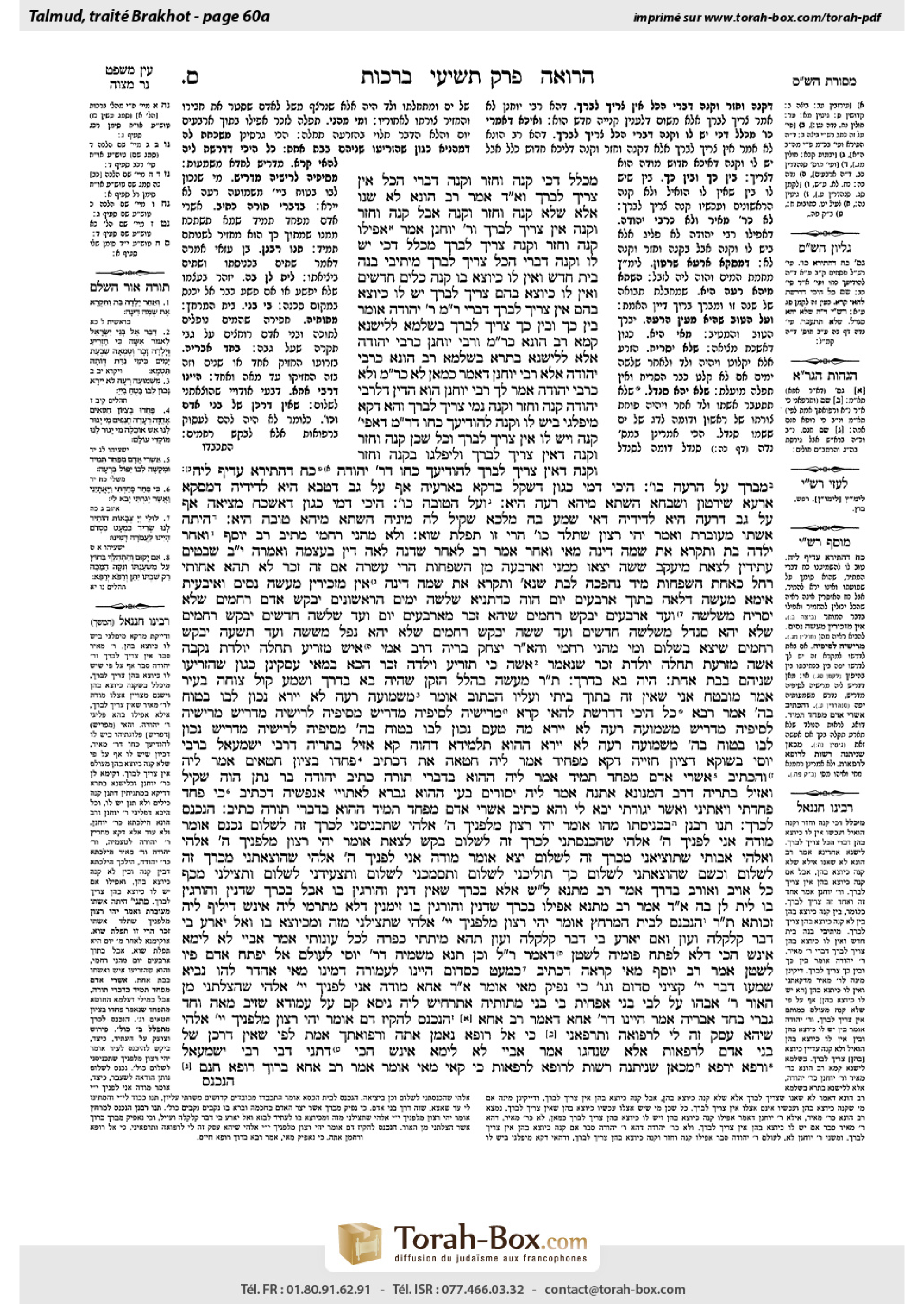
Berakhot 60a: Talmud study for Daf Yomi
Study the Talmud for Daf Yomi with scanned pages, Hebrew text, English translations from Sefaria and AI-generated French translations.
Passage selection and English or AI-generated French translation are available where the scan has annotations. Daf Study is independent of Torah-Box and Sefaria.
Browse Berakhot · ברכות · All tractatesBerakhot 60a text and translations
This page of Berakhot includes the Aramaic text, an English translation and an AI-generated French translation, alongside the scan above.
ברכות ס׳ א · Aramaic and Hebrew text
מִכְּלָל דְּכִי קָנָה וְחָזַר וְקָנָה, דִּבְרֵי הַכֹּל אֵין צָרִיךְ לְבָרֵךְ.
וְאִיכָּא דְּאָמְרִי: אָמַר רַב הוּנָא: לֹא שָׁנוּ אֶלָּא שֶׁלֹּא קָנָה וְחָזַר וְקָנָה, אֲבָל קָנָה וְחָזַר וְקָנָה — אֵין צָרִיךְ לְבָרֵךְ. וְרַבִּי יוֹחָנָן אָמַר: אֲפִילּוּ קָנָה חָזַר וְקָנָה — צָרִיךְ לְבָרֵךְ. מִכְּלָל דְּכִי יֵשׁ לוֹ וְקָנָה — דִּבְרֵי הַכֹּל צָרִיךְ לְבָרֵךְ.
מֵיתִיבִי: בָּנָה בַּיִת חָדָשׁ וְאֵין לוֹ כַּיּוֹצֵא בּוֹ, קָנָה כֵּלִים חֲדָשִׁים וְאֵין לוֹ כַּיּוֹצֵא בָּהֶם — צָרִיךְ לְבָרֵךְ. יֵשׁ לוֹ כַּיּוֹצֵא בָּהֶם — אֵין צָרִיךְ לְבָרֵךְ, דִּבְרֵי רַבִּי מֵאִיר. רַבִּי יְהוּדָה אוֹמֵר: בֵּין כָּךְ וּבֵין כָּךְ צָרִיךְ לְבָרֵךְ.
בִּשְׁלָמָא לְלִישָּׁנָא קַמָּא — רַב הוּנָא כְּרַבִּי מֵאִיר, וְרַבִּי יוֹחָנָן כְּרַבִּי יְהוּדָה. אֶלָּא לְלִישָּׁנָא בָּתְרָא, בִּשְׁלָמָא רַב הוּנָא כְּרַבִּי יְהוּדָה, אֶלָּא רַבִּי יוֹחָנָן דְּאָמַר כְּמַאן? לָא כְּרַבִּי מֵאִיר וְלָא כְּרַבִּי יְהוּדָה!
אָמַר לָךְ רַבִּי יוֹחָנָן: הוּא הַדִּין דִּלְרַבִּי יְהוּדָה קָנָה וְחָזַר וְקָנָה — נָמֵי צָרִיךְ לְבָרֵךְ. וְהָא דְּקָא מִיפַּלְגִי בְּיֵשׁ לוֹ וְקָנָה, לְהוֹדִיעֲךָ כֹּחוֹ דְּרַבִּי מֵאִיר דַּאֲפִילּוּ קָנָה וְיֵשׁ לוֹ — אֵין צָרִיךְ לְבָרֵךְ, וְכׇל שֶׁכֵּן קָנָה וְחָזַר וְקָנָה דְּאֵין צָרִיךְ לְבָרֵךְ.
וְלִיפַּלְגוּ בְּקָנָה וְחָזַר וְקָנָה דְּאֵין צָרִיךְ לְבָרֵךְ, לְהוֹדִיעֲךָ כֹּחוֹ דְּרַבִּי יְהוּדָה! כֹּחַ דְּהֶתֵּירָא עֲדִיף לֵיהּ.
מְבָרֵךְ עַל הָרָעָה כּוּ׳.
הֵיכִי דָּמֵי? כְּגוֹן דִּשְׁקַל בִּדְקָא בְּאַרְעֵיהּ, אַף עַל גַּב דְּטָבָא הִיא לְדִידֵיהּ, דְּמַסְּקָא אַרְעָא שִׂירְטוֹן וְשָׁבְחָא, הַשְׁתָּא מִיהָא רָעָה הִיא.
וְעַל הַטּוֹבָה כּוּ׳.
הֵיכִי דָּמֵי? כְּגוֹן דְּאַשְׁכַּח מְצִיאָה, אַף עַל גַּב דְּרָעָה הִיא לְדִידֵיהּ, דְּאִי שָׁמַע בַּהּ מַלְכָּא שָׁקֵיל לַהּ מִינֵּיהּ, הַשְׁתָּא מִיהָא טוֹבָה הִיא.
הָיְתָה אִשְׁתּוֹ מְעוּבֶּרֶת וְאָמַר: ״יְהִי רָצוֹן שֶׁתֵּלֵד כּוּ׳״ — הֲרֵי זוֹ תְּפִלַּת שָׁוְא.
וְלָא מַהֲנֵי רַחֲמֵי? מֵתִיב רַב יוֹסֵף: ״וְאַחַר יָלְדָה בַּת וַתִּקְרָא אֶת שְׁמָהּ דִּינָה״: מַאי ״וְאַחַר״? אָמַר רַב: לְאַחַר שֶׁדָּנָה לֵאָה דִּין בְּעַצְמָהּ וְאָמְרָה: שְׁנֵים עָשָׂר שְׁבָטִים עֲתִידִין לָצֵאת מִיַּעֲקֹב, שִׁשָּׁה יָצְאוּ מִמֶּנִּי וְאַרְבָּעָה מִן הַשְּׁפָחוֹת, הֲרֵי עֲשָׂרָה. אִם זֶה זָכָר, לֹא תְּהֵא אֲחוֹתִי רָחֵל כְּאַחַת הַשְּׁפָחוֹת, מִיָּד נֶהֶפְכָה לְבַת, שֶׁנֶּאֱמַר: ״וַתִּקְרָא אֶת שְׁמָהּ דִּינָה״. אֵין מַזְכִּירִין מַעֲשֵׂה נִסִּים.
וְאִיבָּעֵית אֵימָא: מַעֲשֶׂה דְּלֵאָה בְּתוֹךְ אַרְבָּעִים יוֹם הֲוָה. כִּדְתַנְיָא: שְׁלֹשָׁה יָמִים הָרִאשׁוֹנִים — יְבַקֵּשׁ אָדָם רַחֲמִים שֶׁלֹּא יַסְרִיחַ. מִשְּׁלֹשָׁה וְעַד אַרְבָּעִים יְבַקֵּשׁ רַחֲמִים שֶׁיְּהֵא זָכָר. מֵאַרְבָּעִים יוֹם וְעַד שְׁלֹשָׁה חֳדָשִׁים — יְבַקֵּשׁ רַחֲמִים שֶׁלֹּא יְהֵא סַנְדָּל. מִשְּׁלֹשָׁה חֳדָשִׁים וְעַד שִׁשָּׁה — יְבַקֵּשׁ רַחֲמִים שֶׁלֹּא יְהֵא נֵפֶל. מִשִּׁשָּׁה וְעַד תִּשְׁעָה — יְבַקֵּשׁ רַחֲמִים שֶׁיֵּצֵא בְּשָׁלוֹם.
וּמִי מַהֲנֵי רַחֲמֵי? וְהָאָמַר רַב יִצְחָק בְּרֵיהּ דְּרַב אַמֵּי: אִישׁ מַזְרִיעַ תְּחִלָּה — יוֹלֶדֶת נְקֵבָה, אִשָּׁה מַזְרַעַת תְּחִלָּה — יוֹלֶדֶת זָכָר. שֶׁנֶּאֱמַר: ״אִשָּׁה כִּי תַזְרִיעַ וְיָלְדָה זָכָר״! הָכָא בְּמַאי עָסְקִינַן — כְּגוֹן שֶׁהִזְרִיעוּ שְׁנֵיהֶם בְּבַת אַחַת.
הָיָה בָּא בַּדֶּרֶךְ.
תָּנוּ רַבָּנַן: מַעֲשֶׂה בְּהִלֵּל הַזָּקֵן שֶׁהָיָה בָּא בַּדֶּרֶךְ וְשָׁמַע קוֹל צְוָחָה בָּעִיר, אָמַר: מוּבְטָח אֲנִי שֶׁאֵין זֶה בְּתוֹךְ בֵּיתִי. וְעָלָיו הַכָּתוּב אוֹמֵר: ״מִשְּׁמוּעָה רָעָה לֹא יִירָא נָכוֹן לִבּוֹ בָּטֻחַ בַּה׳״. אָמַר רָבָא: כׇּל הֵיכִי דְּדָרְשַׁתְּ לְהַאי קְרָא מֵרֵישֵׁיהּ לְסֵיפֵיהּ — מִדְּרִישׁ, מִסֵּיפֵיהּ לְרֵישֵׁיהּ — מִדְּרִישׁ: מֵרֵישֵׁיהּ לְסֵיפֵיהּ מִדְּרִישׁ — ״מִשְּׁמוּעָה רָעָה לֹא יִירָא״, מַה טַּעַם? — ״נָכוֹן לִבּוֹ בָּטֻחַ בַּה׳״. מִסֵּיפֵיהּ לְרֵישֵׁיהּ מִדְּרִישׁ — ״נָכוֹן לִבּוֹ בָּטֻחַ בַּה׳, מִשְּׁמוּעָה רָעָה לֹא יִירָא״.
הַהוּא תַּלְמִידָא דַּהֲוָה קָא אָזֵיל בָּתְרֵיהּ דְּרַבִּי יִשְׁמָעֵאל בְּרַבִּי יוֹסֵי בְּשׁוּקָא דְצִיּוֹן. חַזְיֵיהּ דְּקָא מְפַחֵיד. אֲמַר לֵיהּ: חַטָּאָה אַתְּ, דִּכְתִיב: ״פָּחֲדוּ בְצִיּוֹן חֲטָאִים״. אֲמַר לֵיהּ: וְהָכְתִיב ״אַשְׁרֵי אָדָם מְפַחֵד תָּמִיד״! אֲמַר לֵיהּ: הַהוּא בְּדִבְרֵי תוֹרָה כְּתִיב.
יְהוּדָה בַּר נָתָן הֲוָה שָׁקֵיל וְאָזֵיל בָּתְרֵיהּ דְּרַב הַמְנוּנָא. אִתְּנַח. אֲמַר לֵיהּ: יִסּוּרִים בָּעֵי הַהוּא גַּבְרָא לְאֵתוּיֵי אַנַּפְשֵׁיהּ? דִּכְתִיב: ״כִּי פַחַד פָּחַדְתִּי וַיֶּאֱתָיֵנִי וַאֲשֶׁר יָגֹרְתִּי יָבֹא לִי״! וְהָא כְּתִיב: ״אַשְׁרֵי אָדָם מְפַחֵד תָּמִיד״! הָהוּא בְּדִבְרֵי תוֹרָה כְּתִיב.
הַנִּכְנָס לִכְרַךְ.
תָּנוּ רַבָּנַן: בִּכְנִיסָתוֹ מַהוּ אוֹמֵר? — ״יְהִי רָצוֹן מִלְּפָנֶיךָ ה׳ אֱלֹהַי שֶׁתַּכְנִיסֵנִי לִכְרַךְ זֶה לְשָׁלוֹם״. נִכְנַס, אוֹמֵר: ״מוֹדֶה אֲנִי לְפָנֶיךָ ה׳ אֱלֹהַי שֶׁהִכְנַסְתַּנִי לִכְרַךְ זֶה לְשָׁלוֹם״. בִּקֵּשׁ לָצֵאת, אוֹמֵר: ״יְהִי רָצוֹן מִלְּפָנֶיךָ ה׳ אֱלֹהַי וֵאלֹהֵי אֲבוֹתַי, שֶׁתּוֹצִיאֵנִי מִכְּרַךְ זֶה לְשָׁלוֹם״. יָצָא, אוֹמֵר: ״מוֹדֶה אֲנִי לְפָנֶיךָ ה׳ אֱלֹהַי שֶׁהוֹצֵאתַנִי מִכְּרַךְ זֶה לְשָׁלוֹם. וּכְשֵׁם שֶׁהוֹצֵאתַנִי לְשָׁלוֹם, כָּךְ תּוֹלִיכֵנִי לְשָׁלוֹם, וְתִסְמְכֵנִי לְשָׁלוֹם, וְתַצְעִידֵנִי לְשָׁלוֹם, וְתַצִּילֵנִי מִכַּף כׇּל אוֹיֵב וְאוֹרֵב בַּדֶּרֶךְ״.
אָמַר רַב מַתְנָא: לֹא שָׁנוּ אֶלָּא בִּכְרַךְ שֶׁאֵין דָּנִין וְהוֹרְגִין בּוֹ, אֲבָל בִּכְרַךְ שֶׁדָּנִין וְהוֹרְגִין בּוֹ — לֵית לַן בַּהּ.
אִיכָּא דְּאָמְרִי, אָמַר רַב מַתְנָא: אֲפִילּוּ בִּכְרַךְ שֶׁדָּנִין וְהוֹרְגִין בּוֹ, זִימְנִין דְּלָא מִתְרְמֵי לֵיהּ אִינָשׁ דְּיָלֵיף לֵיהּ זְכוּתָא.
תָּנוּ רַבָּנַן: הַנִּכְנָס לְבֵית הַמֶּרְחָץ, אוֹמֵר: ״יְהִי רָצוֹן מִלְּפָנֶיךָ ה׳ אֱלֹהַי שֶׁתַּצִּילֵנִי מִזֶּה וְכַיּוֹצֵא בּוֹ, וְאַל יֶאֱרַע בִּי דְּבַר קַלְקָלָה וְעָוֹן. וְאִם יֶאֱרַע בִּי דְּבַר קַלְקָלָה וְעָוֹן — תְּהֵא מִיתָתִי כַּפָּרָה לְכׇל עֲוֹנוֹתַי״.
אָמַר אַבָּיֵי: לָא לֵימָא אִינָשׁ הָכִי, דְּלָא לִפְתַּח פּוּמֵּיהּ לְשָׂטָן. דְּאָמַר רֵישׁ לָקִישׁ, וְכֵן תָּנָא מִשְּׁמֵיהּ דְּרַב יוֹסֵי: לְעוֹלָם אַל יִפְתַּח אָדָם פִּיו לַשָּׂטָן.
אָמַר רַב יוֹסֵף: מַאי קְרָאָה — דִּכְתִיב: ״כִּמְעָט כִּסְדֹם הָיִינוּ לַעֲמֹרָה דָּמִינוּ״, מַאי אַהְדַּר לְהוּ נָבִיא — ״שִׁמְעוּ דְּבַר ה׳ קְצִינֵי סְדֹם וְגוֹ׳״.
כִּי נָפֵיק מַאי אוֹמֵר? אָמַר רַב אַחָא: ״מוֹדֶה אֲנִי לְפָנֶיךָ ה׳ שֶׁהִצַּלְתַּנִי מִן הָאוּר״.
רַבִּי אֲבָהוּ עָל לְבֵי בָנֵי. אִפְּחִית בֵּי בָנֵי מִתּוּתֵיהּ, אִתְרְחִישׁ לֵיהּ נִיסָּא קָם עַל עַמּוּדָא, שֵׁזִיב מְאָה וְחַד גַּבְרֵי בְּחַד אֵבְרֵיהּ. אֲמַר: הַיְינוּ דְּרַב אַחָא.
דְּאָמַר רַב אַחָא: הַנִּכְנָס לְהַקִּיז דָּם, אוֹמֵר: ״יְהִי רָצוֹן מִלְּפָנֶיךָ ה׳ אֱלֹהַי שֶׁיְּהֵא עֵסֶק זֶה לִי לִרְפוּאָה, וּתְרַפְּאֵנִי. כִּי אֵל רוֹפֵא נֶאֱמָן אָתָּה וּרְפוּאָתְךָ אֱמֶת, לְפִי שֶׁאֵין דַּרְכָּן שֶׁל בְּנֵי אָדָם לְרַפּאוֹת אֶלָּא שֶׁנָּהֲגוּ״.
אָמַר אַבָּיֵי: לָא לֵימָא אִינָשׁ הָכִי, דְּתָנֵי דְּבֵי רַבִּי יִשְׁמָעֵאל: ״וְרַפֹּא יְרַפֵּא״ — מִכָּאן שֶׁנִּיתְּנָה רְשׁוּת לָרוֹפֵא לְרַפּאוֹת.
כִּי קָאֵי מַאי אוֹמֵר? — אָמַר רַב אַחָא: ״בָּרוּךְ … רוֹפֵא חִנָּם״.
Berakhot 60a · English translation
The Gemara deduces: This proves by inference that if he purchases a new object and then purchases a similar object, everyone agrees that he is not required to recite a blessing, as he has already recited a blessing over the purchase of that type of item.
Some say a different version of this dispute: Rav Huna said: They only taught that one recites the blessing: Who has given us life, on a new vessel if he did not purchase that item in the past and purchased the item now, for the first time. However, if he purchased that item in the past and purchased the item again, he need not recite a blessing. And Rabbi Yoḥanan said: Even if one purchased that item in the past and purchased a similar item again, he must recite a blessing. This proves by inference that if one already has a vessel and then purchased similar vessels, everyone agrees that he must recite a blessing.
The Gemara raises an objection based on what was taught in a baraita: One who built a new house and does not already own a similar house, or purchased new vessels and does not already own similar vessels, must recite a blessing. However, if he already owns a similar one, he need not recite a blessing, this is the statement of Rabbi Meir. Rabbi Yehuda, on the other hand, says: In either case, he must recite a blessing.
The Gemara asks: Granted, according to the first version of the dispute between Rav Huna and Rabbi Yoḥanan, one could say that Rav Huna holds in accordance with the opinion of Rabbi Meir, and that Rabbi Yoḥanan holds in accordance with the opinion of Rabbi Yehuda. However, according to the latter version of the dispute, granted, Rav Huna holds in accordance with the opinion of Rabbi Yehuda, but in accordance with whose opinion did Rabbi Yoḥanan state his opinion? His statement is neither in accordance with the opinion of Rabbi Meir nor in accordance with the opinion of Rabbi Yehuda.
The Gemara responds: Rabbi Yoḥanan could have said to you: The same is true according to Rabbi Yehuda’s opinion; in a case where one has purchased an item in the past and purchased a similar item again, he must recite a blessing. The fact that they only disagreed with regard to a case where he already owned similar vessels and he purchased new ones does not indicate that this is their only disagreement. The dispute was presented in this way to convey the far-reaching nature of Rabbi Meir’s opinion; even in a case where one purchased an item while owning a similar item, he need not recite a blessing; all the more so in a case where he purchased an item and then purchased a similar item again, he need not recite a blessing.
The Gemara asks: And if that is the reason for presenting the dispute in this manner, let them disagree with regard to a case where one purchased an item in the past and then purchased a similar item again, where according to Rabbi Meir one need not recite a blessing, in order to convey the far-reaching nature of Rabbi Yehuda’s opinion; as Rabbi Yehuda requires a blessing in that case. The Gemara responds: The Gemara preferred the version before us in order to demonstrate the extent to which Rabbi Meir was lenient in not requiring a blessing because the strength of leniency is preferable.
We learned in the mishna: One recites a blessing for the bad that befalls him just as he does for the good. This is to say that one recites the blessing appropriate for the present situation even if it is bad, despite the fact that it may develop into a positive situation in the future.
The Gemara asks: What are the circumstances? The Gemara explains: In a case where a dam was breached and water flowed onto one’s land, despite the fact that this will ultimately be beneficial for him, for his land will be covered with sediment from the flowing water which will enhance the quality of his soil, it is nonetheless bad at present.
One must recite a blessing for the good that befalls him just as for the bad.
The Gemara asks: What are the circumstances? The Gemara explains: In a case where one found a lost object, despite the fact that it is ultimately bad for him because if the king heard about it, he would certainly take it from him. At that time, the law deemed all found objects the property of the king’s treasury and one who did not report such an object would be punished. Nevertheless, it is favorable at present.
We learned in the mishna: One whose wife was pregnant and he said: May it be God’s will that my wife will give birth to a male child, it is a vain prayer.
Is a prayer in that case ineffective? Rav Yosef raises an objection based on a baraita: It is stated: “And afterwards she bore a daughter, and called her name Dina” (Genesis 30:21). The Gemara asks: What is meant by the addition of the word: Afterwards? What does the verse seek to convey by emphasizing that after the birth of Zebulun she gave birth to Dina? Rav said: After Leah passed judgment on herself and said: Twelve tribes are destined to descend from Jacob, six came from me and four from the maidservants, that is ten, and if this fetus is male, my sister Rachel will not even be the equivalent of one the maidservants; immediately the fetus was transformed into a daughter, as it is stated: And she called her name Dina; meaning she named her after her judgment [din]. The Gemara rejects this: One does not mention miraculous acts to teach general halakha.
The Gemara introduces an alternative explanation: And if you wish, say instead that the story of Leah and her prayer with regard to the fetus was within forty days of conception. As it was taught in a baraita: During the first three days after intercourse, one should pray that the seed not putrefy, that it will fertilize the egg and develop into a fetus. From the third day until the fortieth, one should pray that it will be male. From the fortieth day until three months, one should pray that it will not be deformed, in the shape of a flat fish, as when the fetus does not develop it assumes a shape somewhat similar to a flat sandal fish. From the third month until the sixth, one should pray that it will not be stillborn. And from the sixth month until the ninth, one should pray that it will be emerge safely. Therefore, during the first forty days from conception, one may still pray to affect the gender of the fetus.
The Gemara asks: Is prayer effective for that purpose? Didn’t Rav Yitzḥak, son of Rav Ami, say: The tradition teaches that the gender of the fetus is determined at the moment of conception. If the man emits seed first, his wife gives birth to a female; if the woman emits seed first, she gives birth to a male, as it is stated: “When a woman emitted seed and bore a male” (Leviticus 12:2). The Gemara answers: With what are we dealing here? We are dealing with a case where they both emit seed simultaneously. In that case, the gender is undetermined and prayer may be effectual.
We learned in the mishna: One who was walking along the way and heard a scream from the city, and says: May it be God’s will that this scream will not be from my house, it is a vain prayer.
The Sages taught: There was an incident involving Hillel the Elder, who was coming on the road when he heard a scream in the city. He said: I am certain that the scream is not coming from my house. And of him, the verse says: “He shall not be afraid of evil tidings; his heart is steadfast, trusting in the Lord” (Psalms 112:7). Rava said: Any way that you interpret this verse, its meaning is clear. It can be interpreted from beginning to end or it can be interpreted from end to beginning. The Gemara explains: It can be interpreted from beginning to end: Why is it that: He shall not be afraid of evil tidings? Because his heart is steadfast, trusting in the Lord. The Gemara continues: And it can be interpreted from end to beginning: One whose heart is steadfast, trusting in the Lord is a person who shall not be afraid of evil tidings.
The Gemara relates: This student was once walking after Rabbi Yishmael, son of Rabbi Yosei, in the marketplace of Zion. Rabbi Yishmael saw that the student was afraid. He said to him: You are a sinner, as it is written: “The transgressors in Zion are afraid, trembling has seized the ungodly” (Isaiah 33:14). The student replied: And is it not written: “Happy is the man that fears always” (Proverbs 28:14)? Rabbi Yishmael said to him: That verse is written with regard to matters of Torah, that one should be afraid lest he forget them. For everything else, one must trust in God.
In a similar vein, the Gemara relates: Yehuda bar Natan was coming and going after Rav Hamnuna. Yehuda bar Natan sighed; Rav Hamnuna said to him: Do you wish to bring suffering upon yourself; as it is stated: “For that which I did fear is come upon me, and that which I was afraid of has overtaken me” (Job 3:25)? He responded: Is it not said: “Happy is the man who fears always”? Rav Hamnuna answered: That verse is written with regard to matters of Torah.
We learned in the mishna: One who enters a large city recites two prayers; Ben Azzai says he recites four prayers.
The Sages taught the details of Ben Azzai’s teaching in a baraita:
Upon his entrance to the city what does he recite?
May it be Your will, O Lord my God, that You bring me into this city to peace.
After he entered the city, he recites: I thank You, O Lord my God, that You brought me into this city to peace.
When he seeks to leave the city, he recites: May it be Your will, O Lord my God and God of my ancestors, that You take me out of this city to peace.
After he left, he recites: I give thanks before You, O Lord my God, that You took me out of this city to peace;
and just as You took me out to peace,
so too lead me to peace, support me to peace, direct my steps to peace,
and rescue me from the hand of any enemy or those lying in ambush along the way.
Rav Mattana said: This was taught only with regard to a city where criminals are not tried and executed, as in a place like that he may be killed without trial. However, in a city where criminals are tried and executed, these prayers do not apply, as if one is not guilty he will not be harmed.
Some say that Rav Mattana said the opposite: Even in a city where criminals are tried and executed one must pray for mercy, as sometimes he may not encounter a person who will plead in his favor.
The Sages taught: One who enters a Roman bathhouse, where a fire burns beneath the pool of water used for bathing, and where there is the risk of collapse, says:
May it be Your will, O Lord my God, that you save me from this and similar matters,
and do not let ruin or iniquity befall me,
and if ruin or iniquity does befall me, let my death be atonement for all of my transgressions.
Abaye said: One should not say: If ruin befalls me, so as not to open his mouth to Satan and provoke him. As Rabbi Shimon ben Lakish said and as it was taught in a baraita in the name of Rabbi Yosei: One should never open his mouth to Satan by raising, at his own initiative, the possibility of mishap or death.
Rav Yosef said: What is the verse that alludes to this? As it is written: “We should have almost been as Sodom, we should have been like unto Gomorrah” (Isaiah 1:9), after which what did the prophet reply to them? “Hear the word of the Lord, rulers of Sodom; give ear unto the law of our God, people of Gomorrah” (Isaiah 1:10). After the analogy to Sodom was raised, it was realized.
Returning to the subject of the Roman bathhouse, the Gemara asks: When he emerges from the bathhouse, what does he say? Rav Aḥa said: I give thanks to You, Lord, that You saved me from the fire.
The Gemara relates: Rabbi Abbahu entered a bathhouse when the bathhouse floor collapsed beneath him and a miracle transpired on his behalf. He stood on a pillar and saved one hundred and one men with one arm. He held one or two people in his arm, with others holding on them and so on, so that all were saved. He said: This is confirmation of the statement of Rav Aḥa, who said that one should offer thanks upon leaving the bathhouse safely.
As Rav Aḥa said: One who enters to let blood says:
May it be Your will, O Lord my God,
that this enterprise be for healing and that You should heal me.
As You are a faithful God of healing and Your healing is truth.
Because it is not the way of people to heal, but they have become accustomed.
Rav Aḥa is saying that people should not practice medicine as they lack the ability to heal; rather, healing should be left to God.
Abaye responded and said: One should not say this, as it was taught in the school of Rabbi Yishmael that from the verse, “And shall cause him to be thoroughly healed” (Exodus 21:19), from here we derive that permission is granted to a doctor to heal. The practice of medicine is in accordance with the will of God.
As for bloodletting, the Gemara asks: When one stands after having let blood, what does he say? Rav Aḥa said: He recites in gratitude: Blessed…Who heals without payment.
Berakhot 60a · Traduction française (IA)
La Guemara déduit : Cela prouve par déduction que si l'on achète un objet nouveau et ensuite un objet similaire, tout le monde convient qu'il n'est pas tenu de réciter une berakha, car il a déjà récité une berakha sur l'achat d'un tel objet.
Certains donnent une version différente de ce débat : Rav Huna a dit : Ils n'ont enseigné que l'obligation de réciter la berakha : Qui nous a donné la vie, sur un nouveau récipient, si l'on n'avait pas acheté cet objet auparavant et qu'on l'achète maintenant, pour la première fois. Cependant, si l'on avait déjà acheté cet objet auparavant et qu'on l'achète à nouveau, il n'est pas tenu de réciter une berakha. Et Rabbi Yoḥanan a dit : Même si l'on avait déjà acheté cet objet auparavant et qu'on achète un objet similaire à nouveau, il doit réciter une berakha. Cela prouve par déduction que si l'on possède déjà un récipient et qu'on achète des récipients similaires, tout le monde convient qu'il doit réciter une berakha.
La Guemara soulève une objection basée sur ce qui a été enseigné dans une baraïta : Celui qui construit une nouvelle maison et ne possède pas déjà une maison similaire, ou qui achète de nouveaux récipients et ne possède pas déjà des récipients similaires, doit réciter une berakha. Cependant, s'il possède déjà un similaire, il n'est pas tenu de réciter une berakha, selon la déclaration de Rabbi Meir. Rabbi Yehuda, en revanche, dit : Dans tous les cas, il doit réciter une berakha.
La Guemara demande : Cela étant, selon la première version du débat entre Rav Huna et Rabbi Yoḥanan, on pourrait dire que Rav Huna suit l'opinion de Rabbi Meir, et que Rabbi Yoḥanan suit l'opinion de Rabbi Yehuda. Cependant, selon la seconde version du débat, on pourrait dire que Rav Huna suit l'opinion de Rabbi Yehuda, mais selon l'opinion de qui Rabbi Yoḥanan a-t-il exprimé son opinion ? Sa déclaration ne suit ni l'opinion de Rabbi Meir ni celle de Rabbi Yehuda.
La Guemara répond : Rabbi Yoḥanan aurait pu dire à vous : Cela est vrai également selon l'opinion de Rabbi Yehuda ; dans le cas où l'on a acheté un objet auparavant et qu'on achète un objet similaire à nouveau, il doit réciter une berakha. Le fait qu'ils aient seulement divergé concernant un cas où l'on possédait déjà un récipient similaire et qu'on achète un nouveau ne montre pas que cela soit leur seul point de divergence. Le débat a été présenté ainsi pour montrer l'étendue de l'opinion de Rabbi Meir ; même dans le cas où l'on achète un objet tout en possédant un similaire, il n'est pas tenu de réciter une berakha ; encore plus dans le cas où l'on achète un objet et qu'on achète un objet similaire à nouveau, il n'est pas tenu de réciter une berakha.
La Guemara demande : Et si c'est la raison pour laquelle le débat a été présenté ainsi, laissons-les diverger concernant un cas où l'on a acheté un objet auparavant et qu'on achète un objet similaire à nouveau, où selon Rabbi Meir on n'a pas besoin de réciter une berakha, afin de montrer l'étendue de l'opinion de Rabbi Yehuda ; car Rabbi Yehuda exige une berakha dans ce cas. La Guemara répond : La Guemara a préféré la version précédente afin de démontrer l'étendue de la leniencé de Rabbi Meir en ne demandant pas une berakha, car la leniencé est préférable.
Nous avons appris dans la Michna : On récite une berakha pour le mal qui arrive à l'homme, tout comme on le fait pour le bien. Cela signifie qu'on récite la berakha appropriée à la situation présente, même si celle-ci est mauvaise, malgré le fait qu'elle puisse évoluer vers une situation positive à l'avenir.
La Guemara demande : Quelles sont les circonstances ? La Guemara explique : Dans le cas où un barrage a été percé et que l'eau s'est répandue sur la propriété de l'homme, malgré le fait que cela sera finalement bénéfique pour lui, car sa terre sera recouverte de sédiments provenant de l'eau qui améliorera la qualité de son sol, il est néanmoins mauvais à l'heure actuelle.
On doit réciter une berakha pour le bien qui arrive à l'homme, tout comme pour le mal.
La Guemara demande : Quelles sont les circonstances ? La Guemara explique : Dans le cas où l'on a trouvé un objet perdu, malgré le fait qu'il soit finalement mauvais pour lui, car si le roi apprenait cela, il le prendrait certainement de lui. À cette époque, la loi considérait tous les objets trouvés comme appartenant au trésor du roi et celui qui ne signalait pas un tel objet serait puni. Cependant, cela est favorable à l'heure actuelle.
Nous avons appris dans la Michna : Celui dont la femme était enceinte et qui disait : Que Dieu ait la volonté que sa femme accouche d'un fils, c'est une prière vaine.
Une prière dans ce cas est-elle inefficace ? Rav Yosef soulève une objection basée sur une baraïta : Il est dit : « Et ensuite elle enfanta une fille, et elle appela son nom Dina » (Genèse 30:21). La Guemara demande : Quel est le sens de l'ajout du mot « ensuite » ? Quel est le but de souligner que, après la naissance de Zebulun, elle a donné naissance à Dina ? Rav a dit : Après que Leah ait rendu un jugement sur elle-même et ait dit : Douze tribus sont destinées à descendre de Jacob, six sont venues de moi et quatre des servantes, ce qui fait dix, et si ce fœtus est masculin, ma sœur Rachel ne sera même pas équivalente à une des servantes ; aussitôt le fœtus est devenu une fille, comme il est dit : « Et elle appela son nom Dina » ; cela signifie qu'elle a nommé sa fille après son jugement [din]. La Guemara rejette cela : On ne mentionne pas les miracles pour enseigner une halakha générale.
La Guemara présente une autre explication : Et si tu le souhaites, dis plutôt que l'histoire de Rachel et sa prière concernant le fœtus s'est déroulée dans les quarante jours de la conception. Comme il a été enseigné dans une baraïta : Durant les trois premiers jours après l'acte sexuel, on devrait prier afin que le sperme ne putréfie, qu'il féconde l'ovule et développe un fœtus. Du troisième jour jusqu'au quarantième, on devrait prier afin qu'il soit masculin. Du quarantième jour jusqu'aux trois mois, on devrait prier afin qu'il ne soit pas déformé, dans la forme d'un poisson plat, car lorsque le fœtus ne se développe pas, il prend une forme quelque peu semblable à un poisson plat. Des trois mois jusqu'aux six mois, on devrait prier afin qu'il ne soit pas né décédé. Et des six mois jusqu'aux neuf mois, on devrait prier afin qu'il sorte en sécurité. Ainsi, durant les quarante premiers jours de la conception, on peut encore prier afin d'agir sur le sexe du fœtus.
La Guemara pose la question : La prière est-elle efficace à cet effet ? N'a-t-on pas dit que Rav Yitzḥak, fils de Rav Ami, a affirmé : La tradition enseigne que le sexe du fœtus est déterminé au moment de la conception. Si l'homme émet le sperme en premier, sa femme donnera naissance à une fille ; si la femme émet le sperme en premier, elle donnera naissance à un garçon, comme il est dit : « Quand une femme émet du sperme et donne naissance à un garçon » (Lévitique 12:2). La Guemara répond : Avec quels cas sommes-nous en train de parler ? Nous parlons d'un cas où ils émettent tous les deux le sperme simultanément. Dans ce cas, le sexe est indéterminé et la prière peut être efficace.
Nous avons appris dans la mitsna : Celui qui marchait sur la route et entendait un cri provenant de la ville, et disait : Que ce soit la volonté de Dieu que ce cri ne provienne pas de ma maison, c'est une prière vaine.
Les Sages ont enseigné : Il y avait un incident concernant Hillel le Vieil, qui marchait sur la route lorsqu'il entendit un cri dans la ville. Il dit : Je suis certain que ce cri ne provient pas de ma maison. Et à son sujet, la Parashia dit : « Il ne doit pas avoir peur des mauvaises nouvelles ; son cœur est ferme, il confie en l'Éternel » (Psaumes 112:7). Rava a dit : Quelle que soit la manière dont tu interprètes cette Parashia, son sens est clair. On peut l'interpréter du début à la fin ou du fin au début. La Guemara explique : On peut l'interpréter du début à la fin : Pourquoi est-ce que : Il ne doit pas avoir peur des mauvaises nouvelles ? Parce que son cœur est ferme, il confie en l'Éternel. La Guemara continue : Et on peut l'interpréter du fin au début : Celui dont le cœur est ferme, il confie en l'Éternel est une personne qui ne doit pas avoir peur des mauvaises nouvelles.
La Guemara rapporte : Ce disciple marchait un jour après Rabbi Yishmael, fils de Rabbi Yosei, dans le marché de Sion. Rabbi Yishmael vit que le disciple avait peur. Il lui dit : Tu es un pécheur, comme il est écrit : « Les transgresseurs de Sion ont peur, l'effroi a saisi les impies » (Yézékia 33:14). Le disciple répondit : Et n'est-il pas écrit : « Heureux l'homme qui craint toujours » (Proverbes 28:14) ? Rabbi Yishmael lui dit : Cette Parashia est écrite concernant les affaires de Torah, afin qu'on craigne de l'oublier. Pour tout autre chose, on doit avoir confiance en Dieu.
De manière similaire, la Guemara rapporte : Yehuda bar Natan marchait après Rav Hamnuna. Yehuda bar Natan soupira ; Rav Hamnuna lui dit : Veux-tu t'exposer à la souffrance ; comme il est dit : « Pour ce que j'ai craint est arrivé, et ce que j'ai redouté m'a surgi » (Job 3:25) ? Il répondit : N'est-il pas dit : « Heureux l'homme qui craint toujours » ? Rav Hamnuna répondit : Cette Parashia est écrite concernant les affaires de Torah.
Nous avons appris dans la Michna : Celui qui entre dans une grande ville récite deux prières ; Ben Azzai dit qu'il récite quatre prières.
Les Sages ont enseigné les détails de la doctrine de Ben Azzai dans une baraïta : En entrant dans la ville, qu'est-ce qu'il récite ? Que ce soit ta volonté, ô Éternel mon Dieu, que tu me conduises dans cette ville à la paix. Après avoir entré dans la ville, il récite : Je te remercie, ô Éternel mon Dieu, que tu m'as conduit dans cette ville à la paix. Quand il veut sortir de la ville, il récite : Que ce soit ta volonté, ô Éternel mon Dieu et Dieu de mes ancêtres, que tu me conduises hors de cette ville à la paix. Après avoir quitté la ville, il récite : Je te remercie devant toi, ô Éternel mon Dieu, que tu m'as conduit hors de cette ville à la paix ; ainsi que tu m'as conduit hors de cette ville à la paix, tel que tu me conduises à la paix, me soutiennes à la paix, diriges mes pas à la paix, et me sauves de la main de tout ennemi ou de ceux qui guettent sur la route.
Rav Mattana a dit : Cela a été enseigné uniquement concernant une ville où les criminels ne sont pas jugés et exécutés, comme dans un lieu semblable, il peut être tué sans jugement. Cependant, dans une ville où les criminels sont jugés et exécutés, ces prières ne s'appliquent pas, car si l'on n'est pas coupable, on ne sera pas blessé.
Certains disent que Rav Mattana a dit l'opposé : Même dans une ville où des criminels sont jugés et exécutés, on doit prier pour la miséricorde, car parfois on ne trouvera pas une personne qui puisse prier en son nom.
Les Sages ont enseigné : Celui qui entre dans un bain romain, où un feu brûle sous la piscine utilisée pour le bain, et où il y a un risque de chute, dit : Que ce soit ta volonté, ô Éternel mon Dieu, que tu me sauves de cela et de tout ce qui est semblable, et que tu ne permettes pas la ruine ou l'iniquité de m'atteindre, et si la ruine ou l'iniquité m'atteint, que ma mort serve d'atonement pour toutes mes transgressions.
Abaye a dit : On ne devrait pas dire : Si la ruine m'atteint, afin de ne pas ouvrir la bouche au démon et le provoquer. Comme Rabbi Shimon ben Lakish a dit et comme il a été enseigné dans une baraïta au nom de Rabbi Yosei : On ne devrait jamais ouvrir la bouche au démon en évoquant, à sa propre initiative, la possibilité d'un malheur ou de la mort.
Rav Yosef a dit : Quel est le verset qui fait allusion à cela ? Il est écrit : « Nous aurions été presque comme Sodome, nous aurions été comme Gomorrah » (Yachout 1:9), après quoi le prophète a-t-il répondu à leur sujet ? « Écoutez la parole du Seigneur, chefs de Sodome ; écoutez la loi de notre Dieu, peuple de Gomorrah » (Yachout 1:10). Après que l'analogue à Sodome ait été évoqué, cela a été réalisé.
En revenant à la question du bain romain, la Guemara demande : Lorsqu'il sort du bain, que dit-il ? Rav Acha a dit : Je remercie Toi, Seigneur, de m'avoir sauvé du feu.
La Guemara rapporte : Rabbi Abbahu est entré dans un bain, et le plancher du bain s'est effondré sous lui, et un miracle s'est produit à son sujet. Il s'est tenu sur une colonne et a sauvé cent un hommes d'un seul bras. Il tenait un ou deux personnes dans son bras, avec d'autres qui s'accrochaient à eux et ainsi de suite, de sorte que tous furent sauvés. Il a dit : Cela est la confirmation de la déclaration de Rav Acha, qui disait que l'on devrait remercier lorsqu'on sort du bain en sécurité.
Comme Rav Acha a dit : Celui qui entre pour saigner dit : Que ce soit selon ta volonté, ô Seigneur mon Dieu, que cette entreprise soit pour la guérison et que tu guérisses moi. Car tu es un Dieu fidèle de guérison et ta guérison est la vérité. Car ce n'est pas la manière des gens de guérir, mais ils sont devenus habitués. Rav Acha dit que les gens ne devraient pas pratiquer la médecine, car ils n'ont pas la capacité de guérir ; plutôt, la guérison devrait être laissée à Dieu.
Abaye a répondu et a dit : On ne devrait pas dire cela, car il a été enseigné dans l'école de Rabbi Yishmael que d'après le verset, « Et il le guérira complètement » (Lévitique 21:19), d'où l'on déduit que l'on autorise un médecin à guérir. La pratique de la médecine est conforme à la volonté de Dieu.
Quant à la saignée, la Guemara demande : Lorsqu'on est debout après avoir saigné, que dit-on ? Rav Acha a dit : On récite en gratitude : Béni… Qui guérit sans rétribution.
Traduction française générée par IA à partir de l’édition anglaise de Sefaria. Vérifie toujours un passage avec le texte source.
Text from Sefaria: William Davidson Edition - Vocalized Aramaic (CC BY NC); William Davidson Edition - English (CC BY NC).