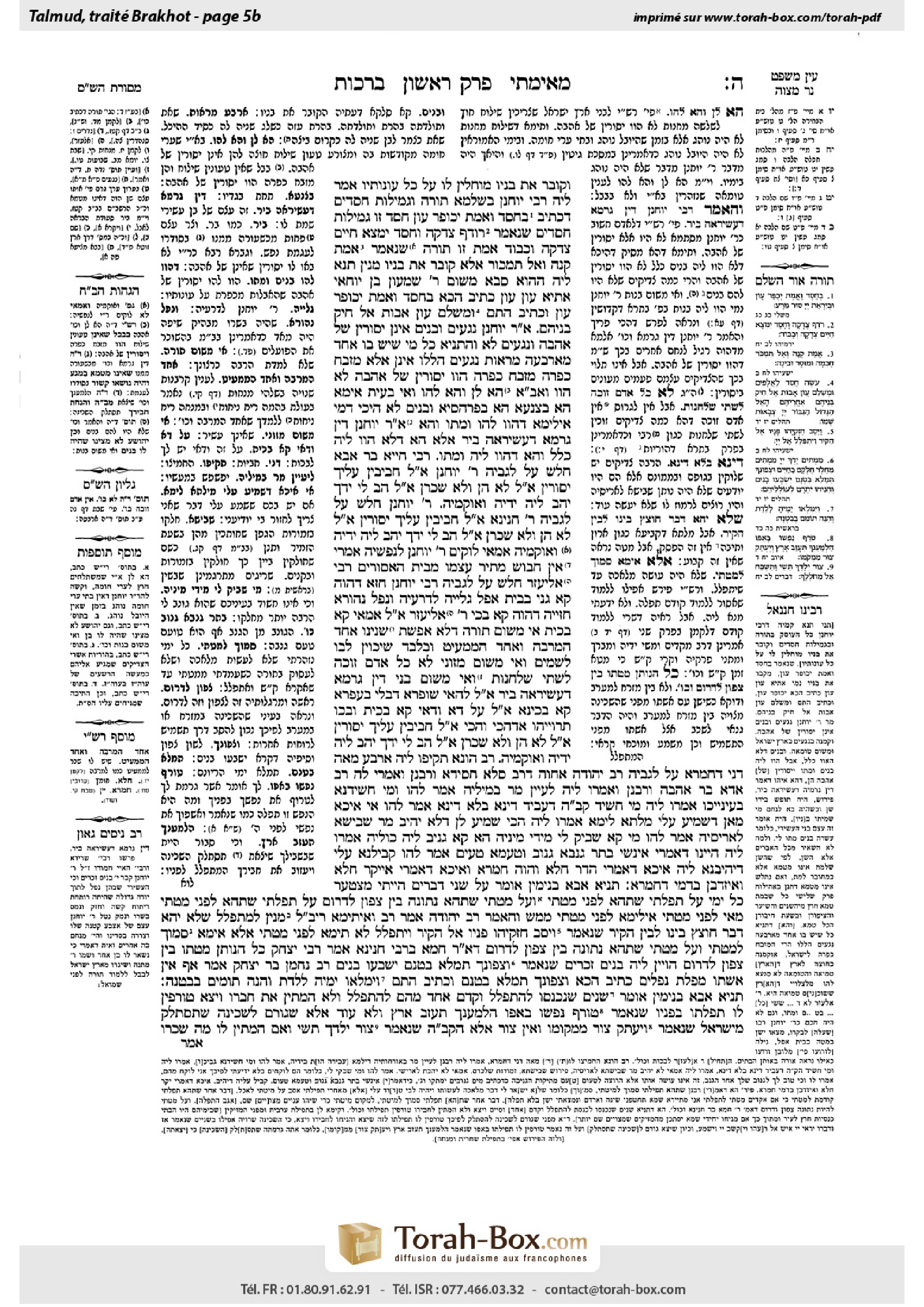
Berakhot 5b: Talmud study for Daf Yomi
Study the Talmud for Daf Yomi with scanned pages, Hebrew text, English translations from Sefaria and AI-generated French translations.
Passage selection and English or AI-generated French translation are available where the scan has annotations. Daf Study is independent of Torah-Box and Sefaria.
Browse Berakhot · ברכות · All tractatesBerakhot 5b text and translations
This page of Berakhot includes the Aramaic text, an English translation and an AI-generated French translation, alongside the scan above.
ברכות ה׳ ב · Aramaic and Hebrew text
וְקוֹבֵר אֶת בָּנָיו — מוֹחֲלִין לוֹ עַל כׇּל עֲוֹנוֹתָיו.
אֲמַר לֵיהּ רַבִּי יוֹחָנָן: בִּשְׁלָמָא תּוֹרָה וּגְמִילוּת חֲסָדִים, דִּכְתִיב: ״בְּחֶסֶד וֶאֱמֶת יְכֻפַּר עָוֹן״. ״חֶסֶד״ — זוֹ גְּמִילוּת חֲסָדִים, שֶׁנֶּאֱמַר: ״רוֹדֵף צְדָקָה וָחָסֶד יִמְצָא חַיִּים צְדָקָה וְכָבוֹד״. ״אֱמֶת״ — זוֹ תּוֹרָה, שֶׁנֶּאֱמַר: ״אֱמֶת קְנֵה וְאַל תִּמְכֹּר״. אֶלָּא ״קוֹבֵר אֶת בָּנָיו״ מִנַּיִן?
תְּנָא לֵיהּ הַהוּא סָבָא, מִשּׁוּם רַבִּי שִׁמְעוֹן בֶּן יוֹחַאי: אָתְיָא, ״עָוֹן״ ״עָוֹן״. כְּתִיב הָכָא ״בְּחֶסֶד וֶאֱמֶת יְכֻפַּר עָוֹן״, וּכְתִיב הָתָם ״וּמְשַׁלֵּם עֲוֹן אָבוֹת אֶל חֵיק בְּנֵיהֶם״.
אָמַר רַבִּי יוֹחָנָן: נְגָעִים וּבָנִים — אֵינָן יִסּוּרִין שֶׁל אַהֲבָה.
וּנְגָעִים לָא? וְהָתַנְיָא: כׇּל מִי שֶׁיֵּשׁ בּוֹ אֶחָד מֵאַרְבָּעָה מַרְאוֹת נְגָעִים הַלָּלוּ — אֵינָן אֶלָּא מִזְבַּח כַּפָּרָה!
מִזְבַּח כַּפָּרָה — הָווּ, יִסּוּרִין שֶׁל אַהֲבָה — לָא הָווּ.
וְאִי בָּעֵית אֵימָא: הָא — לָן. וְהָא — לְהוּ.
וְאִי בָּעֵית אֵימָא: הָא — בְּצִנְעָא, הָא — בְּפַרְהֶסְיָא.
וּבָנִים לָא?! הֵיכִי דָמֵי, אִילֵּימָא דַּהֲווֹ לְהוּ וּמֵתוּ, וְהָא אָמַר רַבִּי יוֹחָנָן, דֵּין גַּרְמָא דַּעֲשִׂירָאָה בִּיר? אֶלָּא הָא — דְּלָא הֲווֹ לֵיהּ כְּלָל. וְהָא — דַּהֲווֹ לֵיהּ וּמֵתוּ.
רַבִּי חִיָּיא בַּר אַבָּא חֲלַשׁ. עָל לְגַבֵּיהּ רַבִּי יוֹחָנָן אֲמַר לֵיהּ: חֲבִיבִין עָלֶיךָ יִסּוּרִין? אֲמַר לֵיהּ: לֹא הֵן וְלֹא שְׂכָרָן. אֲמַר לֵיהּ: הַב לִי יְדָךְ. יְהַב לֵיהּ יְדֵיהּ, וְאוֹקְמֵיהּ.
רַבִּי יוֹחָנָן חֲלַשׁ. עָל לְגַבֵּיהּ רַבִּי חֲנִינָא. אֲמַר לֵיהּ: חֲבִיבִין עָלֶיךָ יִסּוּרִין? אֲמַר לֵיהּ: לֹא הֵן וְלֹא שְׂכָרָן. אֲמַר לֵיהּ: הַב לִי יְדָךְ. יְהַב לֵיהּ יְדֵיהּ, וְאוֹקְמֵיהּ.
אַמַּאי, לוֹקִים רַבִּי יוֹחָנָן לְנַפְשֵׁיהּ?
אָמְרִי: אֵין חָבוּשׁ מַתִּיר עַצְמוֹ מִבֵּית הָאֲסוּרִים.
רַבִּי אֶלְעָזָר חֲלַשׁ. עַל לְגַבֵּיהּ רַבִּי יוֹחָנָן. חֲזָא דַּהֲוָה קָא גָּנֵי בְּבֵית אָפֵל. גַּלְיֵיהּ לִדְרָעֵיהּ וּנְפַל נְהוֹרָא. חַזְיֵיהּ דַּהֲוָה קָא בָּכֵי רַבִּי אֶלְעָזָר. אֲמַר לֵיהּ: אַמַּאי קָא בָּכֵית? אִי מִשּׁוּם תּוֹרָה דְּלָא אַפֵּשְׁתְּ — שָׁנִינוּ: אֶחָד הַמַּרְבֶּה וְאֶחָד הַמַּמְעִיט, וּבִלְבַד שֶׁיְּכַוֵּין לִבּוֹ לַשָּׁמַיִם. וְאִי מִשּׁוּם מְזוֹנֵי — לֹא כׇּל אָדָם זוֹכֶה לִשְׁתֵּי שֻׁלְחָנוֹת. וְאִי מִשּׁוּם בְּנֵי — דֵּין גַּרְמָא דַּעֲשִׂירָאָה בִּיר.
אֲמַר לֵיהּ: לְהַאי שׁוּפְרָא דְּבָלֵי בְּעַפְרָא קָא בָּכֵינָא. אֲמַר לֵיהּ: עַל דָּא וַדַּאי קָא בָּכֵית, וּבְכוֹ תַּרְוַיְיהוּ.
אַדְּהָכִי וְהָכִי אֲמַר לֵיהּ: חֲבִיבִין עָלֶיךָ יִסּוּרִין? אֲמַר לֵיהּ: לֹא הֵן וְלֹא שְׂכָרָן. אֲמַר לֵיהּ: הַב לִי יְדָךְ, יְהַב לֵיהּ יְדֵיהּ, וְאוֹקְמֵיהּ.
רַב הוּנָא תְּקִיפוּ לֵיהּ אַרְבַּע מְאָה דַּנֵּי דְחַמְרָא. עָל לְגַבֵּיהּ רַב יְהוּדָה אֲחוּהּ דְּרַב סַלָּא חֲסִידָא וְרַבָּנַן, וְאָמְרִי לַהּ רַב אַדָּא בַּר אַהֲבָה וְרַבָּנַן, וַאֲמַרוּ לֵיהּ: לְעַיֵּין מָר בְּמִילֵיהּ. אֲמַר לְהוּ: וּמִי חֲשִׁידְנָא בְּעֵינַיְיכוּ? אֲמַרוּ לֵיהּ: מִי חֲשִׁיד קוּדְשָׁא בְּרִיךְ הוּא דְּעָבֵיד דִּינָא בְּלָא דִּינָא?!
אֲמַר לְהוּ: אִי אִיכָּא מַאן דִּשְׁמִיעַ עֲלַי מִלְּתָא — לֵימָא. אֲמַרוּ לֵיהּ: הָכִי שְׁמִיעַ לָן, דְּלָא יָהֵיב מָר שְׁבִישָׁא לַאֲרִיסֵיהּ.
אֲמַר לְהוּ: מִי קָא שָׁבֵיק לִי מִידֵּי מִינֵּיהּ? הָא קָא גָנֵיב לֵיהּ כּוּלֵּיהּ!
אֲמַרוּ לֵיהּ: הַיְינוּ דְאָמְרִי אִינָשֵׁי: ״בָּתַר גַּנָּבָא גְּנוֹב, וְטַעְמָא טְעֵים״. אֲמַר לְהוּ: קַבֵּילְנָא עָלַי דְּיָהֵיבְנָא לֵיהּ. אִיכָּא דְאָמְרִי: הֲדַר חַלָּא וַהֲוָה חַמְרָא. וְאִיכָּא דְאָמְרִי: אִייַּקַּר חַלָּא, וְאִיזְדְּבַן בִּדְמֵי דְחַמְרָא.
תַּנְיָא אַבָּא בִּנְיָמִין אוֹמֵר: עַל שְׁנֵי דְבָרִים הָיִיתִי מִצְטַעֵר כׇּל יָמַי — עַל תְּפִלָּתִי שֶׁתְּהֵא לִפְנֵי מִטָּתִי, וְעַל מִטָּתִי שֶׁתְּהֵא נְתוּנָה בֵּין צָפוֹן לְדָרוֹם. ״עַל תְּפִלָּתִי שֶׁתְּהֵא לִפְנֵי מִטָּתִי״, מַאי ״לִפְנֵי מִטָּתִי״? אִילֵּימָא ״לִפְנֵי מִטָּתִי״ מַמָּשׁ, וְהָאָמַר רַב יְהוּדָה, אָמַר רַב, וְאִיתֵּימָא רַבִּי יְהוֹשֻׁעַ בֶּן לֵוִי: מִנַּיִן לַמִּתְפַּלֵּל שֶׁלֹּא יְהֵא דָּבָר חוֹצֵץ בֵּינוֹ לְבֵין הַקִּיר — שֶׁנֶּאֱמַר: ״וַיַּסֵּב חִזְקִיָּהוּ פָּנָיו אֶל הַקִּיר וַיִּתְפַּלֵּל״? לָא תֵּימָא, ״לִפְנֵי מִטָּתִי״, אֶלָּא אֵימָא ״סָמוּךְ לְמִטָּתִי״.
״וְעַל מִטָּתִי שֶׁתְּהֵא נְתוּנָה בֵּין צָפוֹן לַדָּרוֹם״.
דְּאָמַר רַבִּי חָמָא בְּרַבִּי חֲנִינָא, אָמַר רַבִּי יִצְחָק: כׇּל הַנּוֹתֵן מִטָּתוֹ בֵּין צָפוֹן לְדָרוֹם הָוְיִין לֵיהּ בָּנִים זְכָרִים, שֶׁנֶּאֱמַר: ״וּצְפוּנְךָ תְּמַלֵּא בִטְנָם יִשְׂבְּעוּ בָנִים״.
רַב נַחְמָן בַּר יִצְחָק אָמַר: אַף אֵין אִשְׁתּוֹ מַפֶּלֶת נְפָלִים. כְּתִיב הָכָא: ״וּצְפוּנְךָ תְּמַלֵּא בִּטְנָם״, וּכְתִיב הָתָם: ״וַיִּמְלְאוּ יָמֶיהָ לָלֶדֶת וְהִנֵּה תוֹמִים בְּבִטְנָהּ״.
תַּנְיָא. אַבָּא בִּנְיָמִין אוֹמֵר: שְׁנַיִם שֶׁנִּכְנְסוּ לְהִתְפַּלֵּל. וְקָדַם אֶחָד מֵהֶם לְהִתְפַּלֵּל, וְלֹא הִמְתִּין אֶת חֲבֵרוֹ. וְיָצָא. טוֹרְפִין לוֹ תְּפִלָּתוֹ בְּפָנָיו, שֶׁנֶּאֱמַר: ״טֹרֵף נַפְשׁוֹ בְּאַפּוֹ הַלְמַעַנְךָ תֵּעָזַב אָרֶץ״.
וְלֹא עוֹד, אֶלָּא שֶׁגּוֹרֵם לַשְּׁכִינָה שֶׁתִּסְתַּלֵּק מִיִּשְׂרָאֵל, שֶׁנֶּאֱמַר: ״וְיֶעְתַּק צוּר מִמְקֹמוֹ״. וְאֵין ״צוּר״ אֶלָּא הַקָּדוֹשׁ בָּרוּךְ הוּא, שֶׁנֶּאֱמַר: צוּר יְלָדְךָ תֶּשִׁי״.
וְאִם הִמְתִּין לוֹ מַה שְּׂכָרוֹ?
Berakhot 5b · English translation
and buries his sons, all his transgressions are forgiven.
Rabbi Yoḥanan said to him: What is your source for this? Granted, if one engages in Torah and acts of charity, his transgressions are forgiven, as it is written: “With mercy and truth, iniquity is expiated” (Proverbs 16:6); mercy refers to acts of charity, as it is stated: “He who pursues charity and mercy finds life, charity and honor” (Proverbs 21:21), mercy and charity are listed together. And truth refers to Torah, as it is stated: “Buy truth and do not sell it; also wisdom, guidance and understanding” (Proverbs 23:23). However, from where is it derived that the transgressions of one who buries his sons are also forgiven?
An answer was provided to Rabbi Yoḥanan when a certain elder taught him in the name of Rabbi Shimon bar Yoḥai: This conclusion is derived from a verbal analogy between the words iniquity and iniquity. Here, it is written: “With mercy and truth, iniquity is expiated,” and there it is written: “He repays the iniquity of the fathers onto the bosom of their children” (Jeremiah 32:18). Because he “repays the iniquity of the fathers onto the bosom of their children,” the father’s transgressions are forgiven.
Rabbi Yoḥanan said: Leprosy and suffering due to children are not afflictions of love.
The Gemara asks: Is leprosy not an affliction of love? Didn’t we learn in a baraita: If one has any of the four signs of leprosy (Leviticus 13) they are nothing other than an altar of atonement?
The Gemara answers: Although the signs of leprosy are an altar of atonement for one’s transgressions, they are not an affliction of love.
And if you wish, say instead: This baraita, which says that leprosy is an affliction of love, is for us in Babylonia, because outside of Eretz Yisrael we are not as careful of the laws of ritual impurity, and one afflicted with leprosy may interact with others, mitigating his suffering. And that statement of Rabbi Yoḥanan, that leprosy is not an affliction of love, is for them in Eretz Yisrael, where they are exceedingly careful of the laws of ritual impurity and the suffering of a leper is great because he is banished from society (Rav Hai Gaon).
And if you wish, say instead: This baraita, which says that leprosy is an affliction of love, refers to concealed leprosy that only strikes the concealed areas of one’s body. But that statement of Rabbi Yoḥanan refers to visible leprosy that causes those who see it to distance themselves from the leper.
The Gemara continues to object: And suffering due to children is not an affliction of love? The Gemara clarifies: What are the circumstances? If you say that he had children and they died, didn’t Rabbi Yoḥanan himself say, while consoling the victim of a catastrophe: This is the bone of my tenth son? Rabbi Yoḥanan experienced the death of ten of his children, and he kept a small bone from his tenth child as a painful memorial. He would show that bone to others in order to console them, and since he showed it to them, the deaths of his children must certainly have been affliction of love. He consoled others by displaying that there is an element of intimacy with God that exists in that suffering (Tosafot). Why, then, would Rabbi Yoḥanan have said that suffering due to children is not afflictions of love? Rather, one must conclude that when Rabbi Yoḥanan said that those afflictions are not afflictions of love, he was speaking with regard to one who has no children, and when one had children who died, this could very well be considered afflictions of love.
The Gemara continues to address the issue of suffering and affliction: Rabbi Yoḥanan’s student, Rabbi Ḥiyya bar Abba, fell ill. Rabbi Yoḥanan entered to visit him, and said to him: Is your suffering dear to you? Do you desire to be ill and afflicted? Rabbi Ḥiyya said to him: I welcome neither this suffering nor its reward, as one who welcomes this suffering with love is rewarded. Rabbi Yoḥanan said to him: Give me your hand. Rabbi Ḥiyya bar Abba gave him his hand, and Rabbi Yoḥanan stood him up and restored him to health.
Similarly, Rabbi Yoḥanan fell ill. Rabbi Ḥanina entered to visit him, and said to him: Is your suffering dear to you? Rabbi Yoḥanan said to him: I welcome neither this suffering nor its reward. Rabbi Ḥanina said to him: Give me your hand. He gave him his hand, and Rabbi Ḥanina stood him up and restored him to health.
The Gemara asks: Why did Rabbi Yoḥanan wait for Rabbi Ḥanina to restore him to health? If he was able to heal his student, let Rabbi Yoḥanan stand himself up.
The Gemara answers, they say: A prisoner cannot generally free himself from prison, but depends on others to release him from his shackles.
The Gemara relates that Rabbi Elazar, another of Rabbi Yoḥanan’s students, fell ill. Rabbi Yoḥanan entered to visit him, and saw that he was lying in a dark room. Rabbi Yoḥanan exposed his arm, and light radiated from his flesh, filling the house. He saw that Rabbi Elazar was crying, and said to him: Why are you crying? Thinking that his crying was over the suffering that he endured throughout his life, Rabbi Yoḥanan attempted to comfort him: If you are weeping because you did not study as much Torah as you would have liked, we learned: One who brings a substantial sacrifice and one who brings a meager sacrifice have equal merit, as long as he directs his heart toward Heaven. If you are weeping because you lack sustenance and are unable to earn a livelihood, as Rabbi Elazar was, indeed, quite poor, not every person merits to eat off of two tables, one of wealth and one of Torah, so you need not bemoan the fact that you are not wealthy. If you are crying over children who have died, this is the bone of my tenth son, and suffering of that kind afflicts great people, and they are afflictions of love.
Rabbi Elazar said to Rabbi Yoḥanan: I am not crying over my misfortune, but rather, over this beauty of yours that will decompose in the earth, as Rabbi Yoḥanan’s beauty caused him to consider human mortality. Rabbi Yoḥanan said to him: Over this, it is certainly appropriate to weep. Both cried over the fleeting nature of beauty in the world and death that eventually overcomes all.
Meanwhile, Rabbi Yoḥanan said to him: Is your suffering dear to you? Rabbi Elazar said to him: I welcome neither this suffering nor its reward. Upon hearing this, Rabbi Yoḥanan said to him: Give me your hand. Rabbi Elazar gave him his hand, and Rabbi Yoḥanan stood him up and restored him to health.
The Gemara relates another story regarding acknowledgement of the justice of divine punishment: Four hundred barrels of Rav Huna’s wine fermented and turned into vinegar, causing him great financial loss.
Rav Yehuda, the brother of Rav Sala the Pious, along with the Sages, and some say Rav Adda bar Ahava, along with the Sages, entered to visit him, and said: The Master should examine his actions, as perhaps he committed a transgression for which he is being punished.
Rav Huna said to them: Am I suspect in your eyes? Have I committed a transgression on account of which you advise me to examine my behavior?
They said to him: Is the Holy One, Blessed be He, suspect that He exacts punishment without justice? Your loss was certainly just, and you must examine your conduct to find out why. The Sages were aware of a flaw in Rav Huna’s conduct, to which they alluded (Tosafot).
Rav Huna said to them: If someone has heard something improper that I have done, let him say so. They said to him: We have heard that the Master does not give a share of his grapevines to his tenant farmers. A tenant farmer is entitled to a portion of the crop grown on his landlord’s property, as well as a share of the vines planted during a given year.
Rav Huna said to them: Does this tenant farmer leave me anything from the produce that he grows on my property? He steals it all. Consequently, in denying him his share of the grapevines I am simply recouping that which was stolen from me by this tenant farmer.
They said to him: That is the meaning of the folk saying: One who steals from a thief has a taste of theft. Despite the fact that the property was stolen to begin with, one nevertheless engages in theft. Although he did not violate a prohibition per se, it is still a form of theft, and one who is held to a higher standard than others will be punished for it.
He said to them: I accept upon myself to give my tenant farmer his portion in the future.
Thereupon, as a result of Rav Huna’s repentance, God restored his loss. Some say his vinegar turned back into wine, and some say that the price of vinegar rose and it was sold at the price of wine.
The Gemara returns to the topic of prayer. It was taught in a baraita that the tanna Abba Binyamin would say: All of my life I have taken great pains with regard to two things: That my prayer should be before my bed and that my bed should be placed north to south. Abba Binyamin’s statement requires explanation. With regard to his statement: That my prayer should be before my bed, the Gemara asks, what does before my bed mean? If you say that it literally means that he would stand before his bed and pray, it is difficult, as Rav Yehuda said that Rav said, and some say that Rabbi Yehoshua ben Levi said: From where is it derived that one who prays should have nothing separating between him and the wall? As it is stated: “And Hezekiah turned to face the wall and prayed” (Isaiah 38:2), in order to facilitate his concentration during prayer. That being said, why would Abba Binyamin pray before his bed? Rather, do not say that before my bed refers to where he stood during prayer, but rather, say that he prayed adjacent to the time that he would retire to bed; he was careful to recite Shema and recite the evening prayer just before going to sleep (Rabbeinu Ḥananel).
Abba Binyamin’s statement: And my bed should be placed north to south was in deference to the Divine Presence, which rests between east and west, the direction of the Temple; as the Holy of Holies was to the west, while the main entrance was to the east. Therefore, the Sages were careful not to perform actions inconsistent with that sanctity while facing east to west; and, therefore, Abba Binyamin was careful not to sleep in a bed that faced east to west.
In praise of that stringency, the Sages added that Rabbi Ḥama said that Rabbi Ḥanina said that Rabbi Yitzḥak said: One who places his bed facing north to south will be rewarded with male children, as it is stated: “And whose belly You fill with Your treasure [utzfunekha], who have sons in plenty and leave their abundance to their babies” (Psalms 17:14). This verse indicates that one who sets his bed facing north will be rewarded with sons in plenty, as north [tzafon] is etymologically similar to Your treasure [tzfunekha].
Rav Naḥman bar Yitzḥak said: Moreover, his wife will not miscarry. From where do we derive this? It is written here: “And whose belly You fill [temaleh] with Your treasure,” and it is written there, concerning Rebecca’s pregnancy: “And her time to give birth was fulfilled [vayimle’u] and there were twins in her belly” (Genesis 25:24), consequently: You fill with Your treasure refers to a pregnancy that proceeds without complication.
Another of Abba Binyamin’s statements with regard to the laws of prayer was taught in a baraita: Abba Binyamin says: If two people enter a synagogue outside of the city in order to pray, and one began praying before the other and did not wait for the other person to complete his prayer, and left him alone in the synagogue, his prayer is thrown back in his face. Because he left the other person alone and caused him to be distracted during his prayer, his own prayer is thrown back in his face, as it is stated: “You who throw your soul in your face, for your sake will the earth be forsaken? The Rock will be moved from its place” (Job 18:4). This verse indicates that one who left the other person alone effectively causes his soul, as prayer is the outpouring of the soul before God, to be thrown in his face. God says to that person: For your sake, do you think because you left, the earth will be forsaken, that God will leave the world and the prayer of the other person will go unheard?
Not only that, but it causes the Divine Presence to remove itself from Israel, as it is stated in the continuation of the verse: “The Rock will be moved from its place.” The rock, God, is forced to remove His presence. And Rock means nothing other than the Holy One, Blessed be He, as it is stated: “Of the Rock that gave birth to you, you have been unmindful, and you have forgotten God Who bore you” (Deuteronomy 32:18).
And if he waits for him in the synagogue, what is his reward? Is his reward proportionate to the punishment received by one who failed to do so?
Berakhot 5b · Traduction française (IA)
et il enterrerait ses fils, toutes ses transgressions sont pardonnées.
Rabbi Yoḥanan dit à lui : De quelle source avez-vous cela ? En effet, si l'on pratique la Torah et les œuvres de bienfaisance, ses transgressions sont pardonnées, comme il est écrit : « Avec la miséricorde et la vérité, l'iniquité est expiée » (Proverbes 16:6) ; la miséricorde fait référence aux œuvres de bienfaisance, comme il est dit : « Celui qui poursuit la bienfaisance et la miséricorde trouve la vie, la bienfaisance et l'honneur » (Proverbes 21:21), la miséricorde et la bienfaisance sont mentionnés ensemble. Et la vérité fait référence à la Torah, comme il est dit : « Achète la vérité et ne la vends pas ; aussi la sagesse, la conduite et la compréhension » (Proverbes 23:23). Cependant, d'où vient-il que les transgressions de celui qui enterrerait ses fils soient également pardonnées ?
Une réponse fut donnée à Rabbi Yoḥanan lorsqu'un certain vieillard lui enseigna au nom de Rabbi Shimon bar Yoḥai : cette conclusion est tirée d'une analogie verbale entre les mots iniquité et iniquité. Ici, il est écrit : « Avec la miséricorde et la vérité, l'iniquité est expiée », et là, il est écrit : « Il répare l'iniquité des pères sur la poitrine de leurs enfants » (Jérémie 32:18). Puisque « il répare l'iniquité des pères sur la poitrine de leurs enfants », les transgressions du père sont pardonnées.
Rabbi Yoḥanan dit : La lèpre et la souffrance des enfants ne sont pas des afflictions d'amour.
Le Guemara demande : La lèpre n'est-elle pas une affliction d'amour ? N'avons-nous pas appris dans une baraïta : Si l'on a l'un des quatre signes de la lèpre (Lévitique 13), ils ne sont autre chose qu'un autel d'expiation ?
Le Guemara répond : Bien que les signes de la lèpre soient un autel d'expiation pour ses transgressions, ils ne sont pas une affliction d'amour.
Et si tu veux, dis plutôt : cette baraïta, qui dit que la lèpre est une affliction d'amour, est pour nous en Babylone, car en dehors d'Israël nous ne sommes pas aussi rigoureux dans les lois de l'impureté rituelle, et celui qui souffre de lèpre peut interagir avec les autres, atténuant sa souffrance. Et cette déclaration de Rabbi Yoḥanan, que la lèpre n'est pas une affliction d'amour, est pour eux en Israël, où ils sont extrêmement rigoureux dans les lois de l'impureté rituelle et la souffrance du lépreux est grande car il est exclu de la société (Rav Hai Gaon).
Et si tu veux, dis plutôt : cette baraïta, qui dit que la lèpre est une affliction d'amour, fait référence à la lèpre cachée qui ne frappe que les parties cachées du corps. Mais cette déclaration de Rabbi Yoḥanan fait référence à la lèpre visible qui fait fuir ceux qui la voient du lépreux.
Le Guemara continue à s'opposer : Et la souffrance due aux enfants n'est-elle pas une affliction d'amour ? Le Guemara clarifie : Quelles sont les circonstances ? Si tu dis qu'il avait des enfants et qu'ils sont morts, n'a-t-on pas appris que Rabbi Yoḥanan lui-même, en consolant la victime d'un drame, a dit : C'est l'os de mon dixième fils ? Rabbi Yoḥanan a vécu la mort de dix de ses enfants, et il a gardé un petit os de son dixième enfant comme un souvenir douloureux. Il montrait cet os à d'autres afin de les consoler, et puisque il le montrait à d'autres, la mort de ses enfants doit certainement être une affliction d'amour. Il consolait les autres en montrant qu'il existe un élément d'intimité avec Dieu dans cette souffrance (Tosafot). Pourquoi, alors, Rabbi Yoḥanan a-t-il dit que la souffrance due aux enfants n'est pas une affliction d'amour ? Plutôt, on doit conclure que lorsque Rabbi Yoḥanan a dit que ces afflictions ne sont pas des afflictions d'amour, il parlait d'une personne sans enfants, et lorsque l'on avait des enfants qui sont morts, cela pourrait très bien être considéré comme des afflictions d'amour.
Le Guemara continue à aborder le sujet de la souffrance et de l'affliction : le disciple de Rabbi Yoḥanan, Rabbi Ḥiyya bar Abba, tomba malade. Rabbi Yoḥanan entra pour le visiter et lui dit : Ta souffrance t'est-elle chère ? Veux-tu être malade et affligé ? Rabbi Ḥiyya lui répondit : Je ne souhaite ni cette souffrance ni son récompense, car celui qui accueille cette souffrance avec de l'amour est récompensé. Rabbi Yoḥanan lui dit : Donne-moi ta main. Rabbi Ḥiyya bar Abba lui donna sa main, et Rabbi Yoḥanan le releva et le guérit.
De même, Rabbi Yoḥanan tomba malade. Rabbi Ḥanina entra pour le visiter et lui dit : Ta souffrance t'est-elle chère ? Rabbi Yoḥanan lui répondit : Je ne souhaite ni cette souffrance ni sa récompense. Rabbi Ḥanina lui dit : Donne-moi ta main. Il lui donna sa main, et Rabbi Ḥanina le releva et le guérit.
Le Guemara demande : Pourquoi Rabbi Yoḥanan a-t-il attendu que Rabbi Ḥanina le guérisse ? S'il était capable de guérir son disciple, Rabbi Yoḥanan aurait dû se lever lui-même.
Le Guemara répond : Ils disent : Un prisonnier ne peut généralement pas se libérer lui-même de la prison, mais dépend des autres pour le libérer de ses chaînes.
Le Guemara rapporte que Rabbi Elazar, un autre disciple de Rabbi Yoḥanan, tomba malade. Rabbi Yoḥanan entra pour le visiter et vit qu'il était allongé dans une pièce sombre. Rabbi Yoḥanan exposa son bras, et une lumière radia de sa chair, remplissant la maison. Il vit que Rabbi Elazar pleurait, et lui dit : Pourquoi pleures-tu ? Pensant que ses larmes étaient dues à la souffrance qu'il avait endurée toute sa vie, Rabbi Yoḥanan tenta de le consoler : Si tu pleures parce que tu n'as pas étudié suffisamment de Torah comme tu l'aurais souhaité, nous avons appris : Celui qui apporte un sacrifice substantiel et celui qui apporte un sacrifice modeste ont la même mérite, tant qu'il dirige son cœur vers le Ciel. Si tu pleures parce que tu manques de subsistances et que tu ne peux pas gagner un revenu, comme Rabbi Elazar était en effet très pauvre, nul ne mérite de manger de deux tables, l'une de richesse et l'autre de Torah, donc tu n'as pas besoin de boudier le fait que tu ne sois pas riche. Si tu pleures sur des enfants morts, c'est l'os de mon dixième fils, et la souffrance de ce genre affecte les grands hommes, et ce sont des afflictions d'amour.
Rabbi Elazar dit à Rabbi Yoḥanan : Je ne pleure pas sur mon malheur, mais plutôt sur cette beauté à toi qui pourrira sur la terre, car la beauté de Rabbi Yoḥanan l'avait conduit à méditer sur la mortalité humaine. Rabbi Yoḥanan dit à lui : Il est certainement approprié de pleurer sur cela. Les deux pleurèrent sur la fugacité de la beauté dans le monde et sur la mort qui finit par survenir à tous.
En même temps, Rabbi Yoḥanan dit à lui : Est-ce que ton souffrance t'est chère ? Rabbi Elazar dit à lui : Je ne souhaite ni cette souffrance ni sa récompense. En entendant cela, Rabbi Yoḥanan dit à lui : Donne-moi ta main. Rabbi Elazar lui donna sa main, et Rabbi Yoḥanan le releva et le restaura à la santé.
La Guemara rapporte une autre histoire concernant l'admission de la justice du châtiment divin : Quatre cents barils de vin de Rav Huna fermentèrent et se transformèrent en vinaigre, causant une perte financière considérable. Rav Yehuda, le frère de Rav Sala le Pieux, ainsi que les Sages, et on dit aussi Rav Adda bar Ahava, ainsi que les Sages, entrèrent pour le visiter et dirent : Le Maître devrait examiner ses actions, car peut-être qu'il a commis une transgression pour laquelle il est puni. Rav Huna dit à eux : Ai-je l'air suspect à vos yeux ? Ai-je commis une transgression pour laquelle vous me conseillez d'examiner mon comportement ? Ils dirent à lui : Le Saint, le Très Haut, est-il suspect qu'il exige un châtiment sans justice ? Votre perte a certainement été juste, et vous devez examiner votre conduite pour découvrir pourquoi. Les Sages savaient d'une faute dans la conduite de Rav Huna, à laquelle ils tous suggéraient (Tosafot).
Rav Huna dit à eux : Si quelqu'un a entendu quelque chose de mal que j'ai fait, qu'il le dise. Ils dirent à lui : Nous avons entendu que le Maître ne donne pas une part de ses vignes à ses fermiers. Un fermier a droit à une part des récoltes cultivées sur la propriété de son propriétaire, ainsi qu'à une part des vignes plantées durant une année donnée.
Rav Huna dit à eux : Ce fermier me laisse-t-il quelque chose de la récolte qu'il cultive sur ma propriété ? Il s'empare de tout. Par conséquent, en refusant de lui donner sa part des vignes, je récupère simplement ce qui a été volé par ce fermier.
Ils dirent à lui : C'est la signification de la maxime populaire : Celui qui vole à un voleur a un goût de vol. Bien que la propriété ait été volée d'abord, on engage en vol. Bien qu'il n'ait pas violé une interdiction en soi, c'est tout de même un vol, et celui qui est tenu à un standard plus élevé sera puni pour cela. Il dit à eux : Je m'engage à donner à mon fermier sa part à l'avenir. Ainsi, en raison de la repentance de Rav Huna, Dieu restaura sa perte. On dit aussi que son vinaigre se transforma à nouveau en vin, et on dit aussi que le prix du vinaigre augmenta et qu'il fut vendu au prix du vin.
La Guemara reprend le sujet de la prière. Il a été enseigné dans une baraïta que le tanna Abba Binyamin disait : Toute ma vie j'ai pris grand soin de deux choses : que ma prière soit avant mon lit et que mon lit soit placé nord-sud. La déclaration d'Abba Binyamin nécessite une explication. Concernant sa déclaration : que ma prière soit avant mon lit, la Guemara demande : que signifie avant mon lit ? Si vous dites qu'il signifie littéralement qu'il se tenait devant son lit et priait, c'est difficile, car Rav Yehuda a rapporté que Rav avait dit, et on dit aussi que Rabbi Yehoshua ben Levi avait dit : D'où vient-on que celui qui prie doit avoir quelque chose ne séparant pas entre lui et le mur ? Comme il est dit : « Et Hezékia tourna vers le mur et pria » (Yézékia 38:2), afin de faciliter sa concentration pendant la prière. Ainsi, pourquoi Abba Binyamin priait-il avant son lit ? Plutôt, ne dites pas que avant mon lit signifie où il se tenait pendant la prière, mais plutôt, dites qu'il priait à proximité du moment où il allait se coucher ; il veillait à réciter Chéma et à réciter la prière du soir juste avant de s'endormir (Rabbeinu Ḥananel).
La déclaration d'Abba Binyamin : Et mon lit devrait être placé du nord au sud était en hommage à la Présence Divine, qui repose entre l'est et l'ouest, la direction du Temple ; car la Sainte des Saintes était à l'ouest, tandis que l'entrée principale était à l'est. Par conséquent, les Sages étaient attentifs à ne pas agir de manière incohérente avec cette sainteté en se tournant de l'est à l'ouest ; et par conséquent, Abba Binyamin veillait à ne pas dormir dans un lit tourné de l'est à l'ouest.
En l'honneur de cette stricte observance, les Sages ajoutèrent que Rabbi Ḥama dit que Rabbi Ḥanina dit que Rabbi Yitzḥak dit : Celui qui place son lit du nord au sud sera récompensé par des enfants mâles, car il est dit : « Et dont tu remplis [temaleh] ton ventre avec ton trésor [utzfunekha], qui ont des fils en abondance et laissent leur abondance à leurs bébés » (Psaumes 17:14). Cette verset indique que celui qui place son lit au nord sera récompensé par des fils en abondance, car le nord [tzafon] est étymologiquement similaire à ton trésor [utzfunekha].
Rav Naḥman bar Yitzḥak dit : De plus, sa femme ne sera pas en déshonneur. D'où dérivons-nous cela ? Il est écrit ici : « Et dont tu remplis [temaleh] ton ventre avec ton trésor », et il est écrit là, concernant la grossesse de Rebecca : « Et sa saison de donner naissance fut accomplie [vayimle’u] et il y avait des jumeaux dans son ventre » (Genèse 25:24), par conséquent : Tu remplis avec ton trésor signifie une grossesse qui se déroule sans complication.
Une autre déclaration d'Abba Binyamin concernant les lois de la prière a été transmise dans une baraïta : Abba Binyamin dit : Si deux personnes entrent dans une synagogue en dehors de la ville pour prier, et que l'une commence à prier avant l'autre sans attendre qu'il ait terminé sa prière, et qu'il quitte l'autre seul dans la synagogue, sa prière est renvoyée contre lui. En laissant l'autre personne seule et en le distrayant pendant sa prière, sa propre prière est renvoyée contre lui, comme il est dit : « Vous qui jetez votre âme en votre visage, pour votre compte la terre sera désertée ? La Rocher sera déplacé de son lieu » (Job 18:4). Cette verset indique que celui qui a laissé l'autre personne seule cause en effet que son âme, puisque la prière est l'écoulement de l'âme devant Dieu, soit renvoyée contre lui. Dieu dit à cette personne : Pour votre compte, pensez-vous que parce que vous avez laissé, la terre sera désertée, que Dieu quittera le monde et que la prière de l'autre personne ne sera pas entendue ?
Non seulement cela, mais cela cause la Présence Divine de se retirer d'Israël, comme il est dit dans la continuation du verset : « La Rocher sera déplacé de son lieu ». La roche, c'est-à-dire Dieu, est contrainte de retirer Sa présence. Et Rocher ne signifie rien d'autre que le Saint, béni soit Son Nom, comme il est dit : « De la Rocher qui vous a donné naissance, vous avez été insensé, et vous avez oublié Dieu qui vous a porté » (Deutéronome 32:18).
Et si l'on attend l'autre dans la synagogue, quelle est sa récompense ? Sa récompense est-elle proportionnelle à la punition subie par celui qui n'a pas fait cela ?
Traduction française générée par IA à partir de l’édition anglaise de Sefaria. Vérifie toujours un passage avec le texte source.
Text from Sefaria: William Davidson Edition - Vocalized Aramaic (CC BY NC); William Davidson Edition - English (CC BY NC).