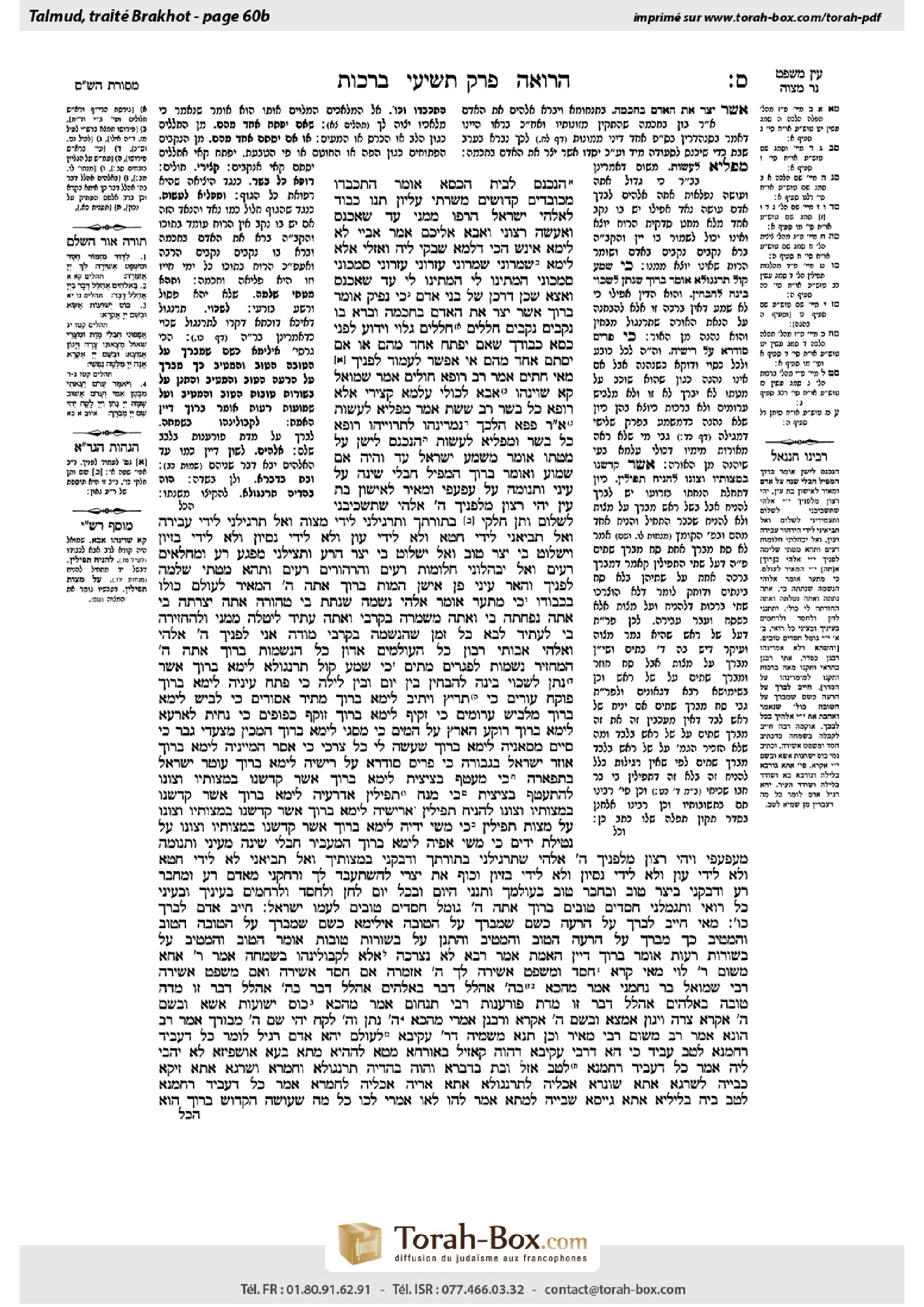
Berakhot 60b: Talmud study for Daf Yomi
Study the Talmud for Daf Yomi with scanned pages, Hebrew text, English translations from Sefaria and AI-generated French translations.
Passage selection and English or AI-generated French translation are available where the scan has annotations. Daf Study is independent of Torah-Box and Sefaria.
Browse Berakhot · ברכות · All tractatesBerakhot 60b text and translations
This page of Berakhot includes the Aramaic text, an English translation and an AI-generated French translation, alongside the scan above.
ברכות ס׳ ב · Aramaic and Hebrew text
הַנִּכְנָס לְבֵית הַכִּסֵּא, אוֹמֵר: ״הִתְכַּבְּדוּ מְכוּבָּדִים קְדוֹשִׁים מְשָׁרְתֵי עֶלְיוֹן, תְּנוּ כָּבוֹד לֵאלֹהֵי יִשְׂרָאֵל, הַרְפּוּ מִמֶּנִּי עַד שֶׁאֶכָּנֵס וְאֶעֱשֶׂה רְצוֹנִי וְאָבֹא אֲלֵיכֶם״. אָמַר אַבָּיֵי: לָא לֵימָא אִינָשׁ הָכִי, דִּלְמָא שָׁבְקִי לֵיהּ וְאָזְלִי. אֶלָּא לֵימָא: ״שִׁמְרוּנִי שִׁמְרוּנִי, עִזְרוּנִי עִזְרוּנִי, סִמְכוּנִי סִמְכוּנִי, הַמְתִּינוּ לִי הַמְתִּינוּ לִי עַד שֶׁאֶכָּנֵס וְאֵצֵא, שֶׁכֵּן דַּרְכָּן שֶׁל בְּנֵי אָדָם״. כִּי נָפֵיק, אוֹמֵר: ״בָּרוּךְ ... אֲשֶׁר יָצַר אֶת הָאָדָם בְּחׇכְמָה, וּבָרָא בּוֹ נְקָבִים נְקָבִים, חֲלָלִים חֲלָלִים, גָּלוּי וְיָדוּעַ לִפְנֵי כִּסֵּא כְּבוֹדֶךָ שֶׁאִם יִפָּתֵחַ אֶחָד מֵהֶם אוֹ אִם יִסָּתֵם אֶחָד מֵהֶם אִי אֶפְשָׁר לַעֲמוֹד לְפָנֶיךָ״.
מַאי חָתֵים? אָמַר רַב: ״רוֹפֵא חוֹלִים״. אָמַר שְׁמוּאֵל: קָא שַׁוִּינְהוּ אַבָּא לְכוּלֵּי עָלְמָא קְצִירֵי. אֶלָּא: ״רוֹפֵא כׇל בָּשָׂר״. רַב שֵׁשֶׁת אָמַר: ״מַפְלִיא לַעֲשׂוֹת״. אָמַר רַב פָּפָּא: הִלְכָּךְ נֵמְרִינְהוּ לְתַרְוַיְיהוּ — ״רוֹפֵא כׇל בָּשָׂר וּמַפְלִיא לַעֲשׂוֹת״.
הַנִּכְנָס לִישַׁן עַל מִטָּתוֹ, אוֹמֵר מִ״שְּׁמַע יִשְׂרָאֵל״ עַד ״וְהָיָה אִם שָׁמוֹעַ״, וְאוֹמֵר: ״בָּרוּךְ … הַמַּפִּיל חַבְלֵי שֵׁינָה עַל עֵינַי וּתְנוּמָה עַל עַפְעַפַּי, וּמֵאִיר לְאִישׁוֹן בַּת עָיִן. יְהִי רָצוֹן מִלְּפָנֶיךָ ה׳ אֱלֹהַי, שֶׁתַּשְׁכִּיבֵנִי לְשָׁלוֹם, וְתֵן חֶלְקִי בְּתוֹרָתֶךָ, וְתַרְגִּילֵנִי לִידֵי מִצְוָה, וְאַל תַּרְגִּילֵנִי לִידֵי עֲבֵירָה, וְאַל תְּבִיאֵנִי לִידֵי חֵטְא, וְלֹא לִידֵי עָוֹן, וְלֹא לִידֵי נִסָּיוֹן, וְלֹא לִידֵי בִזָּיוֹן. וְיִשְׁלוֹט בִּי יֵצֶר טוֹב, וְאַל יִשְׁלוֹט בִּי יֵצֶר הָרָע. וְתַצִּילֵנִי מִפֶּגַע רַע, וּמֵחֳלָאִים רָעִים. וְאַל יְבַהֲלוּנִי חֲלוֹמוֹת רָעִים וְהִרְהוּרִים רָעִים. וּתְהֵא מִטָּתִי שְׁלֵמָה לְפָנֶיךָ. וְהָאֵר עֵינַי פֶּן אִישַׁן הַמָּוֶת. בָּרוּךְ אַתָּה ה׳ הַמֵּאִיר לָעוֹלָם כּוּלּוֹ בִּכְבוֹדוֹ״.
כִּי מִתְּעַר אוֹמֵר: ״אֱלֹהַי, נְשָׁמָה שֶׁנָּתַתָּ בִּי טְהוֹרָה. אַתָּה יְצַרְתָּהּ בִּי, אַתָּה נְפַחְתָּהּ בִּי, וְאַתָּה מְשַׁמְּרָהּ בְּקִרְבִּי, וְאַתָּה עָתִיד לִיטְּלָהּ מִמֶּנִּי וּלְהַחֲזִירָהּ בִּי לְעָתִיד לָבֹא. כׇּל זְמַן שֶׁהַנְּשָׁמָה בְּקִרְבִּי מוֹדֶה אֲנִי לְפָנֶיךָ ה׳ אֱלֹהַי וֵאלֹהֵי אֲבוֹתַי, רִבּוֹן כׇּל הָעוֹלָמִים, אֲדוֹן כׇּל הַנְּשָׁמוֹת. בָּרוּךְ אַתָּה ה׳, הַמַּחֲזִיר נְשָׁמוֹת לִפְגָרִים מֵתִים״.
כִּי שָׁמַע קוֹל תַּרְנְגוֹלָא, לֵימָא: ״בָּרוּךְ … אֲשֶׁר נָתַן לַשֶּׂכְוִי בִּינָה לְהַבְחִין בֵּין יוֹם וּבֵין לָיְלָה״. כִּי פָּתַח עֵינֵיהּ, לֵימָא: ״בָּרוּךְ … פּוֹקֵחַ עִוְּרִים״. כִּי תָּרֵיץ וְיָתֵיב, לֵימָא: ״בָּרוּךְ … מַתִּיר אֲסוּרִים״. כִּי לָבֵישׁ, לֵימָא: ״בָּרוּךְ … מַלְבִּישׁ עֲרוּמִּים״. כִּי זָקֵיף, לֵימָא: ״בָּרוּךְ … זוֹקֵף כְּפוּפִים״. כִּי נָחֵית לְאַרְעָא, לֵימָא: ״בָּרוּךְ … רוֹקַע הָאָרֶץ עַל הַמָּיִם״. כִּי מְסַגֵּי, לֵימָא: ״בָּרוּךְ … הַמֵּכִין מִצְעֲדֵי גָבֶר״. כִּי סַיֵּים מְסָאנֵיהּ, לֵימָא: ״בָּרוּךְ … שֶׁעָשָׂה לִי כׇּל צׇרְכִּי״. כִּי אָסַר הֶמְיָינֵיהּ, לֵימָא: ״בָּרוּךְ … אוֹזֵר יִשְׂרָאֵל בִּגְבוּרָה״. כִּי פָּרֵיס סוּדָרָא עַל רֵישֵׁיהּ, לֵימָא: ״בָּרוּךְ … עוֹטֵר יִשְׂרָאֵל בְּתִפְאָרָה״.
כִּי מִעֲטַף בְּצִיצִית, לֵימָא: ״בָּרוּךְ … אֲשֶׁר קִדְּשָׁנוּ בְּמִצְוֹתָיו וְצִוָּנוּ לְהִתְעַטֵּף בְּצִיצִית״. כִּי מַנַּח תְּפִילִּין אַדְּרָעֵיהּ, לֵימָא: ״בָּרוּךְ … אֲשֶׁר קִדְּשָׁנוּ בְּמִצְוֹתָיו וְצִוָּנוּ לְהַנִּיחַ תְּפִילִּין״, אַרֵישֵׁיהּ, לֵימָא: ״בָּרוּךְ … אֲשֶׁר קִדְּשָׁנוּ בְּמִצְוֹתָיו וְצִוָּנוּ עַל מִצְוַת תְּפִילִּין״. כִּי מָשֵׁי יְדֵיהּ, לֵימָא: ״בָּרוּךְ … אֲשֶׁר קִדְּשָׁנוּ בְּמִצְוֹתָיו וְצִוָּנוּ עַל נְטִילַת יָדַיִם״. כִּי מָשֵׁי אַפֵּיהּ, לֵימָא: בָּרוּךְ … הַמַּעֲבִיר חֶבְלֵי שֵׁינָה מֵעֵינָי וּתְנוּמָה מֵעַפְעַפָּי. וִיהִי רָצוֹן מִלְּפָנֶיךָ ה׳ אֱלֹהַי, שֶׁתַּרְגִּילֵנִי בְּתוֹרָתֶךָ, וְדַבְּקֵנִי בְּמִצְוֹתֶיךָ, וְאַל תְּבִיאֵנִי לֹא לִידֵי חֵטְא, וְלֹא לִידֵי עָוֹן, וְלֹא לִידֵי נִסָּיוֹן, וְלֹא לִידֵי בִזָּיוֹן. וְכוֹף אֶת יִצְרִי לְהִשְׁתַּעְבֵּד לָךְ. וְרַחֲקֵנִי מֵאָדָם רָע, וּמֵחָבֵר רָע. וְדַבְּקֵנִי בְּיֵצֶר טוֹב וּבְחָבֵר טוֹב בְּעוֹלָמֶךָ. וּתְנֵנִי הַיּוֹם וּבְכׇל יוֹם לְחֵן וּלְחֶסֶד וּלְרַחֲמִים בְּעֵינֶיךָ וּבְעֵינֵי כׇּל רוֹאַי, וְתִגְמְלֵנִי חֲסָדִים טוֹבִים. בָּרוּךְ אַתָּה ה׳ גּוֹמֵל חֲסָדִים טוֹבִים לְעַמּוֹ יִשְׂרָאֵל״.
חַיָּיב אָדָם לְבָרֵךְ כּוּ׳: מַאי ״חַיָּיב לְבָרֵךְ עַל הָרָעָה כְּשֵׁם שֶׁמְּבָרֵךְ עַל הַטּוֹבָה״? אִילֵּימָא כְּשֵׁם שֶׁמְּבָרֵךְ עַל הַטּוֹבָה ״הַטּוֹב וְהַמֵּטִיב״, כָּךְ מְבָרֵךְ עַל הָרָעָה ״הַטּוֹב וְהַמֵּטִיב״, וְהָתְנַן עַל בְּשׂוֹרוֹת טוֹבוֹת אוֹמֵר ״הַטּוֹב וְהַמֵּטִיב״, עַל בְּשׂוֹרוֹת רָעוֹת אוֹמֵר ״בָּרוּךְ … דַּיַּין הָאֱמֶת״! אָמַר רָבָא: לֹא נִצְרְכָה, אֶלָּא לְקַבּוֹלִינְהוּ בְּשִׂמְחָה.
אָמַר רַב אַחָא מִשּׁוּם רַבִּי לֵוִי: מַאי קְרָא — ״חֶסֶד וּמִשְׁפָּט אָשִׁירָה לְךָ ה׳ אֲזַמֵּרָה״. אִם חֶסֶד — אָשִׁירָה, וְאִם מִשְׁפָּט — אָשִׁירָה.
רַבִּי שְׁמוּאֵל בַּר נַחְמָנִי אָמַר, מֵהָכָא: ״בַּה׳ אֲהַלֵּל דָּבָר בֵּאלֹהִים אֲהַלֵּל דָּבָר״. בַּה׳ אֲהַלֵּל דָּבָר — זוֹ מִדָּה טוֹבָה, בֵּאלֹהִים אֲהַלֵּל דָּבָר — זוֹ מִדַּת פּוּרְעָנוּת.
רַבִּי תַּנְחוּם אָמַר: מֵהָכָא: ״כּוֹס יְשׁוּעוֹת אֶשָּׂא וּבְשֵׁם ה׳ אֶקְרָא״, ״צָרָה וְיָגוֹן אֶמְצָא וּבְשֵׁם ה׳ אֶקְרָא״.
וְרַבָּנַן אָמְרִי, מֵהָכָא: ״ה׳ נָתָן וַה׳ לָקָח יְהִי שֵׁם ה׳ מְבֹרָךְ״.
אָמַר רַב הוּנָא אָמַר רַב מִשּׁוּם רַבִּי מֵאִיר, וְכֵן תָּנָא מִשְּׁמֵיהּ דְּרַבִּי עֲקִיבָא: לְעוֹלָם יְהֵא אָדָם רָגִיל לוֹמַר: ״כׇּל דְּעָבֵיד רַחֲמָנָא לְטָב עָבֵיד״.
כִּי הָא דְּרַבִּי עֲקִיבָא דַּהֲוָה קָאָזֵיל בְּאוֹרְחָא. מְטָא לְהַהִיא מָתָא, בְּעָא אוּשְׁפִּיזָא לָא יָהֲבִי לֵיהּ. אֲמַר: ״כׇּל דְּעָבֵיד רַחֲמָנָא — לְטָב״. אֲזַל וּבָת בְּדַבְרָא, וַהֲוָה בַּהֲדֵיהּ תַּרְנְגוֹלָא וַחֲמָרָא וּשְׁרָגָא. אֲתָא זִיקָא כַּבְיֵיהּ לִשְׁרָגָא. אֲתָא שׁוּנָּרָא אַכְלֵיהּ לְתַרְנְגוֹלָא. אֲתָא אַרְיָה אַכְלֵיהּ לַחֲמָרָא. אֲמַר: ״כׇּל דְּעָבֵיד רַחֲמָנָא — לְטָב״. בֵּיהּ בְּלֵילְיָא אֲתָא גְּיָיסָא, שַׁבְיַיהּ לְמָתָא. אֲמַר לְהוּ: לָאו אֲמַרִי לְכוּ כׇּל מַה שֶּׁעוֹשֶׂה הַקָּדוֹשׁ בָּרוּךְ הוּא
Berakhot 60b · English translation
One who enters a bathroom says to the angels who accompany him at all times:
Be honored, honorable holy ones, servants of the One on High,
give honor to the God of Israel,
leave me until I enter and do my will and come back to you.
Abaye said: A person should not say this, lest they abandon him and go. Rather he should say:
Guard me, guard me,
help me, help me,
support me, support me,
wait for me, wait for me until I enter and come out, as this is the way of man.
Upon exiting, one says:
Blessed…Who formed man in wisdom,
and created in him many orifices and cavities.
It is revealed and known before the throne of Your glory
that were one of them to be ruptured or blocked, it would be impossible to survive and stand before You.
The Gemara asks: With what should one conclude this blessing? Rav said: One should conclude: Blessed…Healer of the sick. Shmuel said: Abba, Rav, has rendered everyone sick. Rather, one should say: Healer of all flesh. Rav Sheshet said: One should conclude: Who performs wondrous deeds. Rav Pappa said: Therefore, let us say them both: Healer of all flesh, Who performs wondrous deeds.
The Gemara proceeds to cite additional blessings recited as part of one’s daily routine. One who enters to sleep on his bed recites Shema in his bed from Shema Yisrael to VeHaya Im Shamoa. Then he recites:
Blessed…Who makes the bands of sleep fall upon my eyes and slumber upon my eyelids,
and illuminates the pupil of the eye.
May it be Your will, O Lord my God,
that You make me lie down in peace and give me my portion in Your Torah,
accustom me to mitzvot and do not accustom me to transgression,
lead me not into error, nor into iniquity, nor into temptation nor into disgrace.
May the good inclination have dominion over me
and may the evil inclination not have dominion over me.
Save me from an evil mishap and evil diseases.
Let neither bad dreams nor troubling thoughts disturb me.
May my bed be flawless before You, that my progeny should not be flawed.
Enlighten my eyes in the morning lest I sleep the sleep of death, never to awaken.
Blessed are You, O Lord, Who gives light to the whole world in His glory.
When one awakens, he recites:
My God, the soul You have placed within me is pure.
You formed it within me,
You breathed it into me,
and You guard it while it is within me.
One day You will take it from me and restore it within me in the time to come.
As long as the soul is within me, I thank You,
O Lord my God and God of my ancestors, Master of all worlds, Lord of all souls.
Blessed are You, O Lord, who restores souls to lifeless bodies.
Upon hearing the sound of the rooster, one should recite: Blessed…Who gave the heart [sekhvi] understanding to distinguish between day and night.
Upon opening his eyes, one should recite: Blessed…Who gives sight to the blind.
Upon sitting up straight, one should recite: Blessed…Who sets captives free.
Upon dressing, one should recite: Blessed…Who clothes the naked, as they would sleep unclothed.
Upon standing up straight, one should recite: Blessed…Who raises those bowed down.
Upon descending from one’s bed to the ground, one should recite: Blessed…Who spreads the earth above the waters, in thanksgiving for the creation of solid ground upon which to walk.
Upon walking, one should recite: Blessed…Who makes firm the steps of man.
Upon putting on his shoes, one should recite: Blessed…Who has provided me with all I need, as shoes are a basic necessity.
Upon putting on his belt, one should recite: Blessed…Who girds Israel with strength.
Upon spreading a shawl upon his head, one should recite: Blessed…Who crowns Israel with glory.
Upon wrapping himself in ritual fringes, one should recite: Blessed…Who has made us holy through His commandments and has commanded us to wrap ourselves in a garment with ritual fringes.
Upon donning his phylacteries on his arm, one should recite: Blessed…Who has made us holy through His commandments and has commanded us to don phylacteries.
Upon donning phylacteries on his head one should recite: Blessed…Who has made us holy through His commandments and has commanded us with regard to the mitzva of phylacteries.
Upon ritually washing his hands: Blessed…Who has made us holy through His commandments and has commanded us with regard to the washing of the hands.
Upon washing his face, one recites: Blessed…Who removes the bands of sleep from my eyes and slumber from my eyelids.
And may it be Your will, O Lord my God, to accustom me in Your Torah,
attach me to Your mitzvot, and lead me not into transgression,
nor into error, nor into iniquity, nor into temptation nor into disgrace.
Bend my evil inclination to be subservient to You,
and distance me from an evil person and an evil acquaintance.
Help me attach myself to the good inclination and to a good friend in Your world.
Grant me, today and every day, grace, loving-kindness, and compassion in Your eyes and the eyes of all who see me,
and bestow loving-kindness upon me.
Blessed are You, O Lord, Who bestows loving-kindness on His people, Israel.
We learned in the mishna: One is obligated to recite a blessing for the bad that befalls him just as he recites a blessing for the good that befalls him. The Gemara asks: What does it mean: One is obligated to recite a blessing for the bad just as for the good? If we say this means that just as one recites a blessing for a positive event with the formula: Who is good and does good, so too one recites a blessing for a calamity with the formula: Who is good and does good, didn’t we learn in our mishna that over good tidings one recites: Who is good and does good, while over bad tidings one recites: Blessed…the true Judge? Rather, Rava said: The mishna’s statement was only necessary to instruct us to accept bad tidings with the same joy with which we accept good tidings, not to instruct with regard to which blessing to recite.
Rav Aḥa said in the name of Rabbi Levi: What is the verse that alludes to this? “I will sing of loving-kindness and justice; unto You, O Lord, will I sing praises” (Psalms 101:1). Rav Aḥa explains: If it is loving-kindness, I will sing, and if it is justice, I will sing. I will thank God in song for the bad just as for the good.
Rabbi Shmuel bar Naḥmani said: The proof is from here, as it is stated: “In God, I will praise His word; in the Lord, I will praise His word” (Psalms 56:11). The Gemara explains that In God, I will praise His word; that is the revelation of God’s attribute of benevolence, while: In the Lord, I will praise His word; that is the attribute of suffering; even if God brings suffering to bear upon me, I will still praise Him.
Rabbi Tanḥum said: The proof is from here, as it is stated: “I will lift up the cup of salvation and call upon the name of the Lord” (Psalms 116:13), and: “I found trouble and sorrow, but I called upon the name of the Lord” (Psalms 116:3–4).
And the Rabbis said: The proof is from here, as it is stated: “The Lord has given and the Lord has taken away; blessed be the name of the Lord” (Job 1:21).
Rav Huna said that Rav said that Rabbi Meir said; and so it was taught in a baraita in the name of Rabbi Akiva: One must always accustom oneself to say: Everything that God does, He does for the best.
The Gemara relates: Like this incident, when Rabbi Akiva was walking along the road and came to a certain city, he inquired about lodging and they did not give him any. He said: Everything that God does, He does for the best. He went and slept in a field, and he had with him a rooster, a donkey and a candle. A gust of wind came and extinguished the candle; a cat came and ate the rooster; and a lion came and ate the donkey. He said: Everything that God does, He does for the best. That night, an army came and took the city into captivity. It turned out that Rabbi Akiva alone, who was not in the city and had no lit candle, noisy rooster or donkey to give away his location, was saved. He said to them: Didn’t I tell you? Everything that God does,
Berakhot 60b · Traduction française (IA)
Celui qui entre dans une salle de bain dit aux anges qui l'accompagnent en permanence : Soyez honorés, honorables saints, serviteurs du Très-Haut, donnez honneur à Dieu d'Israël, quittez-moi jusqu'à ce que j'entre et accomplisse mon dessein et revienne vers vous. Abaye a dit : Une personne ne devrait pas dire cela, de peur qu'ils l'abandonnent et s'en aillent. Il devrait plutôt dire : Garde-moi, garde-moi, Aide-moi, aide-moi, Soutiens-moi, soutiens-moi, Attends-moi, attends-moi jusqu'à ce que j'entre et sorte, car c'est ainsi que fait l'homme. En sortant, on dit : Béni… Celui qui a formé l'homme avec sagesse, Et qui a créé en lui de nombreux orifices et cavités. Il est révélé et connu devant le trône de votre gloire Que si l'un d'eux était percé ou bloqué, il serait impossible de survivre et de se tenir devant vous.
La Guemara pose la question : Avec quoi doit-on conclure cette bénédiction ? Rav a dit : On doit conclure : Béni… Le guérisseur des malades. Shmuel a dit : Abba, Rav, a rendu tout le monde malade. Plutôt, on doit dire : Le guérisseur de toute chair. Rav Sheshet a dit : On doit conclure : Celui qui fait des œuvres merveilleuses. Rav Pappa a dit : Ainsi, disons-les tous les deux : Le guérisseur de toute chair, Celui qui fait des œuvres merveilleuses.
La Guemara poursuit en citant d'autres bénédictions récitées dans le cadre de la routine quotidienne. Celui qui entre pour dormir sur son lit récite le Chéma sur son lit, de Chéma Yisrael à VeHaya Im Shamoa. Puis il récite : Béni… Celui qui fait tomber les bandes du sommeil sur mes yeux et le sommeil sur mes paupières, Et qui éclaire la pupille de l'œil. Que cela soit ton vœu, ô Seigneur mon Dieu, Que tu me fasses dormir en paix et que tu me donnes ma part dans ta Torah, Que tu m'habitues aux mitsvot et ne m'habitues pas aux transgressions, Que tu ne me conduises pas à l'erreur, ni à l'iniquité, ni à la tentation ni à la disgrâce. Que la bonne inclination ait le pouvoir sur moi Et que la mauvaise inclination n'ait pas le pouvoir sur moi. Sauve-moi d'un mauvais hasard et de maladies mauvaises. Que ni les mauvais rêves ni les pensées troublantes ne me dérangent. Que mon lit soit parfait devant toi, afin que ma descendance ne soit pas défectueuse. Éclaire mes yeux au matin afin que je ne dorme pas le sommeil de la mort, jamais ne me réveille. Béni es-tu, ô Seigneur, qui donne la lumière à tout le monde dans Sa gloire.
Lorsqu'on se réveille, on récite : Mon Dieu, l'âme que tu as placée en moi est pure. Tu l'as formée en moi, Tu l'as soufflée en moi, Et tu la gardes pendant qu'elle est en moi. Un jour tu la prendras de moi et la restaureras en moi dans l'avenir. Tant que l'âme est en moi, je te remercie, Ô Seigneur mon Dieu et Dieu de mes pères, Maître de tous les mondes, Seigneur de toutes les âmes. Béni es-tu, ô Seigneur, qui restaure les âmes aux corps inanimés.
En entendant le chant du coq, on doit réciter : Béni… Celui qui a donné au cœur [sekhvi] l'intelligence de distinguer entre jour et nuit. En ouvrant les yeux, on doit réciter : Béni… Celui qui donne la vue aux aveugles. En s'asseyant droit, on doit réciter : Béni… Celui qui libère les prisonniers. En s'habillant, on doit réciter : Béni… Celui qui habille les nus, comme s'ils dormaient nus. En se levant droit, on doit réciter : Béni… Celui qui relève ceux qui sont prosternés. En descendant de son lit au sol, on doit réciter : Béni… Celui qui étend la terre au-dessus des eaux, en remerciement à la création d'une terre solide sur laquelle marcher. En marchant, on doit réciter : Béni… Celui qui rend fermes les pas de l'homme. En mettant ses chaussures, on doit réciter : Béni… Celui qui m'a fourni tout ce dont j'ai besoin, car les chaussures sont un besoin essentiel. En mettant sa ceinture, on doit réciter : Béni… Celui qui fortifie Israël. En étendant un manteau sur sa tête, on doit réciter : Béni… Celui qui couronne Israël de gloire.
En s'enveloppant dans les franges rituelles, on doit réciter : Béni… Celui qui nous a sanctifiés par Ses commandements et qui nous a commandé d'envelopper nous-mêmes dans un vêtement avec des franges rituelles. En portant ses phylactères sur son bras, on doit réciter : Béni… Celui qui nous a sanctifiés par Ses commandements et qui nous a commandé de porter des phylactères. En portant des phylactères sur sa tête, on doit réciter : Béni… Celui qui nous a sanctifiés par Ses commandements et qui nous a commandé concernant la mitsva des phylactères. En lavant rituellement ses mains, on récite : Béni… Celui qui nous a sanctifiés par Ses commandements et qui nous a commandé concernant le lavage des mains. En lavant son visage, on récite : Béni… Celui qui ôte les bandelettes du sommeil de mes yeux et le sommeil de mes paupières. Et que cela soit ton vœu, ô Seigneur mon Dieu, de m'habituer à ta Torah, de m'attacher à tes mitsvot et de ne pas me conduire à la transgression, en erreur, en iniquité, en tentation ni en disgrâce. Bends mon mauvais penchant pour qu'il soit soumis à toi, et éloigne-moi d'une mauvaise personne et d'un mauvais ami. Aide-moi à m'attacher au bon penchant et à un bon ami dans ton monde. Donne-moi, aujourd'hui et chaque jour, la grâce, la bonté et la compassion dans tes yeux et dans les yeux de tous ceux qui me voient, et accorde-moi la bonté. Béni es-tu, ô Seigneur, qui accorde la bonté à son peuple, Israël.
Nous avons appris dans la mitsna : On est tenu de réciter une bénédiction pour le mal qui arrive à une personne aussi bien que pour le bien qui arrive à une personne. La Guemara pose la question : Que signifie : On est tenu de réciter une bénédiction pour le mal aussi bien que pour le bien ? Si nous disons cela pour signifier que tout comme on récite une bénédiction pour un événement positif avec la formule : Celui qui est bon et fait le bien, alors aussi on récite une bénédiction pour une calamité avec la formule : Celui qui est bon et fait le bien, n'avons-nous pas appris dans notre mitsna que sur les bonnes nouvelles on récite : Celui qui est bon et fait le bien, tandis que sur les mauvaises nouvelles on récite : Béni… Le Juste Véritable ? Plutôt, Rava a dit : La déclaration de la mitsna était nécessaire uniquement pour nous instruire à accepter les mauvaises nouvelles avec la même joie avec laquelle nous acceptons les bonnes nouvelles, pas pour nous instruire concernant la bénédiction à réciter.
Rav Acha a dit en nom de Rabbi Levi : Quel est le verset qui évoque cela ? « Je chanterai de la bonté et de la justice ; à toi, ô Seigneur, je chanterai des louanges » (Psaumes 101:1). Rav Acha explique : Si c'est la bonté, je chanterai, et si c'est la justice, je chanterai. Je remercie Dieu en chantant pour le mal aussi bien que pour le bien.
Rabbi Shmuel bar Naḥmani a dit : La preuve est ici, car il est écrit : « En Dieu, je louerai Son mot ; en l'Éternel, je louerai Son mot » (Psaumes 56:11). La Guemara explique que « En Dieu, je louerai Son mot » correspond à la révélation de l'attribut de bonté de Dieu, tandis que « En l'Éternel, je louerai Son mot » correspond à l'attribut de la souffrance ; même si Dieu m'apporte de la souffrance, je continuerai à le louer.
Rabbi Tanḥum a dit : La preuve est ici, car il est écrit : « Je leverai le bol de la saluation et je invoquerai le nom de l'Éternel » (Psaumes 116:13), et : « J'ai trouvé des afflictions et des maux, mais j'ai invoqué le nom de l'Éternel » (Psaumes 116:3–4).
Et les Rabbins ont dit : La preuve est ici, car il est écrit : « L'Éternel a donné et l'Éternel a ôté ; béni soit le nom de l'Éternel » (Job 1:21).
Rav Huna a dit que Rav a dit que Rabbi Meir a dit ; et ainsi il a été enseigné dans une baraïta en nom de Rabbi Akiva : On doit toujours s'habituer à dire : Tout ce que Dieu fait, il le fait pour le meilleur.
La Guemara rapporte : Comme cet incident, lorsque Rabbi Akiva marchait sur la route et est arrivé à une certaine ville, il a demandé un logement et ils ne lui en ont pas donné. Il a dit : Tout ce que Dieu fait, il le fait pour le meilleur. Il est allé et a dormi dans un champ, et il avait avec lui un coq, un âne et une bougie. Un vent vint et éteignit la bougie ; un chat vint et mangea le coq ; et un lion vint et mangea l'âne. Il a dit : Tout ce que Dieu fait, il le fait pour le meilleur. La nuit, une armée vint et prit la ville en captivité. Il s'est avéré que Rabbi Akiva seul, qui n'était pas dans la ville et n'avait pas de bougie allumée, de coq bruyant ou d'âne à donner sa position, fut sauvé. Il a dit à eux : N'avez-vous pas entendu ? Tout ce que Dieu fait,
Traduction française générée par IA à partir de l’édition anglaise de Sefaria. Vérifie toujours un passage avec le texte source.
Text from Sefaria: William Davidson Edition - Vocalized Aramaic (CC BY NC); William Davidson Edition - English (CC BY NC).