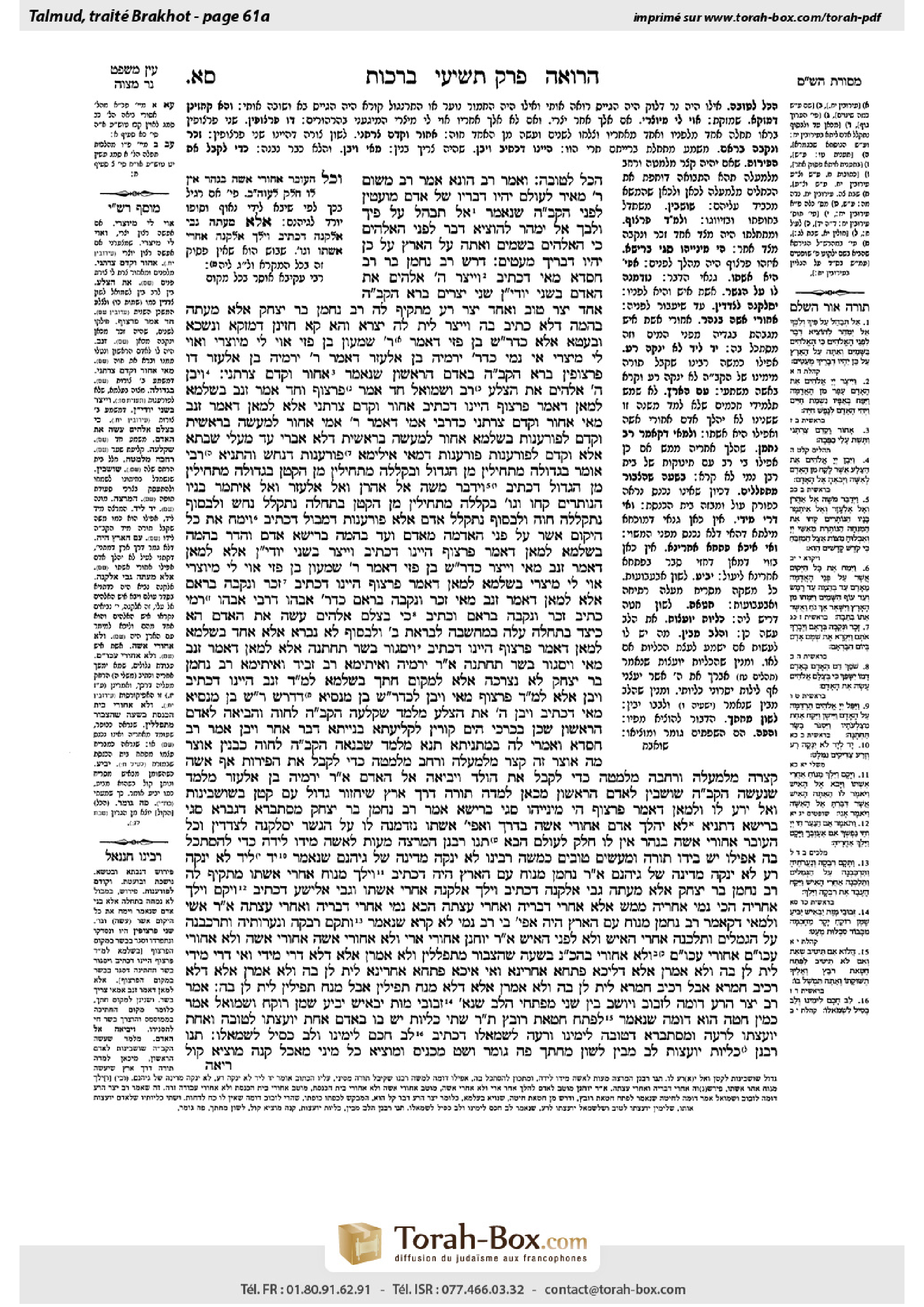
Berakhot 61a: Talmud study for Daf Yomi
Study the Talmud for Daf Yomi with scanned pages, Hebrew text, English translations from Sefaria and AI-generated French translations.
Passage selection and English or AI-generated French translation are available where the scan has annotations. Daf Study is independent of Torah-Box and Sefaria.
Browse Berakhot · ברכות · All tractatesBerakhot 61a text and translations
This page of Berakhot includes the Aramaic text, an English translation and an AI-generated French translation, alongside the scan above.
ברכות ס״א א · Aramaic and Hebrew text
הַכֹּל לְטוֹבָה.
וְאָמַר רַב הוּנָא אָמַר רַב מִשּׁוּם רַבִּי מֵאִיר: לְעוֹלָם יִהְיוּ דְּבָרָיו שֶׁל אָדָם מוּעָטִין לִפְנֵי הַקָּדוֹשׁ בָּרוּךְ הוּא, שֶׁנֶּאֱמַר: ״אַל תְּבַהֵל עַל פִּיךָ וְלִבְּךָ אַל יְמַהֵר לְהוֹצִיא דָבָר לִפְנֵי הָאֱלֹהִים כִּי הָאֱלֹהִים בַּשָּׁמַיִם וְאַתָּה עַל הָאָרֶץ עַל כֵּן יִהְיוּ דְבָרֶיךָ מְעַטִּים״.
דָּרַשׁ רַב נַחְמָן בַּר רַב חִסְדָּא: מַאי דִּכְתִיב ״וַיִּיצֶר ה׳ אֱלֹהִים אֶת הָאָדָם״ בִּשְׁנֵי יוֹדִין? — שְׁנֵי יְצָרִים בָּרָא הַקָּדוֹשׁ בָּרוּךְ הוּא, אֶחָד יֵצֶר טוֹב וְאֶחָד יֵצֶר רָע.
מַתְקִיף לַהּ רַב נַחְמָן בַּר יִצְחָק: אֶלָּא מֵעַתָּה, בְּהֵמָה דְּלָא כְּתִיב בַּהּ ״וַיִּיצֶר״ לֵית לַהּ יִצְרָא? וְהָא קָא חֲזֵינַן דְּמַזְּקָא וְנָשְׁכָא וּבָעֲטָא! אֶלָּא כִּדְרַבִּי שִׁמְעוֹן בֶּן פַּזִּי, דְּאָמַר רַבִּי שִׁמְעוֹן בֶּן פַּזִּי ״אוֹי לִי מִיּוֹצְרִי וְאוֹי לִי מִיִּצְרִי״.
אִי נָמֵי כִּדְרַבִּי יִרְמְיָה בֶּן אֶלְעָזָר. דְּאָמַר רַבִּי יִרְמְיָה בֶּן אֶלְעָזָר: דּוּ פַּרְצוּפִין בָּרָא הַקָּדוֹשׁ בָּרוּךְ הוּא בָּאָדָם הָרִאשׁוֹן, שֶׁנֶּאֱמַר: ״אָחוֹר וָקֶדֶם צַרְתָּנִי״.
״וַיִּבֶן ה׳ אֱלֹהִים אֶת הַצֵּלָע״.
רַב וּשְׁמוּאֵל: חַד אָמַר פַּרְצוּף. וְחַד אָמַר זָנָב.
בִּשְׁלָמָא לְמַאן דְּאָמַר פַּרְצוּף — הַיְינוּ דִּכְתִיב ״אָחוֹר וָקֶדֶם צַרְתָּנִי״. אֶלָּא לְמַאן דְּאָמַר זָנָב, מַאי ״אָחוֹר וָקֶדֶם צַרְתָּנִי״? כִּדְרַבִּי אַמֵּי, דְּאָמַר רַבִּי אַמֵּי: ״אָחוֹר״ — לְמַעֲשֵׂה בְרֵאשִׁית, ״וָקֶדֶם״ — לְפוּרְעָנוּת.
בִּשְׁלָמָא ״אָחוֹר״ לְמַעֲשֵׂה בְרֵאשִׁית — דְּלָא אִבְּרִי עַד מַעֲלֵי שַׁבְּתָא, אֶלָּא ״וָקֶדֶם״ לְפוּרְעָנוּת, פּוּרְעָנוּת דְּמַאי? אִילֵּימָא פּוּרְעָנוּת דְּנָחָשׁ, וְהָתַנְיָא רַבִּי אוֹמֵר: בִּגְדוּלָּה מַתְחִילִין מִן הַגָּדוֹל, וּבִקְלָלָה מַתְחִילִין מִן הַקָּטָן.
בִּגְדוּלָּה מַתְחִילִין מִן הַגָּדוֹל — דִּכְתִיב: ״וַיְדַבֵּר מֹשֶׁה אֶל אַהֲרֹן וְאֶל אֶלְעָזָר וְאֶל אִיתָמָר בָּנָיו הַנּוֹתָרִים קְחוּ וְגוֹ׳״. בִּקְלָלָה מַתְחִילִין מִן הַקָּטָן — בַּתְּחִלָּה נִתְקַלֵּל נָחָשׁ, וּלְבַסּוֹף נִתְקַלְּלָה חַוָּה, וּלְבַסּוֹף נִתְקַלֵּל אָדָם!
אֶלָּא פּוּרְעָנוּת דְּמַבּוּל, דִּכְתִיב: ״וַיִּמַח אֶת כׇּל הַיְקוּם אֲשֶׁר עַל פְּנֵי הָאֲדָמָה מֵאָדָם וְעַד בְּהֵמָה״, בְּרֵישָׁא אָדָם וַהֲדַר בְּהֵמָה.
בִּשְׁלָמָא לְמַאן דְּאָמַר פַּרְצוּף, הַיְינוּ דִּכְתִיב ״וַיִּיצֶר״ בִּשְׁנֵי יוֹדִין. אֶלָּא לְמַאן דְּאָמַר זָנָב, מַאי ״וַיִּיצֶר״?
כִּדְרַבִּי שִׁמְעוֹן בֶּן פַּזִּי, דְּאָמַר רַבִּי שִׁמְעוֹן בֶּן פַּזִּי: ״אוֹי לִי מִיּוֹצְרִי אוֹי לִי מִיִּצְרִי״.
בִּשְׁלָמָא לְמַאן דְּאָמַר פַּרְצוּף, הַיְינוּ דִּכְתִיב ״זָכָר וּנְקֵבָה בְּרָאָם״, אֶלָּא לְמַאן דְּאָמַר זָנָב, מַאי ״זָכָר וּנְקֵבָה בְּרָאָם״? כִּדְרַבִּי אֲבָהוּ, דְּרַבִּי אֲבָהוּ רָמֵי: כְּתִיב: ״זָכָר וּנְקֵבָה בְּרָאָם״, וּכְתִיב ״כִּי בְּצֶלֶם אֱלֹהִים עָשָׂה אֶת הָאָדָם״! הָא כֵּיצַד? — בַּתְּחִלָּה עָלָה בְּמַחְשָׁבָה לִבְרֹאת שְׁנַיִם, וּלְבַסּוֹף לֹא נִבְרָא אֶלָּא אֶחָד.
בִּשְׁלָמָא לְמַאן דְּאָמַר פַּרְצוּף, הַיְינוּ דִּכְתִיב ״וַיִּסְגֹּר בָּשָׂר תַּחְתֶּנָּה״, אֶלָּא לְמַאן דְּאָמַר זָנָב, מַאי ״וַיִּסְגֹּר בָּשָׂר תַּחְתֶּנָּה״? אָמַר רַבִּי יִרְמְיָה, וְאִיתֵּימָא רַב זְבִיד, וְאִיתֵּימָא רַב נַחְמָן בַּר יִצְחָק: לֹא נִצְרְכָה אֶלָּא לִמְקוֹם חֲתָךְ.
בִּשְׁלָמָא לְמַאן דְּאָמַר זָנָב, הַיְינוּ דִּכְתִיב: ״וַיִּבֶן״, אֶלָּא לְמַאן דְּאָמַר פַּרְצוּף, מַאי ״וַיִּבֶן״?
לְכִדְרַבִּי שִׁמְעוֹן בֶּן מְנַסְיָא. דְּדָרֵשׁ רַבִּי שִׁמְעוֹן בֶּן מְנַסְיָא: מַאי דִּכְתִיב ״וַיִּבֶן ה׳ אֶת הַצֵּלָע״? מְלַמֵּד שֶׁקִּלְּעָהּ הַקָּדוֹשׁ בָּרוּךְ הוּא לְחַוָּה, וֶהֱבִיאָהּ לְאָדָם הָרִאשׁוֹן — שֶׁכֵּן בִּכְרַכֵּי הַיָּם קוֹרִין לְקַלָּעִיתָא ״בַּנָּיְיתָא״.
דָּבָר אַחֵר: ״וַיִּבֶן״, אָמַר רַב חִסְדָּא, וְאָמְרִי לַהּ בְּמַתְנִיתָא תָּנָא: מְלַמֵּד שֶׁבְּנָאָהּ הַקָּדוֹשׁ בָּרוּךְ הוּא לְחַוָּה כְּבִנְיַן אוֹצָר, מָה אוֹצָר זֶה קָצָר מִלְּמַעְלָה וְרָחָב מִלְּמַטָּה כְּדֵי לְקַבֵּל אֶת הַפֵּירוֹת, אַף אִשָּׁה קְצָרָה מִלְּמַעְלָה וּרְחָבָה מִלְּמַטָּה כְּדֵי לְקַבֵּל אֶת הַוָּלָד.
״וַיְבִיאֶהָ אֶל הָאָדָם״, אָמַר רַבִּי יִרְמְיָה בֶּן אֶלְעָזָר: מְלַמֵּד שֶׁנַּעֲשָׂה הַקָּדוֹשׁ בָּרוּךְ הוּא שׁוֹשְׁבִין לְאָדָם הָרִאשׁוֹן, מִכָּאן לִמְּדָה תּוֹרָה דֶּרֶךְ אֶרֶץ שֶׁיַּחֲזוֹר גָּדוֹל עִם קָטָן בְּשׁוֹשְׁבִינוּת, וְאַל יֵרַע לוֹ.
וּלְמַאן דְּאָמַר ״פַּרְצוּף״, הֵי מִינַּיְיהוּ סַגִּי בְּרֵישָׁא? אָמַר רַב נַחְמָן בַּר יִצְחָק: מִסְתַּבְּרָא דְּגַבְרָא סַגִּי בְּרֵישָׁא. דְּתַנְיָא: לֹא יְהַלֵּךְ אָדָם אֲחוֹרֵי אִשָּׁה בַּדֶּרֶךְ, וַאֲפִילּוּ אִשְׁתּוֹ. נִזְדַּמְּנָה לוֹ עַל הַגֶּשֶׁר — יְסַלְּקֶנָּה לִצְדָדִין. וְכׇל הָעוֹבֵר אֲחוֹרֵי אִשָּׁה בַּנָּהָר — אֵין לוֹ חֵלֶק לְעוֹלָם הַבָּא.
תָּנוּ רַבָּנַן: הַמַּרְצֶה מָעוֹת לְאִשָּׁה מִיָּדוֹ לְיָדָהּ כְּדֵי לְהִסְתַּכֵּל בָּהּ, אֲפִילּוּ יֵשׁ בְּיָדוֹ תּוֹרָה וּמַעֲשִׂים טוֹבִים כְּמֹשֶׁה רַבֵּינוּ — לֹא יִנָּקֶה מִדִּינָהּ שֶׁל גֵּיהִנָּם. שֶׁנֶּאֱמַר ״יָד לְיָד לֹא יִנָּקֶה רָּע״ — לֹא יִנָּקֶה מִדִּינָהּ שֶׁל גֵּיהִנָּם.
אָמַר רַב נַחְמָן: מָנוֹחַ עַם הָאָרֶץ הָיָה, דִּכְתִיב: ״וַיֵּלֶךְ מָנוֹחַ אַחֲרֵי אִשְׁתּוֹ״.
מַתְקִיף לַהּ רַב נַחְמָן בַּר יִצְחָק: אֶלָּא מֵעַתָּה, גַּבֵּי אֶלְקָנָה, דִּכְתִיב: ״וַיֵּלֶךְ אֶלְקָנָה אַחֲרֵי אִשְׁתּוֹ״, וְגַבֵּי אֱלִישָׁע, דִּכְתִיב: ״וַיָּקׇם וַיֵּלֶךְ אַחֲרֶיהָ״, הָכִי נָמֵי אַחֲרֶיהָ מַמָּשׁ? אֶלָּא אַחֲרֵי דְבָרֶיהָ וְאַחֲרֵי עֲצָתָהּ, הָכָא נָמֵי אַחֲרֵי דְבָרֶיהָ וְאַחֲרֵי עֲצָתָהּ.
אָמַר רַב אָשֵׁי: וּלְמַאי דְּקָאָמַר רַב נַחְמָן, מָנוֹחַ עַם הָאָרֶץ הָיָה — אֲפִילּוּ בֵּי רַב נָמֵי לָא קְרָא, שֶׁנֶּאֱמַר: ״וַתָּקׇם רִבְקָה וְנַעֲרֹתֶיהָ וַתִּרְכַּבְנָה עַל הַגְּמַלִּים וַתֵּלַכְנָה אַחֲרֵי הָאִישׁ״ — וְלֹא לִפְנֵי הָאִישׁ.
אָמַר רַבִּי יוֹחָנָן: אֲחוֹרֵי אֲרִי וְלֹא אֲחוֹרֵי אִשָּׁה, אֲחוֹרֵי אִשָּׁה וְלֹא אֲחוֹרֵי עֲבוֹדָה זָרָה, אֲחוֹרֵי עֲבוֹדָה זָרָה וְלֹא אֲחוֹרֵי בֵּית הַכְּנֶסֶת בְּשָׁעָה שֶׁהַצִּבּוּר מִתְפַּלְּלִין.
וְלָא אֲמַרַן אֶלָּא דְּלָא דָּרֵי מִידֵּי, וְאִי דָּרֵי מִידֵּי — לֵית לַן בַּהּ. וְלָא אֲמַרַן אֶלָּא דְּלֵיכָּא פִּתְחָא אַחֲרִינָא, וְאִי אִיכָּא פִּתְחָא אַחֲרִינָא — לֵית לַן בַּהּ. וְלָא אֲמַרַן אֶלָּא דְּלָא רְכִיב חֲמָרָא, אֲבָל רְכִיב חֲמָרָא — לֵית לַן בַּהּ. וְלָא אֲמַרַן אֶלָּא דְּלָא מַנַּח תְּפִילִּין, אֲבָל מַנַּח תְּפִילִּין — לֵית לַן בַּהּ.
אָמַר רַב: יֵצֶר הָרָע דּוֹמֶה לִזְבוּב וְיוֹשֵׁב בֵּין שְׁנֵי מִפְתְּחֵי הַלֵּב, שֶׁנֶּאֱמַר: ״זְבוּבֵי מָוֶת יַבְאִישׁ יַבִּיעַ שֶׁמֶן רוֹקֵחַ״. וּשְׁמוּאֵל אָמַר: כְּמִין חִטָּה הוּא דּוֹמֶה, שֶׁנֶּאֱמַר: ״לַפֶּתַח חַטָּאת רוֹבֵץ״.
תָּנוּ רַבָּנַן: שְׁתֵּי כְּלָיוֹת יֵשׁ בּוֹ בְּאָדָם, אַחַת יוֹעַצְתּוֹ לְטוֹבָה וְאַחַת יוֹעַצְתּוֹ לְרָעָה. וּמִסְתַּבְּרָא דְּטוֹבָה לִימִינוֹ וְרָעָה לִשְׂמֹאלוֹ, דִּכְתִיב: ״לֵב חָכָם לִימִינוֹ וְלֵב כְּסִיל לִשְׂמֹאלוֹ״.
תָּנוּ רַבָּנַן: כְּלָיוֹת יוֹעֲצוֹת, לֵב מֵבִין, לָשׁוֹן מְחַתֵּךְ, פֶּה גּוֹמֵר, וֶשֶׁט מַכְנִיס וּמוֹצִיא כׇּל מִינֵי מַאֲכָל, קָנֶה מוֹצִיא קוֹל,
Berakhot 61a · English translation
He does for the best.
And Rav Huna said that Rav said in the name of Rabbi Meir: One’s words should always be few before the Holy One, Blessed be He, as it is stated: “Be not rash with your mouth and let not your heart be hasty to utter a word before God; for God is in heaven, and you upon earth. Therefore, let your words be few” (Ecclesiastes 5:1).
Rav Naḥman bar Rav Ḥisda interpreted homiletically: What is the meaning of that which is written: “Then the Lord God formed [vayyitzer] man” (Genesis 2:7), with a double yod? This double yod alludes to that fact that the Holy One, Blessed be He, created two inclinations; one a good inclination and one an evil inclination.
Rav Naḥman bar Yitzḥak strongly objects to this: If that is so, does an animal, with regard to whom vayyitzer is not written with a double yod, not have an inclination? Don’t we see that it causes damage and bites and kicks? Rather, interpret the double yod homiletically, in accordance with the opinion of Rabbi Shimon ben Pazi, as Rabbi Shimon ben Pazi said: This alludes to the difficulty of human life; woe unto me from my Creator [yotzri] and woe unto me from my inclination [yitzri]. If one opts to follow either his Creator or his inclination, woe unto him from the other.
Alternatively, this duplication in the language of creation can be explained in accordance with the statement of Rabbi Yirmeya ben Elazar, as Rabbi Yirmeya ben Elazar said: The Holy One, Blessed be He, created two faces [du partzufin] on Adam the first man; he was created both male and female in a single body, as it is stated: “You have formed me [tzartani] behind and before” (Psalms 139:5); tzartani is derived from the word tzura [face]. God formed two faces on a single creation, back and front.
It is stated: “And the tzela which the Lord, God, had taken from the man, He made a woman, and brought her unto the man” (Genesis 2:22).
Rav and Shmuel disagree over the meaning of the word tzela: One said: It means face. Eve was originally one face or side of Adam. And one said: It means tail, which he explains to mean that the tzela was an appendage, i.e., one of the ribs in Adam’s chest.
The Gemara analyzes this dispute: Granted, according to the one who said that tzela means face; that is why it is written: “You have formed me [tzartani] behind and before.” However, according to the one who said that tzela means tail, what is meant by the verse: “You have formed me [tzartani] behind and before”? The Gemara answers: It can be explained in accordance with the opinion of Rabbi Ami, as Rabbi Ami said: Behind means Adam was created at the end of the act of creation; and before means that he was first for punishment.
The Gemara asks: Granted, Adam was behind, or last, in the act of creation, meaning that he was not created until the sixth day, Shabbat eve; however, before, or first, for punishment, to what punishment does this refer? If you say that he was first for punishment in the wake of the episode with the snake, wasn’t it taught in a baraita that, with regard to punishment, Rabbi Yehuda HaNasi says: In conferring honor, one begins with the greatest; in cursing, one begins with the least significant.
The Gemara explains: In conferring honor, one begins with the greatest, as it is written: “And Moses said unto Aaron, and Elazar and Itamar, his remaining sons: Take the meal-offering that remains” (Leviticus 10:12). Aaron, who was the greatest among those involved, is mentioned first. And in cursing, one begins with the least significant, as first the snake was cursed, then Eve was cursed, and ultimately Adam himself was cursed. The punishment did not begin with Adam.
Rather, this refers to the punishment of the flood, as it is written: “And He blotted out every living substance which was upon the face of the ground, both man and cattle, creeping things and fowl of the heaven” (Genesis 7:23); the punishment began with man, then the animals, and ultimately all the other creatures.
Returning to interpretation of vayyitzer, the Gemara asks: Granted, according to the one who said that Eve was originally a face or side of Adam; that is why it is written vayyitzer, with a double yod, which allude to the two formations. However, according to the one who said that she was a tail, or appendage, of Adam, what is conveyed by spelling vayyitzer with a double yod?
The Gemara responds: This is interpreted homiletically in accordance with the opinion of Rabbi Shimon ben Pazi, as Rabbi Shimon ben Pazi said: This comes to emphasize that which a person says to himself in every circumstance: Woe unto me from my Creator and woe unto me from my inclination.
Granted, according to the one who said that Eve was a face, that is why it is written: “Male and female, He created them” (Genesis 5:2). However, according to the one who said that Eve was a tail, what is the meaning of the verse: “Male and female, He created them”? The Gemara answers: It can be explained in accordance with the opinion of Rabbi Abbahu. As Rabbi Abbahu raised a contradiction between the verses: On the one hand it is written: “Male and female, He created them,” and on the other hand it is written: “For in the image of God He made man” (Genesis 9:6), indicating that man was created alone. How, then, does he resolve the contradiction? At first, the thought entered God’s mind to create two, and ultimately, only one was actually created.
The Gemara asks: Granted, according to the one who said that Eve was a face, that is why it is written: “And He took one of his sides and closed up the place with flesh in its place” (Genesis 2:21), as it was necessary to close the side that was open. However, according to the one who said that Eve was originally a tail, what is meant by the verse: “And closed up the place with flesh in its place”? Rabbi Yirmeya said, and some say Rav Zevid said, and some say Rav Naḥman bar Yitzḥak said: It was necessary to say that only with regard to the place of the incision.
The Gemara challenges the other opinion: Granted, according to the one who said that Eve was a tail, that is why it is written: “And the Lord God built the tzela” (Genesis 2:22); it was a completely new building. However, according to the one who said that Eve was a complete face or side, what is the meaning of: “And He built”? What needed to be built?
The Gemara responds: This must be interpreted homiletically, in accordance with the opinion of Rabbi Shimon ben Menasya, as Rabbi Shimon ben Menasya interpreted homiletically: What is the meaning of that which is written: “And the Lord God built the tzela”? This verse teaches that the Holy One, Blessed be He, braided Eve’s hair, and then brought her to Adam, as in the coastal towns, they call braiding hair, building.
Alternatively, the verse: And He built, could be understood as a description of her basic shape, as Rav Ḥisda said, and some say that it is taught in a baraita: This verse teaches that the Holy One, Blessed be He, built Eve like the structure of a storehouse. Just as a storehouse is built narrow on top and wide on the bottom, in order to hold produce without collapsing; so too a woman is created narrow on top and wide on the bottom, in order to hold the fetus.
With regard to the verse: “And brought her unto the man” (Genesis 2:22), Rabbi Yirmeya ben Elazar said: This verse teaches that the Holy One, Blessed be He, was Adam the first man’s best man. From here, the Torah taught that it is a desired mode of behavior for a greater individual to seek out a lesser individual to assist him and serve as his best man. The greater individual should help the lesser and should not feel badly about it, that it might be beneath his dignity.
The Gemara asks: And according to the one who said that Eve was a face or side of Adam, which one of them walked in front? Rav Naḥman bar Yitzḥak said: It is reasonable to say that the man walked in front, as it is taught in a baraita: A man should not walk behind a woman on a path, as he will look at her constantly, even if it is his wife. If a woman happens upon him along a bridge, he should walk quickly in order to move her to the sides so that she will not walk in front of him. And anyone who walks behind a woman in a river in order to see her exposed skin when she lifts her clothing as she passes through the water has no portion in the World-to-Come.
The Sages taught: One who counts money for a woman from his hand to her hand in order to look upon her, even if he has accumulated Torah and good deeds like Moses our teacher, he will not be absolved from the punishment of Gehenna, as it is stated: “Hand to hand, the evil man shall not go unpunished” (Proverbs 11:21); one who hands money from his hand to her hand, even if he received the Torah from God’s hand to his own, like Moses, he will not be absolved from the punishment of Gehenna, which is called evil.
Rav Naḥman said: From the following verse we know that Samson’s father, Manoah, was an ignoramus, as it is written: “And Manoah…went after his wife” (Judges 13:11).
Rav Naḥman bar Yitzḥak strongly objects to this: If that is so that you understand the verse literally, what do you say about the verse with regard to Elkana, the father of the prophet Samuel, as it is written: “And Elkana walked after his wife,” and what of the verse with regard to the prophet Elisha, as it is written: “And he arose and followed her” (II Kings 4:30)? Does this verse mean that he literally walked after her? Rather, certainly this verse means that he followed her words and advice. Here, too, then the verse concerning Manoah may be similarly interpreted; he followed his wife’s words and followed her advice, and did not literally walk behind her.
Rav Ashi said: And according to what Rav Naḥman said, that Manoah was an ignoramus; he did not even learn to read the basic Torah stories that even children learn in school, as it is stated: “Rebecca arose, and her damsels, and they rode upon the camels, and followed the man” (Genesis 24:61); they followed him and did not walk before the man.
On this topic, Rabbi Yoḥanan said: It is preferable to walk behind a lion and not behind a woman, and preferable to walk behind a woman and not behind idolatry, for then it will appear as if he is accompanying the idolatry. It is preferable to walk behind idolatry and not behind a synagogue when the congregation is praying, as he appears to separate himself from the community in that he does not wish to join them in prayer.
This last halakha has numerous caveats: And we only said this in a case where he is not carrying something, and if he is carrying something, this does not apply, as everyone will understand why he did not enter the synagogue. And we only said this in a case where there is no other entrance to the synagogue, and if there is another entrance, this does not apply. And we only said this in a case where he is not riding a donkey, and if he is riding a donkey, this does not apply. And we only said this in a case where he is not donning phylacteries, but if he is donning phylacteries, this does not apply.
Rav said: The evil inclination is like a fly and it sits between the two entrances of the heart, as it is stated: “Dead flies make the ointment of the perfumer fetid and putrid” (Ecclesiastes 10:1). And Shmuel said: The evil inclination is like a type of wheat, as it is stated: “Transgression [ḥatat] couches at the door” (Genesis 4:7); ḥatat is interpreted homiletically as related to ḥitta, wheat.
The Sages taught in a baraita: A person has two kidneys; one advises him to do good and one advises him to do evil. And it stands to reason that the one advising him to do good is to his right and the one that advises him to do evil is to his left, as it is written: “A wise man’s understanding is at his right hand, but a fool’s understanding is at his left” (Ecclesiastes 10:2).
Tangential to the subject of kidneys, the Gemara cites that which the Sages taught in a baraita with regard to the roles of various organs: The kidneys advise, the heart understands, the tongue shapes the sounds that emerge from the mouth, the mouth completes the shaping of the voice, the esophagus takes in and lets out all kinds of food, the trachea produces the voice,
Berakhot 61a · Traduction française (IA)
Il agit pour le meilleur.
Et Rav Huna a dit que Rav a dit au nom de Rabbi Meir : Ses paroles devraient toujours être rares devant le Saint, le Bienheureux, comme il est dit : « Ne sois pas hâtif de ta bouche et ne fais pas hâte à ton cœur de parler un mot devant Dieu ; car Dieu est au ciel, et toi sur la terre. Ainsi, que tes paroles soient rares » (Ecclésiates 5:1).
Rav Naḥman bar Rav Ḥisda a interprété homiletiquement : Quel est le sens de ce qui est écrit : « Et l'Éternel Dieu forma [vayyitzer] l'homme » (Genèse 2:7), avec un double yod ? Ce double yod désigne le fait que l'Éternel, le Bienheureux, a créé deux inclinations ; l'une une inclination bonne et l'autre une inclination mauvaise.
Rav Naḥman bar Yitzḥak s'oppose fermement à cela : Si c'est ainsi, un animal, pour lequel vayyitzer n'est pas écrit avec un double yod, n'aurait-il pas d'inclination ? Ne voyons-nous pas qu'il cause des dommages et qu'il mord et frappe ? Plutôt, interprétez le double yod homiletiquement, conformément à l'opinion de Rabbi Shimon ben Pazi, comme Rabbi Shimon ben Pazi a dit : Cela désigne la difficulté de la vie humaine ; malheur à moi de mon Créateur [yotzri] et malheur à moi de mon inclination [yitzri]. Si l'on choisit de suivre soit son Créateur soit son inclination, malheur à lui de l'autre.
Une autre interprétation de cette duplication dans la langue de la création peut être expliquée selon la déclaration de Rabbi Yirmeya ben Elazar, comme Rabbi Yirmeya ben Elazar a dit : L'Éternel, le Bienheureux, a créé deux visages [du partzufin] sur Adam, le premier homme ; il fut créé à la fois mâle et femelle dans un seul corps, comme il est dit : « Tu as formé [tzartani] derrière et devant » (Psaumes 139:5) ; tzartani provient du mot tzura [visage]. Dieu forma deux visages dans une seule création, derrière et devant.
Il est dit : « Et la tzela que l'Éternel, Dieu, avait prise de l'homme, Il en fit une femme, et Il la présenta à l'homme » (Genèse 2:22).
Rav et Shmuel s'opposent sur le sens du mot tzela : l'un dit : cela signifie côté. Ève était initialement un côté d'Adam. Et l'autre dit : cela signifie queue, ce qu'il explique pour signifier que la tzela était un appendice, c'est-à-dire l'une des côtes d'Adam.
La Guemara analyse ce débat : Admettons que celui qui dit que tzela signifie côté ; c'est pourquoi il est écrit : « Tu as formé [tzartani] derrière et devant. » Cependant, selon celui qui dit que tzela signifie queue, à quoi fait référence la verset : « Tu as formé [tzartani] derrière et devant » ? La Guemara répond : cela peut être expliqué selon l'opinion de Rabbi Ami, comme Rabbi Ami a dit : Derrière signifie que Adam fut créé à la fin de l'acte de création ; et avant signifie qu'il fut le premier pour la punition.
La Guemara pose la question : Admettons que Adam fut derrière, ou dernier, dans l'acte de création, signifiant qu'il ne fut créé qu'au sixième jour, la veille du Sabbat ; cependant, avant, ou premier, pour la punition, à quelle punition cela fait-il référence ? Si vous dites qu'il fut le premier pour la punition après l'incident avec le serpent, n'a-t-on pas appris dans une baraïta que, concernant la punition, Rabbi Yehuda HaNasi dit : En conférant l'honneur, l'on commence par le plus grand ; en maudissant, l'on commence par le moins important.
La Guemara explique : En conférant l'honneur, on commence par le plus grand, comme il est écrit : « Et Moïse dit à Aaron, et à Eléazar et à Itamar, son fils restant : Prends l'offrande de la table qui reste » (Lévitique 10:12). Aaron, qui était le plus grand parmi ceux impliqués, est mentionné en premier. Et en maudissant, on commence par le moins important, comme d'abord le serpent fut maudit, puis Ève, et enfin Adam lui-même fut maudit. La punition ne commença pas par Adam.
Plutôt, cela fait référence à la punition de la diluvion, comme il est écrit : « Et Il effaça toute créature vivante qui était sur la face de la terre, hommes et bêtes, créatures rampantes et oiseaux du ciel » (Genèse 7:23) ; la punition commença par l'homme, puis les animaux, et enfin toutes les autres créatures.
En revenant à l'interprétation de vayyitzer, la Guemara pose la question : Admettons que celui qui dit que Ève était initialement un visage ou un côté d'Adam ; c'est pourquoi il est écrit vayyitzer, avec un double yod, qui désigne les deux formations. Cependant, selon celui qui dit qu'elle était une queue, ou appendice, d'Adam, à quoi fait référence le fait d'écrire vayyitzer avec un double yod ?
La Guemara répond : Cela est interprété homiletiquement selon l'opinion de Rabbi Shimon ben Pazi, comme Rabbi Shimon ben Pazi a dit : Cela vise à souligner ce que chaque personne se dit en toute circonstance : Malheur à moi de mon Créateur et malheur à moi de mon penchant.
Admettons que celui qui dit que Ève était un visage, c'est pourquoi il est écrit : « Homme et femme, Il les créa » (Genèse 5:2). Cependant, selon celui qui dit qu'Ève était une queue, à quoi fait référence la verset : « Homme et femme, Il les créa » ? La Guemara répond : cela peut être expliqué selon l'opinion de Rabbi Abbahu. Comme Rabbi Abbahu a soulevé une contradiction entre les versets : d'une part il est écrit : « Homme et femme, Il les créa », et d'autre part il est écrit : « Car à l'image de Dieu Il fit l'homme » (Genèse 9:6), indiquant que l'homme fut créé seul. Comment alors résout-il cette contradiction ? D'abord, la pensée entra dans l'esprit de Dieu de créer deux, et finalement, seul un fut effectivement créé.
La Guemara pose la question : Cela est admis, selon celui qui a dit que Ève était un visage, c'est pourquoi il est écrit : « Et il prit une de ses côtes et referma le lieu avec de la chair à cet endroit » (Genèse 2:21), car il fallait refermer la côté qui était ouverte. Cependant, selon celui qui a dit que Ève était initialement une queue, quelle est la signification de la parole : « et referma le lieu avec de la chair à cet endroit » ? Rabbi Yirmeya dit, et certains disent que Rav Zevid a dit, et d'autres disent que Rav Naḥman bar Yitzḥak a dit : Il fallait dire que cela ne concernait que l'endroit de la section.
La Guemara conteste l'autre opinion : Cela est admis, selon celui qui a dit que Ève était une queue, c'est pourquoi il est écrit : « Et l'Éternel Dieu construisit la tzela » (Genèse 2:22) ; c'était une construction entièrement nouvelle. Cependant, selon celui qui a dit que Ève était un visage ou un côté complet, quelle est la signification de : « Et il construisit » ? Qu'avait besoin d'être construit ?
La Guemara répond : Cela doit être interprété de manière allégorique, conformément à l'opinion de Rabbi Shimon ben Menasya, comme Rabbi Shimon ben Menasya l'a interprété de manière allégorique : Quelle est la signification de ce qui est écrit : « Et l'Éternel Dieu construisit la tzela » ? Cette parole enseigne que le Saint, le Très Haut, a tressé les cheveux d'Ève, puis l'a présentée à Adam, comme dans les villes côtières, on appelle tresser les cheveux, construire.
Une autre interprétation, la parole : « Et il construisit », pourrait être comprise comme décrivant sa forme de base, comme l'a dit Rav Ḥisda, et certains disent que cela est enseigné dans une baraïta : Cette parole enseigne que le Saint, le Très Haut, a construit Ève comme la structure d'un entrepôt. Tout comme un entrepôt est construit étroit en haut et large en bas, afin de contenir les récoltes sans s'effondrer ; de même, une femme est créée étroite en haut et large en bas, afin de contenir le fœtus.
Concernant la parole : « Et il la présenta à l'homme » (Genèse 2:22), Rabbi Yirmeya ben Elazar dit : Cette parole enseigne que le Saint, le Très Haut, était le témoin de mariage d'Adam, le premier homme. D'où la Torah enseigne que c'est un mode de comportement souhaitable pour un individu supérieur de chercher un individu inférieur pour l'aider et servir de témoin de mariage. L'individu supérieur devrait aider l'individu inférieur et ne pas se sentir mal à l'aise à ce sujet, car cela pourrait être considéré comme en dessous de sa dignité.
La Guemara pose la question : Et selon celui qui a dit que Ève était un visage ou un côté d'Adam, lequel d'entre eux marchait en avant ? Rav Naḥman bar Yitzḥak dit : Il est raisonnable de dire que l'homme marchait en avant, car cela est enseigné dans une baraïta : Un homme ne doit pas marcher derrière une femme sur un chemin, car il la regardera constamment, même s'il s'agit de sa femme. Si une femme croise son chemin sur un pont, il devrait marcher rapidement afin de la déplacer vers les côtés de sorte qu'elle ne marche pas devant lui. Et celui qui marche derrière une femme dans un fleuve afin de voir sa peau exposée lorsqu'elle passe à travers l'eau n'aura pas sa part dans le monde à venir.
Les Sages enseignèrent : Celui qui compte de l'argent pour une femme, de sa main à sa main, afin de la regarder, même s'il a accumulé la Torah et les bonnes œuvres comme Moïse notre maître, il ne sera pas exempt de la punition de l'Enfer, car il est dit : « De la main à la main, l'homme malveillant ne restera pas impuni » (Proverbes 11:21) ; celui qui donne de l'argent de sa main à sa main, même s'il a reçu la Torah de la main de Dieu à sa propre main, comme Moïse, il ne sera pas exempt de la punition de l'Enfer, qui est appelée mal.
Rav Naḥman dit : D'après cette parole, nous savons que le père de Samson, Manoah, était un ignorant, car il est écrit : « Et Manoah... alla après sa femme » (Juges 13:11).
Rav Naḥman bar Yitzḥak s'oppose fermement à cela : Si c'est ainsi que vous comprenez la parole littéralement, que dites-vous de la parole concernant Elkana, le père du prophète Samuel, car il est écrit : « Et Elkana alla après sa femme », et que de la parole concernant le prophète Elie, car il est écrit : « Et il se leva et la suivit » (II Rois 4:30) ? Cette parole signifie-t-elle qu'il a littéralement marché après elle ? Plutôt, certainement cette parole signifie qu'il a suivi ses paroles et ses conseils. Ici aussi, alors, la parole concernant Manoah peut être interprétée de la même manière ; il a suivi les paroles de sa femme et ses conseils, et n'a pas littéralement marché derrière elle.
Rav Ashi dit : Et selon ce que Rav Naḥman a dit, que Manoah était un ignorant ; il n'avait même pas appris à lire les histoires fondamentales de la Torah que même les enfants apprennent à l'école, car il est dit : « Rebecca se leva, et ses servantes, et elles montèrent sur les chameaux, et elles suivirent l'homme » (Genèse 24:61) ; elles le suivirent et ne marchèrent pas devant l'homme.
Sur ce sujet, Rabbi Yoḥanan dit : Il est préférable de marcher derrière un lion et non derrière une femme, et préférable de marcher derrière une femme et non derrière l'idolâtrie, car cela pourrait sembler qu'il accompagne l'idolâtrie. Il est préférable de marcher derrière l'idolâtrie et non derrière une synagogue lorsque la congrégation prie, car cela pourrait sembler qu'il se sépare de la communauté en ne souhaitant pas participer à la prière.
Cette dernière halakha a de nombreuses exceptions : Nous avons dit cela uniquement dans le cas où il ne porte pas de charge, et si il porte une charge, cela ne s'applique pas, car tout le monde comprendra pourquoi il n'a pas entré dans la synagogue. Nous avons dit cela uniquement dans le cas où il n'y a pas d'autre entrée dans la synagogue, et si il y a une autre entrée, cela ne s'applique pas. Nous avons dit cela uniquement dans le cas où il ne monte pas sur un âne, et si il monte sur un âne, cela ne s'applique pas. Nous avons dit cela uniquement dans le cas où il ne porte pas les phylactères, et si il porte les phylactères, cela ne s'applique pas.
Rav a dit : La tentation mauvaise est comme un moustique et elle est assise entre les deux entrées du cœur, comme il est dit : « Les moustiques morts rendent l’onguent du parfumeur fétide et pourri » (Ecclésiates 10:1). Et Shmuel a dit : La tentation mauvaise est comme un type de blé, comme il est dit : « La transgression [ḥatat] est couchée à la porte » (Genèse 4:7) ; ḥatat est interprété homiletiquement comme lié à ḥitta, le blé.
Les Sages ont enseigné dans une baraïta : Une personne a deux reins ; l’un lui conseille de faire le bien et l’autre lui conseille de faire le mal. Et il est logique que celui qui lui conseille de faire le bien soit à sa droite et celui qui lui conseille de faire le mal soit à sa gauche, comme il est écrit : « La compréhension du sage est à sa droite, mais la compréhension du fou est à sa gauche » (Ecclésiates 10:2).
En marge de la question des reins, le Guemara cite ce que les Sages ont enseigné dans une baraïta concernant les rôles des divers organes : les reins conseillent, le cœur comprend, la langue façonne les sons qui sortent de la bouche, la bouche acheve la formation du son, l’œsophage absorbe et libère toutes sortes de nourriture, la trachée produit le son,
Traduction française générée par IA à partir de l’édition anglaise de Sefaria. Vérifie toujours un passage avec le texte source.
Text from Sefaria: William Davidson Edition - Vocalized Aramaic (CC BY NC); William Davidson Edition - English (CC BY NC).