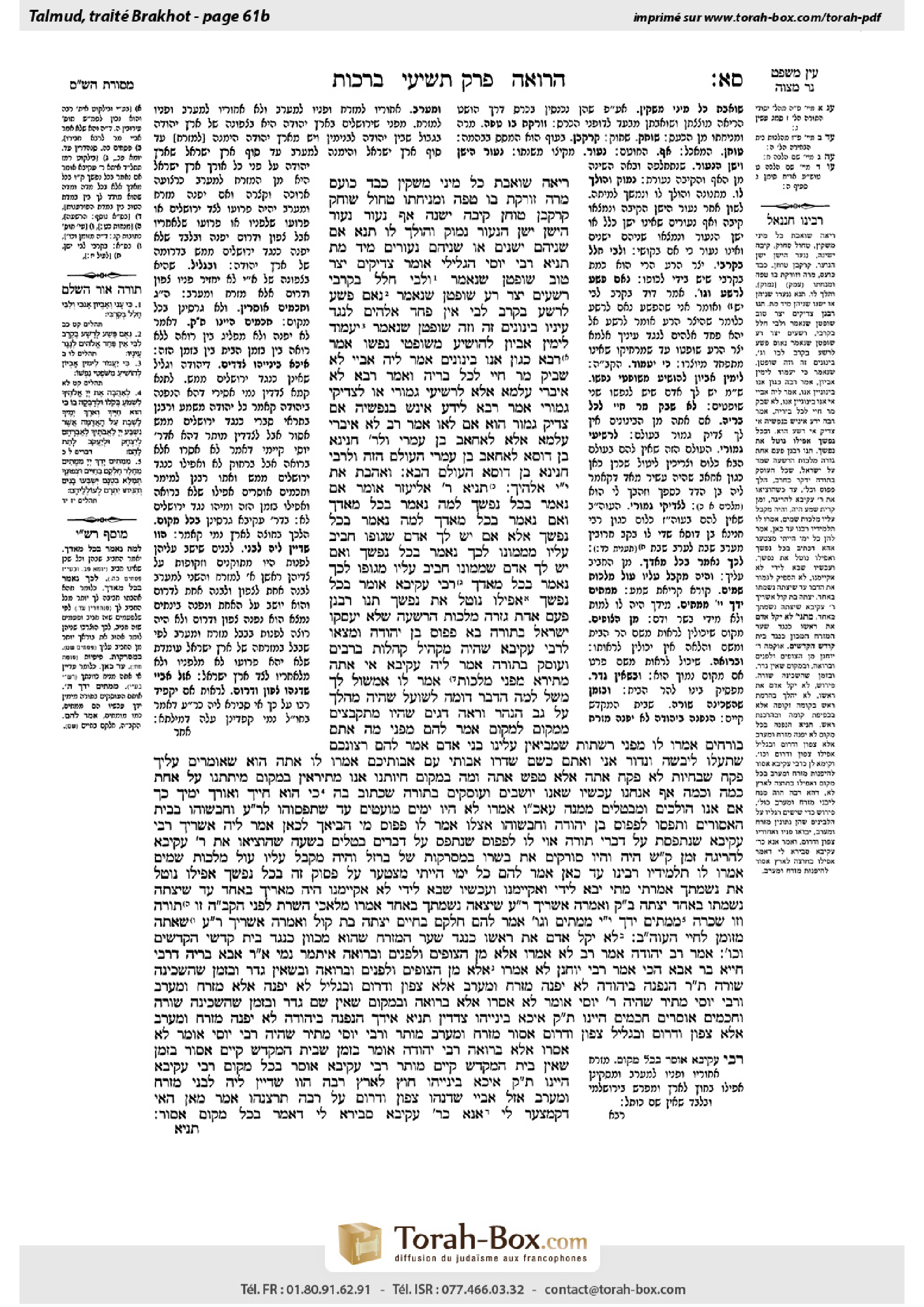
Berakhot 61b: Talmud study for Daf Yomi
Study the Talmud for Daf Yomi with scanned pages, Hebrew text, English translations from Sefaria and AI-generated French translations.
Passage selection and English or AI-generated French translation are available where the scan has annotations. Daf Study is independent of Torah-Box and Sefaria.
Browse Berakhot · ברכות · All tractatesBerakhot 61b text and translations
This page of Berakhot includes the Aramaic text, an English translation and an AI-generated French translation, alongside the scan above.
ברכות ס״א ב · Aramaic and Hebrew text
רֵיאָה שׁוֹאֶבֶת כׇּל מִינֵי מַשְׁקִין, כָּבֵד כּוֹעֵס, מָרָה זוֹרֶקֶת בּוֹ טִפָּה וּמְנִיחָתוֹ, טְחוֹל שׂוֹחֵק, קֻרְקְבָן טוֹחֵן, קֵיבָה יְשֵׁנָה, אַף נֵעוֹר. נֵעוֹר הַיָּשֵׁן יָשֵׁן הַנֵּעוֹר — נִמּוֹק וְהוֹלֵךְ לוֹ. תָּנָא: אִם שְׁנֵיהֶם יְשֵׁנִים אוֹ שְׁנֵיהֶם נֵעוֹרִים — מִיָּד מֵת.
תַּנְיָא רַבִּי יוֹסֵי הַגְּלִילִי אוֹמֵר: צַדִּיקִים יֵצֶר טוֹב שׁוֹפְטָן, שֶׁנֶּאֱמַר: ״וְלִבִּי חָלַל בְּקִרְבִּי״. רְשָׁעִים יֵצֶר רַע שׁוֹפְטָן, שֶׁנֶּאֱמַר: ״נְאֻם פֶּשַׁע לָרָשָׁע בְּקֶרֶב לִבִּי אֵין פַּחַד אֱלֹהִים לְנֶגֶד עֵינָיו״. בֵּינוֹנִים — זֶה וָזֶה שׁוֹפְטָן, שֶׁנֶּאֱמַר: ״יַעֲמֹד לִימִין אֶבְיוֹן לְהוֹשִׁיעַ מִשֹּׁפְטֵי נַפְשׁוֹ״.
אָמַר רַבָּה: כְּגוֹן אָנוּ בֵּינוֹנִים. אָמַר לֵיהּ אַבָּיֵי: לָא שָׁבֵיק מָר חַיֵּי לְכׇל בְּרִיָּה?
וְאָמַר רָבָא: לָא אִיבְּרִי עָלְמָא אֶלָּא לְרַשִּׁיעֵי גְּמוּרֵי אוֹ לְצַדִּיקֵי גְּמוּרֵי. אָמַר רָבָא: לִידַּע אִינָשׁ בְּנַפְשֵׁיהּ אִם צַדִּיק גָּמוּר הוּא אִם לָאו. אָמַר רַב: לָא אִיבְּרִי עָלְמָא אֶלָּא לְאַחְאָב בֶּן עָמְרִי וּלְרַבִּי חֲנִינָא בֶּן דּוֹסָא. לְאַחְאָב בֶּן עָמְרִי — הָעוֹלָם הַזֶּה, וּלְרַבִּי חֲנִינָא בֶּן דּוֹסָא — הָעוֹלָם הַבָּא.
״וְאָהַבְתָּ אֵת ה׳ אֱלֹהֶיךָ״. תַּנְיָא, רַבִּי אֱלִיעֶזֶר אוֹמֵר: אִם נֶאֱמַר ״בְּכָל נַפְשְׁךָ״, לָמָּה נֶאֱמַר ״בְּכָל מְאֹדֶךָ״?, וְאִם נֶאֱמַר ״בְּכָל מְאֹדֶךָ״, לָמָּה נֶאֱמַר ״בְּכָל נַפְשְׁךָ״? אֶלָּא אִם יֵשׁ לְךָ אָדָם שֶׁגּוּפוֹ חָבִיב עָלָיו מִמָּמוֹנוֹ — לְכָךְ נֶאֱמַר ״בְּכָל נַפְשְׁךָ״. וְאִם יֵשׁ לָךְ אָדָם שֶׁמָּמוֹנוֹ חָבִיב עָלָיו מִגּוּפוֹ — לְכָךְ נֶאֱמַר ״בְּכָל מְאֹדֶךָ״. רַבִּי עֲקִיבָא אוֹמֵר: ״בְּכָל נַפְשְׁךָ״ אֲפִילּוּ נוֹטֵל אֶת נַפְשְׁךָ.
תָּנוּ רַבָּנַן: פַּעַם אַחַת גָּזְרָה מַלְכוּת הָרְשָׁעָה שֶׁלֹּא יַעַסְקוּ יִשְׂרָאֵל בַּתּוֹרָה. בָּא פַּפּוּס בֶּן יְהוּדָה וּמְצָאוֹ לְרַבִּי עֲקִיבָא שֶׁהָיָה מַקְהִיל קְהִלּוֹת בָּרַבִּים וְעוֹסֵק בַּתּוֹרָה. אָמַר לוֹ: עֲקִיבָא אִי אַתָּה מִתְיָרֵא מִפְּנֵי מַלְכוּת?
אָמַר לוֹ: אֶמְשׁוֹל לְךָ מָשָׁל, לְמָה הַדָּבָר דּוֹמֶה — לְשׁוּעָל שֶׁהָיָה מְהַלֵּךְ עַל גַּב הַנָּהָר, וְרָאָה דָּגִים שֶׁהָיוּ מִתְקַבְּצִים מִמָּקוֹם לְמָקוֹם. אָמַר לָהֶם: מִפְּנֵי מָה אַתֶּם בּוֹרְחִים? אָמְרוּ לוֹ: מִפְּנֵי רְשָׁתוֹת שֶׁמְּבִיאִין עָלֵינוּ בְּנֵי אָדָם. אָמַר לָהֶם: רְצוֹנְכֶם שֶׁתַּעֲלוּ לַיַּבָּשָׁה, וְנָדוּר אֲנִי וְאַתֶּם, כְּשֵׁם שֶׁדָּרוּ אֲבוֹתַי עִם אֲבוֹתֵיכֶם? אָמְרוּ לוֹ: אַתָּה הוּא שֶׁאוֹמְרִים עָלֶיךָ פִּקֵּחַ שֶׁבַּחַיּוֹת?! לֹא פִּקֵּחַ אַתָּה, אֶלָּא טִפֵּשׁ אַתָּה! וּמָה בִּמְקוֹם חִיּוּתֵנוּ, אָנוּ מִתְיָרְאִין, בִּמְקוֹם מִיתָתֵנוּ — עַל אַחַת כַּמָּה וְכַמָּה. אַף אֲנַחְנוּ עַכְשָׁיו שֶׁאָנוּ יוֹשְׁבִים וְעוֹסְקִים בַּתּוֹרָה, שֶׁכָּתוּב בָּהּ: ״כִּי הוּא חַיֶּיךָ וְאֹרֶךְ יָמֶיךָ״, כָּךְ, אִם אָנוּ הוֹלְכִים וּמְבַטְּלִים מִמֶּנָּה — עַל אַחַת כַּמָּה וְכַמָּה!
אָמְרוּ: לֹא הָיוּ יָמִים מוּעָטִים, עַד שֶׁתְּפָסוּהוּ לְרַבִּי עֲקִיבָא וַחֲבָשׁוּהוּ בְּבֵית הָאֲסוּרִים, וְתָפְסוּ לְפַפּוּס בֶּן יְהוּדָה וַחֲבָשׁוּהוּ אֶצְלוֹ. אָמַר לוֹ: פַּפּוּס, מִי הֲבִיאֲךָ לְכָאן? אָמַר לוֹ: אַשְׁרֶיךָ רַבִּי עֲקִיבָא שֶׁנִּתְפַּסְתָּ עַל דִּבְרֵי תוֹרָה. אוֹי לוֹ לְפַפּוּס שֶׁנִּתְפַּס עַל דְּבָרִים בְּטֵלִים.
בְּשָׁעָה שֶׁהוֹצִיאוּ אֶת רַבִּי עֲקִיבָא לַהֲרִיגָה זְמַן קְרִיאַת שְׁמַע הָיָה, וְהָיוּ סוֹרְקִים אֶת בְּשָׂרוֹ בְּמַסְרְקוֹת שֶׁל בַּרְזֶל, וְהָיָה מְקַבֵּל עָלָיו עוֹל מַלְכוּת שָׁמַיִם. אָמְרוּ לוֹ תַּלְמִידָיו: רַבֵּינוּ, עַד כָּאן?! אָמַר לָהֶם: כׇּל יָמַי הָיִיתִי מִצְטַעֵר עַל פָּסוּק זֶה ״בְּכָל נַפְשְׁךָ״ אֲפִילּוּ נוֹטֵל אֶת נִשְׁמָתְךָ. אָמַרְתִּי: מָתַי יָבֹא לְיָדִי וַאֲקַיְּימֶנּוּ, וְעַכְשָׁיו שֶׁבָּא לְיָדִי, לֹא אֲקַיְּימֶנּוּ? הָיָה מַאֲרִיךְ בְּ״אֶחָד״, עַד שֶׁיָּצְתָה נִשְׁמָתוֹ בְּ״אֶחָד״. יָצְתָה בַּת קוֹל וְאָמְרָה: ״אַשְׁרֶיךָ רַבִּי עֲקִיבָא שֶׁיָּצְאָה נִשְׁמָתְךָ בְּאֶחָד״.
אָמְרוּ מַלְאֲכֵי הַשָּׁרֵת לִפְנֵי הַקָּדוֹשׁ בָּרוּךְ הוּא: זוֹ תּוֹרָה וְזוֹ שְׂכָרָהּ? ״מִמְתִים יָדְךָ ה׳ מִמְתִים וְגוֹ׳״! אָמַר לָהֶם: ״חֶלְקָם בַּחַיִּים״. יָצְתָה בַּת קוֹל וְאָמְרָה: ״אַשְׁרֶיךָ רַבִּי עֲקִיבָא שֶׁאַתָּה מְזוּמָּן לְחַיֵּי הָעוֹלָם הַבָּא״.
לֹא יָקֵל אָדָם אֶת רֹאשׁוֹ כְּנֶגֶד שַׁעַר הַמִּזְרָח שֶׁהוּא מְכוּוָּן כְּנֶגֶד בֵּית קׇדְשֵׁי הַקֳּדָשִׁים וְכוּ׳. אָמַר רַב יְהוּדָה אָמַר רַב: לֹא אָמְרוּ אֶלָּא מִן הַצּוֹפִים וְלִפְנִים, וּבְרוֹאֶה. אִיתְּמַר נָמֵי: אָמַר רַבִּי אַבָּא בְּרֵיהּ דְּרַבִּי חִיָּיא בַּר אַבָּא, הָכִי אָמַר רַבִּי יוֹחָנָן: לֹא אָמְרוּ אֶלָּא מִן הַצּוֹפִים וְלִפְנִים, וּבְרוֹאֶה וּבְשֶׁאֵין גָּדֵר, וּבִזְמַן שֶׁהַשְּׁכִינָה שׁוֹרָה.
תָּנוּ רַבָּנַן: הַנִּפְנֶה בִּיהוּדָה, לֹא יִפָּנֶה מִזְרָח וּמַעֲרָב, אֶלָּא צָפוֹן וְדָרוֹם. וּבַגָּלִיל לֹא יִפָּנֶה אֶלָּא מִזְרָח וּמַעֲרָב. וְרַבִּי יוֹסֵי מַתִּיר. שֶׁהָיָה רַבִּי יוֹסֵי אוֹמֵר: לֹא אָסְרוּ אֶלָּא בְּרוֹאֶה, וּבְמָקוֹם שֶׁאֵין שָׁם גָּדֵר, וּבִזְמַן שֶׁהַשְּׁכִינָה שׁוֹרָה. וַחֲכָמִים אוֹסְרִים.
חֲכָמִים הַיְינוּ תַּנָּא קַמָּא! אִיכָּא בֵּינַיְיהוּ צְדָדִין.
תַּנְיָא אִידַּךְ: הַנִּפְנֶה בִּיהוּדָה — לֹא יִפָּנֶה מִזְרָח וּמַעֲרָב אֶלָּא צָפוֹן וְדָרוֹם. וּבַגָּלִיל, צָפוֹן וְדָרוֹם — אָסוּר, מִזְרָח וּמַעֲרָב — מוּתָּר. וְרַבִּי יוֹסֵי מַתִּיר. שֶׁהָיָה רַבִּי יוֹסֵי אוֹמֵר: לֹא אָסְרוּ אֶלָּא בְּרוֹאֶה. רַבִּי יְהוּדָה אוֹמֵר: בִּזְמַן שֶׁבֵּית הַמִּקְדָּשׁ קַיָּים — אָסוּר, בִּזְמַן שֶׁאֵין בֵּית הַמִּקְדָּשׁ קַיָּים — מוּתָּר. רַבִּי עֲקִיבָא אוֹסֵר בְּכָל מָקוֹם.
רַבִּי עֲקִיבָא הַיְינוּ תַּנָּא קַמָּא! אִיכָּא בֵּינַיְיהוּ חוּץ לָאָרֶץ.
רַבָּה הֲווֹ שַׁדְיָין לֵיהּ לִבְנֵי מִזְרָח וּמַעֲרָב. אֲזַל אַבָּיֵי שְׁדַנְהוּ צְפוֹן וְדָרוֹם, עָל רַבָּה תָּרְצַנְהוּ. אֲמַר: מַאן הַאי דְּקָמְצַעַר לִי? אֲנָא כְּרַבִּי עֲקִיבָא סְבִירָא לִי דְּאָמַר: בְּכָל מָקוֹם אָסוּר.
Berakhot 61b · English translation
and the lungs draw all kinds of liquids, the liver becomes angry, the gall bladder injects a drop of gall into the liver and allays anger, the spleen laughs, the maw grinds the food, and the stomach brings sleep, and the nose awakens. If they reversed roles such that the organ which brings on sleep were to awaken, or the organ which awakens were to bring on sleep, the individual would gradually deteriorate. It was taught: If both bring on sleep or both awaken, the person immediately dies.
With regard to one’s inclinations, it was taught in a baraita that Rabbi Yosei HaGelili says: The good inclination rules the righteous, as it is stated: “And my heart is dead within me” (Psalms 109:22); the evil inclination has been completely banished from his heart. The evil inclination rules the wicked, as it is stated: “Transgression speaks to the wicked, there is no fear of God before his eyes” (Psalms 36:2). Middling people are ruled by both the good and evil inclinations, as it is stated: “Because He stands at the right hand of the needy, to save him from them that rule his soul” (Psalms 109:31).
Rabba said: People like us are middling. Abaye, his student and nephew, said to him: If the Master claims that he is merely middling, he does not leave room for any creature to live. If a person like you is middling, what of the rest of us?
And Rava said: The world was created only for the sake of the full-fledged wicked or the full-fledged righteous; others do not live complete lives in either world. Rava said: One should know of himself whether or not he is completely righteous, as if he is not completely righteous, he knows that his life will be a life of suffering. Rav said: The world was created only for the wicked Ahab ben Omri and for Rabbi Ḥanina ben Dosa. The Gemara explains: For Ahab ben Omri, this world was created, as he has no place in the World-to-Come, and for Rabbi Ḥanina ben Dosa, the World-to-Come was created.
We learned in our mishna the explanation of the verse: “And you shall love the Lord your God with all your heart and all your soul and all your might” (Deuteronomy 6:5). This was elaborated upon when it was taught in a baraita: Rabbi Eliezer says: If it is stated: “With all your soul,” why does it state: “With all your might”? Conversely, if it stated: “With all your might,” why does it state: “With all your soul”? Rather, this means that if one’s body is dearer to him than his property, therefore it is stated: “With all your soul”; one must give his soul in sanctification of God. And if one’s money is dearer to him than his body, therefore it is stated: “With all your might”; with all your assets. Rabbi Akiva says: “With all your soul” means: Even if God takes your soul.
The Gemara relates at length how Rabbi Akiva fulfilled these directives. The Sages taught: One time, after the bar Kokheva rebellion, the evil empire of Rome decreed that Israel may not engage in the study and practice of Torah. Pappos ben Yehuda came and found Rabbi Akiva, who was convening assemblies in public and engaging in Torah study. Pappos said to him: Akiva, are you not afraid of the empire?
Rabbi Akiva answered him: I will relate a parable. To what can this be compared? It is like a fox walking along a riverbank when he sees fish gathering and fleeing from place to place.
The fox said to them: From what are you fleeing?
They said to him: We are fleeing from the nets that people cast upon us.
He said to them: Do you wish to come up onto dry land, and we will reside together just as my ancestors resided with your ancestors?
The fish said to him: You are the one of whom they say, he is the cleverest of animals? You are not clever; you are a fool. If we are afraid in the water, our natural habitat which gives us life, then in a habitat that causes our death, all the more so.
The moral is: So too, we Jews, now that we sit and engage in Torah study, about which it is written: “For that is your life, and the length of your days” (Deuteronomy 30:20), we fear the empire to this extent; if we proceed to sit idle from its study, as its abandonment is the habitat that causes our death, all the more so will we fear the empire.
The Sages said: Not a few days passed until they seized Rabbi Akiva and incarcerated him in prison, and seized Pappos ben Yehuda and incarcerated him alongside him. Rabbi Akiva said to him: Pappos, who brought you here? Pappos replied: Happy are you, Rabbi Akiva, for you were arrested on the charge of engaging in Torah study. Woe unto Pappos who was seized on the charge of engaging in idle matters.
The Gemara relates: When they took Rabbi Akiva out to be executed, it was time for the recitation of Shema. And they were raking his flesh with iron combs, and he was reciting Shema, thereby accepting upon himself the yoke of Heaven. His students said to him: Our teacher, even now, as you suffer, you recite Shema? He said to them: All my days I have been troubled by the verse: With all your soul, meaning: Even if God takes your soul. I said to myself: When will the opportunity be afforded me to fulfill this verse? Now that it has been afforded me, shall I not fulfill it? He prolonged his uttering of the word: One, until his soul left his body as he uttered his final word: One. A voice descended from heaven and said: Happy are you, Rabbi Akiva, that your soul left your body as you uttered: One.
The ministering angels said before the Holy One, Blessed be He: This is Torah and this its reward? As it is stated: “From death, by Your hand, O Lord, from death of the world” (Psalms 17:14); Your hand, God, kills and does not save. God said the end of the verse to the ministering angels: “Whose portion is in this life.” And then a Divine Voice emerged and said: Happy are you, Rabbi Akiva, as you are destined for life in the World-to-Come, as your portion is already in eternal life.
We learned in the mishna that one may not act irreverently opposite the Eastern Gate, which is aligned with the Holy of Holies. Limiting this halakha, Rav Yehuda said that Rav said: They only said this halakha with regard to irreverent behavior from Mount Scopus [Tzofim] and within, and specifically areas from where one can see the Temple. It is also stated: Rabbi Abba, son of Rabbi Ḥiyya bar Abba, said: Rabbi Yoḥanan said the following: They only said this halakha with regard to Mount Scopus and within, when one can see, and when there is no fence obstructing his view, and when the Divine Presence is resting there, i.e., when the Temple is standing.
In this context, the Sages taught: One who defecates in Judea should not defecate when facing east and west, for then he is facing Jerusalem; rather he should do so facing north and south. But in the Galilee which is north of Jerusalem, one should only defecate facing east and west. Rabbi Yosei permits doing so, as Rabbi Yosei was wont to say: They only prohibited doing so when one can see the Temple, where there is no fence, and when the Divine Presence is resting there. And the Rabbis prohibit doing so.
The Gemara argues: But the opinion of the Rabbis, who prohibit this, is identical to that of the first anonymous tanna, who also prohibits doing so. The Gemara replies: The practical difference between them is with regard to the sides, i.e., a place in Judea that is not directly east or west of Jerusalem, or a place in the Galilee that is not directly north of Jerusalem. According to the first tanna, it is prohibited; according to the Rabbis, it is permitted.
It was taught in another baraita: One who defecates in Judea should not defecate when facing east and west; rather, he should only do so facing north and south. And in the Galilee, defecating while facing north and south is prohibited, while east and west is permitted. And Rabbi Yosei permitted doing so, as Rabbi Yosei was wont to say: They only prohibited doing so when one can see the Temple. Rabbi Yehuda says: When the Temple is standing, it is prohibited, but when the Temple is not standing, it is permitted. The Gemara adds that Rabbi Akiva prohibits defecating anywhere while facing east and west.
The Gemara challenges this: Rabbi Akiva’s position is identical to that of the first, anonymous tanna, who also prohibits doing so. The Gemara responds: The practical difference between them is with regard to places outside of Eretz Yisrael, as according to Rabbi Akiva, even outside of Eretz Yisrael, defecating while facing east and west is prohibited.
The Gemara relates that in Rabba’s bathroom, the bricks were placed east and west in order to ensure that he would defecate facing north and south. Abaye went and placed them north and south, to test if Rabba was particular about their direction or if they had simply been placed east and west incidentally. Rabba entered and fixed them. He said: Who is the one that is upsetting me? I hold in accordance with the opinion of Rabbi Akiva, who said: It is prohibited everywhere.
Berakhot 61b · Traduction française (IA)
et les poumons absorbent toutes sortes de liquides, le foie devient en colère, la vésicule biliaire injecte une goutte de bile dans le foie et apaise la colère, le rate rit, la mâchoire mâche la nourriture, et l'estomac provoque le sommeil, et le nez réveille. Si les rôles étaient inversés, de sorte que l'organe qui provoque le sommeil fût celui qui réveille, ou l'organe qui réveille fût celui qui provoque le sommeil, la personne s'aggravera progressivement. Il a été enseigné : Si les deux provoquent le sommeil ou les deux réveillent, la personne meurt immédiatement.
En ce qui concerne les inclinations d'une personne, il a été enseigné dans une baraïta que Rabbi Yosei HaGelili dit : L'inclination bonne domine le juste, comme il est dit : « Et mon cœur est mort en moi » (Psaumes 109:22) ; l'inclination mauvaise a été entièrement expulsée de son cœur. L'inclination mauvaise domine le méchant, comme il est dit : « La transgression parle au méchant, il n'y a pas de crainte de Dieu devant ses yeux » (Psaumes 36:2). Les gens moyens sont dominés par les deux inclinations, comme il est dit : « Parce qu'Il est debout à la droite du pauvre, pour le sauver de ceux qui dominent son âme » (Psaumes 109:31).
Rabba a dit : Les gens comme nous sont moyens. Abaye, son élève et son neveu, lui a dit : Si le Maître affirme qu'il est simplement moyen, il ne laisse aucune créature vivre. Si un homme comme vous est moyen, que deviennent les autres ?
Et Rava a dit : Le monde a été créé uniquement pour le méchant accompli ou le juste accompli ; les autres ne vivent pas une vie complète dans ce monde ou dans le monde à venir. Rava a dit : On doit savoir de soi-même s'il est totalement juste, car si ce n'est pas le cas, il sait que sa vie sera une vie de souffrance. Rav a dit : Le monde a été créé uniquement pour le méchant Ahab ben Omri et pour Rabbi Ḥanina ben Dosa. La Guemara explique : Pour Ahab ben Omri, ce monde a été créé, car il n'a pas sa place dans le monde à venir, et pour Rabbi Ḥanina ben Dosa, le monde à venir a été créé.
Nous avons appris dans notre Michna l'explication du verset : « Et tu aimeras le Seigneur ton Dieu avec tout ton cœur et toute ton âme et toute ta force » (Lévitique 6:5). Cela a été développé lorsqu'il a été enseigné dans une Baraita : Rabbi Eliezer dit : Si on dit : « Avec toute ton âme », pourquoi dit-on : « Avec toute ta force » ? À l'inverse, si on disait : « Avec toute ta force », pourquoi dit-on : « Avec toute ton âme » ? Cela signifie que si le corps est plus cher à une personne que ses biens, donc on dit : « Avec toute ton âme » ; on doit donner son âme pour la sanctification de Dieu. Et si les biens sont plus chers à une personne que son corps, donc on dit : « Avec toute ta force » ; avec tous ses biens. Rabbi Akiva dit : « Avec toute ton âme » signifie : Même si Dieu prend ton âme.
La Guemara relate longuement comment Rabbi Akiva a accompli ces directives. Les Sages ont enseigné : Une fois, après la rébellion de Bar Kokhba, l'empire maléfique de Rome a décrété que les Israélites ne pourraient pas étudier ni pratiquer la Torah. Pappos ben Yehuda est venu et a trouvé Rabbi Akiva, qui convoquait des assemblées en public et étudiait la Torah. Pappos lui a dit : Akiva, n'as-tu pas peur de l'empire ?
Rabbi Akiva lui répondit : Je vais établir une comparaison. À quoi peut-on comparer cela ? C'est comme un renard marchant le long d'une rive lorsqu'il voit des poissons se rassembler et fuir d'un endroit à l'autre. Le renard demanda aux poissons : De quoi fuirez-vous ? Ils lui répondirent : Nous fuyons les filets que les gens jettent sur nous. Il leur dit : Voulez-vous monter sur la terre ferme, et nous habiter ensemble comme mes ancêtres habitaient avec vos ancêtres ? Les poissons lui répondirent : Vous êtes celui dont on dit qu'il est le plus intelligent des animaux ? Vous n'êtes pas intelligent ; vous êtes un imbécile. Si nous avons peur dans l'eau, notre habitat naturel qui nous donne la vie, alors dans un habitat qui nous cause la mort, encore plus. Le moral est : De même, nous Juifs, maintenant que nous nous asseyons et étudions la Torah, dont il est dit : « Car c'est votre vie, et la durée de vos jours » (Deutéronome 30:20), nous craignons l'empire à ce point ; si nous procédons à nous reposer de son étude, comme son abandon est le habitat qui cause notre mort, encore plus nous craignons l'empire.
Les Sages dirent : Peu de jours s'étaient écoulés jusqu'à ce qu'ils emprisonnent Rabbi Akiva et le mettent en prison, et emprisonnent Pappos ben Yehuda à côté de lui. Rabbi Akiva dit à Pappos : Pappos, qui t'a amené ici ? Pappos répondit : Heureux es-tu, Rabbi Akiva, car tu as été arrêté pour l'étude de la Torah. Malheur à Pappos qui a été emprisonné pour l'étude des choses vaines.
La Guemara relate : Lorsqu'ils ont sorti Rabbi Akiva pour l'exécuter, c'était l'heure de la récitation du Chéma. Et ils le grattaient avec des brosses en fer, et il récitait le Chéma, acceptant ainsi le joug du Royaume des Cieux. Ses élèves lui dirent : Notre maître, même maintenant, alors que tu souffres, tu récites le Chéma ? Il leur dit : Toute ma vie j'ai été tourmenté par le verset : Avec toute ton âme, c'est-à-dire : Même si Dieu prend ton âme. J'ai pensé à moi-même : Quand l'occasion sera donnée de remplir ce verset ? Maintenant qu'elle est donnée, ne vais-je pas la remplir ? Il a prolongé la prononciation du mot : Un, jusqu'à ce que son âme quitte son corps lorsqu'il a prononcé son dernier mot : Un. Une voix est descendue du ciel et a dit : Heureux es-tu, Rabbi Akiva, que ton âme a quitté ton corps alors que tu prononçais : Un.
Les anges ministraux dirent devant le Saint, le Béni soit-Il : C'est la Torah et sa récompense ? Comme il est dit : « De la mort, par ta main, ô Seigneur, de la mort du monde » (Psaumes 17:14) ; ta main, ô Dieu, tue et ne sauve pas. Dieu dit la fin du verset aux anges ministraux : « Qui a sa part dans cette vie. » Et alors une Voix divine sortit et dit : Heureux es-tu, Rabbi Akiva, car tu es destiné à la vie dans le monde à venir, car ta part est déjà dans la vie éternelle.
Nous avons appris dans la Michna que l'on ne doit pas agir avec irreverence face à la porte orientale, qui est alignée avec le Saint des Saints. En limitant cette halakha, Rav Yehuda a dit que Rav a dit : Ils ont dit cette halakha uniquement concernant l'irrévérence depuis le mont Scopus [Tzofim] et à l'intérieur, et spécifiquement les zones d'où l'on peut voir le Temple. Il est également dit : Rabbi Abba, fils de Rabbi Ḥiyya bar Abba, a dit : Rabbi Yoḥanan a dit ceci : Ils ont dit cette halakha uniquement concernant le mont Scopus et à l'intérieur, lorsque l'on peut voir, et lorsque l'on n'a pas de clôture qui obstrue la vue, et lorsque la Divine Présence repose là, c'est-à-dire lorsque le Temple est debout.
Dans ce contexte, les Sages ont enseigné : Celui qui défèque en Judée ne doit pas déféquer face à l'est et à l'ouest, car alors il fait face à Jérusalem ; il doit plutôt le faire face au nord et au sud. Mais dans la Galilée, qui est au nord de Jérusalem, on doit seulement déféquer face à l'est et à l'ouest. Rabbi Yosei permet cela, car Rabbi Yosei disait habituellement : Ils ont interdit cela uniquement lorsque l'on peut voir le Temple, où il n'y a pas de clôture, et lorsque la Divine Présence repose là. Et les Rabbins interdisent cela.
Le Guemara discute : Mais l'opinion des Rabbins, qui interdisent cela, est identique à celle du premier tanna anonyme, qui interdisait également cela. Le Guemara répond : La différence pratique entre eux concerne les côtés, c'est-à-dire un lieu en Judée qui n'est pas directement à l'est ou à l'ouest de Jérusalem, ou un lieu en Galilée qui n'est pas directement au nord de Jérusalem. Selon le premier tanna, cela est interdit ; selon les Rabbins, cela est permis.
Il a été enseigné dans une autre baraïta : Celui qui défèque en Judée ne doit pas déféquer face à l'est et à l'ouest ; il doit plutôt le faire face au nord et au sud. Et en Galilée, déféquer face au nord et au sud est interdit, tandis que face à l'est et à l'ouest est permis. Et Rabbi Yosei permet cela, car Rabbi Yosei disait habituellement : Ils ont interdit cela uniquement lorsque l'on peut voir le Temple. Rabbi Yehuda dit : Lorsque le Temple est debout, cela est interdit, mais lorsque le Temple n'est pas debout, cela est permis. La Guemara ajoute que Rabbi Akiva interdit de déféquer partout face à l'est et à l'ouest.
La Guemara conteste cela : La position de Rabbi Akiva est identique à celle du premier tanna anonyme, qui interdisait également cela. La Guemara répond : La différence pratique entre eux concerne les lieux en dehors de la Terre d'Israël, car selon Rabbi Akiva, même en dehors de la Terre d'Israël, déféquer face à l'est et à l'ouest est interdit.
La Guemara rapporte que dans la salle de bain de Rabba, les briques étaient placées à l'est et à l'ouest afin d'assurer que l'on déféquerait face au nord et au sud. Abaye est allé les placer au nord et au sud pour tester si Rabba était particulier à leur orientation ou si elles avaient simplement été placées à l'est et à l'ouest par hasard. Rabba est entré et les a réparées. Il a dit : Qui est celui qui me dérange ? Je suis en accord avec l'opinion de Rabbi Akiva, qui a dit : Cela est interdit partout.
Traduction française générée par IA à partir de l’édition anglaise de Sefaria. Vérifie toujours un passage avec le texte source.
Text from Sefaria: William Davidson Edition - Vocalized Aramaic (CC BY NC); William Davidson Edition - English (CC BY NC).