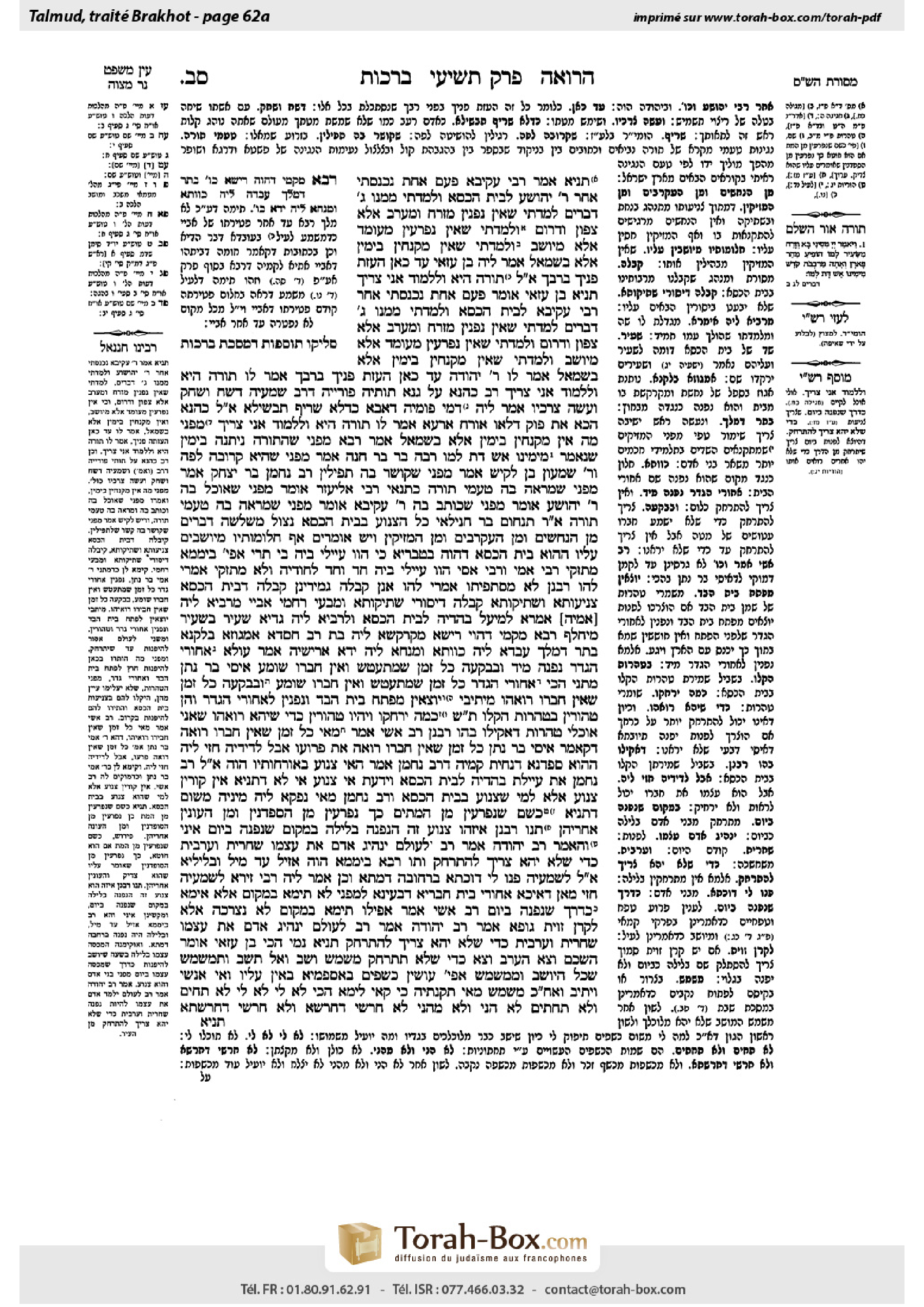
Berakhot 62a: Talmud study for Daf Yomi
Study the Talmud for Daf Yomi with scanned pages, Hebrew text, English translations from Sefaria and AI-generated French translations.
Passage selection and English or AI-generated French translation are available where the scan has annotations. Daf Study is independent of Torah-Box and Sefaria.
Browse Berakhot · ברכות · All tractatesBerakhot 62a text and translations
This page of Berakhot includes the Aramaic text, an English translation and an AI-generated French translation, alongside the scan above.
ברכות ס״ב א · Aramaic and Hebrew text
תַּנְיָא, אָמַר רַבִּי עֲקִיבָא: פַּעַם אַחַת נִכְנַסְתִּי אַחַר רַבִּי יְהוֹשֻׁעַ לְבֵית הַכִּסֵּא, וְלָמַדְתִּי מִמֶּנּוּ שְׁלֹשָׁה דְּבָרִים: לָמַדְתִּי שֶׁאֵין נִפְנִין מִזְרָח וּמַעֲרָב אֶלָּא צָפוֹן וְדָרוֹם, וְלָמַדְתִּי שֶׁאֵין נִפְרָעִין מְעוּמָּד אֶלָּא מְיוּשָּׁב, וְלָמַדְתִּי שֶׁאֵין מְקַנְּחִין בְּיָמִין אֶלָּא בִּשְׂמֹאל. אָמַר לוֹ בֶּן עַזַּאי: עַד כָּאן הֵעַזְתָּ פָּנֶיךָ בְּרַבְּךָ?! אָמַר לוֹ תּוֹרָה הִיא, וְלִלְמוֹד אֲנִי צָרִיךְ.
תַּנְיָא, בֶּן עַזַּאי אוֹמֵר: פַּעַם אַחַת נִכְנַסְתִּי אַחַר רַבִּי עֲקִיבָא לְבֵית הַכִּסֵּא, וְלָמַדְתִּי מִמֶּנּוּ שְׁלֹשָׁה דְּבָרִים: לָמַדְתִּי שֶׁאֵין נִפְנִין מִזְרָח וּמַעֲרָב אֶלָּא צָפוֹן וְדָרוֹם, וְלָמַדְתִּי שֶׁאֵין נִפְרָעִין מְעוּמָּד אֶלָּא מְיוּשָּׁב, וְלָמַדְתִּי שֶׁאֵין מְקַנְּחִין בְּיָמִין אֶלָּא בִּשְׂמֹאל. אָמַר לוֹ רַבִּי יְהוּדָה: עַד כָּאן הֵעַזְתָּ פָּנֶיךָ בְּרַבְּךָ?! אָמַר לוֹ: תּוֹרָה הִיא, וְלִלְמוֹד אֲנִי צָרִיךְ.
רַב כָּהֲנָא עָל, גְּנָא תּוּתֵיהּ פּוּרְיֵיהּ דְּרַב. שַׁמְעֵיהּ דְּשָׂח וְשָׂחַק וְעָשָׂה צְרָכָיו. אֲמַר לֵיהּ: דָּמֵי פּוּמֵּיהּ דְּאַבָּא כִּדְלָא שָׂרֵיף תַּבְשִׁילָא. אֲמַר לֵיהּ: כָּהֲנָא, הָכָא אַתְּ? פּוּק, דְּלָאו אֹרַח אַרְעָא. אֲמַר לֵיהּ: תּוֹרָה הִיא, וְלִלְמוֹד אֲנִי צָרִיךְ.
מִפְּנֵי מָה אֵין מְקַנְּחִין בְּיָמִין אֶלָּא בִּשְׂמֹאל? אָמַר רָבָא: מִפְּנֵי שֶׁהַתּוֹרָה נִיתְּנָה בְּיָמִין, שֶׁנֶּאֱמַר: ״מִימִינוֹ אֵשׁ דָּת לָמוֹ״. רַבָּה בַּר בַּר חָנָה אָמַר: מִפְּנֵי שֶׁהִיא קְרוֹבָה לַפֶּה. וְרַבִּי שִׁמְעוֹן בֶּן לָקִישׁ אָמַר: מִפְּנֵי שֶׁקּוֹשֵׁר בָּהּ תְּפִילִּין. רַב נַחְמָן בַּר יִצְחָק אָמַר: מִפְּנֵי שֶׁמַּרְאֶה בָּהּ טַעֲמֵי תוֹרָה.
כְּתַנָּאֵי. רַבִּי אֱלִיעֶזֶר אוֹמֵר: מִפְּנֵי שֶׁאוֹכֵל בָּהּ. רַבִּי יְהוֹשֻׁעַ אוֹמֵר: מִפְּנֵי שֶׁכּוֹתֵב בָּהּ. רַבִּי עֲקִיבָא אוֹמֵר: מִפְּנֵי שֶׁמַּרְאֶה בָּהּ טַעֲמֵי תוֹרָה.
אָמַר רַבִּי תַּנְחוּם בַּר חֲנִילַאי: כׇּל הַצָּנוּעַ בְּבֵית הַכִּסֵּא נִצּוֹל מִשְּׁלֹשָׁה דְּבָרִים — מִן הַנְּחָשִׁים, וּמִן הָעַקְרַבִּים, וּמִן הַמַּזִּיקִין. וְיֵשׁ אוֹמְרִים אַף חֲלוֹמוֹתָיו מְיוּשָּׁבִים עָלָיו.
הַהוּא בֵּית הַכִּסֵּא דַּהֲוָה בִּטְבֶרְיָא, כִּי הֲווֹ עָיְילִי בֵּיהּ בֵּי תְרֵי — אֲפִילּוּ בִּימָמָא מִתַּזְּקִי. רַבִּי אַמֵּי וְרַבִּי אַסִּי הֲווֹ עָיְילִי בֵּיהּ חַד וְחַד לְחוֹדֵיהּ — וְלָא מִתַּזְּקִי. אָמְרִי לְהוּ רַבָּנַן: לָא מִסְתְּפֵיתוּ? אָמְרִי לְהוּ: אֲנַן קַבָּלָה גְּמִירִינַן, קַבָּלָה דְּבֵית הַכִּסֵּא — צְנִיעוּתָא וּשְׁתִיקוּתָא. קַבָּלָה דְיִסּוּרֵי — שְׁתִיקוּתָא וּמִבְעֵי רַחֲמֵי.
אַבָּיֵי מְרַבְּיָא לֵיהּ אִמֵּיהּ אִמְּרָא לְמֵיעַל בַּהֲדֵיהּ לְבֵית הַכִּסֵּא. וּלְרַבֵּי לֵיהּ גַּדְיָא! שָׂעִיר בְּשָׂעִיר מִיחַלַּף.
רָבָא, מִקַּמֵּי דַּהֲוָה רֵישָׁא, מְקַרְקְשָׁא לֵיהּ בַּת רַב חִסְדָּא אַמְגּוּזָא בְּלָקָנָא. בָּתַר דִּמְלַךְ, עֲבַדָא לֵיהּ כַּוְּותָא, וּמַנְּחָא לֵיהּ יְדָא אַרֵישֵׁיהּ.
אָמַר עוּלָּא: אֲחוֹרֵי הַגָּדֵר — נִפְנֶה מִיָּד. וּבַבִּקְעָה, כׇּל זְמַן שֶׁמִּתְעַטֵּשׁ וְאֵין חֲבֵרוֹ שׁוֹמֵעַ. אִיסִי בַּר נָתָן מַתְנֵי הָכִי: אֲחוֹרֵי הַגָּדֵר, כׇּל זְמַן שֶׁמִּתְעַטֵּשׁ וְאֵין חֲבֵרוֹ שׁוֹמֵעַ, וּבַבִּקְעָה — כׇּל זְמַן שֶׁאֵין חֲבֵרוֹ רוֹאֵהוּ.
מֵיתִיבִי: יוֹצְאִין מִפֶּתַח בֵּית הַבַּד, וְנִפְנִין לַאֲחוֹרֵי הַגָּדֵר, וְהֵן טְהוֹרִין!
בִּטְהָרוֹת הֵקֵלּוּ.
תָּא שְׁמַע: כַּמָּה יַרְחִקוּ וְיִהְיוּ טְהוֹרִין — כְּדֵי שֶׁיְּהֵא רוֹאֵהוּ! שָׁאנֵי אוֹכְלֵי טְהָרוֹת, דַּאֲקִילּוּ בְּהוּ רַבָּנַן.
רַב אָשֵׁי אָמַר: מַאי ״כׇּל זְמַן שֶׁאֵין חֲבֵרוֹ רוֹאֶה״ דְּקָאָמַר אִיסִי בַּר נָתָן — כׇּל זְמַן שֶׁאֵין חֲבֵרוֹ רוֹאֶה אֶת פֵּרוּעוֹ, אֲבָל לְדִידֵיהּ חָזֵי לֵיהּ.
הַהוּא סַפְדָנָא דִּנְחֵית קַמֵּיהּ דְּרַב נַחְמָן, אֲמַר: ״הַאי צָנוּעַ בְּאוֹרְחוֹתָיו הֲוָה״. אֲמַר לֵיהּ רַב נַחְמָן: אַתְּ עֲיַילְתְּ בַּהֲדֵיהּ לְבֵית הַכִּסֵּא וְיָדְעַתְּ אִי צָנוּעַ אִי לָא? דְּתַנְיָא: אֵין קוֹרִין ״צָנוּעַ״ אֶלָּא לְמִי שֶׁצָּנוּעַ בְּבֵית הַכִּסֵּא.
וְרַב נַחְמָן מַאי נָפְקָא לֵיהּ מִינֵּיהּ? מִשּׁוּם דְּתַנְיָא: כְּשֵׁם שֶׁנִּפְרָעִין מִן הַמֵּתִים כָּךְ נִפְרָעִין מִן הַסַּפְדָנִין, וּמִן הָעוֹנִין אַחֲרֵיהֶן.
תָּנוּ רַבָּנַן: אֵיזֶהוּ צָנוּעַ — זֶה הַנִּפְנֶה בַּלַּיְלָה בַּמָּקוֹם שֶׁנִּפְנָה בַּיּוֹם.
אִינִי?! וְהָאָמַר רַב יְהוּדָה אָמַר רַב: לְעוֹלָם יַנְהִיג אָדָם אֶת עַצְמוֹ שַׁחֲרִית וְעַרְבִית, כְּדֵי שֶׁלֹּא יְהֵא צָרִיךְ לְהִתְרַחֵק! וְתוּ, רָבָא בִּימָמָא הֲוָה אָזֵיל עַד מִיל, וּבְלֵילְיָא אָמַר לֵיהּ לְשַׁמָּעֵיהּ: פַּנּוֹ לִי דּוּכְתָּא בִּרְחוֹבָא דְמָתָא. וְכֵן אָמַר לֵיהּ רַבִּי זֵירָא לְשַׁמָּעֵיהּ: חֲזִי מַאן דְּאִיכָּא אֲחוֹרֵי בֵּית חֶבְרַיָּא, דְּבָעֵינָא לְמִפְנֵי! לָא תֵּימָא בַּמָּקוֹם, אֶלָּא אֵימָא: כְּדֶרֶךְ שֶׁנִּפְנָה בַּיּוֹם.
רַב אָשֵׁי אָמַר: אֲפִילּוּ תֵּימָא בַּמָּקוֹם, לֹא נִצְרְכָה אֶלָּא לְקֶרֶן זָוִית.
גּוּפָא. אָמַר רַב יְהוּדָה אָמַר רַב: לְעוֹלָם יַנְהִיג אָדָם אֶת עַצְמוֹ שַׁחֲרִית וְעַרְבִית, כְּדֵי שֶׁלֹּא יְהֵא צָרִיךְ לְהִתְרַחֵק.
תַּנְיָא נָמֵי הָכִי, בֶּן עַזַּאי אוֹמֵר: הַשְׁכֵּם וָצֵא, הַעֲרֵב וָצֵא, כְּדֵי שֶׁלֹּא תִּתְרַחֵק. מַשְׁמֵשׁ וָשֵׁב, וְאַל תֵּשֵׁב וּתְמַשְׁמֵשׁ, שֶׁכָּל הַיּוֹשֵׁב וּמְמַשְׁמֵשׁ — אֲפִילּוּ עוֹשִׂין כְּשָׁפִים בְּאַסְפַּמְיָא, בָּאִין עָלָיו.
וְאִי אִנְּשִׁי וִיתִיב וְאַחַר כָּךְ מַשְׁמֵשׁ, מַאי תַּקַּנְתֵּיהּ? — כִּי קָאֵי, לֵימָא הָכִי: ״לָא לִי לָא לִי, לָא תַּחִים וְלָא תַּחְתִּים, לָא הָנֵי וְלָא מֵהָנֵי, לָא חַרְשֵׁי דְחַרָּשָׁא וְלָא חַרְשֵׁי דְחַרָּשְׁתָא״.
Berakhot 62a · English translation
It was taught in a baraita in tractate Derekh Eretz that Rabbi Akiva said: I once entered the bathroom after my teacher Rabbi Yehoshua, and I learned three things from observing his behavior: I learned that one should not defecate while facing east and west, but rather while facing north and south; I learned that one should not uncover himself while standing, but while sitting, in the interest of modesty; and I learned that one should not wipe with his right hand, but with his left. Ben Azzai, a student of Rabbi Akiva, said to him: You were impertinent to your teacher to that extent that you observed that much? He replied: It is Torah, and I must learn.
Similarly, we learned in a baraita: Ben Azzai said: I once entered a bathroom after Rabbi Akiva, and I learned three things from observing his behavior: I learned that one should not defecate while facing east and west, but rather while facing north and south; I learned that one should not uncover himself while standing, but while sitting; and I learned that one should not wipe with his right hand, but with his left. Rabbi Yehuda said to him: You were impertinent to your teacher to that extent? He replied: It is Torah, and I must learn.
On a similar note, the Gemara relates that Rav Kahana entered and lay beneath Rav’s bed. He heard Rav chatting and laughing with his wife, and seeing to his needs, i.e., having relations with her. Rav Kahana said to Rav: The mouth of Abba, Rav, is like one whom has never eaten a cooked dish, i.e., his behavior was lustful. Rav said to him: Kahana, you are here? Leave, as this is an undesirable mode of behavior. Rav Kahana said to him: It is Torah, and I must learn.
The Gemara asks: Why must one not wipe himself with his right hand, but with his left? Rava said: Because the Torah was given with the right hand, as it is stated: “At His right hand was a fiery law unto them” (Deuteronomy 33:2). Rabba bar bar Ḥana said: Because the right hand is close to the mouth, i.e., people eat with the right hand. And Rabbi Shimon ben Lakish said: Because one ties the phylacteries onto his left hand with his right hand. Rav Naḥman bar Yitzḥak said: Because one points to the cantillation notes of the Torah with his right hand.
The Gemara notes that this is parallel to a tannaitic dispute: Rabbi Eliezer says: One is forbidden to wipe himself with his right hand because he eats with it. Rabbi Yehoshua says: Because he writes with it. Rabbi Akiva says: Because he points to the notes of the Torah with it.
Rabbi Tanḥum bar Ḥanilai said: Anyone who is modest in the bathroom will be saved from three things: From snakes, from scorpions and from demons. And some say that even his dreams will be settling for him.
The Gemara relates: There was a particular bathroom in the city of Tiberias, where, when two would enter it, even during the day, they would be harmed by demons. When Rabbi Ami and Rabbi Asi would each enter alone, they were not harmed. The Sages said to them: Aren’t you afraid? Rabbi Ami and Rabbi Asi said to them: We have learned through tradition: The tradition to avoid danger in the bathroom is to conduct oneself with modesty and silence. The tradition to end suffering is with silence and prayer.
Because fear of demons in bathrooms was pervasive, the Gemara relates: Abaye’s mother raised a lamb to accompany him to the bathroom. The Gemara objects: She should have raised a goat for him. The Gemara responds: A goat could be interchanged with a goat-demon. Since both the demon and the goat are called sa’ir, they were afraid to bring a goat to a place frequented by demons.
Before Rava became the head of the yeshiva, his wife, the daughter of Rav Ḥisda, would rattle a nut in a copper vessel for him. This was in order to fend off demons when he was in the bathroom. After he was chosen to preside as head of the yeshiva, he required an additional degree of protection, so she constructed a window for him, opposite where he would defecate, and placed her hand upon his head.
With regard to where one may or may not go to defecate, Ulla said: Behind a fence, one need not distance himself from people and may defecate immediately. In a valley or open field, one must distance himself sufficiently so that if he passes wind, no one will hear him. Isi bar Natan taught as follows: Behind a fence one must distance himself sufficiently so that if he passes wind another does not hear him, and in a valley, one must distance himself sufficiently so that no one can see him.
The Gemara raises an objection based on what we learned in a mishna in Teharot: Physical laborers, who usually fall into the category of am ha’aretz and are not generally cautious with regard to the laws of ritual purity, exit from the entrance of the olive press, defecate behind the fence, and are ritually pure. There is no reason to be concerned that they might become impure in the interim. This indicates that a greater distance is unnecessary.
The Gemara responds: With regard to the laws of ritual purity, they were lenient. To ensure maintenance of purity, they were lenient and did not require a greater distance.
Come and hear from what we learned: How far may workers distance themselves, and the fruit and oil will remain pure? They may distance themselves only so far that he still sees him. This contradicts the opinion of Isi bar Natan, who required them to distance themselves sufficiently that they may not be seen. The Gemara responds: Those who eat in purity are different, as the Sages were lenient with them.
Rav Ashi said: What is the meaning of: So long as another does not see him, which was the standard that Isi bar Natan said? Sufficient that another person cannot see his nakedness, although he does see him.
The Gemara relates: There was a particular eulogizer who went to eulogize an important person in the presence of Rav Naḥman. Of the deceased, he said: This man was modest in his ways. Rav Naḥman said to him: Did you go to the bathroom with him and know whether or not he was modest? As we learned in a baraita: One can only describe as modest one who is modest even in the bathroom, when no one else is there.
The Gemara asks: And what difference did it make to Rav Naḥman, that he was so insistent upon the details of whether or not this man was modest? The Gemara answers: Because it was taught in a baraita: Just as the deceased are punished, so too are the eulogizers and those who answer after them.The deceased are punished for transgressions committed in their lifetimes. The eulogizers and those who answer are punished for accepting the attribution of virtues that the deceased did not possess.
The Sages taught in a baraita: Who is a modest person? One who defecates at night where he defecates during the day, i.e., who distances himself at night, in order to relieve himself, no less than he distances himself during the day.
The Gemara challenges: Is that so? Didn’t Rav Yehuda say that Rav said: One must always accustom himself to defecate in the morning and at night, when it is dark, so that he will not need to distance himself? Moreover, during the day, Rava would go up to a mil outside the city, and at night he would tell his servant: Clear a place for me in the city street. And so too, Rabbi Zeira told his servant: See who is behind the study hall, as I need to defecate. These Sages did not defecate at night in the same place where they defecated during the day. Rather, emend the statement and say as follows: In the manner that one defecates during the day, i.e. he should conduct himself at night with the same degree of modesty with which he removes his clothing when defecating during the day.
Rav Ashi said: Even if you say that the text can remain as it was: Where he defecates during the day, it was only necessary in the case of a corner, where one may conceal himself. In the interest of modesty, he should go around the corner at night, just as he does during the day.
The Gemara discusses the matter itself. Rav Yehuda said that Rav said: One must always accustom himself to defecate early in the morning and late at night so that he will not need to distance himself.
That opinion was also taught in a baraita: Ben Azzai said: Rise early in the morning and go defecate, wait for evening and go defecate, so that you will not need to distance yourself. He also said: Touch around the anus first to assist in the opening of orifices and then sit; do not sit and then touch, for anyone who sits and then touches, even if sorcery is performed in a distant place like Aspamia, the sorcery will come upon him.
The Gemara says: And if one forgets and sits and then touches, what is his remedy? When he stands, he should recite the following incantation: Not for me, not for me, neither taḥim nor taḥtim, types of sorcery, neither these nor from these, neither the sorcery of a sorcerer nor the sorcery of a sorceress.
Berakhot 62a · Traduction française (IA)
Il a été enseigné dans une baraïta du traité Derekh Eretz que Rabbi Akiva a dit : J’ai un jour entré dans la salle de toilette après mon maître Rabbi Yéhoshua, et j’ai appris trois choses en observant son comportement : j’ai appris qu’on ne doit pas déféquer face à l’est et à l’ouest, mais plutôt face au nord et au sud ; j’ai appris qu’on ne doit pas se découvrir debout, mais assis, en faveur de la modestie ; et j’ai appris qu’on ne doit pas se sécher avec la main droite, mais avec la main gauche. Ben Azzai, un disciple de Rabbi Akiva, lui a dit : Tu as été impertinent avec ton maître à ce point que tu as observé autant de choses ? Il a répondu : C’est la Torah, et je dois apprendre.
De même, nous avons appris dans une baraïta : Ben Azzai a dit : J’ai un jour entré dans la salle de toilette après Rabbi Akiva, et j’ai appris trois choses en observant son comportement : j’ai appris qu’on ne doit pas déféquer face à l’est et à l’ouest, mais plutôt face au nord et au sud ; j’ai appris qu’on ne doit pas se découvrir debout, mais assis ; et j’ai appris qu’on ne doit pas se sécher avec la main droite, mais avec la main gauche. Rabbi Yéhuda lui a dit : Tu as été impertinent avec ton maître à ce point ? Il a répondu : C’est la Torah, et je dois apprendre.
Sur un mode d’expression similaire, la Guemara rapporte que Rav Kahana est entré et s’est allongé sous le lit de Rav. Il a entendu Rav bavarder et rire avec sa femme, et prendre soin de ses besoins, c’est-à-dire avoir des relations avec elle. Rav Kahana a dit à Rav : La bouche d’Abba, Rav, est comme celle d’un homme qui n’a jamais mangé un plat cuit, c’est-à-dire son comportement était luxueux. Rav a dit à lui : Kahana, tu es ici ? Partez, car cela est un comportement indésirable. Rav Kahana a dit à lui : C’est la Torah, et je dois apprendre.
La Guemara pose la question : Pourquoi ne doit-on pas se sécher avec la main droite, mais avec la main gauche ? Rava a dit : Parce que la Torah fut donnée avec la main droite, comme il est dit : « À sa droite, il y avait une loi enflammée pour eux » (Deutéronome 33:2). Rabba bar bar Ḥana a dit : Parce que la main droite est proche de la bouche, c’est-à-dire que les gens mangent avec la main droite. Et Rabbi Šimon ben Lakish a dit : Parce qu’on attache les phylactères sur la main gauche avec la main droite. Rav Naḥman bar Yitzḥak a dit : Parce qu’on pointe les notes de cantillation de la Torah avec la main droite.
La Guemara note que cela est parallèle à un débat tannaitique : Rabbi Eliezer dit : On est interdit de se sécher avec la main droite parce qu’on mange avec elle. Rabbi Yéhoshua dit : Parce qu’on écrit avec elle. Rabbi Akiva dit : Parce qu’on pointe les notes de la Torah avec elle.
Rabbi Tanḥum bar Ḥanilai a dit : Quiconque est modeste dans la salle de toilette sera sauvé de trois choses : des serpents, des scorpions et des démons. Et certains disent même que ses rêves seront calmes.
La Guemara rapporte : Il y avait une salle de toilette particulière dans la ville de Tébérias, où, quand deux personnes y entraient, même pendant la journée, elles étaient mises en danger par des démons. Quand Rabbi Ami et Rabbi Asi entraient chacun seul, ils n’étaient pas mises en danger. Les Sages leur ont dit : N’êtes-vous pas effrayés ? Rabbi Ami et Rabbi Asi ont répondu : Nous avons appris par la tradition : La tradition pour éviter les dangers dans la salle de toilette est de se comporter avec la modestie et le silence. La tradition pour finir la souffrance est avec le silence et la prière.
Parce que la peur des démons dans les salles de toilette était répandue, la Guemara rapporte : La mère d’Abaye éleva un agneau pour l’accompagner dans la salle de toilette. La Guemara s’oppose : Elle aurait dû élever un bouc pour lui. La Guemara répond : Un bouc pourrait être échangé avec un démon-bouc. Puisque tant le démon que le bouc sont appelés sa’ir, ils avaient peur d’apporter un bouc à un lieu fréquenté par des démons.
Avant que Rava ne devienne le chef de la yeshiva, sa femme, la fille de Rav Ḥisda, faisait trembler un noix dans un récipient en cuivre pour lui. Cela était fait afin d’écarter les démons quand il était dans la salle de toilette. Après qu’il ait été choisi pour présider la yeshiva, il exigeait un degré supplémentaire de protection, donc elle construisit une fenêtre pour lui, opposée à l’endroit où il déféquait, et posa sa main sur sa tête.
En ce qui concerne l’endroit où l’on peut ou ne peut pas déféquer, Ulla a dit : Derrière un mur, on n’a pas besoin de s’éloigner des gens et peut déféquer immédiatement. Dans une vallée ou un champ ouvert, on doit s’éloigner suffisamment pour que, s’il émet un gaz, personne ne l’entende. Isi bar Natan a enseigné ainsi : Derrière un mur, on doit s’éloigner suffisamment pour que, s’il émet un gaz, un autre ne l’entende pas, et dans une vallée, on doit s’éloigner suffisamment pour que personne ne le voie.
La Guemara soulève une objection basée sur ce que nous avons appris dans une mitsna de la section Téhara : Les travailleurs, qui sont généralement dans la catégorie d’am ha’aretz et ne sont pas généralement vigilants en ce qui concerne les lois de la pureté rituelle, sortent de l’entrée de la presse d’olive, déféquent derrière le mur, et sont rituellement purs. Il n’y a pas de raison de s’inquiéter qu’ils puissent devenir impurs pendant ce temps. Cela indique qu’un espace plus grand n’est pas nécessaire.
La Guemara répond : En ce qui concerne les lois de la pureté rituelle, ils étaient indulgents. Pour assurer la conservation de la pureté, ils étaient indulgents et n’exigeaient pas un espace plus grand.
Venez écouter ce que nous avons appris : À quelle distance les travailleurs peuvent-ils s’éloigner, et les fruits et l’huile resteront-ils purs ? Ils peuvent s’éloigner seulement à une distance telle qu’il peut encore les voir. Cela contredit l’opinion d’Isi bar Natan, qui exigeait qu’ils s’éloignent suffisamment pour ne pas être vus. La Guemara répond : Ceux qui mangent dans la pureté sont différents, car les Sages étaient indulgents envers eux.
Rav Ashi a dit : Quelle est la signification de : Tant que personne ne le voit, qui était la norme que Isi bar Natan a établie ? Suffisamment que personne ne voie sa nudité, bien qu’il le voie.
La Guemara rapporte : Il y avait un particulier qui allait faire l'éloge funèbre d'une personne importante en présence de Rav Naḥman. À propos du défunt, il disait : Cet homme était modeste dans ses mœurs. Rav Naḥman lui dit : As-tu été avec lui aux toilettes et sais-tu si oui ou non il était modeste ? Comme nous avons appris dans une baraïta : On peut qualifier de modeste uniquement celui qui est modeste même aux toilettes, quand personne d'autre n'est présent.
La Guemara demande : Et en quoi cela a-t-il fait une différence pour Rav Naḥman que ce soit si insistant sur les détails de savoir si oui ou non cet homme était modeste ? La Guemara répond : Parce qu'il a été enseigné dans une baraïta : Comme les défunts sont punis, ainsi aussi sont punis les élogeurs et ceux qui répondent après eux. Les défunts sont punis pour les transgressions commises durant leur vie. Les élogeurs et ceux qui répondent sont punis pour avoir accepté l'attribution de vertus que le défunt n'avait pas.
Les Sages ont enseigné dans une baraïta : Qui est un homme modeste ? Celui qui défèque la nuit là où il défèque pendant la journée, c'est-à-dire celui qui se distancie la nuit, pour se soulager, pas moins que celui qui se distancie pendant la journée.
La Guemara conteste : Est-ce ainsi ? N’a-t-il pas dit Rav Yehuda que Rav a dit : On doit s’habituer toujours à déféquer tôt le matin et tard le soir, quand il fait nuit, afin de ne pas avoir à se distancer ? De plus, pendant la journée, Rava allait jusqu’à un mil en dehors de la ville, et la nuit, il disait à son serviteur : Désigne-moi un endroit dans la rue de la ville. Et ainsi aussi, Rabbi Zeira disait à son serviteur : Regarde qui est derrière la salle de étude, car j’ai besoin de déféquer. Ces Sages ne déféquaient pas la nuit au même endroit où ils déféquaient pendant la journée. Plutôt, corrige la déclaration et dis comme suit : Dans la mesure où l’on défèque pendant la journée, c’est-à-dire qu’il doit se conduire la nuit avec le même degré de modestie que lorsqu’il retire ses vêtements pour déféquer pendant la journée.
Rav Ashi dit : Même si vous dites que le texte peut rester tel quel : Là où il défèque pendant la journée, cela n’était nécessaire qu’au cas d’un coin, où l’on peut se cacher. En faveur de la modestie, il devrait contourner le coin la nuit, tout comme il le fait pendant la journée.
La Guemara discute de la question elle-même. Rav Yehuda a dit que Rav a dit : On doit s’habituer toujours à déféquer tôt le matin et tard le soir afin de ne pas avoir à se distancer.
Cette opinion a aussi été enseignée dans une baraïta : Ben Azzai a dit : Lève-toi tôt le matin et va déféquer, attends le soir et va déféquer, afin de ne pas avoir à se distancer. Il a aussi dit : Frôle d'abord autour de l'anus pour aider à l'ouverture des orifices, puis assieds-toi ; ne sieds pas et ne frôle pas, car celui qui sied et frôle, même si un sortilège est fait dans un lieu éloigné comme Aspamia, le sortilège viendra sur lui.
La Guemara dit : Et si l'on oublie et sied et frôle, quelle est sa remède ? Quand il se lève, il doit réciter l'incantation suivante : Non pour moi, non pour moi, ni taḥim ni taḥtim, types de sortilèges, ni ceux-ci ni ceux-là, ni le sortilège du sorcier ni le sortilège de la sorcière.
Traduction française générée par IA à partir de l’édition anglaise de Sefaria. Vérifie toujours un passage avec le texte source.
Text from Sefaria: William Davidson Edition - Vocalized Aramaic (CC BY NC); William Davidson Edition - English (CC BY NC).