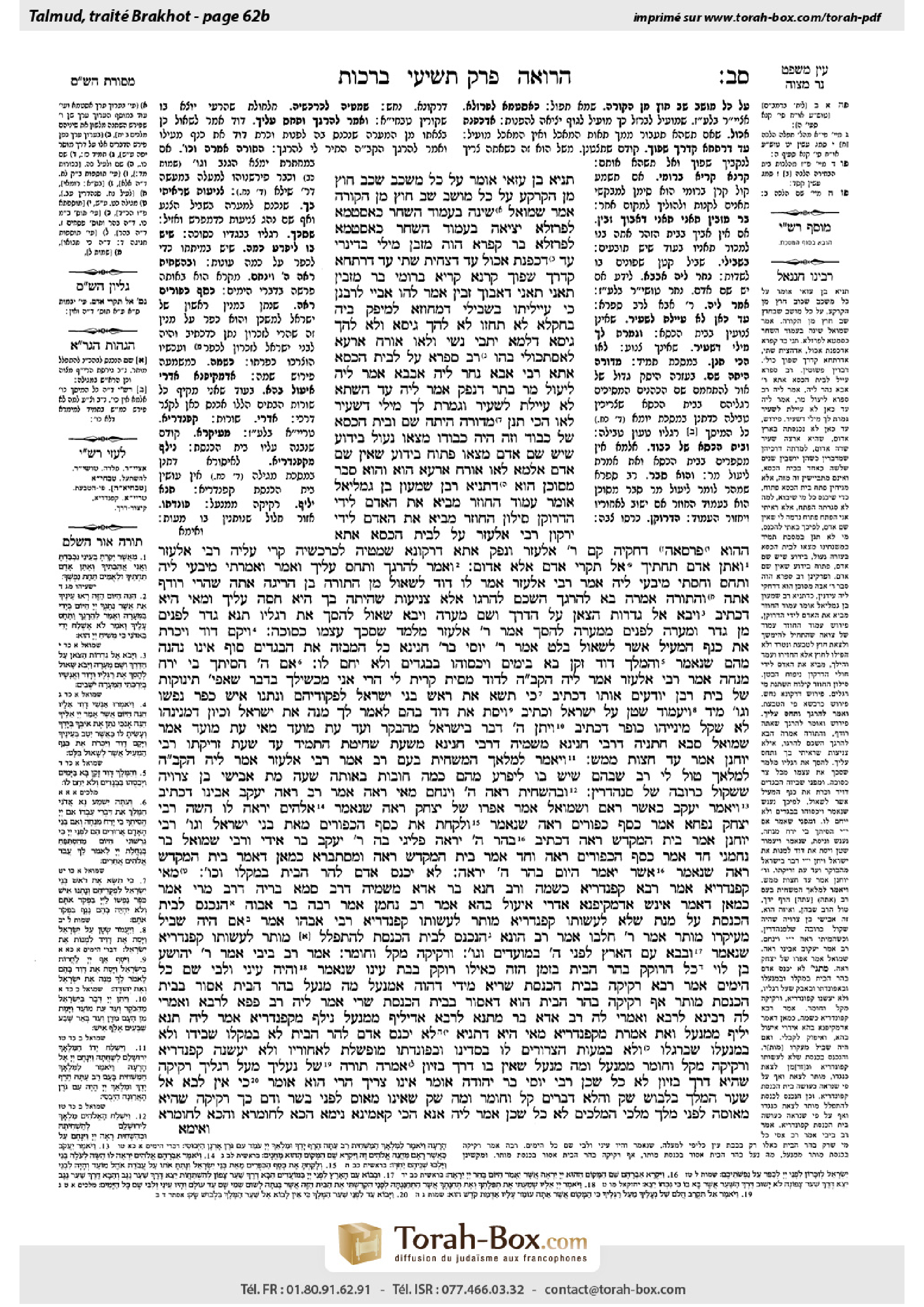
Berakhot 62b: Talmud study for Daf Yomi
Study the Talmud for Daf Yomi with scanned pages, Hebrew text, English translations from Sefaria and AI-generated French translations.
Passage selection and English or AI-generated French translation are available where the scan has annotations. Daf Study is independent of Torah-Box and Sefaria.
Browse Berakhot · ברכות · All tractatesBerakhot 62b text and translations
This page of Berakhot includes the Aramaic text, an English translation and an AI-generated French translation, alongside the scan above.
ברכות ס״ב ב · Aramaic and Hebrew text
תַּנְיָא, בֶּן עַזַּאי אוֹמֵר: עַל כׇּל מִשְׁכָּב שְׁכַב, חוּץ מִן הַקַּרְקַע. עַל כׇּל מוֹשָׁב שֵׁב, חוּץ מִן הַקּוֹרָה. אָמַר שְׁמוּאֵל: שֵׁינָה בְּעַמּוּד הַשַּׁחַר כְּאִסְטָמָא לְפַרְזְלָא. יְצִיאָה בְּעַמּוּד הַשַּׁחַר כְּאִסְטָמָא לְפַרְזְלָא.
בַּר קַפָּרָא הֲוָה מְזַבֵּן מִילֵּי בְּדִינָרֵי: עַד דְּכָפְנַתְּ — אֱכוֹל. עַד דְּצָחֵית — שְׁתִי, עַד דְּרָתְחָא קִדְרָךָ — שְׁפוֹךְ. קַרְנָא קָרְיָא בְּרוֹמִי, בַּר מְזַבֵּין תְּאֵנֵי, תְּאֵנֵי דַּאֲבוּךְ זַבֵּין.
אֲמַר לְהוּ אַבָּיֵי לְרַבָּנָן: כִּי עָיְילִיתוּ בִּשְׁבִילֵי דְמָחוֹזָא לְמִיפַּק בֵּיהּ בְּחַקְלָא, לָא תֶּחֱזוֹ לָא לְהַךְ גִּיסָא וְלָא לְהַךְ גִּיסָא, דִּלְמָא יָתְבֵי נְשֵׁי, וְלָאו אוֹרַח אַרְעָא לְאִסְתַּכּוֹלֵי בְּהוּ.
רַב סָפְרָא עָל לְבֵית הַכִּסֵּא. אֲתָא רַבִּי אַבָּא, נְחַר לֵיהּ אַבָּבָא. אֲמַר לֵיהּ: לֵיעוּל מָר. בָּתַר דִּנְפַק אֲמַר לֵיהּ: עַד הַשְׁתָּא לָא עֲיַילְתְּ לְשֵׂעִיר, וּגְמַרְתְּ לָךְ מִילֵּי דְשֵׂעִיר! לָאו הָכִי תְּנַן: מְדוּרָה הָיְתָה שָׁם וּבֵית הַכִּסֵּא שֶׁל כָּבוֹד. וְזֶה הָיָה כְּבוֹדוֹ: מְצָאוֹ נָעוּל — בְּיָדוּעַ שֶׁיֵּשׁ שָׁם אָדָם, מְצָאוֹ פָּתוּחַ — בְּיָדוּעַ שֶׁאֵין שָׁם אָדָם. אַלְמָא לָאו אוֹרַח אַרְעָא הוּא!
וְהוּא סָבַר מְסוּכָּן הוּא. דְּתַנְיָא, רַבָּן שִׁמְעוֹן בֶּן גַּמְלִיאֵל אוֹמֵר: עַמּוּד הַחוֹזֵר מֵבִיא אֶת הָאָדָם לִידֵי הִדְרוֹקָן. סִילוֹן הַחוֹזֵר מֵבִיא אֶת הָאָדָם לִידֵי יֵרָקוֹן.
רַבִּי אֶלְעָזָר עָל לְבֵית הַכִּסֵּא. אֲתָא הַהוּא רוֹמָאָה דַּחֲקֵיהּ. קָם רַבִּי אֶלְעָזָר וּנְפַק. אֲתָא דְּרָקֹונָא שַׁמְטֵיהּ לְכַרְכְּשֵׁיהּ. קָרֵי עֲלֵיהּ רַבִּי אֶלְעָזָר: ״וְאֶתֵּן אָדָם תַּחְתֶּיךָ״, אַל תִּקְרֵי ״אָדָם״ אֶלָּא ״אֱדוֹם״.
״וְאָמַר לַהֲרָגֲךָ וַתָּחָס עָלֶיךָ״.
״וְאָמַר״, ״וְאָמַרְתִּי״ מִיבְּעֵי לֵיהּ! ״וַתָּחָס״, ״וְחַסְתִּי״ מִיבְּעֵי לֵיהּ! אָמַר רַבִּי אֶלְעָזָר: אָמַר לוֹ דָּוִד לְשָׁאוּל: מִן הַתּוֹרָה בֶּן הֲרִיגָה אַתָּה, שֶׁהֲרֵי רוֹדֵף אַתָּה, וְהַתּוֹרָה אָמְרָה: בָּא לְהׇרְגְּךָ — הַשְׁכֵּם לְהָרְגוֹ, אֶלָּא צְנִיעוּת שֶׁהָיְתָה בְּךָ, הִיא חָסָה עָלֶיךָ.
וּמַאי הִיא? — דִּכְתִיב: ״וַיָּבֹא אֶל גִּדְרוֹת הַצֹּאן עַל הַדֶּרֶךְ וְשָׁם מְעָרָה וַיָּבֹא שָׁאוּל לְהָסֵךְ אֶת רַגְלָיו״. תָּנָא: גָּדֵר לִפְנִים מִן גָּדֵר, וּמְעָרָה לִפְנִים מִמְּעָרָה לְהָסֵךְ. אָמַר רַבִּי אֶלְעָזָר: מְלַמֵּד שֶׁסִּיכֵּךְ עַצְמוֹ כְּסוּכָּה.
״וַיָּקָם דָּוִד וַיִּכְרֹת אֶת כְּנַף הַמְּעִיל אֲשֶׁר לְשָׁאוּל בַּלָּט״, אָמַר רַבִּי יוֹסֵי בְּרַבִּי חֲנִינָא: כׇּל הַמְבַזֶּה אֶת הַבְּגָדִים, סוֹף אֵינוֹ נֶהֱנֶה מֵהֶם, שֶׁנֶּאֱמַר: ״וְהַמֶּלֶךְ דָּוִד זָקֵן בָּא בַּיָּמִים וַיְכַסֻּהוּ בַּבְּגָדִים וְלֹא יִחַם לוֹ״.
״אִם ה׳ הֱסִיתְךָ בִי יָרַח מִנְחָה״, אָמַר רַבִּי אֶלְעָזָר: אָמַר לֵיהּ הַקָּדוֹשׁ בָּרוּךְ הוּא לְדָוִד: ״מֵסִית״ קָרֵית לִי? הֲרֵי אֲנִי מַכְשִׁילְךָ בְּדָבָר שֶׁאֲפִילּוּ תִּינוֹקוֹת שֶׁל בֵּית רַבָּן יוֹדְעִים אוֹתוֹ. דִּכְתִיב: ״כִּי תִשָּׂא אֶת רֹאשׁ בְּנֵי יִשְׂרָאֵל לִפְקֻדֵיהֶם וְנָתְנוּ אִישׁ כֹּפֶר נַפְשׁוֹ וְגוֹ׳״. מִיָּד, ״וַיַּעֲמֹד שָׂטָן עַל יִשְׂרָאֵל״, וּכְתִיב: ״וַיָּסֶת אֶת דָּוִד בָּהֶם לֵאמֹר לֵךְ מְנֵה אֶת יִשְׂרָאֵל״. וְכֵיוָן דִּמְנִינְהוּ לָא שְׁקַל מִינַּיְיהוּ כּוֹפֶר. דִּכְתִיב: ״וַיִּתֵּן ה׳ דֶּבֶר בְּיִשְׂרָאֵל מֵהַבֹּקֶר וְעַד עֵת מוֹעֵד״.
מַאי ״עֵת מוֹעֵד״? אָמַר שְׁמוּאֵל סָבָא חַתְנֵיהּ דְּרַבִּי חֲנִינָא מִשְּׁמֵיהּ דְּרַבִּי חֲנִינָא: מִשְּׁעַת שְׁחִיטַת הַתָּמִיד עַד שְׁעַת זְרִיקָתוֹ. רַבִּי יוֹחָנָן אָמַר: עַד חֲצוֹת מַמָּשׁ.
״וַיֹּאמֶר לַמַּלְאָךְ הַמַּשְׁחִית בָּעָם רַב״. אָמַר רַבִּי אֶלְעָזָר: אֲמַר לֵיהּ הַקָּדוֹשׁ בָּרוּךְ הוּא לְמַלְאָךְ: טוֹל לִי רַב שֶׁבָּהֶם, שֶׁיֵּשׁ בּוֹ לִיפָּרַע מֵהֶם כַּמָּה חוֹבוֹת. בְּאוֹתָהּ שָׁעָה מֵת אֲבִישַׁי בֶּן צְרוּיָה, שֶׁשָּׁקוּל כְּרוּבָּהּ שֶׁל סַנְהֶדְרִין.
״וּבְהַשְׁחִית רָאָה ה׳ וַיִּנָּחֶם״, מַאי רָאָה?
אָמַר רַב: רָאָה יַעֲקֹב אָבִינוּ, דִּכְתִיב: ״וַיֹּאמֶר יַעֲקֹב כַּאֲשֶׁר רָאָם״. וּשְׁמוּאֵל אָמַר: אֶפְרוֹ שֶׁל יִצְחָק רָאָה, שֶׁנֶּאֱמַר: ״אֱלֹהִים יִרְאֶה לּוֹ הַשֶּׂה״.
רַבִּי יִצְחָק נַפָּחָא אָמַר: כֶּסֶף כִּפּוּרִים רָאָה, שֶׁנֶּאֱמַר: ״וְלָקַחְתָּ אֶת כֶּסֶף הַכִּפּוּרִים מֵאֵת בְּנֵי יִשְׂרָאֵל וְגוֹ׳״. רַבִּי יוֹחָנָן אָמַר: בֵּית הַמִּקְדָּשׁ רָאָה, דִּכְתִיב: ״בְּהַר ה׳ יֵרָאֶה״.
פְּלִיגִי בָּהּ רַבִּי יַעֲקֹב בַּר אִידֵּי וְרַבִּי שְׁמוּאֵל בַּר נַחְמָנִי. חַד אָמַר כֶּסֶף הַכִּפּוּרִים רָאָה, וְחַד אָמַר בֵּית הַמִּקְדָּשׁ רָאָה. וּמִסְתַּבְּרָא כְּמַאן דְּאָמַר בֵּית הַמִּקְדָּשׁ רָאָה, שֶׁנֶּאֱמַר: ״אֲשֶׁר יֵאָמֵר הַיּוֹם בְּהַר ה׳ יֵרָאֶה״.
לֹא יִכָּנֵס אָדָם לְהַר הַבַּיִת בְּמַקְלוֹ וְכוּ׳. מַאי ״קַפֶּנְדַּרְיָא״? אָמַר רָבָא: קַפֶּנְדַּרְיָא כִּשְׁמָהּ. וְרַב חָנָא בַּר אַדָּא מִשְּׁמֵיהּ דְּרַב סַמָּא בְּרֵיהּ דְּרַב מָרִי אָמַר: כְּמַאן דְּאָמַר אִינָשׁ: ״אַדְּמַקֵּיפְנָא אַדָּרֵי, אֵיעוּל בְּהָא״. אָמַר רַב נַחְמָן אָמַר רַבָּה בַּר אֲבוּהּ: הַנִּכְנָס לְבֵית הַכְּנֶסֶת עַל מְנָת שֶׁלֹּא לַעֲשׂוֹתוֹ קַפֶּנְדַּרְיָא — מוּתָּר לַעֲשׂוֹתוֹ קַפֶּנְדַּרְיָא.
רַבִּי אֲבָהוּ אָמַר: אִם הָיָה שְׁבִיל מֵעִיקָּרוֹ — מוּתָּר. אָמַר רַבִּי חֶלְבּוֹ אָמַר רַב הוּנָא: הַנִּכְנָס לְבֵית הַכְּנֶסֶת לְהִתְפַּלֵּל, מוּתָּר לַעֲשׂוֹתוֹ קַפֶּנְדַּרְיָא. שֶׁנֶּאֱמַר: ״וּבְבֹא עַם הָאָרֶץ לִפְנֵי ה׳ בַּמּוֹעֲדִים וְגוֹ׳״.
וּרְקִיקָה מִקַּל וָחוֹמֶר. אָמַר רַב בִּיבִי אָמַר רַבִּי יְהוֹשֻׁעַ בֶּן לֵוִי: כׇּל הָרוֹקֵק בְּהַר הַבַּיִת בַּזְּמַן הַזֶּה, כְּאִילּוּ רוֹקֵק בְּבַת עֵינוֹ, שֶׁנֶּאֱמַר: ״וְהָיוּ עֵינַי וְלִבִּי שָׁם כָּל הַיָּמִים״.
אָמַר רָבָא: רְקִיקָה בְּבֵית הַכְּנֶסֶת — שַׁרְיָא, מִידֵּי דְּהָוֵה אַמִּנְעָל. מָה מִנְעָל בְּהַר הַבַּיִת אָסוּר, בְּבֵית הַכְּנֶסֶת מוּתָּר. אַף רְקִיקָה, בְּהַר הַבַּיִת הוּא דְּאָסוּר, בְּבֵית הַכְּנֶסֶת שְׁרֵי.
אֲמַר לֵיהּ רַב פָּפָּא לְרָבָא, וְאָמְרִי לַהּ רָבִינָא לְרָבָא, וְאָמְרִי לַהּ רַב אַדָּא בַּר מַתְנָא לְרָבָא: אַדְּיָלֵיף מִמִּנְעָל, נֵילַף מִקַּפֶּנְדַּרְיָא!
אָמַר לֵיהּ: תַּנָּא יָלֵיף מִמִּנְעָל, וְאַתְּ אָמְרַתְּ מִקַּפֶּנְדַּרְיָא?! מַאי הִיא? — דְּתַנְיָא לֹא יִכָּנֵס אָדָם לְהַר הַבַּיִת לֹא בְּמַקְלוֹ שֶׁבְּיָדוֹ, וְלֹא בְּמִנְעָלוֹ שֶׁבְּרַגְלוֹ, וְלֹא בְּמָעוֹת הַצְּרוּרִים לוֹ בִּסְדִינוֹ, וּבְפוּנְדָּתוֹ מוּפְשֶׁלֶת לַאֲחוֹרָיו, וְלֹא יַעֲשֶׂנָּה קַפֶּנְדַּרְיָא. וּרְקִיקָה מִקַּל וָחוֹמֶר מִמִּנְעָל: וּמָה מִנְעָל, שֶׁאֵין בּוֹ דֶּרֶךְ בִּזָּיוֹן, אָמְרָה תּוֹרָה: ״שַׁל נְעָלֶיךָ מֵעַל רַגְלֶיךָ״. רְקִיקָה, שֶׁהִיא דֶּרֶךְ בִּזָּיוֹן — לֹא כׇּל שֶׁכֵּן?!
רַבִּי יוֹסֵי בַּר יְהוּדָה אוֹמֵר: אֵינוֹ צָרִיךְ: הֲרֵי הוּא אוֹמֵר: ״כִּי אֵין לָבוֹא אֶל שַׁעַר הַמֶּלֶךְ בִּלְבוּשׁ שָׂק״. וַהֲלֹא דְּבָרִים קַל וָחוֹמֶר: וּמָה שַׂק, שֶׁאֵינוֹ מָאוּס, לִפְנֵי בָּשָׂר וָדָם — כָּךְ. רְקִיקָה, שֶׁהִיא מְאוּסָה, לִפְנֵי מֶלֶךְ מַלְכֵי הַמְּלָכִים — לֹא כׇּל שֶׁכֵּן?!
אֲמַר לֵיהּ: אֲנָא הָכִי קָאָמֵינָא: נֵימָא הָכָא לְחוּמְרָא וְהָכָא לְחוּמְרָא,
Berakhot 62b · English translation
Continuing with the subject of health, it was taught in a baraita: Ben Azzai says: On all beds, lie, except for the ground. On all seats, sit, except for a beam, lest you fall off. Shmuel said: Sleeping at dawn is as effective as forging [istema] is to iron. A bowel movement at dawn is as beneficial as forging is to iron.
Similarly, the Gemara relates: Bar Kappara would sell sayings for dinars; he would express his ideas in brief maxims. For example: If you are hungry, eat; do not delay eating, as the hunger may pass and your food will be of no benefit. So too, if you are thirsty, drink; while the pot is still boiling, pour it out before it cools off. This is a metaphor for relieving oneself. Bar Kappara also said: When the horn is sounded in Rome, signifying that there is demand for figs in the Roman market, son of a fig seller, sell your father’s figs, even without his permission, so as not to miss the opportunity.
Abaye said to the Sages: When you enter the paths of the city of Meḥoza in order to go out and defecate in a field, look neither to one side nor to the other, as perhaps women are sitting there and it is improper to look at them.
The Gemara relates: Rav Safra once entered a bathroom, when Rabbi Abba came along. To determine if he could enter, Rabbi Abba coughed next to the door. Rav Safra said to him: Enter, master. When he came out, Rabbi Abba said to him: Until now, you never entered Seir, the land of the Edomites, who are not strict in their practice of modesty, and yet you already learned the customs of Seir? Didn’t we learn in the mishna concerning the Temple: There was a fire next to the ritual bath, and a bathroom of honor. And this was its honor: If one found it locked, it was known that someone was inside; if he found it open, it was known that no one was inside. Speaking in the bathroom is not a desired mode of behavior.
The Gemara explains the opinion of Rav Safra, who told Rabbi Abba that he could enter while in the bathroom: Rav Safra held that it was dangerous for Rabbi Abba. If he waited and was uncertain whether or not he could enter, he would endanger himself. As it was taught in a baraita: Rabbi Shimon ben Gamliel says: A column of feces that is held back because one cannot relieve himself causes dropsy [hidrokan]. A stream [silon] of urine that is held back causes jaundice.
The Gemara relates that Rabbi Elazar entered a bathroom. This Roman came and pushed him away. Rabbi Elazar stood and left, and a serpent came and ripped out the intestines of the Roman. Rabbi Elazar recited the following verse about the Roman: “Therefore I will give man [adam] for you” (Isaiah 43:4); do not read it as adam, but rather read it as Edom, meaning a Roman.
With regard to modesty in a bathroom, the Gemara cites an additional biblical allusion. When David found Saul in the cave and spared him, tearing the corner of his coat, he said to him: “Behold this day, your eyes have seen how the Lord has delivered you today into my hand in the cave, and he said to kill you; and you spared you” (I Samuel 24:10).
The Gemara asks: Why does the verse say: And he said? It should say: And I said. Why does the verse say: And you spared? It should say: And I spared. Rather, Rabbi Elazar said: David said to Saul: By Torah law, you should be killed, as you are a pursuer who seeks to kill me, and the Torah says: If one comes to kill you, kill him first. But it was the modesty that you displayed that spared you.
And what is this modesty? As it is written: “And he came to the sheepcotes by the way, where there was a cave, and Saul went in to cover his feet, to defecate. Now David and his men were sitting in the innermost parts of the cave” (I Samuel 24:3). It was taught that the Sages said: There was a fence within a fence, and a cave within a cave, and Saul entered to defecate in the interest of modesty. With regard to the use of the term, to cover his feet, Rabbi Elazar said: This teaches that, even there, he covered himself with his garment like a sukka.
The Gemara continues with a homiletic interpretation of the verse: “Then David arose, and cut off the corner of Saul’s robe privily” (I Samuel 24:4). Rabbi Yosei, son of Rabbi Ḥanina, said: Anyone who treats clothing with contempt, like David who tore Saul’s robe for no reason, will be punished in that ultimately he will not benefit from his garments, as it is stated: “Now King David was old and stricken in years; and they covered him with clothes, but he could get no heat” (I Kings 1:1).
As for David’s statement to Saul: “If it be the Lord that has incited you against me, let Him accept an offering” (I Samuel 26:19), Rabbi Elazar said that the Holy One, Blessed be He, said to David: Do you call Me an inciter? In retribution, I will cause you to fail in a matter that even schoolchildren know, as it is written: “When you take the sum of the children of Israel, according to their number, then shall they give every man a ransom for his soul unto the Lord, when you number them; that there be no plague among them, when you number them” (Exodus 30:12). Immediately after God said this to David, “Satan stood up against Israel and incited David to number Israel” (I Chronicles 21:1). Moreover, it is written: “And again the anger of the Lord was kindled against Israel, and He incited David against them, saying: Go, number Israel and Judea” (II Samuel 24:1). The proportional response to David’s calling God an inciter was that He incited David. And when he counted them, he did not take a ransom from them, and he was punished, as it is written: “So the Lord sent a pestilence upon Israel from the morning even to the appointed time” (II Samuel 24:15).
The Gemara asks: What is the meaning of the appointed time? Shmuel the elder, father-in-law of Rabbi Ḥanina, said in the name of Rabbi Ḥanina: It means from when the daily offering is slaughtered until when its blood is sprinkled. Rabbi Yoḥanan said: It means precisely until noon.
It is also stated there: “The Lord repented Him of the evil and said to the angel that destroyed the many [rav] people: It is enough; now stay your hand” (II Samuel 24:16). Explaining the meaning of the word rav, Rabbi Elazar said that the Holy One, Blessed be He, said to the angel: Take for me a great one [rav] from among them, who is worthy of defraying several of Israel’s debts. As a result, at that moment Avishai ben Tzeruya, who was equivalent to the majority of the Sanhedrin, died. His death atoned for the entire nation.
On a parallel note, it is said: “The Lord beheld, and He repented him of the evil” (I Chronicles 21:15). The Gemara asks: What did the Lord behold?
Rav said: He saw and remembered the patriarch, Jacob, about whom the term seeing is used: “And Jacob said when he saw them [ra’am]: This is God’s camp” (Genesis 32:3). And Shmuel said: He saw and remembered Isaac’s ashes, as it is said in the portion of the binding of Isaac: “God will provide [yireh] Himself the lamb for a burnt-offering” (Genesis 22:8).
Rabbi Yitzḥak Nappaḥa said: He saw the money of atonement that Israel gave when they were counted during the Exodus from Egypt, as it is stated: “And you shall take the atonement money from the children of Israel, and shall appoint it for the service of the tent of meeting, that it may be a memorial for the children of Israel before the Lord, to make atonement for your souls” (Exodus 30:16). Rabbi Yoḥanan said: He saw the Temple, as it is written: “On the mount where the Lord is seen [yera’e]” (Genesis 22:14).
Additional amora’im, Rabbi Ya’akov bar Idi and Rabbi Shmuel bar Naḥmani, differed in their opinions of what God saw. One said: He saw the money of atonement, and one said: He saw the Temple. And it stands to reason like the one who says that he saw the Temple, as it is stated: “And Abraham called the name of that place: The Lord will see; as it is said to this day: On the mount where the Lord is seen” (Genesis 22:14); generations later, they will recall the initial revelation on Mount Moria, as the angel also appeared to David on this mountain.
We learned in the mishna that, in deference to the Temple, a person may not enter the Temple Mount with his staff and his shoes. He may not make it a kappandarya. The Gemara asks: What is the meaning of kappandarya? Rava said: Kappandarya, as its name implies; a shortcut. Rav Ḥana bar Adda in the name of Rav Sama, son of Rav Mari, said: One may interpret this as an acrostic, as people say: Instead of circumventing the rows of houses [ademakifna adarei], I will enter this [ei’ol beha] one. Rav Naḥman said that Rabba bar Avuh said: This halakha applies in a synagogue as well. However, one who enters a synagogue not intending to make it a shortcut is permitted to make it a shortcut if he later changed his mind.
Similarly, Rabbi Abbahu said: If it was originally a path that passed through the site where the synagogue was erected, one is permitted to pass through, as the public right of passage is not negated by the construction of a synagogue. Rabbi Ḥelbo said that Rav Huna said: One who enters a synagogue to pray is permitted to make it a shortcut, as it is stated: “But when the people of the land shall come before the Lord in the appointed seasons, he that enters by way of the north gate to worship shall go forth by the way of the south gate” (Ezekiel 46:9).
We learned in the mishna that spitting on the Temple Mount is prohibited through an a fortiori inference. Rav Beivai said that Rabbi Yehoshua ben Levi said: Anyone who spits on the Temple Mount, even today, it is as if he spit in the pupil of God’s eye, as it is stated: “And My eyes and My heart shall be there perpetually” (I Kings 9:3).
Rava said: Spitting in a synagogue is permitted, just as in the case of shoes. Just as wearing shoes is prohibited on the Temple Mount but permitted in a synagogue, so, too, spitting is prohibited on the Temple Mount but permitted in a synagogue.
Rav Pappa said to Rava, and some say that Ravina said to Rava, and some say that Rav Adda bar Mattana said to Rava: Instead of deriving this from the case of wearing a shoe, derive it from the case of a shortcut. Just as a shortcut through a synagogue is prohibited, so too is spitting prohibited.
Rava said to him: The tanna derives the prohibition of spitting from the case of a shoe, and you say that it should be derived from the case of a shortcut? The Gemara elaborates: What is this derivation from the case of a shoe? As it was taught in a baraita: One may neither enter the Temple Mount with his staff in his hand, nor with his shoes on his feet, nor with money tied in his cloth and with his money-belt slung behind him, nor should one make it a shortcut. All the more so, spitting is prohibited a fortiori from the halakha with regard to wearing a shoe. Just as with regard to a shoe, which is generally not considered contemptuous, the Torah said: “Put off your shoes from off your feet, for the place upon which you stand is holy ground” (Exodus 3:5), all the more so spitting, which is considered contemptuous, should be prohibited.
Rabbi Yosei bar Yehuda, says: This a fortiori inference is unnecessary. It could be otherwise derived. It says: “For none may enter within the king’s gate clothed with sackcloth” (Esther 4:2). This matter can be inferred a fortiori: Just as sackcloth, which is generally not considered repulsive before one who is flesh and blood, is forbidden within the king’s gate, all the more so spitting, which is repulsive, should be forbidden before the King of Kings.
The one who challenged him, Rav Pappa or Ravina, said to Rava: I intended to say the following: Let us say, be stringent here, with regard to the Temple Mount, and be stringent here, with regard to the synagogue,
Berakhot 62b · Traduction française (IA)
En poursuivant le sujet de la santé, il a été enseigné dans une baraïta : Ben Azzai dit : Sur tous les lits, allongez-vous, sauf sur le sol. Sur toutes les chaises, asseyez-vous, sauf sur une poutre, de peur de tomber. Shmuel dit : Dormir à l’aube est aussi efficace que le forgeage est à l’acier. Une défécation à l’aube est aussi bénéfique que le forgeage est à l’acier.
De même, la Guemara rapporte : Bar Kappara vendait des paroles pour des dinars ; il exprimait ses idées en maximes brèves. Par exemple : Si vous avez faim, mangez ; ne remettez pas à plus tard de manger, car la faim peut passer et votre nourriture ne sera plus utile. De même, si vous avez soif, buvez ; tandis que la marmite est encore bouillante, versez-la avant qu’elle ne refroidisse. C’est une métaphore pour se soulager. Bar Kappara a aussi dit : Lorsque le cor est sonné à Rome, signifiant qu’il y a une demande de figues sur le marché romain, fils d’un vendeur de figues, vendez les figues de votre père, même sans son autorisation, afin de ne pas manquer l’occasion.
Abaye dit aux Sages : Lorsque vous entrez dans les rues de la ville de Meḥoza pour sortir et déféquer dans un champ, ne regardez ni à gauche ni à droite, car peut-être des femmes sont assises là et il est inapproprié de les regarder.
La Guemara rapporte : Rav Safra entra dans une salle de bain, lorsque Rabbi Abba passa. Pour déterminer s’il pouvait entrer, Rabbi Abba toussa à côté de la porte. Rav Safra dit à lui : Entre, maître. Lorsqu’il en sortit, Rabbi Abba dit à lui : Jusqu’à présent, tu n’as jamais entré en Seir, la terre des Edomites, qui ne sont pas stricts dans leur pratique de la modestie, et pourtant tu as déjà appris les coutumes de Seir ? N’avons-nous pas appris dans la mishna concernant le Temple : Il y avait un feu près de la mikva, et une salle de bain d’honneur. Et c’était son honneur : Si l’on trouvait la porte verrouillée, on savait qu’il y avait quelqu’un à l’intérieur ; si l’on trouvait la porte ouverte, on savait qu’il n’y avait personne à l’intérieur. Parler dans la salle de bain n’est pas un mode de comportement souhaitable.
La Guemara explique l’opinion de Rav Safra, qui avait dit à Rabbi Abba qu’il pouvait entrer pendant qu’il était dans la salle de bain : Rav Safra considérait que c’était dangereux pour Rabbi Abba. Si il attendait et était incertain s’il pouvait entrer, il risquait de se mettre en danger. Comme il a été enseigné dans une baraïta : Rabbi Shimon ben Gamliel dit : Une colonne de crottes qui est retenue parce qu’on ne peut pas se soulager provoque un œdème. Un courant d’urine retenue provoque la jaunisse.
La Guemara rapporte que Rabbi Elazar entra dans une salle de bain. Ce Romain vint et le poussa hors. Rabbi Elazar resta debout et partit, et un serpent vint et arracha les intestins du Romain. Rabbi Elazar récita le verset suivant à propos du Romain : « Donc je donnerai l’homme [adam] pour toi » (Yachout 43:4) ; ne le lis pas comme adam, mais plutôt comme Edom, c’est-à-dire un Romain.
En ce qui concerne la modestie dans une salle de bain, la Guemara cite une autre allusion biblique. Lorsque David trouva Saul dans la caverne et le préserva, en déchirant la manche de sa robe, il dit à lui : « Regardez cette journée, vos yeux ont vu comment l’Éternel vous a livré aujourd’hui en ma main dans la caverne, et il dit de vous tuer ; et vous avez préservé vous » (I Samuel 24:10).
La Guemara pose la question : Pourquoi le verset dit : « Et il dit ? » Il devrait dire : « Et je dis. » Pourquoi le verset dit : « Et vous avez préservé ? » Il devrait dire : « Et je préservai. » Plutôt, Rabbi Elazar dit : David dit à Saul : Selon la loi talmudique, vous devriez être tué, car vous êtes un poursuivant qui cherche à vous tuer, et la Torah dit : Si l’un vient te tuer, tue-le d’abord. Mais c’est la modestie que vous avez montrée qui vous a préservé.
Et qu’est-ce que cette modestie ? Comme il est écrit : « Et il vint aux enclos de moutons par le chemin, où il y avait une caverne, et Saul entra pour couvrir ses pieds, pour déféquer. Maintenant David et ses hommes étaient assis dans les parties les plus intimes de la caverne » (I Samuel 24:3). Il a été enseigné que les Sages dirent : Il y avait un mur à l’intérieur d’un mur, et une caverne à l’intérieur d’une caverne, et Saul entra pour déféquer dans l’intérêt de la modestie. En ce qui concerne l’utilisation du terme, « pour couvrir ses pieds », Rabbi Elazar dit : Cela enseigne que, même là, il se couvrit avec sa robe comme un sukka.
La Guemara continue avec une interprétation homiletique du verset : « Alors David se leva, et coupa la manche de la robe de Saul en secret » (I Samuel 24:4). Rabbi Yosei, fils de Rabbi Ḥanina, dit : Quiconque traite les vêtements avec mépris, comme David qui déchira la robe de Saul sans raison, sera puni, car finalement il ne bénéficiera pas de ses vêtements, comme il est écrit : « Maintenant, David était vieux et frappé d’âge ; et ils le couvrirent de vêtements, mais il ne pouvait pas avoir de chaleur » (I Rois 1:1).
En ce qui concerne la déclaration de David à Saul : « Si c’est l’Éternel qui a incité toi contre moi, que Lui accepte un offrande » (I Samuel 26:19), Rabbi Elazar dit que l’Éternel, béni soit Son Nom, dit à David : Tu appelles Moi un incitateur ? En rétribution, Je ferai échouer une affaire que même les enfants savent, comme il est écrit : « Quand vous prenez le recensement des enfants d’Israël, selon leur nombre, alors ils donneront chacun un rachat pour son âme à l’Éternel, quand vous les recenserez ; afin qu’il n’y ait pas de fléau parmi eux, quand vous les recenserez » (Exode 30:12). Immédiatement après que Dieu dit cela à David, « Satan se leva contre Israël et incita David à recenser Israël » (I Chroniques 21:1). De plus, il est écrit : « Et l’indignation de l’Éternel s’embrasa contre Israël, et Il incita David contre eux, disant : Allez, recensez Israël et Juda » (II Samuel 24:1). La réponse proportionnelle à la déclaration de David appelant Dieu un incitateur fut qu’Il incita David. Et lorsqu’il recensa, il ne prit pas un rachat d’eux, et il fut puni, comme il est écrit : « Donc l’Éternel envoya une peste sur Israël du matin jusqu’à l’heure fixée » (II Samuel 24:15).
La Guemara pose la question : Quelle est la signification de l’heure fixée ? Shmuel le plus âgé, beau-père de Rabbi Ḥanina, dit en nom de Rabbi Ḥanina : Cela signifie de l’époque où l’offrande quotidienne est immolée jusqu’à l’époque où son sang est versé. Rabbi Yoḥanan dit : Cela signifie précisément jusqu’à midi.
Il est également dit là : « L'Éternel s'est repenti de l'evil et a dit à l'ange qui détruisait beaucoup de gens [rav] : C'est assez ; maintenant, arrête ta main » (II Samuel 24:16). Expliquant le sens du mot rav, le Rabbi Eléazar a dit que l'Éternel, béni soit Son Nom, a dit à l'ange : Prends pour moi un grand [rav] parmi eux, qui mérite de payer plusieurs des dettes d'Israël. En conséquence, à ce moment-là, Avishai ben Tzeruya, qui était équivalent à la majorité du Sanhédrin, est mort. Sa mort a expié pour toute la nation.
Sur un plan parallèle, il est dit : « L'Éternel regarda, et Il s'est repenti de l'evil » (I Rois 21:15). La Guemara demande : Qu'est-ce que l'Éternel regarda ?
Rav a dit : Il vit et se souvint du patriarche Jacob, dont le terme « voir » est utilisé : « Et Jacob dit lorsqu'il vit [ra’am] : C'est le camp de Dieu » (Genèse 32:3). Et Shmuel a dit : Il vit et se souvint des cendres d'Isaac, comme il est dit dans la portion de l'offrande d'Isaac : « Dieu fournira [yireh] Lui-même leagne pour holocauste » (Genèse 22:8).
Le Rabbi Yitzhak Nappaĥa a dit : Il vit l'argent d'expiation que Israël avait donné lorsqu'ils furent comptés pendant l'Exode d'Égypte, comme il est dit : « Et tu prendras l'argent d'expiation des enfants d'Israël, et tu le désigneras pour le service de la tente de rencontre, afin qu'il soit un souvenir pour les enfants d'Israël devant l'Éternel, pour expier vos âmes » (Exode 30:16). Le Rabbi Yoḥanan a dit : Il vit le Temple, comme il est écrit : « Sur la montagne où l'Éternel est vu [yera’e] » (Genèse 22:14).
D'autres amoraïm, le Rabbi Ya'akov bar Idi et le Rabbi Shmuel bar Naḥmani, différaient sur l'interprétation de ce que Dieu vit. L'un a dit : Il vit l'argent d'expiation, et l'autre a dit : Il vit le Temple. Et cela est logique comme celui qui dit qu'il vit le Temple, comme il est dit : « Et Abraham appela le nom de ce lieu : L'Éternel verra ; comme il est dit jusqu'à ce jour : Sur la montagne où l'Éternel est vu » (Genèse 22:14) ; plus tard, ils se souviendront de la révélation initiale sur la montagne de Moria, car l'ange est apparu à David sur cette montagne également.
Nous avons appris dans la mishna que, par respect pour le Temple, une personne ne peut pas entrer sur le mont du Temple avec son bâton et ses chaussures. Il ne peut pas le rendre un kappandarya. La Guemara demande : Quel est le sens de kappandarya ? Rava a dit : Kappandarya, comme son nom l'indique, est un raccourci. Rav Ḥana bar Adda, dans le nom de Rav Sama, fils de Rav Mari, a dit : On peut interpréter cela comme un acronyme, comme les gens disent : Au lieu de contourner les rangées de maisons [ademakifna adarei], je vais entrer ici [ei’ol beha]. Rav Naḥman a dit que Rabba bar Avuh a dit : Cette halakha s'applique également dans une synagogue. Cependant, celui qui entre dans une synagogue sans l'intention de le rendre un raccourci est autorisé à le rendre un raccourci s'il change d'avis plus tard.
De même, le Rabbi Abbahu a dit : Si c'était initialement un chemin qui passait par le lieu où la synagogue a été édifiée, on est autorisé à y passer, car le droit public de passage n'est pas annulé par la construction d'une synagogue. Le Rabbi Ḥelbo a dit que Rav Huna a dit : Celui qui entre dans une synagogue pour prier est autorisé à en faire un raccourci, car il est dit : « Mais quand les gens du pays viendront devant l'Éternel aux temps prescrits, celui qui entrera par la porte du nord pour prier sortira par la voie du sud » (Ezéchiel 46:9).
Nous avons appris dans la Michna que cracher sur le mont du Temple est interdit par une déduction a fortiori. Rav Beivai a dit que Rabbi Yehoshua ben Levi a dit : Quiconque crache sur le mont du Temple, même aujourd'hui, c'est comme s'il crachait dans l'œil de Dieu, car il est dit : « Et mes yeux et mon cœur seront là toujours » (I Rois 9:3).
Rava a dit : Cracher dans une synagogue est autorisé, tout comme dans le cas des chaussures. Tout comme porter des chaussures est interdit sur le mont du Temple mais autorisé dans une synagogue, de même, cracher est interdit sur le mont du Temple mais autorisé dans une synagogue.
Rav Pappa a dit à Rava, et certains disent que Ravina a dit à Rava, et d'autres disent que Rav Adda bar Mattana a dit à Rava : Au lieu de déduire cela du cas des chaussures, déduisez-le du cas du raccourci. Tout comme un raccourci dans une synagogue est interdit, de même, cracher est interdit.
Rava a dit à lui : Le tanna déduit l'interdiction de cracher du cas des chaussures, et vous dites qu'il devrait être déduit du cas du raccourci ? La Guemara explique : Quel est ce dérivation du cas des chaussures ? Comme il a été enseigné dans une baraïta : On ne peut ni entrer sur le mont du Temple avec son bâton en main, ni avec ses chaussures aux pieds, ni avec de l'argent lié dans son tissu et avec sa ceinture d'argent derrière lui, ni faire un raccourci. Tout autant que cela, cracher est interdit a fortiori à partir de la halakha concernant le port de chaussures. Tout comme, concernant les chaussures, qui n'est généralement pas considéré comme méprisant, la Torah dit : « Enlève tes chaussures de tes pieds, car le lieu où tu t'assieds est un lieu saint » (Exode 3:5), tout autant que cracher, qui est considéré comme méprisant, devrait être interdit.
Le Rabbi Yosei bar Yehuda dit : Cette déduction a fortiori n'est pas nécessaire. Elle pourrait être autrement déduite. Il dit : « Car aucun ne peut entrer dans la porte du roi vêtu de sac de toile » (Esther 4:2). Cette affaire peut être déduite a fortiori : Tout comme la toile de sac, qui n'est généralement pas considérée comme répugnante devant celui qui est chair et sang, est interdite dans la porte du roi, tout autant que cracher, qui est répugnant, devrait être interdit devant le Roi des Rois.
Celui qui l’a défendu, Rav Pappa ou Ravina, a dit à Rava : Je voulais dire ceci : Sois strict ici, concernant le mont du Temple, et sois strict ici, concernant la synagogue,
Traduction française générée par IA à partir de l’édition anglaise de Sefaria. Vérifie toujours un passage avec le texte source.
Text from Sefaria: William Davidson Edition - Vocalized Aramaic (CC BY NC); William Davidson Edition - English (CC BY NC).