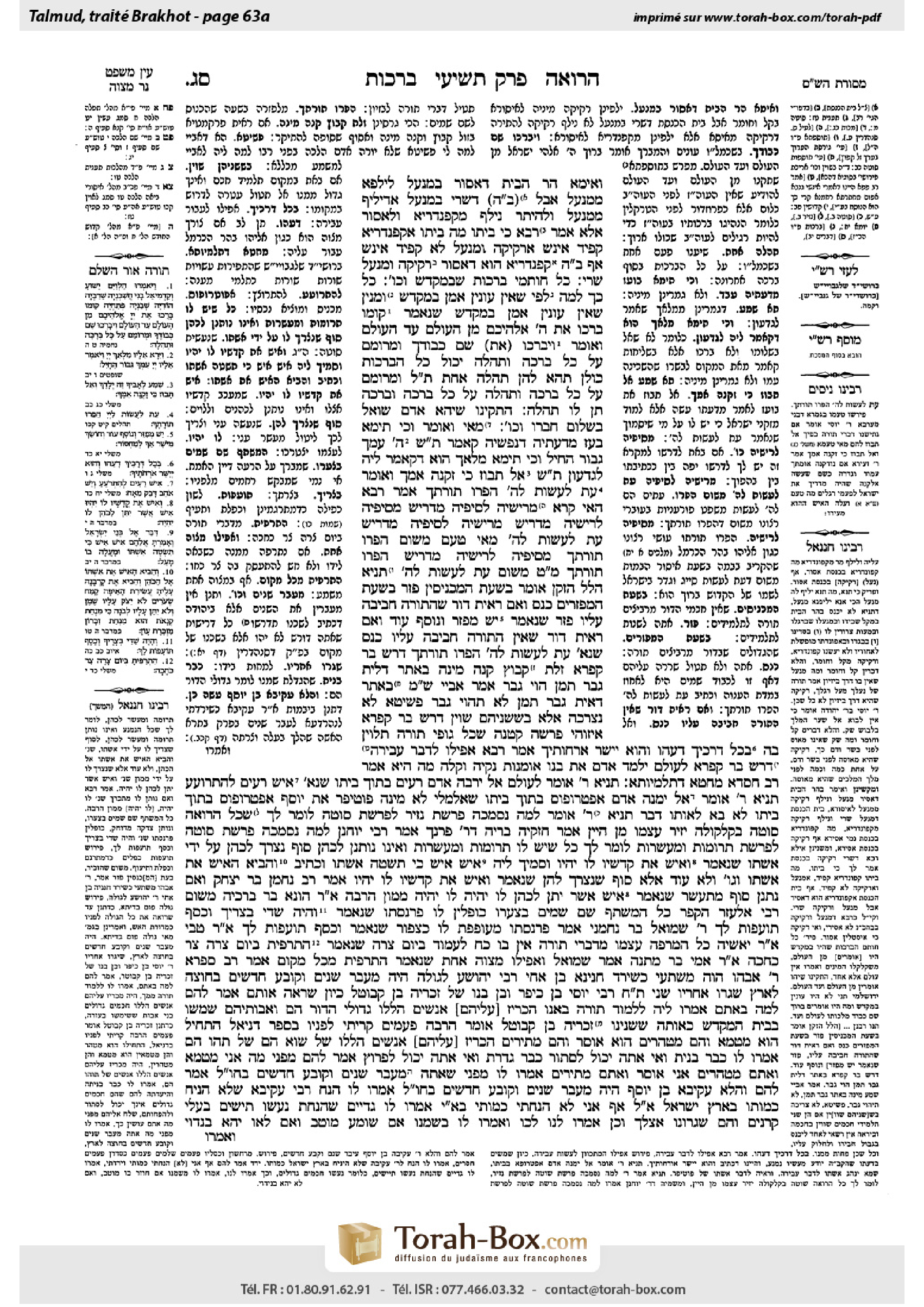
Berakhot 63a: Talmud study for Daf Yomi
Study the Talmud for Daf Yomi with scanned pages, Hebrew text, English translations from Sefaria and AI-generated French translations.
Passage selection and English or AI-generated French translation are available where the scan has annotations. Daf Study is independent of Torah-Box and Sefaria.
Browse Berakhot · ברכות · All tractatesBerakhot 63a text and translations
This page of Berakhot includes the Aramaic text, an English translation and an AI-generated French translation, alongside the scan above.
ברכות ס״ג א · Aramaic and Hebrew text
וְאֵימָא: הַר הַבַּיִת דְּאָסוּר בְּמִנְעָל — לֵילְפֵהּ מִמִּנְעָל. אֲבָל בֵּית הַכְּנֶסֶת דִּשְׁרֵי בְּמִנְעָל, אַדְּיָלֵיף מִמִּנְעָל וּלְהֶיתֵּר, נֵילַף מִקַּפֶּנְדַּרְיָא וּלְאִסּוּר!
אֶלָּא אָמַר רָבָא: כִּי בֵיתוֹ — מָה בֵּיתוֹ, אַקַּפֶּנְדַּרְיָא קָפֵיד אִינָשׁ, אַרְקִיקָה וּמִנְעָל לָא קָפֵיד אִינָשׁ, אַף בֵּית הַכְּנֶסֶת, קַפֶּנְדַּרְיָא הוּא דַּאֲסִיר, רְקִיקָה וּמִנְעָל — שְׁרֵי.
כׇּל חוֹתְמֵי בְּרָכוֹת שֶׁבַּמִּקְדָּשׁ וְכוּ׳.
כׇּל כָּךְ לָמָּה — לְפִי שֶׁאֵין עוֹנִין ״אָמֵן״ בַּמִּקְדָּשׁ. וּמִנַּיִן שֶׁאֵין עוֹנִין אָמֵן בַּמִּקְדָּשׁ? — שֶׁנֶּאֱמַר: ״קוּמוּ בָּרְכוּ אֶת ה׳ אֱלֹהֵיכֶם מִן הָעוֹלָם עַד הָעוֹלָם״. וְאוֹמֵר: ״וִיבָרְכוּ אֶת שֵׁם כְּבֹדֶךָ וּמְרוֹמַם עַל כׇּל בְּרָכָה וּתְהִלָּה״.
יָכוֹל כׇּל הַבְּרָכוֹת כּוּלָּן תְּהֵא לָהֶן תְּהִלָּה אַחַת, תַּלְמוּד לוֹמַר: ״וּמְרוֹמַם עַל כׇּל בְּרָכָה וּתְהִלָּה״, עַל כׇּל בְּרָכָה וּבְרָכָה — תֵּן לוֹ תְּהִלָּה.
הִתְקִינוּ שֶׁיְּהֵא אָדָם שׁוֹאֵל בִּשְׁלוֹם חֲבֵרוֹ וְכוּ׳. מַאי ״וְאוֹמֵר״?
וְכִי תֵּימָא בֹּעַז מִדַּעְתֵּיהּ דְּנַפְשֵׁיהּ קָאָמַר — תָּא שְׁמַע ״ה׳ עִמְּךָ גִּבּוֹר הֶחָיִל״. וְכִי תֵּימָא מַלְאָךְ הוּא דְּקָאָמַר לֵיהּ לְגִדְעוֹן — תָּא שְׁמַע ״אַל תָּבוּז כִּי זָקְנָה אִמֶּךָ״.
וְאוֹמֵר: ״עֵת לַעֲשׂוֹת לַה׳ הֵפֵרוּ תּוֹרָתֶךָ״. אָמַר רָבָא: הַאי קְרָא, מֵרֵישֵׁיהּ לְסֵיפֵיהּ מִדְּרִישׁ, מִסֵּיפֵיהּ לְרֵישֵׁיהּ מִדְּרִישׁ.
מֵרֵישֵׁיהּ לְסֵיפֵיהּ מִדְּרִישׁ — ״עֵת לַעֲשׂוֹת לַה׳״, מַאי טַעַם? — מִשּׁוּם ״הֵפֵרוּ תּוֹרָתֶךָ״. מִסֵּיפֵיהּ לְרֵישֵׁיהּ מִדְּרִישׁ: ״הֵפֵרוּ תּוֹרָתֶךָ״ מַאי טַעְמָא? — מִשּׁוּם ״עֵת לַעֲשׂוֹת לַה׳״.
תַּנְיָא, הִלֵּל הַזָּקֵן אוֹמֵר: בִּשְׁעַת הַמַּכְנִיסִין — פַּזֵּר. בִּשְׁעַת הַמְפַזְּרִים — כַּנֵּס. וְאִם רָאִיתָ דּוֹר שֶׁהַתּוֹרָה חֲבִיבָה עָלָיו — פַּזֵּר, שֶׁנֶּאֱמַר: ״יֵשׁ מְפַזֵּר וְנוֹסָף עוֹד״. וְאִם רָאִיתָ דּוֹר שֶׁאֵין הַתּוֹרָה חֲבִיבָה עָלָיו — כַּנֵּס, שֶׁנֶּאֱמַר: ״עֵת לַעֲשׂוֹת לַה׳ הֵפֵרוּ תּוֹרָתֶךָ״.
דָּרַשׁ בַּר קַפָּרָא: זָלַת — קְבוֹץ קְנֵה מִינַּהּ, בַּאֲתַר דְּלֵית גְּבַר — תַּמָּן הֱוֵי גְּבַר. אָמַר אַבָּיֵי: שְׁמַע מִינַּהּ, בַּאֲתַר דְּאִית גְּבַר — תַּמָּן לָא תִּהְוֵי גְּבַר.
פְּשִׁיטָא! לֹא נִצְרְכָה אֶלָּא בְּשֶׁשְּׁנֵיהֶם שָׁוִין.
דָּרַשׁ בַּר קַפָּרָא: אֵיזוֹהִי פָּרָשָׁה קְטַנָּה שֶׁכָּל גּוּפֵי תוֹרָה תְּלוּיִין בָּהּ — ״בְּכָל דְּרָכֶיךָ דָעֵהוּ וְהוּא יְיַשֵּׁר אֹרְחֹתֶיךָ״. אָמַר רָבָא: אֲפִילּוּ לִדְבַר עֲבֵירָה.
דָּרַשׁ בַּר קַפָּרָא: לְעוֹלָם יְלַמֵּד אָדָם אֶת בְּנוֹ אוּמָּנוּת נְקִיָּה וְקַלָּה. מָה הִיא? אָמַר רַב חִסְדָּא: מַחְטָא דְתַלְמִיּוּתָא.
תַּנְיָא, רַבִּי אוֹמֵר: לְעוֹלָם אַל יַרְבֶּה אָדָם רֵעִים בְּתוֹךְ בֵּיתוֹ, שֶׁנֶּאֱמַר: ״אִישׁ רֵעִים לְהִתְרוֹעֵעַ״.
תַּנְיָא, רַבִּי אוֹמֵר: אַל יְמַנֶּה אָדָם אַפֹּטְרוֹפּוֹס בְּתוֹךְ בֵּיתוֹ, שֶׁאִלְמָלֵי לֹא מִינָּה פּוֹטִיפַר אֶת יוֹסֵף אַפֹּטְרוֹפּוֹס בְּתוֹךְ בֵּיתוֹ — לֹא בָּא לְאוֹתוֹ דָּבָר.
תַּנְיָא, רַבִּי אוֹמֵר: לָמָּה נִסְמְכָה פָּרָשַׁת נָזִיר לְפָרָשַׁת סוֹטָה — לוֹמַר לָךְ שֶׁכָּל הָרוֹאֶה סוֹטָה בְּקִלְקוּלָהּ יַזִּיר עַצְמוֹ מִן הַיַּיִן.
אָמַר חִזְקִיָּה בְּרֵיהּ דְּרַבִּי פַּרְנָךְ אָמַר רַבִּי יוֹחָנָן: לָמָּה נִסְמְכָה פָּרָשַׁת סוֹטָה לְפָרָשַׁת תְּרוּמוֹת וּמַעַשְׂרוֹת — לוֹמַר לָךְ: כֹּל שֶׁיֵּשׁ לוֹ תְּרוּמוֹת וּמַעַשְׂרוֹת וְאֵינוֹ נוֹתְנָן לַכֹּהֵן, סוֹף נִצְרָךְ לַכֹּהֵן עַל יְדֵי אִשְׁתּוֹ, שֶׁנֶּאֱמַר: ״וְאִישׁ אֶת קֳדָשָׁיו לוֹ יִהְיוּ״, וּסְמִיךְ לֵיהּ ״אִישׁ אִישׁ כִּי תִשְׂטֶה אִשְׁתּוֹ״, וּכְתִיב ״וְהֵבִיא הָאִישׁ אֶת אִשְׁתּוֹ״ וְגוֹ׳. וְלֹא עוֹד אֶלָּא סוֹף שֶׁנִּצְרָךְ לָהֶן, שֶׁנֶּאֱמַר: ״וְאִישׁ אֶת קֳדָשָׁיו לוֹ יִהְיוּ״.
אָמַר רַב נַחְמָן בַּר יִצְחָק: וְאִם נְתָנָן, סוֹף מִתְעַשֵּׁר, שֶׁנֶּאֱמַר: ״אִישׁ אֲשֶׁר יִתֵּן לַכֹּהֵן לוֹ יִהְיֶה״, ״לוֹ יִהְיֶה״ — מָמוֹן הַרְבֵּה.
אָמַר רַב הוּנָא בַּר בֶּרֶכְיָה מִשּׁוּם רַבִּי אֶלְעָזָר הַקַּפָּר: כׇּל הַמְשַׁתֵּף שֵׁם שָׁמַיִם בְּצַעֲרוֹ — כּוֹפְלִין לוֹ פַּרְנָסָתוֹ. שֶׁנֶּאֱמַר: ״וְהָיָה שַׁדַּי בְּצָרֶיךָ וְכֶסֶף תּוֹעָפוֹת לָךְ״.
רַבִּי שְׁמוּאֵל בַּר נַחְמָנִי אָמַר: פַּרְנָסָתוֹ מְעוֹפֶפֶת לוֹ כְּצִפּוֹר, שֶׁנֶּאֱמַר: ״וְכֶסֶף תּוֹעָפוֹת לָךְ״.
אָמַר רַבִּי טָבִי אָמַר רַבִּי יֹאשִׁיָּה: כׇּל הַמַּרְפֶּה עַצְמוֹ מִדִּבְרֵי תוֹרָה, אֵין בּוֹ כֹּחַ לַעֲמוֹד בְּיוֹם צָרָה, שֶׁנֶּאֱמַר: ״הִתְרַפִּיתָ בְּיוֹם צָרָה צַר כֹּחֶכָה״. אָמַר רַב אַמֵּי בַּר מַתְנָה אָמַר שְׁמוּאֵל: וַאֲפִילּוּ מִצְוָה אַחַת, שֶׁנֶּאֱמַר ״הִתְרַפִּיתָ״ — מִכׇּל מָקוֹם.
אָמַר רַב סָפְרָא: רַבִּי אֲבָהוּ הֲוָה מִשְׁתַּעֵי: כְּשֶׁיָּרַד חֲנִינָא בֶּן אֲחִי רַבִּי יְהוֹשֻׁעַ לַגּוֹלָה, הָיָה מְעַבֵּר שָׁנִים וְקוֹבֵעַ חֳדָשִׁים בְּחוּצָה לָאָרֶץ.
שִׁגְּרוּ אַחֲרָיו שְׁנֵי תַּלְמִידֵי חֲכָמִים, רַבִּי יוֹסֵי בֶּן כִּיפָּר, וּבֶן בְּנוֹ שֶׁל זְכַרְיָה בֶּן קְבוּטָל. כֵּיוָן שֶׁרָאָה אוֹתָם, אָמַר לָהֶם: לָמָּה בָּאתֶם? אָמְרוּ לוֹ: לִלְמוֹד תּוֹרָה בָּאנוּ. הִכְרִיז עֲלֵיהֶם: אֲנָשִׁים הַלָּלוּ גְּדוֹלֵי הַדּוֹר הֵם וַאֲבוֹתֵיהֶם שִׁמְּשׁוּ בְּבֵית הַמִּקְדָּשׁ. כְּאוֹתָהּ שֶׁשָּׁנִינוּ: זְכַרְיָה בֶּן קְבוּטָל אוֹמֵר: הַרְבֵּה פְּעָמִים קָרִיתִי לְפָנָיו, בְּסֵפֶר דָּנִיאֵל.
הִתְחִיל הוּא מְטַמֵּא וְהֵם מְטַהֲרִים, הוּא אוֹסֵר וְהֵם מַתִּירִים. הִכְרִיז עֲלֵיהֶם: אֲנָשִׁים הַלָּלוּ שֶׁל שָׁוְא הֵם, שֶׁל תֹּהוּ הֵם. אָמְרוּ לוֹ: כְּבָר בָּנִיתָ וְאִי אַתָּה יָכוֹל לִסְתּוֹר, כְּבָר גָּדַרְתָּ וְאִי אַתָּה יָכוֹל לִפְרוֹץ.
אָמַר לָהֶם: מִפְּנֵי מָה אֲנִי מְטַמֵּא וְאַתֶּם מְטַהֲרִים, אֲנִי אוֹסֵר וְאַתֶּם מַתִּירִים? אָמְרוּ לוֹ: מִפְּנֵי שֶׁאַתָּה מְעַבֵּר שָׁנִים וְקוֹבֵעַ חֳדָשִׁים בְּחוּץ לָאָרֶץ.
אָמַר לָהֶם: וַהֲלֹא עֲקִיבָא בֶּן יוֹסֵף, הָיָה מְעַבֵּר שָׁנִים וְקוֹבֵעַ חֳדָשִׁים בְּחוּץ לָאָרֶץ! אָמְרוּ לוֹ: הַנַּח רַבִּי עֲקִיבָא, שֶׁלֹּא הִנִּיחַ כְּמוֹתוֹ בְּאֶרֶץ יִשְׂרָאֵל. אָמַר לָהֶם: אַף אֲנִי לֹא הִנַּחְתִּי כְּמוֹתִי בְּאֶרֶץ יִשְׂרָאֵל. אָמְרוּ לוֹ: גְּדָיִים שֶׁהִנַּחְתָּ נַעֲשׂוּ תְּיָשִׁים בַּעֲלֵי קַרְנַיִם, וְהֵם שִׁגְּרוּנוּ אֶצְלְךָ, וְכֵן אָמְרוּ לָנוּ: לְכוּ וְאִמְרוּ לוֹ בִּשְׁמֵנוּ: אִם שׁוֹמֵעַ — מוּטָב, וְאִם לָאו — יְהֵא בְּנִדּוּי.
Berakhot 63a · English translation
and say as follows: With regard to the Temple Mount, where one is prohibited from wearing shoes, let us derive the prohibition of spitting from the case of shoes. However, with regard to a synagogue, where one is permitted to wear shoes, instead of deriving the law with regard to spitting from the case of shoes and permitting it, derive it from the case of a shortcut, and prohibit it.
Rather, Rava said a different reason: The synagogue is like one’s house. Just as one objects to a person using his house as a shortcut, but does not mind spitting and wearing shoes therein, so too in the case of a synagogue, a shortcut is prohibited while spitting and wearing shoes are permitted.
We learned in the mishna: At the conclusion of all blessings recited in the Temple, the one reciting the blessing would say: Blessed are You Lord, God of Israel, until everlasting.
The Gemara explains: Why were they insistent upon this formula to that extent? Because one does not answer amen in the Temple. Because there is a unique response to the blessings in the Temple, a unique formula for their conclusion was instituted. From where is it derived that one does not answer amen in the Temple? As it is stated: “Stand up and bless the Lord, your God, from everlasting to everlasting” (Nehemiah 9:5), which refers to the conclusion. The verse in Nehemiah continues: “And let them say: Blessed be Your glorious name, that is exalted above all blessing and praise” (Nehemiah 9:5). The response is exalted above other blessings.
From the beginning of the verse, I might have thought that all of the blessings there will have only a single expression of praise, amen. Therefore, the verse teaches: “That is exalted above all blessing and praise”; for every blessing, a unique praise is offered. Therefore, the appropriate response to a blessing in the Temple is: Blessed are You Lord, God of Israel, from everlasting until everlasting.
We learned in the mishna that the Sages instituted that a person will greet another with the name of God, and several biblical sources were cited. The Gemara asks: Why is it necessary for the mishna to cite all of those sources, introduced with the phrase: And it says? Why was the proof from Boaz’s statement to the harvesters: The Lord is with you, insufficient?
The Gemara explains: And if you say: Boaz said this on his own, and it proves nothing with regard to normative practice, come and hear a proof from the verse: “The Lord is with you, mighty man of valor” (Judges 6:12). And if you say that it was an angel who said this to Gideon, that perhaps this verse was the angel informing Gideon that the Lord is with him, but it is not the standard formula of a greeting, come and hear proof from the verse: “And despise not your mother when she is old” (Proverbs 23:22); the customs of the nation’s elders are an adequate source from which to derive halakha.
And the verse states: “It is time to work for the Lord; they have made void Your Torah” (Psalms 119:126). Of this, Rava said: This verse can be interpreted from beginning to end, and can be interpreted from end to beginning.
The Gemara elaborates: This verse can be interpreted from beginning to end: It is time to work for the Lord; what is the reason? Because they have made void Your Torah, so it must be remedied. Conversely, it can be interpreted from end to beginning as follows: They have made void Your Torah; what is the reason? Because it is time to work for the Lord. By means of violating the Torah, it is possible to fundamentally rectify the situation.
With regard to this verse, it was taught in a baraita that Hillel the Elder says: At the time of gathering, if the Sages of the generation see to it that the Torah remains the purview of the few, disseminate it to the public at large. At the time of dissemination, gather, and leave it to others to disseminate the Torah. And if you see a generation for whom Torah is beloved, disseminate, as it is stated: “There is who scatters, and yet increases” (Proverbs 11:24). However, if you see a generation for whom Torah is not beloved, gather; do not cause the Torah to be disgraced, as it is stated: “It is time to work for the Lord; they have made void Your Torah.” Preventing Torah study in that situation is a manifestation of work for the Lord.
On a similar note, bar Kappara taught: If the price of the merchandise has declined, jump and purchase from it; and where there is no man, there be a man; where there is no one to fill a particular role, accept that role upon yourself. Abaye said: Infer from this that where there is a man, there do not be a man.
The Gemara asks: Isn’t Abaye’s conclusion obvious? The Gemara explains: This statement is only necessary in a case where there are two who are equal. Although you, too, are suited to fill that role, since another qualified person is already filling that role, allow him to succeed.
Bar Kappara taught: Which is a brief passage upon which all fundamental principles of Torah are dependent? “In all your ways acknowledge Him, and He will direct your paths” (Proverbs 3:6). Rava said: One must apply this principle even to acts of transgression, as even then one must adhere to God and refrain from sinning excessively.
Bar Kappara taught: A person should always teach his child a clean and simple craft. The Gemara asks: What craft is considered clean and simple? Rav Ḥisda said: Cutting precious stones.
Several ethical tenets and guidelines for life were taught in a baraita. Rabbi Yehuda HaNasi says: One should never have too many friends in his house, i.e., people should not become accustomed to being overly intimate in his house, as it is stated: “There are friends that one has to his own hurt” (Proverbs 18:24); one with friends of that kind will ultimately come to quarrel.
It was taught in a baraita that Rabbi Yehuda HaNasi says: Do not appoint an administrator [apitropos] within your house, as had Potiphar not appointed Joseph as administrator within his house, Joseph would not have come to that incident involving him in allegations of sexual impropriety.
It was taught in a baraita, Rabbi Yehuda HaNasi says: Why is the portion of the Nazirite (Numbers ch. 6) juxtaposed with the portion of the sota (Numbers ch. 5)? They are juxtaposed to tell you that anyone who sees a sota in her disgrace, her transgression, should renounce wine, as wine is one of the causes of that transgression.
Ḥizkiya, son of Rabbi Parnakh, said that Rabbi Yoḥanan said: Why is the portion of sota juxtaposed with the portion of terumot and tithes (Numbers ch. 5)? They are juxtaposed to tell you: Anyone who has terumot and tithes and does not give them to a priest, will ultimately require the services of a priest by means of his wife, as it is stated: “And every man’s hallowed things shall be his” (Numbers 5:10). This refers to one who keeps those hallowed items for himself. To this the Torah juxtaposed: “If any man’s wife go aside and act unfaithfully against him” (Numbers 5:12). And it is written: “Then shall the man bring his wife unto the priest” (Numbers 5:15). Moreover, ultimately that man will require assistance from the tithe given to the poor, as it is stated: “And every man’s hallowed things shall be his” (Numbers 5:10). He will himself need those very hallowed items that he was unwilling to give to others.
Rav Naḥman bar Yitzḥak said: And if he gave them, ultimately he will become wealthy, as it is said: “Whatsoever any man gives the priest, it shall be his” (Numbers 5:10); much property shall be his.
Rav Huna bar Berekhya said in the name of Rabbi Elazar HaKappar: Anyone who includes the name of heaven in his distress, i.e., who turns and prays to God in his time of trouble, his livelihood will ultimately be doubled, as it is stated: “And the Almighty be your treasure, and precious [toafot] silver unto you” (Job 22:25). If you include God in your trouble, your silver will be doubled. Eif, which in Aramaic means double, is etymologically similar to toafot.
Rabbi Shmuel bar Naḥmani said a different explanation: This means that his sustenance flies [meofefet] to him like a bird, as it is stated: “And precious silver [toafot] unto you.”
Rabbi Tavi said in the name of Rabbi Yoshiya: Anyone who is lax in his study of matters of Torah will ultimately lack the strength to stand on a day of adversity, as it is stated: “If you faint in the day of adversity, your strength is small indeed” (Proverbs 24:10). Rav Ami bar Mattana said that Shmuel said: And even if he was lax in the performance of a single mitzva, as it is stated: If you faint; this applies in any case, even in the case of a single mitzva.
Rav Safra said: Rabbi Abbahu would relate: When Ḥanina, son of Rabbi Yehoshua’s brother, went to the Diaspora, Babylonia, he would intercalate years and establish months outside of Eretz Yisrael. Because Judaism in Eretz Yisrael had declined in the wake of the bar Kokheva rebellion, he considered it necessary to cultivate the Jewish community in Babylonia as the center of the Jewish people. Among other things, he intercalated the years and established the months even though the halakha restricts those activities to Eretz Yisrael.
Eventually, the Sages of Eretz Yisrael sent two Torah scholars after him, Rabbi Yosei ben Keifar and the grandson of Zekharya ben Kevutal. When Ḥanina saw them, he asked them: Why did you come? They responded: We came to study Torah. Since he saw his standing enhanced by the Sages of Eretz Yisrael coming to study Torah from him, he proclaimed about them: These people are eminent scholars of our generation, and their fathers served in the Temple. As we learned in tractate Yoma: Zekharya ben Kevutal says: Many times I read before the High Priest from the book of Daniel on the eve of Yom Kippur.
These two scholars, however, began to dispute every decision Ḥanina rendered in response to questions raised in the study hall. He ruled it impure and they ruled it pure; he prohibited it and they permitted it. Eventually, he proclaimed about them: These people are worthless. They are good for nothing and they know nothing. They said to him: You have already built up our names and glorified us; you cannot now demolish. You have already built a fence and you cannot break through it.
He said to them: Why is it that when I rule something impure, you rule it pure; when I prohibit it, you permit it? They said to him: We do this because you intercalate the years and establish the months outside of Eretz Yisrael.
He said to them: Didn’t Rabbi Akiva ben Yosef also intercalate years and establish months outside of Eretz Yisrael? They replied to him: Leave the case of Rabbi Akiva, as, when he left, he did not leave behind anyone as great in Torah as he in Eretz Yisrael. Rabbi Ḥanina said to them: I also did not leave behind anyone as great as me in Eretz Yisrael. They said to him: The kids who you left behind have grown into goats with horns; they are greater than you are. And they sent us to you, and this is what they said to us: Go and tell him in our name: If he obeys, fine; and if he does not obey, he will be ostracized.
Berakhot 63a · Traduction française (IA)
et dites ceci : concernant le mont du Temple, où l'on est interdit de porter des chaussures, déduisez l'interdiction de cracher à partir du cas des chaussures. Cependant, concernant une synagogue, où l'on est autorisé à porter des chaussures, au lieu de déduire la loi concernant le crachement à partir du cas des chaussures et d'autoriser cela, déduisez-le à partir du cas d'un raccourci et interdisez-le.
En réalité, Rava a dit une autre raison : la synagogue est comme la maison d'une personne. Tout comme on s'oppose à ce qu'une personne utilise sa maison comme raccourci, mais on n'y fait pas cas de cracher et de porter des chaussures, de même, dans le cas d'une synagogue, le raccourci est interdit, tandis que le crachement et le port de chaussures sont autorisés.
Nous avons appris dans la mitsna : À la fin de toutes les bénédictions recitées dans le Temple, celui qui récite la bénédiction dira : béni sois-tu, Seigneur, Dieu d'Israël, jusqu'à l'éternité.
La Guemara explique : Pourquoi étaient-ils si insistants sur cette formule à ce point ? Parce qu'on ne répond pas « amen » dans le Temple. Il existe une réponse unique aux bénédictions dans le Temple, une formule unique pour leur conclusion a été instituée. D'où cette dérivation que l'on ne répond pas « amen » dans le Temple ? Comme il est dit : « Levez-vous et bénissez le Seigneur, votre Dieu, de l'éternité à l'éternité » (Néhémie 9:5), ce qui fait référence à la conclusion. La parole de Néhémie continue : « Et qu'ils disent : Béni soit ton nom glorieux, qui est exalté au-dessus de toute bénédiction et louange » (Néhémie 9:5). La réponse est exaltée au-dessus des autres bénédictions.
Du début de la parole, je pourrais avoir pensé que toutes les bénédictions là-bas n'auraient qu'une seule expression de louange, « amen ». Ainsi, la parole enseigne : « Qui est exalté au-dessus de toute bénédiction et louange » ; pour chaque bénédiction, une louange unique est offerte. Ainsi, la réponse appropriée à une bénédiction dans le Temple est : Béni sois-tu, Seigneur, Dieu d'Israël, de l'éternité à l'éternité.
Nous avons appris dans la Michna que les Sages ont institué que l'on saluera une personne avec le nom de Dieu, et plusieurs sources bibliques ont été citées. La Guemara demande : Pourquoi la Michna doit-elle citer toutes ces sources, introduites avec la phrase : Et il dit ? Pourquoi la preuve tirée de la déclaration de Boaz aux récolteurs : « Le Seigneur est avec toi, insuffisant ? »
La Guemara explique : Et si vous dites : Boaz a dit cela à son propre compte, et cela ne prouve rien concernant la pratique normative, viens entendre une preuve à partir de la parole : « Le Seigneur est avec toi, homme de valeur » (Juges 6:12). Et si vous dites que c'était un ange qui a dit cela à Gédéon, peut-être que cette parole était l'ange informant Gédéon que le Seigneur est avec lui, mais ce n'est pas la formule standard d'un salut, viens entendre une preuve à partir de la parole : « Et ne méprisez pas votre mère lorsqu'elle est âgée » (Proverbes 23:22) ; les coutumes des anciens du peuple sont une source suffisante à partir de laquelle dériver la halakha.
Et la parole dit : « Il est temps de travailler pour le Seigneur ; ils ont rendu vide Votre Torah » (Psaumes 119:126). À ce sujet, Rava a dit : Cette parole peut être interprétée du début à la fin, et peut être interprétée de la fin au début.
La Guemara développe : Cette parole peut être interprétée du début à la fin : Il est temps de travailler pour le Seigneur ; quelle est la raison ? Parce qu'ils ont rendu vide Votre Torah, il faut donc la réparer. À l'inverse, elle peut être interprétée de la fin au début comme suit : Ils ont rendu vide Votre Torah ; quelle est la raison ? Parce qu'il est temps de travailler pour le Seigneur. Par le violation de la Torah, il est possible de rectifier fondamentalement la situation.
Concernant cette parole, il a été enseigné dans une baraïta que Hillel le Vieil dit : À l'époque de la répartition, si les Sages de la génération veulent que la Torah reste la propriété des quelques-uns, diffusez-la au grand public. À l'époque de la diffusion, réunissez-vous, et laissez les autres diffuser la Torah. Et si vous voyez une génération qui aime la Torah, diffusez-la ; comme il est dit : « Il y a celui qui disperse, et pourtant il augmente » (Proverbes 11:24). Cependant, si vous voyez une génération qui n'aime pas la Torah, réunissez-vous ; ne causez pas la disgrâce de la Torah, comme il est dit : « Il est temps de travailler pour le Seigneur ; ils ont rendu vide Votre Torah ». Empêcher l'étude de la Torah dans ce cas est une manifestation de travail pour le Seigneur.
Sur un point similaire, bar Kappara a enseigné : Si le prix des marchandises a baissé, sautez et achetez-les ; et là où il n'y a pas d'homme, soyez un homme ; là où il n'y a personne pour remplir un rôle particulier, acceptez ce rôle. Abaye a dit : Déduisez-en que là où il y a un homme, il n'y a pas besoin d'un autre homme.
La Guemara demande : N'est-ce pas la conclusion d'Abaye évidente ? La Guemara explique : Cette déclaration est nécessaire uniquement dans un cas où il y a deux personnes égales. Bien que vous aussi, vous soyez adapté à remplir ce rôle, puisque quelqu'un d'autre qualifié remplit déjà ce rôle, laissez-le réussir.
Bar Kappara a enseigné : Quelle est une courte passage sur laquelle reposent tous les principes fondamentaux de la Torah ? « Reconnaissante en toutes tes voies, Il te dirigera sur tes chemins » (Proverbes 3:6). Rava a dit : On doit appliquer ce principe même aux actes de transgression, car même alors, on doit adhérer à Dieu et éviter de trop transgresser.
Bar Kappara enseigna : Une personne devrait toujours enseigner à son enfant un métier propre et simple. La Guemara demande : Quel métier est considéré comme propre et simple ? Rav Ḥisda dit : Couper des pierres précieuses.
Plusieurs principes éthiques et directives pour la vie furent enseignés dans une baraïta. Rabbi Yehuda HaNasi dit : On ne devrait jamais avoir trop d'amis chez soi, c'est-à-dire que les gens ne devraient pas s'habituer à être trop intimes chez soi, car il est dit : « Il y a des amis qui sont à son propre préjudice » (Proverbes 18:24) ; celui qui a ce genre d'amis finira par avoir des querelles.
Il a été enseigné dans une baraïta que Rabbi Yéhuda Hanassi dit : Ne nommez pas un administrateur [apitropos] dans votre maison, car si Potiphar n'avait pas nommé Joseph administrateur dans sa maison, Joseph ne serait pas venu à cet incident impliquant des allégations d'impudicité sexuelle contre lui.
Il a été enseigné dans une baraïta, Rabbi Yéhuda Hanassi dit : Pourquoi la portion du Nazir (Nombres chap. 6) est-elle placée à côté de la portion de la sota (Nombres chap. 5) ? C'est pour vous dire que celui qui voit une sota dans sa disgrâce, son péché, doit renoncer au vin, car le vin est l'une des causes de ce péché.
Ḥizkiya, fils de Rabbi Parnakh, a dit que Rabbi Yoḥanan a dit : Pourquoi la portion de la sota est-elle placée à côté de celle des terouma et des dîmes (Nombres chap. 5) ? C'est pour vous dire : celui qui possède des terouma et des dîmes et ne les donne pas à un prêtre, finira par avoir besoin des services du prêtre par l'intermédiaire de sa femme, comme il est dit : « Et toutes les choses saintes de chaque homme seront à lui » (Nombres 5:10). Cela fait référence à celui qui garde ces choses saintes pour lui-même. La Torah a placé à côté : « Si une femme de quelqu'un s'éloigne et agit infidèlement contre lui » (Nombres 5:12). Et il est dit : « Alors l'homme doit amener sa femme au prêtre » (Nombres 5:15). De plus, finalement, cet homme aura besoin de l'aide des dîmes données aux pauvres, comme il est dit : « Et toutes les choses saintes de chaque homme seront à lui » (Nombres 5:10). Il lui faudra lui-même ces mêmes choses saintes qu'il n'avait pas donnés aux autres.
Rav Naḥman bar Yitzḥak a dit : Et s'il les donnait, finalement il deviendra riche, comme il est dit : « Tout ce que quelqu'un donne au prêtre, ce sera à lui » (Nombres 5:10) ; beaucoup de biens lui appartiendront.
Rav Huna bar Bérakhya a dit au nom de Rabbi Eléazar Hakappar : Celui qui inclut le nom du Ciel dans sa détresse, c'est-à-dire celui qui se tourne et prie Dieu en temps de difficulté, son revenu sera finalement doublé, comme il est dit : « Et l'Éternel sera votre trésor, et précieux [toafot] argent pour vous » (Job 22:25). Si vous incluez Dieu dans votre difficulté, votre argent sera doublé. Eif, qui en araméen signifie double, est étymologiquement similaire à toafot.
Rabbi Shmuel bar Naḥmani a dit une autre explication : Cela signifie que son sustentation vole [meofefet] vers lui comme un oiseau, comme il est dit : « Et précieux argent [toafot] pour vous ».
Rabbi Tavi a dit au nom de Rabbi Yoshiya : Celui qui est négligent dans l'étude des affaires de la Torah finira par manquer la force de se tenir debout un jour de malheur, comme il est dit : « Si vous vous épuisez le jour du malheur, votre force est très petite » (Proverbes 24:10). Rav Ami bar Mattana a dit que Shmuel a dit : Et même s'il était négligent dans la performance d'une seule mitsva, comme il est dit : « Si vous vous épuisez ; cela s'applique à tout cas, même dans le cas d'une seule mitsva. »
Rav Safra a dit : Rabbi Abbahu rapportait : Quand Ḥanina, fils du frère de Rabbi Yéhoshua, est allé en Diaspora, en Babylone, il intercalait les années et établissait les mois en dehors d'Israël. Parce que la judaïcité en Israël avait décliné après la rébellion de Bar Kochba, il considérait nécessaire de cultiver la communauté juive en Babylone comme centre du peuple juif. Parmi d'autres choses, il intercalait les années et établissait les mois même si la halakha limite ces activités à Israël.
Finalement, les Sages d'Israël ont envoyé deux savants de la Torah après lui, Rabbi Yosei ben Keifar et le petit-fils de Zékhaïa ben Kevutal. Quand Ḥanina les vit, il lui demanda : Pourquoi êtes-vous venus ? Ils répondirent : Nous sommes venus étudier la Torah. Comme il vit son statut renforcé par les Sages d'Israël venant étudier la Torah de lui, il proclama à leur sujet : Ces gens sont des savants éminents de notre génération, et leurs pères ont servi dans le Temple. Comme nous l'avons appris dans le traité Yoma : Zékhaïa ben Kevutal dit : Beaucoup de fois j'ai lu devant le grand prêtre du livre de Daniel la veille de Yom Kippour.
Ces deux savants, cependant, ont commencé à contester chaque décision que Ḥanina rendait en réponse aux questions soulevées dans la salle d'étude. Il déclara quelque chose impur et ils déclaraient quelque chose pur ; il interdisait quelque chose et ils le permettaient. Finalement, il proclama à leur sujet : Ces gens sont inutiles. Ils sont bons à rien et ils ne savent rien. Ils lui dirent : Vous avez déjà élevé notre nom et glorifié nous ; vous ne pouvez pas maintenant détruire. Vous avez déjà construit un mur et vous ne pouvez pas le percer.
Il leur dit : Pourquoi est-ce que quand je déclare quelque chose impur, vous déclarez quelque chose pur ; quand je interdis quelque chose, vous le permettez ? Ils lui dirent : Nous faisons cela parce que vous intercalez les années et établissez les mois en dehors d'Israël.
Il leur dit : N'a-t-il pas Rabbi Akiva ben Yosef aussi intercalé les années et établi les mois en dehors d'Israël ? Ils répondirent à lui : Laissez le cas de Rabbi Akiva, car quand il est parti, il n'a pas laissé derrière lui quelqu'un aussi grand en Torah que lui en Israël. Rabbi Ḥanina dit à eux : Je n'ai pas non plus laissé derrière moi quelqu'un aussi grand que moi en Israël. Ils dirent à lui : Les petits que vous avez laissés derrière vous sont devenus des boucs émissaires ; ils sont plus grands que vous. Et ils nous ont envoyés à vous, et c'est ce qu'ils nous ont dit : Allez et dites-lui en notre nom : Si il obéit, c'est bien ; et si il ne l'obéit pas, il sera exclu.
Traduction française générée par IA à partir de l’édition anglaise de Sefaria. Vérifie toujours un passage avec le texte source.
Text from Sefaria: William Davidson Edition - Vocalized Aramaic (CC BY NC); William Davidson Edition - English (CC BY NC).