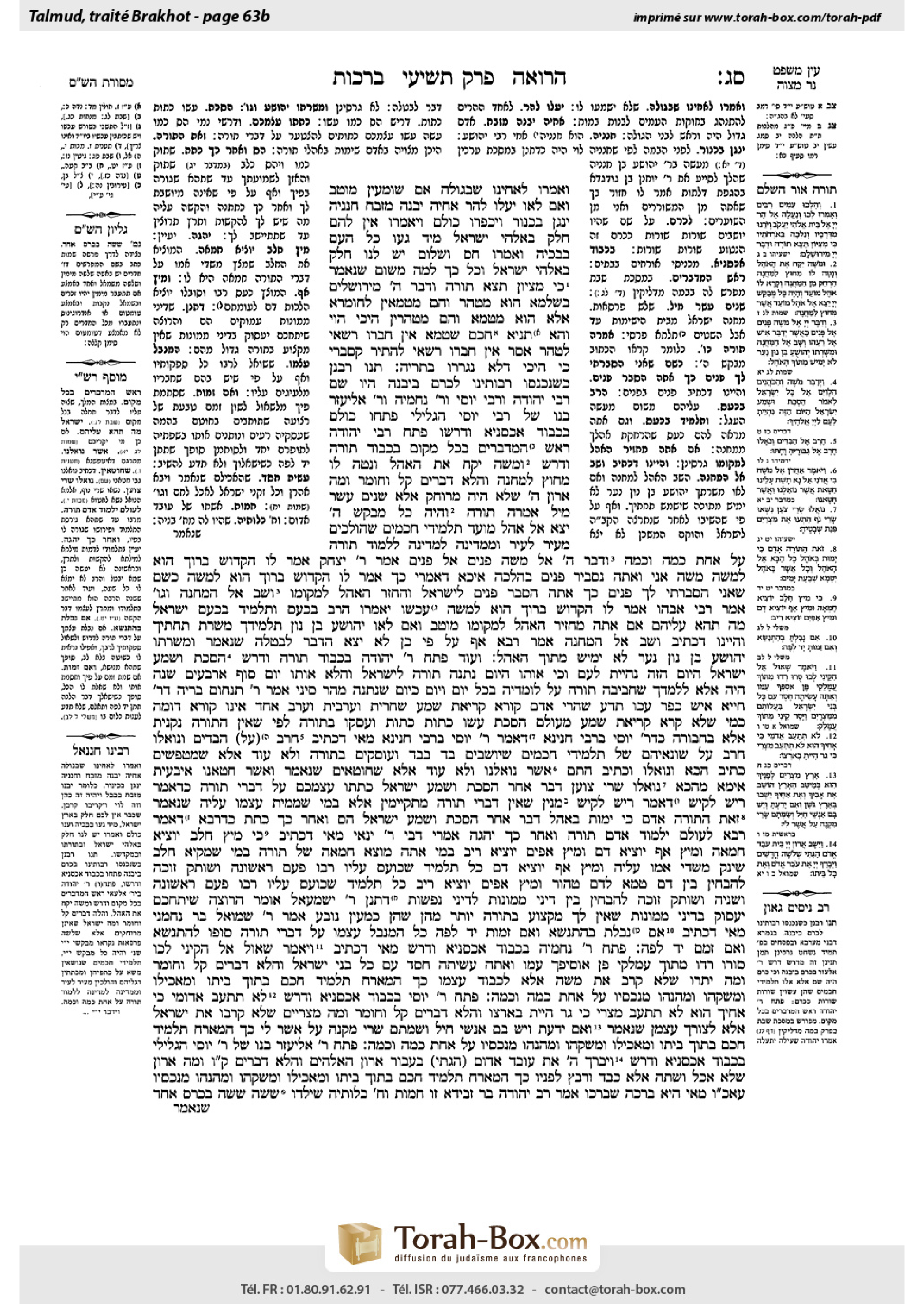
Berakhot 63b: Talmud study for Daf Yomi
Study the Talmud for Daf Yomi with scanned pages, Hebrew text, English translations from Sefaria and AI-generated French translations.
Passage selection and English or AI-generated French translation are available where the scan has annotations. Daf Study is independent of Torah-Box and Sefaria.
Browse Berakhot · ברכות · All tractatesBerakhot 63b text and translations
This page of Berakhot includes the Aramaic text, an English translation and an AI-generated French translation, alongside the scan above.
ברכות ס״ג ב · Aramaic and Hebrew text
וְאִמְרוּ לְאַחֵינוּ שֶׁבַּגּוֹלָה: אִם שׁוֹמְעִין — מוּטָב, וְאִם לָאו, יַעֲלוּ לְהַר, אֲחִיָּה יִבְנֶה מִזְבֵּחַ, חֲנַנְיָה יְנַגֵּן בְּכִנּוֹר, וְיִכְפְּרוּ כּוּלָּם, וְיֹאמְרוּ אֵין לָהֶם חֵלֶק בֵּאלֹהֵי יִשְׂרָאֵל.
מִיָּד גָּעוּ כׇּל הָעָם בִּבְכִיָּה וְאָמְרוּ: חַס וְשָׁלוֹם, יֵשׁ לָנוּ חֵלֶק בֵּאלֹהֵי יִשְׂרָאֵל.
וְכׇל כָּךְ לָמָּה? מִשּׁוּם שֶׁנֶּאֱמַר: ״כִּי מִצִּיּוֹן תֵּצֵא תוֹרָה וּדְבַר ה׳ מִירוּשָׁלָיִם״.
בִּשְׁלָמָא הוּא מְטַהֵר, וְהֵם מְטַמְּאִין — לְחוּמְרָא. אֶלָּא הוּא מְטַמֵּא וְהֵם מְטַהֲרִין, הֵיכִי הָוֵי? וְהָא תַּנְיָא: חָכָם שֶׁטִּמֵּא — אֵין חֲבֵרוֹ רַשַּׁאי לְטַהֵר, אָסַר — אֵין חֲבֵרוֹ רַשַּׁאי לְהַתִּיר! קָסָבְרִי כִּי הֵיכִי דְּלָא נִגָּרְרוּ בָּתְרֵיהּ.
תָּנוּ רַבָּנַן כְּשֶׁנִּכְנְסוּ רַבּוֹתֵינוּ לַכֶּרֶם בְּיַבְנֶה, הָיוּ שָׁם רַבִּי יְהוּדָה וְרַבִּי יוֹסֵי וְרַבִּי נְחֶמְיָה וְרַבִּי אֱלִיעֶזֶר בְּנוֹ שֶׁל רַבִּי יוֹסֵי הַגְּלִילִי. פָּתְחוּ כּוּלָּם בִּכְבוֹד אַכְסַנְיָא וְדָרְשׁוּ.
פָּתַח רַבִּי יְהוּדָה רֹאשׁ הַמְדַבְּרִים בְּכָל מָקוֹם בִּכְבוֹד תּוֹרָה, וְדָרַשׁ: ״וּמֹשֶׁה יִקַּח אֶת הָאֹהֶל וְנָטָה לוֹ מִחוּץ לַמַּחֲנֶה״. וַהֲלֹא דְּבָרִים קַל וָחוֹמֶר: וּמָה אֲרוֹן ה׳ שֶׁלֹּא הָיָה מְרוּחָק אֶלָּא שְׁנֵים עָשָׂר מִיל אָמְרָה תּוֹרָה ״וְהָיָה כׇּל מְבַקֵּשׁ ה׳ יֵצֵא אֶל אֹהֶל מוֹעֵד״ — תַּלְמִידֵי חֲכָמִים שֶׁהוֹלְכִים מֵעִיר לָעִיר וּמִמְּדִינָה לִמְדִינָה לִלְמוֹד תּוֹרָה, עַל אַחַת כַּמָּה וְכַמָּה.
״וְדִבֶּר ה׳ אֶל מֹשֶׁה פָּנִים אֶל פָּנִים״, אָמַר רַבִּי יִצְחָק: אָמַר לוֹ הַקָּדוֹשׁ בָּרוּךְ הוּא לְמֹשֶׁה: מֹשֶׁה, אֲנִי וְאַתָּה נַסְבִּיר פָּנִים בַּהֲלָכָה. אִיכָּא דְּאָמְרִי כָּךְ אָמַר לוֹ הַקָּדוֹשׁ בָּרוּךְ הוּא לְמֹשֶׁה: כְּשֵׁם שֶׁאֲנִי הִסְבַּרְתִּי לְךָ פָּנִים, כָּךְ אַתָּה הַסְבֵּר פָּנִים לְיִשְׂרָאֵל, וְהַחֲזֵר הָאֹהֶל לִמְקוֹמוֹ.
״וְשָׁב אֶל הַמַּחֲנֶה״ וְגוֹ׳, אָמַר רַבִּי אֲבָהוּ: אָמַר לוֹ הַקָּדוֹשׁ בָּרוּךְ הוּא לְמֹשֶׁה: עַכְשָׁיו יֹאמְרוּ הָרַב בְּכַעַס וְתַלְמִיד בְּכַעַס, יִשְׂרָאֵל מַה תְּהֵא עֲלֵיהֶם? אִם אַתָּה מַחֲזִיר הָאֹהֶל לִמְקוֹמוֹ — מוּטָב, וְאִם לָאו — יְהוֹשֻׁעַ בִּן נוּן תַּלְמִידְךָ מְשָׁרֵת תַּחְתֶּיךָ.
וְהַיְינוּ דִּכְתִיב: ״וְשָׁב אֶל הַמַּחֲנֶה״. אָמַר רָבָא: אַף עַל פִּי כֵן, לֹא יָצָא הַדָּבָר לְבַטָּלָה. שֶׁנֶּאֱמַר: ״וּמְשָׁרְתוֹ יְהוֹשֻׁעַ בִּן נוּן נַעַר לֹא יָמִישׁ מִתּוֹךְ הָאֹהֶל״.
וְעוֹד פָּתַח רַבִּי יְהוּדָה בִּכְבוֹד תּוֹרָה וְדָרַשׁ: ״הַסְכֵּת וּשְׁמַע יִשְׂרָאֵל הַיּוֹם הַזֶּה נִהְיֵיתָ לְעָם״, וְכִי אוֹתוֹ הַיּוֹם נִתְּנָה תּוֹרָה לְיִשְׂרָאֵל? וַהֲלֹא אוֹתוֹ יוֹם סוֹף אַרְבָּעִים שָׁנָה הָיָה! אֶלָּא לְלַמֶּדְךָ שֶׁחֲבִיבָה תּוֹרָה עַל לוֹמְדֶיהָ בְּכָל יוֹם וָיוֹם כַּיּוֹם שֶׁנִּתְּנָה מֵהַר סִינַי.
אָמַר רַבִּי תַּנְחוּם בְּרֵיהּ דְּרַבִּי חִיָּיא אִישׁ כְּפַר עַכּוֹ: תֵּדַע — שֶׁהֲרֵי אָדָם קוֹרֵא קְרִיאַת שְׁמַע שַׁחֲרִית וְעַרְבִית, וְעֶרֶב אֶחָד אֵינוֹ קוֹרֵא — דּוֹמֶה כְּמִי שֶׁלֹּא קָרָא קְרִיאַת שְׁמַע מֵעוֹלָם.
״הַסְכֵּת״ — עֲשׂוּ כִּתּוֹת כִּתּוֹת וְעִסְקוּ בַּתּוֹרָה. לְפִי שֶׁאֵין הַתּוֹרָה נִקְנֵית אֶלָּא בַּחֲבוּרָה. כִּדְרַבִּי יוֹסֵי בְּרַבִּי חֲנִינָא, דְּאָמַר רַבִּי יוֹסֵי בְּרַבִּי חֲנִינָא: מַאי דִּכְתִיב ״חֶרֶב אֶל הַבַּדִּים וְנֹאָלוּ״ — חֶרֶב עַל שׂוֹנְאֵיהֶם שֶׁל תַּלְמִידֵי חֲכָמִים שֶׁיּוֹשְׁבִים בַּד בְּבַד וְעוֹסְקִים בַּתּוֹרָה. וְלֹא עוֹד, אֶלָּא שֶׁמִּטַּפְּשִׁים, כְּתִיב הָכָא ״וְנֹאָלוּ״, וּכְתִיב הָתָם ״אֲשֶׁר נוֹאַלְנוּ״. וְלֹא עוֹד, אֶלָּא שֶׁחוֹטְאִים, שֶׁנֶּאֱמַר ״וַאֲשֶׁר חָטָאנוּ״.
אִיבָּעֵית אֵימָא מֵהָכָא: ״נוֹאֲלוּ שָׂרֵי צֹעַן״.
דָּבָר אַחֵר: ״הַסְכֵּת וּשְׁמַע יִשְׂרָאֵל״ — כַּתְּתוּ עַצְמְכֶם עַל דִּבְרֵי תוֹרָה. כִּדְאָמַר רֵישׁ לָקִישׁ, דְּאָמַר רֵישׁ לָקִישׁ: מִנַּיִן שֶׁאֵין דִּבְרֵי תוֹרָה מִתְקַיְּימִין אֶלָּא בְּמִי שֶׁמֵּמִית עַצְמוֹ עָלֶיהָ — שֶׁנֶּאֱמַר: ״זֹאת הַתּוֹרָה אָדָם כִּי יָמוּת בְּאֹהֶל״.
דָּבָר אַחֵר: ״הַסְכֵּת וּשְׁמַע יִשְׂרָאֵל״ — הַס, וְאַחַר כָּךְ כַּתֵּת. כִּדְרָבָא, דְּאָמַר רָבָא: לְעוֹלָם יִלְמוֹד אָדָם תּוֹרָה, וְאַחַר כָּךְ יֶהֱגֶה.
אָמְרִי דְּבֵי רַבִּי יַנַּאי: מַאי דִּכְתִיב ״כִּי מִיץ חָלָב יוֹצִיא חֶמְאָה וּמִיץ אַף יוֹצִיא דָם וּמִיץ אַפַּיִם יוֹצִיא רִיב״?
בְּמִי אַתָּה מוֹצֵא חֶמְאָה שֶׁל תּוֹרָה — בְּמִי שֶׁמֵּקִיא חָלָב שֶׁיָּנַק מִשְׁדֵּי אִמּוֹ עָלֶיהָ.
״וּמִיץ אַף יוֹצִיא דָם״ — כׇּל תַּלְמִיד שֶׁכּוֹעֵס עָלָיו רַבּוֹ פַּעַם רִאשׁוֹנָה וְשׁוֹתֵק — זוֹכֶה לְהַבְחִין בֵּין דָּם טָמֵא לְדָם טָהוֹר.
״וּמִיץ אַפַּיִם יוֹצִיא רִיב״ — כׇּל תַּלְמִיד שֶׁכּוֹעֵס עָלָיו רַבּוֹ פַּעַם רִאשׁוֹנָה וּשְׁנִיָּה וְשׁוֹתֵק — זוֹכֶה לְהַבְחִין בֵּין דִּינֵי מָמוֹנוֹת לְדִינֵי נְפָשׁוֹת. דִּתְנַן, רַבִּי יִשְׁמָעֵאל אוֹמֵר: הָרוֹצֶה שֶׁיִּתְחַכֵּם — יַעֲסוֹק בְּדִינֵי מָמוֹנוֹת, שֶׁאֵין לָךְ מִקְצוֹעַ בַּתּוֹרָה יוֹתֵר מֵהֶן, שֶׁהֵן כְּמַעְיָן נוֹבֵעַ.
אָמַר רַבִּי שְׁמוּאֵל בַּר נַחְמָנִי: מַאי דִּכְתִיב ״אִם נָבַלְתָּ בְהִתְנַשֵּׂא וְאִם זַמּוֹתָ יָד לְפֶה״ — כׇּל הַמְנַבֵּל עַצְמוֹ עַל דִּבְרֵי תוֹרָה — סוֹפוֹ לְהִתְנַשֵּׂא. וְאִם זָמַם — יָד לְפֶה.
פָּתַח רַבִּי נְחֶמְיָה בִּכְבוֹד אַכְסַנְיָא וְדָרַשׁ: מַאי דִּכְתִיב ״וַיֹּאמֶר שָׁאוּל אֶל הַקֵּינִי לְכוּ סֻּרוּ רְדוּ מִתּוֹךְ עֲמָלֵקִי פֶּן אוֹסִפְךָ עִמּוֹ וְאַתָּה עָשִׂיתָה חֶסֶד עִם כׇּל בְּנֵי יִשְׂרָאֵל״? וַהֲלֹא דְּבָרִים קַל וָחוֹמֶר: וּמָה יִתְרוֹ שֶׁלֹּא קֵרַב אֶת מֹשֶׁה אֶלָּא לִכְבוֹד עַצְמוֹ — כָּךְ, הַמְאָרֵחַ תַּלְמִיד חָכָם בְּתוֹךְ בֵּיתוֹ, וּמַאֲכִילוֹ וּמַשְׁקֵהוּ וּמְהַנֵּהוּ מִנְּכָסָיו — עַל אַחַת כַּמָּה וְכַמָּה.
פָּתַח רַבִּי יוֹסֵי בִּכְבוֹד אַכְסַנְיָא וְדָרַשׁ: ״לֹא תְתַעֵב אֲדֹמִי כִּי אָחִיךָ הוּא לֹא תְתַעֵב מִצְרִי כִּי גֵר הָיִיתָ בְאַרְצוֹ״, וַהֲלֹא דְּבָרִים קַל וָחוֹמֶר: וּמָה מִצְרִיִּים שֶׁלֹּא קֵרְבוּ אֶת יִשְׂרָאֵל אֶלָּא לְצוֹרֶךְ עַצְמָן, שֶׁנֶּאֱמַר: ״וְאִם יָדַעְתָּ וְיֶשׁ בָּם אַנְשֵׁי חַיִל וְשַׂמְתָּם שָׂרֵי מִקְנֶה עַל אֲשֶׁר לִי״ — כָּךְ, הַמְאָרֵחַ תַּלְמִיד חָכָם בְּתוֹךְ בֵּיתוֹ וּמַאֲכִילוֹ וּמַשְׁקֵהוּ וּמְהַנֵּהוּ מִנְּכָסָיו — עַל אַחַת כַּמָּה וְכַמָּה.
פָּתַח רַבִּי אֱלִיעֶזֶר בְּנוֹ שֶׁל רַבִּי יוֹסֵי הַגְּלִילִי בִּכְבוֹד אַכְסַנְיָא וְדָרַשׁ: ״וַיְבָרֶךְ ה׳ אֶת עֹבֵד אֱדֹם הַגִּתִּי בַּעֲבוּר אֲרוֹן הָאֱלֹהִים״, וַהֲלֹא דְּבָרִים קַל וָחוֹמֶר: וּמָה אָרוֹן שֶׁלֹּא אָכַל וְשָׁתָה, אֶלָּא כִּבֵּד וְרִבֵּץ לְפָנָיו — כָּךְ, הַמְאָרֵחַ תַּלְמִיד חָכָם בְּתוֹךְ בֵּיתוֹ, וּמַאֲכִילוֹ וּמַשְׁקֵהוּ וּמְהַנֵּהוּ מִנְּכָסָיו — עַל אַחַת כַּמָּה וְכַמָּה.
מַאי הִיא בְּרָכָה שֶׁבֵּרְכוֹ? אָמַר רַב יְהוּדָה בַּר זְבִידָא: זוֹ חָמוֹת וּשְׁמוֹנֶה כַּלּוֹתֶיהָ שֶׁיָּלְדוּ שִׁשָּׁה שִׁשָּׁה בְּכָרֵס אֶחָד.
Berakhot 63b · English translation
And in order to underscore this, tell our brethren in exile: If they obey the Sages of Eretz Yisrael to excommunicate Ḥanina, fine; and if they do not obey us, it is as if they are seceding from the Jewish people. They should climb a mountain; Aḥiya, one of the leaders of the Babylonian Jewish community, will build an altar, Ḥananya, son of Rabbi Yehoshua’s brother, who was a Levite, will play the lute, and all will proclaim heresy and say that they have no portion in the God of Israel.
This message had a profound impact on the people, and immediately the entire nation burst into tears, saying: God forbid. We do have a portion in the God of Israel. They reconsidered their plans to establish Babylonia as the center of the Jewish people.
The Gemara asks: Why did the Sages of Eretz Yisrael go to that extent to stop Ḥanina? The Gemara answers: Because it is stated: “For out of Zion shall go forth the Torah, and the word of the Lord from Jerusalem” (Isaiah 2:3).
The Gemara considers the details of this event: Granted, Ḥanina would rule an item pure and the Sages from Eretz Yisrael would rule it impure; they ruled stringently. But in a case where he ruled an item impure and they ruled it pure, what are the circumstances? How could they rule pure that which he ruled impure? Was it not taught in a baraita: If a Sage ruled an item impure, his colleague is not permitted to rule it pure; if he prohibited it, his colleague may not permit it? The Gemara explains: They held that they must do so in this case, so that people would not be drawn after him; due to the exigencies of the time they overturned his rulings.
The Sages taught: When our Rabbis, the Sages of the Mishna, entered the vineyard, the academy, in Yavne, Rabbi Yehuda, Rabbi Yosei, Rabbi Neḥemya, and Rabbi Eliezer, son of Rabbi Yosei HaGelili, were there presiding over the Sages. They all began to speak in honor of their hosts, the local population hosting them and their students as guests, and they taught.
Rabbi Yehuda, head of the speakers in every place, opened his speech in honor of Torah, and taught: It is stated: “Now Moses used to take the tent and pitch it outside the camp, far off from the camp; and he called it the Tent of Meeting. And it came to pass, that every seeker of God went out unto the Tent of Meeting, which was outside the camp” (Exodus 33:7). He said: Isn’t this an a fortiori inference? Just as the Torah says of the ark of God, which was only twelve mil from the camp: “Every seeker of God went out unto the Tent of Meeting”; all the more so should Torah scholars, who wander great distances and go from city to city and country to country to study Torah, be called seekers of God.
The Gemara continues: It is stated: “And the Lord spoke unto Moses, face to face” (Exodus 33:11). Rabbi Yitzḥak said: The Holy One, Blessed be He, said to Moses: Moses, you and I will show cheerful faces in the study of halakha to those who come to study. Some say that the Holy One, Blessed be He, told Moses: Just as I showed you a cheerful face, so too you will show Israel a cheerful face and restore the tent to its place in the camp.
It is said: “And he would return into the camp; but his minister, Joshua bin-Nun, a young man, departed not out of the Tent” (Exodus 33:11). Rabbi Abbahu said: The Holy One, Blessed be He, told Moses: Now, they will say: The Master, God, is angry and the student, Moses, is also angry, and what will happen to Israel? Rather, you must restore the tent to its place among the people. If you restore the tent to its place, fine; and if not, Joshua bin-Nun, your student, will serve as Israel’s leader in your place.
And that is what is written: “And he would return into the camp; but his minister, Joshua bin-Nun, a young man, departed not out of the Tent.” Rava said: Nevertheless, though Moses obeyed and restored the tent, the statement written with regard to the role of Joshua was not uttered for naught. Joshua bin-Nun remained as deputy to Moses, and ultimately served in his place, as it is stated: “But his minister, Joshua bin-Nun, a young man, departed not out of the Tent.”
And Rabbi Yehuda again began to speak in honor of Torah and taught: When Moses took leave of Israel on his last day in this world, he said: “Keep silence [hasket] and hear, Israel; this day you have become a people unto the Lord your God” (Deuteronomy 27:9). This is surprising: Was the Torah given to Israel on that day? Wasn’t that day at the end of forty years since the Torah was given? Rather, it comes to teach that each and every day the Torah is as dear to those who study it, as it was on the day it was given from Mount Sinai.
Rabbi Tanḥum, son of Rabbi Ḥiyya, of the village of Akko, said: Know that the Torah is indeed beloved, as one who recites Shema, morning and evening, for his entire life, and does not recite it one evening, it is as if he never recited Shema. He cannot compensate for what he missed.
The Gemara interprets the word hasket in this verse homiletically, as an acronym of the words as, make, and kat, group. Form [asu] many groups [kitot] and study Torah, for the Torah is only acquired through study in a group. This is in accordance with the opinion of Rabbi Yosei, son of Rabbi Ḥanina; as Rabbi Yosei, son of Rabbi Ḥanina, said: What is the meaning of that which is written: “A sword is upon the boasters [habaddim], and they shall become fools [noalu]” (Jeremiah 50:36)? This verse can be interpreted homiletically: A sword upon the enemies of Torah scholars, a euphemism for the Torah scholars themselves, who sit alone [bad bevad] and study Torah. And furthermore, those who study alone grow foolish, as it is written here, noalu, and elsewhere it is written that after Miriam was afflicted with leprosy, Aaron told Moses: “For that we have done foolishly [noalnu]” (Numbers 12:11). And furthermore, they sin due to that ignorance, as at the end of that same verse it is stated: “For that we have done foolishly, and for that we have sinned.”
If you wish, say instead that it is derived from here: “The princes of Tzoan are become fools [noalu]” (Isaiah 19:13).
The Gemara offers an alternative explanation of this verse: “Keep silence [hasket] and hear, Israel”; break [kattetu] yourselves over words of the Torah. This is in accordance with the opinion of Reish Lakish, as Reish Lakish said: From where is it derived that matters of Torah are only retained by one who kills himself over it? As it is stated: “This is the Torah: When one dies in a tent” (Numbers 19:14); true Torah study demands the total devotion of one who is willing to dedicate his life in the tent of Torah.
The Gemara offers yet another alternative explanation of this verse: “Keep silence [hasket] and hear, Israel”; first be silent [has] and listen and then study intensively in order to analyze [kattet] and clarify the details. This is in accordance with the opinion of Rava, as Rava said: One must always study Torah and gain expertise in it, and only then analyze and delve into it.
In the school of Rabbi Yannai they said: What is the meaning of that which is written: “For the churning of milk brings forth curd, and the wringing of the nose [af] brings forth blood, so the forcing of wrath [appayim] brings forth strife” (Proverbs 30:33)?
With regard to the beginning of the verse: For the churning of milk brings forth curd; in whom do you find the cream of Torah? With one who spits out the milk that he nursed from his mother’s breasts over it; one who struggles with all his might to study Torah.
With regard to: And the wringing of the nose brings forth blood, any student whose rabbi is angry [af] with him the first time and he is silent and does not react, will merit to be able to distinguish between blood that is ritually impure and blood that is ritually pure.
As for: And the forcing of wrath [appayim] brings forth strife; any student whose rabbi is angry with him for the first and second times, appayim being the plural of af, and he is silent, merits to distinguish between monetary cases, strife, and capital cases, as that is the highest level of learning. As we learned in a mishna: Rabbi Yishmael says: One who seeks to become wise should engage in monetary laws, as there is no greater discipline in Torah, as they are like a flowing well in which innovations constantly spring forth.
Similarly, Rabbi Shmuel bar Naḥmani said: What is the meaning of that which is written: “If you have done foolishly in lifting up yourself, or if you have planned devices [zamota], lay your hand over your mouth” (Proverbs 30:32)? Anyone who abases himself over matters of Torah, asking questions despite the shame he feels for his ignorance, will ultimately be exalted. And if he muzzles [zamam] himself due to embarrassment, he will end up with his hand over his mouth, unable to answer.
The Gemara returns to the homilies offered by the Sages in the vineyard of Yavne. Rabbi Neḥemya began to speak in honor of the hosts and taught: What is the meaning of that which is written: “And Saul said unto the Kenites: Go, depart, get you down from among the Amalekites lest I destroy you with them, for you showed kindness to all the Children of Israel when they came up out of Egypt” (I Samuel 15:6)? Isn’t this an a fortiori inference: Just as Jethro, the forbearer of the Kenite tribe, who only befriended Moses for his own honor, is treated in this way and rewarded that his merit would protect his descendants; all the more so should one who hosts a Torah scholar in his home, providing him with food and drink and availing him of his possessions, be rewarded with that protection.
Rabbi Yosei began to speak in honor of the hosts, and taught: It is said: “You shall not abhor an Edomite, for he is your brother; you shall not abhor an Egyptian, because you were a stranger in his land” (Deuteronomy 23:8). Isn’t this an a fortiori inference: Just as the Egyptians, who only befriended Israel, even when they hosted them, for their own benefit, as Pharaoh said to Joseph, as it is stated: “And if you know any able men among them, then make them rulers over my cattle” (Genesis 47:6), are treated this way, all the more so should one who hosts a Torah scholar in his home, providing him with food and drink and availing him of his possessions without concern for personal gain, be treated this way.
Rabbi Eliezer, son of Rabbi Yosei HaGelili, began to speak in honor of the hosts, and taught: It is stated: “The Lord has blessed the house of Oved-edom…because of the ark of God” (II Samuel 6:12). Isn’t this an a fortiori inference: Just as in reward for honoring the ark, which neither ate nor drank, but before which Oved-edom simply swept and sprinkled water to settle the dust, he was treated this way and merited a blessing, all the more so should one who hosts a Torah scholar in his home, providing him with food and drink and availing him of his possessions without concern for his personal gain, be rewarded with such a blessing.
The Gemara asks: What is that blessing with which Oved-edom was blessed? Rav Yehuda bar Zevida said: This is Ḥamot and her eight daughters-in-law, each of whom bore six in a single womb,
Berakhot 63b · Traduction française (IA)
Et afin de souligner cela, disons à nos frères en exil : Si ils obéissent aux Sages d'Israël pour excommunier Hanina, c'est bien ; et si ils ne nous obéissent pas, c'est comme s'ils se séparaient du peuple d'Israël. Ils doivent monter une montagne ; Aḥiya, l'un des chefs de la communauté juive en Babylone, construira un autel, Hananya, fils du frère de Rabbi Yehoshua, qui était un Lévite, jouera de la lyre, et tous proclameront l'hérésie et diront qu'ils n'ont pas de part dans le Dieu d'Israël.
Ce message eut une profonde influence sur le peuple, et aussitôt toute la nation éclata en larmes, disant : Élohim forbid. Nous avons bien une part dans le Dieu d'Israël. Ils repensèrent à leurs projets d'établir Babylone comme centre du peuple juif.
La Guemara demande : Pourquoi les Sages d'Israël allèrent-ils jusqu'à ce point pour empêcher Hanina ? La Guemara répond : Parce qu'il est dit : « Car de Sion sortira la Torah, et le mot du Seigneur de Jérusalem » (Michna 2:3).
La Guemara examine les détails de cet événement : En effet, Hanina déclarerait un objet pur et les Sages d'Israël le déclaraient impur ; ils étaient stricts. Mais dans un cas où il déclarait un objet impur et qu'ils le déclaraient pur, quels étaient les circonstances ? Comment pouvaient-ils déclarer pur ce qu'il avait déclaré impur ? N'était-il pas enseigné dans une baraïta : Si un Sage déclarait un objet impur, son collègue n'était pas autorisé à le déclarer pur ; si il l'interdisait, son collègue ne pouvait pas le permettre ? La Guemara explique : Ils considéraient qu'ils devaient agir ainsi dans ce cas, afin que les gens ne suivent pas lui ; en raison des exigences de l'époque, ils renversèrent ses décisions.
Les Sages enseignèrent : Lorsque nos Rabbins, les Sages de la Michna, entrèrent dans le vignoble, l'académie, à Yavne, Rabbi Yehuda, Rabbi Yosei, Rabbi Néchemyah et Rabbi Eliezer, fils de Rabbi Yosei HaGelili, étaient là présidant aux Sages. Ils commencèrent tous à parler en l'honneur de leurs hôtes, la population locale qui les accueillait ainsi que leurs élèves, et ils enseignèrent.
Rabbi Yehuda, chef des orateurs dans chaque lieu, ouvrit son discours en l'honneur de la Torah, et enseigna : Il est dit : « Maintenant, Moïse prenait le tabernacle et le dressait en dehors du camp, loin du camp ; et il l'appelait le Tabernacle de rencontre. Et il arriva que tout chercheur de Dieu sortait vers le Tabernacle de rencontre, qui était en dehors du camp » (Exode 33:7). Il dit : N'est-ce pas une déduction a fortiori ? Comme la Torah dit du coffre de Dieu, qui était seulement douze mil du camp : « Tout chercheur de Dieu sortait vers le Tabernacle de rencontre » ; tout autant devraient les savants de la Torah, qui errant à grande distance et voyageant d'une ville à l'autre et d'un pays à l'autre pour étudier la Torah, être appelés chercheurs de Dieu.
La Guemara continue : Il est dit : « Et le Seigneur parla à Moïse, face à face » (Exode 33:11). Rabbi Yitzhak dit : Le Saint, le Très Haut, dit à Moïse : Moïse, toi et moi, nous montrerons un visage joyeux dans l'étude de la halakha à ceux qui viennent étudier. Certains disent que le Saint, le Très Haut, dit à Moïse : Comme je t'ai montré un visage joyeux, ainsi tu montreras à Israël un visage joyeux et restaureras le tabernacle à sa place dans le camp.
Il est dit : « Et il rentrait dans le camp ; mais son ministre, Josué ben-Nun, un jeune homme, ne sortait pas du Tabernacle » (Exode 33:11). Rabbi Abbahu dit : Le Saint, le Très Haut, dit à Moïse : Maintenant, ils diront : Le Maître, Dieu, est en colère et l'élève, Moïse, est aussi en colère, et que sera-t-il de Israël ? Plutôt, tu dois restaurer le tabernacle à sa place parmi le peuple. Si tu le restaures à sa place, c'est bien ; et si non, Josué ben-Nun, ton élève, sera le chef d'Israël à ta place.
Et c'est ce qui est écrit : « Et il rentrait dans le camp ; mais son ministre, Josué ben-Nun, un jeune homme, ne sortait pas du Tabernacle. » Rava dit : Toutefois, bien que Moïse ait obéi et restauré le tabernacle, la déclaration concernant le rôle de Josué n'était pas vaine. Josué ben-Nun resta comme sous-chef de Moïse, et finalement prit sa place, comme il est dit : « Mais son ministre, Josué ben-Nun, un jeune homme, ne sortait pas du Tabernacle. »
Et Rabbi Yehuda recommença à parler en l'honneur de la Torah et enseigna : Lorsque Moïse prit congé d'Israël le dernier jour de ce monde, il dit : « Taisez-vous [hasket] et écoutez, Israël ; ce jour vous êtes devenu un peuple auprès du Seigneur votre Dieu » (Deutéronome 27:9). Cela est surprenant : La Torah fut-elle donnée à Israël ce jour-là ? N'était-ce pas le dernier jour des quarante ans depuis que la Torah avait été donnée ? Plutôt, cela vient enseigner que chaque jour la Torah est aussi chère à ceux qui l'étudient, comme le jour où elle fut donnée du mont Sinaï.
Rabbi Tanḥum, fils de Rabbi Ḥiyya, du village d'Akko, dit : Sache que la Torah est véritablement chère, comme celui qui récite le Chéma, matin et soir, toute sa vie, et qui ne le récite pas un soir, c'est comme s'il n'avait jamais récité le Chéma. Il ne peut compenser ce qu'il a manqué.
La Guemara interprète le mot hasket dans cette verset de manière allégorique, comme un acronyme des mots as, faire, et kat, groupe. Forme [asu] beaucoup de groupes [kitot] et étudie la Torah, car la Torah est acquise seulement par l'étude en groupe. Cela correspond à l'opinion de Rabbi Yosei, fils de Rabbi Ḥanina ; comme Rabbi Yosei, fils de Rabbi Ḥanina, dit : Quelle est la signification de ce qui est écrit : « Une épée est sur les orgueilleux [habaddim], et ils deviendront fous [noalu] » (Jérémie 50:36) ? Ce verset peut être interprété de manière allégorique : Une épée sur les ennemis des savants de la Torah, une équivalence pour les savants de la Torah eux-mêmes, qui s'isolent [bad bevad] et étudient la Torah. Et de plus, ceux qui étudient seul deviennent fous, comme il est écrit ici, noalu, et ailleurs il est dit que après que Miriam fut atteinte de lepra, Aaron dit à Moïse : « Pour cela nous avons agi de manière folle [noalnu] » (Nombres 12:11). Et de plus, ils péchent à cause de cette ignorance, comme il est dit à la fin de ce même verset : « Pour cela nous avons agi de manière folle, et pour cela nous avons péché. »
Si tu le souhaites, dis plutôt qu'il est tiré de là : « Les princes de Tzoan sont devenus fous [noalu] » (Isaïe 19:13).
La Guemara propose une autre explication de cette versette : « Tais-toi [hasket] et écoute, Israël » ; brise [kattetu] toi sur les paroles de la Torah. Cela s'accorde avec l'opinion de Reish Lakish, car Reish Lakish a dit : D'où est tiré le fait que les affaires de Torah sont conservées seulement par celui qui se donne la mort sur elles ? Comme il est dit : « C'est la Torah : Quand l'un meurt dans une tente » (Nombres 19:14) ; la véritable étude de la Torah exige la dévotion totale de celui qui est prêt à consacrer sa vie dans la tente de la Torah.
La Guemara propose une autre explication de ce verset : « Tais-toi [hasket] et écoute, Israël » ; d'abord sois silencieux [has] et écoute, puis étudie intensément afin d'analyser [kattet] et clarifier les détails. Cela s'accorde avec l'opinion de Rava, car Rava a dit : On doit toujours étudier la Torah et acquérir de l'expertise en elle, et seulement alors analyser et s'y plonger.
Dans l'école de Rabbi Yannai, on a dit : Quelle est la signification de ce qui est écrit : « Car le mélange du lait produit du fromage, et l'écrasement du nez [af] produit du sang, ainsi l'excitation de la colère [appayim] produit des querelles » (Proverbes 30:33) ?
Concernant le début du verset : Car le mélange du lait produit du fromage ; dans qui trouves-tu la crème de la Torah ? Celui qui rejette le lait qu'il a suivi de la poitrine de sa mère ; celui qui se bat avec toute sa force pour étudier la Torah.
Concernant : Et l'écrasement du nez produit du sang ; tout étudiant dont le maître est en colère [af] avec lui la première fois et qui est silencieux et ne réagit pas, mérite de pouvoir distinguer entre le sang impur et le sang pur.
Quant à : Et l'excitation de la colère [appayim] produit des querelles ; tout étudiant dont le maître est en colère avec lui la première et la deuxième fois, appayim étant le pluriel d'af, et qui est silencieux, mérite de distinguer entre les cas monétaires, les querelles et les cas de peine capitale, car c'est le niveau le plus élevé d'étude. Comme nous avons appris dans une mitsva : Rabbi Yishmael dit : Celui qui cherche à devenir sage doit s'engager dans les lois monétaires, car c'est la plus grande discipline dans la Torah, car elles sont comme un puits qui coule constamment en produisant des innovations.
De même, Rabbi Shmuel bar Naḥmani a dit : Quelle est la signification de ce qui est écrit : « Si tu as agi stupidement en te haussant, ou si tu as conçu des machinations [zamota], pose ta main sur ta bouche » (Proverbes 30:32) ? Tout celui qui se dégrade sur les affaires de la Torah, en posant des questions malgré la honte qu'il ressent à cause de son ignorance, sera finalement exalté. Et si il mousse [zamam] lui-même à cause de l'embarras, il finira avec sa main sur sa bouche, incapable de répondre.
La Guemara revient aux homélies des Sages dans le vignoble de Yavne. Rabbi Néhemya a commencé à parler en l'honneur des hôtes et a enseigné : Quelle est la signification de ce qui est écrit : « Et Saül dit aux Kenites : Allez, partez, descendez parmi les Amalakites, afin que je ne vous détruisais pas avec eux, car vous avez montré de la bonté à tous les enfants d'Israël lorsqu'ils sont montés d'Égypte » (I Samuel 15:6) ? N'est-ce pas une inférence a fortiori : Comme Jéthor, le patriarche de la tribu des Kenites, qui a seulement fait ami avec Moïse pour son propre honneur, est traité ainsi et récompensé que sa mérite protège ses descendants ; tout autant devrait celui qui accueille un savant de la Torah chez lui, en lui fournissant de la nourriture et de la boisson et en lui permettant d'utiliser ses biens, être récompensé ainsi.
Rabbi Yosei a commencé à parler en l'honneur des hôtes, et a enseigné : Il est dit : « Tu ne devrais pas haïr un Edomite, car il est ton frère ; tu ne devrais pas haïr un Égyptien, car tu étais étranger dans son pays » (Deutéronome 23:8). N'est-ce pas une inférence a fortiori : Comme les Égyptiens, qui ont seulement fait ami avec Israël, même lorsqu'ils les ont accueillis, pour leur propre bénéfice, comme Pharaon a dit à Joseph, comme il est dit : « Et si tu sais des hommes capables parmi eux, alors fais-les des chefs sur mon bétail » (Genèse 47:6), sont traités ainsi, tout autant devrait celui qui accueille un savant de la Torah chez lui, en lui fournissant de la nourriture et de la boisson et en lui permettant d'utiliser ses biens sans souci de son propre bénéfice, être traité ainsi.
Rabbi Eliezer, fils de Rabbi Yosei HaGelili, a commencé à parler en l'honneur des hôtes, et a enseigné : Il est dit : « L'Éternel a béni la maison d'Oved-edom… à cause de l'Arca de Dieu » (II Samuel 6:12). N'est-ce pas une inférence a fortiori : Comme en récompense pour l'honneur de l'Arca, qui ne mangeait ni ne buvait, mais devant lequel Oved-edom ne faisait qu'aspirer et verser de l'eau pour calmer la poussière, il a été traité ainsi et a mérité une bénédiction, tout autant devrait celui qui accueille un savant de la Torah chez lui, en lui fournissant de la nourriture et de la boisson et en lui permettant d'utiliser ses biens sans souci de son propre bénéfice, être récompensé avec une telle bénédiction.
La Guemara demande : Quelle est cette bénédiction avec laquelle Oved-edom a été béni ? Rav Yéhuda bar Zévida a dit : C'est Hamot et ses huit filles, chacune desquelles a donné six dans un seul ventre,
Traduction française générée par IA à partir de l’édition anglaise de Sefaria. Vérifie toujours un passage avec le texte source.
Text from Sefaria: William Davidson Edition - Vocalized Aramaic (CC BY NC); William Davidson Edition - English (CC BY NC).