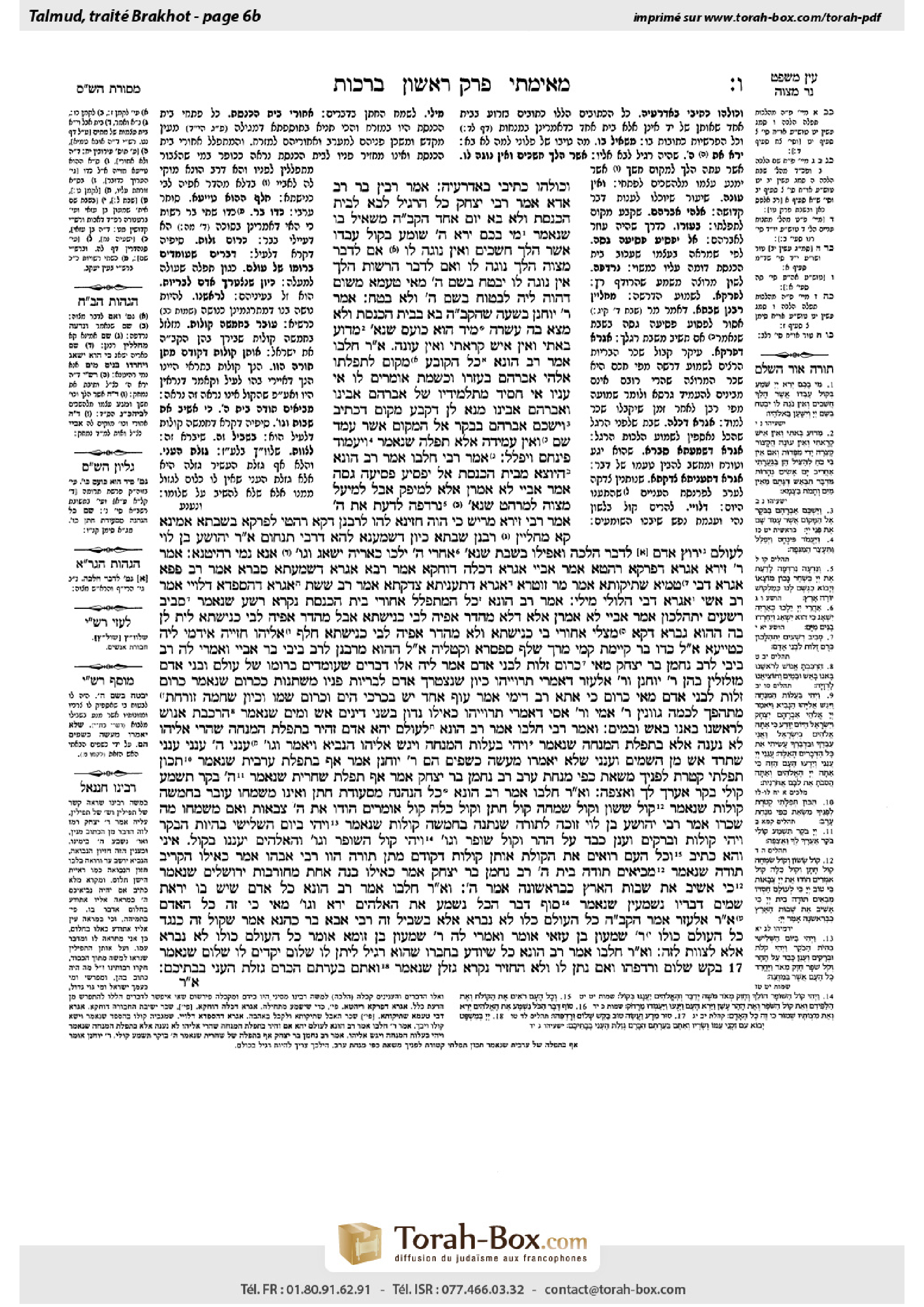
Berakhot 6b: Talmud study for Daf Yomi
Study the Talmud for Daf Yomi with scanned pages, Hebrew text, English translations from Sefaria and AI-generated French translations.
Passage selection and English or AI-generated French translation are available where the scan has annotations. Daf Study is independent of Torah-Box and Sefaria.
Browse Berakhot · ברכות · All tractatesBerakhot 6b text and translations
This page of Berakhot includes the Aramaic text, an English translation and an AI-generated French translation, alongside the scan above.
ברכות ו׳ ב · Aramaic and Hebrew text
וְכוּלְּהוּ כְּתִיבִי בְּאֶדְרָעֵיהּ.
אָמַר רָבִין בַּר רַב אַדָּא, אָמַר רַבִּי יִצְחָק: כׇּל הָרָגִיל לָבֹא לְבֵית הַכְּנֶסֶת וְלֹא בָּא יוֹם אֶחָד, הַקָּדוֹשׁ בָּרוּךְ הוּא מְשָׁאֵיל בּוֹ, שֶׁנֶּאֱמַר: ״מִי בָכֶם יְרֵא ה׳ שֹׁמֵעַ בְּקוֹל עַבְדּוֹ אֲשֶׁר הָלַךְ חֲשֵׁכִים וְאֵין נֹגַהּ לוֹ״.
אִם לִדְבַר מִצְוָה הָלַךְ — נוֹגַהּ לוֹ, וְאִם לִדְבַר הָרְשׁוּת הָלַךְ — אֵין נוֹגַהּ לוֹ.
״יִבְטַח בְּשֵׁם ה׳״ מַאי טַעְמָא? — מִשּׁוּם דַּהֲוָה לֵיהּ לִבְטוֹחַ בְּשֵׁם ה׳, וְלָא בְּטַח.
אָמַר רַבִּי יוֹחָנָן: בְּשָׁעָה שֶׁהַקָּדוֹשׁ בָּרוּךְ הוּא בָּא בְּבֵית הַכְּנֶסֶת, וְלֹא מָצָא בָּהּ עֲשָׂרָה — מִיָּד הוּא כּוֹעֵס, שֶׁנֶּאֱמַר: ״מַדּוּעַ בָּאתִי וְאֵין אִישׁ קָרָאתִי וְאֵין עוֹנֶה״.
אָמַר רַבִּי חֶלְבּוֹ, אָמַר רַב הוּנָא: כׇּל הַקּוֹבֵעַ מָקוֹם לִתְפִלָּתוֹ — אֱלֹהֵי אַבְרָהָם בְּעֶזְרוֹ.
וּכְשֶׁמֵּת, אוֹמְרִים לוֹ: ״אֵי עָנָיו, אֵי חָסִיד, מִתַּלְמִידָיו שֶׁל אַבְרָהָם אָבִינוּ״.
וְאַבְרָהָם אָבִינוּ מְנָא לַן דִּקְבַע מָקוֹם? דִּכְתִיב: ״וַיַּשְׁכֵּם אַבְרָהָם בַּבֹּקֶר אֶל הַמָּקוֹם אֲשֶׁר עָמַד שָׁם״, וְאֵין ״עֲמִידָה״ אֶלָּא תְּפִלָּה, שֶׁנֶּאֱמַר: ״וַיַּעֲמֹד פִּינְחָס וַיְפַלֵּל״.
אָמַר רַבִּי חֶלְבּוֹ, אָמַר רַב הוּנָא: הַיּוֹצֵא מִבֵּית הַכְּנֶסֶת אַל יַפְסִיעַ פְּסִיעָה גַסָּה. אָמַר אַבָּיֵי: לָא אֲמַרַן, אֶלָּא לְמִיפַּק. אֲבָל לְמֵיעַל — מִצְוָה לְמִרְהַט, שֶׁנֶּאֱמַר: ״נִרְדְּפָה לָדַעַת אֶת ה׳״.
אָמַר רַבִּי זֵירָא: מֵרֵישׁ כִּי הֲוָה חֲזֵינָא לְהוּ לְרַבָּנַן דְּקָא רָהֲטִי לְפִרְקָא בְּשַׁבְּתָא, אָמֵינָא: ״קָא מְחַלַּיִין רַבָּנַן שַׁבְּתָא״. כֵּיוָן דִּשְׁמַעְנָא לְהָא דְּרַבִּי תַּנְחוּם אָמַר רַבִּי יְהוֹשֻׁעַ בֶּן לֵוִי: לְעוֹלָם יָרוּץ אָדָם לִדְבַר הֲלָכָה וַאֲפִילּוּ בְּשַׁבָּת, שֶׁנֶּאֱמַר: ״אַחֲרֵי ה׳ יֵלְכוּ כְּאַרְיֵה יִשְׁאָג״ וְגוֹ׳, אֲנָא נָמֵי רָהֵיטְנָא.
אָמַר רַבִּי זֵירָא: אַגְרָא דְפִרְקָא — רִהֲטָא.
אָמַר אַבָּיֵי: אַגְרָא דְכַלָּה — דּוּחְקָא.
אָמַר רָבָא: אַגְרָא דִשְׁמַעְתָּא — סְבָרָא.
אָמַר רַב פָּפָּא: אַגְרָא דְבֵי טַמְיָא — שְׁתִיקוּתָא.
אָמַר מָר זוּטְרָא: אַגְרָא דְתַעֲנִיתָא — צִדְקְתָא.
אָמַר רַב שֵׁשֶׁת: אַגְרָא דְהֶסְפֵּדָא — דַּלּוֹיֵי.
אָמַר רַב אָשֵׁי: אַגְרָא דְבֵי הִלּוּלֵי — מִילֵּי.
אָמַר רַב הוּנָא: כׇּל הַמִּתְפַּלֵּל אֲחוֹרֵי בֵּית הַכְּנֶסֶת נִקְרָא ״רָשָׁע״, שֶׁנֶּאֱמַר: ״סָבִיב רְשָׁעִים יִתְהַלָּכוּן״.
אָמַר אַבָּיֵי: לָא אֲמַרַן אֶלָּא דְּלָא מַהְדַּר אַפֵּיהּ לְבֵי כְּנִישְׁתָּא, אֲבָל מַהְדַּר אַפֵּיהּ לְבֵי כְּנִישְׁתָּא — לֵית לָן בַּהּ.
הַהוּא גַבְרָא דְּקָא מְצַלֵּי אֲחוֹרֵי בֵּי כְּנִישְׁתָּא, וְלָא מַהְדַּר אַפֵּיהּ לְבֵי כְּנִישְׁתָּא. חֲלַף אֵלִיָּהוּ. חַזְיֵיהּ, אִידְּמִי לֵיהּ כְּטַיָּיעָא, אֲמַר לֵיהּ: כְּדוּ בָר קָיְימַתְּ קַמֵּי מָרָךְ?! שְׁלַף סַפְסֵרָא וְקַטְלֵיהּ.
אֲמַר לֵיהּ הָהוּא מֵרַבָּנַן לְרַב בִּיבִי בַּר אַבָּיֵי, וְאָמְרִי לַהּ רַב בִּיבִי לְרַב נַחְמָן בַּר יִצְחָק: מַאי ״כְּרֻם זֻלּוּת לִבְנֵי אָדָם״?
אֲמַר לֵיהּ: אֵלּוּ דְּבָרִים שֶׁעוֹמְדִים בְּרוּמוֹ שֶׁל עוֹלָם, וּבְנֵי אָדָם מְזַלְזְלִין בָּהֶן.
רַבִּי יוֹחָנָן וְרַבִּי אֶלְעָזָר דְאָמְרִי תַּרְוַיְיהוּ: כֵּיוָן שֶׁנִּצְטָרֵךְ אָדָם לַבְּרִיּוֹת, פָּנָיו מִשְׁתַּנּוֹת כִּכְרוּם, שֶׁנֶּאֱמַר: ״כְּרֻם זֻלּוּת לִבְנֵי אָדָם״.
מַאי ״כְּרוּם״? כִּי אֲתָא רַב דִּימִי, אָמַר: עוֹף אֶחָד יֵשׁ בִּכְרַכֵּי הַיָּם, וּ״כְרוּם״ שְׁמוֹ, וְכֵיוָן שֶׁחַמָּה זוֹרַחַת מִתְהַפֵּךְ לְכַמָּה גְּווֹנִין.
רַבִּי אַמֵּי וְרַבִּי אַסִּי דְאָמְרִי תַּרְוַיְיהוּ: כְּאִלּוּ נִדּוֹן בִּשְׁנֵי דִינִים, אֵשׁ וּמַיִם, שֶׁנֶּאֱמַר: ״הִרְכַּבְתָּ אֱנוֹשׁ לְרֹאשֵׁנוּ בָּאנוּ בָאֵשׁ וּבַמַּיִם״.
וְאָמַר רַבִּי חֶלְבּוֹ, אָמַר רַב הוּנָא: לְעוֹלָם יְהֵא אָדָם זָהִיר בִּתְפִלַּת הַמִּנְחָה, שֶׁהֲרֵי אֵלִיָּהוּ לֹא נַעֲנָה אֶלָּא בִּתְפִלַּת הַמִּנְחָה, שֶׁנֶּאֱמַר: ״וַיְהִי בַּעֲלוֹת הַמִּנְחָה וַיִּגַּשׁ אֵלִיָּהוּ הַנָּבִיא וַיֹּאמַר וְגוֹ׳ עֲנֵנִי ה׳ עֲנֵנִי״.
״עֲנֵנִי״ — שֶׁתֵּרֵד אֵשׁ מִן הַשָּׁמַיִם, וַ״עֲנֵנִי״ — שֶׁלֹּא יֹאמְרוּ מַעֲשֵׂה כְשָׁפִים הֵם.
רַבִּי יוֹחָנָן אָמַר: אַף בִּתְפִלַּת עַרְבִית, שֶׁנֶּאֱמַר: ״תִּכּוֹן תְּפִלָּתִי קְטֹרֶת לְפָנֶיךָ מַשְׂאַת כַּפַּי מִנְחַת עָרֶב״. רַב נַחְמָן בַּר יִצְחָק אָמַר: אַף תְּפִלַּת שַׁחֲרִית, שֶׁנֶּאֱמַר: ״ה׳ בֹּקֶר תִּשְׁמַע קוֹלִי, בֹּקֶר אֶעֱרׇךְ לְךָ וַאֲצַפֶּה״.
וְאָמַר רַבִּי חֶלְבּוֹ, אָמַר רַב הוּנָא: כׇּל הַנֶּהֱנֶה מִסְּעוּדַת חָתָן וְאֵינוֹ מְשַׂמְּחוֹ עוֹבֵר בַּחֲמִשָּׁה קוֹלוֹת, שֶׁנֶּאֱמַר: ״קוֹל שָׂשׂוֹן וְקוֹל שִׂמְחָה קוֹל חָתָן וְקוֹל כַּלָּה קוֹל אוֹמְרִים הוֹדוּ אֶת ה׳ צְבָאוֹת״.
וְאִם מְשַׂמְּחוֹ מַה שְּׂכָרוֹ? אָמַר רַבִּי יְהוֹשֻׁעַ בֶּן לֵוִי: זוֹכֶה לַתּוֹרָה שֶׁנִּתְּנָה בַּחֲמִשָּׁה קוֹלוֹת, שֶׁנֶּאֱמַר: ״וַיְהִי בַיּוֹם הַשְּׁלִישִׁי בִּהְיוֹת הַבֹּקֶר וַיְהִי קֹלֹת וּבְרָקִים וְעָנָן כָּבֵד עַל הָהָר וְקֹל שׁוֹפָר וְגוֹ׳. וַיְהִי קוֹל הַשֹּׁפָר וְגוֹ׳ וְהָאֱלֹהִים יַעֲנֶנּוּ בְקוֹל״.
אִינִּי? וְהָא כְּתִיב ״וְכׇל הָעָם רוֹאִים אֶת הַקּוֹלוֹת״!
אוֹתָן קוֹלוֹת, דְּקוֹדֶם מַתַּן תּוֹרָה הֲווֹ.
רַבִּי אֲבָהוּ אָמַר: כְּאִילּוּ הִקְרִיב תּוֹדָה, שֶׁנֶּאֱמַר: ״מְבִאִים תּוֹדָה בֵּית ה׳״. רַב נַחְמָן בַּר יִצְחָק אָמַר: כְּאִילּוּ בָּנָה אַחַת מֵחוּרְבוֹת יְרוּשָׁלַיִם, שֶׁנֶּאֱמַר ״כִּי אָשִׁיב אֶת שְׁבוּת הָאָרֶץ כְּבָרִאשׁוֹנָה אָמַר ה׳״.
וְאָמַר רַבִּי חֶלְבּוֹ, אָמַר רַב הוּנָא: כׇּל אָדָם שֶׁיֵּשׁ בּוֹ יִרְאַת שָׁמַיִם — דְּבָרָיו נִשְׁמָעִין, שֶׁנֶּאֱמַר: ״סוֹף דָּבָר הַכֹּל נִשְׁמָע אֶת הָאֱלֹהִים יְרָא וְגוֹ׳״.
מַאי ״כִּי זֶה כׇּל הָאָדָם״? אָמַר רַבִּי אֶלְעָזָר, אָמַר הַקָּדוֹשׁ בָּרוּךְ הוּא: כׇּל הָעוֹלָם כֻּלּוֹ לֹא נִבְרָא אֶלָּא בִּשְׁבִיל זֶה.
רַבִּי אַבָּא בַּר כָּהֲנָא אָמַר: שָׁקוּל זֶה כְּנֶגֶד כׇּל הָעוֹלָם כּוּלּוֹ, רַבִּי שִׁמְעוֹן בֶּן עַזַּאי אוֹמֵר, וְאָמְרִי לַהּ רַבִּי שִׁמְעוֹן בֶּן זוֹמָא אוֹמֵר: כׇּל הָעוֹלָם כּוּלּוֹ לֹא נִבְרָא אֶלָּא לִצְווֹת לָזֶה.
וְאָמַר רַבִּי חֶלְבּוֹ, אָמַר רַב הוּנָא: כׇּל שֶׁיּוֹדֵעַ בַּחֲבֵרוֹ שֶׁהוּא רָגִיל לִיתֵּן לוֹ שָׁלוֹם, יַקְדִּים לוֹ שָׁלוֹם, שֶׁנֶּאֱמַר: ״בַּקֵּשׁ שָׁלוֹם וְרׇדְפֵהוּ״. וְאִם נָתַן לוֹ וְלֹא הֶחֱזִיר — נִקְרָא ״גַּזְלָן״, שֶׁנֶּאֱמַר: ״וְאַתֶּם בִּעַרְתֶּם הַכֶּרֶם גְּזֵלַת הֶעָנִי בְּבָתֵּיכֶם״.
Berakhot 6b · English translation
in the phylacteries of the head, where there are four separate compartments. And all of the verses are written together on one parchment in the phylacteries of the arm, which has only one compartment.
Additionally, Ravin bar Rav Adda said that Rabbi Yitzḥak said: One who is accustomed to come to the synagogue and did not come one day, the Holy One, Blessed be He, asks about him, as it were, to determine what happened to him, as it is stated: “Who among you fears the Lord? Who hears the voice of His servant? Though he walks in darkness and has no light, let him trust in the name of the Lord, and rely upon his God” (Isaiah 50:10). In other words, God asks, who among you fears the Lord yet did not come to hear the voice of His servant the prayer leader, who engages in the service of God? He who went out before dawn and walks in darkness before prayer.
If it is for a matter involving a mitzva that he went and absented himself from prayer in the synagogue, then, despite the darkness, there is light for him, the aura of his mitzva will protect him. But if it is for an optional matter, some mundane purpose, that he went and absented himself from prayer in the synagogue, then, even once the day begins, there is no light for him (Maharsha).
The verse continues: “Let him trust in the name of the Lord.” The Gemara asks: What is the reason that God is so exacting with this person? The Gemara answers: Because he should have relied on the name of the Lord, and trusted that he would not incur any loss if he postponed dealing with his mundane matters until after prayer in the synagogue, and he did not rely on God.
On this same topic, Rabbi Yoḥanan said: When the Holy One, Blessed be He, enters a synagogue and does not find ten people there, He immediately becomes angry, as it is stated: “Why, when I came, was there no one? When I called, there was no one to answer…Behold, with My rebuke I dry up the sea, I make the rivers a wilderness” (Isaiah 50:2).
Concerning another aspect of the constancy of prayer, Rabbi Ḥelbo said that Rav Huna said: One who sets a fixed place for his prayer, the God of Abraham assists him. Since prayer parallels the Temple service, it is a sign of respect to set a fixed place for this sacred rite (Rabbi Yoshiyahu Pinto). The God of Abraham assists him because this pious custom evokes Abraham’s conduct.
When he dies, those who eulogize one who set a fixed place for his prayer say about him: “Where is the humble one, where is the pious one, of the disciples of our father Abraham?” Presumably, one who sets a fixed place for prayer is a disciple of Abraham in every respect, including humility and piety (Rabbi Yoshiyahu Pinto).
The Gemara asks: From where do we derive that Abraham our father set a fixed place for his prayer? The Gemara answers: As it is written: “And Abraham rose in the morning to the place where he had stood before God” (Genesis 19:27), and the verb “standing” means nothing other than prayer, as it is stated: “And Pinehas stood and prayed” (Psalms 106:30).
Rabbi Ḥelbo said that Rav Huna said: One who leaves the synagogue should not take large strides because it creates the impression that he is eager to leave. Abaye explained Rav Huna’s statement and said: This halakha was only said with regard to leaving the synagogue, where large strides seem particularly disrespectful. However, with regard to entering a synagogue, it is a mitzva to run and one is permitted to rush and take large strides (Rabbi Yoshiyahu Pinto). As it is said: “And let us know, eagerly strive to know the Lord” (Hosea 6:3). One who eagerly enters a synagogue displays his enthusiasm to follow the path of God.
Rabbi Zeira said: Initially, when I saw the Sages running to the Rabbi’s lecture on Shabbat, I said: These Sages are desecrating Shabbat. One is prohibited from running on Shabbat in deference to the sanctity of the day. Once I heard that which Rabbi Tanḥum said that Rabbi Yehoshua ben Levi said: One should always run for a matter of halakha, even on Shabbat, as it is stated: “They shall walk after the Lord, who will roar like a lion” (Hosea 11:10). In other words, one should rush as though he were chased by a lion (Birkat Hashem), I too run.
Rabbi Zeira said: The reward for attending the lecture is for running. Since most individuals attending the lecture did not fully understand the material taught, the primary reward for attendance was given for their intention to hear the Torah being taught, as evidenced by their rush to arrive.
Similarly, Abaye said: The reward for attending the kalla is for the crowding. Due to the large crowd, study was difficult, so the primary reward was given for their effort to hear and understand some part of the lecture.
Similarly, Rava said: The reward for learning the halakhic traditions of the amora’im is for the logical analysis, as the primary reward for studying Talmud was not given for knowing the halakhic conclusions, but for the logical reasoning that led to those conclusions.
Rav Pappa said: The primary reward for attending a house of mourning [bei tammaya] is for the silence, which is the optimal manner for those consoling the mourners to express their empathy.
Mar Zutra said: The primary reward for fasting is for the charity given to the poor on the fast day (see Isaiah 58).
Rav Sheshet said: The primary reward for delivering a eulogy is for causing those in attendance to raise their voices and cry, as that increases the grief over the deceased.
Rav Ashi said: The primary reward for participating in a wedding is for the words, i.e., the good wishes with which the guests regale the bride and groom.
Back to the topic of deference for a synagogue, the Gemara records that Rav Huna said: One who prays behind the synagogue is called wicked, as while the entire congregation is facing one direction to pray, he faces the opposite direction creating the impression that he is treating the synagogue and its congregation with contempt. As it is stated: “The wicked walk round about, when vileness is exalted among the sons of men” (Psalms 12:9). In other words, only the wicked walk round about the synagogue in order to pray.
Abaye said: This halakha was said only in a case where one does not turn his face toward the synagogue. But where he turns his face toward the synagogue and prays we have no prohibition in that case.
To reinforce the gravity of this prohibition, the Gemara relates: A certain individual prayed behind the synagogue and did not turn to face the synagogue. Elijah the Prophet passed by and he saw him. He appeared to him as an Arab [taya’a]. Elijah said: “This is how [kadu bar] you stand before your Master?” Elijah drew a sword and killed him.
Rav Huna already explained the beginning of the verse, “The wicked walk round about.” The Gemara explains the end of the verse: “When vileness is exalted among the sons of men.” One of the Sages said to Rav Beivai bar Abaye, and some say Rav Beivai said to Rav Naḥman bar Yitzḥak: What is the meaning of: “When vileness is exalted among the sons of men”?
He said to him: These are matters of utmost importance, exalted, i.e., mitzvot or prayer, which people nonetheless treat with contempt, vileness among the sons of men.
Rabbi Yoḥanan and his student, Rabbi Elazar, both said an alternative explanation of this verse: Once a person needs the help of others and loses dignity in their eyes, vileness among the sons of men, his face changes and becomes like a kerum, as it is stated: “When [kerum] vileness is exalted among the sons of men.”
What is kerum referred to by Rabbi Yoḥanan and Rabbi Elazar? When Rav Dimi came to Babylonia from Eretz Yisrael he said: There is a bird in the cities by the sea called kerum and when the sun rises, the bird changes several colors. Similarly, one who becomes dependent upon others blushes in embarrassment.
Rabbi Ami and Rabbi Asi both said: One who becomes dependent upon others, it is as if he was punished with two punishments: Fire and water. As it is stated: “You have caused men to ride over our heads; we have gone through fire and water” (Psalms 66:12).
And Rabbi Ḥelbo said that Rav Huna said: One must always be vigilant with regard to the afternoon prayer, as Elijah’s prayer was only answered in the afternoon prayer, as it is stated: “And it was at the time of the afternoon offering that Elijah the Prophet came near, and he said: Lord, God of Abraham, Isaac and Israel, let it be known on this day that You are God in Israel, and that I am Your servant, and that I have done all these things at Your word. Answer me, Lord, answer me, that this people will know that You, Lord, are God” (I Kings 18:36–37). Because Elijah was answered in the afternoon prayer, it has particular significance.
In passing, the Gemara explains why it was necessary for Elijah to repeat, “answer me, Lord, answer me”: The first answer me was the request that fire descend from the heavens, while the second answer me was the request that Israel should accept complete faith in God and not say that the fire descending from the heavens was an act of sorcery.
Rabbi Yoḥanan said: One must be vigilant with regard to the evening prayer as well, as it is stated: “Let my prayer come forth as incense before You, the lifting of my hands as the evening offering” (Psalms 141:2).
Rav Naḥman bar Yitzḥak said: One must be vigilant with regard to the morning prayer as well, as it is stated: “Lord, in the morning You shall hear my voice; in the morning I will order my prayer unto You and will look forward” (Psalms 5:4).
And Rabbi Ḥelbo said that Rav Huna said: Anyone who benefits from the feast of a groom but does not cause him to rejoice violates the five voices mentioned in this verse, as it is stated: “The voice of joy and the voice of gladness, the voice of the groom and the voice of the bride, and the voice of those who say: Give thanks to the Lord of hosts, for the Lord is good, for His mercy lasts forever, even of those who bring a thanks-offering to the house of the Lord. For I will restore the captivity of the land as it was in the beginning, says the Lord” (Jeremiah 33:11). These five voices in the context of a bride and groom correspond to the five voices mentioned in the context of the revelation at Sinai, as in Song of Songs, the day of the revelation at Sinai is alluded to by the phrase: His wedding day (Rabbi Yoshiyahu Pinto, Maharsha).
What is his reward if he causes the groom to rejoice? Rabbi Yehoshua ben Levi said: He is privileged to acquire the Torah, which was given with five voices, as it is stated: “And it was on the third day, when it was morning, there were sounds [kolot], and lightning and a thick cloud upon the mountain, and the voice of the shofar” (Exodus 19:16). The plural kolot indicates at least two sounds, while “the voice of the shofar” is one more. The passage continues: “And when the voice of the shofar grew louder and louder, Moses spoke and God answered him by a voice” (Exodus 19:19). Along with the three previous voices, the second shofar and the voice with which God answered Moses amount to a total of five voices at the revelation at Sinai.
The Gemara asks: Is this so? Isn’t it also written: “And the whole nation saw the voices and the torches and the sound of the shofar” (Exodus 20:15)? Clearly more than five voices are mentioned with regard to the revelation at Sinai.
The Gemara answers: Those voices were sounded prior to the giving of the Torah, so they are not included in this calculation of voices.
Rabbi Abbahu said: The reward for causing a groom to rejoice is the same as if one had offered a thanks-offering in the Temple, for as it is stated later in the previously cited verse from Jeremiah: “Those who bring a thanks-offering to the house of the Lord.”
And Rav Naḥman bar Yitzḥak said: The reward for causing a groom to rejoice is the same as if one rebuilt one of Jerusalem’s ruins, as it is stated later in the same verse: “For I will restore the captivity of the land as it was in the beginning.”
And Rabbi Ḥelbo said that Rav Huna said: Any person who has the fear of Heaven, his words are heeded, as it is stated: “The end of the matter, all having been heard: Fear God, and keep His commandments; for this is all of man” (Ecclesiastes 12:13). The Gemara explains: “The end of the matter, all having been heard,” refers to the words of one “who keeps His commandments; for this is all of man.”
With regard to the end of this verse, the Gemara asks: What is meant by, “for this is all of man”? Rabbi Elazar said: The Holy One, Blessed be He, said about him: The entire world was created only for this person. This is the ultimate person for which all of man was created.
Rabbi Abba bar Kahana said: The end of this verse teaches that this is equivalent to the entire world, all of man.
Rabbi Shimon ben Azzai, and some say Rabbi Shimon ben Zoma, says: Not only is he the equivalent of the entire world, but the entire world was created to serve as companions for him, so that he would have a society in which to live and with which to interact.
And Rabbi Ḥelbo said that Rav Huna said: One who is aware that another person is accustomed to greet him is not only obligated to return his greeting, but he must greet him first, as it is stated: “Seek peace and pursue it” (Psalms 34:15). If the other person extended his greeting to him and he did not respond, he is called a robber, as it is stated: “It is you who have eaten up the vineyard, the spoils of the poor is in your houses” (Isaiah 3:14). The only way to steal from a pauper who owns nothing is to rob him of his dignity by refusing to return his greeting.
Berakhot 6b · Traduction française (IA)
dans les phylactères de la tête, où il y a quatre compartiments distincts. Et toutes les paroles sont écrites ensemble sur une seule feuille de parchemin dans les phylactères de l'arm, qui n'a qu'un seul compartiment.
De plus, Ravin bar Rav Adda a dit que Rabbi Yitzḥak a dit : Celui qui est habitué à venir à la synagogue et qui n'y est pas venu un jour, l'Éternel, béni soit-Il, pose une question à son sujet, comme si on cherchait à déterminer ce qui lui est arrivé, comme il est dit : « Qui parmi vous craint l'Éternel ? Qui écoute la voix de Son serviteur ? Bien qu'il marche dans l'obscurité et n'ait pas de lumière, qu'il se confie dans le nom de l'Éternel, et se repose sur son Dieu » (Isaïe 50:10). En d'autres termes, Dieu pose la question : qui parmi vous craint l'Éternel, mais n'est pas venu écouter la voix de Son serviteur, le chef de prière, qui s'engage dans le service de Dieu ? Celui qui est sorti avant l'aube et marche dans l'obscurité avant la prière.
Si c'est à cause d'une affaire liée à une mitsva qu'il est parti et s'est absenté de la prière en synagogue, alors, malgré l'obscurité, il y a de la lumière pour lui, l'aura de sa mitsva le protègera. Mais si c'est à cause d'une affaire facultative, un but mondain, qu'il est parti et s'est absenté de la prière en synagogue, alors, même une fois que la journée commence, il n'y a pas de lumière pour lui (Maharsha).
Le verset continue : « Qu'il se confie dans le nom de l'Éternel. » La Guemara demande : Quelle est la raison pour laquelle Dieu est si exigeant envers cette personne ? La Guemara répond : Parce qu'il aurait dû se reposer sur le nom de l'Éternel, et croire qu'il ne subirait aucun préjudice s'il reportait la gestion de ses affaires mondiales à après la prière en synagogue, et il n'a pas se reposé sur Dieu.
Sur ce même sujet, Rabbi Yoḥanan a dit : Quand l'Éternel, béni soit-Il, entre dans une synagogue et ne trouve pas dix personnes là, Il s'indigne immédiatement, comme il est dit : « Pourquoi, quand je suis venu, n'y avait-il personne ? Quand j'ai appelé, n'y avait-il personne pour répondre… Regarde, avec ma réprobation je dessèche la mer, je fais des rivières un désert » (Isaïe 50:2).
Concernant un autre aspect de la constance de la prière, Rabbi Ḥelbo a dit que Rav Huna a dit : Celui qui fixe un lieu pour sa prière, l'Éternel d'Abraham l'aide. Puisque la prière est parallèle au service du Temple, il s'agit d'un signe de respect de fixer un lieu pour ce rite sacré (Rabbi Yoshiyahu Pinto). L'Éternel d'Abraham l'aide parce que cette coutume pieuse évoque le comportement d'Abraham.
Quand il meurt, ceux qui célèbrent la mort de celui qui fixait un lieu pour sa prière disent à son sujet : « Où est le humble, où est le pieux, des disciples de notre père Abraham ? » On suppose que celui qui fixe un lieu pour la prière est un disciple d'Abraham en tous points, y compris l'humilité et la piété (Rabbi Yoshiyahu Pinto).
La Guemara demande : D'où dérivons-nous que notre père Abraham a fixé un lieu pour sa prière ? La Guemara répond : Comme il est écrit : « Et Abraham se leva en matin pour le lieu où il avait été debout devant Dieu » (Genèse 19:27), et le verbe « debout » ne signifie autre chose que la prière, comme il est dit : « Et Pinḥas se leva et pria » (Psaumes 106:30).
Rabbi Ḥelbo a dit que Rav Huna a dit : Celui qui quitte la synagogue ne doit pas marcher avec des grands pas, car cela donne l'impression qu'il est pressé de partir. Abaye a expliqué la déclaration de Rav Huna et a dit : Cette halakha a été dite uniquement concernant la sortie de la synagogue, où les grands pas semblent particulièrement impudiques. Cependant, concernant l'entrée dans une synagogue, il est un mitsva de courir et on est autorisé à courir et à prendre des grands pas (Rabbi Yoshiyahu Pinto). Comme il est dit : « Et nous connaissons, nous nous hâtons de connaître l'Éternel » (Osée 6:3). Celui qui s'empresse d'entrer dans une synagogue montre son enthousiasme pour suivre le chemin de Dieu.
Rabbi Zeira a dit : D'abord, quand j'ai vu les Sages courir vers la lecture du Rabbi le sabbat, j'ai dit : Ces Sages déshonorent le sabbat. On est interdit de courir le sabbat en raison de la sanctité du jour. Une fois que j'ai entendu ce que Rabbi Tanḥum a dit que Rabbi Yehoshua ben Levi a dit : On doit toujours courir pour une affaire de halakha, même le sabbat, comme il est dit : « Ils marcheront après l'Éternel, qui rugit comme un lion » (Osée 11:10). En d'autres termes, on doit courir comme si on était poursuivi par un lion (Birkat Hashem), je cours aussi.
Rabbi Zeira a dit : La récompense pour assister à la lecture est pour courir. Puisque la plupart des personnes qui assistaient à la lecture ne comprenaient pas pleinement le matériel enseigné, la récompense principale pour l'assistance était donnée pour leur intention d'écouter la Torah être enseignée, comme le montre leur hâte à arriver.
De même, Abaye a dit : La récompense pour assister à la kalla est pour la foule. En raison de la grande foule, l'étude était difficile, donc la récompense principale était donnée pour leur effort d'écouter et de comprendre une partie de la lecture.
De même, Rava a dit : La récompense pour apprendre les traditions halakhiques des amoraïm est pour l'analyse logique, car la récompense principale pour étudier le Talmud n'était pas donnée pour connaître les conclusions halakhiques, mais pour la raison logique qui a conduit à ces conclusions.
Rav Pappa a dit : La récompense principale pour assister à une maison de deuil [bei tammaya] est pour le silence, qui est la manière optimale pour que ceux qui consolent les veuves expriment leur empathie.
Mar Zutra a dit : La récompense principale pour le jeûne est la charité donnée aux pauvres le jour de jeûne (voir Isaïe, 58).
Rav Sheshet a dit : La récompense principale pour délivrer un panégyrique est de faire que ceux qui assistent lèvent la voix et pleurent, car cela accroît la tristesse pour le défunt.
Rav Ashi a dit : La récompense principale pour participer à un mariage est les paroles, c'est-à-dire les bonnes paroles avec lesquelles les invités félicitent la mariée et le mari.
En revenant sur la question de la dévotion envers une synagogue, le Guemara rapporte que Rav Huna a dit : Celui qui prie derrière la synagogue est appelé méchant, car alors que l'ensemble de la congrégation se tourne dans une direction pour prier, il se tourne dans l'autre direction, créant l'impression qu'il traite la synagogue et sa congrégation avec mépris. Comme il est dit : « Les méchants tournent autour, lorsque la bassesse est exaltée parmi les fils des hommes » (Psaumes 12:9). En d'autres termes, seuls les méchants tournent autour de la synagogue pour prier.
Abaye a dit : Cette halakha a été dite uniquement dans le cas où l'on ne tourne pas son visage vers la synagogue. Mais lorsqu'on tourne son visage vers la synagogue et qu'on prie, nous n'avons pas de prohibition dans ce cas-là.
Pour renforcer la gravité de cette interdiction, le Guemara rapporte : Un certain individu a prié derrière la synagogue et n'a pas tourné son visage vers la synagogue. Elie le Prophète est passé par là et l'a vu. Il lui semblait un Arabe [taya’a]. Elie a dit : « C'est ainsi [kadu bar] que vous vous tenez devant votre Maître ? » Elie a tiré une épée et l'a tué.
Rav Huna avait déjà expliqué le début de la verset, « Les méchants tournent autour. » Le Guemara explique la fin de la verset : « Lorsque la bassesse est exaltée parmi les fils des hommes. » Un des Sages a dit à Rav Beivai bar Abaye, et certains disent que Rav Beivai a dit à Rav Naḥman bar Yitzḥak : Quel est le sens de : « Lorsque la bassesse est exaltée parmi les fils des hommes ? »
Il lui a dit : Ces sont des choses de la plus haute importance, exaltées, c'est-à-dire des mitsvot ou des prières, que les gens néanmoins traitent avec mépris, la bassesse parmi les fils des hommes.
Rabbi Yoḥanan et son élève, Rabbi Elazar, ont tous deux dit une autre interprétation de cette verset : Lorsqu'une personne a besoin de l'aide des autres et perd son honneur à leurs yeux, la bassesse parmi les fils des hommes, son visage change et devient comme un kerum, comme il est dit : « Lorsque [kerum] la bassesse est exaltée parmi les fils des hommes. »
Quel est le kerum auquel Rabbi Yoḥanan et Rabbi Elazar font référence ? Lorsque Rav Dimi est venu en Babylonie depuis Eretz Yisrael, il a dit : Il y a un oiseau dans les villes près de la mer appelé kerum et lorsque le soleil se lève, l'oiseau change de couleur plusieurs fois. De même, celui qui devient dépendant des autres rougit de honte.
Rabbi Ami et Rabbi Asi ont tous deux dit : Celui qui devient dépendant des autres, c'est comme s'il était puni de deux punitions : Feu et eau. Comme il est dit : « Vous avez fait monter les hommes sur nos têtes ; nous avons traversé feu et eau » (Psaumes 66:12).
Et Rabbi Ḥelbo a dit que Rav Huna a dit : On doit toujours être vigilant concernant la prière de l'après-midi, car la prière d'Elie a été seule répondue à l'après-midi, comme il est dit : « Et c'était à l'heure de l'offrande de l'après-midi que le Prophète Elie s'approcha, et il dit : Seigneur, Dieu d'Abraham, d'Isaac et d'Israël, faites connaître ce jour-ci que Vous êtes Dieu en Israël, et que je suis Votre serviteur, et que j'ai fait toutes ces choses selon Votre parole. Répondez-moi, Seigneur, répondez-moi, afin que ce peuple sache que Vous, Seigneur, êtes Dieu » (I Rois 18:36–37). Puisque Elie a été répondu à la prière de l'après-midi, cela a une signification particulière.
En passant, la Guemara explique pourquoi il était nécessaire que Elie répète, « Répondez-moi, Seigneur, répondez-moi » : La première « Répondez-moi » était la demande que le feu descende du ciel, tandis que la seconde « Répondez-moi » était la demande que le peuple d'Israël accepte une foi totale en Dieu et ne dise pas que le feu descendant du ciel était une action de magie.
Rabbi Yoḥanan a dit : On doit être vigilant concernant la prière du soir également, comme il est dit : « Que ma prière sorte comme un parfum devant Vous, le levé de mes mains comme l'offrande du soir » (Psaumes 141:2). Rav Naḥman bar Yitzḥak a dit : On doit être vigilant concernant la prière du matin également, comme il est dit : « Seigneur, à l'aube Vous écouterez ma voix ; à l'aube je ferai mon prière à Votre sujet et je m'attends » (Psaumes 5:4).
Et Rabbi Ḥelbo a dit que Rav Huna a dit : Quiconque profite du festin d'un marié mais ne cause pas son joie enfreint les cinq voix mentionnées dans cette verset, comme il est dit : « La voix de la joie et la voix de la joie, la voix du marié et la voix de la mariée, et la voix de ceux qui disent : Dites grâce au Seigneur des armées, car le Seigneur est bon, car Sa miséricorde dure pour toujours, même de ceux qui apportent un sacrifice de remerciement à la maison du Seigneur. Car je restaurerai l'achèvement du pays comme il était au début, dit le Seigneur » (Jérémie 33:11). Ces cinq voix dans le contexte d'un marié et d'une mariée correspondent aux cinq voix mentionnées dans le contexte de la révélation au Sinaï, comme dans le Cantique des Cantiques, la journée de la révélation au Sinaï est évoquée par la phrase : Son jour de mariage (Rabbi Yoshiyahu Pinto, Maharsha).
Quel est son récompense s'il fait réjouir le marié ? Rabbi Yehoshua ben Levi a dit : Il est privilégié à acquérir la Torah, qui fut donnée avec cinq voix, comme il est dit : « Et c'était le troisième jour, quand il était matin, il y avait des sons [kolot], et un éclair et un nuage épais sur la montagne, et la voix du cor » (Exode 19:16). Le pluriel kolot indique au moins deux sons, tandis que « la voix du cor » est un de plus. Le passage continue : « Et quand la voix du cor s'élargissait de plus en plus, Moïse parlait et Dieu répondait à Moïse par une voix » (Exode 19:19). Avec les trois voix précédentes, le deuxième cor et la voix avec laquelle Dieu répondit à Moïse, cela fait un total de cinq voix à la révélation au Sinaï.
Le Guemara demande : Est-ce ainsi ? N'est-il pas aussi écrit : « Et toute la nation vit les voix et les torches et le son du cor » (Exode 20:15) ? Il est clair que plus de cinq voix sont mentionnées concernant la révélation au Sinaï.
La Guemara répond : Ces voix ont été émises avant la révélation de la Torah, donc elles ne sont pas incluses dans ce calcul des voix.
Rabbi Abbahu a dit : La récompense de faire réjouir un mari est la même que celle d'offrir un sacrifice de remerciement dans le Temple, car il est dit plus tard dans la citation précédente du livre de Jérémie : « Ceux qui apportent un sacrifice de remerciement à la maison du Seigneur. » Et Rav Naḥman bar Yitzḥak a dit : La récompense de faire réjouir un mari est la même que celle de reconstruire l'une des ruines de Jérusalem, car il est dit plus tard dans la même citation : « Car je restaurerai l'achèvement du pays comme il était au commencement. »
Et Rabbi Ḥelbo a dit que Rav Huna a dit : Tout homme qui a la crainte de Dieu, ses paroles sont écoutées, car il est dit : « La fin des choses, toutes ayant été entendues : craignez Dieu et observez Ses commandements ; car c'est tout pour l'homme » (Ecclésiaste 12:13). La Guemara explique : « La fin des choses, toutes ayant été entendues », fait référence aux paroles de celui qui « observe Ses commandements ; car c'est tout pour l'homme. »
En ce qui concerne la fin de cette citation, la Guemara demande : De quoi parle-t-on lorsqu'on dit : « car c'est tout pour l'homme » ? Rabbi Elazar a dit : Le Saint, le Très Haut, a dit à son sujet : Le monde tout entier a été créé uniquement pour cette personne. C'est la personne ultime pour laquelle tout l'homme a été créé.
Rabbi Abba bar Kahana a dit : La fin de cette citation enseigne que cela équivaut à tout le monde, à tout l'homme. Rabbi Shim'on ben Azzai, et certains disent Rabbi Shim'on ben Zoma, a dit : Non seulement cela équivaut à tout le monde, mais le monde tout entier a été créé pour servir de compagnons à cette personne, afin qu'il ait une société dans laquelle vivre et avec laquelle interagir.
Et Rabbi Ḥelbo a dit que Rav Huna a dit : Celui qui sait que quelqu'un d'autre a l'habitude de le saluer n'est pas seulement tenu de lui rendre son salut, mais il doit le saluer en premier, car il est dit : « Cherchez la paix et poursuivez-la » (Psaumes 34:15). Si la personne a étendu son salut vers lui et qu'il n'a pas répondu, il est appelé un voleur, car il est dit : « C'est vous qui avez mangé la vigne, les dépouilles du pauvre sont dans vos maisons » (Yachout 3:14). La seule façon de voler à un pauvre qui n'a rien est de lui voler sa dignité en refusant de lui rendre son salut.
Traduction française générée par IA à partir de l’édition anglaise de Sefaria. Vérifie toujours un passage avec le texte source.
Text from Sefaria: William Davidson Edition - Vocalized Aramaic (CC BY NC); William Davidson Edition - English (CC BY NC).